On My Wedding Night, My Mother-in-Law Forced Me to Drink a Liquor I Had Refused While My Husband Stayed Silent. Then I Remembered the Red Dot Blinking Inside a Wooden Clock.
On My Wedding Night, My Mother-in-Law Forced Me to Drink a Liquor I Had Refused While My Husband Stayed Silent. Then I Remembered the Red Dot Blinking Inside a Wooden Clock.
Part 1
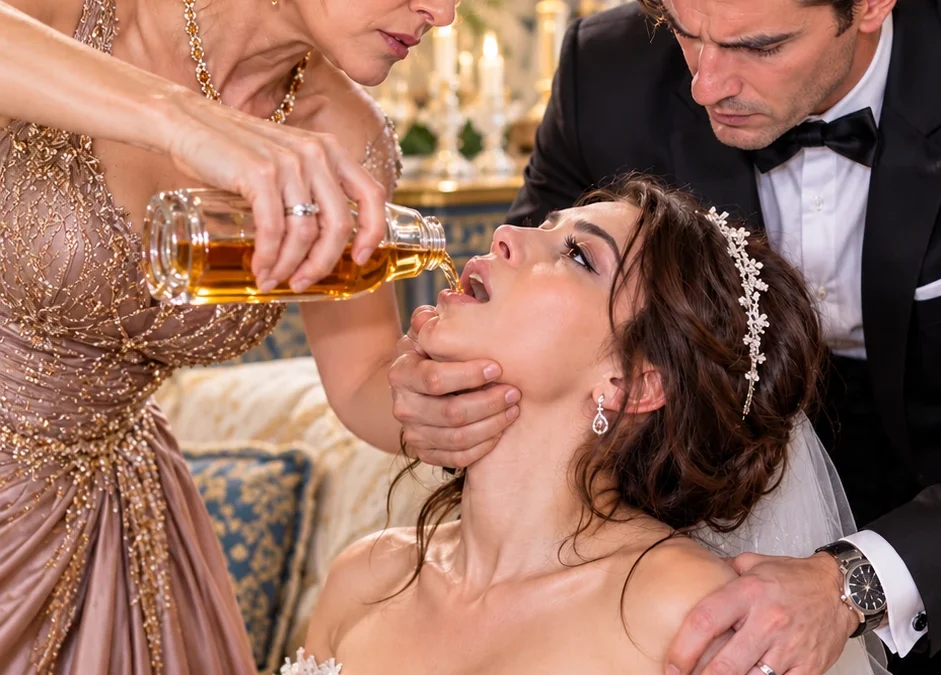
My mother-in-law’s fingers dug into my jaw while my husband of a few hours held me by the shoulders and looked the other way.
The herbal liquor burned all the way down. I coughed, twisted, and managed to say I didn’t want any more. Soledad smiled, thin and dry.
“In this house, traditions are respected.”
My name is Lucía. I’m thirty, an accountant at a logistics company in Toledo. That night was supposed to be the happiest of my life.
I had married Mateo, thirty-three, who worked at his father’s furniture shop and carpentry in Sonseca. For almost a year, he had been attentive, quiet, and kind. He drove my father to the ER when he hurt his wrist. He fixed the old blue gate at my parents’ house. One night, he drove thirty kilometers through the rain when my gastritis flared up.
I mistook that practical kindness for something he had never actually shown me: the ability to stand up to his mother.
“My mother will calm down,” he always said.
On our wedding night, that sentence stopped being domestic cowardice and became danger.
Minutes after the liquor, my legs began to fail. The hallway tilted. The wedding music from the earlier party still echoed in my head like it was underwater. I remember grabbing the wall and Mateo’s voice saying, “Mamá, ya está,” in the weakest tone I’ve ever heard.
Soledad didn’t stop. She dragged me down the hallway of the family house. I thought she was taking me to our room.
She opened a different door. My father-in-law’s bedroom.
She shoved me inside and I heard the key turn from the outside.
I pounded on the door with both fists, or at least I tried. My arms felt heavy as wet sand. “Mateo!” I called. “Mateo, open the door!”
Nobody answered.
Behind me, a floorboard creaked. I spun around and almost fell. Joaquín, my father-in-law, was crossing the room fast. Before I could scream, his hand covered my mouth.
I fought him. I was terrified. My heart was slamming against my ribs and all I could think was no, no, no.
Then he leaned close and whispered, so quietly I almost missed it:
“If you want to get out of here, play along.”
His eyes weren’t the eyes of someone who wanted to hurt me. They were the eyes of a man who was frightened too.
He let go of me slowly. He didn’t touch me again. He pointed, with one trembling finger, at the wall in front of the bed.
A wooden clock hung there. Behind its glass, something was blinking.
A tiny red dot.
A camera.
My blood turned to ice. I stared at it, then at him.
Joaquín moved quickly. He dragged a chair next to the window, as far from me as the room allowed. He slid his phone beneath a pillow and pressed something on the screen. Then he whispered, “Audio. Recording.”
I tried to understand, but my head was swimming. “Why?”
“Because somebody wants a scene,” he said. “And I don’t know what kind.”
Outside the door, I could hear footsteps. Whispers. Soledad’s voice, low and sharp. A man’s cough, and a woman’s nervous laugh. People were out there. Waiting.
Joaquín overturned a chair. He pulled a blanket onto the floor. He was building the noise of an argument that wasn’t happening.
“Why are you helping me?” I managed.
His jaw tightened. “Earlier, she brought me tea. I took one sip and it tasted wrong. I stopped. Then I saw your face when you came in.”
I tried to stand up. My knees buckled. He caught me by the shoulders, only to stop me from hitting the floor, and the second he did, I heard the lock turn.
The door swung open.
Soledad stood there, with a crowd behind her. And just behind her, framed in the doorway with his eyes locked on my husband’s father’s hands on my shoulders, was Mateo.
I saw his face change. I saw him see exactly one second of what happened, and none of the rest.
And then he raised his hand.
What happened next still gives me chills. Part 2 is in the comments—or leave any word below and I’ll send it to you privately.
Part 2
What happened next still gives me chills. Part 2 is in the comments—or leave any word below and I’ll send it to you privately.
The slap sent me crashing against the chair.
The sound seemed to echo for ages. My cheek burned. My ears rang. I looked up at Mateo, the man who had sworn to protect me that very afternoon, and he looked back at me like a stranger.
He didn’t ask what had happened. He didn’t ask if I was okay.
Soledad spoke for him.
“Look at her,” she said, loud enough for everyone in the hallway to hear. “She drank on her own. Then she ran into Joaquín’s room. I locked the door to avoid a scandal.”
I tried to answer, but my tongue felt thick. I pointed at the key in her hand.
“You locked it,” I said. “You forced me to drink. Mateo… he held me.”
Mateo said nothing.
The silence from my husband hurt more than the slap.
I don’t remember how I got to the hospital. I only remember my mother’s face under harsh white lights, and a doctor telling us I had a racing heartbeat, trouble with coordination, and bruises along my shoulders and jaw. I told them I’d been forced. A nurse wrote it down. My father, Rafael, stood in the corner gripping his cap so tightly I thought it would tear.
By the next morning, a video was circulating on WhatsApp.
It was short. It showed only one thing: Joaquín holding me by the shoulders as I fell. No door. No key. No Soledad. Just a young bride in her father-in-law’s bedroom on her wedding night.
I was the girl in that video. And suddenly, half of Toledo had an opinion about me.
Three days later, Soledad stood in my parents’ kitchen with divorce papers in her hand.
My mother, Pilar, went white. I knew why. Years ago, when my father was sick and money was tight, Pilar had borrowed money from Soledad, back when they both sold at the same market. Later, in a moment of desperation, my mother mentioned the debt in front of other vendors. Soledad paid every euro. But she never forgot the humiliation. My mother apologized privately, many times. It never mattered.
Now Soledad leaned across the table.
“Sign it. Don’t ask for anything. In exchange, I’ll delete the video. If you refuse, I’ll send it to your neighbors, your relatives, and your coworkers.”
My father stood up. I put my hand on his arm.
I set the pen down on the table, very gently.
“I won’t sign a lie.”
Her eyes flashed with fury. She snatched the papers and left.
That same afternoon, my phone buzzed. A message from Joaquín. He asked to see me. He had moved out and was living in a small room next to the carpentry shop. When I arrived, he looked ten years older.
He took out his phone and set it on the table between us.
“I saved the audio from that night,” he said. “All of it.”
I held my breath.
“And that’s not all. The camera in the clock recorded everything. Soledad cut one piece out and sent it. But there’s a full file.”
I looked at him. My mother-in-law had spent years controlling every room she entered. Now her husband stared at me with a steadiness I hadn’t seen before.
“This time,” Joaquín said, “I’m not staying quiet.”
If you want to know what that full recording showed, LIKE this post and comment “RELOJ.” When enough people comment, I’ll post Part 3.
Part 3
I went home without knowing whether I wanted a divorce, a police report, or just a week of sleep without anyone telling me what to do.
What I did know was that I wasn’t going back to Mateo’s house as long as my safety depended on Soledad’s mood.
My mother didn’t ask me to forgive anyone. My father didn’t demand that I end the marriage. My brother Sergio wanted to go find Mateo, but my father stopped him.
“First, Lucía decides what she needs.”
That simple sentence made me realize how long I’d spent letting other people decide for me.
Joaquín kept his word. He handed over the audio and explained that he’d spotted the camera as soon as he entered his bedroom. On the recording, you could hear me crying, begging him to stay away from the bed, calling for Mateo again and again from behind a locked door. You could hear Soledad outside, telling people not to open it yet.
The video took longer to sort out. The camera had stored the full file, and in the app that connected to it, Soledad had trimmed a fragment before sending it around. When the complete footage was reviewed, the story changed completely.
You could see me stagger in, pushed from the hallway. You could see me trying to open the door and failing. Joaquín stayed at the far end of the room. When the door opened from outside, I tried to stand, lost my balance, and he caught me for a few seconds. Then Mateo appeared and, without asking a single question, hit me.
I watched it once.
It hurt more to see myself from the outside than to remember it. For days I’d insisted I’d been conscious, that I knew what was happening. On that screen, I understood something else: knowing where you are doesn’t mean you can protect yourself. My legs wouldn’t answer. My reflexes were slow. I could barely hold up my head. If Joaquín had reacted differently, if the tea had affected him too, it all could have gone far worse.
That decided it.
I filed a formal complaint, and I only said what I could swear to. I didn’t claim to know what was in the liquor, because I didn’t. I didn’t say Mateo knew the plan, because I had no proof. I said he held me while I refused the drink, that he watched me start to lose my balance, that he saw his mother take me down the hallway, and that he didn’t open the door when I called.
Soledad’s family began to crack in the places she thought she controlled.
My mother’s old friend Mercedes, Soledad’s cousin, came to our house first. She stood on the doorstep with her eyes down. She admitted she had believed Soledad that night. It had seemed possible to her that the bride had drunk too much and wandered into the wrong room. She had even told other people:
“I saw her in there.”
She never said I’d done anything wrong, but she understood those four words had been enough to feed the rumor.
Then she remembered something.
Before opening the door, Soledad had told her and her brother Tomás to wait.
“When I open it, look closely. If she denies it later, there’ll be witnesses.”
Tomás took one more day to admit it. Soledad was his sister, and he couldn’t bear to believe she’d planned this. But he finally said he had wanted to open the door earlier, and Soledad stopped him. She hadn’t kept them outside to protect me. She’d done it so they would see exactly the scene she had chosen, at the exact moment she’d chosen.
Joaquín called everyone to the family house. My mother asked to come.
Before we left, she took my hands.
“I’m going to apologize to Soledad in front of everyone,” she said. “It’s been pending for more than twenty years.”
I protested. She shook her head.
“What she did to you is her responsibility. But what I did is mine. I shamed her in front of other people. Apologizing in private never erased that.”
The meeting started badly. Soledad accused my mother of raising a daughter who wanted to take over the business. My mother answered that no mistake from the past justified using my daughter as revenge. The voices climbed until Joaquín slammed his palm on the table.
He pressed play on the audio.
The room went still as my own voice filled it.
“Mateo, open the door.”
Then silence.
Joaquín explained that the full video had already been handed over for verification. Mercedes told them what Soledad had said at the door. Tomás confirmed that she had delayed the opening.
Soledad turned to Mateo. “You talk. Tell them she drank.”
Mateo’s face was white.
“She didn’t drink because she wanted to.”
Nobody moved.
“I held her,” he said. “Mamá brought the glass and Lucía refused. I grabbed her shoulders because I thought you just wanted to finish some stupid tradition and end the argument.”
Soledad stared at him in disbelief.
“I also saw her get dizzy,” Mateo went on. “I saw you take her toward Papá’s room. And when she called me from inside, I heard her.”
I didn’t look away. “Why didn’t you open the door?”
It took him several seconds.
“Because I was afraid to fight with my mother.”
There was no more complicated explanation. No secret that would suddenly make him innocent. Only that: fear of upsetting the person he’d obeyed his entire life.
Soledad lost control and slapped her own son. When she raised her hand a second time, Mateo caught her wrist.
“That’s enough.”
She looked at him as if he’d betrayed her. “Everything I’ve done was for you.”
Mateo shook his head. “No. A lot of it you did so you could keep deciding for everyone.”
Then Joaquín opened a notebook. For years, Soledad had covered Mateo’s financial mistakes: a failed investment, advances he never repaid, lost orders she paid out of pocket so her son wouldn’t face the consequences. Joaquín admitted he had helped create it. He’d argued sometimes, but always ended up silent, confusing silence with peace.
“Every time one of us avoided the conflict,” he said, “Soledad understood she could go a little further.”
That was the first real crack in her defense.
She looked at my mother. For a few seconds she seemed exhausted, not furious.
“I wanted your daughter out of this house.”
My mother closed her eyes.
Soledad confessed she couldn’t stand the thought of me going through the business accounts, of Joaquín trusting me, of the daughter of the woman who had humiliated her years ago seeing her as incompetent. She wanted people to look at me, just once, with the same suspicion she felt they had looked at her in the market.
“I didn’t want something irreversible to happen to her,” she said. “I wanted her confused. Enough for the camera to record a scene that could be misread.”
Joaquín asked about the tea.
Soledad lowered her head. “It was so you’d be slower. I thought you’d drink the whole cup.”
Nobody tried to soften the sentence.
My mother spoke next.
“I humiliated you more than twenty years ago, and it was wrong. I needed the money, I was desperate, and it was still wrong. I apologized to you in private for something I did in front of others. Today I say it again in front of everyone. That was my responsibility.”
Soledad looked at her, eyes wet.
“But Lucía didn’t inherit my debt,” my mother finished. “And you had no right to collect it from her.”
Soledad had no answer.
For the first time, nobody rescued her from the consequences of her own choices.
After that meeting, the investigation took its course. I didn’t turn it into a public war. I submitted medical reports, messages, recordings, and the names of the people who’d been there. Soledad had to send corrections to everyone who’d received the video and admit the version she shared had been cut. She told two former friends from the market, in person, that I hadn’t gone into that bedroom willingly.
I didn’t attend those apologies. I didn’t need to watch her be humiliated. I needed the lie to stop circulating as if it were truth.
Joaquín never slept in the marital house again. He settled into a simple room beside the workshop. He still drove Soledad to the doctor if her knee hurt, and asked if she needed anything. But he stopped pretending that caring for someone meant accepting any behavior.
He made a decision about Mateo, too. He didn’t hand him the shop.
“You’re thirty-three. From now on, if you lose money, you pay for it. If you make a mistake, you explain it. If you make a decision, it will be yours.”
Mateo rented a small apartment near work. For the first time, he stopped living under his mother’s rules. He didn’t cut her off, but he no longer asked permission for every choice.
A month later, he asked to meet me at a café in Toledo.
He’d lost weight. He looked older.
“I told the truth,” he said.
“I know.”
“At first I thought if I admitted everything, maybe you’d come back to me.”
I said nothing.
He stared into his coffee. “Then I understood that telling the truth can’t be the price I pay to win you back. Some things I have to admit even if I gain nothing.”
I studied him. It was probably the most adult version of Mateo I’d ever met. And that made it hurt even more to realize he’d arrived too late.
He asked if all the good memories had been a lie.
“No,” I said.
They hadn’t been. The night in the ER was real. The blue gate he’d fixed with his own hands was real. The thirty kilometers through the rain were real.
But so was his hand holding me while his mother forced the glass to my mouth. So was his silence behind the door. So was the slap.
“A person can love you for real and hurt you for real,” I told him. “The good things aren’t permission to put up with the rest.”
He bowed his head. “Do you want the divorce?”
“Yes.”
This time, he didn’t argue.
Ten months after the wedding, the marriage was dissolved. Joaquín offered me money to help me start over. I turned it down. I wanted to walk out of that story without owing anyone another explanation.
My mother tracked down the old vendors she still knew and publicly admitted her mistake toward Soledad. They didn’t become friends. There were no hugs, no perfect reconciliation. Months later they crossed paths at a funeral, looked at each other, and exchanged a brief nod. It was enough.
In late December, Joaquín called me. I could hear saws in the background.
“Do you remember what I told you that night?”
I smiled sadly. “That if I wanted to get out, I had to play along.”
“Well, don’t play any role now. Not the perfect daughter-in-law. Not the happy wife. Not the woman who has to prove she’s already moved on.”
I looked out the window of my old bedroom. “I haven’t forgotten.”
“You don’t have to.”
That evening I had dinner with my parents and Sergio. Baked fish, hot soup, a simple salad. Outside, the blue gate Mateo had repaired years ago swung open and shut without sticking.
I watched it from the table.
I didn’t need to turn every memory bad to justify leaving. I could accept that Mateo had done good things and still understand that a house stops being a home when someone has to stay silent to feel safe in it.
My mother served me another piece of fish. “If you want to stay here, you stay. If you want to rent somewhere, that’s your decision.”
I smiled. “First let me finish dinner.”
My father laughed. So did Sergio.
And for the first time since my wedding, I didn’t have to prove my innocence, save a marriage, or protect another family’s pride.
I only had to be there.
Without performing.
Disclaimer: This story is entirely fictional and created for entertainment purposes only. It does not represent any organization or individual, nor does it encourage inappropriate behavior. The content was generated with AI assistance.








