On Their Wedding Night, the Duke Handed His Bride the Rusted Keys to a Derelict Kitchen to Break Her Spirit. He Never Imagined What She Would Unlock.
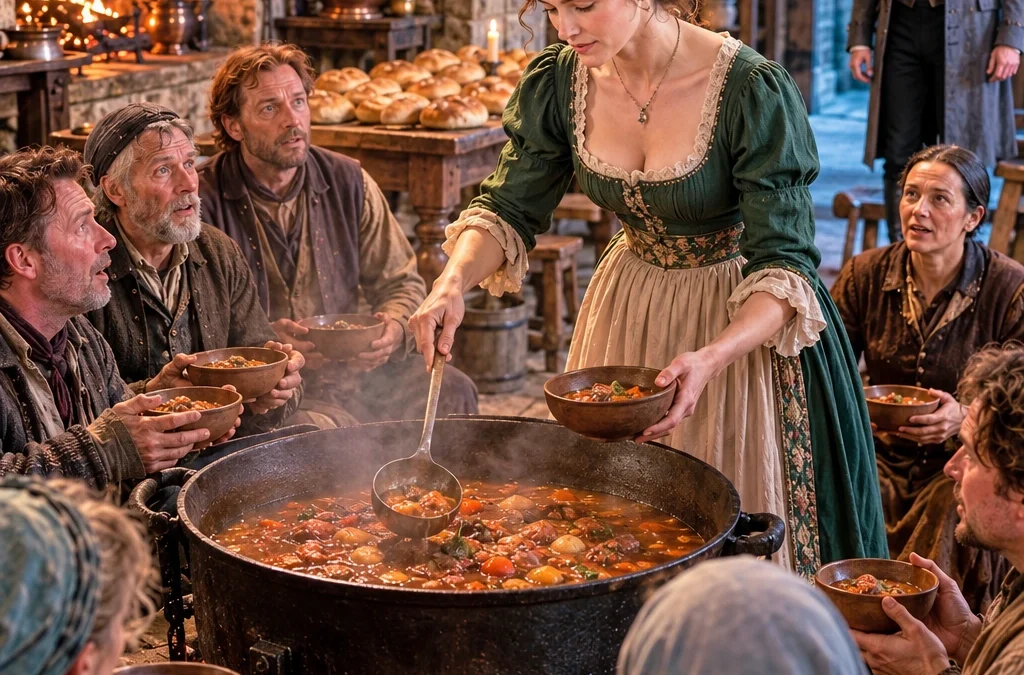
On Their Wedding Night, the Duke Handed His Bride the Rusted Keys to a Derelict Kitchen to Break Her Spirit. He Never Imagined What She Would Unlock.
PART 1
Marriage for most women of consequence was a negotiation of silk and lineage. 🗝️
For Caitlyn Ashdown, it was a transaction of cold copper and desperation.
She didn’t expect love from the Duke of Westford. She barely expected civility. But when he handed her the rusted iron keys to a derelict kitchen on their wedding night and told her to earn her keep, he thought he was breaking her spirit.
He didn’t realize he was handing her the keys to his entire estate. 😳
November brought a bitter chill to the moors, carrying the scent of damp earth and rot. Rain lashed the carriage glass in jagged streaks as Caitlyn sat perfectly still, hands folded over her traveling cloak.
She was twenty-six, a spinster by the ton’s unforgiving mathematics. Her father had practically wept with relief when the Duke of Westford offered for her, eager to trade her modest, liquid dowry for the prestige of a ducal connection. No one asked why a duke would settle for the daughter of a minor baron.
Caitlyn knew why. 🌧️
The moment the wheels crunched onto the gravel of Westford Abbey, the truth of the Duke’s desperation was laid bare. A towering silhouette of crumbling limestone. Ivy choking the eastern wing. Half the windows shuttered, blind to the world. No footmen. No lanterns. Only wind howling through the courtyard.
She stepped out unassisted. Her boots sank into freezing mud. She did not flinch.
Inside, the abbey smelled of wet ash and old wool. Pale squares on the foyer walls marked where masterpieces had once hung, sold to quiet the hounds of debt his late father had unleashed.
Armando Coleman, the Duke of Westford, waited in the doorway of his study. Tall, all sharp angles and exhausted lines, shadows clinging to the hollows of his cheeks. His coat was cut by a master tailor, but the cuffs were frayed. He looked at her not as a bride, but as a creditor come to collect.
“You arrived.”
“I did, Your Grace.” She kept her chin level.
He did not offer her a chair. He walked behind his desk and lifted a heavy rusted iron ring holding two massive keys. “Your father’s draft cleared my father’s gambling markers in London. For that you have my gratitude and my title.” The keys clattered onto the wood. “But if you expect courtiers and banquets, you have been severely misled. I have twelve servants left. None is a lady’s maid.”
“I require very little, Your Grace.”
“Good.” His jaw tightened. He hated her composure. He had expected tears. Her quiet dignity felt like judgment. “You will take the rooms in the south corridor.”
“The old servant quarters above the Tudor kitchens,” said Caitlyn. She had memorized the estate plans. “They are the only rooms we can afford to heat.”
He leaned forward, wanting to push her away before she could see the full humiliating extent of his ruin. “The modern kitchen collapsed last winter. The staff boils cabbage over a hearth in the laundry. If you want better, you may use the old kitchens below your quarters.” He shoved the iron keys across the polished wood. “They have been abandoned for fifty years. Filthy. Freezing. Entirely yours. If you want to eat like a duchess, manage your own affairs.”
It was a cruel, calculated dismissal, meant to send her to her chambers in shame.
Caitlyn looked at his white knuckles. A proud, drowning man, lashing out at the only piece of driftwood in reach.
She picked up the keys. The iron was freezing.
“Breakfast is at eight, I assume?”
Armando blinked, caught off guard. “There is no formal breakfast.”
“There will be.”
She slipped the keys into her pocket and walked out into the freezing corridor. 🕯️
Morning leaked gray and reluctant through the clouds. Caitlyn woke in a room that smelled of mildew, dressed herself in plain dark blue wool, tied on an apron, and pinned her hair back ruthlessly.
She followed the draft down winding stone stairs to the lowest level of the estate and threw her shoulder against a heavy oak door. It screamed in protest.
The Tudor kitchen was cavernous, built for an era when the abbey housed hundreds. Three massive hearths, large enough to roast oxen. Blackened spits hanging from rusted chains. Tables thick with a gray carpet of dust. Copper pots tarnished green and black. Dead leaves scattered across the flagstones.
A graveyard of feasting.
“You’ll break your neck, Your Grace.”
In the doorway stood a man in his late fifties, his left leg braced with stiff leather, in the faded livery of a butler, his hands raw and calloused like a ditch digger’s. Thorbin Ortiz, estate manager, butler, groundskeeper, “whatever the Duke needs me to be when the rest of the rats flee the ship.”
“His Grace told me he gave you the keys. It’s a bad joke, ma’am. Go upstairs. I’ll bring you tea and dry toast. It’s all we have.”
“It was not a joke, Mr. Ortiz.” She ran a gloved finger over the nearest table. It left a black trench in the dust. “It was a challenge. And I do not intend to starve in a house this large.”
He barked out a laugh. “Starve? The Duke is starving. He eats one meal a day. He sells the wheat before it’s harvested. The pantries are empty. This room has been dead since his grandfather’s time.”
“Then we shall resurrect it. Are the flues clear?”
“Birds have nested in there twenty years.”
“Then we will smoke them out. I need a bucket, harsh lye soap, a wire brush, and whatever able-bodied maids you have.”
“Three scullery maids who are entirely feral. And none of them take orders from a lady playing house in the soot.”
“I am not playing.” Her voice dropped, losing its polite veneer. Her family had been poor, desperately so, hiding frayed collars behind closed doors. She knew how to stretch a shilling. She knew how to scrub a floor. “I am the Duchess of Westford. My dowry bought your master another year of pretending he is not ruined. Now. Fetch the lye.”
Ortiz looked at her hands. They were not soft. There were faint old burn marks on her wrists.
He gave a slow nod. “As you say, Your Grace.” 🧼
For four days, Caitlyn did not see her husband. She lived in the cavernous dark of the old kitchens, scrubbing fifty years of grime from the stones beside two bewildered, freezing scullery maids, Martha and Jane. Her knuckles cracked and bled in the caustic lye. The maids, sullen at first, fell silent when they saw the Duchess working twice as hard as they did.
They cleared the chimneys, and a deluge of dead rooks, twigs, and decades of soot choked the room for an entire afternoon. They scrubbed the oak tables with sand and vinegar until the pale wood shone through.
On the third day, without being asked, Ortiz brought down a bundle of dry oak logs and stacked them by the hearth.
By the end of the fourth, the kitchen was clean. Hollow. Echoing. Entirely empty of food.
Caitlyn stood before the massive empty cauldron, her back aching, her muscles trembling.
“Now,” she breathed, her breath pluming in the cold. “We need something to cook.” 🔥
Upstairs, Armando stared at his ledgers. The numbers were a death sentence in black ink. He had sold the last of his prime breeding horses just to cover the interest on the northern mortgages. He had avoided his wife, and guilt gnawed at his ribs. He knew he had been savage on the night of her arrival.
She is probably huddled under her blankets, weeping, he thought bitterly.
Then he stopped. A scent was drifting under his study door.
It had been years since the abbey smelled of anything but dust, wet wool, and boiled cabbage. But this was the rich, intoxicating aroma of roasting fat, of onions sweating in butter, of garlic and thyme and dark meat simmering in broth.
His stomach cramped violently. His mouth watered in a way that felt entirely involuntary.
Down in the Tudor kitchens, a fire roared for the first time in fifty years. 🍲
Getting the ingredients had cost Caitlyn the pearl hairpin her grandmother had given her. She had walked three miles to the village. The butcher, a massive man who hated the Duke for unpaid bills, had laughed at her request for credit. She hadn’t argued. She had laid the gold-and-pearl pin on his bloody chopping block and asked for beef ribs, flour, vegetables, and salted butter.
At the long scrubbed tables, she told Ortiz: “Tell the staff to come down. Dinner is ready.”
“Ma’am, the staff cannot dine in the presence of the Duchess. It goes against every rule…”
“The rules died when the bank took the silver, Mr. Ortiz. I made enough for thirty. There are twelve of us. No one sleeps cold on an empty stomach tonight.”
Within twenty minutes, the kitchen was full of hesitant, wide-eyed servants: footmen in threadbare coats, shivering housemaids, the old stable master. She gave no speech. She filled wooden bowls to the brim and broke hot bread with her bare hands.
Silence fell, broken only by the frantic scraping of spoons.
Then Caitlyn looked toward the stone archway. 😶
Standing in the shadows, hidden from the staff but visible to her, was Armando. The haughty cold Duke was gone. In his place was a man watching a miracle unfold in the basement of his ruined life.
She held his gaze. She did not smile. She did not offer him a bowl.
She simply sat by the fire she had built in the ruin he had given her, and ate.
He swallowed hard, stood a long moment, and then retreated up the stairs, leaving his pride bleeding on the stone floor.
PART 2
Ice coated the study windows in jagged, opaque claws. Armando sat at his desk, the ink blurring into a meaningless swarm of numerals. Far below, he could hear a sound that had been absent from his home for five years: the muffled rhythm of life. A knife meeting a block. Iron scraping stone. Hushed voices.
His servants were no longer ghosts lingering in freezing corridors.
They had all migrated to her.
Ortiz entered carrying a tray with a single teacup and a thin slice of dry bread. “Your breakfast, Your Grace.”
“Take it away.”
“You are starving, sir, as we all were.” Ortiz did not move the tray. “The men repaired the woodshed roof this morning. The Duchess had them up at dawn.”
Armando flinched. He had handed her the rusted keys as an insult. Instead she had seized the iron, built a fire, and fed his people while he hid in his study.
“She demands nothing, Your Grace. But she is outside your door.”
The door creaked open. Caitlyn walked in, sleeves rolled past her elbows, forearms dusted with flour. In her hands was an unpolished wooden bowl. Thick steam rose from it, carrying roasted beef and root vegetables, beside a massive heel of fresh bread.
Her husband’s body betrayed his pride in a heartbeat. 🥣
She pushed his damning ledger aside and set the bowl down. “Eat.”
It was not a request.
“If you have spent your dowry on a single feast for the staff, you are a fool.”
“I spent a pearl hairpin. It bought us four days of beef and flour. But I am not a magician, Armando. When the flour is gone, it is gone.”
She used his Christian name. It stripped the title away, leaving a man and a woman negotiating their survival in a freezing room.
“The land is not dead. It is merely unmanaged.” She slapped a folded parchment onto the desk. “These are my terms. The armory keys. Unrestricted access to the fowling pieces and dry powder. Permission to cull the deer in the eastern woods. The keys to the sealed cellars beneath the old greenhouse. And laborers to split wood.”
“You want to poach your own lands? I have no gamekeeper. Who exactly do you intend to send into the freezing woods to shoot a stag?”
“William is terrified of his own shadow.” She looked down at him, her gaze traveling over his broad shoulders with brutal practicality. “You have two legs, two arms, and a working eye, Your Grace. Or do you only shoot birds when other men flush them out for sport?”
Silence, thick and suffocating. Ortiz suddenly found the ceiling architecture fascinating.
“You are sinking with this house,” said Caitlyn, “and taking your people with you. A ledger will not fill a stomach. Eat the stew. Then get your rifle. We need meat.”
She turned and walked out.
Alone, Armando lifted the wooden spoon. The rich, savory heat exploded in his mouth. It was the best thing he had tasted in years. He ate like a starving animal, mopping the last drops with crusty bread.
Then he stood, unlocked the oak cabinet, and took out his hunting rifle. 🦌
Frost snapped under his boots in the deathly silence of the eastern woods. He hadn’t tracked an animal since boyhood. No hounds. No beaters. Just a desperate man stalking the treeline, praying for a mistake. He crawled through damp bracken, his trousers soaked with freezing mud. He didn’t care.
An hour later, a rifle crack echoed through the valley.
He returned at dusk, dragging a wooden sled with a massive, bloody stag strapped to it. William, the young footman, froze with a bucket in his hands, jaw dropping at the sight of the Duke of Westford hauling a carcass like a common poacher.
“Fetch the Duchess.”
Caitlyn emerged into the freezing courtyard. She did not gasp. She simply assessed the weight of the meat.
“A clean shot to the neck.”
“Will it suffice?” He hated that his voice held a pathetic thread of seeking approval.
“It will feed us for three weeks if we salt the haunches and smoke the rest.” She stepped closer. No flowery compliment. They both knew the stakes were too high for theatrics. “You did well, Armando. Bring it inside.”
For three hours, the Duke, the Duchess, and the estate manager worked shoulder to shoulder in the suffocating heat. Caitlyn was ruthless in her efficiency, plunging her bare hands into the carcass, saving the fat for rendering, the bones for stock. There was no waste. Every ounce was a victory against the winter.
Armando watched her knuckles, raw and bleeding into flour and grease. The fresh burns on her wrists. She was pushing herself past the limits of endurance, driven by a terrifying, stubborn will.
By midnight, the kitchen was empty save for glowing embers. He came down carrying a jug of water.
Caitlyn was asleep on a low stool by the hearth, her head against the stone arch, her palms facing up in her lap.
He looked at the blisters from the lye. The burns from the iron pots. Calluses on a woman raised to play the pianoforte and pour tea. 💔
She was destroying herself to keep his household alive.
He took her freezing hands in his. She stirred but didn’t wake. He took off his one clean wool coat and tucked it around her. Then he pulled up a stool, stretched his legs toward the embers, folded his arms, and for the first time since his father died, he slept deeply, guarded by the warmth of a kitchen he had abandoned. 🔥
December tightened its grip. The moors turned blinding white. Inside the abbey, the geography of power had shifted. The grand drawing rooms were abandoned to ghosts. Life and heat were concentrated in the Tudor kitchens.
The venison was holding. But the flour was dangerously low, and the root vegetables nearly gone.
“The keys to the greenhouse cellars,” said Caitlyn.
“The locks have rusted solid,” sighed Ortiz. “The last gardener lost the key ten years ago.”
A heavy iron crowbar thudded onto the table. Armando stood there in a worn wool sweater, sleeves rolled to his elbows. A week of labor and proper meals had put color in his cheeks. He looked dangerous, capable, and entirely awake.
“Show me the door.”
Beneath a skeletal greenhouse frame half buried in snow, he wedged the bar into the frozen gap and threw his entire weight backward. The padlock snapped and bounced off the ice.
The main cellar was a disappointment. Empty bins, a carpet of mold and mouse droppings. Caitlyn’s shoulders dropped. She had been banking on a forgotten cache.
But Armando walked slowly past, holding the lantern high, frowning. “This isn’t right. My grandfather expanded these cellars. He dug back into the limestone.” He tapped the wall. A solid, dull sound. He stepped three paces left and tapped again.
Hollow.
“This wall is new. It’s brick, covered in sloppy mortar.”
He drove the bar into it. Mortar cracked. Dust rained down. On the fourth strike, a section caved inward, revealing a pitch-black cavity. 😳
The lantern light hit glass. Hundreds of bottles. Racks upon racks of dark green glass, thick with a decade of dust.
“Bordeaux,” Caitlyn whispered. “And port. Heavy, aged port.”
Armando stood perfectly still, his jaw locked. “My father didn’t sell it to pay the creditors. He walled it up. He hid the best vintages down here while the staff upstairs ate boiled cabbage and his son faced debtor’s prison.”
He looked at the bottles as if he wanted to smash every one against the stones.
“Armando.” She stepped in front of him. “Do not waste energy on the dead. Your father hid this. Good. That means the bank does not know it exists. And gold cannot be eaten. We need oats. Barley. Salt. Fat. A butcher willing to barter.”
Slowly, the bitterness drained from his face, replaced by a hard pragmatism that mirrored hers.
“Ortiz. Hitch the draft horse to the flatbed. Put down heavy straw.”
The village of Oak Haven lay three miles down the valley. When a flatbed wagon rattled across the cobblestone bridge, driven not by a servant but by the Duke of Westford himself, the square fell into stunned silence.
Armando hauled a crate on his shoulder into the butcher’s shop. Elias Miller, a man the size of an anvil, glared. “I told your wife, no more meat on credit. The Abbey’s word isn’t worth the paper.”
The crate landed on the chopping block with a heavy, expensive thud. Twelve bottles of pristine Bordeaux, packed in straw.
“I am not asking for credit. I am offering a trade.”
Miller wiped the dust from a label. His eyebrows shot up. “French. Smuggled, likely.”
“Twenty years in my cellars. I have six more crates outside. I want fifty pounds of salted pork, two sides of cured bacon, a barrel of rendering fat, and two sacks of oats, loaded into my wagon today.”
“You are selling the family cellar to buy bacon.”
“I am feeding my people.” The haughtiness was gone, replaced by a fierce, protective instinct. “Will you make the trade, or shall I take it to the tavern?”
Miller saw the calluses on the nobleman’s hands, the dirt on his boots, the unyielding set of his jaw. The village had thought Armando Coleman a soft, dying man. The man in front of him was anything but.
“Deal, Your Grace.”
By afternoon, the wagon was heavy with flour, oats, salt, a wheel of hard cheese, and thick cuts of cured meat. Back at the abbey, Caitlyn waited on the steps. She rested a gloved hand on a massive sack of flour. Real, tangible security.
“You did it.”
“We did it.” Before joining the unloading, he pulled a small paper parcel from his coat. “Open it.”
Inside was a tin of black tea, real leaves, and three lumps of crystallized sugar.
A sudden, unfamiliar tightness gripped her throat. She had faced the freezing kitchen without a tear. She had butchered a stag without flinching. But this small, unnecessary luxury broke right through her armor. 🥹
“You haven’t stopped working since I gave you those keys,” he said quietly. “I wanted you to have a moment of warmth you didn’t have to build yourself.”
She did not say thank you. The words felt too small. She folded the paper, tucked it into her apron, and nodded at the sacks.
“Then let’s get this inside. I am making a proper roast tonight.”
By the third week of December, the Tudor kitchen had developed a gravitational pull. The social hierarchy of the estate had burned away in the central hearth. William chopped wood with steady confidence. Martha and Jane laughed as they kneaded dough. Even Ortiz walked with less of a limp.
Armando had abandoned his study entirely. He moved a scarred table into the corner nearest the pantry and balanced his ledgers amid the clatter of pans. He wore coarse wool, forearms corded with new muscle. He watched Caitlyn, and no longer tried to hide it.
“You are staring again, Armando.”
“I am calculating our stores.”
“You are calculating the odds of me dropping this bowl.” She wiped her forehead with the back of her wrist, leaving a streak of flour. “We have flour for two more weeks, and the pork will see us through January.”
“Three days to Christmas, Your Grace,” said Ortiz. “The village is completely snowed in.”
The chopping and stirring ceased. Christmas at the abbey had been a dead affair for half a decade.
Caitlyn looked around at the tired, soot-stained faces of the staff who had worked themselves to the bone.
“We are holding a feast.” 🎄
“Ma’am, a feast…”
“Not a rationed stew. We have worked like dogs for six weeks. We have survived the worst of the freeze. We will celebrate that fact, or we will lose our minds to the winter.”
Armando crossed the flagstones and stopped before her. “A feast requires a celebration. We have no decorations. No musicians.”
“We have warmth. And a home that is no longer dying. That is enough.”
He studied her face, and the cynical shell he had worn for years was entirely gone. “It is.” He turned. “Ortiz, take William into the eastern woods. Find the largest pine you can carry. Cut all the holly you can find.”
Ortiz’s weathered face broke into a massive grin.
Armando looked back, a rare smile touching his mouth. “If the Duchess requires a feast, she shall have one.”
Snow fell in thick, silent curtains on Christmas Eve. Below the frozen earth, the Tudor kitchen was a cathedral of light.
Boughs of pine and winterberry draped the stone arches. Dozens of tallow candles, saved meticulously by Caitlyn all month, burned in rusted candelabras. A spiced venison roast crackled on the spit. Savory pies of salted pork. A dense fruit cake studded with dried apples she had found in a forgotten pantry corner. Two bottles of the smuggled Bordeaux, breathing in the warm air.
At seven, the entire household sat down. No head of the table. No division of class. A ruined Duke, a desperate Duchess, and a ragged staff, bound together by mud, soot, and fire.
Armando poured the wine himself, filling even the scullery maids’ chipped mugs with the same vintage he drank. Then he stood. The kitchen fell dead silent.
“Two months ago, I stood in a freezing hallway and handed my wife a set of rusted keys. I did it because I was a coward. A proud, drowning man, terrified of his own ruin, and I wanted to hide it from her.”
He met Caitlyn’s gaze and, for the first time, stripped away every defense he had left.
PART 3
“She did not break,” Armando said quietly. “She took the keys. She built a fire. And she dragged this family back from the edge of the grave.”
His throat worked.
“She taught me that true nobility has nothing to do with a title, and everything to do with what you are willing to build with your own two bare hands.” He raised a chipped tin mug. “To the Duchess. The keeper of the fire.”
“To the Duchess!” barked Ortiz, raising his mug high. The staff echoed the cry, slamming their cups against the heavy oak. 🥂
Caitlyn’s vision blurred. A sudden, sharp ache seized her chest, not from pain, but from the overwhelming, terrifying weight of being entirely seen and completely valued. She raised her own mug, her hands trembling slightly, and drank.
The feast lasted for hours. The food was demolished, the wine was drunk, and for the first time in years, genuine raucous laughter echoed through the bedrock of Westford Abbey. 🎶
It was well past midnight when the staff retreated, exhausted and comfortably full. The kitchen was empty again. The great hearth had burned down to a thick bed of glowing red coals. Caitlyn stood stacking dirty plates, her back aching, unable to wipe the smile from her face.
Heavy, deliberate footsteps approached. Armando gently took the plate from her hands and set it down.
From his pocket, he drew a heavy iron ring with a single massive key, entirely free of rust, polished until it gleamed black in the low light.
“The key to the front doors of the abbey,” he said. “You proved you could survive the basement, Caitlyn. But you are the mistress of this house. The entire house. When the thaw comes, we open the upper floors. We will scrub them raw if we have to. But we do it together.”
He placed the key in her palm and folded her calloused fingers over it with his own.
She looked up. The coals caught the sharp angles of his face, the dark intensity in his eyes. She did not see a ruined duke. She saw a partner, a man who had bled in the snow beside her to keep their people alive.
“Armando…”
He didn’t wait. He cupped her face in both hands, thumbs grazing her cheekbones, and kissed her. It wasn’t a polite, aristocratic kiss. It was desperate, grounded, and entirely real. It tasted of wine and woodsmoke. She gripped the lapels of his coarse coat and kissed him back with the same fierce, unyielding passion she had poured into their survival. 💋
When they broke apart, he rested his forehead against hers, both breathing hard, in the center of a forgotten kitchen that had become the center of their world.
“Happy Christmas, Caitlyn.”
“Happy Christmas, Armando.”
But the thaw brought something more than open doors.
In March, when the snow finally retreated from the moors, a carriage arrived at the abbey bearing a man in a gray coat, a representative of the northern mortgage holders. Armando went pale. The year’s interest was due, and there was no gold left. There was only a hungry, hardened household and a cellar of vintage wine that Caitlyn had begun to catalog like a treasury.
“Your Grace,” said the banker, surveying the thin, cracked hands of the Duchess who had come up from the kitchens to stand beside her husband. “I was told this estate was dead.”
“It was,” said Caitlyn. “We have been resurrecting it.”
She laid a ledger on the table. It showed six months of careful accounting. The wine, sold in measured lots to merchants who paid in coin. The venison, the cured meats, the surplus grain, sold to villages cut off by snow. The repaired woodshed, the stables, the mended roofs. Every shilling accounted for.
The banker read in silence for a very long time.
“The interest will be paid in full,” Armando said quietly. “And the principal in installments, over five years.”
“This,” said the banker, closing the ledger, “is the most honest set of books I have seen from a noble house in twenty years. Who kept them?”
Armando looked at his wife. “The Duchess.”
The banker rose, and to Caitlyn’s astonishment, bowed.
By summer, the upper galleries were scrubbed. Sunlight poured through windows long shuttered. The tapestries had not returned, but Caitlyn hung pressed herbs and drying lavender from the beams of the great hall, and the long-dead house began, slowly, to smell alive.
Her father came to visit. He stood in the foyer, staring at the Duchess in her plain wool dress, her hands rough, her eyes clear. He had sold her to save himself. He looked at her as a man looks at something he has lost without knowing.
“Caitlyn,” he said, his voice breaking. “I thought I was trading you away.”
“You were.” She did not say it unkindly. “But you did not know what you were trading me toward.”
He wept. She let him. She did not forgive everything at once. But she poured him tea, real tea, from a tin she kept on the shelf above the central hearth, and she sat with him while he drank it.
The Tudor kitchen remained the heart of the house. It never again went cold. In the evenings, the household still gathered there: the Duke with his ledgers in the corner, the Duchess at her great oak table, Ortiz holding court by the fire, Martha and Jane laughing over the dough.
And on the wall by the central hearth, where all who entered could see it, hung a single rusted iron key on a nail. 🗝️
It was the first one he had ever handed her.
Beneath it, in her own careful hand, she had written a line on a small slate:
“He thought he was handing me a punishment. He handed me a home.” ❤️
Disclaimer: This story is entirely fictional and created for entertainment purposes only. It does not represent any organization or individual, nor does it encourage inappropriate behavior. The content was generated with AI assistance.
💬 Which moment hit you hardest: the first fire in the Tudor kitchen, the hidden wine cellar, or the Duke’s toast to the keeper of the fire? Tell me in the comments, and share this with someone who has ever been handed a ruin and built a home. 👇








