“OPEN YOUR MOUTH!” THE MAID’S 3-YEAR-OLD ORDERED THE MOST POWERFUL DUKE IN HAMPSHIRE… AND HE OBEYED. BUT THE MAN WHO WATCHED IT HAPPEN WAS ALREADY PLANNING HIS RUIN
“OPEN YOUR MOUTH!” THE MAID’S 3-YEAR-OLD ORDERED THE MOST POWERFUL DUKE IN HAMPSHIRE… AND HE OBEYED. BUT THE MAN WHO WATCHED IT HAPPEN WAS ALREADY PLANNING HIS RUIN 😱
Part 1
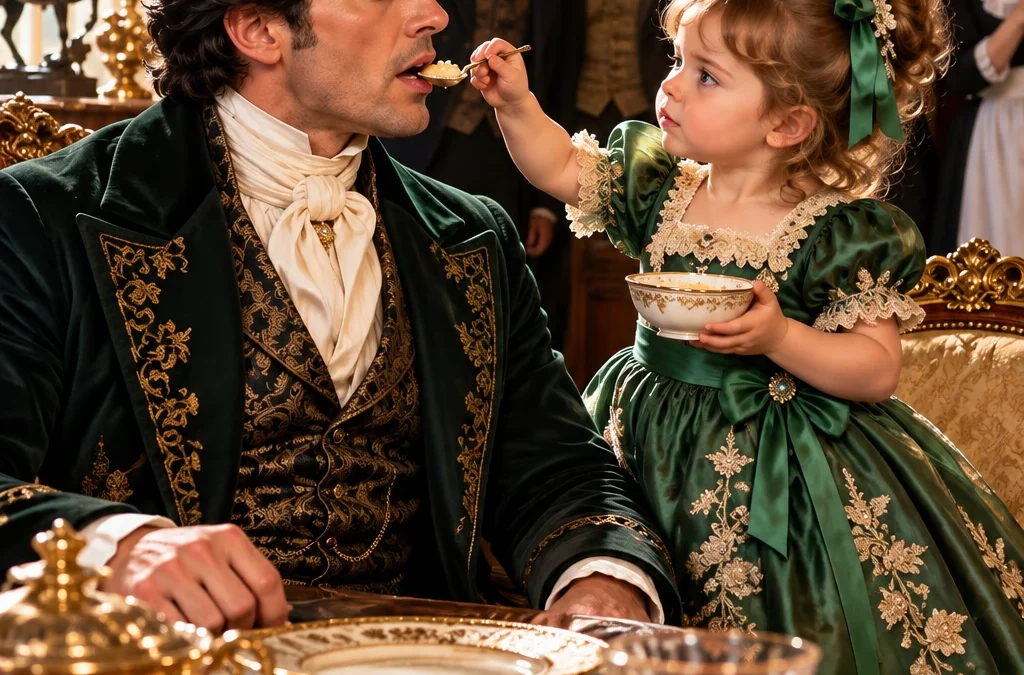
“Open your mouth,” the little girl ordered.
In the Duke of Ravensmere’s study, three grown men forgot how to speak. 😳
Frederick Vale had spent thirty-nine years learning what happened when powerful people mistook an order for a suggestion. He had inherited one of the oldest titles in Hampshire. Land agents waited at his convenience. Creditors chose their words carefully in his presence. Even his aunt had learned that an argument with him could last for hours without his ever raising his voice.
Yet a child in a faded cream dress stood on a low upholstered chair beside his desk, holding out a spoonful of porridge as though addressing a very stubborn patient.
“It is getting cold,” she warned.
Thomas Harkort stopped midway through an explanation about timber accounts. Across from him, Samuel Price lowered his pen. The footman by the door stared at the silver tray as if it might explain the remarkable event unfolding before him.
Frederick looked at the spoon. Then at the child.
Her pale ribbon had slipped behind one ear. A stuffed cloth rabbit rested in the crook of her elbow. She had no understanding of rank, and no calculation in her clear gray eyes. She had simply seen an untouched breakfast and decided someone ought to do something about it.
“Are you in the habit of issuing orders?” Frederick asked.
“Yes,” she said. “To Button. But he is very bad at listening.”
“Button?”
She held up the rabbit. One ear had been mended with blue thread. “He is not hungry. You are.”
For a long moment, nobody moved.
Then Frederick opened his mouth. 🥄
The child fed him the porridge with solemn care. Samuel suddenly studied a loose thread on his cuff. Thomas pressed his lips into a straight line. Frederick swallowed, and the girl lifted another spoonful. Again, he obeyed.
After the third mouthful, she examined the bowl and announced that the last one would be the most important.
“Why?”
“Because there will not be any more.”
Frederick found himself unable to challenge such reasoning. He finished the bowl.
The child gave a satisfied nod, set down the spoon, and leaned forward until her face was level with his.
“Why do you never smile?”
Thomas shifted his weight. Samuel went perfectly still.
Frederick might have dismissed the question from anyone else. He had dismissed harder questions from ministers and cousins and men who claimed to know what would make him happy. But the girl waited without fear, as though a smile were a missing button that someone could simply sew back onto a coat.
“I seem to have forgotten how.”
“That happened to Mama,” she said. “After Papa went away.” She considered him gravely. “I made her remember. I kept trying.”
A hurried footstep sounded in the corridor. Margaret Bellamy appeared in the doorway with a folded sheet still in her hands. Her gaze traveled from her daughter on the chair, to the empty bowl, to Frederick’s unreadable face.
The sheet slid from her arms.
“Your Grace.” Her voice was barely audible. “Poppy. Come here at once.”
“Mama, he ate all of it!”
Margaret crossed the carpet and lifted the child down. Poppy was three, small enough to tuck against her shoulder. Margaret held her as though even the air in the room could harm her.
“I beg your pardon,” she told Frederick. “She was meant to remain downstairs. I shall see that it does not happen again.”
An hour earlier, Margaret had brought Poppy to Ashcombe Hall because Mrs. Collins, who normally watched her, had been called away. A tray of glass had fallen near the servants’ stair, and a maid rushed to help, leaving a side door ajar. Poppy had followed the passage toward an open study and discovered a breakfast tray abandoned beside it.
It had been irresistible evidence of neglect.
Now Margaret knew she could lose her position. Her wages paid the rent on their cottage and bought the coal that kept its little hearth alive through winter. There was no family fortune. No second income.
Frederick looked at her white knuckles against her daughter’s dress.
“She has disturbed no one,” he said.
Thomas gave a discreet cough. Frederick did not look his way.
“Mrs. Bellamy, your daughter must not wander these corridors unsupervised. That is a matter of safety, not punishment. If Mrs. Pembroke approves arrangements for her care when necessary, I have no objection to her presence in the household.”
Margaret blinked. She had prepared herself for dismissal. She had not prepared an answer for permission.
“Will he eat tomorrow?” Poppy asked.
“I suspect I shall,” Frederick said. He glanced at the empty bowl. “After today’s inspection, I hardly dare do otherwise.”
The child’s laughter broke the silence that had governed the study all morning. At the threshold, Poppy waved the rabbit’s mended ear.
And Frederick, with an expression that astonished Thomas more than anything else, raised two fingers in farewell.
That evening, alone, he found the little spoon overlooked among his papers. He opened a drawer and placed it inside. He had never kept an object so ordinary for reasons he could not explain.
When his mother died, he had been fifteen. He remembered less of the funeral than of his father telling him to stand straight and not weep before the household. Years later, when his wife Helena died, the same corridors had swallowed another grief without giving anything back.
Ashcombe Hall had survived both losses untouched.
A knock. Thomas entered with a letter bearing the seal of Lord Westford. The Earl wished for progress on an understanding between their families, the sort that had been discussed so long it was in danger of being mistaken for a promise.
Frederick looked once toward the drawer.
For the first time in a very long while, he found himself wondering not what the next day would demand of him, but when a little girl might return.
By the 14th of October, she had. Mrs. Collins needed to attend her sister again, and Mrs. Pembroke approved another carefully arranged visit. Poppy arrived with Button, a handful of ribbons, and a determination to inspect the Duke’s meals.
On the 21st, she came with a folded piece of coarse paper, her fingers smudged with charcoal.
“I made a picture. You must see.”
A great brown house with a wildly crooked roof. Before it stood three figures. One in an enormous dark coat. One in a blue skirt. And between them, a little girl whose hair looked like a crown of sunbeams.
“That one is Mama. That is me. And that is you.”
“I see I have acquired a remarkable hat.”
“That is your hair.”
“Then I must speak to my valet.” Poppy giggled.
Frederick studied the drawing longer than so simple an object required. “Why have you put me there?”
“Because you were lonely.”
There was no cruelty in it. She might as easily have said the sky was blue.
He carried the picture into his study and pinned it at a child’s height beside the framed family letters. His grandfather’s portrait looked down upon it with painted disapproval.
And standing in the doorway, watching, Thomas Harkort felt something cold settle in his chest.
Because on his desk, beneath a pile of correspondence, lay the first invoice Samuel Price had asked to see. The one for the north granary. The one that did not add up.
Thomas had been stealing from the Duke of Ravensmere for six years.
Part 2
Thomas had been stealing from the Duke for six years.
It had not begun as theft. It had begun as a loan from himself, to himself, covering a personal obligation he could never quite name. Then the next entry disguised the first. Then the next, the second. He had called each one temporary until there was no honest way back.
Frederick had trusted him since 1806, when winter flooding ruined the lower tenants’ cottages and Thomas rode through the rain to shelter six families before the Duke even heard the news. Frederick remembered that loyalty. Thomas remembered how urgently he had needed to conceal the first missing funds.
The child no longer troubled him. The unanswered invoices did.
Samuel Price had obtained receipts from a timber merchant near Winchester. They did not agree with Thomas’s annual summaries. When Frederick asked, Thomas spoke of rising carriage costs and extra labor.
“Then there will be vouchers for the labor.”
“There should be.”
That night, Thomas wrote to a supplier managed by his brother-in-law. He asked for copies of old accounts and a meeting before Mr. Price’s next visit.
His hand was steady as he sealed it.
At Ashcombe, the household was changing in ways no one had announced. Frederick began taking a short break each afternoon instead of eating at his desk. His trays returned empty. When he asked Mrs. Pembroke about leave for servants with young children, she described the difficulties, and he proposed a modest provision open to all eligible servants. When he began to single out Margaret, the housekeeper interrupted respectfully.
“She would prefer proper terms, Your Grace, and the freedom to decline. I suspect that is precisely why you are asking.”
He had been corrected in front of his own housekeeper. He found he preferred the truth.
One evening, Margaret found him standing before Poppy’s picture.
“She puts only people she feels safe with in her pictures,” Margaret said. “She believes you will do what you say.”
Frederick had measured trust by agreements and signatures all his life.
“You are checking the repair costs,” she said. “You might ask why two laundry girls were kept past their shift without extra pay. They were told it would be remembered when their positions were reviewed. That is not a choice, Your Grace.”
He was stung. “I gave no such order.”
“I believe you. But the women heard it in your house.” She folded the cloth in her hands. “Children trust what we do, not only what we intend.”
He could have defended himself. Instead, he asked Mrs. Pembroke to examine the matter and see that the women were paid.
Later, in the quiet, he spoke of his late wife. “Her name was Helena. We respected one another. There were no great quarrels. I mistook that for happiness.” He watched leaves move beyond the glass. “What makes a house a home, Mrs. Bellamy?”
She smiled. “I could tell you how much coal it takes to keep ours warm. I cannot tell you how much love. I think it requires more than most people care to give. It simply cannot be counted.”
For a moment they regarded one another without speaking.
Behind them, a footstep stopped, then retreated. Thomas, on his way to deliver a sealed packet, had heard enough to know that the conversation was no longer about a child’s drawing.
On the 28th of October, the Westford carriage rolled through the gates. Lady Arabella Wickliffe, composed and admired in every drawing room she entered, noticed the picture at once.
“What a curious addition. Who is your little artist?”
“The daughter of one of the women employed here.”
“I should have expected you to be less sentimental.”
“So should I,” he replied.
Lady Augusta, his aunt, watched this exchange with sharpened attention. Westford had advanced twelve thousand pounds under a written agreement. A marriage to Arabella, Augusta argued, would make cooperation easier and calm the county’s doubts.
“Is the agreement conditional on my marrying his daughter?” Frederick asked.
“No, Your Grace,” Samuel answered. “The loan is a legal obligation. The marriage is separate.”
“Then we shall pay what is owed when it is owed. And we shall not purchase favorable terms with a woman’s future.”
Arabella found Margaret alone in the linen room.
“When two families depend upon an alliance, a change of mind reaches farther than the people making the choice. Servants lose positions. Such matters do not disappear because a gentleman discovers he has a heart.”
Margaret felt the insult, and heard the anxiety beneath it. “I have not asked His Grace to change any arrangement.”
“I believe you.” The answer surprised them both. “You seem to want nothing from him. Do you truly imagine others will make that distinction?”
Margaret could not answer. She had already noticed the whispers.
“May I ask you something? Do you wish to marry him?”
For the first time, the lady’s composure failed. “I was raised to expect that I would.”
“That is not the same thing.”
“No,” Arabella said softly. “It is not.”
That night, by a single candle, Margaret wrote her letter of resignation. The words were formal, spare, and utterly inadequate. She read it twice and folded it away without signing.
Then, on the 6th of November, the cold rain began.
Poppy was quiet through breakfast. By evening she refused the apple Margaret had saved and asked to be carried upstairs. Margaret touched her forehead and felt the heat beneath the skin.
For two nights she sat beside the child’s bed, wiping her face, helping her drink, watching every movement of her chest. Water seeped through an old patch of plaster beside the chimney. There were hours when Margaret felt utterly alone.
“Has he eaten?” Poppy whispered on the second morning.
“Who, sweetheart?”
“The Duke.”
Margaret pressed her lips together. “I imagine so.”
“All of it?”
“Perhaps not. He is a stubborn gentleman.”
Poppy gave the faintest smile and closed her eyes.
At Ashcombe, Frederick had noticed the silence long before anyone explained it. The little chair near his study was empty. Mrs. Pembroke told him at last. The child is ill.
A younger version of himself would have ordered a carriage and expected his arrival to be welcome. Instead, he sent a message. If she wanted help, he would give it. Otherwise he would respect her wishes.
The reply came the next afternoon. Margaret would welcome help, provided he understood that no obligation would arise from it.
He read it twice. Not because the terms offended him, but because he recognized how much courage it had cost her to write them.
He arrived at the cottage before dusk. He noticed the narrow table, the patched rug, the crooked shelf holding a framed drawing of a bridge. Nothing was expensive. Yet the room felt inhabited in a way the grand halls of Ashcombe never did.
He took off his coat, rolled back his sleeves, and knelt at her hearth.
“That log will smoke the room if you lay it so, Your Grace.”
“Then you had better show me the correct way.”
She did. And Margaret watched the Duke of Ravensmere on his knees before her fire, with no audience to impress and no credit to earn, simply wanting the room warm for her daughter.
He stayed through the night in the passage by Poppy’s door. Near dawn, the fever broke.
Margaret leaned against the doorframe, so relieved her knees nearly failed her. Frederick moved to steady her, then stopped, and waited until she reached for his arm herself.
“You owe me nothing,” he said.
“People say that. And later they remember the debt.”
“I shall not. Judge me by what I do afterward.”
Poppy stirred just after sunrise. “You stayed?”
“I did.”
“Why?”
He looked from her small face to Margaret in the doorway. “Some people are worth staying for.”
Poppy accepted this immediately and asked for toast.
By mid-November, Margaret knew she had fallen in love with Frederick Vale. He had made no grand promise. He had simply stayed.
That was both the comfort and the danger.
And on the 16th, Samuel Price arrived at Ashcombe with a leather case. Copies of receipts. Two years of account extracts. A carting charge paid twice. Repairs claimed for a roof never touched. A delivery of stone billed at double the supplier’s price.
“Approximately two thousand three hundred pounds,” Samuel said. “And several of the payments went to a business connected to Mr. Harkort’s brother-in-law.”
Frederick remembered a wet and exhausted man arriving through the flood with six families safely housed.
Thomas was summoned. He blamed old methods. Samuel told him the original ledgers would be inspected on the 21st.
Alone, Thomas stared into the hearth. He took out the old letter Frederick had written after the flood, thanking him. For a moment, he considered confessing.
Then he put it away.
And that night, Thomas Harkort conceived a desperate plan. If the ledgers burned, the evidence burned with them.
He ordered the footman James Turner away from his post. He told himself the records room would be empty. He told himself the damage would be limited.
On the morning of the 20th of November, Margaret returned to Ashcombe to finish her handover. She had signed her resignation two days before. Mrs. Collins brought Poppy, and they were placed in the small library.
“Will I see the Duke?” Poppy asked.
“I do not know, darling.”
“I have a picture for him.”
Poppy sat beside a low table with Button in her lap and began to draw three figures beneath a tree.
Down the east passage, a heavy bookstand stood where it should not have been.
Then James Turner smelled smoke.
Part 3
A thin thread of smoke gathered at the records room door. Within moments, someone shouted for water. Another ran for the courtyard. The steady habits of a great house dissolved into running feet and alarm.
Mrs. Collins smelled it beneath the library door. She took Poppy’s hand and pulled the door open, but the heavy bookstand in the passage had toppled against the frame. The gap was barely wide enough for her to squeeze through sideways. When she tried to lift the child across, Poppy recoiled from the hot, smoky air. Mrs. Collins went back for the window, but the narrow casement was fastened too high.
She slipped through the gap to call for help.
“The child is in the small library!” she cried to James. “By the low table. A fallen stand is against the door!”
James tried to shift it. Smoke rolled along the ceiling and drove them back. He sent a man for a ladder and ran to find the Duke.
Margaret came into the courtyard as the alarm spread. She saw Mrs. Collins. She heard Poppy’s name.
“She was with you.”
“She is in the library. I could not lift her past the stand.”
Margaret ran toward the east door. James caught her sleeve. She fought him with the strength of a mother who understood no word but her child’s name.
“You cannot see the passage, Mrs. Bellamy!”
“My daughter is in there!”
Only that morning, she had promised to return shortly. Her last words to her child had been a promise.
Frederick arrived from the main staircase and heard the end of it. Margaret turned to him.
“She is waiting.”
He remembered a boy standing motionless outside his mother’s door, listening for a voice that never came.
He would not let Poppy wait without someone trying.
“Which room?”
“The small library. The main passage is nearly blocked.”
But Frederick knew another way. As a boy, his mother had taken him secretly up the narrow back stairs to the small library to read adventure stories. The service passage ran behind the inner wall and opened near a low door below the west window. He had not used it in years. He had never forgotten it.
Margaret gripped his sleeve. “Please.”
He put his hand over hers for an instant. “I know where she is.”
Then he went. 🔥
The narrow service door had swollen in its frame. He pushed once, felt it give, and drove it inward with his shoulder.
“Poppy!”
“Here,” came a small voice.
She crouched beside the low table, tears cutting pale lines through the soot on her cheeks. Button lay beneath the chair. Frederick took the rabbit first, then the child.
“You came?” she whispered.
“I did.”
“You really came back.”
He carried her toward the back stairs, keeping low. Halfway down, smoke rose through the stairwell and hid the final turn. He stopped, coughing, the child pressed to his chest. Below, the lower door rattled. James shouted from the garden side. Frederick counted Poppy’s shallow breaths while the men forced the door from outside.
Cold air broke through.
He staggered across the threshold. Margaret was waiting, her arms already outstretched. She took Poppy and sank to her knees, holding her so tightly the child began to protest even while she cried.
“Mama! Button!”
“I have him,” Frederick rasped. He pressed the worn rabbit into her hand. Only then did Poppy begin to weep.
“I said I would come back,” Margaret whispered, scarcely aware she spoke. “I said I would.”
“He came, Mama.”
Margaret looked at Frederick. And fear did not vanish merely because gratitude had arrived beside it. 💔
Dr. Fenwick examined them both. The child had inhaled smoke and needed careful watching. The Duke’s wrist was burned and his breathing irritated. The records room was gutted. Part of the passage ceiling had fallen.
Later, Margaret came to him and could barely find the words.
“You might have died.”
“So might she.”
“That does not make your life less precious.”
He looked at her. “I am beginning to understand that.”
On the third day, Samuel arrived with the copied accounts. The missing money was traced. But proof of the money did not prove the fire. James produced Thomas’s written order moving him from the east passage. Another servant described seeing Thomas leave the records corridor shortly before smoke appeared.
Frederick requested an official investigation. Before Thomas was taken, he and Samuel questioned him with a witness present.
Thomas called the revised roster routine. Samuel pointed out the order was dated for repairs scheduled for the following week. Thomas said he had inspected the records for damp. Then Samuel asked why he had told James the room would be empty that afternoon, when the original ledgers were due for examination the next morning.
Thomas’s hands tightened on the chair.
“I thought I could restore the money before you saw it,” he said. “At first, I meant to replace every shilling.”
“And the rest?”
Thomas did not answer.
“You used my father’s trust and mine.”
“You never understood how much rested on me.”
“Then you should have asked for help. You chose deception.”
Thomas closed his eyes. He admitted the false entries. He admitted deliberately starting the blaze to destroy the ledgers. He had believed he could keep it confined to the records room.
“I did not know she was there.”
“I believe you,” Frederick said. “And that changes nothing.”
He removed Thomas from every role on the estate, and passed everything to the authorities. He did not threaten private revenge. Nor did he pretend that years of friendship could erase what had happened. He did not sleep that night. 🕯️
The harder reckoning came when he visited Margaret.
Poppy was recovering but still startled at loud noises, and sometimes woke in the night calling for her mother. On the table lay Button, the tip of his mended ear blackened.
“Your world almost killed her,” Margaret said.
Frederick did not look away. “I trusted him. And I failed to ask questions I should have asked long ago.”
“I cannot lose her.”
“Nor can I bear the thought of losing either of you.”
He had never spoken more plainly. Yet he did not step closer or demand a reply.
Margaret knew that love could be sincere and still be dangerous if the people offering it refused to see the consequences of their power. She needed more than a rescue. She needed evidence that he would live differently when there was no fire, no crisis.
So that winter, she watched.
Repairs at Ashcombe proceeded under closer scrutiny. Samuel pursued lawful recovery of the stolen funds. Westford received his interest on schedule. Frederick sold unnecessary luxury furnishings, reduced extravagant entertaining, and appointed temporary estate officers whose records would be independently checked. He listened when servants described problems he had never noticed from his desk.
These were not grand gestures. They were unglamorous changes that had to survive ordinary days if they were to mean anything.
On the 5th of November, he had already told Arabella and her father he would not seek her hand. He had apologized for allowing their expectations to stand unchallenged for so long. Lord Westford received it with cold restraint, but the loan stood according to its terms. Arabella, pale but steady, told him she preferred a painful truth to a lifetime of polite pretense.
“You should have spoken sooner.”
“I should have,” Frederick agreed.
Now, in early December, Margaret invited him to call. He arrived without a procession and accepted tea from a chipped cup.
“I am grateful for what you did. But gratitude is not the same as trust. I know I could love you and still be afraid of the life your title would bring us.”
She had said the word at last.
“I cannot make every drawing room kind,” he answered. “I can promise I will never ask you to pretend those difficulties do not exist. And I will not make decisions for you because I believe I know best. Poppy had a father. I would never ask her to forget him. I hope only that, if you permit it, I might become someone who stays.”
They met over the months that followed, with Mrs. Collins close enough to satisfy propriety. At the cottage they discussed Poppy’s future. At Ashcombe they spoke of wages, leases, and the tenants who would remain long after a season’s gossip had faded. Frederick sometimes disagreed. Margaret no longer mistook his disagreement for an order. He had begun asking what she thought before stating what he intended to do.
One January afternoon, Lady Augusta suggested with elaborate courtesy that Poppy be kept away from public occasions until the county grew accustomed to Margaret’s presence.
Margaret answered before Frederick could. “My daughter has already been made to feel unwelcome in rooms where she did no harm. I will not teach her to hide so that strangers need not question their manners.”
Frederick said only, “Mrs. Bellamy has answered for herself. I agree with her.”
Later, she told him she had not needed saving.
“I know,” he said. “That is why I stayed beside you.”
It was the first time she could imagine entering his world without disappearing inside it. 💛
On a February afternoon, after a walk in the orchard with Mrs. Collins and Poppy some distance ahead, Margaret took Frederick’s hand. He stopped, surprised by the freedom of the gesture.
“I am choosing to be here,” she said.
“I know.”
“You may kiss me, if you wish.”
He smiled faintly. “I have wished it for a long time.”
Their first kiss was gentle and unhurried. When they drew apart, neither pretended it had settled every difficulty. It was a beginning they had both chosen.
Later that month, he asked her to marry him. There was no speech about rescuing her from poverty. He spoke instead of the quiet courage with which she had raised Poppy, the honesty with which she had challenged him, and the life he hoped they might build.
Margaret asked what would happen to her name, her daughter’s security, and the small independence she had worked so hard to keep. Frederick answered each question seriously. With Samuel’s help they drew up marriage settlements and lawful provisions for Poppy, and Margaret took independent advice.
Only after that did she say yes.
Lady Augusta received the news with dismay, then reluctant consideration, and came at last to understand that her nephew was not acting in a fit of sentiment. Arabella sent a brief, gracious note wishing them well.
In April 1817, they were married in the parish church. Poppy carried a small bunch of flowers, with Button tucked under her arm, having refused every suggestion that he remain at home. Mrs. Pembroke cried quietly. Mrs. Collins cried without embarrassment.
And Frederick looked at his bride as though a life he had not dared imagine had finally come within reach. 💍
One morning after the wedding, the three of them sat in a small breakfast room overlooking the garden. Sunlight lay across the table. Frederick was reading a letter and had forgotten the bowl before him.
Poppy noticed at once.
She climbed onto her chair, lifted a spoonful of warm porridge, and held it toward him.
“Open your mouth.”
Frederick looked at Margaret. She was trying, and failing, not to laugh. He set down the letter, and obeyed.
Poppy nodded with satisfaction. “You remembered how to eat.”
“I did.”
“And how to smile.”
Frederick looked from the child to the woman beside him. Then he laughed, openly and without restraint.
“I remembered.”
In his study, a crooked drawing of a brown house and three figures still hung among the portraits and family letters. The door that had once stayed closed to almost everyone now stood open whenever the family was home.
And in the great house, where silence had once been mistaken for strength, a little girl’s laughter became the sound of home. ❤️🥄
THE END
This story is entirely fictional and created for entertainment purposes only. It does not represent any organization or individual, nor does it encourage inappropriate behavior. The content was generated with AI assistance.








