“Our Marriage Ends Today,” the Duke Said. She Calmly Set Down the Pen and Whispered Six Words That Shattered His Perfect Plan
“Our Marriage Ends Today,” the Duke Said. She Calmly Set Down the Pen and Whispered Six Words That Shattered His Perfect Plan
PART 1
“Our marriage ends today.”
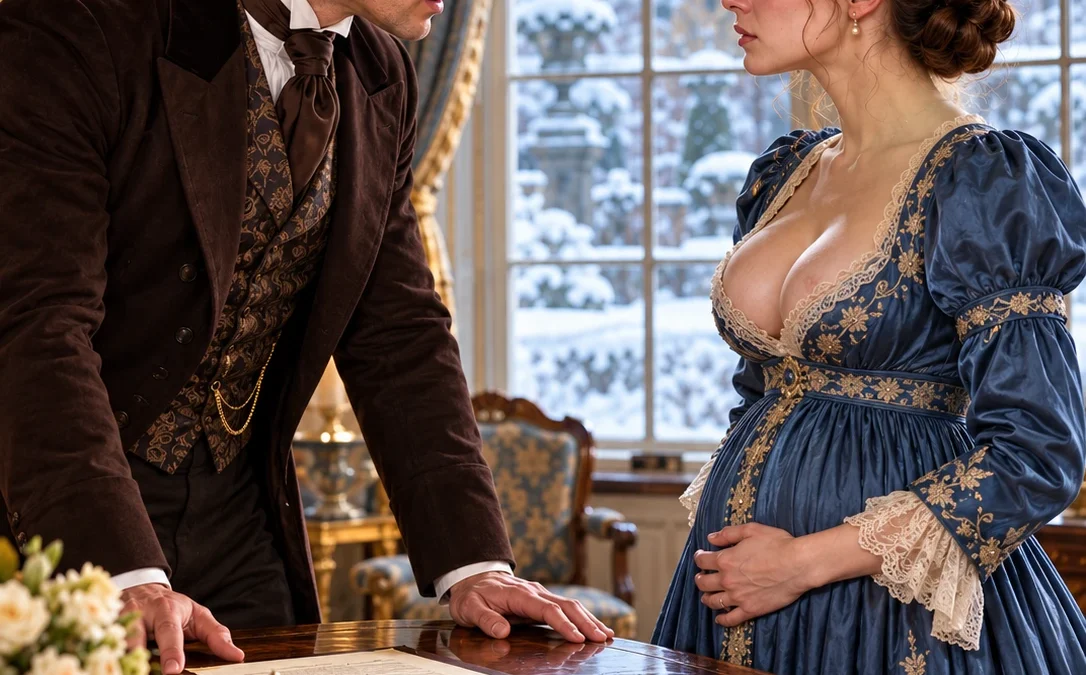
The Duke of Ravensmere said it as he slid the papers across the table. ❄️
Beyond the windows, snow had buried the gardens beneath a white silence. Lady Clara stared at the documents. For two years she had waited for her husband to come home. And now he had finally come, only to send her away.
“You will be generously provided for,” he promised.
Clara slowly placed a trembling hand against her stomach.
“Before I sign,” she whispered, “there is something you should know.”
The Duke frowned. “What is it?”
She met his eyes.
“I am carrying your heir.” 😳
The snow had been falling since before dawn, and by the time the clocks of Ravensmere Hall struck nine, the great gardens had vanished beneath it. The clipped hedges, the rose beds, the stone paths winding toward the frozen fountain, all lay under a white so complete that the world beyond the glass seemed to have forgotten its own shape.
Inside the Duke’s study, a fire burned in the wide marble hearth. Its light danced across the polished oak of the desk, yet the warmth never quite reached the two people seated on either side of it.
Nathaniel Ashcombe, Duke of Ravensmere, sat with his back straight and his hands resting on a neat stack of documents. He had arrived from London only that morning, the cold of the road still clinging to his coat. Across from him sat his wife, composed and silent, her gaze fixed on the papers between them.
He did not raise his voice. He never did. He spoke now as he spoke in the House of Lords, evenly and with care.
He explained that both families had reached an understanding. Her dowry would be returned in full. A house in London had been secured in her name, with servants already engaged. She would receive a generous allowance for the rest of her life. Nothing was left uncertain. He laid out each provision in order, the way he laid out every problem he had ever been asked to solve.
And when he finished, he believed with complete sincerity that he had behaved honorably.
Clara listened to every word. When he was done, she lifted her eyes to his.
“You have planned everything?”
“Every detail. You will be well cared for, Clara. I have made sure of it.”
A faint, sorrowful smile touched her lips.
“Kindness usually asks the other person what they need.”
The words settled into the room the way the snow settled against the glass, soft and impossible to brush away. Nathaniel opened his mouth to answer and found he had nothing to say.
He had calculated rents and allowances, travel arrangements, the proper wording of every clause. He had considered her comfort, her security, her reputation. But not once, while the solicitors drafted and the families exchanged their letters, had he sat down beside his wife and asked her what she wanted. 💔
Clara drew the papers toward her at last. She dipped the pen in the inkwell. For a moment the only sound was the low crackle of the fire. The nib hovered above the line where her name was meant to go.
Then she stopped, and set the pen down.
“I should tell you something first.”
She rested one hand, trembling only slightly, against her stomach.
“I am expecting a child.”
The silence that followed was absolute. Even the fire seemed to hush. Nathaniel stared at her, then at her hand, then back at her face, as though the words belonged to a language he had once known and somehow forgotten.
“Are you certain?”
“The physician confirmed it yesterday. There is no doubt.”
He looked down at the careful clauses and the empty line awaiting her signature. Then he looked at his wife again.
“You should have sent for me,” he said, his voice rougher than he intended.
Clara held his gaze without anger. “You arrived this morning with the papers. I assumed you had already decided what mattered.”
There was no bitterness in it. No accusation sharpened to wound. It was simply the truth, laid upon the desk beside everything else, and somehow that made it heavier than any reproach.
The heir he had always expected, the child his family had waited for, the future of Ravensmere itself, had finally arrived. And it had arrived carried by a woman who was preparing to walk out of his life. 🕯️
To understand how it had come to this, we must go back to the beginning.
It had begun as so many marriages among their kind began, with an agreement rather than a romance. Two years earlier, Nathaniel had been thirty-four, a duke with an ancient name, a seat in Parliament, and an estate that stretched across the Yorkshire hills. He needed a wife suited to his rank. Clara was twenty-five, the eldest daughter of a respected family whose fortunes had been worn thin by failed harvests. Her father needed stability. The Ashcombe name offered it.
No one was deceived. No one pretended to a passion that did not exist. Nathaniel promised courtesy and security. Clara promised loyalty and grace. They both believed, quite honestly, that respect would be enough.
In the beginning, it almost seemed so. They took breakfast together in the east morning room. They appeared side by side at formal dinners with perfect manners. But between them lay a quiet absence neither knew how to name. Nathaniel knew which tea his wife preferred, but not what made her laugh. Clara knew his schedule down to the hour, but not what he truly thought of the marriage they shared.
Then the work began to swallow everything. Trade disputes in London. Committees. Debates that stretched late into the night. Journeys meant to last days lasted a fortnight. Clara began taking her meals alone in a dining room built for forty.
One winter evening she waited nearly four hours at the long table while the candles burned low and the dishes grew cold beneath their silver covers. When Nathaniel finally came through the door, snow on his shoulders, he apologized sincerely and went straight to his study to finish a report.
Clara picked up her fork and ate in silence. 🍂
She tried to draw him into her world in small ways. One afternoon she brought him sketches for improvements to the orphanage at Thornwick, pages she had labored over for days. He glanced at them, nodded, and said, “Tomorrow.”
Tomorrow never came.
On a quiet Sunday, with fresh snow lying smooth across the gardens, she stood in the doorway of his study and asked if he would walk with her. He did not lift his eyes. “I cannot.”
She reminded him, very gently, that he had given her the same answer for many Sundays. He promised next week would be different. Next week became next month. Next month became the next season. And at some point, without announcement or complaint, Clara stopped asking.
The most frightening thing about that silence was how ordinary it seemed.
She still made certain his fire was lit before he rose. She still saw that every important paper reached his hands in perfect order. But she no longer waited by the window when his carriage was due. Nathaniel noticed that the house had grown quieter, fewer interruptions, fewer hopeful knocks at his door. He took it as a sign that things had settled into a comfortable rhythm.
He did not realize that the woman he barely saw had already begun to build a life of her own. 🌨️
Clara refused to let her days dissolve into the long, empty corridors of Ravensmere Hall. She turned her attention outward. She read parish records, spoke with the vicar, and visited families in their cottages. What she found troubled her: farms too far from town to reach a physician, schools with too few books, an orphanage clean but cramped, its classroom cold through the long winters.
She did not simply write a check and walk away. She drafted budgets, compared costs, consulted builders, and searched for solutions that would last. In Thornwick she helped establish the Ravensmere medical clinic, with clean beds and a reliable supply of medicine. She arranged for physicians to travel out to the hill farms. At the orphanage she oversaw new classrooms, a small library lined with donated books, and a kitchen large enough to feed every child a warm meal.
She inspected the work herself, read every report, and adjusted the budgets whenever costs rose.
One snowy afternoon, Lady Margaret, the Dowager Duchess, arrived unannounced and found her daughter-in-law alone in the conservatory with a book open on her lap.
“Is Nathaniel working?”
“He always is.”
The older woman mentioned the new clinic. When she remarked that Nathaniel must be very proud, Clara hesitated. Lady Margaret was astonished to learn her son knew nothing about it at all.
“Is he unkind to you, my dear?”
Clara shook her head at once. “He is not unkind.”
It was the simplest answer, and it revealed the deepest wound. Lady Margaret laid a hand over hers. “He is simply looking in the wrong direction.”
Clara gazed through the frosted glass toward the white roads winding down to the villages she had spent two years trying to help, and said nothing more.
Then, on a gray morning, Nathaniel sat down to review the estate accounts and came upon entries he did not recognize. Clinic supplies. School books. Orphanage renovations. Running, and growing, for close to two years.
He called for Mr. Finch, the steward. “Who has been managing these?”
Mr. Finch looked faintly surprised. “Her Grace, the Duchess. All of it.”
“I do not remember approving those budgets.”
The steward chose his words with care. “In the beginning, Her Grace brought every proposal to you for your signature. After a time, she stopped asking.” He paused. “You were rarely available, sir.”
That night, Nathaniel carried the files into his study and read them by lamplight. Cost estimates in Clara’s neat handwriting. Research on the price of medicine. Alternative plans in case a builder failed. Comparisons showing which choices would serve the villages best over ten years rather than one. A mind precise, practical, and generous.
Then, in the margin of the first page of the medical program, he found a small note.
Discuss with Nathaniel.
A single firm line had been drawn through it. Beneath, in the same hand, two more words.
Proceed alone. 😢
Nathaniel looked at those lines for a very long time. The fire burned down to embers while he sat there. It was not merely a change in procedure. It was the moment, preserved in ink, when his wife had stopped believing he would ever make time for her.
The next day he rode through the snow to Thornwick Orphanage and stood in the doorway of a classroom he had never seen. Freshly plastered walls. A stove burning warmly in the corner. A small library lining one wall. An elderly teacher curtsied in surprise and told him the duchess came every Thursday without fail to read with the children.
“How long has she been doing this?”
“Since your wedding, Your Grace.”
He felt the words strike him like cold air. Through the whole of his marriage, he had never once wondered where his wife spent her Thursdays.
That evening he found Clara writing letters in the small sitting room off the library. He asked why she had never told him about the clinics, the schools, the orphanage, any of it.
Clara set down her pen. “I wrote seventeen letters.”
He stood frozen. “Seventeen? What happened to them?”
She shook her head slightly. “You were busy.”
And with painful clarity, he remembered the piles of unopened correspondence on his desk, the letters handed to his secretary to be summarized, the conversations he had postponed again and again.
“I failed you,” he said quietly.
Clara considered him for a long moment, as though weighing whether to spare him.
“You overlooked me. There is a difference.”
He understood. Failure was a single great mistake that could be confessed and forgiven. Being overlooked was slower and colder, built from hundreds of small absences, each easy to excuse and impossible to undo.
He looked at his wife, truly looked at her, perhaps for the first time since their wedding day. 🕯️
That winter, Parliament rose for recess, and for once Nathaniel did not hurry back to London. For the first time he began to observe life at Ravensmere instead of merely passing through it. Fresh flowers from the hothouse appeared in the hall every Monday. On Wednesdays the library filled with village women learning to read. On Fridays the sound of children practicing music drifted down the corridors.
“Her Grace believes houses should breathe, sir,” said Mrs. Bellamy, the old housekeeper, folding her hands and smiling.
Then, one evening as the snow fell heavily, he heard a piano drifting from the old music room. Inside, by the light of a single candelabra, Clara sat alone, her fingers moving slowly over the keys.
He listened until the last note faded.
“You play beautifully.”
She turned, startled. “You have never listened before.”
The words were not unkind, but they cut him all the same. He did not argue. He crossed the room, sat down beside the window, and asked her to play it again.
She did. The melody was gentle and a little sad, like a memory of something nearly lost, yet beneath it ran a thread of quiet hope. When she finished, he asked what it was called.
“I wrote it myself. I never gave it a name.”
“Choose one now.”
Clara looked out at the snow falling past the window.
“How about Second Chances?” 🥹
Nathaniel felt something shift in his chest. He leaned forward to answer her, and at that very moment a knock sounded at the door. A messenger stood there, snow melting on his coat, holding an urgent dispatch from London. His presence in Parliament was required immediately.
For the first time in his life, he truly hesitated. But duty had its claims, and in the end he went. He promised her he would return as soon as he could. And this time, he meant every word.
Three weeks later he came home earlier than anyone expected, carrying flowers from a London hothouse. He had canceled meetings and cleared an entire week with nothing in it but time for his wife. He believed there was still time to repair everything.
But a packet of papers was waiting on his study desk.
While he had been away, the solicitors of both families had completed the arrangements for ending the marriage, arrangements set in motion months earlier. A covering letter informed him that everything was settled. He read it standing in his coat. He thought of the seventeen letters, of the note that said proceed alone, and he concluded that he had come back too late.
He set the flowers aside, unopened. And so we return to that snowy morning, to the fire in the hearth, the papers on the desk, and Clara’s hand resting against her stomach.
Nathaniel looked at the documents for a long time. In his mind he saw the dinners he had missed, the candles burning down while she waited, the sketches he had promised to read tomorrow, the Sundays he had refused to walk with her, and the melody she had named Second Chances.
He understood, finally, that his marriage had not been broken by a single dramatic event. There had been no betrayal, no scandal, no great quarrel. It had been worn away by hundreds of moments when he simply had not been there.
He reached across the desk and picked up the papers.
Then he tore them in half. 😱
PART 2
He tore them again, and again, until the clauses and signatures and careful provisions were nothing but scraps drifting onto the carpet like the snow beyond the window.
Clara watched without moving. She did not smile. She did not rush to believe that everything had been mended.
“I did not tell you so that you would stay,” she said, her voice steady.
“I know.”
She explained that she had only wanted him to know the truth before she signed, because the child was his as much as hers, and she would not begin a new life built on silence.
Nathaniel nodded slowly. She had asked for nothing. He told her about the flowers lying forgotten in the hall, the meetings he had canceled, the week he had cleared, and the letter that had made him believe he had arrived too late. He told her he needed to listen to everything he had refused to hear.
But Clara did not declare forgiveness. She had lived through too many lonely months, too many empty chairs at the dinner table, to believe one gesture could change everything. She told him so, kindly but plainly. Nathaniel accepted it without argument.
Tearing up the papers had kept the marriage alive. It had not won back her heart. That, he understood, he would have to prove day after day. 🕯️
The next morning was a Thursday. He canceled his meetings and rode to Thornwick Orphanage, where he found Clara in the snowy garden helping the children build a row of small snowmen. A boy of perhaps eight marched straight up to the Duke and asked, with the bluntness only children possess, why he had never come on Thursdays before.
Nathaniel did not offer excuses. He knelt in the snow so he was level with the boy and admitted he had been absent, and that it was his fault.
The boy considered this seriously. “The Duchess says people can always start doing better.”
Nathaniel looked up at his wife. “Is that true?”
Clara smiled, and for the first time in a very long while, the smile reached her eyes.
“It is.” 💛
That afternoon they walked home together from Thornwick, no carriage, no footman, only the two of them on a narrow road with snow banked high on either side. Nathaniel admitted he had always believed providing for his wife’s comfort was the whole of a husband’s duty.
“You fulfilled one obligation,” said Clara, “and forgot all the others.”
“What did I forget?”
She spoke of conversations at the end of the day, laughter over small things, joy and disappointment carried together, ordinary afternoons that meant nothing to the world and everything to two people.
“I thought love could wait,” he confessed, “until work grew less demanding.”
She stopped walking. “Love is not built after life becomes convenient. It is built while life is inconvenient.”
He understood his mistake now. What remained was to turn understanding into something real.
When they returned, he went straight to his study. The towers of documents still waited, as they always had. He began to divide them. Some he set aside for his secretary. Some he marked to be handled by others. Some he simply declared could wait. He called in Mr. Price, his secretary, who looked alarmed and worried aloud about how Parliament would react if the Duke were absent from committee.
“Parliament will go on without me. It has survived worse.” His gaze drifted to the window. “But my wife will never experience her first pregnancy a second time.” 🥹
In the weeks that followed, as the snow melted from the hills, Nathaniel began to visit the villages. He met the physicians at the clinic. He sat in on lessons at the village schools. He attended the small community gatherings he had once thought beneath a duke. And more importantly, he began to read the plans his wife brought him. He did not merely sign. He read every page, asked questions, and discussed them with her, sometimes over breakfast, sometimes late into the evening.
One night, with the plans for a new village school spread across the library table, he suggested the classroom face east to catch the morning light.
Clara shook her head. “South. It will capture far more sun through the short winter days, keep the rooms warmer, and save fuel through the coldest months.”
He looked at her figures and realized she had already calculated all of it. He began to laugh, and after a moment, Clara laughed too. It was a small thing, a disagreement over windows. But for the first time in their marriage, a difference of opinion had not ended in silence.
It had become a conversation between equals. 💫
The seasons turned. Clara’s pregnancy progressed in good health, and Nathaniel attended every appointment. He asked about her strength, her sleep, her appetite. He did not do it because his advisers were eager for an heir. He did it because he wanted to be there. There were no grand declarations, only conversations, smiles across the table, and the steady presence of a man who now came home.
When autumn returned and the first snow touched Yorkshire, Clara wandered into the long portrait gallery on the upper floor. Nathaniel found her there before the paintings of the dukes who had come before him: men in military uniforms, in ceremonial robes, in velvet and lace with swords at their hips. Beneath each frame, a brass plate recorded a battle won or an office held.
“This collection is not complete,” he said quietly.
Clara turned, puzzled.
He explained that the duchesses of Ravensmere had built schools, nursed the sick through fevers, fed tenants through hungry winters, and kept the villages alive while their husbands rode to war or sat in Parliament. Yet hardly one of them hung on these walls, and those who did were half hidden in shadow.
He decided that day to change it. Painters were invited to the hall. Old miniatures were found in attics and carefully restored. One by one, the women who had served Ravensmere appeared along the gallery walls. 🖼️
Not everyone approved. An elderly lord from a neighboring county stopped short before the new paintings and remarked that such a display was hardly in keeping with tradition.
Nathaniel smiled, folded his hands behind his back, and answered without hurry.
“Neither was forgetting half our history.”
Clara, standing a few steps away, felt her throat tighten.
Then the winter arrived early and fierce. Violent snowstorms swept down from the moors, burying roads, tearing slates from roofs, cutting off the smaller villages for days. Cottage roofs sagged and broke beneath the drifts. Food and firewood ran dangerously low.
As soon as the worst of the wind died down, Nathaniel and Clara set out together. He hauled timber and slate beside the tenants. Clara, heavy now in the last months of her pregnancy, set up her post in the Thornwick schoolhouse beside a roaring stove, keeping the records of which families needed fuel and which needed food.
“They work like true partners,” a volunteer remarked, shaking his head in admiration.
An elderly widow warming her hands by the stove smiled. “I believe that is called marriage.”
And as Christmas drew near, Clara entered the final weeks of her pregnancy. Late one evening, with the wind moaning against the shutters, her labor began. The family’s advisers gathered downstairs, wishing to see the Duke.
Nathaniel sent them away. And then the physician’s face changed, and he spoke very quietly…
PART 3
“Your Grace,” said the physician, “the child is lying wrong. It will be a long night, and I will not pretend otherwise.”
Nathaniel looked at Clara, pale against the pillows, her hair damp, her fingers gripping the sheet. She met his eyes and, even then, managed a small, fierce smile.
“Do not look so frightened,” she whispered. “You have been very good at staying.”
He pulled a chair to the bedside and took her hand. “I am not going anywhere.”
Through the long and difficult hours, while the wind moaned and the snow beat against the glass, he stayed. When a footman knocked to say the advisers wished a word, he did not turn his head. When a messenger arrived from London with a dispatch marked urgent, he did not open it. Every candle in the house burned low. The only thing in the world that concerned him was the woman whose hand he held. 🕯️
Near dawn, when the sky began to pale, Clara’s grip tightened. The physician’s quiet voice rose. The midwife murmured. And Nathaniel Ashcombe, who had never in his life prayed for anything he could not arrange, found that he was praying without knowing the words.
Then a thin, furious cry filled the room.
“A girl,” said the physician, and for the first time that night he smiled. “A healthy girl. And the Duchess is well.”
Relief flooded through Nathaniel so powerfully that he had to steady himself against the bedpost. Clara was safe. That was the thought that filled him, the thought that mattered more than any other. He watched his wife cradle their daughter against her chest, exhausted and radiant, the tiny child wrapped in soft white linen.
“Elanor,” Clara whispered. “I thought Elanor.”
“It is perfect.” His voice cracked. “It is perfect.” 😭
Outside in the corridor, the advisers had waited through the night. When the news reached them that the child was a daughter, their faces fell. They exchanged glances and murmured among themselves. They had hoped, as tradition demanded, for a son to secure the title.
Nathaniel stepped into the hallway with Elanor held carefully in his arms. He looked directly at the men gathered there.
“Not one of you,” he said, quietly, “has asked the only question that matters. Is the Duchess well?”
The corridor fell completely silent. No one could meet his eyes.
After a long pause, one adviser cleared his throat and cautiously raised the matter of inheritance.
“My daughter,” said Nathaniel, “has already inherited something more precious than any title.”
Bewildered, the man asked what that could possibly be.
Nathaniel looked down at the sleeping child, then back at them.
“A remarkable mother.”
He returned to Clara’s room and closed the door behind him, leaving the advisers alone with their disappointment. 💛
The weeks that followed were the quietest and happiest of his life. He learned to hold his daughter without panic. He learned that Clara hummed when she was content. He learned that he could sit for an entire afternoon doing nothing at all, watching his wife sleep with a baby on her shoulder, and feel not a single flicker of guilt.
One evening, near the New Year, Clara looked up from the cradle.
“You have not opened any of your correspondence today.”
“No.”
“Nor yesterday.”
“I am rather enjoying it.”
She laughed softly. “Nathaniel Ashcombe. I never thought I would live to hear you say that.”
“Nor I.” He sat beside her and took her hand. “Clara. I know I have said it many times. But I want to say it once more, without any papers between us. I am sorry. Not for one mistake. For all the small ones, the hundred thousand small ones. For every Thursday I was not there.”
She was quiet for a long moment. “I know you are. I have watched you be sorry, every day, for a year. That is what I needed.” She touched his cheek. “Not the words. The staying.”
Their daughter stirred and sighed, and the Duke and Duchess of Ravensmere bent their heads together over her cradle in the firelight, a family at last. 🥹
Two years passed. Clara gave birth to a son, and they named him Thomas. The succession of Ravensmere was secure, and the advisers were satisfied. But something remarkable had happened in the meantime. People no longer spoke only of heirs when they spoke of the Ashcombe family. They spoke of the clinics that served the farms in the hills, the schools with their sunny south-facing classrooms, the orphanage where children learned and ate and grew strong, and the villages rebuilt after the great storms.
The work Clara had once carried out in silence, writing proceed alone in the margins of her plans, had become the shared achievement of a husband and wife. 🌟
Many years after the morning their marriage had nearly ended, on a winter day with snow falling softly beyond the windows, Nathaniel decided to clear out the old cabinets in his study. Behind a stack of faded parliamentary papers, in a drawer he had not opened in years, he found an old wooden box.
Inside lay seventeen letters.
Every one was addressed in Clara’s handwriting. Every one was still sealed.
He recognized them instantly. These were the letters she had spoken of in the candlelit sitting room so long ago, set aside by a busy secretary, filed away, and forgotten while he rushed between London and Ravensmere. He carried the box to the morning room, where Clara sat by the fire.
“I found them.”
Clara looked at the familiar handwriting, her own younger self looking back at her from every envelope. “I sometimes wondered where they had gone.”
“May I read them now?”
She smiled gently. “They belong to you.”
He took them to the old music room, where the piano still stood by the tall windows, and broke the first seal. Each letter held a piece of the life he had missed. Ideas for the village schools, sketched in the margins. Stories from the cottages: a farmer’s child recovered from fever, an old woman who had learned to write her own name. Questions about the community programs, written with care, asking for his advice. And woven through them all, the simplest invitations. Would he walk with her after dinner? Would he sit with her for an hour one evening and talk? Would he spend a Sunday afternoon with her in the garden?
Clara had never asked for anything grand. She had only wanted to share her life with her husband. 💔
He opened the seventeenth letter last. It was shorter than the others. He read it slowly until he reached its final line.
I miss someone who lives in the same house as I do.
Nathaniel sat very still for a long time, the paper resting in his hands. The memories returned all at once: the evenings she had waited, the promises he had postponed, the dinners she had eaten alone at a table built for forty. And the woman who had gone on caring for him, quietly and faithfully, even when he gave her nothing in return.
When he returned to the morning room, Clara looked up from her book. He sat beside her.
“I do not deserve your forgiveness.”
She reached out and took his hand. “Forgiveness is not earned. It is chosen.”
“Why did you choose it?”
“Because if I had held on to my bitterness, we would both have lost all the years that remained to us. I wanted to build something better than what we had been.”
He understood then that her forgiveness had never erased the past. It had simply refused to let the past decide their future. 🕯️
Time went on. The Ravensmere clinics expanded into the neighboring districts, and young physicians were trained to serve the rural communities of the north. The schools grew, and the children who had once learned in cold rooms went on to become teachers, clerks, and craftsmen. Nathaniel kept his custom of visiting the orphanage every Thursday. No one needed to remind him to keep his promises anymore. It had become part of who he was.
Many years later, a young journalist traveled to Ravensmere to interview the old duke. Nathaniel’s hair had turned silver. Across the lawn, Clara sat reading beneath a great oak, surrounded by their grandchildren.
The journalist asked what had changed his marriage.
Nathaniel looked toward his wife. He remembered the woman who had once sat across from him on a snowy morning, her hand resting on her stomach, calmly telling him she was carrying his child. He had believed back then that what he needed was an heir.
“What I truly needed,” he said, “was someone patient enough to keep inviting me into a life I had been too busy to see.”
When the journalist asked about the papers that had nearly ended it all, Nathaniel smiled. “Our marriage was saved only when I stopped treating it as an obligation and began to cherish it as the greatest privilege of my life.”
The interview ended. Nathaniel rose and walked across the lawn toward Clara.
Together they strolled through the gardens of Ravensmere as a light snow began to fall upon the branches. No longer two strangers beneath the same roof, but partners who had learned to build a family through presence, respect, and love.
The duke had once believed an heir would secure his family’s future. But as he took his wife’s hand beneath the falling snow, he finally understood that a legacy was never built by blood alone.
It was built by love, by promises kept, and by choosing every single day to remain beside the person who made a house worth calling home. ❄️💛
💭 Isn’t it something, how a marriage can be lost in a thousand small silences, and saved by a thousand small choices?
If this story moved you, a LIKE genuinely helps. 👍 Share it with anyone who has ever felt overlooked, or been too busy to notice. And tell me in the comments: would you have forgiven Nathaniel? 👇
Disclaimer: This story is entirely fictional and created for entertainment purposes only. It does not represent any organization or individual, nor does it encourage inappropriate behavior. The content was generated with AI assistance.








