“PACK HER THINGS. SHE WAS NEVER ONE OF US,” THE DUKE’S SISTER ORDERED… WHILE THE STEWARD’S DAUGHTER FOLDED HER TWO DRESSES INTO A TRUNK, NOT KNOWING SHE HAD ALREADY BEEN MADE A DUCHESS
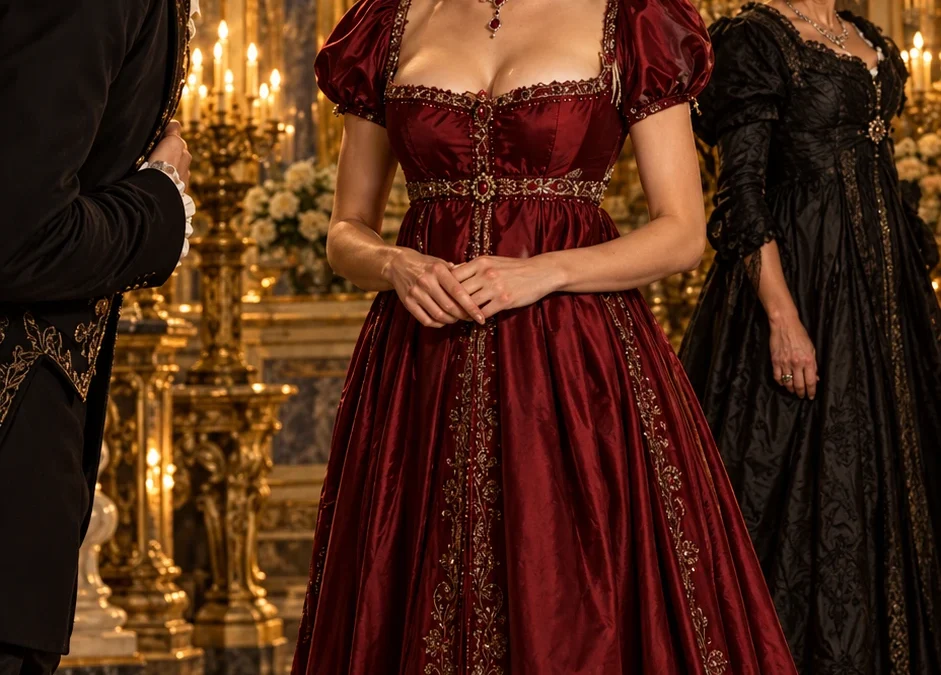
“PACK HER THINGS. SHE WAS NEVER ONE OF US,” THE DUKE’S SISTER ORDERED… WHILE THE STEWARD’S DAUGHTER FOLDED HER TWO DRESSES INTO A TRUNK, NOT KNOWING SHE HAD ALREADY BEEN MADE A DUCHESS 😱
Part 1
“Pack her things. All of them, and be quick about it. She was never truly one of us, whatever my brother let her believe.”
The words came through the morning room door before Rowena had reached the top of the stairs. She stopped, one hand on the cold rail, and did not move. 💔
Downstairs, the old Duke had been in his grave a single night. Black crepe was still nailed over the great hall mirror. And already the Countess, the dead man’s sister, who had arrived from London the very hour the will was read, was giving orders about the steward’s daughter as though she were a chair to be carried out to the yard.
“She has run tame in this house eleven years,” the Countess went on. Rowena could hear the pleasure beneath the grief the woman did not feel. “Reading his letters. Whispering in his ear. Keeping his books, if you please, like some little clerk in skirts. Well, that is finished. The new Duke will want the house clean of the old man’s pets before he sets foot in it.”
A softer voice. Sophia, the Countess’s daughter, pretty and bored. “And if he asks after her?”
“He will not ask. Why should a duke ask after a servant’s brat?”
Rowena stood very still on the stair. She was four-and-twenty, and she had learned long ago to keep her face smooth when her heart was doing something else entirely. Her father had taught her that at the end, when his hands shook too badly to hold the ledger and she had held it for him.
Keep your face still, Rowena. Let them think you are nothing. It is the cheapest armor there is, and the best.
She did not weep. She turned quietly and went back up to the little room under the eaves that had been hers since she was thirteen. And because she was a practical creature, and there was nothing else to be done, she began to fold her two good dresses into her mother’s old trunk.
That was the part she would remember afterward. That she had believed them. That she had knelt on the floor of a cold attic and packed to be turned out.
She did not know that, somewhere in the south, on a road slick with autumn rain, a man was already riding hard toward Harrogate with a folded contract inside his coat. A contract signed at dawn in a lawyer’s chambers, with two seals and three witnesses, that named her:
Rowena, Duchess of Harrogate. 😳
To understand what the Countess did not know, what none of them in that grand, cold house knew, you must go back two months, to a night when the old Duke was still alive, and dying, and honest at last.
Rowena’s father had been steward of Harrogate for twenty years. Not a servant, precisely, and not a gentleman either, but in that in-between place that has no comfortable name. He loved the estate the way some men love a woman. He raised his motherless daughter inside its account books, teaching her rents and drainage and the price of wheat, because she was quick, and because he had no son, and because he said a mind was a sin to waste.
When he died four years before the old Duke, he left Rowena two things. A head full of everything that made Harrogate run. And a promise, given on his deathbed by the old Duke himself, that the girl would never want for a roof.
The old Duke kept that promise in a way no one expected.
He had a son, Julian, the heir, gone these six years to the war and then to the diplomatic service abroad. A grave and distant man Rowena had met exactly twice. And on a night two months past, feeling death in his chest, the old Duke summoned his lawyer and did a strange, deliberate thing.
He drew up a contract of marriage between his son Julian and Rowena Blythe.
He wrote to Julian and told him why. That the estate was being quietly gutted by the new man of business, a Mr. Crayle. That only the steward’s daughter understood the theft. That a wife who knew the land and could not be bought was worth more to Harrogate than any dowry. And that he would go to his grave easier knowing the girl who had held his old friend’s hand at the end was protected beyond the reach of grasping relations.
Julian, who remembered a quiet, clever girl with ink on her fingers, and who trusted his father’s judgment above his own, had signed.
But the old Duke died before he could tell Rowena. The letter meant for her still lay unsent in a drawer.
And so the one person in England the contract most concerned was the one person who had no idea it existed. 🕯️
They did not even give her the morning.
By ten, the Countess had installed herself in the old Duke’s study, in the dead man’s chair, at the dead man’s desk, and sent the footman to fetch the Blythe girl and the keys. Rowena came down with the household keys on their iron ring and set them on the desk without being asked twice. She was composed. She was always composed.
“You have kept the accounts,” said the Countess, not looking up from a ledger she had opened and plainly could not read. “How irregular. Mr. Crayle will take them now, as is proper.”
Behind her stood Crayle himself, a soft, well-tailored man of forty-five with a pink, pleasant face and eyes that never quite settled. He had come to Harrogate three years before, when the old Duke’s sight began to fail, and had smiled his way into the running of everything.
“I am sure the young person has done her best,” he said smoothly. “But a great estate wants a professional hand. There will be errors to put right.” He smiled at Rowena. “I dare say a great many errors.”
And Rowena, who kept her face still, understood him perfectly. He was not warning her. He was telling her he knew that she knew, and that once she was gone from Harrogate, penniless and unbelieved, she could name his theft to the sky and no one would listen to a turned-off servant’s daughter.
She looked at the ledger open under the Countess’s hand. She read it upside down and saw the false entry at once. Timber sold from the north wood, £300, entered as £120.
She had a second book upstairs, sewn into the lining of her trunk, where the true figures lived. Her father’s habit. Never trust one book, Rowena. Keep the true one where no thief thinks to look.
“Of course,” she said quietly. “The errors.”
“You may go when the cart comes,” said the Countess. “Wait in the kitchen, and leave the keys.”
But the cart never came.
Because the Duke came first. 😱
There was no grand arrival. Only the sound of a single tired horse in the courtyard, and then a tall man in a dark greatcoat standing in the doorway of the great hall, the crepe-hung mirror behind him, mud to the knee, his face gray with three days’ hard riding and an older grief than that.
Julian, Duke of Harrogate, had come home to bury his father, and had missed it by a night.
The Countess was across the hall in an instant, all rustling black and outstretched hands. “Julian, my dear, dear nephew…”
He let her take his hands. But he was looking past her. He was looking at the young woman standing very straight against the far wall in a plain gray dress, a bundle at her feet and a servant’s shawl over her arm.
A face he had seen twice in his life, and had, to his own quiet surprise, thought of more than twice in the years between.
“Aunt,” he said, low and even, used to being obeyed. “Who is that? And why is she standing by the door with her things packed?”
And what the Duke did next, before the whole stunned household, was something no one in that hall would ever forget… 😨
Part 2
“Who is that? And why is she standing by the door with her things packed?”
The Countess laughed, light and dismissive. “No one to trouble you with, dear. My brother’s old steward’s girl. She has been lingering. I am sending her on. The house should be clean for you.”
“Her name,” said the Duke. Not a question now.
A small silence. Then Rowena, because no one else would, spoke it herself, clear across the hall.
“Rowena Blythe, your grace.”
Something moved in his tired face. Not surprise, exactly. The settling of a thing long expected.
He put the Countess’s hands gently from him and crossed the whole length of that great cold hall, past his aunt, past the pretty daughter, past the smiling man of business. He stopped in front of the steward’s daughter in her packed-up gray.
And he bowed to her. 🥹
Bowed to the servant by the door.
“Miss Blythe. I am sorry I was not here sooner. Please take that bundle back upstairs. You are not going anywhere.”
The hall went very quiet. Crayle’s smile froze into something that was no longer a smile. The Countess’s face was a study in a woman rearranging her entire understanding of a room.
“Julian,” she said carefully. “I don’t think you can be aware. The girl is nobody. Her father kept the books. She has no family, no fortune…”
“I am aware of a great deal, Aunt.” He did not raise his voice. He never, Rowena would learn, raised his voice. The quiet was the whole of his authority. “More than you might suppose. Miss Blythe stays. Her rooms are not to be touched. And the keys…” He glanced at the iron ring on the desk. “The keys go back to her until I have had time to understand this house, which she plainly knows and I plainly do not.”
“The accounts are with me now, your grace,” Crayle put in, oily and quick. “Everything is quite in order.”
“Then it will cost you nothing to hand them over for a fortnight,” said the Duke. “I have spent three years reading treaties that men wrote to deceive me. Mr. Crayle, I find I have a taste for small print.”
He did not explain himself. That was what Rowena could not fathom, standing there with her heart going like a hare’s. He did not say why. He did not mention a contract or his father’s letter or anything that would have made sense of a duke crossing a hall to bow to a servant.
But as he turned away, he passed close to her, and beneath the Countess’s scramble for the housekeeper, he said, very low, meant for no one but Rowena:
“My father wrote to me about you. I had hoped to speak with you before any of this. It seems the world would not wait.” A pause. Something almost like apology. “Forgive me. We will talk tonight.”
He sent for her at nine, to the study. He had the decency to leave the door open and a maid within call, because he was that kind of man, and because he could see she was frightened and would not add to it. Without the mud and the greatcoat he was younger than she had thought, perhaps thirty, with a soldier’s stillness and a scholar’s tired eyes.
On the desk between them lay a folded paper, heavily sealed.
“I am going to tell you something that will be a shock, and there is no gentle way to it. My father, before he died, made an arrangement. He believed the estate was being robbed. He believed you were the only person who understood how. And he believed, rightly I think, that grasping people would put you out of the house the moment he was cold, precisely so that no one who knew the truth would remain to tell it.”
Rowena’s hands were folded in her lap. She kept her face still. It was very hard.
“So he protected you in the only way the law makes truly binding. He proposed a marriage between you and me.” He touched the paper. “I signed it at dawn yesterday in London, before I knew he was gone. It is witnessed and sealed. By every law of England, Miss Blythe, you have been my wife since yesterday morning.”
The clock ticked. Somewhere below, a door closed.
“You simply did not know it. Neither did they.”
Rowena sat frozen, staring at the folded paper that had remade her whole life while she knelt packing a trunk in the attic… 😶
“You may be angry,” he said quietly. “You have every right. You were not asked. It was done to you, however kindly meant, and I will not pretend otherwise. If you wish it undone, there are ways, and I will not hold you. But I would ask you to wait a fortnight before you decide. Because there is a man in this house robbing it blind, and you and I together can stop him, and apart we cannot.”
A faint, exhausted, almost-smile. “It is not the marriage proposal you were owed. It is the one I have.”
Rowena looked at the contract, and then at the grave, tired man who had bowed to her in front of the people who despised her. And she found that the thing rising in her chest was not anger at all.
“Show me the seals,” she said.
She did not tell him, that first night, about the second book sewn into her trunk. She had learned caution in a hard school, and a signature on a contract was not yet trust.
But a woman was already watching from the shadows, and she was not a stupid woman. That was what made her dangerous… 😈
Part 3
Over the fortnight that followed, in the long evenings in the study, with the door open and a maid always in the passage, the two of them bent over the books together. And something changed that neither of them named.
Julian was cleverer than she had feared, quick to see a pattern once she showed him where to look. And he listened. Rowena had spent eleven years in a house where no one listened to her, and she had not known how starved she was until a duke sat across a desk and said, “Go on, I don’t follow. Explain it again.”
She learned him, too. That he had gone to the war at twenty and come back at four-and-twenty with a stillness that was really the lid on something. That his father had been cold to him and warm to the estate. That Julian had spent his whole life trying to be worth a love that was mostly given to fields and tenants. That he had signed the contract partly because his father asked, and partly, he admitted one late evening, not looking at her, because he remembered a girl with ink on her fingers who had once spoken to him about drainage as though it were poetry, and he had not been able to forget her.
“You remembered that?” said Rowena. “I was nineteen. You said perhaps a dozen words to me.”
“I remembered that,” said the Duke.
The candle was low. Their hands were very close on the open ledger. For one moment the whole cold house seemed to hold its breath.
And the study door banged open, and the Countess sailed in without knocking, her eyes going at once from the closeness of them to the guilty inch of space that opened between their hands.
“How cozy. The Duke and the clerk.” 😠
The Countess began with Sophia. The pretty daughter was suddenly everywhere the Duke was: at breakfast, on the stairs, in the garden with a book she was not reading. And in her carrying voice, the Countess began to lay a story into the household air like poison into a well. That the steward’s girl had wormed her way into the old Duke’s confidence for years. That she had managed the dying man. That a female who kept a great man’s accounts and slept under his roof was not, whatever airs she gave herself, quite respectable.
“People will say she trapped you,” she told Julian over a dinner Rowena was pointedly not invited to, all tender worry. “A soldier grieving alone, and a scheming girl who has had eleven years to learn every corner of your father’s weakness. They will say she got the old man to write that shameful paper. I say it only because I love you, Julian.”
The terrible thing, the thing that kept Rowena awake beneath the eaves, was that it would work. It was a story that fit every prejudice a drawing room held. A duke and a steward’s daughter. Of course she had schemed. Who would believe the other tale? That a dying man had done a kind and clever thing, and the girl herself had known nothing until it was done?
Crayle poured his own poison beside the Countess’s. He went quietly to the tenants and the neighboring magistrate with the suggestion, never quite stated, that the old accounts were a shocking muddle, and that whoever kept them before his arrival had perhaps more reason than sentiment to fear a review.
Between them they built it neatly. If the marriage stood, Rowena was a schemer who had trapped a duke. If the accounts were questioned, Rowena was a thief covering her tracks. Either way, when the storm broke, it would break on her.
She saw it coming. She had always been able to see the shape of a thing before it arrived.
So she stopped waiting for it to arrive.
Rowena went first to the people the Countess and Crayle had forgotten to count: the servants and tenants who had known her eleven years. Old Fenn the butler, who had carried her on his shoulders when she was small, and wept alone in the pantry the night the old Duke died. Nan in the kitchen. The tenant farmers in the low cottages, whose leaking roofs sat in Crayle’s ledger as new thatched, £40.
She did not ask them to love her. She asked them to remember, and to be willing to say what they remembered aloud, to the Duke’s face, when the day came.
Then she went up under the eaves and took her scissors to the lining of her mother’s trunk. She drew out the thing she had carried folded against the wood for three years. The true book. Her father’s second ledger, and her own after him. Every real figure, every real date, in a hand so neat it could not be argued with.
She laid it beside Crayle’s false book on the study desk, and showed Julian not a suspicion but a proof. Timber. Bridge. Cottages. The steady, quiet bleeding of three, five hundred pounds a year into a soft man’s pockets, three years running.
Julian looked at it a long time in silence.
“This is a rope. Long enough to hang him.” He looked up. “Why did you not show me on the first night?”
“Because on the first night, I did not know if you were one of them.” She met his eyes. “I know now.”
“What changed your mind?”
“You listened. They never listen. You did.”
He reached across the ledgers slowly, giving her every moment to draw back, and took her ink-stained hand in his. This time, no door banged open. Neither of them moved away.
“When this is done, and the house is clean,” said Julian, his quiet voice not quite steady, “I am going to ask you a question my father never gave you the chance to answer. Not the contract. Me. And you will be free to say no, and I will abide by it. But I find I very much hope you will not.” 🥹
The Countess forced the moment herself, as proud people do. She invited half the county to a dinner at Harrogate, ostensibly to honor the late Duke’s memory: the magistrate, the neighboring gentry, the vicar, everyone whose good opinion made or unmade a family. In truth, she meant to display her daughter beside the new Duke, and to see the steward’s girl put finally in her place before an audience that mattered.
She had not reckoned on the steward’s girl choosing the same stage.
The great dining hall was full of candlelight and county faces when the Countess rose, glittering. Not crude. Never crude. But deadly. She spoke with tears in her voice of the family’s grief, and then of a painful matter that honor compelled her to raise: the shocking discovery of irregularities in the old accounts, kept, as some present might not know, not by a qualified man of business but by a young woman of no family, who had, she let the pause do its work, insinuated herself remarkably close to the household.
“Mr. Crayle has examined the books. Perhaps he will tell the company what he found.”
Crayle rose, grave and regretful, the very picture of an honest man pained by his duty. “It gives me no pleasure. But the figures do not lie. Sums are missing. Entries have been altered. And they were altered, I am sorry to say, by the hand that kept them before mine.”
“Yes,” said Rowena, standing at the foot of the table, clear and calm. Every head in the hall turned. “They were. Let us show the company exactly which hand, and exactly which entries. I have brought the books. Both of them.”
She had them carried in and laid open among the silver. Crayle’s ledger. And beside it, her father’s true one. And in a voice that never rose and never shook, she walked the whole company through it.
“The north wood. Three hundred pounds of timber, entered by Mr. Crayle as one hundred and twenty. Here is the timber merchant’s own receipt, which I rode eleven miles in two days to fetch. Here is his signature. Here is the sum.
“The bridge in the east meadow. Forty pounds for repairs, entered and paid twice in the spring. The bridge is a hundred yards from this house. Any gentleman here may walk out after dinner and see it has not been touched in twenty years. The moss on it is older than I am.
“The cottages. New thatched, forty pounds. Tom Ferris farms the nearest. He is standing in your own kitchen passage tonight with his hat in his hand, and he will tell any of you who cares to ask that his roof has leaked on his children’s beds for three winters, and no man came to thatch, and no forty pounds was ever spent.”
Entry by entry. Receipt by receipt. Witness by witness. She took Crayle’s smooth ledger apart, and the pink, pleasant face above it went first white, then a terrible mottled color, and his soft hands began to shake on the back of his chair. 🔥
Then she turned it, gently, like a knife.
“These alterations are in Mr. Crayle’s hand, gentlemen. You may compare them at your leisure with his letters, which are here. They were made after my father died, and after I was forbidden these books. I could not have made them. I was not permitted to touch the ledger. The Countess herself gave that order before witnesses three weeks ago.” She inclined her head to the Countess with perfect courtesy. “You will remember it, madam. You said Mr. Crayle should have the accounts, as was proper. He did, and this is what he did with them.”
The silence in that hall was total.
The magistrate, a blunt old man who had known the true steward twenty years, rose slowly, put on his spectacles, and bent over the two books for a long time. Then he straightened and looked at Crayle.
“Sir. You will not leave this house tonight except with me.”
It was the Countess who could not let it lie. Cornered, she did what cornered proud people do. She reached for the cruelest thing left on the table.
“This is all very clever,” she said, her voice shaking with fury, losing at last its silk. “Very clever for a servant. But it does not change what she is. A steward’s brat who schemed her way into a dying man’s favor and a grieving man’s bed. Who forged a contract no court will honor.” She flung the word out to the horrified room. “She has no more right to stand at that end of my brother’s table than the girl who blacks the grates! Whatever she has proved about Mr. Crayle, she is nothing. She is nobody. She always was.”
And the quiet man at the head of the table finally stood.
Julian, Duke of Harrogate, rose to his full height in the candlelight, and for the first time the county saw why soldiers had followed him and treaties had been signed across from him. The stillness in him had a floor of iron beneath it.
“You are mistaken, Aunt.” He did not raise his voice, but it carried to the last candle in the hall. “On a point of fact. Let me correct it before witnesses, so that it need never be raised again.”
He looked down the length of the table at Rowena, and his grave, tired face did something it had not done in all the time she had known him. It softened, completely, in front of everyone.
“The contract is not forged. It was drawn by my father’s own lawyer, signed by my own hand in London before my father died, and witnessed three times. I have it here.” He laid it on the table beside the ruined ledger. “The lady you have spent a fortnight ordering about your kitchen. The lady you told to pack her things and wait for the cart. Is my wife. She has been the Duchess of Harrogate since the morning of the tenth. You have been, this whole fortnight, a guest in her house.”
He let that land. Then, more gently, and only to her, though the whole room heard it:
“Though I mean to ask her properly all the same. She was never asked. She should be asked.”
The county went home stunned and delighted, as counties do when they have witnessed something they will talk about for a decade. Crayle went with the magistrate. The Countess and her daughter left before noon the next day in a hired shay, unaccompanied, unspeeded, no one troubling to stand on the steps to see them go. 😶
In the evening, when the great house was finally quiet and clean, Julian found Rowena in the study that had become, over that strange fortnight, the one warm room in Harrogate. He did not come with the contract this time. He came with nothing in his hands at all.
“I told them you were my wife. It was true, and I would say it again to the king. But it was also done to you twice now. Once by my father. And once by me, tonight, in front of the county, because I could not bear to hear you called nobody for one more second. Neither time were you asked.”
He stood before her, this grave man who commanded rooms without raising his voice, and she saw with wonder that he was nervous.
“So I am asking. No contract. No estate. Nothing bound. If you walked out of that door tomorrow, I would see you settled and safe and free, and never trouble you again, and count it the price of having behaved like every other person who has ever decided your life for you.” He drew a breath. “Rowena Blythe. Will you stay? Not because a paper says you must. But because you might, God help me, want to? Will you be my wife because you choose it?”
Rowena, who had packed her mother’s trunk to be turned out into the yard a fortnight before, who had kept her face still her whole life because it was the cheapest armor there was, felt the armor come at last all the way off.
“I have kept the books of this house for eleven years,” she said, her voice not quite steady either. “I know to the penny what everything in it is worth.” She stepped toward him. “You are worth more than the estate. You listened. Yes. I choose it. Yes.”
And when he kissed her, no door banged open, and no one interrupted, and the low candle burned down quietly in a house that was at last entirely their own. 💍
They were married again in the spring, properly, in the small stone church on the estate, with the tenants crowded in, and Tom Ferris’s children, under a roof at last, new-thatched and honestly paid for, throwing more petals than strictly landed on anyone.
Crayle was tried at the assizes and transported. The money he had not yet spent came home to Harrogate, and went, at the new Duchess’s blunt instruction, straight into roofs and drains and the unromantic things that keep a great estate alive. Rowena kept the books still. She saw no reason to stop being good at the thing she was best at. And Julian, who had married her partly for exactly that, saw no reason to ask her to.
The Countess wrote once, a year later, when Harrogate was prospering and its Duchess spoken of with respect across three counties. A careful letter, all warmth, hoping dear Rowena bore no grudge and might receive her at Christmas.
Rowena read it once at her own desk, in the dead Duke’s study that was hers now. Then she took up her pen, in the neat, unarguable hand her father had taught her, and wrote a short, courteous, final reply. She kept her face quite still while she wrote it. Old habits.
But there was, this time, the smallest smile underneath. The smile of a woman who had once folded her two good dresses into a trunk, believing every word they told her, and who had learned in a single fortnight exactly what she was worth. 🤍
She had been kind once, and quiet, and easily overlooked. She was still kind.
She was no longer quiet.
And no one at Harrogate, or in the three counties round it, would ever make the mistake of overlooking her again. ✨
Have YOU ever been underestimated by people who thought you were “nobody”? Tell me in the comments, and share this with someone who needs to know their worth was never up for debate. 👇
This story is entirely fictional and created for entertainment purposes only. It does not represent any organization or individual, nor does it encourage inappropriate behavior. The content was generated with AI assistance.








