“Please Don’t Leave Me Out Here…” She Whispered at His Door in a Killing Storm. Then She Found the Hidden Brass Badge in His Bag and Whispered a Name That Turned His Blood to Ice
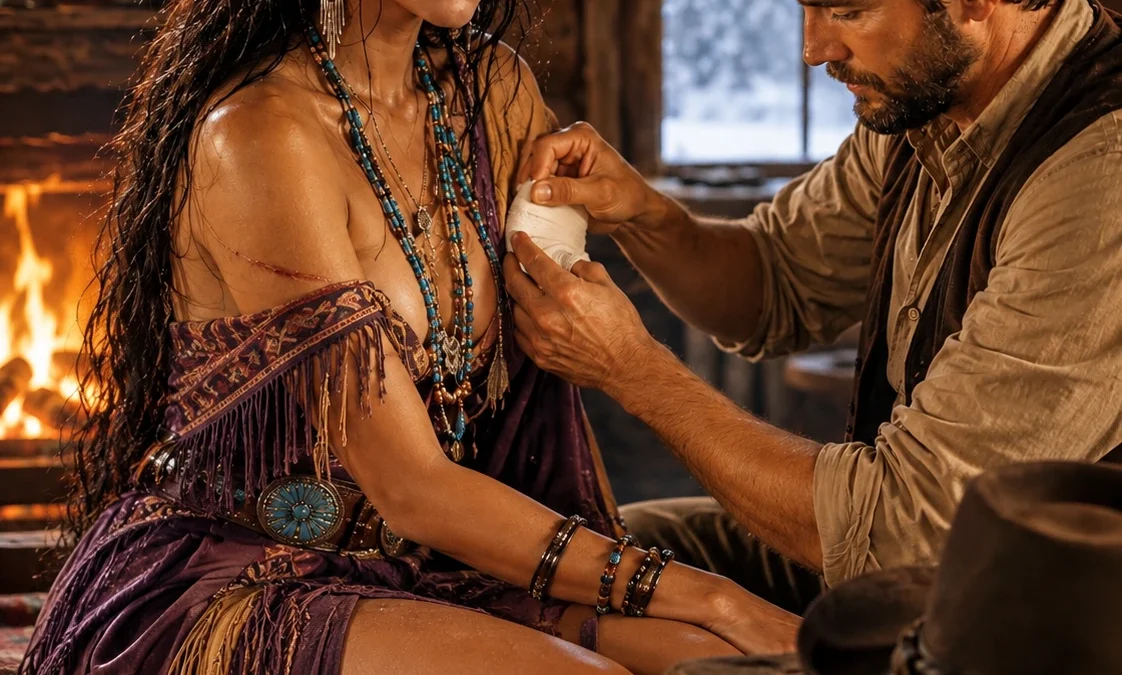
“Please Don’t Leave Me Out Here…” She Whispered at His Door in a Killing Storm. Then She Found the Hidden Brass Badge in His Bag and Whispered a Name That Turned His Blood to Ice 😱❄️
PART 1
The wind tore down from the ridge, scraping the cabin roof like it meant to peel the night open. 🌨️
Then came a knock. Soft. Barely there.
Cabins this high didn’t get visitors, not in weather that killed.
Caleb Whitlock held his breath, one hand closing on the rifle. For three winters he had counted the cold the way other men counted wounds: this one, that one, the one that never quite closed. He didn’t light the lamp anymore. The dark didn’t ask questions. The dark didn’t show him the second chair at the table, or the worn spot on the shelf where a cradle used to sit, or the drawer he hadn’t opened since the fever took his wife.
Inside that drawer lay a small, plain ring. Mary’s. 💔
He cracked the door. Ice flooded in.
A woman stood on his porch, small against a night built to swallow her. Her shawl was frozen stiff, her hair torn loose, her moccasins soaked black. And her wrists were raw, marked by the kind of rope that’s pulled tight and mean. 😰
She didn’t beg. She looked at him steadily, as if she had already decided what kind of man opened his door this late into a storm, and had only come to find out whether she was right.
“Please,” she said, voice cracked at the edges. “Don’t leave me out here.”
Every instinct the army had beaten into him said a stranger on your porch after dark was trouble wearing a kind face. But she wasn’t asking for charity. She was asking for a door.
“I have nothing to give you,” she said. “Except my word.”
“Don’t care what you can give,” Caleb said. “Get in before the storm decides for you.”
She crossed the threshold, stumbling, catching herself before he could reach her. He dropped the latch, and the cabin, which had felt like a held breath for three winters, let something out.
He set the old horse blanket around her shoulders without touching her more than he had to. She flinched at the warmth like it burned and healed her at once. He offered the bed. She shook her head before he finished the sentence.
“Floor’s fine.”
“Got a name?”
She weighed it like it was one more thing she’d learned not to give away for free. “Kaia.”
He didn’t offer his own. Not yet.
That night he sat against the far wall with the rifle across his knees, listening to her breathing slowly even out. For the first time in three years, the cabin didn’t feel like a held breath. It felt like a room with two people in it.
He hated how much that scared him.
The days found a shape neither of them named. He dug out an old wool shirt and trousers and set them on the table. “You want something for it?” she asked flatly. “Everybody wants something.”
“Not everybody. Thread doesn’t care who wears it, Kaia.”
Her shoulders came down half an inch.
He mended her torn dress while she watched. “You were army,” she said, suddenly sure. “Coats cut like it. Boots, too.”
“Scout. Long time ago.”
On the second night she told him about the trappers who raided her aunt’s camp, about the men who sold her twice, about the night they drank too deep and slept too hard and she walked until her feet bled and she stopped feeling the blood. She told it flat, with no tears left to spend. He told her less about Mary and the grave on the ridge. She didn’t push.
By the third morning she took the bed, saying the floor had started to feel less like survival and more like stubbornness. She began humming while she worked the dough. Caleb stood in the doorway, axe forgotten in his hand, listening to a sound the cabin hadn’t heard in years. 🥹
On the fourth morning, he found the tracks.
Fresh powder kicked up sharp along the ridge trail. Two horses, maybe three, angling toward his valley. His stomach went cold. She’d said the men who held her rope wouldn’t chase far. Too drunk. Too sure the cold would finish her.
He rode to the trading post the next dawn. The shopkeeper, Sloan, filled his sacks without asking questions, but on the board by the door, half hidden beneath an old church-social flyer, Caleb found a notice. A description of an Apache woman, twenty-some years old, “escaped from lawful custody.” A reward. Not small. Posted three days ago by a stranger.
Lawful custody. He almost laughed. He knew exactly what kind of custody left rope marks still raw four days later. 😡
He told her that night. She didn’t cry. She said only, “They don’t chase for free. I was wrong about how far money travels.”
“We go to the law,” he said. “A marshal two valleys over. Dale Puit.”
“The law has never once helped me, Whitlock.”
“Then let me find out what kind of man he is before we decide he’s the enemy.”
Marshal Puit’s office smelled of tobacco and something sour. He listened to the whole story without a flicker of anger, interest, or surprise. But when Caleb said the word reward, Puit’s eyes flicked toward a ledger on his desk, and he closed it fast.
Too fast. 👀
Caleb rode home half frozen, certain of one thing: the law already knew her name.
When he came through the door, Kaia was sitting at the table. In her open palm lay a small brass insignia, worn smooth, crossed rifles stamped above a unit number. She had found it beneath a fold of wool in his old kit bag.
Her face had gone somewhere he’d never seen it go. Colder than anger.
“This unit,” she said, voice terribly even. “I know this unit.”
Caleb’s stomach dropped through the floor.
“Tell me you didn’t ride with the soldiers who swept my people off their land.”
And in the silence that followed, the fire settling low in the stove, he understood that the one thing he’d never told her was the thing she’d already guessed. 😶
PART 2
Caleb didn’t lie. He had learned the cost of that.
“I rode point on some of it,” he said. “A sweep, years before I came to this ridge. Command wanted the bands cleared. I scouted. I didn’t ask what happened to the people at the other end.”
“Don’t make it smaller than it is,” she said, her voice cracking for the first time since the storm. “Because it’s easier for you to carry.”
“I’m not asking you to forgive it. I’m telling you because you deserve the truth more than you deserve my comfort.”
She walked out into the cold without her coat, the badge still clenched in her fist. 💔
She came back an hour later, pale but calm. “I’m not leaving. Not tonight. That isn’t forgiveness, Whitlock.”
“I know.”
“Then tell me everything. Not the parts that make you sound less guilty.”
So he did. And when he spoke of a young corporal in his unit, cruel in a way that unsettled even hardened men, whose crimes the whole unit had buried under orders, Kaia’s head snapped up.
“Say his name.”
“Cutter Reyes.”
The color left her face.
“That’s the man who runs the camp,” she whispered. “The one who bought me the second time. The one whose men held my rope.”
The room tilted. Years ago, after Caleb left the army, he had filed a report against Reyes. Command buried it, or Reyes ran before they acted. He never found out which. And now that old, unfinished business had walked straight up his ridge. 😨
Three days later a lone rider appeared on the fence line, hands raised. Garrett Voss, an old rancher with gray temples and a sturdy bay. He held out a folded notice, rougher than the one in town. Reyes’s man had offered him coin for information, he said.
“You didn’t take it,” Caleb said.
“My mother was half Apache. Kept quiet about it her whole life. I watched her go small in rooms full of white men.” Voss’s jaw set. “I’ve hidden folks running from worse than winter. If you’ll lower that rifle.”
Over coffee he told them the rest. Reyes’s camp sat half a day northwest, past a dry mining claim. Eight men at least. And held there, chained, was a young Apache man who’d fought hard when they took him.
Kaia’s cup hit the table.
“Taji,” she breathed. “My brother. They took us together. I told myself he got away, because I couldn’t survive believing anything else.” 😭
“We’ll bring him home,” Caleb said.
“You don’t get to promise that.”
“No. But I get to mean it.”
Two days later, under a moon bright enough to ride by, the three of them crept over the last rise before dawn. A guard dozed by a banked fire. Voss took him quietly. Kaia led them to the smallest building, exactly where she’d said it would be, barred from the outside.
Inside, chained to a post in the gray light, a young man scrambled up.
“Kaia? Is that… it’s me?”
“It’s me. I’ve got you. I’ve got you.” 🥹
Caleb broke the chain. They ran. Then a shout went up across the camp, and gunfire cracked behind them. A man stepped out from behind the corral, rifle already leveled at Caleb’s chest.
Voss shoved him sideways.
The bullet found the old rancher instead. He went down hard, a sound tearing out of him that Caleb would hear in his sleep.
PART 3
“Voss, no!”
Kaia’s rifle came up. She put the man by the corral down before he could fire again, her hand steady even as her voice broke apart.
Voss’s fist clamped around Caleb’s wrist, blood already soaking through his shoulder. “Get them out. Don’t you dare stop for me, Whitlock.”
“I’m not leaving you.”
“You are.”
“No.” Kaia was already hauling the old man’s good arm across her shoulders. “We carry him. All of us together, or none of us.”
Caleb saw the set of her jaw, the same look she’d worn the night she knocked on his door, and understood there was no version of this morning where he won that argument.
“Together,” he said, and got his shoulder under Voss’s other side.
They made the tree line by the barest margin, bullets chewing bark off the pines, and kept stumbling until the shouting faded behind them. They got Voss into a saddle, Kaia riding behind him to hold him steady, blood soaking the old man’s coat with every jolt. Taji, weak from the chains, rode on without a word of complaint.
“Cabin,” Caleb said, voice raw. “Fastest way. We patch him there or we don’t patch him at all.” 🐎
The ride felt endless. Voss slipped in and out, muttering nonsense, then Kaia’s name, then something about a bay horse he still owed feed money on. A ghost of dark humor. Caleb clung to it. The old man wasn’t done fighting yet.
They laid him on the bed as the sun cleared the ridge. Kaia cut away his shirt and pressed cloth hard against the wound.
“Went through muscle. Missed anything that would have killed him outright. I think.”
“You’ve done this before,” Caleb said.
“I’ve watched it done. Whiskey. And something to bite on, if he’s got the strength to need it.”
Voss’s eyes fluttered open partway through. “Feels like I got shot.”
“You did. Hold still.”
“Wasn’t planning on dancing.”
Even with blood soaking the sheets, he found room for a joke, and the whole room breathed easier. 🥹
The fever came hard at midnight and broke by dawn. When Voss woke with color returning, Kaia changed his bandage with hands that had finally stopped shaking.
“You carried me half a mile with a bullet in my shoulder,” he said, weak but clear. “Ain’t a lot of folks would have.”
“It wasn’t a choice. A man saves my life, I don’t leave him bleeding in the dirt. That’s not charity, Voss. That’s what’s owed.”
Caleb watched from across the room and felt something settle, deep and quiet. That was Kaia entirely. Not a woman waiting to be saved. A woman who saved people right back, every chance she got, whether or not the world had ever returned the favor.
Reyes came two days later.
Caleb had known he would. A man like that didn’t lose a prisoner and let it lie. Pride alone would drag him up the ridge.
He heard the horses before he saw them. Three riders, slow and deliberate. This wasn’t neighborly caution. This was a man who wanted the fear of his arrival to do half his work.
“Inside,” Caleb said. “Kaia, keep Voss down. Keep the rifle ready.”
“I’m not hiding,” Taji said, rougher than his sister but every bit as stubborn. “Whatever’s coming, I’ve earned the right to face it standing.”
Caleb stepped onto the porch alone.
Cutter Reyes hadn’t changed much. Leaner, harder around the eyes, but the same cold, easy arrogance sat on him as it had when he was a corporal too cruel for hardened men to watch.
“Whitlock. Been a long time.”
“Not long enough.”
“Heard you filed a report on me years back.” Reyes’s mouth curved. “Heard nothing ever came of it. Funny how that works out for men who think they’re doing the right thing.”
“Something’s coming of it now.”
“I lost some property up at my camp. Lost a man, too. Tracks led straight back this direction.”
“Funny thing,” Caleb said, “calling people property.”
Reyes’s smile thinned. “You always did have opinions above your station. Here’s how this ends quiet. You hand over the woman. The boy, too, now that he’s caused me this much trouble.”
“They’re not yours. Never were. Ride off this land or you’re not riding anywhere again.”
Reyes laughed, short and ugly. “Big words for one rifle against three.”
“Wasn’t counting on it being one rifle.”
The cabin door swung open. Kaia stepped out, rifle steady, Voss’s own weapon slung across her back, two sleepless nights still pale on her face. Behind her came Taji, a hunting knife gripped tight in his fist. 🔥
Reyes’s smile finally died. “Kaia. You always did have more fight in you than sense.”
“I learned it from surviving men exactly like you. You want to collect what’s yours? Come try.”
The yard went silent except for the wind and the nervous shifting of horses. Then one of Reyes’s men, young and jumpy, reached too fast for his gun.
Kaia’s shot took him before his hand closed. Caleb’s rifle swung toward Reyes, and Reyes’s own weapon came up just as fast. Both men fired in the same breath. 💥
Caleb felt the burn along his ribs a half second before he heard his own shot connect. Reyes went down off his horse, clutching his side. The third rider, outgunned and watching his boss bleed in the dirt, wheeled and bolted for the trees without a backward glance.
Caleb dropped to one knee, a graze burning like fresh iron. Then he crossed to Reyes and looked down at the man who had haunted the edges of his conscience for years.
“Should have stayed gone,” Caleb said quietly.
A wet, broken laugh rattled in Reyes’s chest. “Neither of us ever were any good at staying where we were put, Whitlock.”
He said nothing else.
They buried him a half mile off the property. No marker, no ceremony. A debt closed, though never entirely clean.
“Man like that,” Voss said from the bed, listening to the account with grim satisfaction. “The world’s better off without.”
“Wasn’t planning on losing sleep,” Caleb said, though something in his chest still sat heavy and complicated.
Kaia sat beside him, her hands still faintly trembling. “He can’t hurt anyone else now,” she said quietly. “That’s what matters. Not how it ends. Just that it’s over.” 🕊️
Word of the camp reached the territorial authorities within the week. Voss saw to it himself once he was strong enough to ride, carrying a name Caleb gave him with grim satisfaction: Marshal Dale Puit, and the ledger he’d closed so fast. It took time. Territorial law moved slow. But eventually word came back that Puit had been relieved of his badge, quietly, the kind of quiet that told Caleb there was more in that ledger than anyone official wanted printed.
Whether justice had been fully served or only partly, he couldn’t say. But the badge was gone, and that was something.
Spring came slow that year, reluctant, testing the ground before committing. One morning Caleb woke to find the whole valley gone soft and green at the edges.
Taji healed steadily, though something in his eyes had gone permanently older than his years. He and Kaia talked low on the porch some evenings, about the family scattered by that old sweep. The sweep Caleb had once ridden point on.
“There’s still people,” Taji told her one evening, while Caleb listened from inside the door. “Some of the old band. They settled two valleys south. They never stopped looking for us. Kaia never once stopped.”
Kaia went still. “I told myself they had. Because it was easier than hoping and being wrong.”
“You weren’t wrong to survive,” Taji said. “Nobody who wasn’t there gets to judge how you carried it.”
A few evenings later, Caleb found her on the ridge, standing near the grave he still hadn’t fully learned to look at.
“You come up here a lot.”
“Some things don’t stop needing tending just because winter’s over.”
She was quiet a moment. “I’ve been thinking about the band to the south.”
His chest tightened. “You’re leaving.”
“I didn’t say that.” She turned to face him fully. “I said I’ve been thinking. There’s a difference between leaving and going to see what’s still standing of something you thought was gone. I need you to actually understand it, Whitlock. Not just say the words.”
“I understand it. If you want to go home, even just to know what’s there, I won’t be the man who stands in your way. I did enough of that once without even meaning to.”
Something in her face softened, the last of some old guardedness easing loose. “I don’t want to go alone. And I don’t want to go just to visit. I want to go and come back. Both.”
He almost smiled. “I understand wanting both at once better than most men alive.” ❤️
They rode south together two weeks later, Caleb, Kaia, and Taji, while Voss stayed behind to mind the cabin and complain that Caleb had let the fence line go to ruin.
The band’s camp sat in a wide green valley, smoke rising from a dozen fires. Caleb watched from a respectful distance as Kaia rode in ahead of him. An older woman came running from one of the lodges, a hand pressed hard against her mouth, disbelief and joy warring on her face.
“Kaia! Oh, Kaia!”
Kaia slid off her horse before it had stopped, and the two women collapsed into each other, the older woman’s hands moving frantic over Kaia’s face and shoulders, as if she needed to confirm with her touch what her eyes were already telling her. 😭
Caleb hung back near the tree line, giving the moment the space it deserved. He watched a woman who had knocked half frozen on his cabin door, now surrounded by people who had never once stopped looking for her.
Eventually Kaia turned, searching the crowd until she found him. She didn’t say a word. She simply held out her hand, an invitation and not a command, and waited to see if he’d close the distance on his own.
He did.
They stayed a week. Caleb helped where he could, mending, building, the quiet practical work he always knew how to offer when words failed him. Slowly, some of the old weariness from the elders eased into something like cautious acceptance. One evening an old man, weathered and sharp-eyed, sat with him by the fire.
“You were army.”
“I was. I rode with the sweeps.” Caleb’s jaw tightened, but he didn’t look away. “Didn’t understand then what I understand now.”
The old man was quiet a long while, firelight flickering across a face that had seen more grief than Caleb could imagine. “Understanding late is still better than never understanding at all. What you do now with what you understand, that is the part that matters. Not what you were.” He nodded toward where Kaia sat across the fire, laughing at something Taji had said, freer and lighter than Caleb had ever seen her. “She chose you knowing what you were. That tells me something about what you have become.”
Caleb had no words for how much that landed. He nodded, throat tight, and let the fire say the rest. 🥹
They rode back to the ridge as summer settled in. Voss met them at the gate, grumbling about the fence line, though the warmth in his voice gave the gruffness away.
“About time. Was starting to think you’d found somewhere better than my company.”
“Nowhere’s better than your company, Voss,” Kaia said, swinging down. “It just took a while to remember there was somewhere else worth visiting first.”
Caleb stood a moment looking at the cabin, really looking at it, the way he hadn’t allowed himself to in three long years. It didn’t look like a held breath anymore. It looked like a home. Not because grief had left it. Grief didn’t work that way. It looked like a home because he had finally stopped asking it to be only a monument to what he’d lost, and let it become something built on what he still had left to give.
That evening he walked up the ridge alone one last time before dark and stood at Mary’s grave.
“I’m not leaving you behind,” he said quietly, to the wind and the single stone that had marked his life for three years. “I don’t think that’s how any of this works. I think I just figured out how to keep walking forward without needing to leave you behind to do it.”
The wind answered the way it always did: with nothing, and with everything, depending on how a man chose to listen.
He turned and looked down at the cabin, at the warm light spilling from its windows, at Kaia standing in the doorway, watching him with a patience that asked for nothing and offered everything at once.
He walked back down. And for the first time in longer than he could measure, walking toward that light didn’t feel like betrayal.
It felt like coming home. 🕯️
THE END
💬 Which moment hit you hardest: the knock at the door, the badge, or Mary’s grave? Tell me in the comments, and share this with someone who needs a reminder that it’s never too late to understand. 👇
Disclaimer: This story is entirely fictional and created for entertainment purposes only. It does not represent any organization or individual, nor does it encourage inappropriate behavior. The content was generated with AI assistance.








