“Please Send Me Someone Who Sees My Worth,” She Prayed Alone in an Empty Church. She Never Knew Who Was Standing in the Shadows
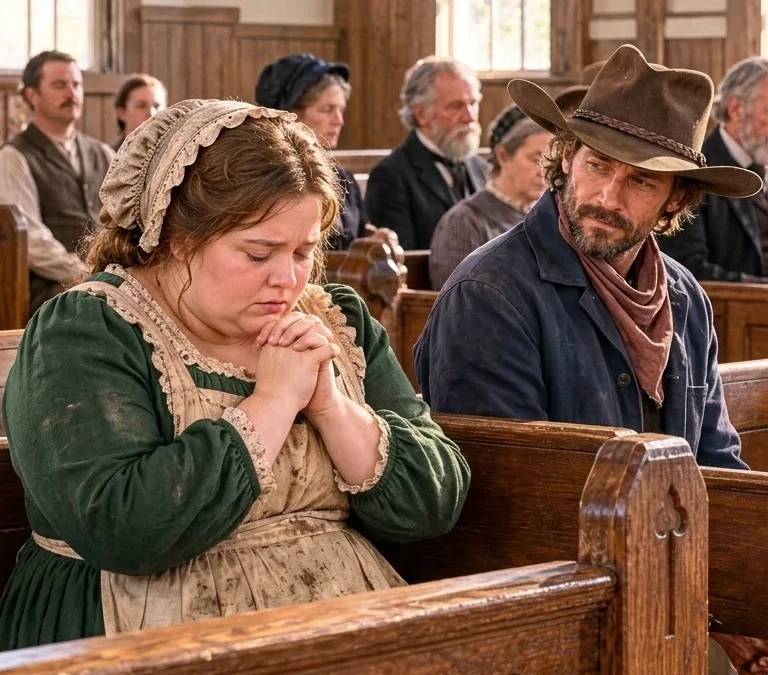
🔥 “Please Send Me Someone Who Sees My Worth,” She Prayed Alone in an Empty Church. She Never Knew Who Was Standing in the Shadows 🙏🌾
PART 1
She slammed her handwritten notice onto the counter so hard the storekeeper flinched.
Three rejections in three days. Three men who looked at her body before they looked at her hands. Three doors closed before she’d finished her first sentence. 😔
Maggie Whitmore was three hundred and thirty pounds of fury, grief, and exactly eleven dollars standing between her and the street. She wasn’t begging. She was declaring.
And somewhere behind her, in a church the morning before, a quiet rancher had heard her pray for a man who could see past the weight of her.
He had said nothing. Yet.
The notice was still warm from her hands. She had written it twice. The first draft she crumpled because her fingers shook and the letters looked desperate. She would not look desperate. The second was clean and steady: Experienced cook. Household management, bookkeeping, sewing, food preservation. References available. Honest work for honest wages.
The storekeeper, Fowler, a narrow man who smelled of tobacco and always looked slightly past the people he spoke to, read it. Then he looked at her. Then back at the notice.
“You do all this yourself?”
“I do. The bookkeeping, too. I kept accounts for a household in Ohio for six years. I caught a supplier overcharging by nearly forty dollars in a single winter.”
“I’ll post it. Can’t promise anything.”
“I’m not asking for promises. I’m asking for fair posting.”
Outside, the Montana sun hit her full in the face, and she made herself breathe. The hotel kitchen had turned her away before nine. The laundry woman, Adah Picket, had looked her up and down with the careful expression of someone deciding how to be cruel politely, and said the work would be “too demanding.” The dress shop had “no immediate needs.”
Maggie knew exactly what they all saw. She’d known it every day of her adult life with the exhausting consciousness of someone who could never forget. She had watched a thousand faces arrange themselves into surprise, careful neutrality, pity dressed up as courtesy.
What she had never been able to make them understand was that none of those expressions told them a single true thing about who she was.
She was Margaret Louise Whitmore. She could stretch a pound of dried beans into a week of meals. She could balance a ledger to the penny. She could spot a bad contract at fifty paces. She had once talked a creditor out of foreclosing on a neighbor by citing three clauses in the loan agreement that the creditor himself had never read.
She had done all of this while also being fat. The two things existed simultaneously. They always had.
But the people of Pine Hollow weren’t interested in simultaneity. They were interested in the first thing they saw. 💔
The church had been Sunday.
Her boarding house cost money, and Maggie’s money had a visible bottom. She’d done the arithmetic the night before, as she always did: roughly three weeks before things turned genuinely dangerous. She didn’t panic. She added the number to her mental ledger and went to church.
The little wooden church sat at the edge of town like an afterthought. She chose the back pew on purpose. The back was safer: fewer people to step past, fewer chances for someone to glance up and then glance away.
When the service ended and the families filed out, Maggie stayed seated. She told herself she was tired. That was true, but not the whole truth. The whole truth was that she didn’t want to walk back into the town where she’d spent three days being told no.
She waited until the church was quiet. Then, because she was alone and exhausted, she bowed her head.
“Lord,” she whispered. “I’m not asking for easy. I’ve never asked for easy. But I am tired. I am so tired of walking into rooms and watching people decide what I am before I’ve had a chance to show them. I’m tired of proving I deserve a place in this world. Every day I have to earn what other women simply have.”
She pressed her lips together.
“If there is still a good man somewhere. If there is a man left who can see the woman before he sees the size. Please send me someone who sees my worth.” 🕯️
She sat a moment longer. Then she straightened her back, smoothed her skirt, and stood.
She did not hear the man behind her.
A tall man in the back of the church had slipped in late and quietly, and had been standing still in the shadow of the doorframe for the last three minutes of her prayer. He had heard every word. Ethan Caldwell, who hadn’t voluntarily attended church more than six times in two years, stood motionless as Maggie walked past him and out the door, watching her go with an expression that had no name yet but was already more complicated than anything he’d felt in a long time.
He put on his hat. He left. He said nothing.
That restraint was the first thing he ever did for her. She wouldn’t know about it for months.
On Monday she tried the hotel kitchen again. “We need someone light on their feet,” said the manager, Mrs. Delaney. “I’m fast. I’m clean. I don’t break things,” Maggie said evenly. The owner, Mr. Harding, appeared from his back office and informed her the position had been filled. It hadn’t. She could tell by the way Mrs. Delaney studied the wall.
At the laundry, Adah Picket said the work might be too demanding.
“For whom?” Maggie asked, with the careful pleasantness of someone who’d had this conversation for twenty years. “Because I’m the one doing it. And I’m the one telling you I can.”
Adah’s face closed like a shutter.
Maggie went back to her boarding house, did the arithmetic again, and wrote a third notice in her steadiest hand.
Two days later, on the boardwalk outside Fowler’s store, a shadow fell across her.
The man was tall. Genuinely tall, the kind that comes from growing up on a ranch. Broad-shouldered and lean, mid-thirties, with a weathered face and the stillness of a man who spent more time outdoors than in. He had been reading the notice in Fowler’s window. He turned. He removed his hat.
“Mrs. Whitmore.”
“Yes.”
“Ethan Caldwell. I have a ranch four miles out. I need someone who understands accounts and can manage a household properly. I saw your notice.”
She studied him the way she studied everything: carefully and all at once. “What kind of arrangement?”
He listed it like a man reading from a list he’d been compiling. Housekeeper, accounts, provisions. Weekly wages paid on time. A separate cottage behind the main house.
“And privacy meaning what?”
He looked at her with an expression that was not offended. “Meaning your space is your space. I knock before I come to the door. Your hours off are your hours.”
Maggie waited for the catch. She didn’t find one.
“Why me specifically?”
He could have said a dozen things. Later, she would understand what he chose not to say. Right then, he only nodded toward the window. “Because you listed exactly what I need done.”
She thought about her eleven dollars. About the three weeks that were now closer to two. About Adah Picket’s deliberate, traveling gaze. And about the man in front of her, who had not once looked at anything but her face.
“I want to see the property before I agree to anything.”
“That’s reasonable.”
She picked up her reticule. “Then let’s go.”
What Maggie didn’t know was that the man who’d just hired her had heard her prayer, and that she was about to find out whether it was answered by kindness or by something far more dangerous to a woman who’d learned never to rely on anyone. ❤️🔥
👇 Want Part 2? Find it in the comments, or drop any word and I’ll send it to you privately!
PART 2
Caldwell Ranch was not what she expected. Not a ramshackle pile of timber and bad decisions, and not a showpiece. It was a genuinely successful operation, lived in by a man who hadn’t paid it much attention. Good timber, a stone chimney, tight windows. Someone had once put real care into the construction. Not in a while, though.
She stood in the doorway of the main room and took inventory without moving. Receipts stuffed in a coffee tin. A beautiful hand-embroidered linen tablecloth, the kind that cost real money, covering a damaged shelf in the pantry.
“It needs work,” Ethan said.
“It needs a system.” She lifted the corner of the tablecloth. Blue and cream thread, weeks of work. “You know what this is?”
“I know that now.”
She almost laughed and pressed her lips together instead. In the accounts room, she took one look at the desk and briefly closed her eyes. “You’re probably paying for some things twice.”
“What makes you say that?”
“Six months without a working account system.”
The cottage was small, but separate. She tested the latch herself. She checked every window frame. She opened the stove and looked inside. This was the closest thing to a door of her own since Samuel died, and she set that thought aside immediately because it was dangerous.
“I have conditions. Wages paid on schedule, with the amount in writing. The cottage is part of the arrangement, not a favor I owe. If you want me to take on duties we haven’t discussed, we discuss compensation before I start, not after. And the household purchasing is mine to execute.”
Ethan thought about it for approximately four seconds. “Agreed. I’ll write it down tonight so we’re both looking at the same piece of paper.”
That small, unremarkable offer to put it in writing was the first moment Maggie felt something shift. Not relief. Something quieter and more suspicious. The thing that happens when something turns out to be exactly what it appeared to be, and you aren’t sure yet whether to trust it.
“I’ll be here at seven tomorrow,” she said. She did not say thank you.
By the end of the first week, she’d found four payments entered in the ledger twice. Reynolds at the mill, paid once on delivery and again at month’s end. The feed store overbilling since April. She showed Ethan at supper. He read the figures. His jaw tightened.
“You’ve been here six days.”
He looked at her with something more specific than surprise or admiration. The look of a man recalibrating.
“What else?”
By the third week, the ranch ran in a way it hadn’t in years. She knew this not because Ethan told her (he wasn’t a man who gave compliments freely, which she appreciated, because compliments given freely meant nothing) but because she could see the evidence.
What she was less prepared for were the other things.
The morning she found a cord of firewood split and stacked beside her porch overnight. She’d only mentioned she needed to split some before the weather turned. Neither of them spoke of it.
The evening her stove began to draw wrong. Two days later, Ethan climbed on the roof and fixed the chimney himself. “What’s the cost?” she asked, saying his name for the first time. “I had the materials. Call it a maintenance expense.” He asked for absolutely nothing in return.
Maggie had spent a long time learning to identify what men wanted when they were kind to her. She was very good at it. She had needed to be. She could not figure out what Ethan Caldwell wanted.
That frightened her more than anything else he could have done. 😨
She found the photograph on a Thursday, dusting the sitting room. A young woman, early twenties, dark hair, in a Sunday dress, not quite smiling. It sat on the mantel the way things end up when someone can’t bring themselves to put them away.
That evening she asked Mrs. Heler, casually. The woman’s name was Abigail Hart. She and Ethan had been engaged nearly two years. Fever took her in the spring, three years ago. Three weeks before the wedding.
Maggie went back to the ranch and understood the house differently. The beautiful tablecloth used as a pantry rag. The accounts ignored until they were a disaster. The forward-leaning focus of a man who’d decided work was the only reliable thing.
She kept it to herself. It wasn’t her story to tell.
On a Tuesday evening in late July, she stayed late sorting receipts when Ethan came in from the range, dusty and stiff. “You’re still here.” She offered him coffee, for the first time. They talked, not about the ranch, but about Ohio. About Samuel.
“He wasn’t a bad man,” Maggie said, looking at her cup. “He was a good man who didn’t tell me the truth about our finances because he thought he could fix it before I found out. When he died, the truth came out instead of him. I lost the house six weeks after the funeral.” She turned the cup slowly. “What I learned is that love is not the same thing as security. You can have one without the other.”
“That’s why the conditions,” Ethan said.
“Yes.”
He nodded. He didn’t say it’s different now or any of the consoling things that would have required her to be softened by them. He just nodded, like what she’d said was reasonable and accurate.
“Abigail,” she said quietly. He went still. “Mrs. Heler told me. I’m sorry I found out through gossip.”
“It’s not a secret.” A pause. “She was particular. She knew exactly what she wanted and said so. She would have hated those fence receipts.”
Maggie almost laughed. “She sounds like she had good sense.”
“The best.” He was quiet. “The house has been waiting a long time, I think. Not for her specifically. Just for someone to be in it.”
She said nothing about the photograph. She went back to her receipts after he left, and the coffee went cold beside her. 🕯️
That summer she learned things about him she hadn’t intended to learn. That he took his coffee with no sugar and a little less than full milk. That when something worried him on the range, he came back moving slower. That he fell asleep in his chair with a history book face down on the armrest. That he corrected his hands without raising his voice, and earned a kind of respect shouting never could.
And one evening in mid-August, washing dishes, she caught herself listening for the sound of his boots on the porch. She realized she’d been listening for a quarter hour.
Don’t, she told herself, with the same firmness she applied to any mistake before it became one. You cannot afford this.
The trouble was that for the first time in a long time, she wasn’t sure what she couldn’t afford.
The real test came with a supplier named Dawson, who had been billing the ranch at the old contract rate on paper while quietly pocketing the difference as “handling fees.” Maggie found it. Ethan sat across from her and read her notes with the careful attention he gave anything with numbers on it.
“I’d like to come with you,” she said. “You’ll do the talking. But I should be there to answer questions about the numbers.”
At Dawson’s warehouse, the man’s smile recalibrated the moment he saw her. Behind his eyes, she watched him decide she was decorative and Ethan was the one who’d understand.
She set the contract on his counter with her annotated list on top. “Mr. Dawson, I’ve identified a discrepancy.”
“Ethan, I’m not sure…”
“Walk through it with her,” Ethan said pleasantly.
Twenty minutes later, Maggie had a signed amendment and a corrective credit against the next three orders. In the wagon, Ethan was quiet a while. “He tried to explain it to me twice instead of answering your question.”
“Yes. Reacting would have let him make it about my reaction instead of the numbers.” She looked at the road. “The numbers were right. That was the only thing that mattered.”
“You’ve done that before.”
“Many times.”
She thought she was almost certain the corner of his mouth moved. 🌾
In September, she found a crate of good glass canning jars on her porch. No note. She’d mentioned wanting to put up apple preserves. She went to town and bought her own supplies, because accepting jars was one thing and she was not going to become a person who stopped buying her own things. But she made extra preserves, and left two jars on Ethan’s kitchen table without a word. He didn’t say a word either. Somehow that was worse.
Then she found Abigail’s last letter by accident, wedged behind a desk drawer. She didn’t read it. She saw the signature. She handed it to him without explanation.
“I know you didn’t read it,” he said. That evening he found her on the porch. “She wrote it the week before she died. She told me not to let the house become a monument. Her exact words: Ethan Caldwell, if I find out you turned that kitchen into a shrine, I will be very disappointed in you from wherever I end up.”
“Did you turn it into a shrine?”
“The tablecloth was hers. I put it on the pantry shelf because I didn’t want to use it without her, and I didn’t want to look at it.”
“That’s not a shrine. That’s grief. Those are different things.”
“Samuel’s watch is still in my bag,” Maggie said. She hadn’t planned to say it. “I don’t wear it. I just can’t make myself put it somewhere else.”
“Grief doesn’t have a shelf life.”
“No. It doesn’t.”
They stood in the not-quite-dark, not talking. It was the most comfortable silence she’d been in since she couldn’t remember when. That made it dangerous. She stayed in it anyway, just a little longer than she should have.
Then, on a Sunday in late September, she ran her weekly numbers and found real savings in the tin box under her floorboard. Her own money, earned by her own hands. And instead of feeling safe, she felt afraid.
The savings meant she could leave. That was what they were for. So why did the thought of leaving feel like something being removed?
She knew the answer before she finished asking. The answer was the sound of boots on the porch in the evening. Two jars of apple preserves on a table. A man who had let her handle the negotiation herself because he understood she needed to.
She had started wanting to stay. Not because she had to. Because she wanted to.
And that terrified her in a way debt and three rejections never had, because those things she knew how to fight. 😰
Charles Wright arrived on a Friday in a hired carriage, in a good coat, with the ease of a man who expected every room to rearrange itself upon his entry. A cattle buyer from Billings. A significant one. His fall contract was potentially the largest transaction the ranch had made in three years.
Ethan had asked Maggie to sit in. She did. She watched Wright make his assessment of the room in four seconds, and place her just as quickly and just as incorrectly.
He spoke to her once at supper, for the salt. The second time, he said, “You keep the accounts,” like a household curiosity. The third time was forty minutes later, after she’d provided the cost breakdowns that shaped the per-head pricing.
“Your girl keeps good books,” Wright said.
The table went quiet.
Maggie set her fork down precisely on the edge of her plate and looked at her hands.
Wright, with the complete confidence of a man who hadn’t noticed the quiet, continued. “Tell me, Caldwell, how do you manage with this one? She takes up half the kitchen, I’d wager.” He gestured broadly in her direction and laughed. A genuinely amused laugh, a joke he had made before in rooms like this one and always gotten away with.
The heat hit Maggie’s face so fast her vision went white at the edges. She did not move. She did not breathe. She felt the humiliation move through her like cold water, familiar and hated: being reduced to a shape in a room by someone who’d decided in thirty seconds that she wasn’t worth the courtesy of personhood.
She had survived it before. She would survive it now.
What she wasn’t prepared for was what happened next.
Ethan did not stand. He did not raise his voice. He picked up the contract ledger on the table, looked at it a moment, and closed it. The sound was very quiet. But Wright stopped laughing.
“Mrs. Whitmore,” Ethan said, his voice perfectly level, “identified accounting errors in this ranch’s vendor contracts that recovered several hundred dollars this season alone. She renegotiated two supply agreements. She audited thirty years of land documents. She is the reason the numbers you’re looking at tonight are accurate.”
Wright’s smile was still working on disappearing.
“The joke,” Ethan continued, “was about her size. No man who makes that kind of joke in my house receives Caldwell cattle.”
He slid the ledger across the table. “The contract is over.”
“Caldwell, I didn’t mean…”
“I know what you meant. You’re welcome to finish your supper. But the discussion is done.”
Wright left before dessert.
Maggie stood at the kitchen sink with her hands in the water and did not cry, because she never cried in front of people. When she heard the carriage pull away, she dried her hands and went to find Ethan in the sitting room.
“You threw away that contract. That was significant money.”
“Yes.”
“You didn’t have to defend me.”
“I know.” He looked at her directly. “It wasn’t about you, not the way you mean. It was about what kind of man I am in my own house. This isn’t charity, Maggie. A man who talks about the people under my roof that way doesn’t get my cattle.”
“I was humiliated,” she said plainly, because she believed naming a true thing was more dignified than pretending it wasn’t there.
“I know. I’m sorry it happened. I let him in the door.”
“You didn’t know what he’d do.”
“No.” He held her gaze. “But I knew what I’d do when he did it.”
Maggie stood in the doorway and felt something shift so completely it was almost physical, like a knot she had held so long she’d stopped feeling it as tension. She turned and went back to the kitchen before he could see her face.
She sat with it three days. On the fourth, she found him in the barn repairing saddle rigging.
“I need you to answer me honestly. When you offered me this position, did you know? Had you heard my prayer in church?”
The barn was very quiet. Ethan looked at her for a long moment.
“Yes.”
The word landed like a stone in still water. She had known it, somewhere deep. But knowing and hearing it said aloud were completely different.
“The prayer made me look at the notice,” he said. “The notice told me what I was looking for. Everything after that was because of you. The way you handle the work. The way you handle people. The way you are.”
“Was any of it pity?”
“No.”
“How do I know that?”
“You can’t. Not from the outside. Only from watching over time.” He picked up his hat. “And I think you’ve been watching very carefully, and I think you’re afraid of what you’ve seen.”
Her breath caught. She had expected defense, or the soft comfortable lie.
“That is the most accurate thing anyone has said to me in a very long time.”
“Maggie. I want to court you.”
The words were simple and direct, like everything he said. And they were the most terrifying thing she’d heard in years.
She didn’t sleep that night. She lay in her cottage running arithmetic on herself, not money this time but something harder to count. Was what she felt love? Or was it gratitude so large it had taken the shape of love? She had learned that she was a woman who could mistake safety for affection when safety was rare enough. She would rather be alone forever than build on a foundation she hadn’t verified.
In the morning, she found him at the stove, making coffee, as he’d taken to doing on her working days. He handed her a cup without being asked.
“I can’t tell,” she said, “whether what I feel for you is real, or whether it’s because you gave me somewhere to go when I had nowhere. How am I supposed to find that out when everything I am here is tangled up with everything you’ve given me?”
He looked at his coffee. At the window. At her.
“Then don’t choose me while you need me.”
Maggie stared at him. “I’m not telling you to leave,” he said quickly. “I’m saying, if you can’t trust the answer while you’re here, maybe the answer has to come from somewhere else. I would rather lose you and know it was your real choice than keep you and always wonder.”
She set her cup down. “That is either the most honest thing you’ve ever said, or the most manipulative.”
“I know.” He held her gaze. “I’m hoping you know me well enough by now to tell the difference.”
She did. That was the problem. She absolutely did.
And two weeks later, a letter arrived from Helena that would force her to answer.
💬 Did Maggie take the job in Helena, and did the man who told her to leave wait for her to come back? Comment the word “STAY” below, and once we reach our goal, Part 3 goes live! ❤️ LIKE this post so you don’t miss it!
PART 3
The letter from the Grand Helena Hotel offered a salary better than what she earned now, housing in the staff quarters, and a reference from her old Ohio employer calling her “the finest household account manager in thirty years of business.” She’d written the inquiry herself months earlier, before she ever reached Pine Hollow, and forgotten it.
She read it twice. Then she went to find Ethan at the fence line.
He read it. His expression didn’t change, but she saw something move behind his eyes, fast and contained: a man absorbing something he’d half expected and still wasn’t ready for.
“That’s a good opportunity. The wages are fair. Better than fair.” He looked at the mountains beyond the fence. Then at her. “You should go.”
“Ethan…”
“You should go. Not because I want you to. Because you need to know the difference, and you can’t know it here.”
“And if I go and I find out what I feel for you is real?”
He looked at her a long moment. “Then come back. When you’re sure. When you have nothing to lose. Come back and tell me.”
“You’re a very unusual man, Ethan Caldwell.”
“I’ve been told that. Usually it’s not a compliment.”
She almost smiled. “This time it might be.”
She left on a cold October morning. She wrote a complete briefing document: every vendor agreement, the pantry system, the filing logic. She left it on the accounts desk with a note, and did not look at the desk again.
Ethan had the wagon ready. He handed her her wages. She counted them herself, right there in front of him, not because she didn’t trust him, but because she had promised herself she would always count her own money, no matter who handed it to her. He didn’t flinch. Of course he didn’t.
Neither of them said the things that might have made leaving harder. Instead, Ethan said, “The pantry latch is already giving me trouble.”
“It was giving you trouble before I arrived.”
“I know.”
She drove herself to Pine Hollow. She did not look back. She told herself not looking back was strength, and was not entirely sure she believed it. Behind her, a rancher walked into a very quiet house and sat down at a kitchen table with coffee he’d made himself, the way he used to before she came. It tasted slightly wrong. 🍂
Helena was nothing like Pine Hollow, which was exactly what Maggie needed. The Grand Helena Hotel was four stories of brick and managed ambition. Her supervisor, a precise, overworked man named Aldrich, cared nothing for her size and everything for what she could do on a Monday morning.
By Wednesday she’d found seven discrepancies in three months of provision accounts, including a duplicate ordering pattern with a supplier named Harrove that they’d been trying to track for two months.
“You’ve done this kind of work before.”
“For several months, yes. Before that, for my household in Ohio for six years.”
“Where were you before Helena?”
“A ranch outside Pine Hollow.”
He raised an eyebrow. “Caldwell’s place. Good man. Runs a solid operation.” He set the summary down. “He let you go.”
“I chose to take this position.”
“His loss,” said Aldrich simply, and went back to his desk. Maggie stood in the corridor with her hand against the wall and took one long, careful breath.
She was good at the job. Within weeks, she knew which supplier overbuilt, which kitchen worker did double the work for half the credit, which purchasing habit persisted because nobody had asked why. At night, in her small room, she did her own accounting, tracking her savings, the arithmetic of her own floor, her own capacity to walk out of any room at any time. The number grew every week.
And every week she waited for the feeling she thought she’d have. The pure, clean satisfaction of independence achieved.
It came. It was real. But it wasn’t the only thing she felt.
Ethan’s first letter arrived three weeks after she left. She’d told herself he probably wouldn’t write. She was wrong. One page, in a strong, slightly cramped hand.
Maggie, the pantry latch gave out entirely on Tuesday. I replaced it with something sturdier. I found one of your storage logs and have been using it. I’ll admit I added two things to the wrong column and didn’t catch it until Thursday. The first frost came early. The north pasture fence is holding. I hope Helena is treating you well. EC.
She read it twice and put it in her bedside drawer. She told herself these were ordinary facts about an ordinary ranch. She felt something particular about them anyway. She wrote back the next day, professionally, about the Harrove supplier, because writing about work was easier than writing about anything else.
He wrote back the following week. The letters continued.
Then a supplier named Dearborne, who’d interpreted Aldrich’s hands-off approach as permanent policy, came to renegotiate and expected to deal with the boss. He dealt with Maggie. For forty minutes he tried four different ways to redirect the conversation to Aldrich’s office. Each time, she redirected him back to the numbers. He signed a revised agreement that cost him twelve percent of his margin.
“I don’t know what Aldrich is thinking, letting her run the accounts,” Dearborne said loudly on his way out.
Aldrich, coming from the opposite direction, said, “I’m thinking she found twelve percent I was losing. Good afternoon, Dearborne.”
Aldrich stopped beside her. “You’re wasted on a hotel supply contract right now. For how long?”
“I’m committed through spring. After that, I’ll know better where I stand.”
But the question sat with her long afterward. For how long. 🤔
The twist came from a dining room waitress named Ruth Callaway, a sturdy, dry-humored widow with whom Maggie had fallen into the habit of end-of-shift coffee.
“Can I ask you something personal? The ranch you came from. Pine Hollow. I have a cousin there, Emma Harlow. Her husband is Fletcher.”
Maggie went very still.
“Fletcher talks about the Caldwell ranch. He talks about you, too. He says Ethan Caldwell turned down a major cattle contract to defend his housekeeper’s dignity. He says Ethan’s been managing the accounts himself since you left and it’s a disaster. And he says Ethan rides into Pine Hollow every Saturday and checks the post before he does anything else.” She paused. “Fletcher’s not a sentimental man. He said Ethan looks like someone who let something get away.”
“I left for good reason,” Maggie said. “I needed to know the difference between gratitude and…”
“I know.” Ruth said it gently. “I just think you should know what you’re deciding about.”
“I haven’t decided anything.”
“Honey. You’ve been making this decision since the day you left.”
Maggie said nothing, because Ruth was right. That was the thing about truth. It didn’t wait for you to be ready. It sat there, patient, until you looked at it straight.
She looked at it that night. She sat at her small table and did the other arithmetic, the kind with no numbers. She wrote out every observation from four months at Caldwell Ranch: the jars, the chimney, Dawson, Wright. The letters. The way he’d told her not to choose him while she needed him, and had meant it. She knew he’d meant it, because everything else about him had been exactly what it appeared to be every single time.
Is this love?
And the answer wasn’t a rush of feeling. The answer was: When did you stop sleeping well, and what were you thinking about?
She knew exactly when. She knew exactly what.
She pulled out his letters and laid them in order on the table. The pantry latch. The frost. The fence. And in the last one, at the bottom of the page, as if added after the rest was finished: The house is quiet this winter. I didn’t expect to notice it this much. 🥺
She sat with that sentence a long time.
Independence means the ability to leave, she told herself. Not the requirement to stay away. She had confused those two things. She saw it clearly now.
On Monday she gave Aldrich three weeks’ notice.
“Pine Hollow,” he said. It wasn’t a question. “You know there’s a place here for you if things don’t work out the way you expect.”
“I know. Thank you. I mean that.”
“Caldwell’s a fortunate man. He probably doesn’t know how fortunate.”
“He might. He’s smarter than he looks.”
“They usually are, the quiet ones.”
She trained her replacement, a sharp widow named Josephine. She packed. The tin box went into her travel bag, considerably heavier than the day she’d arrived in Pine Hollow with eleven dollars and enough pride to refuse charity. Then she bought her own railway ticket, which was the detail that mattered most to her. Every dollar of it hers, earned by her own hands, spent on a journey she was taking because she wanted to.
On the train she tried to script what she’d say. She wrote a few lines in her notebook and crossed them out. She didn’t need a script. She also knew, with the Montana landscape sliding past, that this might not end the way she hoped. He’d had four months. He owed her nothing.
She sat with that possibility and did not flinch from it. Whatever the answer was, she’d be all right. She had money, skills, a reputation, and the absolute knowledge that she could walk into any room and handle what was in it.
She did not need Ethan Caldwell. She wanted him. That distinction had taken four months and several hundred miles to get exactly clear. 🚂
She reached Pine Hollow just before noon on a Thursday. The town looked the same: Fowler’s store, Mrs. Heler’s boarding house with its blue curtains, the little church where she’d prayed for a man who could see past her size, not knowing he was standing behind her.
At Fowler’s, the storekeeper watched her with a small-town shopkeeper’s attention. “Back from Helena.”
“Back from Helena.”
“You heading to the ranch?”
“That’s my intention.”
Fowler put the cornmeal on the counter. Then, with the air of a man who’d been sitting on information and was done sitting, he said, “He comes in Saturdays. Checks the post.”
Maggie looked at him.
“Every Saturday,” said Fowler. “Since you left.”
She paid for her provisions without a word.
She drove out to Caldwell Ranch. The kitchen garden had been attempted. Badly, she could tell from a hundred yards. She pulled up and set the brake.
The door opened. Ethan came out in his work clothes, and stopped on the front step the way a person stops when their body processes something before their mind catches up.
She climbed down from the wagon herself, because she always climbed down from wagons herself, and walked to the bottom of the porch steps with the same suitcase she’d had in October.
“You told me not to choose you while I needed you.”
His expression was doing something complicated and quiet.
“I’m not going to recite everything I thought about in Helena. The short version is I found out the answer to the question I needed to answer. Whether what I felt for you was gratitude or something real.” She looked at him steadily. “I have savings. I have a professional reputation. I have an open offer from Aldrich in Helena. I have everything I came to Pine Hollow without. I have absolutely no practical reason to be standing in your front yard right now.”
“Then why are you?”
“Because I want to be.” She held his gaze. “Not because I need a roof. Not because you’re the only one who was ever kind to me. Because I know you, Ethan. I know how you think and what you do when things go wrong and what won’t bend. I know you’re better at fixing chimneys than keeping accounts, and that you read history in the evenings, and that you let other people’s grief sit beside your own without trying to rank them. I know that when you told me to leave so I could find the truth, it cost you. And you did it anyway.” Her voice was steady. “I came back. Not because you saved me. Because I chose you.”
Something changed in Ethan’s face. Not dramatically. Just the quality of his stillness shifted, and in its place was something unguarded, something held back a long time and no longer held.
He came down the steps. He stopped two feet from her.
“The pantry latch broke again,” he said.
Maggie stared at him.
“Two weeks ago. The replacement gave out. I’ve been propping the door with a boot.”
She put her hand over her mouth. She couldn’t tell whether she wanted to laugh or cry, and it turned out it didn’t matter, because both happened at once. Not loud, just the human response to four months of careful restraint dissolving at the absurdity of Ethan Caldwell choosing the pantry latch as the thing to say. He was smiling, the full one, the one she’d seen once before and filed away as something she might not see again.
“Of all the things you could have said!”
“I’ve been thinking about that latch for four months. It seemed relevant.”
He took her hand. Not the way you take something. The way you hold something you’ve been careful about for a long time.
“Stay.”
“Yes.”
One word each. Exactly the right amount for the two most careful people in Pine Hollow, Montana, both of whom had learned that words were only useful when accurate. 🥹❤️
She did not become his wife overnight. That distinction mattered to Maggie, and Ethan understood it without needing it explained.
The cottage was still hers. She noticed the new, sturdier latch on its door. Her braided rug, the lavender tin, the shelf beside the stove, all where she’d left them. She sat on the edge of the bed and looked at four walls that were hers, and did something she hadn’t done since before Samuel died. She stopped thinking. She just sat in the quiet of a place that had been waiting, patient as a good tool, for the right pair of hands to come back.
She was not grateful. She was not rescued. She was Maggie Whitmore: widow, bookkeeper, negotiator, maker of the best apple preserves in Pine Hollow, exactly where she’d chosen to be, for reasons entirely her own.
Boots on the porch. A knock. “Supper in an hour. If you want it.”
“I want it.”
His footsteps went back across the yard. Maggie smiled and started unpacking.
The first weeks were quiet and practical and exactly right. She rebuilt the accounts system where Ethan had let it drift. She wrote to a seed supplier in Bozeman for what was actually suited to the elevation. And she opened formal bookkeeping accounts with three neighboring ranches, including Fletcher Harlo’s. She told Ethan at breakfast, directly.
“I’m taking accounts work from the Harlos and two other ranches. It won’t affect the Caldwell books. I’ll schedule it on my off days.”
“Will you need the accounts room on Saturdays?”
“Probably the afternoon.”
“I’ll stay out of it.”
“Thank you.”
“That’s what the system is for,” he said, which was exactly what she’d said to him months ago. He’d remembered it and handed it back without comment. She pressed her lips together very firmly over something that was not quite a smile.
They argued, which made it real. Over a vendor Ethan wanted to take back and Maggie wanted gone. (“Three times isn’t a mistake. It’s a pattern.”) They compromised: one more chance, with a written agreement he’d draft. The supplier’s next three deliveries were immaculate. Neither said I told you so. And over the dried apricots, which Ethan had moved to a lower shelf without asking.
“They were taking up prime shelf space.”
“They were on the second shelf. They’re heavy. Someone shorter than me has to reach.”
Maggie stopped. “You moved them so I wouldn’t have to strain.”
“I moved them because it’s a more logical position,” he said, which was absolutely not what his face was doing.
She moved them back. “Next time, ask first. And thank you. For thinking about it, even if you went about it wrong.”
The corner of his mouth did the thing it did. 😊
The proposal came in December, the first week of real snow. Ethan took her back to the church on a Sunday morning, after the congregation had filed out. Empty, except for two people who’d started their story there.
“I heard you,” he said. “That morning you didn’t know I was there. You asked God for someone who could see your worth.” He held her gaze. “I’ve thought a lot about what it meant that you had to ask. You already had worth. You had it the day you walked through that door. You had it before Pine Hollow, before Ohio, before any of it. The asking wasn’t about getting something you were missing. I think you just needed someone who wasn’t foolish enough to miss it.”
The church was very quiet.
“That’s a finer distinction than most men would make.”
“I had time to think about it.” He reached into his coat. A simple gold ring, chosen by someone who’d thought about the person rather than the gesture. “Before you answer, ask me whatever you need to ask.”
She looked at him a long moment. “The ranch accounts. Will they stay mine to manage?”
“Yes.”
“My bookkeeping work with the other ranches?”
“That continues.”
“My savings are mine. My professional agreements are mine. Any major financial decision affecting both of us, we discuss before it’s made. Not after.”
“Agreed.”
“I’m not changing how I am, Ethan.”
“I know. I’m not asking you to.”
She looked at the ring. At him. “Yes.”
He slid it on her finger. His hands were steady. Hers weren’t entirely, but she let that be what it was: not weakness, just the honest response of a woman who’d held herself in hand for a very long time and was choosing, in this moment, to let go of some of it. 💍
They married in February, when the snow was deepest and Pine Hollow hunkered down waiting for spring. Abigail’s photograph stayed on the mantel. Samuel’s pocket watch stayed in Maggie’s cottage drawer, because the cottage was still hers, which they’d agreed on, because some kinds of space aren’t about distance but about knowing it’s there. Neither past was erased. Both were carried the way people carry what made them: not as wounds, but as history.
Fletcher Harlo came with his wife. Aldrich sent a letter. Mrs. Heler brought a cake better than anything the hotel kitchen produced all winter. Even Fowler sent a crate of good coffee with a note: Congratulations. The town is better for it.
Pine Hollow, which had once looked at Maggie Whitmore and seen only what she weighed, now saw what she’d built: the vendor agreements, the water rights resolution, the ranch accounts she managed with a precision that had already saved real money. And the way Ethan Caldwell looked at his wife across a room, steady and sure and completely without concealment.
Not everyone changed at once. Adah Picket crossed to the other side of the street the first time she saw her after the wedding. Maggie let her go and did not waste a step following.
By March, four ranches ran their accounts through Maggie’s system. By April, a fifth had asked. She sat at the kitchen table one morning and told Ethan she wanted to formalize it: a proper business, her name, her seal.
“What do you need to make that happen?”
She told him.
“Then let’s do it.”
Not I’ll help you. Not I can ask around. Just let’s. That single plural word meant more to her than the ring and the wedding combined, because it was the thing she hadn’t known how to ask for in Ohio or anywhere else: a partner who looked at her ambition and moved toward it instead of away.
That spring, Maggie Whitmore, who kept her name professionally because it was hers, opened the first formal bookkeeping service in the Pine Hollow district.
Some evenings Ethan came in from the range and found her still at the desk with the lamp burning and three ledgers open at once, pencil moving with the certainty she brought to everything. He’d set a plate beside her without a word. She’d eat without looking up. He’d sit in the chair by the door with his book and the lamp, two people who had each learned the value of quiet and were now choosing together when to break it.
One night in April, she stretched and found him watching her.
“What?”
“You look like yourself.”
“What does that mean?”
“It means when you’re doing the work, you look like the person who does it completely. It’s a good look.”
Maggie turned back to her ledger. She picked up her pencil. After a long moment, she said, “You overpaid for oats again, Ethan. I’ve been home ten minutes and you’ve been overpaying for two weeks.”
He put down his book and pulled his chair to the desk. Outside, the snow was finally retreating from the mountains, slow and inevitable. Inside, two people who had survived loss and debt and loneliness and the specific cruelty of being seen wrong by the wrong people sat with their ledgers and their coffee and their ordinary, chosen, carefully built life.
Maggie Whitmore had once prayed for a man who could see her worth. She understood now what she’d really been asking for. Not someone to recognize her. She had always known her own worth. She’d carried it through every door that closed in her face, every sideways glance, every polite dismissal. She had never lost it. She had just grown tired of carrying it alone.
What she’d needed was someone worth showing it to.
And Ethan Caldwell, quiet and steady, the man who knocked before he came to the door and put firewood on the porch and told her to leave so her return could mean something, turned out to be exactly that. Not her rescuer. Her equal. The person she had chosen with her whole self.
She did not need saving. She needed room to be who she already was. And once she had that room, once she’d built it and earned it and chosen it, she filled it with everything she had. 🌾❤️🕯️
If you had been standing in the back of that church, would you have said something, or kept the silence the way he did, until you could prove it with your actions?
Disclaimer: This story is entirely fictional and created for entertainment purposes only. It does not represent any organization or individual, nor does it encourage inappropriate behavior. The content was generated with AI assistance.








