“SEND HER AWAY BEFORE THE SEASON,” HER STEPMOTHER ORDERED—UNAWARE THE DUKE WAS WATCHING
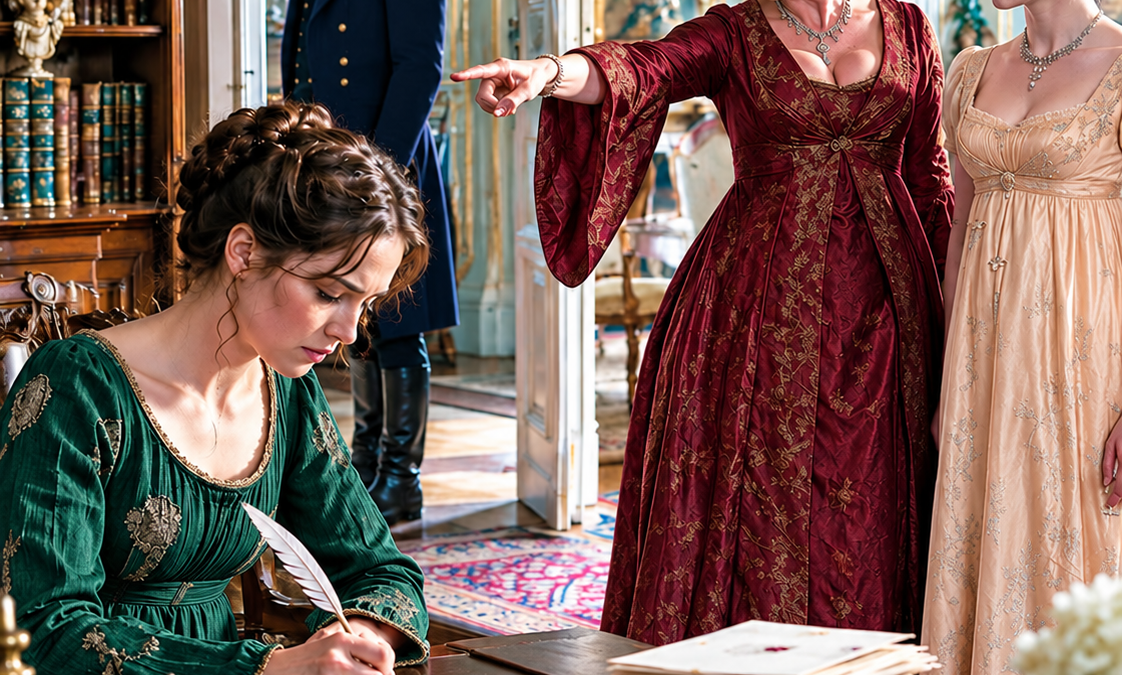
“SEND HER AWAY BEFORE THE SEASON,” HER STEPMOTHER ORDERED—UNAWARE THE DUKE WAS WATCHING 😳
Part 1
The ink was going to fall.
Verity Loxley saw the black bead gathering at the tip of her quill and watched it swell until gravity won.
It dropped onto the mahogany desk one inch from the name she had just written in perfect copperplate.
At that exact moment, through the badly fitted oak doors of the library, her stepmother said:
“Send her away before the Season.”
Verity did not move.
She reached into her apron pocket, pulled out the gray rag she kept for such accidents, and pressed it against the ink.
Lady Prudence continued from the drawing room.
“I want her things packed tonight.”
Verity dipped the pen again.
Envelope sixty-three.
Three hundred invitations sat beside her.
All for Delphine.
All addressed in Verity’s hand.
And apparently, once she finished preparing her stepsister’s triumphant entrance into London society, Verity herself would be removed from it.
“She simply cannot be here,” Delphine complained.
Verity recognized the voice immediately.
Delphine had one tone for eligible gentlemen and another for everyone else.
This was the second.
“Lord Danvers returns next week. Everyone knows how men are.”
Prudence answered coolly.
“He will not see her.”
“But men stare at Verity.”
Silence.
Then Delphine added bitterly:
“They stare at her mouth. Even in church.”
Verity’s pen stopped for half a heartbeat.
Then continued.
She had learned years ago that anger was expensive.
So was humiliation.
Both consumed strength without buying food, coal, shelter, or freedom.
And Verity had very little strength left to waste.
The library was freezing.
Loxley House had fires where people of consequence might feel the cold.
Drawing room.
Dining room when guests were present.
Certain bedrooms.
Never the library.
The library contained old ledgers, unpaid accounts, dust…
and Verity.
Since her father’s death three years earlier, those four things had become strangely interchangeable.
Lord Edmund Loxley had died in Calais with eleven thousand pounds in debt and a will so poorly drafted that two solicitors had declined to fight over it.
He left behind Prudence, his wife of barely a year, and Verity, his nineteen-year-old daughter from his first marriage.
Prudence had begun dismantling Verity’s life almost immediately.
First went Chestnut, Verity’s mare.
Then her mother’s jewels.
Then her place at the family dining table.
Then her second-floor room.
Now she slept under the eaves in a space so narrow she could not stand straight near the window.
And tomorrow, apparently, even that would be gone.
“I have made arrangements,” Prudence said.
“The carriage leaves at dawn.”
Verity’s fingers tightened around the quill.
“Wyckmoor?” Delphine asked.
“Of course.”
Verity closed her eyes.
Wyckmoor.
Four hundred acres of northern moorland.
A ruined east wing.
A roof that leaked in eight places.
A deaf caretaker and his nearly blind wife.
It was where Loxleys sent old relatives nobody wished to entertain.
It was where troublesome dogs disappeared.
A grave with chimneys.
“Send her away before the Season,” Prudence repeated. “I will not have her interfering with Delphine’s prospects.”
Verity set down the quill.
Carefully.
She stacked the finished invitations.
Aligned their edges.
Capped the ink.
Then stood.
She walked past the drawing room doors without looking inside.
Took the servants’ staircase.
And climbed four flights to her room.
Her trunk waited under the iron cot.
Old brown leather.
Cracked straps.
Green brass.
She pulled it out.
There was not much to pack.
Three dresses.
Two aprons.
A comb.
Two books.
Her father’s old pocketknife.
Nothing from her mother.
Prudence had taken the blue velvet jewelry box years ago.
It had contained pearls, a sapphire brooch and diamond earrings promised to Verity since childhood.
“To settle household accounts,” Prudence had said.
Verity glanced toward the empty corner of her bedside table where the box once sat.
Then she began folding her clothes.
Downstairs, something extraordinary had happened five minutes earlier.
The front doors of Loxley House had opened.
A footman found a tall man standing beneath the portico.
Dark greatcoat.
Rain on his shoulders.
No carriage visible.
No servant beside him.
The footman opened his mouth to ask the man’s name.
Then recognized him.
And forgot how to speak.
His Grace, Nathaniel Ashbourne, Duke of Wycliffe.
Thirty-five.
Unmarried.
Owner of three estates, two London houses and enough political influence to make men twice his age choose their words carefully.
He had come to Loxley House because Edmund Loxley had once been his father’s closest friend.
He had also come because, among old correspondence recently discovered in his estate archives, there was a letter from Edmund written only weeks before his death.
A letter mentioning Verity.
Nathaniel had intended to request a private conversation with Lady Prudence.
Instead, the footman left him waiting in the hall while searching for the butler.
Then voices floated from the drawing room.
Nathaniel heard Delphine complain about men staring at Verity.
He heard Prudence order the girl sent north.
He heard the carriage was already arranged.
He heard enough.
And then he saw Verity.
She came out of the library carrying nothing except an ink-stained rag.
She did not cry.
Did not hesitate outside the drawing-room doors.
Did not realize anyone stood in the shadows near the entrance.
Nathaniel watched her take the servants’ staircase.
The servants’ staircase.
A Loxley.
In her own father’s house.
His expression changed.
Then Lady Prudence swept into the hall.
She stopped dead.
“Your Grace.”
Delphine appeared behind her.
Her entire face transformed.
The bitterness vanished.
A perfect smile appeared.
“Duke Wycliffe.”
Nathaniel looked from Delphine to Prudence.
Then toward the back staircase.
“I fear I arrived at an inconvenient moment.”
“Not at all,” Prudence said instantly.
“We were simply discussing arrangements for the Season.”
“So I heard.”
Prudence went pale.
Only slightly.
Nathaniel noticed.
Delphine recovered faster.
“We had no idea you were coming.”
“That was intentional.”
Prudence forced a smile.
“How may we help you?”
Nathaniel removed one glove.
Slowly.
“I came concerning the late Lord Loxley.”
Prudence’s smile weakened.
“And his daughter.”
Now Delphine stopped smiling too.
Upstairs, unaware of any of this, Verity closed her trunk.
She had just fastened the second strap when Mrs. Hughes appeared at the door.
“Miss Verity?”
“Yes?”
The housekeeper looked strangely pale.
“Lady Prudence wants you downstairs.”
Verity almost laughed.
“Now?”
“Yes.”
“Why?”
Mrs. Hughes swallowed.
“There is a gentleman here.”
Verity stood.
“I am hardly dressed to receive anyone.”
The housekeeper lowered her voice.
“He asked for you by name.”
That made Verity still.
“Who?”
Mrs. Hughes glanced toward the corridor as though someone might overhear.
Then whispered:
“The Duke of Wycliffe.”
Verity stared at her.
She knew the name.
Everyone did.
But she had never met him.
“Why would the Duke of Wycliffe ask for me?”
Mrs. Hughes did not know.
Neither did Verity.
But downstairs, Nathaniel had just placed an old sealed letter on the drawing-room table.
Lady Prudence recognized Edmund Loxley’s handwriting immediately.
And when she saw the words written across the front—
To be opened if anything happens to me. Concerning my daughter Verity.
—the color drained completely from her face.
👉 Find Part 2 in the comments, or leave ANY WORD below and I’ll send it to you privately.
Part 2
To be opened if anything happens to me. Concerning my daughter Verity.
—the color drained completely from her face.
Verity entered the drawing room moments later wearing the same plain gray dress she had worked in all day.
Nathaniel stood beside the fireplace.
Delphine sat perfectly straight.
Prudence remained near the table, one hand resting too close to the letter.
“Miss Loxley,” Nathaniel said.
Verity curtsied.
“Your Grace.”
“You knew my father?”
“No.”
“Your father knew mine.”
Prudence interrupted.
“Surely this can wait. Verity travels early tomorrow.”
Nathaniel turned toward her.
“No.”
One word.
Nothing more.
Prudence fell silent.
He held up the letter.
“This was found last month among my father’s private papers.”
Verity recognized the handwriting.
Her father’s.
Her knees almost weakened.
Nathaniel broke the seal.
Prudence moved.
Barely.
But Verity saw it.
The duke began reading.
Edmund’s letter was short.
He wrote that his finances were deteriorating.
That certain family property legally belonging to Verity through her late mother had been placed temporarily under his management.
That if he died before correcting the arrangements, the relevant documents could be found through a solicitor named Mr. Pritchard.
Then came one sentence that made Prudence grip the back of a chair.
Prudence must not be permitted to dispose of Anne’s settlement or Verity’s jewels. They are not mine to sell.
Verity stopped breathing.
“My mother’s settlement?”
Nathaniel lowered the paper.
Prudence spoke quickly.
“Edmund was ill. His affairs were confused.”
Nathaniel’s eyes hardened.
“Were the jewels sold?”
Prudence said nothing.
Verity stepped forward.
“The pearls. Sapphire brooch. Diamond earrings.”
Delphine looked at her mother.
“Mother?”
“They were needed for the household.”
Nathaniel’s voice became dangerously calm.
“They were not household property.”
Prudence snapped:
“You cannot arrive after three years and judge decisions made while creditors stood at the door.”
“No.”
Nathaniel looked toward Verity.
“But I can ask where her money went.”
Prudence paled.
Verity felt as though the room had shifted beneath her.
All those years she believed there was nothing.
That her father left only debt.
That every roof over her head was charity.
Nathaniel placed another paper beside the letter.
“I have already contacted Mr. Pritchard.”
Prudence’s eyes widened.
“He still practices?”
“He does.”
The duke continued:
“And he confirms that Mrs. Anne Loxley’s marriage settlement contained property specifically reserved for her daughter.”
Verity whispered:
“How much?”
Nathaniel looked at her.
“We do not yet know what remains.”
That phrase hurt more than she expected.
What remains.
Meaning someone might have taken the rest.
Prudence recovered.
“This is absurd. Verity is leaving tomorrow. We can discuss financial matters when she returns.”
Nathaniel looked at her.
“She is not going to Wyckmoor.”
Prudence stared.
“You have no authority over my household.”
“No.”
His gaze remained steady.
“But neither do you have authority to remove an adult woman from London because you fear gentlemen might notice her.”
Delphine flushed crimson.
Verity looked between them.
Then Prudence made the mistake.
She reached for Edmund’s letter.
Nathaniel covered it with his hand.
“Do not.”
The room went silent.
That was when a footman entered carrying another envelope.
“For His Grace.”
Nathaniel opened it.
Read.
Then looked at Prudence.
Something in his expression changed.
“What is it?” Verity asked.
Nathaniel folded the page.
“Mr. Pritchard has found the original settlement ledger.”
Prudence took one step backward.
“And?”
Nathaniel looked directly at Verity.
“Your mother did not leave you merely jewelry.”
Verity’s heart began pounding.
“She left you property.”
Prudence whispered:
“No.”
Nathaniel ignored her.
“A townhouse in Bloomsbury.”
Delphine gasped.
“And funds held in trust.”
Verity could barely speak.
“How much?”
Nathaniel looked once at Prudence before answering.
“Enough that nobody in this house had the right to call you penniless.”
Prudence suddenly crossed the room toward the bell.
But before she reached it, Nathaniel added:
“And there is one more problem.”
She froze.
“The Bloomsbury house was sold two years ago.”
Verity looked at her stepmother.
Nathaniel’s voice dropped.
“Someone signed Verity Loxley’s name.”
And Verity knew immediately that the Season was no longer the greatest danger inside Loxley House.
👉 LIKE this post or COMMENT TRUTH to see Part 3. Once I receive the right number of TRUTH comments, I’ll post Part 3.
Part 3
Verity looked at Prudence.
Not Delphine.
Not the duke.
Only Prudence.
The room had become unbearably quiet.
Outside, carriage wheels moved along the wet street.
Inside, nobody breathed normally.
Nathaniel placed the letter from Mr. Pritchard on the table.
“The sale took place twenty-three months ago.”
Prudence finally found her voice.
“You are making accusations based on documents you have not properly examined.”
Nathaniel remained calm.
“The document was examined.”
“By whom?”
“Mr. Pritchard.”
“He is ancient.”
“And by my solicitor.”
Prudence’s face changed again.
Nathaniel continued.
“And this afternoon, by a handwriting clerk from Baines & Harlow.”
Verity turned toward him.
“You knew before coming here?”
“I suspected.”
“Why didn’t you say that immediately?”
“Because I wanted to see whether Lady Prudence would tell you herself.”
Everyone looked toward Prudence.
She didn’t.
Delphine stood.
“Mother?”
“Sit down.”
“But—”
“Sit.”
Delphine obeyed.
Verity felt no triumph.
Only exhaustion.
Three years.
Three years of sleeping under the roof.
Working without payment.
Keeping accounts.
Writing invitations.
Eating near the kitchen.
Believing every mouthful was charity.
And all that time she had owned something.
Perhaps not enough to make her wealthy.
Perhaps enough to give her choices.
Choices Prudence had never intended her to discover.
“Who signed my name?” Verity asked.
Prudence stared past her.
“Answer me.”
Nathaniel did not intervene.
This was Verity’s question.
Eventually Prudence said:
“Your father left chaos.”
“That isn’t an answer.”
“The creditors were relentless.”
“Who signed my name?”
Prudence’s mouth tightened.
“I did.”
Delphine gasped.
Verity did not move.
The truth was almost strangely small once spoken.
Three words.
I did.
No thunder.
No shattered windows.
No dramatic collapse.
Just a woman confessing she had taken something that did not belong to her.
“Why?”
Prudence laughed once.
It was not amusement.
“Why?”
She looked around the drawing room.
“You think this house maintained itself after Edmund died?”
Verity’s expression hardened.
“You sold my mother’s house.”
“I kept this family from ruin.”
“With my property.”
“With available property.”
“It was not available.”
“You were nineteen.”
“I was not dead.”
Prudence flinched.
Verity continued.
“You sold my mother’s jewelry.”
“I used it.”
“You forged my name.”
“For the family.”
There it was.
The oldest excuse in the world.
Nathaniel watched Verity closely.
She was shaking now.
Not visibly enough for anyone else to notice.
He did.
Delphine began crying.
“Mother, you said there was nothing.”
Prudence turned on her.
“You wanted dresses.”
Delphine froze.
“You wanted Almack’s subscriptions, music lessons, French tutors, a new carriage because the old one embarrassed you.”
“That doesn’t mean—”
“You think those things appeared from air?”
Verity stared at her stepsister.
For the first time, Delphine looked genuinely young.
Not cruel.
Not polished.
Afraid.
Verity suddenly understood that Delphine had benefited from the deception without knowing its full shape.
That did not erase her cruelty.
But it changed its size.
Prudence sat down.
Her composure finally cracked.
“When Edmund died, the accounts were catastrophic. Men came to the door. Tradesmen refused credit. There was no cash. I had Delphine to launch. This house was the only thing keeping the Loxley name respectable.”
Verity looked around.
The silk curtains.
The gilt frames.
The polished tables.
The drawing room fire that burned while the library froze.
“How much of my money kept this respectable?”
Prudence said nothing.
Nathaniel answered.
“Possibly most of what remained.”
Verity closed her eyes.
Then opened them.
“Possibly?”
“The trust account was partially liquidated.”
“Legally?”
“No.”
That word landed harder than everything else.
Verity turned toward Nathaniel.
“What happens now?”
He answered honestly.
“You speak to your own solicitor.”
“My own?”
“Yes.”
“I don’t have one.”
“You will.”
Prudence scoffed.
“Paid for by whom?”
Nathaniel’s eyes flicked toward her.
“If necessary, me.”
Verity looked at him sharply.
“No.”
He raised an eyebrow.
She surprised everyone.
“I will not exchange one dependency for another.”
Something almost like approval appeared in his face.
“Good.”
Prudence stared between them.
Nathaniel continued:
“Mr. Pritchard has agreed to advise you initially without charge because he believes he failed your father by not following the matter more aggressively.”
Verity considered that.
“That I can accept.”
“Good.”
Prudence stood again.
“You are behaving as though I am some common thief.”
Verity looked at her.
“You forged my signature.”
Prudence went silent.
“I don’t know what name you prefer.”
Delphine whispered:
“Verity…”
Verity turned.
Her stepsister looked miserable.
For once there was no sharpness in her.
“I didn’t know about the house.”
“I believe you.”
Delphine looked surprised.
Verity added:
“But you knew I was being sent away because you didn’t want men to look at me.”
Delphine lowered her head.
“That part you did know.”
“Yes.”
“Why?”
Delphine wiped her face.
The answer took time.
“Because everything is easier for you.”
Verity almost laughed.
“Easier?”
“You don’t care what anyone thinks.”
“I have spent three years being careful about what everyone thinks.”
“No. You don’t understand.”
Delphine looked toward the mirror over the mantel.
“When I enter a room, Mother has already told me which man matters.”
Verity said nothing.
“What to say. What not to say. How long to smile. Which color makes me look pale. Which girl is prettier.”
Her voice broke.
“You walk into church wearing gray and men still look at you.”
Verity stared.
Delphine continued:
“I hated that.”
For the first time, Verity saw the strange prison hidden inside Delphine’s privilege.
It was not the same prison.
Not even close.
But it was one.
“Then you should have hated the rules,” Verity said quietly.
“Not me.”
Delphine closed her eyes.
“I know.”
Prudence snapped:
“That is enough sentiment.”
Nathaniel looked toward her.
“Yes.”
She mistook his agreement.
Then he continued.
“It is enough.”
He walked toward the bell.
Prudence stiffened.
“What are you doing?”
“Sending for my carriage.”
“You are leaving?”
Nathaniel looked at Verity.
“Miss Loxley is.”
Verity blinked.
“What?”
Prudence almost shouted.
“She is certainly not going with you.”
Nathaniel’s expression became cold.
“Nor should she.”
Then to Verity:
“My aunt, Lady Beatrice Ashbourne, lives three streets away. She is seventy-one, terrifying, widowed, and entirely immune to gossip.”
Verity almost smiled.
“I see.”
“She also has twelve unused bedrooms and has already been informed that you may require one.”
“You informed her?”
“Before arriving.”
That irritated Verity.
Nathaniel noticed.
“I suspected you might need somewhere temporary. You are free to refuse.”
That changed everything.
Choice.
Not command.
Verity looked toward Prudence.
Then toward the hall.
Then, strangely, she thought of her trunk upstairs.
Already packed.
Prudence had done that much for her.
“I accept.”
Prudence stepped forward.
“You cannot simply walk out.”
Verity looked at her.
“You intended to send me to Yorkshire at dawn.”
“That is different.”
“Yes.”
Verity’s voice became calm.
“This time I chose the destination.”
Twenty minutes later, Verity came downstairs carrying the battered trunk.
Nathaniel reached for it.
She shook her head.
“I can carry it.”
“I can see that.”
He stepped aside.
That mattered too.
At the front door, Mrs. Hughes began crying.
Verity hugged her.
“Don’t.”
“I should have done more.”
“You did what you could.”
Mrs. Hughes whispered:
“No. We all say that when we’re ashamed.”
Verity looked at her.
Then squeezed her hand.
Outside, Nathaniel’s carriage waited.
Lady Beatrice Ashbourne turned out to be exactly as advertised.
Seventy-one.
Silver-haired.
Sharp-eyed.
And terrifying.
She looked Verity up and down in the entrance hall.
“So.”
Verity curtsied.
“My lady.”
Beatrice waved a hand.
“None of that in the house unless someone is visiting whom I dislike.”
Nathaniel coughed.
Beatrice ignored him.
“You are Edmund Loxley’s girl.”
“Yes.”
“You look like Anne.”
Verity stopped.
“You knew my mother?”
“Of course.”
Beatrice frowned.
“Didn’t anyone tell you?”
No.
Apparently nobody had told Verity much of anything.
Lady Beatrice took her hand.
“Come upstairs.”
Verity remained still.
“Why?”
“To show you something.”
She led Verity to a blue sitting room.
On the wall hung a portrait.
A young woman with dark hair and serious eyes.
Around her throat—
pearls.
At her shoulder—
a sapphire brooch.
Verity covered her mouth.
“My mother.”
“Yes.”
Beatrice stood beside her.
“She was my friend.”
Verity couldn’t speak.
“I wondered where those jewels went.”
Verity finally whispered:
“So did I.”
The next weeks changed everything.
Mr. Pritchard produced records.
Nathaniel’s solicitor helped trace the Bloomsbury sale.
A buyer confirmed he had dealt through an agent acting for Prudence.
The forged signature became impossible to deny.
Some of the money was gone.
Spent.
Debts.
Delphine’s wardrobe.
Household expenses.
Creditors.
But not everything.
A remaining trust fund still existed.
Smaller than Anne Loxley had intended.
Still substantial enough to change Verity’s life.
And the sale of the townhouse could be challenged.
Verity faced another decision.
She could pursue Prudence aggressively.
Potentially force the sale of Loxley House.
Potentially ruin them.
Everyone expected anger.
Nathaniel did not.
One evening, he found Verity in Lady Beatrice’s library.
This library had three fires.
Verity considered that excessive.
“You’ve decided,” Nathaniel said.
She looked up.
“How do you know?”
“You’ve been reading the same page for ten minutes.”
Verity closed the book.
“I will recover what can reasonably be recovered.”
“And Loxley House?”
“I won’t force its sale.”
Nathaniel studied her.
“Why?”
“Not for Prudence.”
“Delphine?”
“Partly.”
Verity looked toward the fire.
“And partly because I don’t want my freedom to require watching someone else become homeless.”
Nathaniel sat opposite her.
“That is generous.”
“No.”
She shook her head.
“It is selfish.”
He waited.
“I want to stop thinking about them.”
That answer made him smile.
“Much healthier.”
Prudence eventually agreed through solicitors to a settlement.
Remaining proceeds from the trust were restored to Verity.
A portion of future rental income from another Loxley property would repay what could be documented.
The forged sale was formally acknowledged.
The jewelry could not be recovered.
It had already been sold through dealers.
That hurt Verity more than the house.
Nathaniel found her one morning staring at her mother’s portrait.
“I can buy you pearls.”
“No.”
“Sapphires?”
“No.”
“Diamonds?”
She turned.
“Your Grace.”
He raised both hands.
“Message understood.”
Months passed.
The Season began.
And Verity remained in London.
Not as Delphine’s rival.
Not as Prudence’s dependent.
As herself.
Lady Beatrice introduced her where Verity wanted to be introduced.
She attended musical evenings.
Lectures.
Two dinners.
One deeply boring ball.
And because society was society, people stared.
Not because Verity had suddenly become wealthy.
Because rumors had spread.
The mysterious Loxley daughter.
Hidden upstairs.
Nearly sent to Yorkshire.
Rescued by legal papers and, depending on which version one heard, a duke.
Verity hated the last version.
Nathaniel found it hilarious.
“You are not amused enough,” he told her during one ball.
“I was not rescued by you.”
“I know.”
“You arrived with a letter.”
“Yes.”
“Mr. Pritchard found the documents.”
“Yes.”
“I confronted Prudence.”
“Yes.”
“So why is everyone looking at you as though you rode into the drawing room on a white horse?”
Nathaniel considered it.
“I own a better coat.”
Verity laughed before she could stop herself.
Across the ballroom, Delphine saw it.
For one painful second, Verity expected the old jealousy.
Instead, Delphine approached.
Alone.
She looked different.
Quieter.
“Verity.”
“Delphine.”
“I wanted to tell you something.”
Verity waited.
“Haddington proposed.”
Verity blinked.
“And?”
“I refused.”
That was unexpected.
Delphine smiled faintly.
“Mother hasn’t recovered.”
“Why did you refuse?”
“Because he spent twenty minutes explaining what my allowance would be after marriage.”
Verity tried not to smile.
“And then?”
“I realized he was interviewing me for a position.”
That time Verity did smile.
Delphine continued:
“I don’t know what I want yet.”
“That sounds promising.”
“I think so.”
They stood awkwardly for a moment.
Then Delphine said:
“I am sorry.”
Verity did not pretend not to understand.
“For what?”
“For wanting you gone.”
A pause.
“For believing there was only room for one of us to be seen.”
Verity looked around the ballroom.
Hundreds of candles.
Dozens of women arranged like flowers.
Dozens of men evaluating them like land.
“There should have been room for both of us.”
Delphine nodded.
“I know.”
They did not become sisters overnight.
Some injuries require more than one apology.
But they began again.
Slowly.
As for Nathaniel—
he did not propose that Season.
That surprised everyone except Verity.
He asked her something else instead.
They were walking in Lady Beatrice’s garden when he said:
“What do you want?”
Verity frowned.
“About what?”
“Anything.”
No one had asked her that before.
Not seriously.
Verity thought.
“I want to study estate accounting properly.”
Nathaniel blinked.
“That is remarkably unromantic.”
“You asked.”
“I did.”
“I want to understand trusts, property law, rents, leases, investments.”
“So nobody can hide my own money from me again.”
Verity nodded.
“And after that?”
She smiled.
“I’ll decide after that.”
Nathaniel smiled back.
“Good.”
A year later, Verity helped Lady Beatrice reorganize two neglected estates.
Two years later, she quietly began advising widows and unmarried women whose property arrangements nobody had bothered to explain to them.
Three years later, Nathaniel asked another question.
This time he did propose.
Not at a ball.
Not in front of anyone.
In the same library where Verity was correcting one of his estate ledgers.
He placed a small box beside her hand.
She looked at it.
Then at him.
“No pearls.”
“No.”
“Sapphires?”
“No.”
“Diamonds?”
“No.”
Verity opened the box.
Inside was a simple gold ring.
She looked at Nathaniel.
“You remembered.”
“I occasionally do.”
She smiled.
Then closed the box.
Nathaniel’s expression changed.
“That does not look promising.”
“I haven’t answered.”
“Very true.”
Verity stood.
“When Prudence sent me away, she believed removing me from one house would remove me from the world.”
Nathaniel listened.
“When you arrived, everyone later said you rescued me.”
“I know you hate that version.”
“I do.”
She placed the ring in his palm.
Then closed his fingers around it.
Nathaniel looked confused.
Verity smiled.
“Ask me again.”
His eyes narrowed.
“Why?”
“Because this time I want you to ask knowing I don’t need your house, your money, your name or your protection.”
Understanding moved across his face.
Slowly.
Completely.
Nathaniel took her hand.
“Verity Loxley.”
“Yes?”
“Will you marry me?”
She looked at him for a long moment.
Then smiled.
“Yes.”
Years earlier, Lady Prudence had ordered Verity removed before anyone important could notice her.
She had believed a carriage north could erase a young woman from society.
Instead, that order forced open the first door Verity had ever been allowed to choose for herself.
And in the end, the most important thing the Duke of Wycliffe gave her was not protection.
It was not money.
It was not marriage.
It was something far rarer in Verity’s life.
When everyone else told her where to go—
Nathaniel stepped aside and asked where she wanted to go instead. ❤️
Disclaimer: This story is entirely fictional and created for entertainment purposes only. It does not represent any organization or individual, nor does it encourage inappropriate behavior. The content was generated with AI assistance.








