“Send the Plain One, He’ll Reject Her,” They Laughed. But the Duke Could Not Take His Eyes Off Her
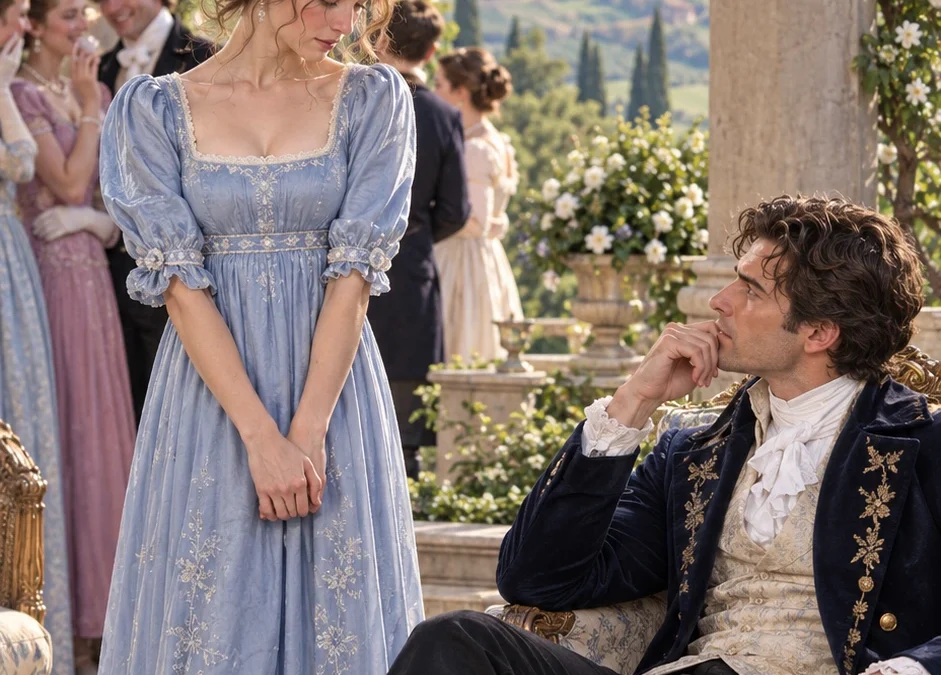
“Send the Plain One, He’ll Reject Her,” They Laughed. But the Duke Could Not Take His Eyes Off Her 😱👑
Part 1
There are women who enter a room and are seen at once. And there are others who enter a room, rearrange the cushions, mend the fire, find the lost spectacles, and leave again, and no one can quite remember whether they were there at all. 🕯️
Hester Larkin was the second kind.
On the October evening this story begins, she sat in the window seat of Marchbank House, hemming her cousin’s petticoat, while her aunt read aloud a letter that would change her life. It was written on heavy cream paper beneath a ducal crest. The Dowager Duchess of Halsingham invited Lady Marchbank to Halsingham Park for three weeks. At the bottom, one more line: Please bring two young ladies of your household, as my son has at long last agreed to look about him for a wife.
Lady Marchbank set the letter down. Her daughter Arabella, nineteen, golden, and told daily that she was lovely, clapped her hands.
“Two young ladies,” said Lady Marchbank. “But we have only Arabella.” Her eyes traveled slowly past the fire and the tea things, and came to rest on the window seat.
“Oh, Mama,” Arabella giggled. “Not Hester.”
“Why not?” Her mother’s smile spread like cream on a cat. “Send the plain one. He’ll reject her in an hour. And beside her, my darling, you will look like the sunrise.”
They laughed. Even Sir Giles by the fire made a small, guilty sound before hiding behind his newspaper.
Hester did not laugh. She was twenty-eight and had been a poor relation in this house for six years. She knew exactly what she was for. She bent her head, went on sewing, and said only, “Yes.”
In three weeks, the whole of Shropshire would be whispering that the proud Duke of Halsingham could not take his eyes off plain Miss Larkin. Only Hester would know the truth. And the truth would nearly break her heart before it mended it. 💔
Hester had not always been invisible. Once, she had been the most important person in the world to exactly one man.
Her grandfather, the Reverend Josiah Larkin, a vicar in the Welsh hills, raised her after a fever took her parents when she was five. He was blind. So Hester became his eyes. Every evening on the bench outside the vicarage, he said, “Tell me what it looks like tonight, Hetti.” But he never let her say the sky is pink.
“Pink is only a word, child. Give me the thing itself.”
So she learned to look properly. The sky is the color of the inside of a seashell, Grandpapa. The swallows are cutting it into pieces. And Mrs. Price has left her washing out, and her husband’s nightshirt is waving at the church as if it wants to confess something.
The old man would laugh until he wiped his eyes. “You look at the world and see everything worth loving. Don’t ever let anyone make you stop.”
He died when she was twenty-two. With no money and a face no one had ever called pretty, she was sent to her aunt. She was not quite a servant, so the servants disliked her. She was not quite family, so the family did not see her. When a young curate once asked her to dance, her aunt called her away for a shawl and said afterward, “Don’t make a fool of yourself, Hester. He was only being kind.”
So she stopped hoping, quietly, the way you let a fire die when there is no one left to keep warm.
The night before they left, Lady Marchbank swept into her attic room. “You’ll wear the brown. You’ll stand beside Arabella whenever the Duke is present. You are there to make up the numbers. Nothing more.”
After she left, Sir Giles crept in, pressing a small book into Hester’s hands. It was her grandfather’s pocket volume of poems, which she thought had been sold long ago.
“Hester,” he mumbled, “I’d not have you think everyone in this house fails to see you.”
She held that little book against her heart. She could not know that her grandfather’s gift was about to become the most precious thing in a great man’s life. 📖
Halsingham Park lay in a Shropshire valley, honey-colored stone among beeches just beginning to turn. Four other families had come, each with a daughter polished to a shine. At the center of the glittering drawing room stood Nathaniel, the fourth Duke of Halsingham: thirty-four, tall, lean, dark hair silvering at the temples, with a face that might have been handsome had he ever smiled.
He had fought in Spain and come home with a fever that nearly killed him. Since then, the county said, he had grown proud. He cut old friends dead in Shrewsbury. He looked straight through ladies who curtsied. He never danced.
“Merely shy,” said Lady Marchbank, steering Arabella forward.
Hester stood one step behind, in brown, unseen. So she did what she always did. She looked properly.
She noticed the Duke never moved quickly through a room. She noticed he never greeted a guest until that guest spoke first. She noticed he held his dinner card all through the soup and never once looked down at it. She noticed the old brown-and-white spaniel at his left knee, who leaned against his leg whenever a chair or step lay ahead. And she noticed that before he reached for his wine, he touched the table with two fingers to find it.
Hester had seen those small movements every day for seventeen years. 👀
She said nothing. Across the table, a fair, smiling gentleman, Mr. Rupert Vere, the Duke’s cousin and heir, was watching the Duke too, with a smile that never reached his eyes.
The next evening, the party gathered on the terrace for the sunset. Hester lingered by the great stone urns. That afternoon the gardeners had moved one to repair the balustrade, and a low flight of steps now yawned open on the lawn.
The Duke came along the terrace alone. His spaniel had been called away. And Hester saw, in one cold instant, that he was walking straight toward the open steps.
She did not shout. Her grandfather had taught her shouting only frightens.
“Three steps down and to your left, Your Grace. The gardeners have moved the urn.”
The Duke stopped dead. His hand found the balustrade. Slowly, he turned his face toward her voice, not quite at her, just a little to the side of her, exactly as her grandfather used to.
“Who is there?”
“Nobody of consequence. Miss Larkin, Lady Marchbank’s niece. The one in brown.”
“How did you know…” she started, startled.
“I overheard your aunt say it on the stairs.” Grim amusement crossed his face. “I have very good hearing, Miss Larkin. It has become necessary.”
“You are the first person in this house,” he said at last, very low, “who has told me where the steps are. Everyone else simply lets me walk.”
“My grandfather was blind for twenty years,” Hester said gently. “One does not forget the signs.”
The proudest man in Shropshire went white. “Miss Larkin, I must beg you to tell no one. Not your aunt. Not my mother. No one.”
She looked at this cold, untouchable duke, gripping stone because he could not see the ground. “I’ll tell no one. But you cannot go down those steps alone. Give me your arm.”
And the Duke of Halsingham, who had not taken anyone’s arm in three years, gave her his.
But from the shadows by the stone urns, a fair, smiling gentleman had seen everything. 😳
👇 What will Rupert do with the secret he just discovered? Comment “PART 2” below or leave any word and I will send it to you privately!
Part 2
But from the shadows by the stone urns, a fair, smiling gentleman had seen everything.
By the end of that first week, every guest at Halsingham Park had noticed the same astonishing thing. The Duke could not take his eyes off Miss Larkin. At dinner, while Arabella sparkled at his right hand, his face kept turning down the table toward the plain cousin in brown. In the drawing room, he crossed the floor to sit beside her while a young lady sang Italian songs directly at him. Every afternoon, to the open horror of four ambitious mothers, he asked Miss Larkin to walk with him in the gardens.
“A whim,” sniffed one mother. “Pity,” hissed Lady Marchbank through her teeth.
It was neither. Had they walked close enough to hear, they would have found two people speaking in low voices that sounded nothing like courtship.
“Tell me what’s in front of us,” the Duke would say.
“The beech avenue, Your Grace. The leaves have turned the color of a fox’s back, and the low sun comes through them sideways, so the path looks laid with copper pennies. At the far end, a gardener’s boy is meant to be cutting back ivy. Instead he is eating an apple and watching a girl from the dairy.”
The Duke laughed, a real laugh, rough and surprised. “Is she watching him back?”
“She is pretending very hard not to. Which means yes.” 🍂
Bit by bit, he told her everything. The Spanish fever had damaged something behind his eyes. He now saw the world through thick frosted glass: shapes, light, a face only at arm’s length. The finest physicians in London agreed that within a year there would be nothing.
“The cuts in the street were never pride,” he said. “I simply did not know they were there.”
“Why not tell people?”
“Because my mother wants me married, and if I die without a son, my cousin Rupert sells the woods for timber before my coffin is cold. But what woman would take a blind man? Either she marries me out of pity, which I could not bear, or she wakes a year later chained to an invalid she never chose, which I could not bear either.”
Hester was quiet. Then she said, “My grandfather told me once that the dark is not empty. It is full of things you never bothered to listen to. Birds, rain, the way a person breathes before they say something true.”
“Was he happy?”
“He laughed every single day.”
The Duke smiled fully for the first time since she had met him. And Hester, who had never once had a man smile at her like that, had to look very hard at the beech leaves for a minute or two. 🤍
But Rupert had begun his work. A chair moved six inches. A glove dropped at his cousin’s feet. A letter handed across the breakfast table: “Do read this, Nat. Terribly amusing.” Hester rescued him lightly, offering to read it herself. Rupert looked at her for the first time, slowly, like a cat at a mouse that has unexpectedly bitten it.
Then, one evening, he made his real move.
“Harvest Sunday next week! Nat will read the lesson, of course. The Dukes of Halsingham have read it in St. Michael’s for two hundred years. The whole county comes to hear.”
Hester’s heart dropped like a stone into a well. The great Bible was old, the print tiny, the church dim even at noon. He would stand before three hundred people and be unable to read a line.
That night she found him in the library, sitting in the dark, Bramble across his feet.
“He knows,” said the Duke quietly.
“It is always the Sixty-fifth Psalm,” said Hester. “I know it by heart. So will you.”
For six nights, after the house slept, she taught a duke the psalm line by line, not the words, but the pictures beneath them. “Thou crownest the year with thy goodness. That is the beech avenue in October, Your Grace. The copper pennies.” And for “The little hills rejoice on every side,” she said, “That is the gardener’s boy and the dairymaid.” He laughed so hard that Bramble woke and barked.
On the fifth night, he recited the whole psalm without a stumble. Then he went very quiet.
“Miss Larkin, would you mind very much if I looked at you?”
Her heart did something strange. She should have said no. Instead, she moved her chair until their knees touched, held the candle beside her face, and let him look.
He looked longer than anyone had ever looked at her in her life, his eyes moving slowly from her brow to her mouth to her chin, as if reading very small print.
“Everyone told me you were plain,” he said softly.
“I am, Your Grace.”
“Then I have misunderstood that word my entire life.”
Suddenly, the library door crashed open. 🚪
💬 Who was standing there, and what did she threaten? Comment “HESTER” or LIKE this post, and once we reach enough comments I will post the final part! 👑❤️
Part 3
Lady Delphine Marchbank stood in the doorway in her nightcap, a candle trembling in her fist, her face white with fury.
“Hester. To your room. Now.”
Out in the corridor, her aunt’s fingers closed on her arm like a trap. “Shameless creature! Alone with him at midnight. Do you think he is in earnest? Look at yourself, girl. He amuses himself with you because you are plain and grateful and there is nothing else to do in the country. Men like that do not marry the shadow. They marry the sun.” She thrust Hester toward the stairs. “One more word to him, and I send you home in disgrace.”
Hester kept away from him the next day. It was the hardest thing she had ever done. She refused the afternoon walk with a headache she did not have. Twice she heard his voice asking a footman where Miss Larkin was. Twice she slipped out of a room before he reached it.
That afternoon, Rupert Vere found her alone in the rose garden.
“A little friendly advice, Miss Larkin. My cousin’s physicians say he will soon need a companion. Someone to lead him about, read his letters, manage his days. And what better choice than a lady from the shelf? No money, nowhere else to go. She would be so grateful. Far cheaper than a nurse, and much more loyal.” He tilted his head. “You did not truly imagine it was anything else?”
His words went into her like splinters. That evening they were driven deeper. Passing the Dowager’s sitting room, she heard her own name.
“If it must be the Larkin girl, Nathaniel, then at least she will be useful to you.”
And the Duke’s voice, low and certain: “Useful? Yes, Mother. She is the most useful.”
Hester did not wait for the rest. She walked to her room, shut the door, and sat on the bed with her hands folded. Useful. Of course. She had always been useful. To her grandfather, to her aunt, and now to a duke who needed eyes. How foolish to believe, for one candlelit moment, that he saw anything more. 💔
But she would not abandon him before Sunday. She would see him through the reading. Then she would go home and never think of Halsingham again. Or try not to.
Harvest Sunday dawned golden and still. St. Michael’s was dressed as only an English country church can be: wheat sheaves tied with red ribbon on every pew, fat marrows and polished apples along the windowsills, a great loaf baked in the shape of a wheatsheaf upon the altar. The air smelled of fresh bread and autumn flowers. Three hundred faces turned as the Duke walked up the aisle on his mother’s arm.
Hester sat three rows back beside her aunt, her nails leaving marks in her palms.
The old vicar climbed into the pulpit, beaming. “As has been our custom for two hundred years, His Grace will read the harvest lesson. Though this year, at the kind suggestion of Mr. Vere, we depart a little from tradition. Instead of the Sixty-fifth Psalm, His Grace will read from the Book of Ruth, chapter one.”
Hester’s blood ran cold. In the front pew, Rupert folded his arms and smiled.
The Duke rose and walked alone to the great brass eagle of the lectern, where the old Bible lay open to a page he had never seen, in tiny faded print, in dim October light. He placed both hands upon the book.
Ten seconds. Twenty. Somewhere at the back, a child dropped an apple, and it rolled all the way down the stone aisle, and nobody moved to stop it. 🍎
Hester watched his shoulders, and she knew, as she had always known with her grandfather, the exact moment he decided.
“I will not pretend,” said the Duke of Halsingham, not loudly, but every soul in the church heard, “to read what I cannot see.”
A ripple ran through the pews.
“You have trusted this family for two hundred years, and I will not repay that trust with a lie. I came home from Spain with a fever that has been taking my sight a little at a time. Within a year, I am told, it will be gone altogether.” He paused. “I am sorry for the men I passed in the street without a word. I am sorry for the ladies whose curtsies I never returned. It was not pride. I simply did not see you.”
In the front pew, the Dowager sat bolt upright, tears running silently down her powdered face. Three rows back, Lady Marchbank whispered sharply, “Arabella, we leave first thing in the morning.” Half the church heard. A farmer’s wife turned and gave her a look that could have curdled milk.
The Duke heard it too. Something almost like a smile touched his mouth.
“But the harvest lesson must be read. And there is someone here who has been my eyes these three weeks. She asked nothing for it. She has had nothing for it, I am afraid, but a good deal of unkindness.” He turned his face down the aisle, not quite toward her, just a little to the side. “Miss Larkin, would you read it for me?”
Three hundred heads turned. Hester stood. Her aunt’s hand shot out to grip her sleeve, and Hester, for the first time in six years, gently took it off. 🌾
She walked the long aisle past the sheaves and the marrows and the staring faces, and every step felt like a mile. At the lectern, the Duke stepped aside but did not return to his pew. He stood at her shoulder, close enough that she heard him breathe.
She read of Naomi, widowed in a strange country. Of Orpah, who kissed her mother-in-law and went home. And of Ruth, the foreigner, the one with nothing, who would not leave.
Then she reached the verse she had known since girlhood, and her voice began to shake.
“Entreat me not to leave thee, or to return from following after thee: for whither thou goest, I will go; and where thou lodgest, I will lodge: thy people shall be my people, and thy God my God.”
She could not go on. Standing there with his shoulder nearly touching hers, she understood that every word was true. She did not want to be useful to him. She did not want to be his eyes. She simply wanted to go wherever he went for the rest of her life, in the light and in the dark.
And she would tell no one. Ever.
“Thank you, Miss Larkin,” he said quietly. Then he turned to the congregation, his voice dry as autumn leaves. “I must thank my cousin Rupert for his choice of reading. He chose better than he knew.”
And the old vicar, growing pinker and pinker in his pulpit, burst out: “Mr. Vere asked me most particularly not to tell His Grace of the change! He said it was to be a happy surprise!”
Every face in the church turned toward Rupert, and every soul understood exactly what kind of surprise he had intended. Rupert went scarlet, then white. He rose and walked out alone, and the great oak door boomed shut behind him. By morning he had left the county. The Dowager had told him he would never dine at Halsingham again. 🚪
Hester did not see him go. When the last hymn ended, she slipped out the side door and hurried up the lane toward the beech avenue. Her aunt’s carriage left in the morning. She would go home. It was the only sensible thing.
She had almost reached the end of the copper avenue when she heard a joyful bark. Bramble came bounding up the path, ears flying. Behind him, walking fast and steady with one hand on the dog’s back, came the Duke of Halsingham.
“You heard the word useful,” he said, “and you ran. You did not stay for the rest of the sentence.”
Hester stood among falling leaves, unable to speak.
“Shall I tell you what I said to my mother?” He came close enough to see her face. “I said, She is the most useful thing in my life, Mother. Useful the way the sun is useful. She makes everything else worth looking at.”
“You need not say that,” Hester whispered. “I know what you need. Someone to read to you. Someone to tell you where the steps are. I do it gladly. But I will not be married for my eyes, Your Grace. I have been useful all my life. I cannot bear to be only useful to you.”
“Hester.” It was the first time he had said her name. “If I wanted eyes, I could hire a secretary for sixty pounds a year. He would read my letters perfectly well. He would never once make me laugh about a dairymaid.”
She made a sound halfway between a laugh and a sob.
“Everyone in this county says I cannot take my eyes off you. They are quite right. Shall I tell you why? I have perhaps a year left of seeing faces. One year. And I have spent every day of these three weeks looking at yours, in the library, at dinner, in candlelight. I am learning it by heart. The way you taught me the psalm, not the words, but the pictures beneath. So that when the dark comes, your face will be the last thing I lose, and the one thing I keep.” 💛
Tears ran down Hester’s cheeks, and she did not try to stop them.
“I am not asking you to be my eyes. I am asking you to be my wife. Because the dark is not empty. A very wise old vicar told you so, and I would rather not find out what is in it without you.”
He held out his hand, not quite toward her, just a little to the side. Hester took it and pressed it gently against her own wet cheek, so he would know exactly where she was.
“Whither thou goest,” she whispered.
And Bramble, who had been sitting patiently on the path all this while, barked once, as if to say it was about time. 🐕
Lady Marchbank left Halsingham Park at seven the next morning, exactly as she had threatened. She told all of Shrewsbury she had rescued her darling girl from a dreadful fate and that her scheming niece had trapped a blind man. But half of Shropshire had sat in St. Michael’s that Sunday and heard her whisper. From then on, wherever she went, she was known as the woman who walked out on a blind man in the middle of Harvest Sunday. The invitations grew fewer, and then they stopped.
Arabella did marry in the end, a very rich, very dull gentleman who found his mother-in-law so tiresome he would not have her in the house.
Hester and Nathaniel married at Christmas in St. Michael’s, with holly on the pews and snow on the churchyard yews. Sir Giles gave the bride away and wept openly through the whole service. He stayed a fortnight afterward and said it was the happiest he had been in twenty years. He never quite went back to living the way he had before.
The Duke’s sight faded, as the physicians had said, the following autumn. But he laughed every day, mostly at his wife. And every evening for the rest of their long lives, the Duke and Duchess of Halsingham sat on the bench at the end of the stone terrace, Bramble at their feet, and later Bramble’s grandchildren, and later still their own.
And every evening he would take her hand and say, “Tell me what it looks like tonight, Hetti.”
And she would tell him.
They had sent the plain one, certain he would reject her. Instead, he looked at her until the last light left his eyes. And long after it was gone, he used to say he could still see her perfectly. 🌅
If Hester and Nathaniel’s story warmed your heart, please LIKE and SHARE it with someone who needs a little kindness today. 💬 Tell me in the comments: which moment touched you most? The terrace steps, the candlelight in the library, or the reading in the church? And if this story moved you, just type three words: “Whither thou goest.” I will know exactly what you mean.
Disclaimer: This story is entirely fictional and created for entertainment purposes only. It does not represent any organization or individual, nor does it encourage inappropriate behavior. The content was generated with AI assistance.








