SHE BOUGHT A RUINED KITCHEN FOR $12 — THEN FOUND SOMETHING BENEATH THE FLOOR THAT UNCOVERED A 20-YEAR FAMILY SECRET & BROUGHT DOWN A TOWN’S MOST POWERFUL MAN
Part 1
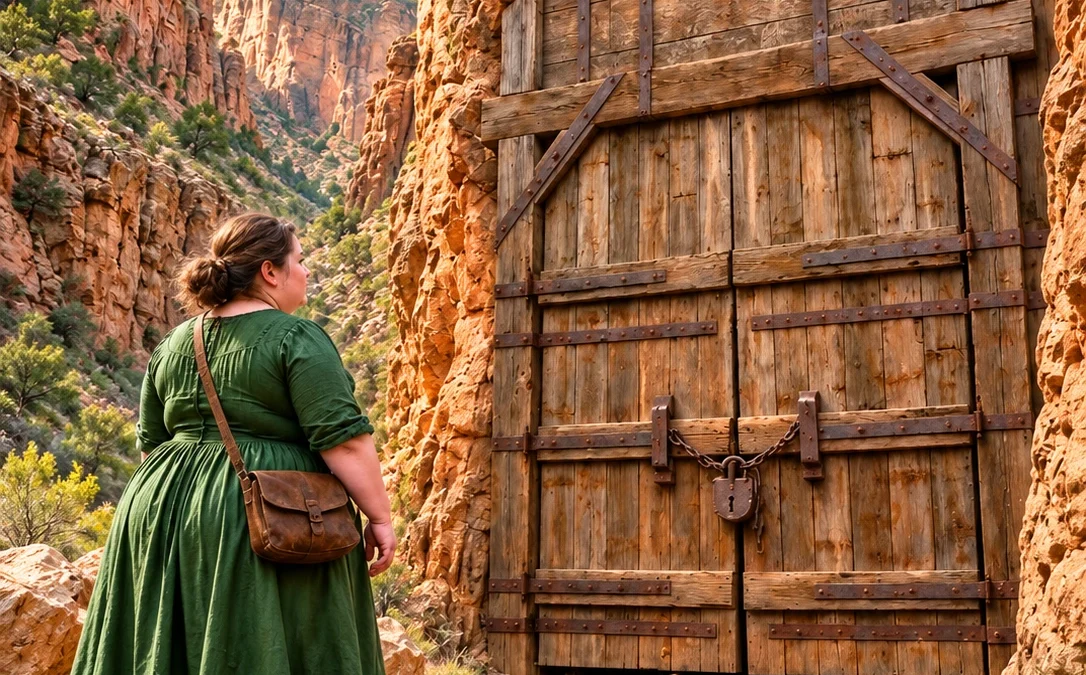
Eleanor Whitaker stood in the cold Montana rain, clutching a crumpled deed in one hand and a worn canvas bag in the other.
It was all she had left: twelve dollars, a mother’s recipe book, and a stone building everyone else called worthless.
Her uncle had told her she was a burden her whole life — and now, with nowhere else to go, she’d spent nearly every cent she owned on what was supposed to be nothing more than a leaky roof and broken walls.
The auctioneer had laughed when she raised her hand.
The neighbors had turned away.
Even the seller had looked confused, as if he couldn’t believe someone would actually pay for the place.
But Eleanor saw something no one else did.
She saw walls that had stood strong through blizzards, a foundation carved solid from native stone, and a cast-iron range that still waited, silent and steady, to be used again.
This wasn’t just a kitchen.
It was a fresh start.
A place where she could finally stop feeling small, stop apologizing for taking up space.
She set to work at once.
She patched holes, scrubbed decades of grime from the floorboards, and lit a fire in the range that hadn’t burned in years.
The first time she baked bread, the scent drifted all the way to the main road — and drew the attention of Caleb Thornton, the quiet, hardworking rancher whose land bordered hers.
He’d watched her from a distance, curious but respectful, until one afternoon he stepped onto her porch.
“I don’t want to intrude,” he’d said, his voice low and steady, “but I’ve seen folks come and go from that place.
None of them stayed this long.
You’re doing good work.
”
Eleanor had learned to be wary of kindness that came with strings attached — but there was no hidden motive in his gaze.
He told her about Victor Holston, the richest man in Dust Hollow, who seemed to control everything from the bank to the sheriff.
Holston held the mortgage on Caleb’s family land, and the deadline was approaching fast.
If Caleb couldn’t pay, Holston would take everything — the house, the fields, the cattle, all of it.
“Holston doesn’t just want the land,” Caleb said quietly.
“He’s been waiting years for a chance to get his hands on this whole ridge.
I don’t know exactly why — but I know it’s not for farming.
”
Days later, Eleanor knelt to fix a loose floorstone near the back wall.
It shifted more easily than she expected.
Beneath it, she found a hollow space — and tucked inside, wrapped in oilcloth to keep it safe from time and damp, were survey notes, old maps, and a handwritten manifest dating back to 1874.
They described a Northern Pacific Railroad supply car that had vanished somewhere on this very ridge, carrying not just tools and provisions, but official contracts and land grants worth a fortune.
That evening, she and Caleb climbed the ridge together.
Hidden among the pines, half-buried by fallen branches and forgotten by time, sat the car.
Its door had already been pried open.
One crate stood empty.
“Someone’s been here,” Eleanor whispered, her heart hammering.
“And not just recently.
”
Caleb’s face hardened.
“Holston,” he said.
“He’s been corresponding with the railroad.
He knew this was here.
He’s been dragging out my mortgage payments, giving himself time to search — and when I couldn’t pay, he’d foreclose and claim everything as his own.
”
They opened the remaining crates together.
Inside were precision instruments, preserved supplies, and six heavy ledgers bound in cloth — records proving the land grants Holston claimed were never legally completed.
The contracts had never been fulfilled.
The railroad had never signed them off.
Which meant Victor Holston’s hold on this entire territory was built on nothing but lies — and the Thornton land, the grain store, even Eleanor’s kitchen, all of it might never have been his to threaten.
But before they could act, Eleanor made a terrifying discovery: one crate was listed on the manifest as holding two cases of railroad payroll — cash meant for survey crews, lost and never recovered.
And the first empty crate they’d found? It matched the description perfectly.
Holston already had part of it.
And he would realize the rest was missing any moment.
“We need to get these to a lawyer,” Eleanor said, her voice trembling but firm.
“Now.
”
They rode hard for Billings through the freezing night.
When they laid the evidence before attorney H.
M.
Garrett, his expression shifted from curiosity to shock.
The records they held were the missing link federal investigators had been searching for years — proof that the land commissioner’s son had falsified grants, hidden the truth, and profited from a secret buried deep in the woods.
But before Garrett could file the official papers, a rider burst into his office with news that turned their blood cold: Holston had found the storage building in Eleanor’s absence.
He’d set it on fire.
Not by accident — deliberately, starting right where the hidden compartment lay.
He was destroying the evidence before their eyes.
Part 2
The rider didn’t wait to be asked twice.
“He came at night,” Pete said breathlessly, his horse lathered and winded.
“Flames took the storage building fast.
We managed to pull out what we could — your bag, the recipe book — but the floor… it’s gone.
Burned right down to the earth.
”
Eleanor gripped the edge of Garrett’s desk until her knuckles turned white.
If the physical site was destroyed, if there was no proof of where the documents had been found, everything they’d built could unravel.
Holston would claim the ledgers were stolen.
He’d say they’d planted evidence.
He’d bury the truth in legal delays until the mortgage deadline passed and Caleb lost his land forever.
“Not everything is gone,” she said suddenly.
“We filed the petition.
We have our statements.
We have witnesses.
”
Garrett nodded slowly.
“True — but Holston’s already filed a counter-claim through his attorney in Helena.
He says the ledgers were taken from property he controls.
He’s muddying the waters, and in territorial court, confusion buys time — time he doesn’t deserve.
”
Then came the next blow: Holston hadn’t just burned the building.
He’d sent men up the ridge that very night, to clear out the supply car completely.
Rope, one of Caleb’s hands, had watched from the trees — and he’d seen who led them: Frank Clearary, one of the wealthiest cattlemen in the county, and a man who had stood beside Holston at the auction where Eleanor bought her kitchen.
Clearary was no mere hired hand.
He was deep in this — whatever “this” was.
“He took two crates,” Rope reported quietly.
“And he didn’t look happy about it.
Said something about ‘making sure it’s all gone.
’ Looked over his shoulder the whole time, like he was afraid someone was watching.
”
Eleanor spread the manifest across the table, her eyes scanning line by line until they landed on the entry that made the room go quiet: Currency — two cases — NP Treasury — payroll — 1874.
“Holston only has one,” she breathed.
“The first crate was empty, but there were supposed to be two.
The other one… it’s still there.
”
They rode back to the ridge under cover of darkness, no lantern, no sound, just starlight and the knowledge that every moment counted.
When they slipped inside the car, Caleb knelt beneath a fallen beam and reached into a shadowed gap Eleanor hadn’t seen on their first visit.
His hand closed around something heavy — a plain wooden chest, bound with iron, its rope handle half-rotted but still holding strong.
Together they pulled it out.
It was heavier than anything either of them had lifted in years.
“Sixty thousand dollars,” Eleanor whispered, her voice barely audible.
“That’s what this was worth then — and it was never claimed.
Never found.
”
Footsteps crunched on the gravel outside.
A lantern flared bright.
“Someone’s coming,” Pete hissed from the doorway.
They froze.
Through the open door, they saw Frank Clearary step into the light — alone this time, but carrying a shovel and looking desperate.
He didn’t see them yet.
He scanned the empty crates, checked the far corner, and then his gaze fell on the space where the chest had been.
“It’s gone,” he said, his voice tight with panic.
“It’s actually gone.
”
He turned back toward the ridge, raising his voice as if speaking to someone waiting out of sight in the trees.
“They beat us here! Holston’s going to know — and he’ll burn this whole mountain down before he lets anyone else have it!”
Part 3
Eleanor held her breath.
Beside her, Caleb stood perfectly still, his hand resting lightly on the chest, ready to lift it back into hiding if needed.
Clearary stood motionless in the doorway, lantern swinging gently at his side, and for a moment Eleanor thought he might step inside and see them.
Instead, he turned and vanished into the dark, riding hard down the western slope.
They waited until the sound of hooves faded completely before moving.
“We can’t leave it here,” Caleb said quietly.
“If Holston comes back with more men —”
“He will,” Eleanor finished.
“We take it.
Tonight.
”
They carried the chest between them, heavy and awkward, passing it down to Pete, who had the horses waiting in the shelter of the pines.
They rode not toward the farmhouse, but toward Billings — slowly, carefully, pausing often to listen, keeping to the shadowed places where the road was rough and slow but safe from prying eyes.
By the time they reached Garrett’s office, dawn was streaking the sky pale gray.
The lawyer stared at the chest as they set it on his desk, then at Eleanor, then at Caleb.
“You realize what this means,” he said, his voice serious.
“Possession of this changes everything — and draws a target on every one of your backs.
”
“We know,” Eleanor said.
“But leaving it there would have been worse.
”
Before Garrett could reply, a knock sounded at the door.
He opened it to find not a messenger, but Thomas Aldrich — Federal Land Surveyor, arrived from Helena sooner than anyone had hoped.
He listened without interruption as they told their story, asking only quiet, precise questions, and when they finished, he leaned forward across the desk.
“The fire at the railroad office in 1879,” he said, “was no accident.
We’ve known that for years.
Someone destroyed the official records so the falsified grants couldn’t be traced back to them.
What you’ve brought us is the only proof that survives.
”
He turned to Eleanor.
“And that chest? It doesn’t just secure Caleb’s land.
It ties Victor Holston directly to what his father began — hiding evidence, concealing assets, building an empire on land that never legally belonged to his family.
”
But Holston didn’t wait quietly.
That same morning, he served notice — Eleanor’s kitchen property was being claimed as part of the railroad’s abandoned assets, and her deed was “defective.
” He arrived with the sheriff and two men, standing on her porch with that same calm, reasonable smile that had fooled so many people.
“Step aside, Miss Whitaker,” he said.
“This isn’t yours to keep.
”
Sheriff Barker shifted uncomfortably.
“Victor, the federal office —”
“Has no jurisdiction here,” Holston cut in.
“This is local property matter.
”
Then Eleanor stepped forward.
She didn’t shout.
She didn’t argue.
She simply handed Barker a paper — the signed, witnessed inventory they’d drawn up in the dark hours, and beneath it, Aldrich’s telegram confirming federal involvement.
“Seizing this property now,” she said clearly, “would be interfering with an active federal investigation.
And I think the U.
S.
Attorney would be very interested to know who tried to stop us from recovering evidence of fraud.
”
Holston’s smile faltered.
For the first time, Eleanor saw what lay beneath it — not confidence, but fear.
Frank Clearary was the one who broke first.
That afternoon, he walked into the sheriff’s office with a stack of letters and account books tucked under his arm — years of records showing payments, secret agreements, and instructions to hide, move, and destroy whatever Holston ordered.
He testified that Holston had planned to burn the entire ridge, not just the storage building, and had waited years for the chance to foreclose and claim everything in plain sight.
Within days, the news spread fast.
The federal injunction blocked the foreclosure.
The land grants were officially under review.
And Victor Holston was arrested — not just for fraud, but for conspiracy, arson, and attempting to obstruct justice.
He walked out of the bank that morning buttoned and composed, but everyone in Dust Hollow saw it: the performance was finally over.
Life didn’t change overnight.
There were hearings, paperwork, delays, and days when Eleanor wondered if it would ever truly be settled.
But slowly, steadily, the truth took hold.
Caleb’s land was his — clear, free, and protected.
Eleanor rebuilt the storage building, stronger and brighter than before, and the kitchen became the heart of the community — a place where hands ate well, travelers found warmth, and no one was turned away for lack of coin.
One evening in late spring, Caleb sat across from her at the counter, watching her write in the recipe book that had traveled through everything with her.
“I told you I’d ask something when it was all done,” he said quietly.
Eleanor set down her pen.
“I remember.
”
He reached across and took her hand, his calloused fingers closing gently around hers.
“I don’t have fancy words.
But I know what I want.
I don’t want to eat anywhere else.
I don’t want to build anything else.
I don’t want to walk through a single more winter without you beside me.
Will you marry me, Eleanor?”
She looked at him — really looked — at the man who had stood beside her when she had nothing, who had never once made her feel small or burdensome or less than.
“Yes,” she said softly.
“I will.
”
They were married in March, when the ground was still hard but the sun was beginning to stay longer in the sky.
The church was full — ranch hands, townsfolk, federal deputies, the surveyor, even Sheriff Barker.
At the back sat her uncle Gerald, quiet and awkward, who nodded at her when she walked down the aisle.
She nodded back.
Some things don’t need to be fixed to be forgiven.
Years later, a young girl came to the kitchen door — thin, quiet, and carrying the weight of too many unkind words.
Eleanor looked at her and saw herself, standing in the rain with twelve dollars and a dream.
“Can you work?” she asked.
“Can you learn? Can you show up?”
The girl lifted her chin.
“I can try.
”
“Then come in,” Eleanor said.
“That’s all any of us can do.
”
She opened the recipe book to page 112 — Railroad Chili — and smiled.
Some stories don’t just survive.
They get passed along, shared, and made better with every hand that holds them.
This story is entirely fictional and created for entertainment purposes only.
It does not represent any organization or individual, nor does it encourage inappropriate behavior.
The content was generated with AI assistance.








