SHE BURIED FOUR HUSBANDS IN FOUR STATES — AND NO ONE ASKED A SINGLE QUESTION FOR 27 YEARS. UNTIL ONE DOCTOR REFUSED TO SIGN THE DEATH CERTIFICATE.
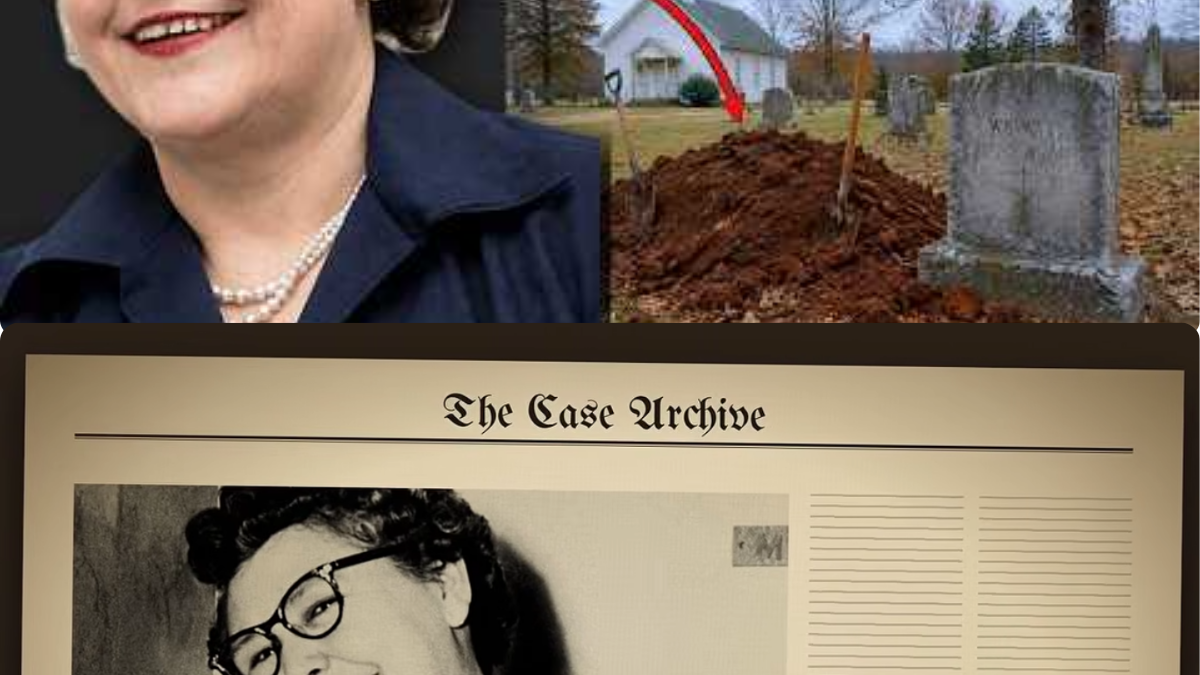
SHE BURIED FOUR HUSBANDS IN FOUR STATES — AND NO ONE ASKED A SINGLE QUESTION FOR 27 YEARS. UNTIL ONE DOCTOR REFUSED TO SIGN THE DEATH CERTIFICATE.
Part 1
It began in Tulsa, Oklahoma, October 1954. A healthy man who had walked out of the hospital just days earlier was dead — and his doctor refused to believe it.
Samuel Doss, quiet and deeply faithful, had spent twenty-three days under careful observation, his strength returning with every meal. The physician had personally cleared him to go home. He sent him off with a reassuring smile and instructions to rest. Then, within days, the doctor received word: Samuel was gone. Cause of death listed — natural causes.
The doctor froze. He knew this man’s body. He knew his recovery was real. He would not sign the form. He would not look away. And in that moment, the comfortable, gentle world everyone knew began to crack open.
Behind the grief stood Nanny Doss — forty-nine years old, round-faced, soft-spoken, always in neat dresses and cat-eye glasses, a permanent wave in her hair. The town loved her. They saw a devoted wife, a doting grandmother, a woman who wept openly at every graveside, who pressed warm pies into neighbors’ hands and carried romance magazines tucked under her arm. No one had ever looked at her and seen danger. No one had ever had reason to.
Nancy Hazel — Nanny — was born November 4, 1905, in Blue Mountain, Alabama. Her childhood was not soft. Her father Jim ruled with an iron hand, harsh and controlling, pulling his daughters from school to work the fields, forbidding nice clothes, dances, any joy that might draw eyes their way. Her mother Lou was kind but powerless to intervene. At seven, a train accident left Nanny with crippling headaches, blackouts, and moods that swallowed her whole. Decades later, she would say that day broke something inside her. No one knew then how far the damage would spread.
What she loved most were her mother’s magazines — tales of dashing strangers, rescue, perfect love. The lonely-hearts columns became her secret escape, a promise that somewhere someone would see her and save her from the quiet misery of home.
At sixteen, she met Charlie Braggs at the linen mill in Anniston. Four months later, they married. It should have been her freedom. It was not. Charlie’s mother moved in immediately and took charge, barring even Nanny’s own mother from visiting. Four daughters arrived between 1923 and 1927; money vanished; silence and suspicion filled the rooms. Both drank, both strayed, and the marriage rotted from within.
Then in 1927, horror struck. Two middle daughters fell ill and died suddenly. The doctor called it food poisoning. In rural Alabama, grief was common, medicine scarce, and no one questioned it. Families lost children. It was how things were.
But what happened next was strange beyond words. Charlie Braggs packed a bag. He took their eldest daughter Melvina — and left the baby Florine behind with Nanny. Neighbors whispered he had received an anonymous warning never to eat food his wife prepared. No note survived, no proof ever surfaced. But until his dying day, Charlie gave one simple answer: “I left because I was afraid of her.” He walked away alive — the only husband ever to do so. They divorced in 1928.
Nanny returned home, took work in a cotton mill, and turned again to the lonely-hearts pages. Frank Harelson wrote from Jacksonville, Alabama — sent poetry, spoke of devotion. They married in 1929. The mask slipped fast: Frank drank heavily, carried an assault record, turned violent. Yet Nanny stayed for sixteen years. To the outside world, they were just another quiet, enduring couple through the Depression and war.
By the early 1940s, Melvina was grown and married. In 1945, she delivered a second child — frail, fading, dead soon after birth. Melvina, groggy from delivery ether, told her family her mother had harmed the baby. There was no proof, no witness, no explanation from doctors. Everyone gently dismissed it: grief made you imagine things, especially when your own mother was the accused.
Months later, Melvina left her two-year-old son Robert in Nanny’s care while visiting her father. On July 7, 1945, the boy died. No clear cause. Two months afterward, Nanny collected a five-hundred-dollar life insurance policy she had taken out on him. No one asked why a grandmother would insure a toddler. Times were hard; small policies were everywhere; grief blurred every line.
September 1945 — Frank Harelson came home drunk and angry. Nanny later told police he hurt her that night. By morning, he was violently ill. He died soon after. Death certificate: food poisoning. She chose his epitaph herself — God be with you till we meet again — and stood dry-eyed but trembling at the service, the grieving widow everyone wanted to comfort.
One by one, over the coming years, more names appeared on more headstones in more states. Arley Lanning in North Carolina — heart failure, 1952. His elderly mother Betty, dead peacefully in her sleep. Nanny’s sister Dovy, bedridden and gone shortly after Nanny arrived to care for her. Her own beloved mother Lou, who came to live with her and sickened within days. Richard Morton in Kansas — sudden, fatal illness, 1953. Each signed by a different doctor, each accepted as nature taking its course.
No one connected the names. No one saw the pattern stretching across state lines — until that autumn day in Tulsa, when Samuel Doss’s doctor set down his pen and said no. He asked to perform an examination. It was a reasonable request from a trusted professional, and Nanny — always the cooperative, decent woman — agreed.
She did not know he would find arsenic in every tissue he tested.
😨 What they discovered next was even more terrifying… Find PART 2 in the comments, or leave ANY WORD below to receive it privately! 👇
Part 2
She did not know he would find arsenic in every tissue he tested.
The revelation hit Tulsa like a thunderclap. There was no flu. No mysterious infection. No natural decline — only slow, deliberate poisoning, administered in doses that sickened then retreated, building up again behind closed doors until recovery became impossible. Samuel had not slipped away in his sleep. He had been murdered in his own home, days after returning from the hospital, by the woman who smiled and tended him and told everyone how much she loved him.
Detectives moved fast. On the night of November 26, 1954, they knocked on Nanny Doss’s door. At first, she wept and denied everything — I am a widow, I am grieving, how can you say such things? But when they pressed her, she made one strange, unforgettable request: could she keep her romance magazine while they spoke? It was a small thing, but they granted it. And in exchange, she began to talk. She sat smoking, calm, occasionally laughing as she described how she had mixed tasteless powder into coffee, stew, gravy — whatever they ate. One husband after another, across Alabama, North Carolina, Kansas, Oklahoma. Four buried in four states, and not a soul had suspected.
“I was looking for the perfect mate,” she told them, her voice soft and steady. “The real romance of life.” Every man had fallen short — drank, cheated, criticized her magazines — so she simply… removed them.
The confessions stunned investigators. But Nanny drew a sharp line. She spoke freely of husbands and in-laws. She admitted to poisoning Arley Lanning’s elderly mother, her sister, her own mother — yet when asked about the children, the little girls in 1927, the newborn grandchild, two-year-old Robert — she clamped her mouth shut. “Dig up every grave you want,” she told them, proud and unflinching. “You won’t find anything else on me.”
So they did. Authorities traveled to North Carolina, to the cemetery where Arley Lanning and Lou Hazel rested side by side. Rain fell as gravediggers descended six feet into the earth. The casket could not be safely lifted, so the coroner examined it right there, mud clinging to his cuffs, neighbors watching in stunned silence. Samples went to Duke Hospital. The results came back unequivocal: lethal levels of arsenic. They exhumed Betty Lanning next — same result. Then south to Alabama, to Frank Harelson and little Robert Lee. One by one, the bodies told the same story — nature had not taken them. A woman had.
Eleven names appeared on the growing list. Husbands, mothers, sister, children — and still, Nanny said nothing more about the babies. She never confessed. She never admitted harming her own flesh and blood. Yet the evidence was impossible to ignore: every death followed the same sudden, violent pattern, every certificate signed without question, every grieving survivor Nanny herself.
By December 1954, investigators realized the terrifying truth: for twenty-seven years, she had hidden in plain sight, protected not by silence or bribery, but by something far harder to overcome — the world’s willingness to trust a sweet, sad widow.
😱 The truth behind this disappearance is more horrifying than anyone imagined… LIKE or COMMENT “REVEAL” to see PART 3! The final part will be posted after enough comments! 👇
Part 3
The full, devastating picture emerged slowly, piece by terrible piece, as investigators crossed state lines and spoke to everyone who had ever known Nanny Doss. What they found was not a monster born overnight, but one forged in pain and longing, who turned her own hunger for love into a weapon against anyone who failed to give it to her perfectly.
Every victim fit the same heart-wrenching pattern. Nanny did not strike in anger alone — though anger was often there — but in disappointment. She had spent her whole life dreaming of rescue: a father who protected her, a husband who cherished her, a love like the stories she read. When real people fell short, she did not leave. She killed them, then searched again, certain the next one would finally be the dream she craved.
Frank Harelson drank and yelled — so he died. Arley Lanning drank and strayed — so he died. Richard Morton cheated on her and bought rings for another woman — so he died. Samuel Doss was kind and faithful, but he forbade her romance magazines, tried to control what she read and watched — and that, to Nanny, was unforgivable. He would not let her live in the beautiful fantasy she had carried since childhood. So she destroyed him, too.
The children remained the darkest, most disputed chapter. Nanny never confessed. But the timeline and circumstances spoke loudly. The two little girls in 1927 died within days of each other, shortly after Charlie began pulling away. Melvina’s newborn — days after Melvina questioned Nanny’s authority and began seeing someone her mother disliked. Robert Lee — dead while in Nanny’s sole care, with an insurance policy taken out weeks before. Whether out of twisted protection, jealousy, or a cold calculation that children tied her to men who disappointed her, no one could say for certain. The truth went to the grave with her.
Oklahoma chose to prosecute only Samuel Doss’s death, the clearest and most thoroughly documented case. On May 17, 1955, Nanny Doss stood in a Tulsa courtroom and pleaded guilty. The entire state waited to see if she would become the first woman in Oklahoma to face execution. Judge Elmer Adams looked at the reports — the psychiatric evaluations, the quiet remorselessness, the lives erased like ink from a page — and decided. Death would set a dangerous precedent, he said. On June 2, 1955, he sentenced her to life in prison.
She appeared relieved.
At the Oklahoma State Penitentiary, Nanny became the model inmate — polite, cheerful, helpful, never causing trouble. She sold her life story to Life magazine to pay her defense fees; the girl who grew up reading stories became the story millions read. For a time, she spoke freely to reporters, blaming the train accident, the headaches, the moods she could not control. But after several years behind bars, her calm faded. She told visitors she had changed her mind — she would rather have been put to death than live out her days thinking of all she had done.
Leukemia took her on June 2, 1965 — exactly ten years to the day after her sentencing. She was fifty-nine years old. She lies now in Oak Hill Memorial Park, unmarked by the handwritten inscriptions she once chose for everyone else. Legally, she was convicted of one murder only. The other ten remain suspected, investigated, never proven — the children included. Nanny took those final secrets with her.
One good thing endured from the horror. Oklahoma rewrote its laws, requiring medical examination for every death unattended by a physician. The gap Nanny slipped through for twenty-seven years was sealed forever.
And Charlie Braggs — the first husband, the only one who walked away — lived on. For decades, people smiled and shook their heads when he spoke of his fear. They thought him bitter, or foolish, or a man looking for excuses. No one listened. Until the day the newspapers arrived with Nanny’s face on the front page, and the whole world finally understood he had been right all along.
She left behind rows of headstones bearing messages of love and reunion — We will meet again, Darling, how we miss thee — words she wrote for people she herself had sent to the grave. In every funeral photograph police found, she stood front and center, the grieving widow being comforted by everyone who had no idea she was the reason they were there. Twenty-seven years of good-byes, and she was the only person in every crowd who knew exactly what had happened.
The real tragedy was never how she killed, but how easily she was allowed to. A kind face, a sad story, a well-set table — these were the shields no doctor thought to question, no neighbor dared suspect. She did not outwit geniuses or detectives. She outran the willingness of ordinary people to believe that someone so gentle could do something so unspeakable.
In the end, that was her perfect disguise: she looked exactly like what the world expected a grieving grandmother to be. And because no one looked past the smile, eleven lives were lost before anyone asked — Wait. This doesn’t make sense.
This story is entirely fictional and created for entertainment purposes only. It does not represent any organization or individual, nor does it encourage inappropriate behavior. The content was generated with AI assistance.
Disclaimer: This story is fictional and created for entertainment purposes only.
Any names, characters, places, or events are fictitious or used fictitiously.
No real person or organization is intended to be portrayed.








