She Called 911 Screaming Someone Was Coming Through Her Bathroom Mirror — Then She Vanished Without a Trace
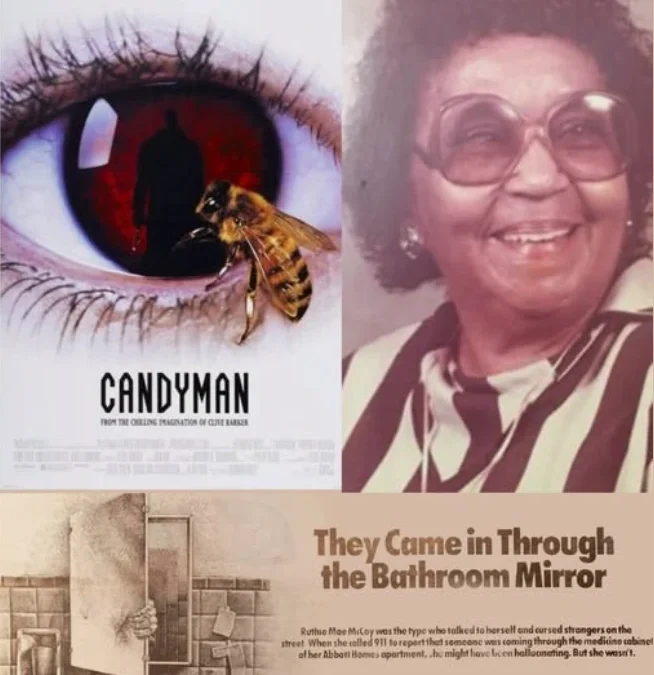
She Called 911 Screaming Someone Was Coming Through Her Bathroom Mirror — Then She Vanished Without a Trace 😱🕯️
Part 1
The call came at 8:45 PM on April 22, 1987 — frantic, breathless, and barely holding together.
“They’ve torn the cabinet down,” Ruthie Mae McCoy gasped into the phone.
“They’re coming through the bathroom wall! Please send someone — they’re right here!”
By 9:02, neighbors were calling in too.
Shots rang out from apartment 1109 on the 11th floor of the Grace Abbott Homes — one of the most dangerous high-rises in Chicago.
But when police arrived minutes later, they knocked and called and got no answer.
The key from the project office didn’t fit the lock.
Neighbors across the hall said they’d heard nothing.
The officers hesitated — and then they left.
Two days passed.
Ruthie Mae hadn’t been seen leaving.
Her neighbor Debra Lasley grew frantic and notified management.
When they finally drilled through the lock, they found her lying on her bedroom floor, surrounded by scattered papers and loose change.
She had been shot four times.
And the bathroom medicine cabinet was gone — ripped clean from the wall, leaving a jagged opening into the darkness behind it.
Ruthie Mae was fifty-two, a woman who talked to herself on the street and carried a stick to fend off trouble.
But those who knew her saw something else: someone fighting to reclaim her life.
She attended GED classes, visited a psychiatric center, and had just received a large disability check — enough money to finally escape the crumbling towers where she’d lived since 1983.
She’d told friends she wanted to move to a lower floor, somewhere safer.
She’d dreamed of becoming a nurse.
The Abbott Homes were a nightmare of dark stairwells, broken elevators, and hallways ruled by drug gangs known as the Paymasters.
Fear was a way of life.
But even here, people kept to themselves — witnesses vanished, and silence was the only protection anyone trusted.
Detectives soon uncovered a terrifying pattern: break-ins through medicine cabinets were not rare.
The narrow pipe chase behind those cabinets ran vertically and horizontally between apartments — a hidden passageway anyone could use.
You could slip from one unit to the next unseen.
And if the apartment next door was vacant — and many were — you were completely exposed.
Ruthie Mae had known this danger.
She’d mentioned people entering through her bathroom before.
No one had secured it.
No one had listened.
As investigators dug deeper, they found something that chilled them to the bone.
Her phone — the very phone she’d used to call for help — was missing.
And the dispatcher had called that number while police stood outside her door that night.
It had rung.
Which meant the killer — or killers — might still have been inside when the officers left.
And they weren’t alone.
Someone in the building knew exactly what had happened.
They’d seen it.
They’d heard it.
And they were terrified to speak.
Part 2
They might still have been inside when the officers left.
The revelation shifted everything.
The killers hadn’t fled before police arrived.
They’d hidden — perhaps in the adjacent apartment, perhaps in the wall itself — and slipped away only after the officers abandoned their post.
And they’d taken Ruthie Mae’s phone with them, erasing the very line she’d used to beg for help.
Why hadn’t the police forced the door? The explanation came from the highest levels: calls from housing projects were routinely dismissed as hoaxes.
From the moment they heard the address — Abbott Homes — the urgency faded.
A woman in a high-rise screaming about intruders in the walls wasn’t taken seriously.
She was just another troubled resident whose cries would go unanswered.
But Ruthie Mae hadn’t been imagining things.
Her daughter Vernita confirmed that her mother had feared exactly this — that someone would come through the bathroom.
She’d warned management.
She’d asked for help.
No one had acted.
Then came the most unsettling detail: the killers hadn’t come for a random burglary.
They’d come for her.
They knew she’d received the large disability check.
They knew she kept cash at home.
They’d watched her.
They’d waited.
And they’d struck the moment she was most vulnerable — alone, planning her escape, and finally within reach of a better life.
Two men were eventually arrested: John Hondras and Edward Turner.
Hondras had a criminal record; Turner did not.
They were said to have removed the medicine cabinet from the vacant apartment next door, crawled through the wall, and shot Ruthie Mae when she confronted them.
Witnesses stepped forward — quietly, fearfully — to place them at the scene.
But as the case unfolded, a far more disturbing truth began to surface.
It wasn’t just two men.
It was the entire building — the silence, the neglect, the way people looked away — that had killed her.
And there was one secret no one wanted to admit: the medicine cabinet passageways were known to everyone — including the authorities — and had been for more than a year.
Part 3
The truth was written into the very walls of the Abbott Homes.
The pipe chases behind the medicine cabinets had been designed for maintenance — easy access to plumbing without tearing apart rooms.
But in a place where doors were boarded up and security was nonexistent, they had become something else entirely: a secret network of tunnels that ran through the building like veins.
Gang members used them to move between apartments unseen.
They slipped into vacant units.
They evaded police.
And they preyed on anyone living alone at the ends of hallways — where the medicine cabinets lined up back-to-back.
Residents had been reporting these break-ins for months — a year or more.
The Chicago Housing Authority had received “isolated reports,” officials claimed.
But those who lived there knew better.
At least three times as many incidents went unreported, because victims knew no one would come.
Ruthie Mae herself had been targeted before.
She’d told her daughter.
She’d told neighbors.
Her fear wasn’t paranoia — it was foresight.
When police arrived that first night, they had everything they needed to act: a frantic call, reports of gunshots, a woman who always answered her door.
But they hesitated.
They told themselves it was probably a false alarm — just another distressed resident in a troubled building.
They left.
And in those empty hours, Ruthie Mae died alone.
The disparity was impossible to ignore.
When a white professional died in a Loop high-rise fire weeks earlier, the city launched investigations, hearings, and reforms.
When Ruthie Mae McCoy died in the projects, her case was buried in the back pages, unexamined, unmourned.
Her life had been worth less — not because it mattered less, but because those in power had decided it did.
The killers had watched her.
They’d seen her receiving mail from government agencies.
They’d seen her buying new clothes.
They’d guessed she had money.
On the night of April 22, they removed the cabinet in apartment 1108, broke through the wall, and confronted her.
She didn’t run — there was nowhere to go.
She called 911.
She begged for help.
And when no one came, they shot her four times and left her where she fell.
Before they fled, they nailed the cabinet back in place — a crude, silent cover-up.
They took her phone so she couldn’t call anyone else.
They took small things — a television, a rocking chair — to make it look like a routine robbery.
But they left what truly mattered untouched: her papers, her GED workbook, her letters promising a new life.
The two men arrested were residents of the project.
They knew the layout.
They knew who lived alone.
They knew the police would hesitate.
And they knew that in the Abbott Homes, silence was the strongest weapon of all.
In the months that followed, the tragedy inspired the horror film Candyman — a story about a killer who moved through mirrors and walls, born from the real fear that haunted these towers.
But the real horror wasn’t supernatural.
It was the knowledge that doors were left unlocked, passageways unblocked, and calls for help unanswered — day after day, year after year.
Ruthie Mae McCoy had been trying to leave.
She’d fought her demons, earned her way forward, and saved every penny to escape.
The system that should have protected her failed her at every turn — from the crumbling walls that let killers in, to the officers who walked away, to the officials who never fixed what everyone already knew was broken.
Her death changed almost nothing.
The medicine cabinets were never fully secured.
The towers stood for years before being demolished.
Many residents simply moved to other neighborhoods, carrying the fear with them.
But her story remained — a reminder that the most terrifying monsters don’t always hide in the dark.
Sometimes they walk right through the front door, or slip through the wall, while the rest of us look away.
And sometimes the greatest tragedy isn’t how someone dies — it’s how alone they are when they do.
This story is entirely fictional and created for entertainment purposes only.
It does not represent any organization or individual, nor does it encourage inappropriate behavior.
The content was generated with AI assistance.








