She Carried Wine at His Wedding as the Servant Girl He Once Promised a House
She Carried Wine at His Wedding as the Servant Girl He Once Promised a House. When the Vampire King Stopped Mid-Vow, the Hem of the Bride’s Gown Held a Secret Her Dead Mother Had Stitched Into It 🍷
PART 1
Clara Vale learned that a silver tray could become heavier than a coffin when everyone in the hall expected her to smile.
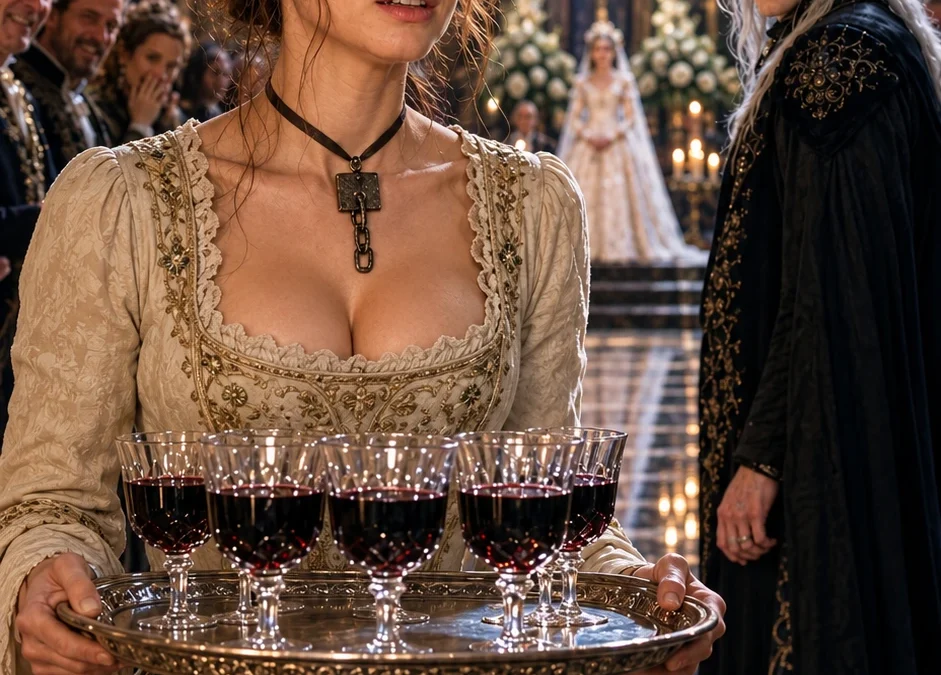
She stood beneath the black arches of Blackthorne Hall, holding crystal flutes of dark winter wine, while the boy she had loved since childhood waited at the altar to marry a woman chosen by the vampire court. Chandeliers burned with cold blue flame. White roses climbed the pillars, though no root could live in that stone. Every noble in the mountain kingdom had come in velvet, pearls, and old arrogance, whispering as servants moved around them like shadows trained not to breathe. 🕯️
Clara wore a plain cream dress and an apron pinned too tightly at her waist. Her wrists smelled faintly of lavender water, the last recipe her mother had left her before fever took her from the worker cottages below the ridge. It was a poor girl’s courage, dabbed on before dawn.
At the far end of the aisle stood King Lucien Blackthorne, ruler of the northern vampire clans. He had once been only Lucienne to her, a pale, solemn boy who hid from tutors in the apple tunnels and asked her to read aloud because her voice made the dark seem less empty. Now he stood beneath a canopy of black lace beside Lady Saraphene Veilheart, a noble bride with a moonstone crown and a smile that never warmed her eyes.
“Lower your eyes,” hissed Mrs. Thorne, the head steward. “Servants do not stare at kings.”
Clara lowered them. She did not need to look to remember. Years ago, a barefoot child and a lonely prince, he had drawn a little cottage in frost on a greenhouse pane: a porch, flower boxes, a kitchen wide enough for all the bread she wanted to bake. “When I rule, no one will make you bow in your own home.”
Children did not understand crown contracts, blood laws, or councils that could turn affection into treason. Adults did. Lucienne had been taken from the orchards after his father’s death. Clara’s father, the estate steward, had died with an accusation attached to his name and a debt ledger attached to Clara’s life. Since then, she had scrubbed floors in the hall where she had once been allowed to laugh, and pretended not to hear nobles call her the steward’s debt girl. 💔
The priest lifted a silver book. “Your Majesty, repeat the vow that joins House Blackthorne to House Veilheart.”
Lucienne opened his mouth. At that exact moment, a draft swept through the western doors. It rolled over the white roses, stirred the altar candles, and carried Clara’s lavender through the hall.
Lucienne stopped.
The silence was small at first, then enormous. Lady Saraphene’s fingers tightened on his sleeve. Clara felt the tray tremble as the glass rims struck one another with delicate, accusing notes. Lucienne turned before he seemed aware of doing it. Across the aisle, over titled guests and armored guards, his ancient gray eyes found hers.
For one suspended breath, the court vanished. There was no bride, no crown, no debt chain hidden beneath Clara’s collar. There was only a boy in a frost-covered greenhouse drawing a house with his finger, and a girl laughing because she believed him. 🌿
“Continue, Your Majesty,” Saraphene whispered, sweet enough for the first rose to hear.
He looked back at the silver book. But his voice had changed. He repeated the vow without warmth.
Clara waited until the hall erupted in applause, set the tray on a side table, and slipped through the servants’ door before anyone could see her face break. She ran past the kitchens and the old laundry stairs into a courtyard where snow gathered in the seams of the stones, and on to a narrow creek that cut through the black pines. She sank onto a flat rock and pressed her hands over her mouth.
“Child. They will notice if the wine walks away.”
Mara, the oldest cook at Blackthorne Hall, stood with a shawl over her gray hair. She had known Clara’s mother, and had fed Clara after her father’s disgrace.
“I only needed a minute. Loving a king is a hard way to stay warm.”
“I know. Remembering is not choosing, Clara.”
The words settled cruelly, because they were true. 🌨️
Clara returned before the feast began. Near midnight, carrying empty glasses through a corridor lined with portraits of dead Blackthorne rulers, she heard a child’s voice from the alcove by the chapel door.
“Why did the king look at you like he’d lost something?”
A little boy in a page’s uniform stood half hidden behind a curtain, dark curls in need of a comb. Oliver, Saraphene’s young cousin, brought to court because no one trusted his mother with the Veilheart accounts. Before Clara could answer, footsteps approached. Lucienne emerged alone, no guards, no bride, no crown. The candle flames bent away from him.
“Oliver. Your nurse is looking for you.”
When the boy fled, Lucienne looked at the faint violet stains on Clara’s wrists. “I thought that scent was gone from this house.”
“My mother taught me the recipe.”
He flinched at her next words. “You should return to your bride, Your Majesty.”
“You used to call me Lucienne.”
“And you used to make promises to girls who did not know better.”
His composure cracked, only enough for pain to show. “I did not choose this wedding.”
“A difficult choice is still a choice.”
His eyes dropped to the black ribbon at her throat, beneath which an iron charm rested against her skin, the mark of her father’s debt. “There are things you were never told.”
“There are always things servants are never told.”
He reached half a step toward her, then stopped himself as if restraint were a physical chain. That pause mattered. It kept the old love from becoming another kind of command. “If you are ever in danger, send word to me.”
She gave a small, wounded laugh. “I served at your wedding today. I think danger already knows my name.” 🥀
PART 2
Morning came with no mercy. Clara was ordered to polish every goblet used at the royal feast, more than a hundred, until Lady Saraphene could see her reflection in them. By noon, she was summoned to the bridal chamber, which smelled of rose oil and cold metal.
“You are Clara Vale. Daughter of Edmund Vale, the steward who stole from the crown.”
“My father was never allowed to answer that accusation.”
“Dead men rarely answer anything.” Saraphene smiled. “You ran wild with the king as a child. You will not speak to him privately. You will not linger in corridors. You will not wear that scent again. If he remembers you, you will help him forget.”
For a moment, Clara saw fear beneath the bride’s elegance. It did not soften the insult.
That evening, she poured winter wine at the council table, where old vampires with jeweled rings sat beside human land agents and clerks with ledgers chained to their wrists. Saraphene’s uncle, Lord Veilheart, leaned back. “It is charitable of Your Majesty to keep debt-born servants in the house. Some kings would sell the contracts south.”
Laughter moved around the table. Clara’s face burned.
“Set it down,” said Lucienne. The laughter stopped. “Lord Veilheart. Explain what you mean by debt.”
“Only a common term, Your Majesty.”
“Common things are often lazy. Define it.” He turned to Clara. “Miss Vale. Show me the token at your throat.”
Shame pinned her in place. But she untied the ribbon, and the iron charm fell into her palm, stamped with a blackthorn crest and a number she had never understood. Lucienne held out his hand, palm upward, not taking until she chose to give it. When the charm touched his skin, frost spread across the iron.
“This mark was outlawed before my coronation.” A murmur ran through the room. “It bears my seal.”
“Your Majesty signs many accounts,” said the treasurer. Lucienne’s gaze lifted. The treasurer looked away first.
“From this hour, no servant in my hall will be called debt-born at my table.” 🛡️
Clara wanted the floor to open. She wanted Lucienne to stop rescuing her in a way that made every noble remember her name. And it was worse in the West Gallery, where Saraphene summoned her beneath a painting of Lucienne’s mother, Queen Aurelia.
“You enjoyed that. You stand wounded in the corner until men imagine themselves noble for noticing.”
“If your place beside him is secure, my corner should not frighten you.”
Saraphene struck her without raising a hand. A vampire noble’s pressure, cold and commanding, buckled Clara’s knees and flared the lamps blue. “I was bred for courts. You were bred for kitchens.”
The doors opened. The pressure vanished. “Leave us,” said Lucienne. “You used blood pressure against a human under my roof.” He turned to Clara. “Do you wish to file a complaint before the steward court?”
Every instinct screamed no. Complaints from servants vanished. But Lucienne had asked, not declared. “Not tonight. But I want what happened recorded.”
A faint change moved through his face, almost pride. “Record it.”
The punishment came disguised as chores: the coldest corridors, the heaviest linen chests, the north tower stairs. Then, one dawn, a royal bell rang. His Majesty requests Miss Vale in the archive.
The archive lay beneath the chapel, behind an iron door that opened only to royal blood. On a long table lay copies of debt books from after his coronation. “I need someone who can read human account hands. I have clerks who tell me old crimes are inconvenient to find. And because the mark at your throat should not exist. I am asking, not ordering.”
She saw her father’s name on the top ledger and stepped to the table. 📜
For three days she worked. The ledgers told a cruel story in tidy columns. Edmund Vale’s alleged theft had been converted into an inherited obligation. Clara’s wages had been taken to repay it. Medicine for her mother’s final illness had been added to the account after the woman was already buried. “This ink is different. The charge was added later. Whoever forged it wanted the total to match the token number.”
Lucienne looked at her as if the hall had grown brighter. For the first time in years, he smiled, small and startled, like a candle deciding it had not died.
Oliver slipped in with a list of names he had copied from scraps the clerks burned: workers, widows, stable boys, laundresses, each with a token number. The system was not a mistake. Her wound had never been private. Saraphene had not feared a servant’s memory. She had feared a servant who could read.
Then, on the eve of the final binding, Clara carried mended lace to the bridal suite in the old queen’s wing. On a dressmaker’s frame stood Saraphene’s binding gown, pearl gray, silver-threaded, moonstoned. And inside the hem, where no guest would see, a row of small embroidered lavender flowers.
Her hands began to shake. Her mother had taught her that stitch: a split thread turned twice so the petal looked folded. Behind the lavender, nearly covered by a later seam, were two initials: E.V. and E.V.
Her mother had sometimes marked work with both her own and her husband’s initials, saying love was the only signature poor people were allowed to share.
Beneath the newer stitching lay a narrow pocket. Inside was a folded paper, stiff with age. 🧵
PART 3
She read it in the pantry with Mara and Oliver, by tallow light. The ink had faded brown, but the hand was her mother’s.
My dearest Edmund, if this reaches you, do not bring Clara to the hall tonight. The Queen’s gown has been altered, and Lord Veilheart’s clerk hid the transfer pages inside the hem before I could stop him. They mean to blame you for accounts you refused to sign. I heard them speak of a marriage bargain and a child witness. Lucienne must know before he vows.
They brought it to the archive. Lucienne read it twice, utterly still. “My mother’s hand is on the back. Trust Eliza. Protect the girl if I fail.” He told them he had been twelve when his mother “died of fever.” He had not been allowed to see her in the final month. He had never opened her private cabinet. “Grief can become a locked room, and after enough years, people call it respect.”
The cabinet opened to his blood and a silver key. Inside: a portrait of Queen Aurelia, one hand on the shoulder of a young human woman. Clara’s mother. And letters. Aurelia had discovered Veilheart clerks creating false debts against human workers to seize land and labor. Edmund had helped her copy the accounts. Eliza had hidden the transfer pages in a gown when guards searched the queen’s rooms. Eliza’s child must never be marked, for I have placed her name under royal protection.
“Then how did I become debt-marked?”
“Someone removed the protection order. Someone with access to my father’s seal.”
Saraphene arrived with two guards and a too-bright smile. Oliver sneezed behind a ledger stand. Lucienne moved between them, and the candles went blue. “Leave.” She looked at the cabinet, at his face, and understood too much. “Tomorrow the court will expect a queen.” “Then the court should prepare to hear why it does not have one.”
Near dawn, he walked Clara to her door. “Do not mistake justice for permission. I am grateful you listened. But I am not a lost piece of your childhood waiting to be returned to its shelf.”
“I know. I want to. That may be the more honest answer.” ✨
The next day, Saraphene struck first. Two Veilheart guards blocked Clara in the infirmary corridor. “You are accused of stealing a private letter and a ceremonial jewel from the queen’s wing.” Mara stood behind her with a rolling pin held like a royal staff, kitchen servants gathering at her side. Then the corridor darkened. “Remove your hands from my witness.” Lucienne did not ask if she was all right. He asked, “Do you wish the accusation answered now or before the full court tonight?”
“Let her say it where everyone can hear.”
That night, Oliver produced a silver thorn-shaped key from his cousin’s jewel box, stamped with Aurelia’s crest and a single word: greenhouse. In the sealed winter greenhouse, beneath the stone bench, lay a narrow box. Inside: a full ledger, a royal protection order bearing Clara’s childhood name, and a final letter from Queen Aurelia to her son. A single red tear gathered at Lucienne’s eye and vanished.
“She did not die of fever. She was imprisoned in the south tower until she weakened. My father signed the order under Veilheart pressure.”
“So the wedding is ransom,” whispered Oliver.
Clara lifted the protection order. “And this means my debt never existed.”
“It means more. Their child was granted standing to testify before crown law.”
The bells began to ring. Lucienne held out his hand to help her rise. Clara placed the ledger in his palm instead. “Carry this. I will carry myself.” His mouth curved with understanding. “As you wish.” ⚖️
In the hall, every candle blazed. Nobles stood near the altar, human workers pressed to the back under guard eyes. Saraphene waited in pearl gray beneath the lace canopy. When Clara walked down the center aisle, carrying no tray, a hundred people recalculated her shape in the world.
“Your Majesty, I must ask that this girl be searched. She has stolen from my chamber and corrupted a child of my house.”
“I was corrupt already,” said Oliver. A startled laugh rose from the workers.
Lucienne set the greenhouse ledger on the altar. “The binding is suspended.”
Saraphene accused Clara of theft. Lucienne said only, “Answer.” Not defend her. Not rescue her. Clara stepped onto the first altar stair. “I found a letter written by my mother in the hem of Lady Saraphene’s gown.” Mara brought the gown. Clara showed the lavender stitch, the initials, the hidden pocket. “My mother was Eliza Vale, seamstress to Queen Aurelia. Any seamstress in this hall may inspect it.”
Lady Morwin Ash, once keeper of royal textiles, bent over the hem. “This stitch is Eliza Vale’s. I trained beside her.”
For the next hour, the wedding dissolved into account. Names, read aloud. A widow charged for medicine never delivered. A stable boy, grown, who showed the iron mark that had taken his wages for a dead uncle’s invented debt. Shame left individual shoulders and became collective anger. When Saraphene threatened to call the royal loans due by dawn, shadows rose along the pillars, and Lucienne’s restraint flickered toward the vampire.
“Your Majesty,” said Clara. “Do not frighten them into truth. Make them answer it.”
He released the pressure. “Lord Veilheart. Answer the ledger.”
Then Oliver, pale but determined, stepped forward. “I heard my cousin tell Mr. Calder to put the moonstone clasp in Clara’s mattress. He said he wouldn’t. He said theft was one thing and sacrilege another.” Calder, Saraphene’s private clerk, bolted. Guards caught him. His confession unraveled it all: the false theft, the debt tokens managed through Veilheart accounts, the forged charges begun under the late king and continued because everyone profitable kept quiet.
“I would have been a good queen,” said Saraphene.
“A good queen does not need servants kneeling over lies to feel tall,” said Clara.
The priest closed the silver book. “The binding cannot proceed.” 🌹
Lucienne laid the black ceremonial ring beside the ledger. “House Veilheart is suspended from court privilege. All debt tokens issued under disputed accounts are void.” One by one, workers came forward and laid iron charms on the altar. Iron struck stone in small hard notes until the altar looked less like a wedding place than a grave for false debts.
At the inquiry that followed, Clara refused a chair near the throne. “If I sit above them now, they may think justice means being lifted away from the people who still need it.” She read from a final paper in the greenhouse ledger: Aurelia’s last testimony. If my son is ever told he must marry Veilheart blood to preserve peace, let him know the peace was purchased by threats against him, theft from his people, and the erasure of Clara Vale, whose parents guarded the truth when I could not. Lady Morwin stood. “By old law, a treaty founded on concealed coercion is void.”
The twist was simpler and more painful than any prophecy. Clara had always been legally protected. Her parents had not died leaving her poor and stained by debt. They had died protecting a truth that made her free.
“And what do you receive?” Saraphene sneered. “A crown for your suffering?”
“I received my name. My wages. My father’s honor. And the right to decide what my life becomes without a chain under my collar. That includes the right not to become anyone’s answer tonight.”
“It does,” said Lucienne. Then he decreed that no person under Blackthorne rule could be bound by inherited debt without open proof, and added: “And no king’s attention shall be treated as a claim upon a woman’s future.” 🕊️
That night, in the broken greenhouse, he asked from the door, “May I come in?” Clara closed her eyes at the question, small and right. “I loved a boy who made promises in frost because neither of us knew what promises cost. I do not know yet how to love the king sitting here.”
“Then do not hurry. I can learn to bear waiting honestly.”
“That was a very royal way to say yes.”
“I am trying to be plain.”
“Try harder.” He smiled, and this time it reached his eyes. 💞
Spring arrived by negotiation. Roofs were mended in the worker cottages first. The medicine store became a public infirmary with records posted in plain language. Clara designed the account books herself, leaving wide margins for questions. Oliver stayed as Lucienne’s ward and studied law because “criminals are less frightening once you understand footnotes.” Saraphene was sent south to face her own house’s judgment, and Clara felt only the clean absence of someone else’s hand at her throat.
One evening in late summer, Lucienne came to her cottage with a rolled paper. A drawing: a porch, flower boxes, a kitchen expanded toward the garden. “The boy drew a house and imagined giving it to you. The man should ask whether you want one, and who should build it, and whether a porch is any use in mountain rain.”
“I want the kitchen wider. And the porch repaired, not rebuilt too grandly. I like that it leans a little.”
By the first snow, the cottage held a long table. Workers came in the evenings to learn numbers, and children sat on the floor with slates.
At the creek below the black pines, where she had once cried, he placed an altered ring on the flat rock between them: a narrow silver band, a dark stone, a lavender flower engraved inside. He did not kneel. He did not reach for her hand. “I love you. Not because you were promised to my memory. Not because your parents saved my mother. If you do not choose me, the laws remain, the cottage remains, your name remains. Nothing I repaired becomes a bargain.”
Clara picked up the ring. “I choose you. And the cottage, and the ledgers, and Mara’s opinions, and Oliver’s footnotes. I am not entering a fairy tale. I am entering a life.” 💍
They wed in the repaired greenhouse at winter’s end. Workers stood beside council members. Mara baked a lavender cake, and Oliver dropped the rings only once. Clara wore a simple dress with lavender sewn openly at the hem. When the priest asked for vows, Clara spoke first. “I come by choice. I keep my name.”
“I will protect without possessing,” said Lucienne. “I will listen before law. I will love you as a free woman or not at all.”
Years later, people on Blackthorne Ridge still told the story of the servant forced to carry wine at the vampire king’s wedding. But Clara preferred the quieter ending: the public account books with smudged fingerprints in the margins, Mara asleep by the hearth pretending to rest her eyes, Lucienne bringing her tea during long winter meetings and setting it beside her papers without interrupting the sentence that would correct him.
Love had not repaid her suffering. Nothing could. What love did, at its best, was refuse to build a home on top of a lie. 🤍
Which would you choose: the king who loved you first, or the freedom to love him on your own terms? Tell me in the comments. 👇
Disclaimer: This story is entirely fictional and created for entertainment purposes only. It does not represent any organization or individual, nor does it encourage inappropriate behavior. The content was generated with AI assistance.








