SHE CLIMBED OUT A WINDOW TO ESCAPE A FORCED MARRIAGE—THEN A DUKE FOUND HER BEFORE DAWN
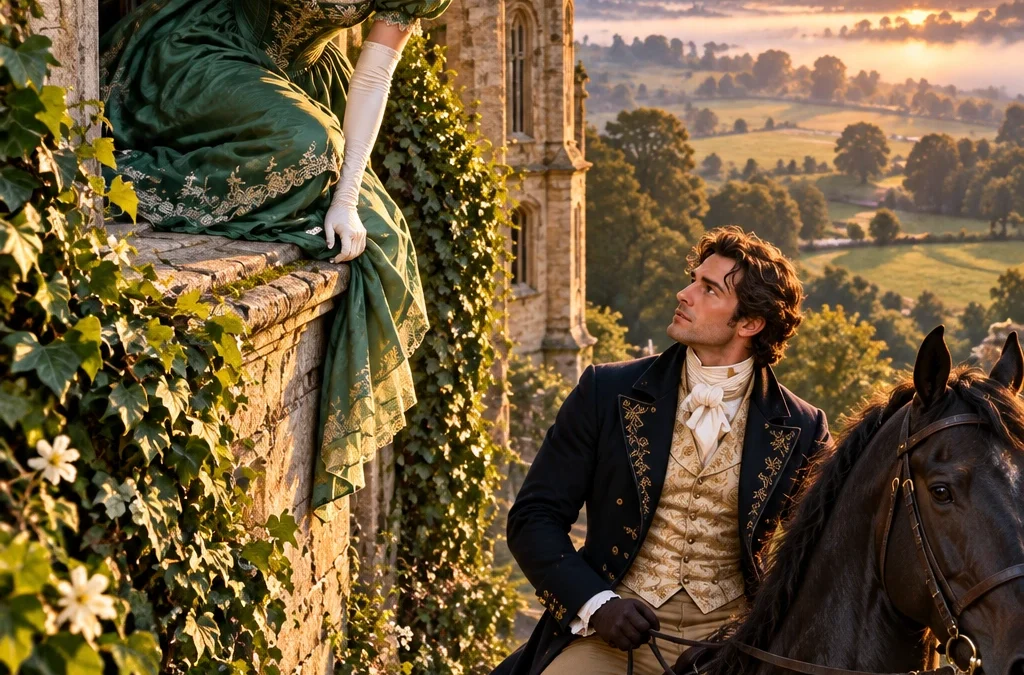
SHE CLIMBED OUT A WINDOW TO ESCAPE A FORCED MARRIAGE—THEN A DUKE FOUND HER BEFORE DAWN
Part 1
At 4:30 in the morning, Francesca Penn climbed out of her bedroom window with one small valise, a pair of ruined gloves, and no intention of ever returning as the obedient daughter her father remembered.
She was twenty-four years old.
Until that morning, she had never run away from anything.
For three years, Francesca had nursed her sick mother, managed Pennwood Hall while her father’s investments collapsed, balanced household accounts, dismissed creditors politely, and asked for almost nothing herself.
She had believed patience was a virtue.
Then her father signed her marriage contract.
Sir Ewan Garvey was wealthy, influential, and old enough to know precisely how much power four thousand pounds could buy from a desperate baronet.
That was the amount Francesca’s father owed him.
And Francesca was apparently the settlement.
Her father called the match “necessary.”
Francesca called it what it was.
A transaction.
She had met Sir Ewan once.
That single dinner had been enough.
He had looked at her the way a livestock dealer inspected an animal before purchase—not cruelly, which somehow made it worse, but calculatingly.
When the betrothal papers arrived three weeks later, Francesca did something she had almost forgotten she was capable of doing.
She chose herself.
She secretly wrote to her godmother, Lady Flora Wynn, in Edinburgh.
The reply came quickly.
Come north.
Take the first coach you can reach without being seen.
Do not write again until you are safely gone.
Francesca packed a valise.
Then she waited eleven days for the right morning.
Now, hanging from the ivy outside her bedroom window in the freezing October darkness, she discovered that courage felt remarkably similar to terror.
Her boots finally touched the garden wall.
She dropped to the other side.
No shout came from the house.
No lamp appeared.
Francesca ran.
At the end of the lane, she stopped and looked back.
Her open window was barely visible against Pennwood Hall.
Her mother’s garden lay dark beneath it.
Her father was still asleep.
In two and a half hours, he would discover her room empty.
In fourteen days, Sir Ewan was supposed to arrive and formally claim his bride.
Francesca turned away.
“Goodbye,” she whispered.
Then she walked toward Greystone.
The coaching inn was two miles away.
She had calculated everything—the distance, the departure time, the household routines, even how long it would take her father to send someone after her.
There was only one thing she had not calculated.
The horseman.
She heard the animal before she saw him.
Slow hoofbeats sounded through the darkness.
Francesca immediately stepped toward the roadside.
A tall rider appeared over the ridge on an iron-gray horse.
He stopped when he saw her.
For two seconds, neither spoke.
“I beg your pardon,” Francesca finally said.
The stranger looked at her valise, then at the empty road behind her.
“I imagine you are going to Greystone.”
She stiffened.
“How would you know?”
“The Edinburgh mail leaves at half past five. You are walking toward the only inn from which you can board it.”
Francesca tightened her grip on the valise.
“You observe too much.”
“So I have been told.”
He was perhaps in his thirties, broad-shouldered and dressed plainly enough for riding, though everything about the quality of his coat suggested money.
“My carriage is behind me,” he continued. “My coachman can take you to the inn.”
“I do not know you.”
“No.”
He did not seem offended.
“Deverell.”
She waited.
“That is your name?”
“It is one of them.”
Despite herself, Francesca almost smiled.
“My name is Miss Penn.”
He inclined his head.
Wheels sounded behind him.
A carriage emerged from the darkness.
Francesca hesitated.
The stranger made no attempt to persuade her.
That mattered.
Men had spent three weeks telling her what she must do.
This man simply offered a choice and waited for her answer.
“I will accept the ride, Mr. Deverell.”
“The title is Carmount,” he said calmly. “You may use whichever is less inconvenient.”
Francesca stared.
The Duke of Carmount.
Of all the people she might encounter while escaping an arranged marriage before sunrise, she had somehow chosen a duke.
His coachman, Tomlin, opened the carriage.
Francesca climbed inside.
As they descended toward Greystone, the Duke rode beside the carriage without asking a single question.
That restraint unsettled her more than curiosity would have.
At the White Hart, breakfast appeared before Francesca even realized she was hungry.
Then the Duke entered the small private parlor.
“The coach leaves shortly.”
“I know.”
He sat opposite her.
“Miss Penn, I need to ask you something.”
Francesca’s spine straightened.
“The gentleman whose name appears on the betrothal agreement you are presently escaping—how soon will he know you are gone?”
Her cup stopped halfway to her mouth.
“How do you know there is a betrothal?”
“Because women carrying their lives in one valise before dawn are rarely taking recreational journeys.”
She slowly lowered the cup.
“My father will know by seven. Sir Ewan will not arrive for another fortnight.”
Something changed in the Duke’s expression.
“Sir Ewan Garvey?”
Francesca froze.
“You know him.”
“Yes.”
The answer came heavily.
“How?”
The Duke looked toward the fire.
“When I was twenty, I behaved like an idiot and provoked a confrontation that nearly ended with a pistol ball in my chest.”
Francesca waited.
“Garvey stepped between me and the shot.”
Her breath caught.
“He carried the bullet in his shoulder for three years.”
“So you owe him your life.”
“That is how he prefers to describe it.”
“And how do you describe it?”
The Duke considered.
“A debt I have spent ten years attempting to repay.”
He leaned forward.
“Last month Garvey wrote to me. He said he was arranging an advantageous marriage in Cumberland and expected my family to recognize his new position.”
Francesca’s face went cold.
“You did not know the woman was me.”
“No.”
“Do you know why my father agreed?”
“Four thousand pounds.”
Francesca stared.
So he knew.
“My father’s debt.”
“Yes.”
The Duke’s jaw tightened.
“I came north because Garvey has turned what happened ten years ago into something that can never be fully repaid. Every time I approach settlement, the terms change.”
Francesca understood immediately.
“He does not want the debt paid.”
The Duke looked at her.
“No.”
“He wants you indebted.”
Silence filled the room.
Then Francesca said, “My godmother is Lady Flora Wynn of Charlotte Square.”
For the first time, genuine surprise crossed his face.
“Lady Wynn?”
“You know her?”
“I know her reputation.”
“And Mrs. Bryce?”
Now something almost resembling amusement appeared.
“The former solicitor’s clerk?”
“Yes.”
“I would rather negotiate with Parliament.”
Francesca smiled.
It was her first real smile in weeks.
“Mrs. Bryce is helping me challenge the betrothal.”
The Duke stood.
“My carriage can reach Edinburgh faster than the mail.”
Francesca looked up.
“I will ride,” he continued. “You will have the carriage. Tomlin will drive. I can send a messenger ahead to Lady Wynn.”
“Why?”
His expression became serious.
“Because I spent ten years believing honor required me to repay Garvey.”
He looked directly at her.
“But whatever debt I owe him does not include your freedom.”
Something tightened painfully in Francesca’s chest.
“You may refuse,” he added. “The mail coach is still available.”
Again.
A choice.
Francesca studied him.
Then she stood.
“I accept.”
They left Greystone before sunrise had fully touched the valley.
By the following evening, Edinburgh appeared through rain and mist.
Lady Flora Wynn was waiting at the door.
She was seventy-one, silver-haired, small, and possessed the terrifying expression of a woman who had spent decades discovering that most problems could be solved if everyone simply stopped wasting her time.
She embraced Francesca.
Then she looked at the Duke.
“Carmount.”
“Lady Wynn.”
“Do not bow in the rain. Come inside.”
The following morning, Mrs. Bryce arrived carrying a leather case.
She placed three documents on Lady Wynn’s library table.
Francesca recognized her father’s promissory note.
Then Mrs. Bryce placed beside it a chemical analysis of the ink.
“The note supposedly securing Sir Ewan’s claim against your father is dated March fourteenth.”
“Yes.”
“The underlying transaction was signed March seventeenth.”
Francesca frowned.
“That is impossible.”
“Precisely.”
Mrs. Bryce tapped the document.
“The date was altered. Different ink.”
The Duke stepped closer.
Francesca stopped breathing.
Mrs. Bryce looked directly at her.
“The debt instrument was forged.”
“And the betrothal?” Francesca whispered.
Mrs. Bryce’s expression did not change.
“If the marriage agreement was obtained on the basis of a fraudulent instrument, the agreement can be challenged.”
Francesca gripped the edge of the table.
Freedom was suddenly no longer hundreds of miles away.
It was sitting in front of her.
But Mrs. Bryce had not finished.
“There is another matter.”
She opened her leather case again.
“Sir Ewan can withdraw quietly—or the evidence can become the basis of proceedings concerning document fraud.”
Francesca looked toward the Duke.
His face had gone pale.
Because suddenly this was no longer only her battle.
The man who had saved his life ten years earlier might now be publicly destroyed.
And Francesca realized the Duke of Carmount would have to choose between the debt that had controlled him for a decade…and the woman he had known for barely two days.
But when Francesca finally asked him which one he would choose, the Duke gave her an answer she never expected.
👉 Find Part 2 in the comments—or leave ANY WORD below and I’ll send it to you privately.
Part 2
But when Francesca finally asked him which one he would choose, the Duke gave her an answer she never expected.
“Neither,” he said.
Francesca stared at him. “Neither?”
“This decision is not mine.”
He looked at the forged document, then back at her. “Garvey’s debt to me and mine to him are irrelevant. He tried to purchase your future. You are the injured party. You decide what happens next.”
Mrs. Bryce remained silent.
So did Lady Flora.
For years, Francesca’s father had made decisions for her because he believed being her father gave him that right. Sir Ewan had attempted to purchase the same authority. Yet the most powerful man in the room had simply stepped aside.
Francesca looked down at the evidence.
“What happens if I prosecute?”
“Garvey could face serious consequences,” Mrs. Bryce replied. “His reputation would almost certainly collapse.”
“And if I do not?”
“We demand withdrawal of the betrothal, cancellation of the note, release of all claims against Pennwood Hall, and a written apology. I retain the evidence. If he ever attempts anything similar again, he knows precisely what I possess.”
Francesca thought about the young Ewan Garvey who had once stepped in front of a pistol.
Then she thought about the older man who had treated a woman’s freedom as currency.
“I will not prosecute.”
The Duke’s eyes lifted.
“But I will not protect him from himself either,” Francesca continued. “He withdraws everything. The betrothal. The debt. Every claim against my father’s estate. Mrs. Bryce keeps the evidence permanently.”
Mrs. Bryce nodded.
“Practical.”
“Exactly.”
Four days later, Sir Ewan arrived in Edinburgh.
He did not look like a villain.
That surprised Francesca.
He looked tired.
Older than she remembered.
Mrs. Bryce placed the evidence before him.
Garvey examined it.
Then he looked at Francesca.
“You ran away.”
“I left.”
“Your father gave me his word.”
“My father did not own mine.”
His mouth tightened.
Then his eyes moved toward the Duke.
“Carmount.”
“Ewan.”
“You owe me.”
The room went silent.
The Duke did not flinch.
“I did.”
Garvey’s face changed.
“Did?”
“I spent ten years trying to repay an act of courage performed by the man you were. I will not allow that act to become justification for the man you chose to become.”
Garvey looked as though he had been struck.
Francesca saw something flicker across his face.
Shame.
Perhaps the Duke saw it too.
Sir Ewan signed.
The betrothal disappeared.
The debt against Pennwood Hall disappeared.
And by afternoon, he was gone.
Francesca should have felt nothing but relief.
Instead, when she stood alone beside the window afterward, she began to cry.
The Duke found her there.
“I am free,” she whispered.
“Yes.”
“Then why does it hurt?”
“Because freedom does not return what was taken before you won it.”
Francesca looked at him.
He did not touch her.
He merely stood beside her.
Weeks passed.
The Duke remained in Edinburgh longer than necessary.
There were dinners.
Walks.
Conversations that stretched far beyond propriety.
Then, one November afternoon beneath the shadow of Edinburgh Castle, he told her about Carmount Park and an ancient orchard of sixty apple trees.
“They all flower together in May,” he said.
Francesca smiled.
“I should like to see that.”
The Duke stopped walking.
The look he gave her was so intense that her pulse quickened.
“In May?”
“In May.”
“Francesca…”
She waited.
He stepped closer.
But before he could say what was clearly trembling behind his careful expression, a messenger came running toward them carrying a letter bearing the Pennwood seal.
Francesca opened it.
Her face changed.
“What is it?” the Duke asked.
She looked up.
“My father.”
Her fingers tightened around the page.
“He wants me to come home.”
The Duke’s expression hardened.
“Why?”
Francesca read the final sentence again.
And suddenly the freedom she had fought for no longer seemed as simple as leaving Cumberland behind.
👉 LIKE this story or comment “APPLE” if you want Part 3. Once I receive the right number of comments, I’ll post the complete ending. 🍎
Part 3
Francesca read the final sentence again.
And suddenly the freedom she had fought for no longer seemed as simple as leaving Cumberland behind.
The Duke watched her carefully.
“What did your father write?”
Francesca folded the letter.
For three weeks, she had imagined that if her father contacted her, it would be with anger.
Instead, the letter contained something far more difficult to resist.
Regret.
“He says he received the settlement documents.”
The Duke waited.
“He says he did not understand what he was signing.”
“Do you believe him?”
“I believe he did not want to understand.”
That distinction mattered.
Her father had spent years avoiding the collapsing numbers of his estate because looking directly at failure would have required accepting responsibility for it.
Francesca unfolded the letter again.
“There is one sentence.”
“What sentence?”
She swallowed.
“He wrote, ‘I did not consider what I was asking you to surrender.’”
The Duke remained silent.
Francesca laughed softly, without humor.
“Four words.”
“What?”
“‘I did not consider.’”
She looked down.
“I cannot remember my father ever admitting that before.”
“Then perhaps that is why the sentence feels heavier than the rest.”
She looked at him.
“You understand people rather inconveniently well.”
“Only occasionally.”
Francesca returned to Charlotte Square.
She read the letter twice more that evening.
Lady Flora did not tell her what to do.
Neither did Mrs. Bryce.
And the Duke certainly did not.
That was becoming the defining difference between this new life and the one Francesca had escaped.
People asked.
Francesca decided.
Eventually, she wrote to her father.
She did not return to Pennwood Hall.
Not yet.
Instead, she told him that forgiveness was not the same as pretending nothing had happened.
She told him she would correspond with him.
She told him Pennwood’s accounts needed to be placed under professional management.
And she told him, perhaps most importantly, that he would never again negotiate her future.
His reply was short.
Understood.
It was not enough to repair everything.
But it was a beginning.
Francesca placed both letters inside her writing case.
Then she began building a life that belonged to her.
In November, Lady Flora hosted a dinner at Charlotte Square.
The Duke of Carmount attended.
Lady Flora seated Francesca beside him.
Francesca suspected this was deliberate.
Lady Flora denied everything.
“I am seventy-one,” she said when accused. “I have no time for schemes.”
Mrs. Bryce nearly choked on her wine.
After dinner, Lady Flora somehow remembered an urgent matter requiring her presence on the opposite side of the house.
Francesca found herself alone with the Duke.
He stood near the fireplace.
“Your godmother is subtle.”
“She believes so.”
“Tomorrow,” he said, “would you walk with me?”
Francesca smiled.
“Yes.”
The following afternoon, they walked through Princes Street Gardens beneath pale winter light.
For once, neither spoke about Garvey.
Or debts.
Or contracts.
Or fathers.
The Duke told Francesca about Devon.
About Carmount Park.
About tenants whose agreements his grandfather had surprisingly made fair.
About the sea.
About an orchard planted by his great-grandmother during the year of the French Revolution.
“Sixty apple trees,” he said.
“All producing fruit?”
“Far too much.”
“What happens to it?”
“The household takes what it requires. The rest goes to the village.”
Francesca looked at him.
“You sound proud of that.”
“I am.”
“Of all your estates?”
“No.”
“Your title?”
“No.”
“Your wealth?”
“Certainly not.”
Francesca laughed.
“What are you proud of?”
The Duke considered.
“The orchard. The tenancy agreements.”
“That is only two things.”
“I know.”
“What is the third?”
He stopped walking.
Francesca turned toward him.
For several seconds, he said nothing.
She had learned that silence in him did not mean uncertainty.
It meant care.
“The third,” he finally said, “is that my family has generally made sensible choices about whom they loved.”
Francesca’s heart stumbled.
He looked directly at her.
“I find myself under considerable pressure from family precedent.”
She smiled despite herself.
“Is that a proposal, Your Grace?”
“No.”
Her smile disappeared.
The Duke stepped closer.
“It is an admission.”
“Of what?”
“That I am falling in love with you.”
Everything around Francesca seemed to become strangely quiet.
“I will not ask you to marry me today.”
“Why not?”
His eyebrow rose.
“That sounded dangerously like disappointment.”
“It was curiosity.”
“Of course.”
He resumed walking.
Francesca followed.
“Why not?” she repeated.
“Because you escaped one marriage arrangement less than two months ago. If I immediately place another proposal before you, then I become merely a more agreeable version of the same problem.”
That answer touched her more deeply than a proposal might have.
“What will you do instead?”
“Ask whether you would like to continue walking with me.”
“And after that?”
“Perhaps dinner.”
“Scandalous.”
“I am prepared to risk it.”
“And after dinner?”
“Another walk.”
Francesca smiled.
“You have planned quite an extensive courtship.”
“I manage several estates. Planning is unavoidable.”
She stopped.
“So is May.”
He looked at her.
“The orchard,” she said. “I still want to see it.”
Something in his expression softened.
“When the trees flower, all sixty bloom within several days.”
“Then that is what we are working toward.”
He did not touch her.
But the look he gave her stayed with Francesca for the rest of the winter.
They did exactly what he had promised.
They walked.
They talked.
They disagreed.
Sometimes spectacularly.
Francesca discovered the Duke was patient about large matters and impossibly stubborn about small ones.
He discovered she could identify accounting irregularities faster than some of his stewards.
When he asked her opinion, he genuinely wanted it.
When they disagreed, he argued rather than commanded.
That mattered to Francesca more than roses ever could.
He did send flowers once.
Lady Flora examined them.
“Expensive.”
Francesca smelled one.
“They are lovely.”
“They will be dead by Tuesday.”
“Must everything be practical?”
“Yes.”
The Duke happened to arrive in time to hear this.
The following week, instead of flowers, he sent Francesca three books on estate management.
Lady Flora stared at them.
Then at Francesca.
“He learns.”
Francesca laughed.
“Yes.”
“He may be trainable.”
“Godmother!”
“What? I am trying to be encouraging.”
By February, Francesca realized something frightening.
She no longer waited for the Duke’s visits because he made her feel safe.
She waited because he made her feel alive.
There was an important difference.
Safety could become another cage if a woman feared leaving it.
But what existed between Francesca and Carmount did not require dependence.
He did not need her to be helpless so he could rescue her.
And she did not need him to surrender his strength so she could possess her own.
They could simply stand beside each other.
In March, Francesca finally returned to Pennwood Hall.
The Duke did not accompany her.
He offered.
Francesca declined.
He accepted the answer immediately.
She went alone.
Her father was waiting in the library.
He looked older.
The ledgers were arranged neatly across his desk.
For once, they were open.
“Francesca.”
“Father.”
There was an awkward silence.
Then he said, “I was wrong.”
She had imagined that sentence many times.
Hearing it did not magically repair her childhood.
But it mattered.
“I know.”
He flinched.
Francesca sat opposite him.
“I do not hate you.”
His eyes lifted.
“But I cannot return to being the daughter I was.”
“I understand.”
“I hope you do.”
They spoke for nearly two hours.
Not everything was resolved.
Some things never would be.
But when Francesca left Pennwood Hall that afternoon, she did not climb through a window.
She walked through the front door.
That mattered too.
May arrived.
The apple trees at Carmount Park exploded into blossom.
All sixty.
Francesca stood beneath them in stunned silence.
White and pink petals filled the branches above her.
The air smelled sweet and green.
Sunlight moved through the orchard.
The Duke watched Francesca rather than the trees.
“You were right,” she whispered.
“About?”
“This being worth seeing.”
“I occasionally tell the truth.”
“Occasionally?”
“I am a duke. We must preserve some mystery.”
She laughed.
He smiled.
Then his expression changed.
“Francesca.”
She knew.
He had waited.
From October until May.
He had given her time to discover who she was without a marriage contract waiting at the end of every thought.
Now, beneath the apple blossoms, he reached into his coat.
Francesca held up one finger.
“Before you do that.”
He froze.
“Yes?”
“I have conditions.”
The Duke slowly lowered his hand.
“I expected nothing less.”
“I will continue managing financial matters.”
“I would be disappointed if you did not.”
“I will maintain correspondence with Mrs. Bryce.”
“An excellent threat to keep available.”
“I will visit Lady Flora whenever I please.”
“I would never attempt to stop Lady Flora Wynn from doing anything. I value my life.”
Francesca smiled.
“And if I disagree with you?”
“I expect you to say so.”
“Even publicly?”
He hesitated.
Francesca raised an eyebrow.
“Privately whenever possible.”
“Your Grace.”
He sighed.
“Publicly when necessary.”
“Better.”
“Anything else?”
“Yes.”
Francesca stepped closer.
“You never get to believe that saving me made me yours.”
His amusement vanished.
He answered without hesitation.
“I did not save you.”
Francesca became still.
“You climbed out the window.”
He looked at her with that steady amber gaze she remembered from the road before dawn.
“You planned the route. You wrote to Lady Flora. You carried the valise. You chose Edinburgh. You decided Garvey’s fate.”
He took her hand.
“I merely happened to have a carriage.”
Francesca’s eyes filled.
The Duke continued softly.
“You saved yourself.”
A tear escaped.
“And if you marry me, Francesca, I will never ask you to forget that.”
For a moment, neither spoke.
Then Francesca glanced toward his coat.
“You were doing something before I interrupted you.”
“I was.”
“You may continue.”
“Your generosity overwhelms me.”
He reached inside his coat.
Then stopped.
“No.”
Francesca blinked.
“No?”
He took both her hands instead.
“I had prepared a speech.”
“Oh dear.”
“It was excellent.”
“I am sure.”
“I practiced it twice.”
“Then perhaps spare us both.”
He laughed.
Then his expression became completely serious.
“Francesca Penn, will you marry me?”
She looked at him.
No father stood behind her.
No creditor waited outside.
No contract had already been signed.
No debt determined her answer.
For the first time in her life, marriage stood before Francesca as nothing more—and nothing less—than a choice.
So she made it.
“Yes.”
The Duke closed his eyes briefly.
Francesca laughed.
“Were you worried?”
“Terrified.”
“You concealed it remarkably well.”
“I have years of practice.”
She touched his face.
“You may kiss me now.”
His eyes opened.
“May?”
“Do not ruin this.”
“I would not dream of it.”
And beneath sixty flowering apple trees, he kissed the woman he had first met carrying a valise along a Cumberland road before dawn.
They married the following June.
Lady Flora gave a seven-minute toast containing three complaints about wedding breakfasts, two insults directed at politicians who were not present, and one observation that silenced the room.
“The measure of a marriage,” she said, “is not its beginning, when everyone is behaving beautifully.”
She looked at Francesca and the Duke.
“It is the middle—when two people have seen enough of one another to stop pretending.”
Mrs. Bryce nodded.
Tomlin, standing discreetly near the doors, almost smiled.
Francesca’s father attended.
He did not give her away.
Francesca had been very clear about that.
She walked into the church herself.
Halfway down the aisle, she saw Carmount waiting.
And she suddenly remembered another morning.
The freezing road.
Her aching shoulder.
The valise.
The terror that every hoofbeat behind her might mean someone had discovered her escape.
She remembered seeing a stranger on an iron-gray horse.
She had thought he was an obstacle she had failed to calculate.
Instead, he had become something she had never known how to plan for.
A man who could help without taking control.
A man who understood that protection without choice could become another kind of prison.
A man who had never demanded gratitude for simply doing what was right.
When Francesca reached him, he held out his hand.
She took it.
Not because she had nowhere else to go.
Because she had discovered exactly where she wanted to be.
That afternoon, after the wedding breakfast, they escaped the guests and walked into the orchard.
The blossoms were already gone.
Small green apples had begun appearing along the branches.
Francesca touched the nearest tree.
“It looks different.”
“Disappointed?”
“No.”
She looked upward.
“I think I like this better.”
“The fruit?”
“The evidence that something happened after the flowers.”
The Duke smiled.
They walked deeper between the trees.
After several minutes, Francesca asked, “What were you going to do that morning?”
“What morning?”
“The morning you found me.”
He knew immediately.
“You had spent three days at your steward’s farm trying to find a way to settle your obligation to Garvey.”
“Yes.”
“What had you decided before you reached the ridge?”
The Duke was silent.
Then he said, “I had decided to end it.”
Francesca stopped.
“The debt?”
“The obligation.”
He looked toward the branches.
“I had written Garvey a letter telling him that whatever debt existed between us had become corrupted by the manner in which he used it.”
“Did you send it?”
“No.”
“Why?”
“I wrote it twice.”
Francesca waited.
“I disliked both versions.”
She laughed softly.
“You?”
“I can be indecisive.”
“I have seen no evidence.”
“Ask my secretary about correspondence.”
She smiled.
“So you were riding home to write it again?”
“Yes.”
“And then?”
He looked at her.
“And then I found a woman walking along a Cumberland road before dawn with a valise dragging down her right shoulder.”
Francesca smiled.
“The ridge rendered the letter unnecessary.”
She laughed.
Not the polite laugh she had once manufactured for dinner guests.
Not the careful sound of the dutiful daughter who had spent years making herself convenient.
A real laugh.
Warm.
Unrestrained.
The Duke laughed too.
They continued walking until Francesca stopped beside another tree.
“How many did you say there are?”
“Sixty.”
“I want to know all their names.”
He stared at her.
“They do not have names.”
“They will.”
“Francesca.”
She pointed toward one.
“That one looks like a Beatrice.”
“It is an apple tree.”
“Beatrice.”
“No.”
“Then you choose.”
The Duke considered the tree with absurd seriousness.
“Arthur.”
“Absolutely not.”
“You asked.”
“And you answered incorrectly.”
“That seems unfair.”
“Marriage is demanding.”
“I was warned.”
Francesca slipped her hand into his.
“Then we shall name all sixty together.”
“That may take years.”
“Good.”
The Duke looked at her.
“Good?”
She squeezed his hand.
“We have years.”
Something changed in his face.
That expression again.
The same one she had noticed on the ridge in October.
The same one she had slowly learned to understand.
It was the expression of a man who had spent years treating every human connection like a debt to be calculated, repaid, or guarded—and had finally discovered something that required no accounting at all.
Francesca leaned against the apple tree.
Months earlier, she had climbed from a window because every door in her life seemed controlled by someone else.
Her father controlled one.
Garvey controlled another.
Money controlled a third.
So she had created an exit where none had been offered.
That had been the real beginning.
Not meeting the Duke.
Not reaching Edinburgh.
Not breaking the betrothal.
The beginning was the moment Francesca placed one boot on the windowsill and understood that obedience and goodness were not the same thing.
She had spent years believing patience meant endurance.
Now she knew better.
Sometimes patience was wisdom.
Sometimes patience was fear wearing respectable clothing.
And sometimes courage looked remarkably undignified—like a twenty-four-year-old woman climbing down ivy before dawn with her skirts caught on a branch.
The Duke squeezed her hand.
“What are you thinking?”
“About that window.”
“Do you regret it?”
Francesca looked at him as though the question were absurd.
“No.”
“Not even the ivy?”
“My gloves were destroyed.”
“A tragedy.”
“And I tore my skirt.”
“Unforgivable.”
“And I walked almost half the road before your carriage rescued my feet.”
The Duke lifted an eyebrow.
“I thought we established that I did not rescue you.”
“You rescued my shoes.”
“I will accept responsibility for the shoes.”
She smiled.
Then she looked across the orchard.
Sixty trees.
Sixty names yet to be argued over.
Seasons still to come.
Choices still to make.
A life not purchased, negotiated, or surrendered.
A life chosen.
“By the apple trees,” she whispered.
The Duke looked at her.
“By the apple trees,” he answered.
And kept his hand around hers.
Because Francesca Penn had not climbed out of a window to find a man.
She had climbed out to find herself.
The love that followed mattered precisely because it never asked her to climb back into the cage. 🍎❤️
Disclaimer: This story is entirely fictional and created for entertainment purposes only. It does not represent any organization or individual, nor does it encourage inappropriate behavior. The content was generated with AI assistance.








