She Cooked the Entire Wedding Feast for 200 Guests, and the Bride Called Her a “Fat Kitchen Widow” to Their Faces. Then the Groom Walked Into the Kitchen and Said Four Words That Ended the Wedding..
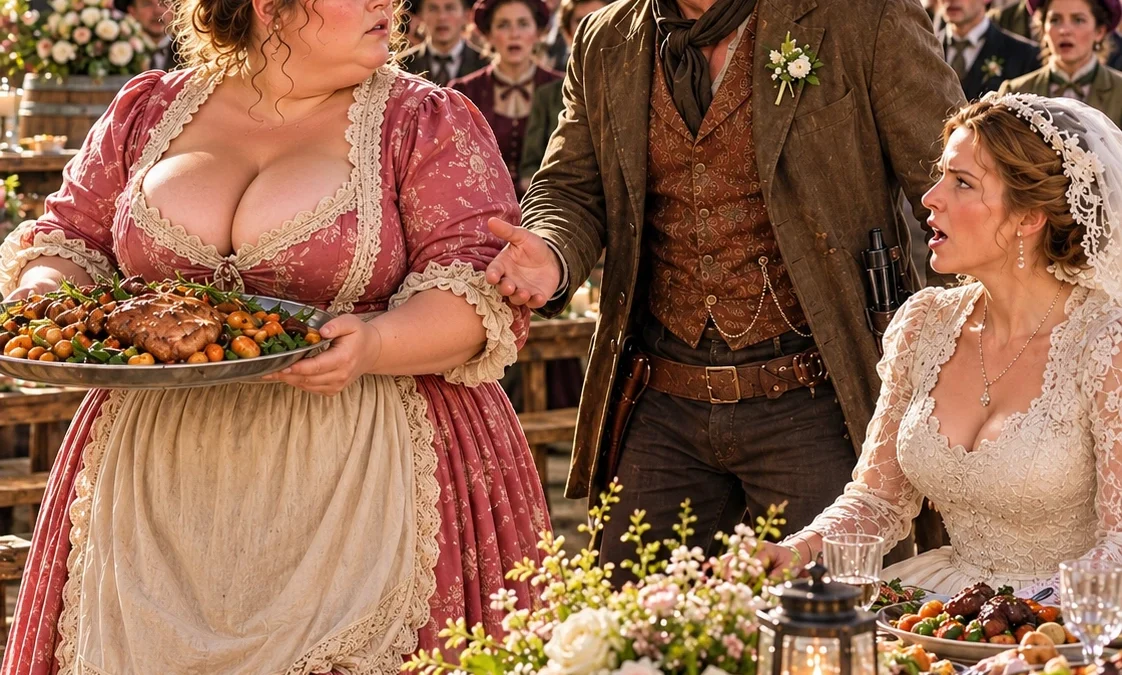
She Cooked the Entire Wedding Feast for 200 Guests, and the Bride Called Her a “Fat Kitchen Widow” to Their Faces. Then the Groom Walked Into the Kitchen and Said Four Words That Ended the Wedding… 😱
Part 1
Hannah Miller did not cry when Victoria Whitmore called her the fat kitchen widow in front of two hundred wedding guests. 💔
She stood behind the kitchen door, her flour-covered hands resting against the wood, listening as laughter rolled through the dining room.
Every dish on those tables had passed through her hands. Every pie. Every loaf of bread. Every delicate sugar rose on the four-tier wedding cake.
Yet the woman receiving the applause had never once asked Hannah how any of it was made.
Hannah looked down at the small burn on her wrist. For the first time that day, she allowed herself to feel it.
Six weeks earlier, she had been standing beneath a leaking roof in her little Wyoming farmhouse, wondering how much longer she could afford to call it home.
Her husband, Thomas, had been dead for six years. The illness that took him had swallowed their savings, leaving Hannah with forty acres, an aging house, and a mortgage that never seemed to grow smaller. She earned what she could, baking bread and preparing meals for neighboring ranch hands.
It was honest work. But honest work did not always pay an honest living.
Then a letter arrived. Forty dollars to prepare a wedding feast at the Bennett ranch.
Hannah read it twice. Forty dollars would cover her overdue payment and buy enough tin to repair the roof before winter.
She accepted that evening.
On the morning she left, she wrapped her mother’s cast iron skillet in an old towel and packed the handwritten recipe book she had inherited. Inside its worn cover, her mother had written a simple instruction.
Make enough for the person who wasn’t expected.
Hannah remembered the extra chair her mother always kept beside the kitchen table.
Somewhere along the way, Hannah had stopped setting one for herself. 🪑
The Bennett ranch was larger than anything she had imagined. Its kitchen alone seemed nearly as spacious as her whole farmhouse. She was studying the enormous wood-burning stove when Victoria Whitmore entered.
The bride wore an expensive traveling dress and gloves that had clearly never touched a dirty dish. Her eyes moved over Hannah’s apron, her broad waist, and her worn shoes.
“You’re the cook.”
“Yes, ma’am. Hannah Miller.”
Victoria placed a folded menu on the table. “You’ll remain in the kitchen throughout the celebration. The guests won’t need to see you.”
Hannah glanced toward the dining room. “Will I be allowed to supervise the service from here?”
“That’s what the kitchen door is for.”
For a moment, Hannah considered leaving. Then she remembered the banker’s letter waiting on her kitchen table.
People who have never worried about losing their homes often mistake silence for agreement. They rarely consider how expensive a simple refusal can become.
Hannah lowered her eyes. “I understand.”
Victoria left without another word.
Hannah opened her mother’s recipe book, tied her apron, and began working. Outside, the afternoon sunlight stretched across the empty dining room. Inside, she prepared a feast for people who had already decided she did not belong among them.
The first time Caleb Bennett entered the kitchen, Hannah was kneading bread beneath the pale light of dawn.
He wore dusty boots and a faded work shirt. Silver touched his dark hair, and his hands looked like they belonged to a man who knew the weight of a shovel.
“Morning. Caleb Bennett. Mind if I get some coffee?”
Hannah stepped aside. “It’s your kitchen, Mr. Bennett.”
“You’re the one running it.”
He sat at the far end of the worktable and watched the sun rise through the window. He did not question her work or ask why she had not finished something. For twenty minutes, he simply let her work.
The next morning, he returned. And the morning after that.
By the end of the second week, Hannah had begun setting out a second cup before he arrived. ☕
One morning, Caleb watched her turn a loaf upside down and tap its bottom.
“What are you listening for?”
“A hollow sound means it’s done.”
“And if it doesn’t sound hollow?”
“Then you wait.”
He smiled. “My mother used to say that about people.”
Hannah looked up.
“It’s been twelve years since she passed.” He turned his cup between his hands.
Hannah recognized the quiet that followed. Grief did not always arrive as tears. Sometimes it lived in an empty chair or a morning habit nobody remembered starting.
“My mother taught me to cook,” she said. “She always made enough for one more person.”
Caleb looked toward the empty dining room. “Mine did, too.”
Neither spoke for a while.
Hannah had spent years being useful to people who never wondered what she remembered, feared, or missed. Caleb asked questions and listened to the answers.
That was what frightened her.
Then, one afternoon, she found something that made her blood run cold. 😨
Tucked among the kitchen invoices was an unsigned document: the sale of Caleb’s eastern grazing land to a railroad group connected to Victoria’s father. And somewhere in that pasture ran a creek that kept three families alive, including her own.
Part 2
Hannah handed the document to Ruth Dawson, the longtime housekeeper.
Ruth glanced at it. “His father built this ranch on those acres. Caleb never wanted to sell.”
“Then why is he considering it?”
Ruth folded the paper. “Sometimes families call something a wedding gift when it’s really the price of keeping everyone happy.”
That evening, Hannah watched Caleb ride toward the eastern pasture. She thought about her own forty acres and everything Thomas had left behind. Land could be measured in dollars. What it meant to lose it was harder to calculate.
The next afternoon, she carried lunch to the ranch hands repairing a fence in the eastern pasture. Caleb walked her toward an old stone marker beside the creek.
“My father put that there forty years ago.”
Hannah watched the water moving between the cottonwoods. “This creek runs through my property.”
Caleb nodded. “The railroad wants to redirect part of it.”
“Have they spoken to the families downstream?”
He looked toward the distant hills. “They’ve promised compensation.”
“That’s not what I asked.”
Caleb turned toward her. For a moment, Hannah feared she had overstepped.
Then he looked back at the creek. “No,” he admitted. “I don’t believe they have.”
That night, she heard raised voices outside the kitchen. Victoria was arguing with Caleb about the sale.
“My father has already promised those investors. Do you understand what happens if you refuse?”
“I understand what happens if I agree. Your father built this ranch so you wouldn’t have to live like the people working for you.”
“He built it by working beside them,” Caleb said quietly.
Silence followed. Then Victoria mentioned Hannah. The words were familiar. Fat. Poor. Widowed. Foolish enough to imagine Caleb might care about her.
“Don’t speak about her that way,” Caleb said.
Hannah retreated into the pantry. She was grateful he had defended her. She was also ashamed of how desperately she wanted his defense to mean something more.
A kind word could become dangerous when someone had gone too long without hearing one. 💛
The following day, Ruth brought an old ranch ledger into the kitchen while searching for a recipe Caleb’s mother once requested. Hannah noticed a familiar name on one of its pages.
Thomas Miller. Her husband’s father.
The entry described an agreement granting three neighboring families continued access to the eastern creek.
Hannah read it twice. If the railroad redirected the water, her property would not be the only one affected.
She asked Ruth to bring Caleb. When he arrived, she placed the ledger before him.
“I’m not telling you what to do with your land. But your father made promises to people who trusted him.”
Caleb studied the signatures. “I didn’t know about this.”
“Neither did I.”
He ran his thumb along the faded handwriting. “I’ve been thinking about what selling that pasture would mean to me.” He looked at her. “I never asked what it would mean to anyone else.”
He promised to review the agreement before signing anything.
Later, Victoria entered the kitchen and noticed the ledger. “So now you’re advising Caleb about our business.”
“I’m trying to protect my water.”
Victoria’s expression tightened. “My father has spent years arranging this investment. If Caleb refuses, my family loses everything we’ve worked toward.”
For the first time, Hannah heard fear beneath her anger.
“Do you know what it’s like having an entire family depend on you?”
Hannah thought of Thomas, the mortgage, and six winters spent keeping their home standing.
“Yes,” she answered.
Victoria looked away.
Hannah understood then. Victoria was frightened of disappointing her family, just as Hannah was frightened of losing hers. But fear did not give either woman the right to make someone else pay the price. 🕊️
That night, Hannah wrote to the county land office requesting copies of the creek agreements.
By two o’clock on the morning of the wedding, she was already at work. Fourteen pies cooled in the cellar. Fresh bread filled the kitchen with warmth. Smoked hams waited beneath clean linen. At the center of the worktable stood the four-tier wedding cake, decorated with roses and sweet peas.
Hannah touched one delicate sugar flower. Her mother would have loved it. 🌹
Shortly before noon, Ruth entered with a letter from the land office. The old creek agreements were valid, but the railroad’s proposed contract offered no clear protection for the neighboring families.
Hannah tucked the letter into her recipe book. She would speak with Caleb after the wedding.
Victoria appeared in her ivory gown. For a moment, she simply stared at the cake.
“It’s beautiful,” she admitted.
“Thank you, ma’am.”
Then she adjusted her gloves. “Remember our arrangement. Stay in the kitchen.”
By afternoon, two hundred guests filled the dining room. Hannah heard their compliments through the door. Someone called the bread extraordinary. Another asked who had prepared the pies.
Then Victoria rose to speak.
“Oh, we hired a local widow,” she laughed. “A rather large woman who probably spends more time eating than cooking.” 😳
Part 3
Laughter spread across the room.
“She’s lucky we gave her the opportunity.”
Hannah stood motionless. She looked at the burns on her wrists, remembering six weeks of early mornings and carefully measured ingredients.
What hurt was not that Victoria had taken credit. It was hearing the work Hannah loved turned into something shameful.
She removed her apron and began packing her knives.
Caleb entered before she reached the door.
“Hannah.”
She kept folding the towel around her mother’s skillet. “I heard what she said.”
“I’m sorry.”
Hannah looked at him. “I needed this job, Caleb. That doesn’t mean I deserved any of it.”
“No. You didn’t.”
He noticed the letter beside her recipe book. She explained what the land office had confirmed.
Caleb listened. “I’ve already refused to sign the agreement until those families are protected.”
“And Victoria? Does she know?”
He looked exhausted, but his voice was steady. “Hannah, I can’t marry her.”
She felt her heart tighten.
“Then tell her,” she said. “But don’t make that decision because of me.”
Caleb stepped aside. Hannah picked up her basket and walked out.
She had almost reached the road when the music stopped. 🎻
Minutes later, Ruth hurried toward her. “Caleb ended the wedding.”
Hannah stared at her.
“He told everyone he couldn’t build a marriage on contempt and promises neither of them believed in. Victoria’s father threatened to withdraw his investment. Caleb said the land wasn’t for sale under those terms.”
Hannah felt no triumph. A wedding had ended. Two families had been humiliated. Whatever happened next would leave scars.
She returned to the kitchen. Caleb stood beside the empty chair.
“I should have stopped this weeks ago.”
Hannah set down her basket. “Yes. You should have.”
He accepted the words without defending himself.
Then Victoria entered. Her wedding dress was wrinkled, and a broken pearl necklace hung from her hand.
She looked at Hannah. “I knew the cake was beautiful. I knew you worked harder than anyone here.” She swallowed. “I couldn’t stand watching him admire you.”
For the first time, Hannah saw fear rather than arrogance in Victoria’s eyes. But understanding someone’s fear did not require accepting what they had done with it.
“I wish you’d told the truth before you needed it.”
Victoria lowered her gaze and left.
Caleb asked Hannah to stay. She shook her head. “I need to go home.”
He did not stop her.
Outside, the evening sun stretched across the road. Behind her, the kitchen door remained open, the untouched plate still waiting beside the window.
For the first time, the chair was empty because Hannah had chosen to leave. 🌅
Eleven days later, Hannah stood beneath her farmhouse roof, listening to the rain.
For the first time in six years, no water dripped into the kitchen. The wedding money had paid her overdue mortgage and bought enough tin to repair the roof. She carried the old leaking bucket into the barn.
The house was still small. The fences needed mending. Winter would bring new expenses. But the land was hers.
That afternoon, Ruth arrived with a letter from a cattleman who had attended the wedding. He wanted Hannah to prepare dinner for sixty guests in Laramie. The payment was three times what she had earned at the Bennett ranch.
More importantly, he wanted her name printed on the menu.
Hannah read the letter twice. For years, people had praised her food without remembering who made it. Now a stranger wanted to hire her because he remembered.
She accepted.
That evening, she opened her mother’s recipe book and began planning the dinner. For the first time, she wrote her own name beneath the menu title. ✍️
Ruth also brought news of Caleb. He had refused the railroad agreement and was negotiating protections for the families who depended on the eastern creek. He had not asked Ruth to bring Hannah back.
She appreciated that more than she expected.
A week later, Hannah wrote him a letter. She told him about the Laramie dinner and asked whether he would be in the kitchen at five on Thursday morning.
When she arrived, two coffee cups waited beside the stove. Caleb stood as she entered.
“Congratulations on the dinner.”
“Thank you.”
They sat across from each other. Hannah told him she intended to keep her land and build a business under her own name.
“I don’t want to spend the rest of my life depending on someone else.”
“I’m not asking you to.”
She studied his face. “I’m afraid of needing someone again. I’m afraid of making promises I don’t know how to keep.”
Neither tried to offer an easy answer.
After a while, Caleb asked whether he might visit her farmhouse on Sunday.
Hannah smiled. “Bring coffee. Mine’s terrible.”
Three weeks later, he asked her to marry him. 💛
They wed in October beneath the cottonwoods beside her farmhouse. Hannah wore her best blue dress with her mother’s old apron tied beneath it.
She had once believed strength meant never needing a place at anyone else’s table. But surviving alone had taught her how to endure loneliness, not how to stop feeling it.
Caleb had not given her a new identity. Her forty acres, her work, and the years she had spent keeping herself alive still belonged to her. Love did not have to erase any of them.
After the ceremony, Hannah returned to the kitchen and placed two coffee cups beside her mother’s recipe book. Caleb entered carrying fresh bread and pulled out a chair.
This time, Hannah sat down first. ☕
Sometimes the smallest sign of a better life is simply having someone to share your morning coffee. 💛
This story is entirely fictional and created for entertainment purposes only. It does not represent any organization or individual, nor does it encourage inappropriate behavior. The content was generated with AI assistance.








