She Didn’t Bother Fixing Her Hair for Her Father’s “Humble” Guest. By Noon the Next Day, She Learned He Was the Duke, and the Lie That Had Erased an Old Woman’s Name Was Already in the Parish Book
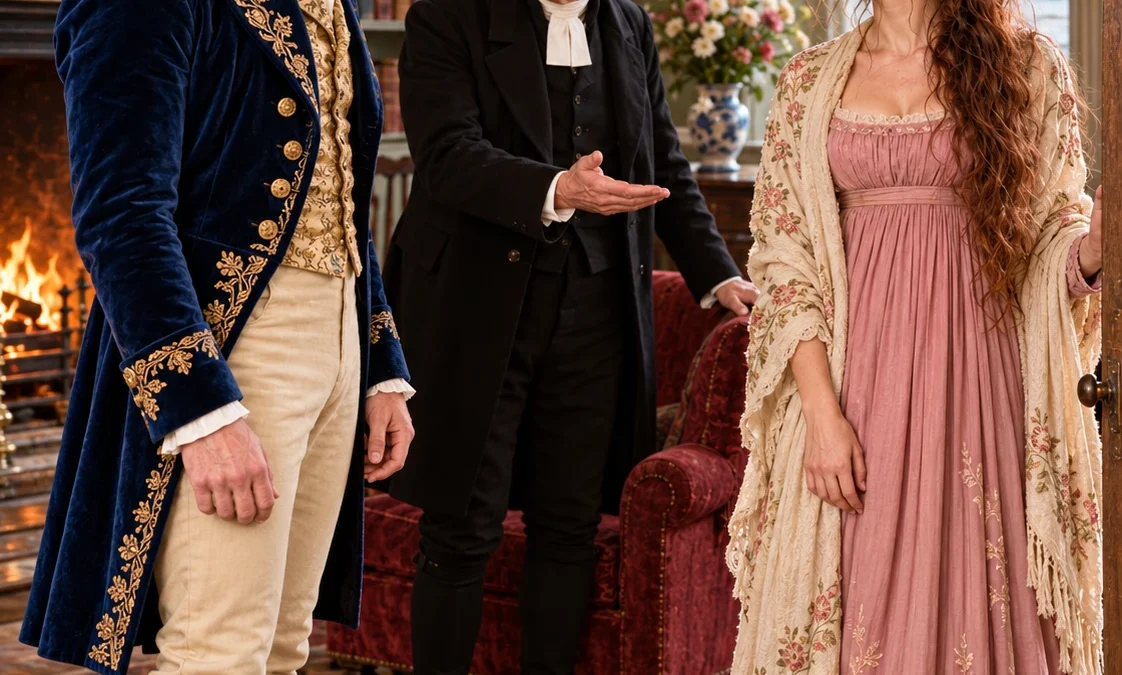
😱 She Didn’t Bother Fixing Her Hair for Her Father’s “Humble” Guest. By Noon the Next Day, She Learned He Was the Duke, and the Lie That Had Erased an Old Woman’s Name Was Already in the Parish Book 📖
PART 1
The weather turned in the middle of the afternoon, the way it always did on that coast in the week before Michaelmas. 🌊
All morning the sea had lain flat and pale under a thin sun. Then a line of dark cloud came up out of the southwest, and the gulls rose off the beach all at once and went inland, crying.
Harriet Wickridge saw them go over the churchyard wall. She knew what it meant. She did not stop working.
She was kneeling in the long grass beside a leaning headstone, copying the last lines of an inscription the salt wind had nearly worn away. If she did not take it down today, the first winter storm would take it for her. The first drops struck her paper while she was still on the second line.
Then the wind came over the wall in a single long push, and her bonnet went sailing across the graves like a frightened hen. She let it go. She finished the line, slid the paper inside her bodice to keep it dry, and only then got to her feet.
That was when she felt the pins go. 🌬️
Her hair came down past her shoulders in a wet brown tangle that whipped across her eyes and stuck to her mouth. She laughed, because it was all she could do, and ran down the lane toward the rectory, rain coming sideways, the whole gray sea behind her turning white at its edges.
She came in by the kitchen door like a wave breaking.
“Miss Harriet, look at you!” The housekeeper’s mouth fell open. “Your father has a gentleman in the study this half hour asking for you. Come about the registers, he says. You’ll want to put your hair to rights.”
Harriet looked at her hands. Ink on two fingers. Grass stains on the cuff. A long smear of lichen across her wrist. She thought of the gentlemen who usually came about the registers: elderly antiquarians in snuff-colored coats who never once looked up from the page.
“He has come to look at old books,” she said. “He will not be looking at me.”
She went down the passage to the study exactly as she was.
Her father sat by the driftwood fire, a rug over his knees, turning his face toward the door the way he did now, listening rather than looking. His eyes had been failing for three years.
“There you are, my dear. Harriet, this is Mr. Daniel Fairley, who is writing a history of the family at Briar Cross.”
The gentleman stood at the window with the storm behind him. Tall, perhaps thirty, in a plain dark coat, his boots muddy to the ankle. Chestnut hair darkened by rain. And eyes the color of dark honey, warm and steady, that traveled slowly from her wet hair to the ink on her fingers and came back to her face.
He did not smile. Something moved at the corner of his mouth and was put away again. 😶
“Forgive me,” Harriet said, lifting her chin. “I did not think it worth keeping you waiting while I went upstairs to be made presentable.”
“No,” he said. “I am glad you did not.”
It was said so plainly she could not tell whether he was teasing.
He asked about a certain Lady Sophia, the old Duke’s aunt, who had left Briar Cross very young and was never spoken of again. Harriet kept her voice ordinary. “She ran away with the village schoolmaster, and her father never forgave her. They say he turned her portrait to the wall of the long gallery. They say it still faces the wall.”
“And what do you say, Miss Wickridge?”
She was cold, wet, and more disturbed than she wished to be, and it made her blunt. “I say the family at Briar Cross has had its back to this village as long as that portrait has had its face to the wall. And now there is a new Duke no one has ever seen, and I expect he will sit in London and believe whichever story is told him most prettily.”
Her father said, “Harriet,” mildly.
But the gentleman did not seem offended. That small movement came again at the corner of his mouth, and this time it stayed a little longer. 😏
“Then he should come and ask for it himself,” she added, “instead of sending gentlemen to write histories.” She heard how it sounded. “I beg your pardon. You are not to blame for the Duke.”
“No,” he agreed, very gravely. “I am not to blame for him at all.”
Her father explained the rest. A very gracious widow, a Mrs. Camilla Royal, had come in August while Harriet was away nursing a friend. She had asked to see the old register, and he had let her sit alone with it in the vestry for a whole afternoon. She believed Lady Sophia had been her grandmother. She had written to the Duke to say so.
Harriet said nothing. She was thinking of an old woman in a cottage by the church who mended nets by touch because her eyes were too poor to see the twine. She was thinking of a promise she had made at fourteen: My mother wanted nothing from that house, child, and I want nothing either. Let it lie.
She had let it lie for ten years. 🤫
The next morning, the weather had blown itself out exactly as she had said it would. She put her hair up with every pin she owned and told herself it was because of the wind. At the lychgate, Mr. Fairley was waiting with her lost bonnet in his hand, ruined beyond saving. She thanked him as gravely as if it were a crown.
In the cold vestry, she opened the parish chest and lifted out the oldest book, bound in soft brown calf. She found the marriage of Thomas Sams, schoolmaster, and Sophia Spinster, with no family name for the bride at all.
“I have always thought it the bravest line in the book,” she said softly. “She walked out of that house with nothing but her Christian name.”
“And the children?” he asked.
She turned to the christenings. She knew the page without counting. She put her finger beside the entry to show him, and then she stopped, and the cold of the vestry went into her all at once.
The entry did not say what it had always said. It said Mary, daughter of Thomas Sams and Sophia his wife. The ink was brown like the ink around it. The hand was close to the old curate’s, but it was not his. The name was wrong. The date beside it was wrong, too. 😨
She tilted the page against the green window. Under the new letters, the paper had been scraped almost through, and in the thinness, faint as breath on a mirror, lay the ghosts of the old words.
“This page has been altered,” she said, her voice strangely calm. “Someone has scraped away the entry and written another in its place.”
“What did it say before?” he asked quietly.
She closed the book and held it to her chest with both arms. She thought of the old woman with the nets.
“I cannot tell you that. Not yet. It is not mine to tell.”
She waited for him to argue. Any other gentleman would have said that she was a parson’s daughter and had no business keeping secrets from her betters. Mr. Fairley looked at her for a long while, as though she were a page he was learning to read.
“Very well,” he said. “I will wait.”
He put on his hat and walked out into the bright morning, and left her alone with the book.
Harriet found Agnes Toms on her bench by the churchyard wall, fingers moving through a heap of torn net, deep-set dark eyes turned toward the sea. She told her everything. When she reached the new name, the old fingers stopped.
“Mary,” Agnes said, tasting the word. “There was never any Mary. There was only me.” 💔
PART 2
Agnes’s voice was dry as driftwood. “I was scraped out the day I was born, child. My grandfather saw to that. My mother never had a penny from that house, and she never asked. She taught me my letters on a slate by this very fire.”
“I know,” said Harriet. “But this is different. They have written a lie over you in a book that is in my keeping.”
Agnes was quiet a long time. Then: “This Mr. Fairley. What sort of man is he?”
Harriet thought of muddy boots, a ruined bonnet carried up the lane, and Very well, I will wait, said as though it cost him nothing. “I don’t know yet. I think he is a man who listens.”
“Then bring him to me when you know.”
So for days she went up to the vestry at nine, and he was waiting at the gate with his hat in his hand. He wanted to read the whole of the old register, he said, not just the Briar Cross pages. She taught him the tall S that looked like an F. He read fif for fish and could not stop seeing it until she laughed too, and the sound rang up into the cold rafters and surprised them both. 😄
“The gentlemen who come to read our books never want the plowman,” she said. “Why do you?”
His finger rested beside the burial of a drowned sailor, name not known. “Because I was not always somebody. I was the son of a younger son, raised in lodgings that smelled of other people’s dinners. I used to think nobody would ever write my name down anywhere that mattered.” He moved to the next line. “Someone ought to know who these people were.”
Harriet found she had nothing to say to that. After a while, she turned the page.
On Thursday, he asked her and her father to Weymouth, to an assembly where Mrs. Royal would be. Harriet pinned her hair as firmly as she could. Within ten minutes, the sea wind had pulled half of it loose.
Mrs. Royal was the center of the room: a handsome woman of forty in dove-gray silk so beautiful it made every other gown look like a dishcloth, her hair a smooth dark gold without one strand astray. She was telling a crowd by the fire how her mother had been christened at Holcombe, in the little church above the sea, on Lady Day, and how her grandmother had carried her up that hill in the snow.
“And this must be the rector’s daughter,” she said sweetly, her eyes traveling from Harriet’s loosened hair to her old gray silk. “How refreshing to meet a lady who cares so little for appearances.”
Someone laughed behind a fan. “I care a great deal for them, ma’am,” Harriet said. “It is only that the wind cares more.”
Mr. Atwell, a stout antiquarian in a striped waistcoat who had once visited the rectory and not spoken a word to her, told the company she copied gravestones “like a stonemason’s boy.” Several people laughed.
Harriet barely heard. She was thinking about Lady Day. The date beside the forged name was Lady Day. And a grandmother who never spoke of it had somehow handed down the feast day, the hill, and the snow? Nobody writes the weather in a parish book. 🌨️
In the carriage afterward, with her father asleep against the window, Mr. Fairley said quietly, “Lady Day.” She looked up. “A story nobody told her has grown a great deal of weather. Someone who sat with that book for an afternoon could learn the date. The rest she would have to invent.” He turned from the black glass. “I think you know more than you have said. I am not asking. But I am not a fool, Miss Wickridge. I can see you are protecting someone.”
Two days later, a letter arrived sealed in black wax with a coronet. His Grace the Duke had returned to Dorset, and would be obliged if the Reverend Mr. Wickridge and his daughter would call at Briar Cross on Thursday, with the old register. By the same post came a short note from the inn: Mr. Fairley had been called away to attend his Grace, with apologies. It was signed only with his initials.
Harriet felt an odd hollowness, as if a step she had expected had not been there.
On Thursday she changed gowns twice and pinned her hair with every pin in the house. “You have taken great trouble this morning,” her father said. “I am going to meet a duke, Papa.” “Ah,” said her father mildly. “Of course. The Duke.”
Briar Cross stood on the high ground above the next bay, a long gray house with its back to the downs and its face to the sea. The footman led them into the long gallery, with tall windows full of sea on one side and gilt-framed ancestors on the other. Near the far end, between a gentleman in armor and a lady in a ruff, was a frame that showed only its back. Brown canvas. A wooden stretcher. A cobweb in the corner.
It had been turned to the wall, exactly as the village said. 🖼️
Mrs. Royal sat by the window, smiling warmly. At the far end, a tall man in a dark coat stood with his back to them, looking out at the sea.
“The Reverend Mr. Wickridge, Your Grace, and Miss Wickridge.”
The man turned. Chestnut hair. Steady dark honey eyes. He was not wearing a plain coat today. He was wearing a very good one.
And Harriet stood in the middle of the long gallery with the register in her arms and every pin in her hair, and looked at Mr. Daniel Fairley, and understood at last who her father’s guest had been. 😳
She sank into a curtsy so deep and correct that her old dancing master would have wept. When she rose, her face was perfectly calm and perfectly white. She did not look at him again.
Mrs. Royal spoke beautifully, with a little catch in her voice. Harriet, in a clear cold voice, said the page had been scraped. The Duke held it to the light. “Old books are always being mended, Your Grace,” Mrs. Royal said gently. “Some careless curate blotted his line. I am sure Miss Wickridge knows that better than anyone.” She smiled. “She knows so much.”
When the others had gone, Harriet was alone with the Duke, the turned portrait, and the sound of the sea against the cliffs.
“You stood in my father’s study,” she said, wrapping the register with unsteady hands, “and let me say the Duke would believe whoever flattered him. You let me teach you to read as if you were a stranger. And all the time you were laughing at me.”
“I was never laughing at you.”
“Then what were you doing?”
“Mrs. Royal wrote to me in London. She said the rector’s daughter was a meddling, clever girl who would say anything to keep the favor of the village. And I knew that if I came as the Duke, you would put up your hair and tell me exactly what you thought a duke wished to hear. Everyone does.” He paused. “So I came as Daniel Fairley. It is my name. I did not lie about that. Only about everything that comes after it.”
“And I walked in with my hair down my back,” Harriet said bitterly.
“I thought, here is someone who will not arrange a single thing for my sake. I have not met many of those. I did not want to lose the only one I had found by telling her who I was.”
“I put it up today with every pin in the house.”
“I noticed,” said the Duke. “I liked it better the other way.”
She did not trust herself to answer. She turned toward the door. Behind her, he crossed to the far wall, took hold of the frame that showed only its back, lifted it from its hook, and turned it round.
A girl of about seventeen in a white gown, sitting in a garden with the sea behind her. Too thin in the face, too wide in the mouth, with straight dark brows over deep-set dark eyes that looked out of the canvas as if they could see straight through whoever stood before them.
Harriet knew that face. She had sat beside it on a bench in the sun a fortnight ago. 😮
PART 3
“You know who she is,” the Duke said quietly. “Not Lady Sophia. The one who has her eyes.”
“I know whose name was written on that page before somebody scraped it away,” said Harriet. “And it is still not mine to tell. I gave my word.”
“Then ask whoever holds your word whether she would come and see her mother’s face. Tell her the picture has been turned round. Tell her I will not turn it back.” He looked down at the girl in white. “Someone ought to have done it long ago.”
When Harriet reached the cottage, Agnes heard her step a long way off. Harriet walked differently when she was hurt, as if the ground had tilted and she was too proud to let it show. When she reached the part where the Duke took the portrait down with his own hands, the old woman’s fingers went still in the net.
“You love him,” said Agnes.
“I do not. He lied to me for a fortnight.”
“Mm. And you have been crying about it all the way up the lane. I could hear it in your feet.” She folded the net. “Very well. I will go and see my mother. But I will tell him myself what I want from him. It is not his money, and it is not his house. It is my name, put back in the book where it belongs.” 🥹
The next afternoon, Agnes rode to Briar Cross in the Duke’s carriage while half the village watched from their doorways. In the long gallery, the Duke did not bow to her as a duke bows to a fisherman’s widow. He gave her his arm as he would have for a duchess, and set a chair before the portrait.
Agnes leaned until her face was close to the canvas, and laid her old brown fingers on the painted cheek. “That is my mother. That is how she held her head when she was cross with me. I had forgotten.”
She turned toward the Duke. “I am Agnes Toms, Your Grace. I was christened Agnes Sams in Holcombe church. I want nothing from you, not a shilling. I only want what was mine put back where it was.”
The Duke knelt beside her chair. “Then you shall have it, cousin. I give you my word.” 🤍
He walked them home along the clifftops that evening, because Agnes wanted to feel the wind. Where the path dropped steeply over loose shingle, Harriet’s foot slipped, and he caught her hand. He did not let it go. She did not take it away.
“My father was struck out of this family too,” he said, low. “Not painted and turned to the wall, just struck out. He died waiting for a letter. And then a fever, a fall from a horse, a ship lost off Ireland. In two years, every man who stood between me and this house was dead.” He looked down at their hands. “I walked that gallery every night for a month, looking at the back of that picture. I could not turn it. I kept thinking that if I touched it, I would become the man who turned it in the first place. That is what I was afraid of when you asked me. Not the title. The kind of man it makes.”
“You turned it,” Harriet said.
“Because you looked at it, as if somebody ought to.”
She let him keep her hand all the way to Agnes’s door. 💞
But Mrs. Royal was not finished. She came to the rectory when Harriet’s father was out, sat in the rector’s own chair without being asked, and smiled. “I sat in this room in August, and I glanced at your new register. Every entry for three years in the same small, pretty hand. The minister’s name at the foot of each, too.” She drew on her glove, finger by finger. “The archdeacon will not see that so kindly. Your father will lose his church and his house. Or you may tell his Grace you were mistaken about the page. I shall write to the archdeacon on the morning of Michaelmas. Think of your father.”
Outside, a horse picked up a stone, and Mrs. Royal’s carriage halted in the lane near Agnes’s bench. Through the open window, Agnes heard a sound she had not expected: a woman crying, not prettily, but dry and ugly and hopeless. “If this fails, there is nothing. I have spent the last of it on this.”
Agnes sat a long time with her hands in the net. So she is frightened, too. And she found, to her own surprise, that she was sorry for her.
Harriet did not sleep. She sat with the new register, looking at her father’s name in her own hand down every page. She thought of the scraped page and every name in that old book that nobody had ever cared to write down anywhere else.
At gray dawn she woke her father and told him everything.
He found her hand. “We shall go to the archdeacon today, you and I, and tell him before she does. It was my doing, Harriet, not yours. I asked you to do it. I will not have you carry it alone.” 💪
The archdeacon heard them with his fingers pressed together and his eyes on the ceiling. He would examine both registers himself at his visitation, in the week after Michaelmas, before the clergy and churchwardens, and decide then.
Three evenings later, at a dinner at Briar Cross for Agnes, Mrs. Royal arrived uninvited in silver gray and asked to be heard. “Ask her. She cannot deny it. She has signed her father’s name to every christening since he lost his sight. And now she tells his Grace a page has been scraped. Who else in Holcombe has a pen, a knife, and the key to the vestry chest? The rector’s daughter could not trouble herself to put up her hair for his Grace, but she has found a much better use for her pen.”
Harriet heard set her cap whispered. She stood, legs shaking, voice steady. “It is true I wrote my father’s name, at his asking. I have told the archdeacon so. But I have never touched the old book with a knife in my life, and Mrs. Agnes Toms is exactly who she says she is. You know that, ma’am. You knew it in August.”
Mrs. Royal spread her hands sadly, as if to say you see how she is, and half the faces at the table had already decided.
“I believe Miss Wickridge,” said the Duke quietly. “I believed her in the vestry before I knew anything at all. Mrs. Royal, I think you should go.”
But as Harriet left on her father’s arm, she heard Mr. Atwell in the hall: “Well, he would say so, wouldn’t he? A pretty girl with her hair down.” And when she looked back for the Duke, he was not on the steps.
By morning, the innkeeper’s wife said he had ridden north before dawn with a single groom. He had left no word. 😢
Michaelmas came in with mist and geese. In Holcombe, nobody spoke to Harriet. Two ladies who had sat beside her in church for ten years moved to another pew. Only the children did not seem to know. Agnes’s great-granddaughter gave her a snake stone, the biggest yet. “Gran says you are to have the best one because you are in trouble.”
Harriet sat in the vestry and did the only thing she knew how to do. She read the old book, not the christenings this time, but the burials at the back. And near the bottom of a page, she found him. Thomas Sams, schoolmaster of this parish, buried.
She counted twice on her fingers. The schoolmaster had been lying in Holcombe churchyard for nearly two winters on the Lady Day his daughter Mary was supposed to have been carried to the font. Whoever wrote that page had moved the date forward to fit Mrs. Royal’s own mother’s age. They had only looked at the christenings. They had never once turned to the back of the book. 🔍
She put her face on her folded arms and cried.
The archdeacon held his visitation in the great church of St. Peter in Dorchester, with the fair still going on outside. The church was full. Mr. Atwell sat with the antiquaries. Mrs. Royal sat near the front in dove gray, composed. Harriet came in on her father’s arm with both registers wrapped in a shawl and Agnes walking behind, and felt every head turn.
Mrs. Royal spoke well. Harriet could see the pews believing her.
“Miss Wickridge,” said the archdeacon at last. “What have you to say?”
She carried the old register to his table, held the forged page against the tall east window, and asked him to look at the paper under the name. Then she turned to the burials and found the line.
“This is the burial of Thomas Sams, schoolmaster, husband of the lady in Mrs. Royal’s story. He was buried nearly two winters before the day his daughter Mary is supposed to have been christened. A dead man does not bring a child to the font. Whoever wrote that page knew the christenings, sir. They never once looked at the back of the book.”
Mrs. Royal rose, her lovely voice not quite steady. “She has a pen and a knife and the habit of writing other people’s names. How can anyone take her word for what it said before?”
“She does not ask you to take her word,” said a voice from the back of the church. 🔔
Every head turned. The Duke of Holme stood in the west doorway, splashed with mud to the thighs, coat dark with rain, four days of stubble on his jaw. He came up the long aisle without hurrying and laid a sealed paper before the archdeacon.
“From the bishop’s registry at Bristol. Every parish sends the bishop a fair copy of its register at the end of each year. They have done so for two hundred years. This is the copy Holcombe sent in the year of that christening, in the old curate’s own hand, with the registrar’s seal.” He looked at Harriet, and for a moment the crowded church was not there at all. “Miss Wickridge once told me the old books must be read with patience. I took her at her word.”
The archdeacon broke the seal and read aloud in his dry carrying voice. “Agnes, daughter of Thomas Sams, schoolmaster, and Sophia his wife.”
No Mary. There had never been any Mary at all.
Agnes stood up in the front pew with her stick in her hand. She did not say anything. She did not need to. She stood small and straight in her Sunday black, her mother’s dark eyes in her old brown face, and let the whole church look at her. 🥹
The archdeacon gave judgment before noon. The entry had been altered by a hand not the curate’s. It would be corrected by a margin note written by Miss Wickridge and signed by himself. The new register was the best-kept book he had seen in thirty years of visitations. From this day, Mr. Wickridge would sign his own name at the foot of each entry, however poorly he could see, while his daughter held the pen for all the rest.
“The rector keeps his church.” He looked over his spectacles at the antiquaries. “And I should be glad, Mr. Atwell, if your gentlemen would take some trouble to keep their own books half so well.”
Mr. Atwell went a dull red and studied his boots.
Mrs. Royal went down the aisle alone, gray silk whispering on the stones. At the door she looked back, and for a moment her face was not lovely at all. It was only tired and frightened and forty. “You do not know what it is,” she said to nobody in particular, “to be nobody’s.” Then she was gone.
Agnes found the Duke’s sleeve. “Let her go, Your Grace. I heard her crying in the lane. She is frightened, the same as we were.”
The Duke would not have her pursued. She left Weymouth by the evening coach, and nobody in that part of Dorset ever saw her again.
He found Harriet in the churchyard behind St. Peter’s, where she had gone to be out of the crowd. Mist had come down soft and white over the town, and the noise of the fair was muffled in it.
“You went to Bristol,” she said. “I could not have done it. They would not have let a rector’s daughter into that strong room. I found the burial, but it would have been my word against hers, and half that church had decided what I was before I opened my mouth. You brought the thing that could not be argued with.”
“Harriet.” He came closer. “I am a new duke and a poor hand at it, and I have been afraid since the spring of becoming the kind of man who turns faces to the wall. And then a girl came in out of the storm with her hair down her back and ink on her fingers, and told me exactly what she thought of me, and did not trouble to tidy herself first. I have loved you since that afternoon. I do not want a duchess who will arrange herself for my sake. I want you exactly as you are, with the registers and the gravestones and the snake stones on the windowsill. Will you marry me?”
She looked at him a long moment, the bells of the town beginning to ring for noon. Then she set the register carefully on the wall.
“I will keep the books. Holcombe’s and Briar Cross’s. And I will not give up the gravestones.”
“I would not dream of asking you to.”
“Then yes,” said Harriet. He drew her close and kissed her in the churchyard while the mist drifted over the old stones and the bells rang on over the fair. 💍
They were married on a Tuesday in the middle of November in the little church above the sea. Her father read the service by heart, because he did not need to see the page. Agnes sat in the front pew in a new black gown the Duke had not been permitted to pay for, her great-granddaughter beside her holding a basket of snake stones in case the bride should want one. Afterward, in the cold vestry under the green window, Harriet wrote the entry of her own marriage into the register, and her father signed it himself, slowly, her fingers resting lightly over his to guide the pen to the line.
At Briar Cross, the portrait of the girl in the white gown hung in the long gallery, facing the room. Nobody ever turned it to the wall again. On fine evenings, the new duchess would stop before it with her husband, and the girl in the garden looked back at them both, as if she had been waiting a long time for someone to look. 🖼️
And on the evening of their wedding, they walked home along the clifftops in the last of the light. The wind came in off the sea in a single long push, the way it always did on that coast, and found Harriet’s hair and pulled it loose all at once. She put up her hands to catch it.
Her husband caught them first, and held them, and smiled.
“Leave it,” he said.
So she left it, and the wind had her hair all the way home. 🌬️❤️
💬 Have you ever been loved most by the person who saw you at your least “presentable”? Tell me your story in the comments. 👇
Disclaimer: This story is entirely fictional and created for entertainment purposes only. It does not represent any organization or individual, nor does it encourage inappropriate behavior. The content was generated with AI assistance.








