SHE DRAGGED HERSELF UP A MOUNTAIN RATHER THAN KNEEL TO THE MOST FEARED MAN IN THE TERRITORY
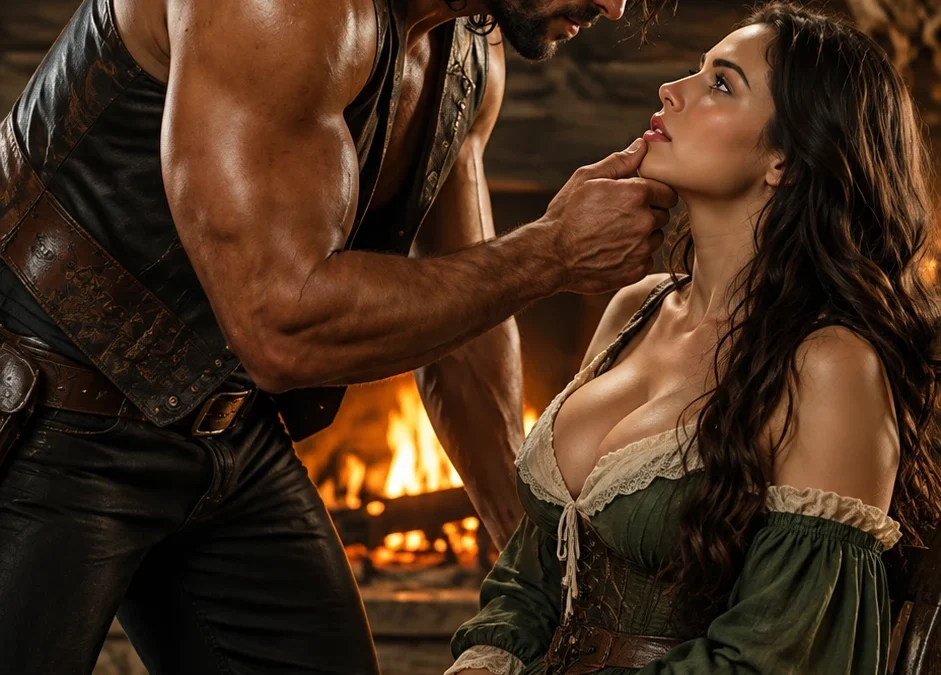
SHE DRAGGED HERSELF UP A MOUNTAIN RATHER THAN KNEEL TO THE MOST FEARED MAN IN THE TERRITORY… BUT WHEN SIX GUNMEN CAME FOR HER, HE CONFESSED THE SECRET HE’D BEEN HIDING SINCE HER FIRST NIGHT 😱🔥
Part 1
She would not kneel.
That was the first thing the Dalton gang learned about the woman they dragged out of the burning town of Red Hollow.
Black smoke rolled across the noon sky. They had burned her town. They had killed her uncle, the blacksmith who raised her. They had taken everything she owned in this world.
But they had not taken the fire behind her eyes. 🔥
Her name was Eliza Crane. Her wrists were rubbed raw by the rope, her blue Sunday dress gone gray with ash, and still she kept her chin lifted every step of the way.
The gang meant to leave her at the foot of Black Pine Ridge, where the most feared man in the territory lived alone. Cole Driscoll. The mountain man. They said he had killed nine men with his bare hands and never raised his voice doing it. They said the wolves gave his land a wide berth. They said he had no use for towns, or law, or women.
The gang did not climb the trail themselves. Cowards rarely do.
They cut her ropes, fired two shots into the air, and rode off laughing.
“Mountain man can have her,” the leader spat, wiping soot from his beard. “Either way, she’s not our problem now.”
Eliza stood alone at the bottom of the ridge with her town burning behind her and the snow already falling, early and mean, the kind that kills.
She could walk down toward the valley, toward the men who’d just destroyed her life.
Or she could walk up.
Eliza Crane did not walk toward men who had burned her home. So she gathered her ruined skirt in raw hands and started to climb.
The pines closed over her within minutes. Twice she heard something heavy move in the trees, pacing her, and she did not let herself look. Her fingers went from aching to burning to a frightening numbness. And still she climbed, because a girl raised by a blacksmith learns young that you do not stop walking just because the road turns hard.
Two hours later, a cabin appeared in the dusk.
And on its porch, a rifle leveled at her chest, stood the mountain man.
He was not what the stories promised. Not a hunched, wild thing of beard and blood. He was tall and broad, with dark hair streaked gray at the temples and a hard, still, watchful face. His eyes were a pale wolf gray, and they did not blink.
“You’re trespassing,” he said.
His voice was quiet. That was the terrifying part. Men who shout can be reasoned with.
“The Dalton gang left me here,” Eliza said, steadier than she felt. “I didn’t choose your mountain, mister. It was just the only direction that wasn’t them.”
The rifle did not lower. His eyes moved over the ruined dress, the soft town boots, the hands that had clearly never skinned a deer.
“You’ll be dead by morning out here.”
“Then I’ll be dead on my feet. Not on my knees.”
Something flickered across his face. Gone before she could name it.
He stepped down off the porch and stopped close, a full head taller. She could see the old white scar slicing through one dark eyebrow.
“Kneel,” he said.
It was a test, she realized dimly. He wanted to see if she was just another soft town thing who would fold and weep and beg.
Eliza Crane, freezing, having lost everything she owned before noon, looked the most feared man in the territory dead in his wolf-gray eyes.
“Make me.”
You could have heard the snow land.
Then, at the corner of his hard mouth, so fast she would later wonder if she’d imagined it, something twitched. Interest, in a man who hadn’t been interested in anything for ten years.
He lowered the rifle and turned his back on her. A man doesn’t turn his back on someone he truly fears.
“Inside,” he said. “You’re no use to anyone frozen on my porch.”
The cabin was warm. A stone hearth, furs on the walls, a pot of stew that smelled wonderful against all reason. He sat apart by the door, rifle within reach, and watched her eat.
That was when she saw the blood soaking the left side of his shirt.
“You’re hurt.”
“It’s nothing.”
“It’s not nothing.” She was already on her feet. “Take off your shirt, mountain man. I’ve seen worse.”
To her surprise as much as his, he did.
By firelight she cleaned the wound, a bear trap gash he’d stitched badly one-handed. He did not make a sound. He simply sat and let a stranger’s hands move over the most vulnerable part of him, as if he’d decided for reasons he couldn’t explain to trust her.
“Why?” he asked, when she tied the last stitch. “Why fix the man who told you to kneel?”
“Because you didn’t make me.” She wiped her hands. “A man who burns a town makes you kneel. You lowered the rifle and gave me stew. I don’t understand you yet, mountain man. But I know what cruelty looks like, and you’re not that.”
He was quiet a long moment.
“Cole,” he said at last.
“Eliza.”
Outside, a storm buried the trail under four feet of snow, sealing the two of them in together for six long days.
By the sixth day, she had made a plan to learn him and escape. By the sixth day, the plan was ruined. 🔥
But on the morning the trail finally opened, Eliza woke to a dried golden flower lying on her pillow. A desert poppy. A flower that grew only in the dry south, the country she’d come from as a child.
“Where did this come from?” she asked.
Cole went very still. “Found it pressed in an old book.”
It was the first thing he had ever said to her that she did not believe.
Then, ten days later, six riders came up the ridge at dawn. And at the front rode the leader of the Dalton gang.
Cole took one look and his whole face changed. He crossed the room, kissed her hard and quick, and said:
“They didn’t leave you on my mountain by accident.”
Then he took down his rifle and walked out onto the porch to meet six armed men alone.
👇 Want Part 2? Comment any word below and I’ll send it to you privately, or find it in the comments!
Part 2
Then he took down his rifle and walked out onto the porch to meet six armed men alone.
Eliza did not hide behind the woodpile as he’d ordered. She crouched by the window, the oilcloth curtain concealing her, heart hammering against her ribs.
Even these hard men, who had burned a town without blinking, kept their distance from the figure on the porch.
The leader walked his black horse forward, grinning the grin of a man more frightened than he wanted to show.
“Mountain man. Heard you took in a stray. We’ve come to collect her.”
“She’s not a thing you collect,” Cole said. His quiet voice carried across the clearing and made the horses stamp.
“She’s worth more than you’ll see in ten lifetimes up here. There’s a man in the south who’ll pay a king’s ransom for that girl.” The grin widened. “He’d prefer her alive. But he was specific that dead would do.”
Eliza’s blood turned to ice.
“Six guns to one, friend,” the leader said. “That’s not much of a choice.”
“You burned Red Hollow,” Cole said. “You put a rope on her and dragged her up my trail to die. Now you’ve come back to do murder for southern coin.” He shifted the rifle, slow and easy. “I’ve let a great many men ride off this mountain alive. Killing is a weight, and I’ve carried enough.”
He stepped to the edge of the porch.
“I’m not going to let you go.”
The leader’s hand dropped to his pistol. Cole was already moving.
The first shot was his. The rider on the far left was down before his rifle cleared the saddle. Then the clearing erupted. Gun smoke. Screaming horses. Flat hard cracks rolling across the snow.
Eliza watched Cole move like nothing she had ever seen. Ten years alone in the wilderness had made him something more than a man. He used the porch post, the woodpile, the angle of the cabin. He never stopped moving and never wasted a shot. A bullet tore a splinter from the door frame inches from his head. He didn’t flinch.
But six guns to one is six guns to one.
She saw it before he did. A rider circling wide around the side of the cabin, lining up the shot Cole couldn’t see.
The shot that would take him in the back.
Eliza did not think. She burst out the cabin door, low and fast, and snatched up the rifle of the first man Cole had dropped. Her uncle had taught her years ago. Lever, aim, squeeze. You never know, girl.
She fired at the rider circling wide.
She wasn’t a marksman. The bullet took his horse instead of the man. But the horse went down screaming and flung him hard into the snow, and the shot Cole couldn’t see never came. 😱
Cole spun at the sound and saw her standing in the open, a smoking rifle in her hands.
“INSIDE!” he roared. It was the first time she’d ever heard him raise his voice, and there was raw terror in it.
But the tide had turned. The thrown rider did not rise. The two still mounted looked at their fallen, at the silent killer on the porch, at the wild-eyed woman with the rifle. And they did what such men always do when the cost climbs higher than the coin.
They ran.
The morning fell quiet. Gun smoke drifted blue across the trampled snow.
Cole crossed to her in three strides and pulled her hard against his chest. She could feel his heart slamming, feel the fine tremor running through all that fearsome strength.
“I told you to stay inside. God, Eliza, he had a shot on me. You could have been…”
“He didn’t,” she said, clutching his shirt. “Because I didn’t stay inside.” She pulled back to look up at him, fierce and pale and steady. “You don’t get to stand alone anymore, Cole Driscoll. Whatever this is, whoever’s hunting me, we stand in it together or not at all.”
He looked down at her for a long moment. The dead in the snow around them. The smoke clearing. The truth he’d been holding finally come due.
“Then it’s time,” he said, “that I told you who you really are.”
👇 Want to see what happens next? LIKE or COMMENT “REVEAL” and Part 3 will be posted once we have enough comments!
Part 3
They buried the dead at the tree line, because even outlaws ought not be left for the wolves. Then Cole sat her down by the fire and told her the truth.
“Ten years ago, I wasn’t a mountain man. I was a territorial marshal, out of the southern district. The dry country.” He turned the dried poppy over in his rough fingers. “There was a man down there named Augustus Vane. Cattle baron. Land baron. He owned half the south and meant to own the rest. The only thing standing between him and the richest valley in the territory was an old land grant, a deed signed under the Spanish crown, held by one family.”
He looked at her.
“The Cranes.”
Eliza went very still.
“Your grandfather held the deed to the Verde Valley. Vane offered to buy it. Your grandfather said no. So Vane sent men in the night.” Cole’s jaw tightened. “I rode out to that ranch the next morning. I found your grandfather, your grandmother, your father, and your mother.”
“The fever,” Eliza breathed. “They told me it was the fever.”
“They told you fever because the truth would have gotten you killed, too. There was a little girl, two years old. A ranch hand carried her out a back window while the house burned. He rode three days north and left her with a blacksmith in a small high-country town who took in strays and asked no questions.”
The fire popped.
“Your uncle wasn’t your uncle by blood, Eliza. He was your blood’s last kindness.”
She sat with her hands knotted in her lap, the world she’d known dissolving and reforming around her.
“And you?”
“I was the marshal who couldn’t prove it.” Ten years of bitterness weighed in his voice. “Vane owned the judges and the witnesses. I pushed too hard. He had me run out, branded a liar, my badge taken. So I walked north until the towns ran out and built a cabin where no man Vane could buy would ever bother to climb.” He held up the poppy. “I told myself I’d left it all behind. The valley. The Cranes. The little girl I never found. Until the Daltons dragged a dark-haired town girl up my trail, a girl who would rather die on her feet than kneel.”
His voice went rough.
“Only one bloodline in the territory ever had that kind of spine. Your grandfather wouldn’t kneel to Vane, and it cost him everything. Then a girl stood freezing in my clearing and said make me. I knew that night who you had to be.”
“The flower.”
“Grows in the Verde Valley. I pressed a dozen the day I rode out, the day I swore I’d find that lost girl if it took my life.” He set it in her palm. “I never did. She found me. Climbed right up my mountain through a killing storm.”
Eliza looked down at the pale gold bloom, the flower of a home she’d never known she’d lost. Her whole life rearranged into something terrible and true, and underneath it all, strangely full of love. A ranch hand riding through the dark. A blacksmith who took in a stray. A ruined marshal who built a fortress at the edge of the world and pressed desert flowers in a book.
“Vane is the man in the south,” she said slowly.
“He’s old now. Dying, they say. And a dying man gets afraid of old ghosts. When word reached him that a girl with the Crane look had turned up in a high-country town, he burned it to the ground trying to put out one last ember.” Cole took her hands. “You’re the rightful heir to the richest valley in the southern territory. And the last living proof of the worst thing Augustus Vane ever did.”
When Eliza lifted her head, the fear was gone from her face. In its place was something her grandfather would have known.
“Then we don’t wait for them to come,” she said. “We go south.”
They came down off Black Pine Ridge in the first thaw of spring.
Cole had not been idle in his ten years of exile. Between trapping and trading, he had quietly found others like himself. A deputy Vane had ruined. A rancher he had burned out. A widow whose husband testified against Vane and was found at the bottom of a dry well a week later.
A scattered handful of bitter people is not an army. They needed something to gather around.
“You give angry people a wrong,” Cole told her by a desert fire, “all they do is drink and curse the dark. You give them a rightful heir, living proof that Augustus Vane is a murderer and a thief, and you give them something to ride toward.”
So town by town, ranch by ranch, they gathered them. Every time a wary, ruined face cracked a door open, Cole would step aside and the lamplight would fall on Eliza, and the desert poppy pinned at her collar, and the dark green eyes the old ones in the south still remembered.
The journey changed her. The soft town girl was worn away on the long road. In her place was someone who could ride sixteen hours and sleep on stone, who could read the dust on the horizon. Cole taught her to shoot properly on those long evenings, not the wild lucky shot that dropped a horse, but the slow, patient marksmanship that had made him a legend.
“Crane good,” said an old vaquero who had ridden for her grandfather, watching her shoot.
One night they camped in the ruins of a burned homestead. Cole sat in the dark by the fallen chimney and said nothing. Eliza slipped her hand into his, and he held it so tight it nearly hurt.
“A man who testified for me before Vane had me ruined,” he said finally. “He had a wife and two little ones. They never found where Vane put them.” He looked at the broken walls. “I used to lie awake on my mountain and tell myself the world’s cruelty was none of my business. You cured me of that, Eliza. The day you wouldn’t kneel. I haven’t been able to look away since.”
By the time they reached the edge of the Verde Valley, green and impossible in the brown desert, they were sixty riders strong. Every one of them had a reason.
On their last night, Cole sat beside her in the dark above the great white house Vane had built on Crane bones.
“Say the word, and we ride in at dawn and finish it. You never have to look that old monster in the face.”
“My grandfather wouldn’t kneel to him,” Eliza said. “I’m going to walk into that house, Cole. I’m going to make him look at the eyes he tried to put out. And then I’m going to take back what’s mine.”
“Then I’ll be one step behind you the whole way.”
“No.” She took his hand. “Beside me. One step behind is for servants. You stand beside me or you don’t stand there at all.”
He huffed a quiet laugh and pressed his rough mouth to her knuckles. “Beside you, then. Always.”
They rode in at first light. Not charging. Not shooting. Sixty strong and silent, they had the house surrounded before Vane’s hired guns finished their morning coffee.
Eliza rode alone up the broad front steps of her grandfather’s house, with Cole exactly one step beside her.
Vane’s men spilled out onto the veranda, thirty rifles ready. And then the great door opened, and Augustus Vane came out. He was older than his legend, bent and thin, his fine coat hanging loose on a hollowed frame. But his eyes were still cold.
“So,” he rasped. “The mountain dog finally crawled out of his hole and brought a…”
His eyes found Eliza. For the first time in thirty years, his face changed. The contempt drained out. Something buried rose up white and afraid.
“No. She’s dead. They’re all dead. I made certain.”
Eliza climbed the steps slow and steady, the desert poppy at her collar, and did not stop until she stood close enough that the dying old man could see her eyes.
“You made certain of everyone but me. A ranch hand carried me out the window while your men burned the house. For thirty years, Augustus, I grew up free, never knowing your name, never thinking of you once.” She tilted her head. “You spent your whole life afraid of a ghost, and you never even knew if it was real.”
“Guards!” Vane shrieked. “Kill them! I’ll pay! Gold! Land! Anything!”
Not one man moved.
Vane had believed, as cruel men always do, that fear and money would hold his guns forever. But fear curdles. A man who learns he’s been paid to murder the rightful heir of the valley, to finish a thirty-year-old crime his own father whispered about in shame, finds his gun gets very heavy.
A young hired gun lowered his rifle first and set it on the boards. Then he took off his hat. Another followed, and another. Down the whole veranda in the gray dawn, Vane’s army laid down its guns and bared its heads. Not for the old man who had paid them, but for the dark-eyed woman on the steps with her murdered grandfather’s spine.
“They never served you,” Cole said, climbing the steps beside her. “They feared you. There’s a difference. You lived your whole life and never learned it. Fear ends here.”
And then Cole Driscoll, the most feared man in the territory, turned to face Eliza Crane.
In front of sixty riders and thirty surrendered guns, he sank to one knee. He drew the rifle from across his back, laid it across both open palms, and lifted it to her like an offering.
“Ten years ago I swore an oath to find the lost Crane heir and see her home. I failed. I went to the mountain to die.” The hardness was gone from his face, and underneath was the man from the firelit cabin. “Then she walked up my mountain through a killing storm and would not kneel to me. So now I kneel to her. By right, by oath, and because I love her, which is the only reason that ever truly mattered. Welcome home, Eliza Crane.”
One by one, down the green valley in the rising sun, every rider and every surrendered gun followed him down onto one knee. Sixty of them. Then ninety.
And at the center stood a blacksmith’s stray in a travel-worn dress, who had lost everything before noon on a winter’s day and climbed a mountain rather than walk toward the men who burned her home, and who had come, by spring, all the way back to the valley that was hers by blood. 🥹
Vane begged. He offered gold. He offered the deed back, signed over. He offered the whole valley and twice as much besides.
“My grandfather asked you for nothing,” Eliza said when he ran out of offers. “He only said no. That was his whole crime. You should have let them be, Augustus. Now you’ve taught their granddaughter exactly how little mercy a man like you is owed.”
They did not kill him. Eliza would not begin her family’s return with the same blood Vane had built his kingdom on. They took him to the real territorial court in the south, the one he no longer owned because the men who feared him had stopped. There, with sixty witnesses and a living Crane heir, a thirty-year-old crime was finally told in the light of day.
Augustus Vane died in a stone cell eight months later, alone and afraid, remembered not as a baron but as exactly what he was.
The Verde Valley came back to the Cranes. The land remembers its blood.
That first night in her grandfather’s house, Eliza stood at the tall window of the master room, looking out over the moonlit valley that was hers. She heard the door open behind her.
“You knew,” she said, not turning. “From that very first night in the snow.”
“I knew.”
“You let me think I was so clever.” A small smile touched her mouth. “Plotting my escape. Baiting the cold mountain man. Building my key out of every piece of you.”
“I know.” He crossed the room and stopped close. “It was the most dangerous thing about you. Not the spitting. Not the rifle. The patience. I’d been alone on that mountain ten years, and you sat across from me every night and set out to learn me by heart. You never understood that letting yourself be learned right back was the trap you were walking into.”
“Whose trap?”
“Mine,” he admitted. “And then somewhere around the fourth night, also mine. I caught myself in it, too.”
She laughed, low and warm. He pressed his forehead to hers.
“I planned to keep you alive, Eliza. That’s all. I did not plan to lie awake every night listening for your breathing. I did not plan the second flower on your pillow, or the third. Falling for you was the one part of it I never once controlled.”
She took his face in both hands. The marshal and the heir, the long war finally behind them. Outside, the moon stood silver over the green valley restored at last to the blood it belonged to.
And in the morning, when the sun came up gold over a valley that finally had its rightful family home, there were two dried desert poppies on the pillow instead of one.
Some stories begin with a man telling a woman to kneel.
The very best ones end with both of them rising up together, and never, ever letting go. ❤️
THE END
This story is entirely fictional and created for entertainment purposes only. It does not represent any organization or individual, nor does it encourage inappropriate behavior. The content was generated with AI assistance.








