SHE DRAINED HER POND TO FIX HER FARM — AND UNCOVERED A 150-YEAR-OLD SECRET THAT COULD TEAR HER WHOLE COUNTY APART
Part 1
Marin Wickham stood at the edge of her family’s pond, the damp autumn wind tangling in her hair.
For generations, this body of water had been the heart of their land — but now it was failing.
The clay lining had cracked, water was vanishing fast, and if she didn’t act, she’d lose the farm her family had tended for five generations.
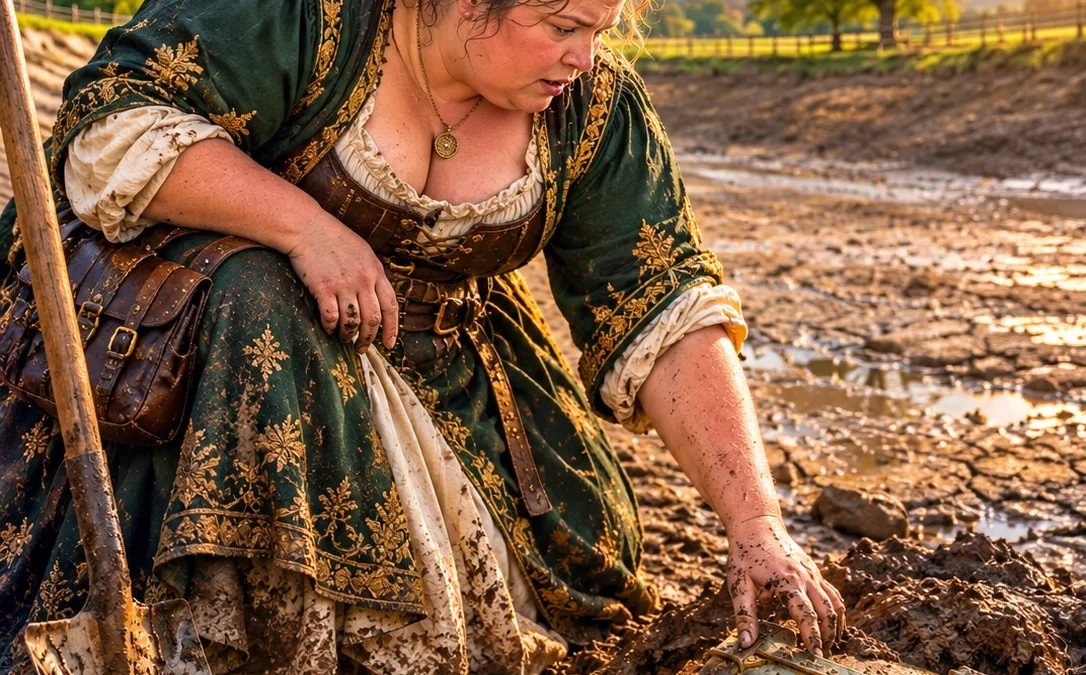
So she fired up the pumps and watched the water slowly recede, exposing dark, heavy mud that hadn’t seen sunlight in half a century.
News travels fast in small towns.
Before long, Lenora Quillin knocked on her door.
Lenora was the quiet keeper of Brier County’s history, the one who knew every name carved into courthouse stone and every story buried in old records.
She didn’t waste time with pleasantries.
“I heard you’re draining the pond,” Lenora said, her voice steady but heavy with something unspoken.
“I need to tell you something before anyone else does.
”
She spoke of 1874, of county records that vanished overnight — land registers, survey maps, documents that proved ownership for nearly 60% of the farmland in southern Brier County.
Families had spent years searching for them.
Some gave up.
Some lost their homes and fields because they couldn’t prove what was theirs.
“Your great-grandfather was the Land Commissioner that year,” Lenora said gently.
“Gideon Whitam.
And he built this pond that very summer.
”
Marin went still.
“Are you saying…?”
“I’m saying if those documents were hidden anywhere, this would be the place.
”
For days, Marin sifted through the mud.
She found old fence posts, a rusted horse collar, a boot worn thin by time — nothing of what Lenora had spoken of.
The whispers started at the general store and the diner: She’s wasting what little she has.
She’s chasing ghosts.
She’s stubborn, always has been.
Marin kept her head down, recorded every water level in her notebook, and worked late into the evenings by lantern light.
Her grandmother’s voice stayed with her: Pay attention to what the mud gives back.
On the nineteenth night, the water dropped low enough to reveal the original drainage pipe at the pond’s deepest point.
And there — protruding from the black mud, six inches below what used to be the surface — was a straight, sharp edge of metal.
Not stone, not wood.
Someone had placed it there, on purpose.
Her heart hammering, Marin waded in.
The mud clung thick and cold around her calves.
She dug carefully, her fingers brushing smooth, solid metal.
It was large, rectangular, heavy — sealed tight along every edge.
When she pulled, the mud released with a sound like something waking from a long sleep.
She wiped away the grime, held her lantern close — and her breath caught.
Stamped into the surface, faint but unmistakable beneath the corrosion: BRIER COUNTY LAND COMMISSIONER • 1874.
Below the plate, half-buried still, she could feel the outline of something larger.
A chest.
And she was not alone in knowing it was there.
Two days later, Corbin Sedwick rode up to her fence line.
He was the wealthiest man in the county, polished, quiet, always in control — and he’d never shown the slightest interest in her farm before.
He looked past her, straight at the empty mud basin where the pond had been.
“Find anything interesting?” he asked, calm as a summer morning.
Marin met his gaze.
“Mud.
Fence posts.
One boot.
”
Sedwick smiled, thin and sharp.
“Old records can be… unreliable.
Expensive to fight over.
My offer for your farm still stands.
It won’t stand forever.
”
He knew.
Before she’d told anyone, before she’d even fully pulled it free — he knew.
Marin watched him ride away, then sank onto the bank, her hands shaking.
What had her great-grandfather hidden? And why was the most powerful family in the county so desperate to make sure it stayed buried?
Part 2
That night, Marin went straight to Lenora.
By dawn, they were back at the pond with Elden Marsh — a man who asked no questions and kept his word.
It took three people, a tractor, and most of the morning to lift the chest free.
Black mud poured from its sides as they hauled it up the bank.
It was heavy steel, seams soldered shut, built to last.
When they finally opened it in Lenora’s study, working the rusted lock with delicate, careful hands, what they found stopped them cold.
Inside, wrapped in oilskin that had held back the damp for decades, were the records — land registers, official surveys, courthouse ledgers, all authentic, all dated 1874.
And on top of everything, a single sheet of paper in Gideon’s own handwriting:
Removed for safekeeping by order of conscience, not of men.
May they be returned when the honest can protect them.
But that wasn’t all.
Tucked secretly inside one sealed case, separate from the rest, was a page no one had expected — a transfer record showing three families losing their land to the Sedwick name.
Beside each signature, in Gideon’s cramped, hurried script, were words that changed everything: Signature obtained under duress.
Original surveys withheld.
Owners not informed.
He hadn’t just hidden documents — he’d left proof.
Proof that the Sedwick fortune had been built on land stolen by fraud.
They weren’t alone in knowing.
Before the week was out, someone broke into Lenora’s study in the dead of night — and found the chest gone.
Marin had already moved it, along with every note and copy, to Deputy Marshall Everett Duval — a man known for being honest, unshakable, and impossible to buy.
But the threat was real.
Sedwick had hired a high-powered attorney from Jefferson City, and he was moving fast.
Then came the meeting — the county board had been called, and Sedwick’s lawyer was already spreading the word: the documents were unreliable, improperly stored, untrustworthy.
They would dismiss them before anyone even read them.
Marin gathered the families — Ezra Hartley, whose father had spent eleven years trying to prove his boundaries were wrong; Margaret Cummings, who’d watched her parents lose their farm and never speak of it again; and Garrett Cole, a county board member whose own great-aunt was one of the victims.
They stood together, ordinary people who’d carried grief they couldn’t name for generations.
The morning of the hearing arrived.
The room was packed.
Sedwick sat at the front, calm as ever, his lawyer beside him.
Marin looked at the faces around her — people who had been told to stay quiet, to accept things as they were — and stepped forward.
She spoke simply, plainly, of the pond and the mud and the chest.
She spoke of Gideon’s note, of the families who’d lost their homes.
Then she laid the evidence on the table.
Sedwick’s lawyer stood to object — but before he could speak, Garrett Cole stepped forward, holding something trembling in his hands.
It was a letter, yellowed, sealed for decades.
“My great-aunt Celeste wrote this,” he said, his voice steady but breaking.
“She was there.
She saw it happen.
She gave it to my family before she died — told us to keep it, and give it only to whoever found the truth.
”
He laid it beside Gideon’s records.
The room fell silent.
Sedwick went very still.
Part 3
Garrett unfolded the letter and read aloud.
Celeste Brousard had written it not as a weapon, but as a witness — of men arriving at her father’s farm with papers he could not fully read, of signing because the county official stood there and said nothing, of realizing too late he had given away his land.
He asked Gideon Whitam if it was true, she’d written.
And Gideon looked away.
A murmur moved through the room.
Marin stood frozen.
Her great-grandfather hadn’t just hidden the truth — he had failed to speak it when it mattered most.
Sedwick’s lawyer tried to argue — chain of custody, storage conditions, age of the documents — but the room had shifted.
Professor Reyes, an expert brought in to authenticate the records, stood and confirmed: the paper, ink, seals, and handwriting were all genuine.
Hollis Vardaman stepped forward next, holding his own father’s old notebook — the entry dated September 1874, describing two men helping Gideon lower something heavy into the pond at midnight.
Piece by piece, the story came together, and Sedwick’s defenses crumbled.
The board voted to launch a full, formal review.
Sedwick stood as they finished, his face tight with controlled anger.
“My family has held this land in good faith for three generations,” he said.
“This process will be contested at every step.
”
“And so did the Hartleys,” Marin answered quietly.
“And the Cummingses.
And the Brousards.
They held their claim in good faith, too — and the documents that should have protected them were buried under eighty years of mud.
”
Sedwick left without another word.
But the fight was far from over.
His lawyers filed challenge after challenge, delaying, questioning, demanding more proof — and every time, Marin and the families met them with more: letters, journals, fading photographs, memories passed down like fragile treasures.
They didn’t just have documents — they had a community that had finally found its voice.
Then came the letter from St.
Louis.
A woman named Clara Fontaine, Henri Brousard’s youngest daughter, had read about the discovery.
She sent her father’s journal — written entirely in French, a language few in the county could read, but every page spoke clearly: of fear, of confusion, of trusting an official who looked away.
When Lenora read the translation aloud, even the most skeptical listeners in the room fell silent.
Slowly, painfully, things began to change.
Ezra Hartley’s family received a portion of their land back — not all, but enough to mean something.
Mediation moved forward for the others.
Some agreements came easily; others dragged on for months, even years.
Not every wrong was fully righted — the law could not give back decades of grief or lost lives — but the truth was no longer hidden.
One evening, Marin sat at her kitchen table and opened the final, sealed letter Gideon had left, tucked deep inside the chest.
It was addressed to whoever found it.
If you are a Whitam, I am sorry for the burden I have placed on our land, it began.
If you are not, then my family is gone — and I am sorry for that, too.
He wrote of the fear that had silenced him, of watching families robbed and not daring to speak, of hiding the records not as a hero, but as a man trying to redeem his own failure.
Water does not take bribes, he’d written.
I chose the pond because I could not choose the courthouse.
Marin folded the letter carefully.
He had not been perfect.
He had been afraid, and silent, and late — but he had kept the truth alive when no one else could.
And now it was her turn to carry it forward.
The pond filled again, clear and still under the sun.
The farm thrived — modest, steady, shared with neighbors who had become family.
A historical marker was placed at its edge, not to glorify one name, but to honor all the families whose stories had been buried there.
People came to share their own records, their own memories, building something stronger than any single claim.
Sedwick eventually stepped back from public life.
His family kept much of their land, but they no longer controlled the narrative — the truth belonged to everyone now.
One year to the day after pulling the chest from the mud, Marin stood at the pond’s edge with Ezra and Margaret and Clara and Garrett.
Hollis Vardman joined them, bringing his granddaughter with a book of family recipes filled with names she wanted to know.
“You ever wonder what would’ve happened if you’d waited another year?” Hollis asked quietly.
Marin looked at the water, bright and unhidden.
“The timing wasn’t mine to choose.
But the doing was.
”
She opened her notebook and wrote: The truth does not disappear because people stop looking for it.
We found what was buried.
We gave it back.
The pond is full.
The farm is whole.
That is enough.
Some stories don’t end with everyone getting everything they lost.
They end with everyone finally knowing what happened.
And that, Marin thought, watching the sun set over water that held no secrets anymore, was more than enough.
This story is entirely fictional and created for entertainment purposes only.
It does not represent any organization or individual, nor does it encourage inappropriate behavior.
The content was generated with AI assistance.








