SHE FAINTED AT THE ALTAR, AND WHEN THE DUKE TORE OFF HER GLOVE, HE FOUND 6 SECRET WORDS STITCHED INSIDE… HE READ THEM, WHISPERED “YES, IT WILL,” AND MARRIED HER ANYWAY
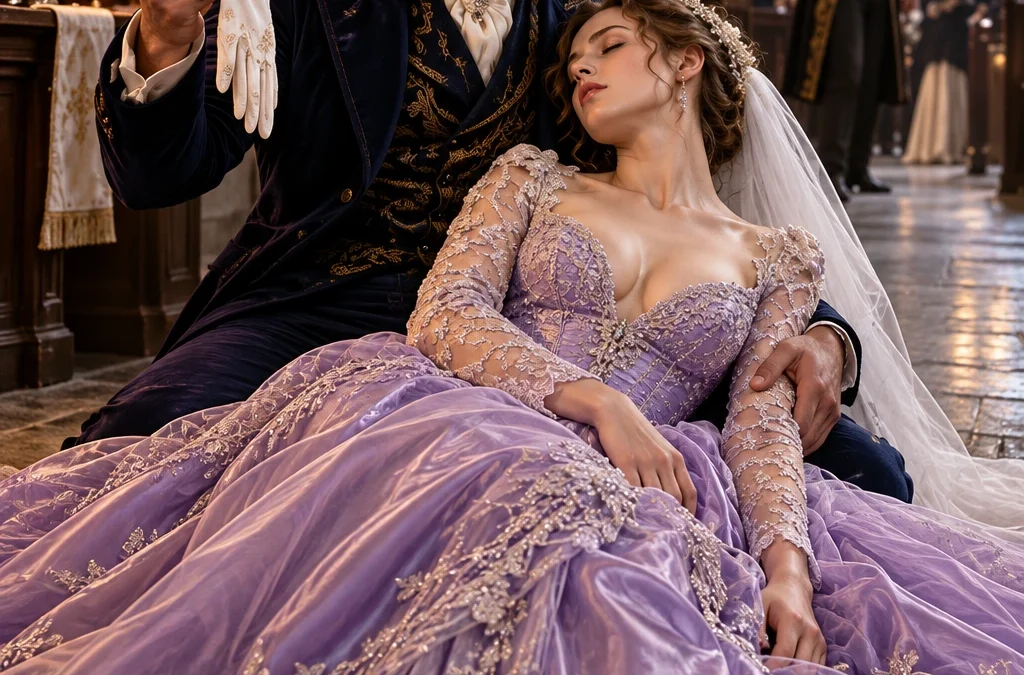
SHE FAINTED AT THE ALTAR, AND WHEN THE DUKE TORE OFF HER GLOVE, HE FOUND 6 SECRET WORDS STITCHED INSIDE… HE READ THEM, WHISPERED “YES, IT WILL,” AND MARRIED HER ANYWAY 😱
Part 1
The Duke of Saxton’s bride fainted at the altar.
And in the vestry, stripping off her glove to find a pulse, he found something else.
Six words, stitched into the lining in thread the color of the silk.
“Please, I am being forced. Help.”
Tobias Reeve had read a great many documents in his thirty-three years. Deeds. Treaties of settlement. His father’s endless ledgers of debts and apologies.
But he had never read anything the way he read those six words.
Twice. Then a third time. Kneeling on the cold flagstones of St. Mary’s vestry, his bride senseless in his arms, her glove crushed in his fist. 😨
He had met Helena Ross exactly twice before this morning. Both times in drawing rooms crowded with the polite fictions of an arranged match. Her father’s voice too loud. Her own barely present at all.
He had thought her shy.
With the mild, distracted kindness of a man who had never once needed to wonder what a woman’s silence might be hiding, he had believed shyness was a small and manageable thing. The sort that warmed with time and a patient husband.
He had gone into this marriage prepared to be patient.
His father had arranged the match a year before his death. A settlement between two old families that suited everyone’s ledgers and no one’s heart. And Tobias had agreed to it the way he agreed to most things asked of him as Duke.
Because it was asked. Because it was sensible. Because refusing would have required a reason he did not, at the time, possess.
The wedding had gone wrong in the ordinary way at first. The rector reached “Do you take this woman?” and Helena, white as the lace at her throat, swayed on her feet and went down before anyone could catch her.
Tobias caught her. He carried her through the vestry door while the congregation gasped and the organist, uncertain what music suited a collapsed bride, played nothing at all.
She weighed almost nothing. That had troubled him, even before he understood why. 💔
He laid her on the bench and called for water, for salts, for the surgeon sitting somewhere in the third pew. And because a pulse was the first thing any sensible man reached for, he took her wrist.
And because her glove was in the way, he drew it off.
The stitches were small.
Whoever had done this, and he understood within a breath that it could only have been Helena herself, had worked by the dim light of a servant’s candle, with a needle too fine for the thread. She had aimed for nothing more than the chance that some stranger, some maid dressing her for burial should the worst happen, might one day find it.
She had not sewn it to be found by him.
She had sewn it to be found by anyone at all. Because anyone at all was better than the man who had walked her up the aisle.
Tobias looked up.
Through the half-open door, he could see the church. The guests craning. And filling the doorway with his bulk and his impatience, Mr. Silas Ross, father of the bride, demanding of the rector in a voice pitched to carry that the ceremony proceed at once. His daughter was prone to weak nerves. There was no cause for delay.
Tobias had met Silas Ross exactly four times in the course of arranging this marriage. And each time the man had reminded him, unprompted, of the settlement, the sum, the timing, the folly of delay. As though Tobias were a merchant who might renege on a shipment.
He had thought, uncharitably, that Ross loved money more than his daughter.
He had not imagined, until this moment on his knees with a strip of silk in his hand, that the truth was so much worse. That money was the whole of it. That the daughter was merely the vehicle for delivering it. And that the girl had understood this so completely, so long before he had, that she had taken up a needle and sewn her own rescue into a glove no one was ever meant to remove.
He closed his hand around the fabric.
“Will the wedding proceed, Your Grace?” the rector asked, glancing between the unconscious bride, the furious father, and the Duke, who had gone so still that even the surgeon paused with his salts uncorked.
“Yes,” said Tobias. “It will.”
He said it to the rector. But he said it, in truth, to the girl on the bench, whose color was beginning to return, and whose hand had curled, without her knowing, around two of his fingers.
The rest of the ceremony was conducted with a haste that would have scandalized every dowager in the church. Helena was walked back to the altar rail on the surgeon’s arm, pale and silent. The vows were spoken too low for the pews to hear. The register was signed with a hand that shook so badly the clerk had to steady the book.
Tobias signed his name beneath hers and did not look up until it was done. He did not trust his face to hide what he had just read.
She woke properly in the carriage, somewhere past Marylebone, with the city thinning into hedgerows. For several minutes she did not speak at all.
Then her eyes found his, and she said, in a voice barely above a breath:
“Your Grace… I am so sorry. I don’t know what came over me. I had not eaten, I think, and the church was very warm.”
“Helena.” It was the first time he had used her Christian name without her father present. He watched it land on her like a struck bell. “You needn’t account for fainting. I have accounted for it myself.”
He drew the glove from his coat and held it out to her, lining upward, the tiny stitches catching the gray light.
She looked at it the way a woman looks at a snake coiled in her own bed.
Every trace of color left her face. Her hand rose, shaking too badly to take it.
“I read it,” Tobias said quietly. “Twice. And I want you to hear what comes next before you decide how afraid to be.”
He leaned forward.
“I married you anyway.”
Part 2
“I married you anyway.”
Helena stared at him. She had stopped breathing.
“I want that understood plainly,” Tobias said, “because I think you have spent a great deal of time believing that the truth, once known, could only end badly for you. It has not. You are the Duchess of Saxton. There is no court in England, no father, no man of any rank who has the smallest claim upon you now. He cannot fetch you home. He cannot sell you again. You will never be alone with him unless it is you who chooses it.”
She looked up. And he saw something in her face that was not fear and not gratitude. It was a disbelief so total it looked almost like pain.
“Why?” It was the only word she could produce.
“Because a woman who sews a plea for help into her own glove, with no earthly reason to think it will ever be read, has done the bravest thing I have seen anyone do in thirty-three years. And I found, kneeling on that floor, that I wanted very badly to do the second bravest thing anyone did today.”
She did not smile. She was not a woman who had smiled easily in a great while. But she took the glove and held it against her chest with both palms flat, like something recovered from a fire.
At Saxton Hall, he led her to his late mother’s rooms, south-facing and bright, and showed her the lock.
“It bolts from within. No key opens it from outside. I had the outer mechanism removed years ago. It is yours now.”
She tested it with her eyes, imagining what a lie would look like, and found none.
He ordered a tray. Bread. Soup. Cold meat. And he watched as her hand shook so badly she set the bread down twice before it reached her mouth. 💔
Three days without food. Her maid had let it slip to his man. Her father’s particular method of ensuring a bride reached the altar too weak and frightened to make a scene.
Tobias said nothing of what he knew. He poured her watered wine and set it near her hand.
“I will not trouble you tonight. Or tomorrow, unless you send for me. The door bolts from within. Use it.”
He left her completely alone.
The week that followed taught him more patience than the whole of his life before it. She flinched from doors opening too quickly. She ate as though someone might take the plate. She was waiting, he understood, to be claimed. A transaction concluded. A price collected.
He did not go to her.
On the fourth day, she asked the housekeeper, so quietly, whether she might walk in the garden, as though walking in her own garden required permission.
“Tell her she may walk wherever her feet wish to carry her,” Tobias said, “and that she need never ask again.”
On the fifth day she came down to dinner and sat at the far end of the table. He did not correct it. The distance itself was a kindness.
On the seventh day, she spoke first.
“The book you sent up. The Wordsworth. I have read it three times.”
“Did you like it?”
“I don’t know that anyone has ever asked me that before.” She glanced up. Gray eyes, clearer than he had expected. “I liked it. Very much.”
“Then there will be more.”
Something in her face eased by a fraction he would have missed had he not been watching with the whole of his attention.
And then, eleven days into the marriage, Silas Ross arrived at Saxton Hall unannounced.
Tobias received him in the hall, because Ross would not be staying long enough to need a chair.
“The settlement,” Ross said, without so much as asking after his daughter. “I have creditors, Your Grace, who do not share your patience.”
“You sold me a daughter you had starved for three days to ensure her compliance at the altar,” Tobias said, in the flat, quiet voice he used for men who mistook his restraint for weakness. “The settlement is real, Mr. Ross. It exists in trust for Helena alone. You will not see a shilling. Leave my house.”
Ross turned purple. His eyes slid past Tobias to the stairs, where Helena had appeared, one hand on the banister.
“After everything I have done for you, girl! Everything I sacrificed!”
“I’m grateful,” Helena said.
Her voice came down the stairwell clear and entirely without tremor. Tobias, who had spent eleven days listening for the smallest catch of fear in it, heard none.
“Just not to you,” she finished. 🔥
Ross opened his mouth and found nothing equal to it.
After that, it was slow, the way spring is slow. Tobias found himself, without quite deciding to, courting his own wife. Books left where she would find them. Questions at dinner with no purpose but to hear her answer. Walks with no destination beyond walking.
He learned that she was clever, in the wary way of someone taught that cleverness in a woman was a fault to be corrected. The first time he made her laugh outright, it landed in his chest with an impact entirely out of proportion to the joke.
And then, in her seventh week as his wife, she came to him in the library and asked for the glove back.
“I mean to burn it.”
“I’d rather you didn’t,” he said, and went to the drawer where he had kept it, wrapped in paper. “It is the first entirely honest thing anyone has ever said to me, Helena.”
Something crossed her face that he had never seen before. Not fear. Closer to confession.
“It was not the first one,” she said quietly.
He went absolutely still.
“I sewed one two years ago. And another the year after. Three gloves. Three weddings my father arranged before this one. I thought no man would ever get close enough to find it.” She steadied herself. “You were the first who got as far as the altar. The first who got as far as my wrist.”
Tobias understood, standing there with the paper-wrapped glove in his hand, that he was not the answer to one prayer. He was the accident at the end of a long, hopeless habit of praying. 💔
And then, the very next week, the letter arrived.
A solicitor’s seal. A father’s name. And the single word that had governed the whole of her life:
Duress.
He didn’t know until that evening, when he went looking for her and found her rooms empty, that she had already read it.
Part 3
He found her in the small dressing room off her chamber, a trunk half packed on the floor before her.
Her hands, steadier these past weeks, were shaking again as she folded a gown with a precision that had nothing to do with care and everything to do with keeping busy enough not to think.
“Where?” he said from the doorway.
She did not startle. She had known he would find her.
“Anywhere he can’t reach.” She did not look up. “I saw the word duress, Your Grace. I know what English courts think a woman’s word is worth against her father’s. I will not be a thing returned. I would rather vanish on my own account than be carried back to that house by an officer of the court.”
“He cannot reach you here,” Tobias said. “And there will be no order, because I intend to stand in that courtroom myself and end this before it begins. I will produce the glove. I will say that my wife asked, in the only language left to her, for someone to help her, and that I answered. And that I would answer again tomorrow and every day after.”
His voice dropped.
“I will say I have never once touched you as a husband might claim the right to. And I will not, until the day you ask it of me yourself. And I will say…”
He stopped.
She had turned to look at him, the gown still folded over her arm. And the sentence he had meant to deliver as testimony wanted suddenly to be said as something else entirely.
“I will say that I am in love with you, Helena. And have been since the day you fainted.”
“Since I fainted,” she whispered. Beneath the disbelief, there was the very beginning of something that was not fear.
“Since I read your handwriting,” said Tobias. “Everything since has only confirmed what six words told me in a vestry. Put the trunk down. Let me finish what I started that day.”
She did not answer in words.
She set the gown down on the lid of the trunk. She crossed the small room and stood before him, closer than she had ever stood by her own choosing, searching his face for the lie she had spent two years learning to expect.
Once again, she did not find one.
Then she took his hand. The first time she had ever reached for him first. She lifted it and pressed her lips to his knuckles, the way one seals a promise rather than begins one.
“Then finish it,” she said. “In court, and everywhere after.” 💛
The hearing was shorter than his solicitors had predicted, and far worse for Silas Ross.
Tobias laid the glove before the bench with the stitches turned upward, and read the six words aloud in a courtroom gone entirely silent.
He testified to the three days without food. The housekeeper confirmed it, repeating the whispered confidence of Helena’s own former maid, Agnes Pratt, who had left Ross’s household in disgust the week after the wedding. Agnes came forward now with an account of bruised silences and locked larders that made the presiding judge’s mouth go thin with distaste.
Helena testified last.
She did not shake. She said of her father only what needed saying, and nothing more. And Tobias watched her from across the room with a pride so fierce it felt like the love he had confessed in the dressing room, only larger now. Tested and proven true. ⚖️
The petition was dismissed within the hour.
Before rising, the judge remarked from the bench that he had sat on many matters of consent in his years, and had rarely seen the question answered so plainly as by six words sewn in silk. He hoped every gentleman in the room might carry the lesson home.
Silas Ross left the courtroom to find his creditors had heard of the proceedings before he reached the street. Within the year, his name would carry no more weight in any respectable house in England than the debts that finally consumed what remained of it.
Tobias found Helena on the courthouse steps afterward, in the thin, clean autumn light.
She was not weeping, though he had half expected it. She was simply standing very straight, as though something that had bent her posture for years had finally been set down.
He offered his arm.
She took it, not the way a woman takes an arm for balance, but the way she had taken his hand in the dressing room. Deliberately. As a choice made in full possession of every alternative.
They walked to the carriage together without either of them needing to say what both understood. That whatever had been decided in that room, the truer verdict had been rendered weeks before, in a garden, over a borrowed book, in the slow unlearning of fear. 🍂
The glove hangs now in a small frame in the Duchess’s study at Saxton Hall. The stitches are turned toward the light, so that anyone who looks closely enough may read them. Few visitors ever do.
Helena keeps it there deliberately. Not as a wound reopened, she told Tobias once. But as a reminder of the exact size of the courage it takes a frightened woman to ask for help, and the exact size of the debt owed to anyone who troubles to listen.
She sits beside her husband now at every case that comes before him touching a daughter sold, starved, or silenced. The magistrates of three counties have learned to expect her quiet, exacting questions before they render judgment.
And Tobias, watching her lean forward at such moments, her gray eyes clear and entirely without fear, thinks often of a church vestry.
And of a glove he was clumsy enough, and fortunate enough, to remove. 🧤❤️
THE END
This story is entirely fictional and created for entertainment purposes only. It does not represent any organization or individual, nor does it encourage inappropriate behavior. The content was generated with AI assistance.








