She Found A Hidden Chamber Buried In Her Hillside — And Uncovered A Secret The Most Powerful Man In The Valley Had Kept Buried For 40 Years
She Found A Hidden Chamber Buried In Her Hillside — And Uncovered A Secret The Most Powerful Man In The Valley Had Kept Buried For 40 Years 😱
Part 1
Evelyn Marlo stood at her back door, knuckles white against the wooden frame.
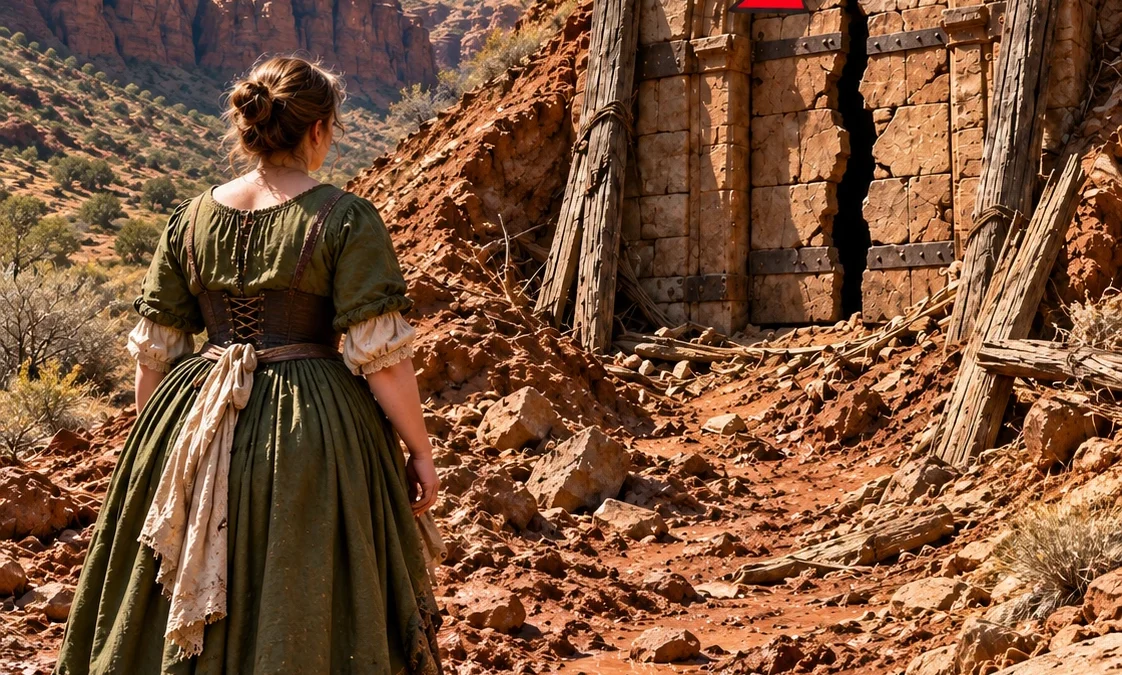
Three days of relentless rain had torn open the north slope of her land — the quiet, rugged edge of the property she’d tended alone since her father died — and something lay exposed beneath the mud and fallen stone.
Most people would have turned away.
Most women, the town had long whispered, had no business holding land this far from the nearest road, no business living without a husband, no business being so stubbornly, quietly herself.
But Evelyn had never been like most people.
She pulled on her heavy boots, grabbed her father’s old lantern, and climbed.
What she found stopped her breath cold.
Carved deep into the hillside, hidden beneath layers of earth and brush, was a solid timber door.
It was weathered, iron-bound, and heavy — and it had been sealed shut for decades.
With every ounce of her strength, she pried it open.
Inside lay a small, rough-hewn chamber, and at its heart, a cedar chest wrapped in oilcloth.
She carried it out into the pale morning light, her hands trembling, and when she unfolded the wrapping, her world shifted forever.
Inside were original land surveys dating back to 1831, handwritten boundary descriptions, a tattered leather journal, and a name she had only heard mentioned in half-whispers: Nathaniel Crowe.
Nathaniel had vanished from the valley in 1847.
No one spoke of him much anymore — not openly, anyway.
The stories said he’d packed up and left, unable to hold his land against the changing times.
But the documents in her hands told a different story entirely.
The boundaries on his maps did not match the boundaries the county recorded today.
They showed her north slope — the very land someone was now trying to claim — belonged to her fully, and had been stolen from Nathaniel by falsified records.
She set out to find the truth.
Her first stop was August Fen, the oldest man in the valley, his hands worn thin by a lifetime of labor, his eyes sharp as flint.
He listened in silence as she laid everything out — the storm, the chamber, the chest, the papers.
When she finished, he sat very still for a long moment.
“He built it,” August said, his voice soft with wonder.
“He actually built it.
”
Nathaniel, he explained, had been one of the finest blacksmiths and most honest men the valley had ever known.
When a powerful man named Aldis Peton began quietly altering land records to seize property, Nathaniel was one of the few who dared say no.
He gathered the proof — original surveys, deeds, everything — but knew he could not fight Peton openly.
So he built the chamber by night, hid his evidence deep in the mountain, and walked away, trusting that one day someone would find it.
“I told him to leave,” August admitted, his face lined with old grief.
“I told him Peton had too many friends in high places.
I was afraid — I had a wife and a new baby.
I was wrong.
I’ve carried that weight every day since.
”
Evelyn now had witnesses: August, elderly but unshaken; EMTT Chase, who still used hinges Nathaniel had forged on his barn door after forty years; and Vera Dugen, whose family remembered the truth well.
She had filed a formal claim with the county recorder, halting the takeover.
She thought she was safe.
She was wrong.
The next morning, three riders appeared at her gate.
At the front sat Calvin Whitmore — wealthy, respected, the most powerful man in the county.
He smiled the smile of someone accustomed to being obeyed, and made her an offer: buy the land for a generous sum, walk away quietly, and avoid trouble.
When Evelyn stood firm, his tone hardened.
He had lawyers, he had influence, and he would not be stopped.
Worst of all — riding behind him, eyes fixed firmly on his horse’s ears, not daring to meet her gaze — was Harold Briggs.
The quiet storekeeper who knew everyone’s business, who had been friendly to her face, who had been watching her every move… and reporting every single one to Whitmore.
Evelyn stood tall in her doorway, her documents hidden safely away, and refused to back down.
But as they rode off, she realized with a cold, sinking feeling: they knew.
They didn’t know everything — not yet — but they knew she had found something that threatened everything Whitmore had built.
And they would stop at nothing to destroy it.
That night, a folded note appeared under her door.
It contained only four words, written in an unfamiliar hand:
BE CAREFUL.
HE KNOWS.
Part 2
The warning changed everything.
Evelyn stopped thinking in days and started thinking in hours.
Before sunrise, she saddled her horse and rode to see Vera Dugen, who confirmed what she already feared: Harold Briggs had been working for Whitmore for twenty years, passing along every whisper, every visitor, every unusual thing that happened in the valley.
He had seen her visit August Fen.
He had told Whitmore.
By mid-morning, Samuel Holt — the county surveyor who had quietly sided with her — rode up breathless with worse news: the hearing had been moved forward.
Whitmore had pulled strings, and it was now only eight days away.
Worse, the official notification had been delayed in the mail — intentionally, it seemed — leaving her almost no time to prepare.
They raced to the county seat together, Evelyn clutching her precious documents, Samuel by her side.
Against all odds, County Recorder Edmund Carr — a quiet, careful man who valued truth above influence — accepted her claim, officially registering Nathaniel’s surveys as a competing land interest.
Whitmore’s petition could not move forward until her evidence was reviewed.
She had bought time — but she had also made this a fight to the finish.
The next days brought threats and tests.
Someone tried to force open the chamber door in the night; Evelyn found fresh scrape marks in the rusted iron at dawn and placed her father’s old rifle within easy reach.
August Fen fell ill — his heart worn out — and Whitmore sent a man to his bedside with a thinly veiled threat: withdraw your testimony, or face ruin.
Instead, August promised he would be there.
“I’ve been silent long enough,” he said.
“I won’t be silent now.
”
Evelyn brought in Harlon Webb, a blacksmith of thirty years, to examine Nathaniel’s tools.
He compared them to the hinges on EMTT Chase’s barn and confirmed what she had hoped: the same hands had made both.
It was physical proof — tangible, undeniable, impossible to dismiss as a forgery.
The night before the hearing, her kitchen was full: August, frail but determined; Vera, calm and steady; EMTT, solid as the land he farmed; and Samuel, quiet and loyal, watching her with eyes that saw everything.
They were ready.
But as Evelyn finally sat down to rest, Samuel pulled her aside with a grave expression.
He had learned something about Whitmore’s star witness — the man brought in to declare her documents fakes — and it was far worse than she had imagined.
This expert was not just hired help.
He had testified for Whitmore twice before, and every single time, the outcome had gone exactly Whitmore’s way.
“Evelyn… they already have a plan to destroy Edmund Carr’s reputation if he dares to support you.
They’re not just coming for your land.
They’re coming for anyone who stands with you.
”
This just got real.
Part 3
Evelyn stood very still.
“They can’t touch everyone,” she said, though her heart hammered in her chest.
“The truth is on record.
The documents are real.
”
“Truth doesn’t always win on its own,” Samuel said gently.
“Not when money and power rewrite the rules.
”
The morning of the hearing dawned clear and bright, but the air in the courthouse was heavy with unspoken pressure.
Calvin Whitmore sat in the back, composed and confident, watching everything unfold as if he already knew the ending.
His lawyer, Garfield Reed, opened smoothly — dismissing Nathaniel’s surveys as suspicious, improbable, almost certainly forged.
He called his expert, Porter Dills, who pointed out tiny inconsistencies with practiced authority, his tone calm and devastating.
Then Evelyn stood.
“Before we proceed,” she said, her voice steady despite the racing of her heart, “I would like it noted that Mr.
Dills has testified in four cases in this county — and in two of them, he appeared on behalf of Calvin Whitmore.
”
A murmur rippled through the room.
Before Reed could object, a quiet voice spoke from the side of the room.
“Her statement is accurate.
” All eyes turned to Edmund Carr.
“I have reviewed the records.
The connection exists and should be considered.
”
Evelyn called her witnesses.
August Fen spoke first, his voice thin but unshakable.
He did not just tell the story — he owned his part in staying silent, his shame, and his determination to speak now.
“When you wrong a man,” he told the room, “you do not forget his name.
” Reed tried to rattle him, to cast doubt on an old man’s memory, but August would not be moved.
EMTT Chase spoke next, describing the hinges on his barn door with the precision of someone who had looked at them every day for forty years.
Then Harlon Webb laid his experience before them — not as a scholar, but as a man who knew iron.
“Paper can be faked,” he said simply.
“Iron cannot.
These tools and these hinges were made by the same hand.
I would stake my name on it.
”
Finally, Evelyn laid Nathaniel’s journal on the table.
She did not read it aloud.
She asked the assessor to read the final page — the message Nathaniel had left for whoever found his work: For whoever finds this — be honest.
Be brave.
What is inside is meant for you.
Silence filled the room as the assessor finished reading.
Then Edmund Carr stood again.
He had not come to speak — only to observe — but he could not stay silent.
“I requested independent verification of the documents,” he said, placing a report on the table.
“The paper and ink match federal survey stock from the exact period.
Mr.
Dills’s claims do not hold against archival evidence.
”
Whitmore’s jaw tightened.
Reed looked at his client — and for the first time, Evelyn saw uncertainty in their eyes.
The assessor paused, looking between the papers before him and the powerful men watching from the back.
“A ruling will be issued in thirty days,” he said at last.
“Until then, the original boundary stands unchanged.
”
They had not won — not fully, not yet — but they had not been broken, either.
The ruling came down twenty-two days later.
The county recorder’s claim was upheld.
Nathaniel Crowe’s surveys were accepted as authentic.
The land was hers — officially, permanently, beyond dispute.
The valley shifted slowly around her.
Mrs.
Alderton, who had once kept her distance, appeared at her gate with coffee and an apology.
Families looking for land to farm came to her.
Harold Briggs showed up one quiet Tuesday, hat in hand, smaller than he ever was behind the counter, and apologized for what he had done.
“I just wanted to be on the winning side,” he said.
Evelyn did not forgive him fully — some things cannot be undone — but she told him she would not hold his mistakes against those who had done nothing wrong.
August Fen passed away eleven days after the ruling.
He died at peace, his daughter Ruth told her — finally free of the secret he had carried so long.
“He said you gave him his name back,” she whispered.
Samuel became a steady presence in her life — not just an ally, but someone who saw her clearly, without judgment, without expectation.
When he told her he would like to keep coming back, not just for work but because he wanted to, Evelyn did not look away or turn aside.
She opened the door fully this time.
The most unexpected arrival came one crisp autumn afternoon.
A woman named Clara Stokes pulled up with three children in a wagon, holding a letter worn soft by years of handling.
“Nathaniel was my great-great-uncle,” she said.
“He wrote to his sister — my ancestor — in 1846.
We always wondered what happened to him.
”
Evelyn brought her to the workshop, where Nathaniel’s journal sat beside her father’s tools and a small fragment of iron from the chamber door.
Clara read the journal slowly, her children quiet around her, and when she finished, she wept — not from grief alone, but from relief.
He had not been lost.
He had not been forgotten.
He had been waiting.
That evening, Evelyn climbed the slope to the chamber as the sun set over the valley.
The door stood open now, no longer sealed away in fear.
She stepped inside and spoke quietly to the shadows, to the man who had built this place in darkness so that light might one day find it.
“You were right,” she said.
“Someone found it.
And you were not alone.
”
She walked back down the slope as dusk fell, the valley stretching out before her — the land hers, the truth hers, the people who stood with her hers.
She had not won everything at once, and not everyone had cheered.
But she had kept open the doors that mattered most, and in doing so, she had found a life far greater than the one she had been protecting.
This story is entirely fictional and created for entertainment purposes only.
It does not represent any organization or individual, nor does it encourage inappropriate behavior.
The content was generated with AI assistance.








