SHE GAVE A HUNGRY STRANGER THE LARGER HALF OF HER LAST LOAF—AT MIDNIGHT, A DUKE’S CARRIAGE CAME TO TAKE HER AWAY
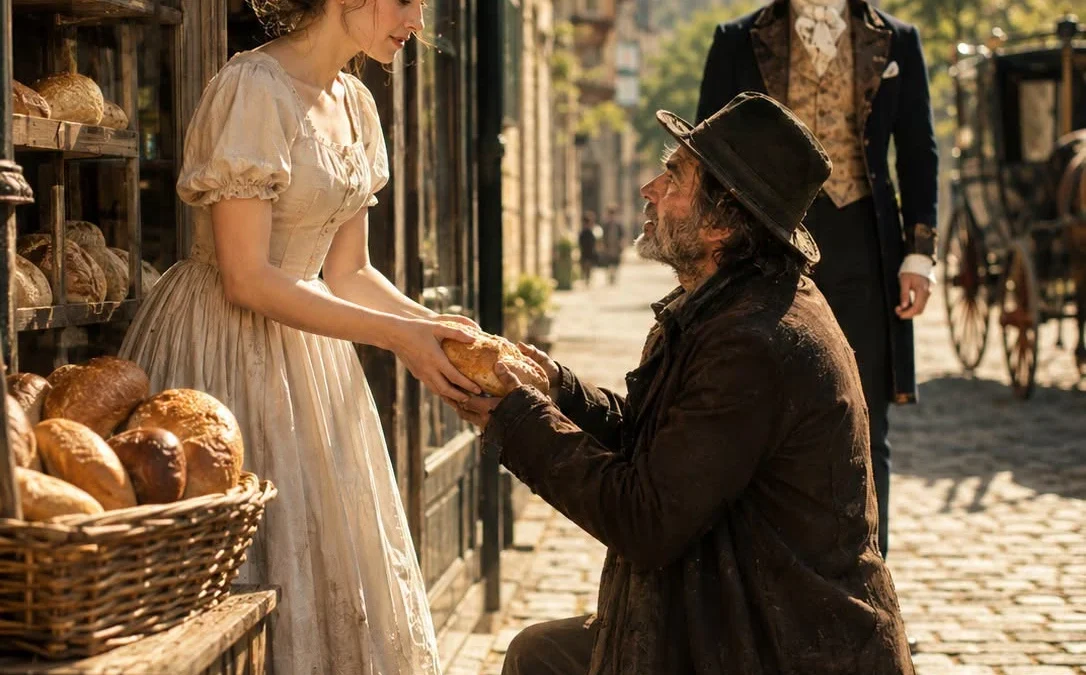
SHE GAVE A HUNGRY STRANGER THE LARGER HALF OF HER LAST LOAF—AT MIDNIGHT, A DUKE’S CARRIAGE CAME TO TAKE HER AWAY 😱
PART 1
Eleanor Puit had exactly one loaf of bread left when the hungry stranger knocked on her door.
By sunrise, she expected to lose the bakery her family had owned for generations.
By midnight, a duke’s carriage would be waiting outside.
And before the following evening, Eleanor would learn that one small act of kindness had just awakened a forty-year-old debt no one in her family knew existed.
The stranger arrived near sunset.
Little Dunore was glowing gold beneath the summer sky, but Eleanor barely noticed.
She had spent the entire day baking with the last of her flour.
Most of the bread was already sold.
The coins lay in a small wooden box beside the oven.
They were nowhere near enough.
Tomorrow morning, Mr. Gresham, the landlord’s agent, would arrive for three months of unpaid rent.
If she could not pay, Puit’s Bakehouse would be taken from her.
Her father had died three years earlier.
Her mother had been gone even longer.
There was no brother coming home.
No wealthy uncle.
No hidden purse beneath the floorboards.
Only Eleanor.
And one loaf.
She had intended it for supper and breakfast.
Then the old man appeared.
His coat was almost colorless from years of wear.
His boots were cracked.
His shoulders sagged as though the road itself had been sitting on them.
He stopped outside the bakery door.
“Forgive me,” he said. “Would you have anything you might spare?”
Eleanor looked at the loaf.
Then at him.
She could have said no.
Eleven other houses apparently had.
Instead, she broke the bread in half.
Then paused.
One piece was clearly larger.
She handed him that one.
The stranger stared at it.
“I have nothing to give you.”
“Then it is fortunate I did not ask for payment.”
His pale gray eyes lifted to hers.
“You should keep the larger portion.”
“You look as if you have walked farther than I have.”
A faint smile touched his mouth.
“That is true.”
“Then sit before your knees make the decision for you.”
He lowered himself carefully onto the doorstep.
Eleanor returned inside, pretending to clean.
In truth, she was trying not to watch him eat.
There was something painfully private about hunger.
He tore off small pieces at first.
Then larger ones.
His hands trembled.
The sight made Eleanor swallow.
She had spent months counting flour by the cup, butter by the ounce, candles by how many minutes of darkness she could endure before lighting one.
Yet even she had not been that hungry.
After several bites, the stranger looked around the bakery.
“Yours?”
“My father’s before me.”
“He is gone?”
“Three years.”
“I am sorry.”
Eleanor shrugged, because shrugging was easier than explaining grief to strangers.
“People still call this Puit’s Bakehouse.”
“Puit.”
The man repeated the name strangely.
Almost reverently.
“Yes.”
“What was your father’s name?”
“Thomas.”
“And his father?”
That made Eleanor laugh.
“You ask questions like a parish clerk.”
“Humor an old man.”
“Samuel Puit.”
The stranger stopped chewing.
For the first time, his calm expression cracked.
“Samuel?”
Eleanor frowned.
“Yes.”
“Samuel Puit of Little Dunore?”
“You knew him?”
The stranger looked at her so intensely that Eleanor suddenly wished she had not invited him to sit.
“No,” he said after a moment.
But the answer came too quickly.
He finished the last crust, then placed his hands upon his knees.
“You gave me the larger half.”
“You mentioned that.”
“Most people would have given the smaller.”
“Most people are probably wiser.”
“No.”
His answer was quiet.
“You are the twelfth door I tried today.”
Eleanor leaned against the doorway.
“Twelve?”
“Eleven people refused me.”
“I am beginning to think you chose the village badly.”
A strange little smile crossed his weathered face.
“No, Miss Puit. I believe I chose perfectly.”
The hairs along Eleanor’s arms rose.
“How do you know my name?”
“You told me.”
“I told you Puit.”
“Yes.”
He stood.
The weakness seemed suddenly gone from him.
Not completely.
But enough that Eleanor noticed.
He straightened his ragged coat with the precise movement of someone accustomed to better clothes.
Then he bowed.
An actual bow.
Not mockery.
Not clumsy gratitude.
The formal inclination of a gentleman.
“Eat your half,” he said.
“I intend to.”
“You will need your strength tonight.”
Eleanor stared.
“Why?”
He did not answer.
Instead, he walked toward the lane.
Eleanor called after him.
“There is a barn at Weller’s farm. Tell them Nell Puit sent you. They will let you sleep in the straw.”
He stopped.
“Nell Puit.”
Again, he repeated her name as though committing it to memory.
“You will likely forget this evening.”
“I doubt that.”
“But others will remember it.”
“What does that mean?”
The stranger turned.
The setting sun made his face difficult to read.
“It means kindness has a longer memory than cruelty, Miss Puit.”
Then he walked away.
Eleanor stood outside until he disappeared beyond the church wall.
Only then did she mutter, “Odd man.”
She ate her bread.
Counted her coins again.
Then counted them a second time, as if numbers might become kinder when asked twice.
They did not.
Nine shillings and threepence.
She owed nearly five pounds.
By ten o’clock, the village slept.
By eleven, Eleanor had extinguished the ovens.
She sat alone at the kitchen table, looking at the rent notice.
PAYMENT DUE IN FULL.
Below it, another sentence had been written by Mr. Gresham.
Failure to pay will result in immediate possession of the premises.
Eleanor folded the paper.
Then unfolded it.
Her father had died in the upstairs room.
Her grandfather had built the second oven himself.
Her mother had painted the blue flowers over the door.
Tomorrow all of it might belong to someone else.
Eleanor allowed herself exactly three tears.
Then she wiped them away angrily.
“Three is enough.”
A sound came from outside.
Hoofbeats.
Eleanor froze.
Not one horse.
Several.
Then came the rumble of wheels.
At midnight?
She moved to the window.
A black carriage rolled slowly into Little Dunore.
Four horses.
Silver lamps.
A crest painted on the door.
The carriage stopped directly outside Puit’s Bakehouse.
Eleanor backed away.
A footman descended.
Then another.
Both wore dark green livery trimmed with silver.
One approached her door.
Knock.
Knock.
Knock.
Eleanor picked up the rolling pin.
“Who is it?”
A man’s voice answered.
“Lady Eleanor Puit?”
She almost laughed.
“There is no lady here.”
A pause.
“Miss Eleanor Puit, then.”
“Yes?”
“We have been ordered to escort you immediately.”
“By whom?”
“The Duke of Bellgrave.”
Eleanor’s fingers tightened around the rolling pin.
“I do not know the Duke of Bellgrave.”
“No, miss.”
“Then why does he want me?”
The footman hesitated.
“The duke has been waiting forty years to repay a debt to the Puit family.”
Eleanor opened the door.
“What debt?”
But before the footman could answer, another voice came from inside the carriage.
A voice Eleanor recognized.
Cracked.
Courteous.
And no longer weak.
“Perhaps,” said the hungry stranger, “I had better explain that myself.”
👉 Find Part 2 in the comments—or leave ANY WORD below and I’ll send it to you privately.
PART 2
“Perhaps,” said the hungry stranger, “I had better explain that myself.”
The carriage door opened.
Eleanor stared.
The same ragged man stepped down.
Only he was no longer wearing rags.
His coat was black wool, perfectly tailored. A silver-headed walking stick rested in one hand. His white hair had been combed neatly back.
Even his posture had changed.
“You lied to me.”
“A little.”
“You were never starving.”
His expression softened.
“That part was not entirely false. I had eaten nothing since morning.”
“You went from door to door pretending to be a beggar?”
“Yes.”
“Why?”
“To find you.”
Eleanor almost shut the door in his face.
He stopped her with four words.
“Samuel Puit saved me.”
Her hand froze.
“My grandfather?”
The old man nodded.
“Forty years ago.”
He looked toward the carriage.
“I am Arthur Vale, steward to the Duke of Bellgrave. Forty years ago, I was not a steward. I was a terrified seventeen-year-old servant running through a storm with blood on my coat and men hunting me.”
Eleanor lowered the rolling pin.
“What does that have to do with Grandfather?”
“Everything.”
Arthur explained during the carriage ride.
Forty years earlier, the previous Duke of Bellgrave had been nearly killed during a violent dispute over an inheritance. Arthur, then a junior servant, escaped with documents proving who had orchestrated the attack.
He reached Little Dunore half-dead.
Samuel Puit hid him inside the bakehouse.
Fed him.
Bandaged him.
Then concealed the documents inside a flour barrel while armed men searched the village.
Because of Samuel, Arthur survived.
Because Arthur survived, the duke survived.
And because the papers were preserved, the Bellgrave estate remained in the rightful family.
“The duke offered Samuel money,” Arthur said.
“My grandfather hated charity.”
“He refused every penny.”
Eleanor smiled despite herself.
“That sounds like him.”
“He requested one thing.”
“What?”
Arthur looked at her.
“That if his family were ever truly desperate, Bellgrave would remember them.”
Eleanor’s smile vanished.
The carriage climbed a long hill.
Ahead, a great house appeared beneath the moonlight.
Hundreds of windows.
Tall chimneys.
Stone wings stretching into darkness.
Bellgrave House.
Eleanor’s stomach tightened.
“And you have spent forty years checking?”
“Every few years.”
“Why didn’t you come sooner?”
“Your father refused assistance twice.”
Eleanor closed her eyes.
That also sounded painfully like Thomas Puit.
“So tonight was a test.”
Arthur looked embarrassed.
“Yes.”
“You knocked on eleven doors?”
“Yes.”
“To see whether I was like Samuel?”
“Yes.”
“That is a ridiculous way to judge character.”
“Possibly.”
“And if I had given you the smaller half?”
Arthur smiled.
“You still would have been invited.”
“Then what was the point?”
“To tell the duke whether the Puit kindness survived another generation.”
The carriage stopped.
The front doors opened.
An elderly man stood at the top of the steps.
The Duke of Bellgrave.
He descended slowly.
When he reached Eleanor, he did something she never expected.
A duke bowed to a baker.
“Miss Puit,” he said, “my family has been in your family’s debt for forty years.”
Eleanor swallowed.
“Then I am afraid you have arrived one day too late.”
The duke frowned.
“Why?”
“Tomorrow morning, my landlord takes the bakery.”
The duke’s expression changed.
“Who owns the property?”
“Mr. Harcourt.”
Behind him, Arthur made a strange sound.
The duke turned.
“What?”
Arthur’s face had gone pale.
“Your Grace… Harcourt does not own Puit’s Bakehouse.”
Eleanor stared.
“What are you talking about?”
Arthur slowly removed an old leather folder from beneath his coat.
“Because forty years ago, Samuel Puit was given the deed.”
He opened it.
“And this says the bakery, the house, and twelve surrounding acres belong to his heirs.”
🔥 LIKE this post or COMMENT “LOAF” if you want Part 3. Once there are enough comments, I’ll post the complete ending.
PART 3
Eleanor stared at the document.
Then at Arthur.
Then back at the document.
“No.”
The Duke of Bellgrave raised an eyebrow.
“No?”
“There must be some mistake.”
Arthur handed her the parchment.
“You may inspect the seal.”
“I would not know what seal I was inspecting.”
“A sensible objection.”
The duke almost smiled.
Eleanor did not.
She unfolded the document carefully.
The parchment was old.
Very old.
The writing had faded to brown.
But one name remained perfectly legible.
Samuel Puit.
Her grandfather.
Below it were boundaries Eleanor recognized.
The brook behind the bakery.
The old ash tree beside the church lane.
Weller’s south field.
The stone bridge.
Twelve acres.
Not merely the bakery.
Twelve acres surrounding it.
“That cannot be right.”
“It is,” Arthur said.
“Then why have we paid rent all these years?”
The duke’s face hardened.
“That is an excellent question.”
Eleanor looked up.
“My father paid Harcourt.”
“And your grandfather?”
“I suppose he did too.”
Arthur shook his head.
“Samuel died believing this deed was safely registered.”
“Was it?”
Silence.
The duke answered.
“No.”
Eleanor felt suddenly cold.
“What does that mean?”
“It means someone failed to register the transfer properly.”
“Failed?”
Arthur glanced at the duke.
“We do not yet know whether it was an accident.”
The words settled heavily.
Eleanor folded the deed with great care.
“My grandfather owned the bakery.”
“Yes.”
“My father should have owned it.”
“Yes.”
“And now I do?”
“Yes.”
She thought of every quarter-day.
Every envelope.
Every coin her father had counted at the same kitchen table.
Every winter they had gone without coal.
Every repair postponed.
Every sack of flour bought on credit.
Then she thought of Mr. Gresham’s notice.
FAILURE TO PAY WILL RESULT IN IMMEDIATE POSSESSION.
A very quiet anger began rising inside her.
“How much rent has my family paid for property we already owned?”
Arthur hesitated.
“I cannot answer tonight.”
“Guess.”
“Miss Puit—”
“Guess.”
The duke answered instead.
“Over four decades?”
“Yes.”
“At least several hundred pounds.”
Eleanor laughed.
There was no humor in it.
“Several hundred.”
In Little Dunore, several hundred pounds was not money.
It was generations.
It was roofs repaired.
Doctors summoned sooner.
Children educated longer.
Flour bought without begging creditors.
It was the difference between endurance and living.
“Who knew?”
The duke’s gaze sharpened.
“That is what we must discover.”
Eleanor handed the deed back.
“No.”
Arthur frowned.
“No?”
“You said it belongs to me.”
“It does.”
“Then give it back.”
He obeyed.
She folded it once and tucked it carefully inside her dress.
“If my family has been cheated for forty years, I am keeping the proof against my own heart.”
The duke looked at her for a long moment.
Then nodded.
“Samuel would have approved.”
“You knew him?”
“I was a child.”
The duke gestured toward the great house.
“My father spoke of Samuel Puit until the day he died.”
They entered Bellgrave House.
Eleanor had never seen anything like it.
The entrance hall alone could have swallowed her entire bakery.
Portraits lined the walls.
Candles burned in chandeliers.
Servants stood silently beneath marble columns.
Eleanor suddenly became acutely aware of her flour-stained dress.
The duke noticed.
“If anyone in this house judges you by your clothing, Miss Puit, inform me.”
“What will you do?”
“Dismiss them.”
Eleanor blinked.
He continued walking.
She decided she liked him.
They entered a library where papers had already been arranged across a long table.
A solicitor was waiting.
So was a silver-haired woman introduced as Lady Bellgrave, the duke’s widowed sister.
She crossed the room immediately and took Eleanor’s hands.
“So this is Samuel’s granddaughter.”
Eleanor stiffened.
Lady Bellgrave’s eyes filled unexpectedly with tears.
“You have his eyes.”
“You remember him too?”
“I remember bread.”
Eleanor frowned.
The woman laughed softly.
“When my father was recovering after the attack, Samuel came to Bellgrave House once. He refused money, refused land, refused employment, refused every gift my father offered.”
“That sounds exhausting.”
“It was magnificent.”
Lady Bellgrave smiled.
“Before he left, he baked bread in our kitchens because he said noblemen had no business discussing gratitude on empty stomachs.”
Eleanor laughed despite herself.
Yes.
That sounded exactly like the grandfather she remembered.
The solicitor cleared his throat.
“Miss Puit, there is another matter.”
“Of course there is.”
He pushed several ledgers toward her.
Arthur had spent years quietly tracing the property records.
The original deed existed.
So did a copy in the Bellgrave archives.
But when Samuel tried to have the transfer recorded at the county office, the registration disappeared.
Years later, a man named Jonathan Harcourt claimed the parcel as part of a neighboring estate.
“Mr. Harcourt’s grandfather?” Eleanor asked.
“Yes.”
“And no one questioned it?”
“Bellgrave was embroiled in legal disputes after the old duke’s death. Samuel apparently believed the matter settled. By the time anyone noticed the discrepancy, both men were dead.”
Eleanor leaned over the ledger.
“What about my father?”
Arthur sighed.
“I approached Thomas twenty-two years ago.”
Eleanor looked sharply at him.
“You said he refused help.”
“He did.”
“Did you tell him about the deed?”
“No.”
“Why?”
Arthur’s face tightened.
“I did not know then.”
Eleanor stared at him.
“You have known about it how long?”
“Seven months.”
She stood.
“Seven months?”
Arthur rose too.
“We needed certainty.”
“You had seven months while I was selling furniture to buy flour.”
His face went pale.
“I did not know matters were that desperate.”
“You could have asked.”
“I should have.”
The duke did not defend him.
“That was a failure,” he said.
Arthur lowered his head.
“Yes, Your Grace.”
Eleanor’s anger shifted.
Not vanished.
But changed.
They had not deliberately abandoned her.
They had been careful.
Too careful.
And cautious people could cause damage almost as easily as cruel ones.
“What happens tomorrow?” she asked.
The solicitor answered.
“Tomorrow, Mr. Gresham will attempt to collect rent.”
“He will.”
“And you will not pay him.”
“That was already becoming unlikely.”
The duke’s mouth twitched.
The solicitor continued.
“We will accompany you.”
“No.”
Four people stared at Eleanor.
“I do not want a procession of aristocrats entering the village behind me.”
The duke folded his arms.
“Why not?”
“Because then everyone will spend the next fifty years saying Eleanor Puit kept her bakery because a duke rescued her.”
Lady Bellgrave smiled slowly.
“What would you prefer them to say?”
Eleanor touched the deed hidden inside her dress.
“That Eleanor Puit kept her bakery because it belonged to her.”
The duke smiled.
“Very well.”
At eight the following morning, Eleanor returned to Little Dunore.
Arthur came with her.
Only Arthur.
He wore ordinary clothes.
This time, good ones.
When they arrived, Mr. Gresham was already waiting.
He stood outside the bakery with two men and a new lock.
“You are late,” he said.
Eleanor glanced at the church clock.
“It is three minutes past eight.”
“Your rent?”
“No.”
Gresham sighed dramatically.
“Miss Puit, I warned you.”
“Yes.”
“Then you understand I must take possession.”
“No.”
He frowned.
Eleanor removed the deed.
“You understand this?”
Gresham took it.
His expression altered almost immediately.
“Where did you get this?”
“My family kept better company than I knew.”
His eyes moved toward Arthur.
Recognition flashed.
“You.”
Arthur nodded.
“Good morning.”
Gresham folded the parchment too quickly.
“This proves nothing.”
“Then return it.”
He hesitated.
Eleanor held out her hand.
“Now.”
He gave it back.
“This property belongs to Mr. Harcourt.”
“Then Mr. Harcourt will have no difficulty proving that in court.”
Gresham’s face hardened.
“You cannot afford court.”
Arthur spoke quietly.
“She can.”
Gresham looked at him.
Arthur smiled.
“Very comfortably.”
That afternoon, Harcourt himself arrived.
Unlike Gresham, he did not pretend ignorance for long.
He demanded a private conversation.
Eleanor refused.
So the confrontation took place inside the bakery in front of Arthur, Mrs. Weller from the neighboring farm, and three villagers who had developed urgent reasons to purchase buns.
“You are making an enormous mistake,” Harcourt said.
“People keep telling me that just before discovering the mistake belongs to them.”
His jaw tightened.
“My family has managed that property for decades.”
“Mine has paid you for the privilege.”
“You cannot prove deliberate wrongdoing.”
“Perhaps not.”
That surprised him.
Then Eleanor continued.
“But I can prove ownership.”
He stared at her.
“And Arthur tells me a court can determine what rent was improperly collected.”
Harcourt’s face changed.
There it was.
Fear.
Not guilt.
Fear.
Eleanor saw it.
And suddenly understood.
“You knew.”
“No.”
“You knew something.”
“Nonsense.”
“My father went to you once, didn’t he?”
Silence.
Eleanor remembered.
She had been sixteen.
Her father had returned from Harcourt Hall furious.
He had refused to explain why.
“Thomas asked questions,” Harcourt said finally.
Arthur stepped closer.
“What questions?”
Harcourt looked toward the door.
Arthur blocked it.
“What questions?”
Harcourt sighed.
“He found one of Samuel’s old letters.”
Eleanor felt her heartbeat quicken.
“What letter?”
“A reference to the land transfer.”
“And?”
“I told him Samuel had misunderstood.”
“You lied.”
“My father told me the deed had never been valid.”
Arthur’s voice became very quiet.
“Did you believe him?”
Harcourt did not answer.
That was answer enough.
The dispute lasted months.
But the result did not.
The Bellgrave archive contained the duke’s copy of the transfer.
The original deed in Eleanor’s possession matched it.
Witness statements, old maps, tax ledgers, and correspondence established the chain of ownership.
Puit’s Bakehouse belonged to Eleanor.
So did the twelve acres.
Harcourt settled before trial.
He had little choice.
A substantial portion of the rent paid by the Puit family was returned.
Not all.
Time had swallowed some claims.
Law swallowed others.
But it was enough.
More money than Eleanor had ever possessed.
When the first payment arrived, Arthur found her sitting at the bakery table staring at it.
“You look disappointed.”
“I am terrified.”
“Of money?”
“Of becoming foolish because I suddenly have some.”
Arthur laughed.
“You gave away half your last loaf.”
“The larger half.”
“Precisely.”
She looked at him.
“So what would Grandfather have done?”
Arthur considered.
“He would have repaired the roof.”
Eleanor looked upward.
Rainwater stains darkened one corner.
“Very sensible.”
“He would have fired the second oven.”
She smiled.
“That too.”
“And then he would probably have fed half the county until someone stopped him.”
Eleanor laughed.
Within a year, both ovens were burning again.
Eleanor hired two village girls as apprentices.
Then a widow with three children.
Then an old soldier whose left hand shook but whose pies were somehow perfect.
She bought grain locally whenever she could.
And every evening, whatever bread remained unsold was placed in a basket outside the door.
Above it, Eleanor hung a small wooden sign.
IF YOU ARE HUNGRY, TAKE WHAT YOU NEED. NO QUESTIONS.
Some villagers said she was inviting thieves.
Others said she would be ruined.
She was neither.
Something unexpected happened instead.
People who could pay began placing extra coins in a jar beside the basket.
Farmers donated flour.
Children carried stale loaves to elderly neighbors.
The vicar contributed soup twice a week.
One act became another.
Then another.
Kindness, Eleanor discovered, was strangely contagious when someone was willing to begin.
She visited Bellgrave often.
Not because she had become dependent upon the duke.
Quite the opposite.
The old debt between their families was finally considered settled.
What remained afterward was friendship.
Arthur continued appearing at the bakery.
Sometimes in his fine coat.
Sometimes in the same battered coat he had worn that first evening.
The first time Eleanor saw it again, she pointed at him.
“No.”
He looked innocent.
“No what?”
“You are not conducting another test.”
“I merely like the coat.”
“You look like a scarecrow recovering from influenza.”
“It has character.”
“It has holes.”
He bought two loaves.
Eleanor deliberately gave him the smaller one.
Arthur stared at it.
She smiled.
“You can afford the larger now.”
Years later, travelers passing through Little Dunore often heard the story.
Most told it badly.
In some versions, Eleanor had fed a disguised duke.
In others, the duke had fallen in love with her.
One particularly absurd version claimed the carriage arrived filled with gold.
None was true.
The truth was simpler.
And perhaps better.
A poor baker had one loaf.
A hungry-looking stranger asked for food.
She did not know he could repay her.
She did not know anyone was watching.
She did not know her grandfather had once made the same choice.
She simply saw someone who needed more than she did.
And gave him the larger half.
That was all.
But forty years earlier, Samuel Puit had hidden a frightened boy in a bakery because helping him was the decent thing to do.
That boy remembered.
A duke remembered.
A family remembered.
And eventually the kindness found its way home.
On the fiftieth anniversary of Samuel’s deed, Eleanor received a parcel from Bellgrave House.
Inside was a small brass plaque.
She mounted it beside the bakery door.
It read:
PUIT’S BAKEHOUSE
EST. 1789
Then beneath it, in smaller letters:
NO KINDNESS IS EVER TRULY LOST.
Eleanor stood back and examined it.
Arthur, now leaning more heavily on his walking stick, stood beside her.
“Too sentimental?” he asked.
“Terribly.”
“Shall I remove it?”
“No.”
She slipped her arm through his.
“Leave it.”
A little boy approached the bread basket.
His clothes were patched.
He looked at Eleanor nervously.
“Miss Puit?”
“Yes?”
“My mother says I’m only to take one.”
“Then your mother is sensible.”
He chose the smallest roll.
Eleanor frowned.
“Wait.”
She reached into the basket and took the largest loaf.
The boy’s eyes widened.
“That’s too much.”
Eleanor placed it into his arms.
“No,” she said gently.
“It is the half that will do you the most good.”
Arthur looked at her.
His pale gray eyes shone.
And somewhere, Eleanor liked to imagine, Samuel Puit would have understood perfectly.
Because fortunes disappear.
Titles pass from one generation to another.
Great houses crumble.
Documents are misplaced.
Money is lost and found.
But kindness has an astonishing memory.
Sometimes it waits hours.
Sometimes years.
Sometimes forty years.
But every once in a while, when the world has nearly convinced someone that generosity is wasted, kindness finds the road back home.
And knocks on the door. ❤️
Disclaimer: This story is entirely fictional and created for entertainment purposes only. It does not represent any organization or individual, nor does it encourage inappropriate behavior. The content was generated with AI assistance.








