She Gave Shelter to a Freezing Stranger Thinking He Was Poor — She Didn’t Know He Was the Duke
She Gave Shelter to a Freezing Stranger Thinking He Was Poor — She Didn’t Know He Was the Duke
Part 1: The Stranger at the Gate
If you die on my doorstep, sir, I shall be very cross with you.
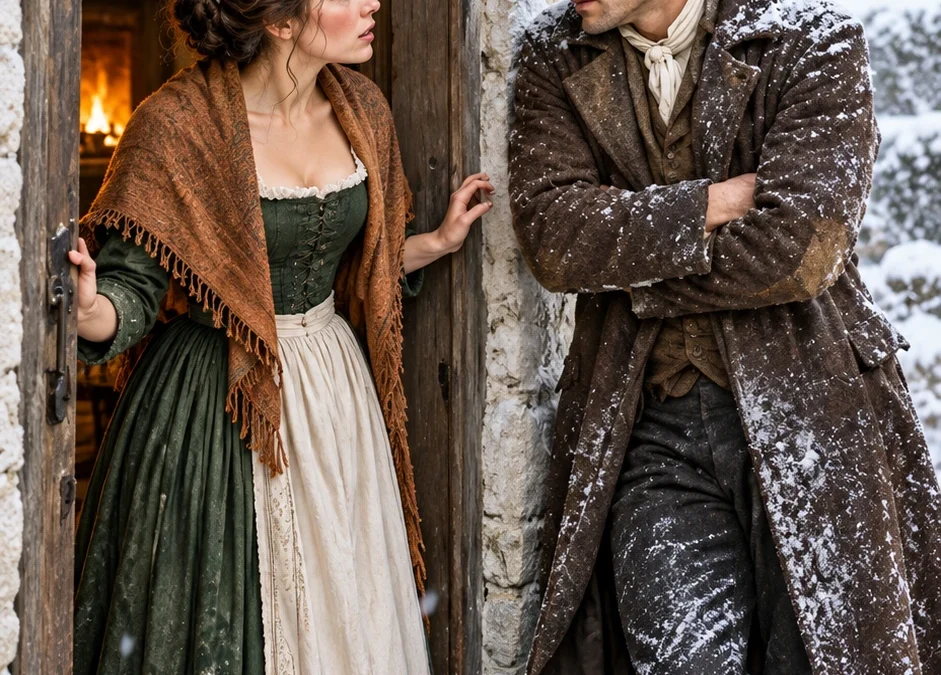
The man at the gate did not answer. He could not. He leaned against the post with both arms folded tight across his chest. When Francis Lanhurst lifted her lantern, she saw his coat had frozen stiff from hem to waist, as if he had waded into the stream and the night had turned him half to ice on the walk out. Snow clung in his hair. His hands were tucked under his arms, breath coming short and white in the lantern light.
It was early January, and the bitter cold had held the world in its grip for ten days. The lane down to Ashlett was iron under her boots. Every hedge stood furred white, and the cottages on the ridge were dark shapes against a sky pricked with hard, bright stars.
The ford, he managed at last, voice low and hoarse and shaking. The horse slipped. I went in. I saw your light.
She had been coming home from the Wheat Sheaf, where she’d sat up half the night tending the carrier’s mare, and she was bone-weary. A woman alone at midnight, a stranger at the gate, no neighbor within call — her grandfather and the vicar would have had plenty to say about the risk. But his lips had gone blue, and she knew well what a January night could do to a man who lay down in the snow to rest.
She hooked the lantern on the gatepost and pulled him up the path. He was heavier than he looked, tall, his legs refusing to obey. They stumbled together to the door, and she kicked it twice in the way the latch liked — it swung open to the warm scents of peat, banked fire, and horses stabled beyond the wall.
From the stairs, a voice like a rusted hinge called down: Francis, who’s that you’ve got?
Someone the ford didn’t want, she answered.
She settled him on the settle by the hearth and set to work as she would a chilled horse — coat first, buttons frozen fast until she broke the ice away with her thumbnail; boots pulled free with a sound like a cork leaving a bottle; sodden stockings stripped off and his feet wrapped in the horse-blanket kept by the door. She built up the fire until it roared, then knelt and took his hands — white to the wrists, cold as yard stones — and rubbed them slowly, never hard enough to hurt, never stopping, the way her grandfather had taught her to warm a foal’s legs.
That hurts, he said politely after a moment.
Good. If it hurts, they’re coming back. It’s when it doesn’t hurt that I’d worry.
She glanced at his coat on the floor — plain brown wool, thin at the cuffs, patched at one elbow with cloth that didn’t quite match. No hat, no gloves, nothing in the pockets. A road-worn laborer, she thought — a groom dismissed without reference, or a soldier whose regiment had vanished. She rubbed his hands a little more gently.
Her grandfather descended the stairs slowly, one step at a time, stick in one hand, rail in the other — once he’d broken horses for half of Kent, and his body had paid for every one. He studied the stranger from feet upward, as he would a horse at fair.
Came through the ford, did he?
Yes, sir.
Nobody crosses Ashlett Ford after dark in January — not unless they don’t know it. You’re not from here, then?
No, sir.
Got a name?
He paused, looking into the fire as if reading his name from the flames. Ned.
Ned what?
Just Ned — for tonight, if you’ll allow it.
Her grandfather grunted — high praise from him; he’d known plenty who chose to leave their names behind and never judged them for it. Francis fetched hot ale spiced with ginger; he held the mug in both hands and drank slowly, color seeping back into his face.
When he could sit upright steadily, he asked where he was.
Ashlett, she told him. Bottom of the lane’s the ford, top’s the church, Wheat Sheaf in between. All Northbridge land — though you’d never guess it looking at the roofs. The old Duke used to come shooting when I was small. The new one’s never set foot here. Lives far away, I suppose — too many other roofs to mind. She set the kettle down harder than intended. And now he’s selling us. Auction’s at Candlemas — every cottage — because they say we haven’t paid rent.
Every quarter, she said, voice tightening. Every quarter of my life I’ve carried the money myself. She stopped, ashamed — midnight, stranger half-frozen, none of this his burden. I’m sorry. You didn’t come here to hear grievances.
I’m glad I heard, Ned said quietly. Truly.
She made up the settle as a bed. Her grandfather went back upstairs. Francis sat up through the small hours — a man that cold could still turn fevered or take a chill; she’d nursed enough animals to know the dangerous hour is when everyone else sleeps. He slept fitfully at first, then deeply. Toward dawn he opened his eyes and found her still there.
You didn’t go to bed.
No.
Why not?
Because you’d be no use to anyone dead. And the ground’s too hard to dig.
He laughed — cracked, surprised, as if he hadn’t done so in a long time — then drifted back to sleep before she could see if he still smiled.
Part 2: The Horse and the Secret
At first light, young Watt from the forge ran shouting down the lane — a strange bay horse loose in the hop-garden, saddle hanging, reins broken. Francis pulled on her boots; Ned was already sitting up wrapped in the blanket.
That will be mine. Well — I hired it.
Stay put. You’re not walking up that hill in stockings.
He followed anyway — her grandfather’s too-large borrowed boots flapping, face set against the cold. The bay stood at the far end of the hop-garden, eyes rolling, reins snagged and snapped. Half the village men gathered with ropes and advice; Francis sent them back, then walked slowly toward the frightened horse — not straight on, but angled, eyes low, voice steady, telling it of the cold, the carrier’s mare, the stranger who’d come from the ford.
The horse snorted and backed. She waited, looked at the hedge as if it were the most interesting thing in Kent. The sun rose, gilding the snow. At last the bay stretched out its nose and breathed on her hands. She knotted the broken reins short, rested her forehead against its neck until breathing synced. She hadn’t needed the spare snaffle bit in her pocket.
When she led it back, Ned stood alone at the gate. He took the reins, ran a practiced hand down the foreleg, lifted the hoof — done easily, like someone who’d spent a lifetime with horses.
Mark of the Crown at Tonbridge on the saddle, she noted. Hired yesterday afternoon. And your things? She touched the torn strap.
Gone — ford, roadside, ditch. Doesn’t matter. Nothing I can’t replace. He looked at her with an intensity she couldn’t quite name. I’ve never seen anyone do what you just did.
It’s only patience.
Nobody has that much patience.
Horses do, Francis said. You just borrow some of theirs.
On Sunday the village gathered in the churchyard. Mr. Keley, estate clerk, thin and anxious, read the notice: Ashlett’s cottages to be sold at Candlemas by order of the Dowager Duchess, acting for the Duke — families in arrears, properties ruinous. No shouts, no anger — only quiet despair. Widows bowed heads; children stared up at grown faces to learn how to feel.
We paid, Francis said afterward, knuckles white in her shawl. Every quarter. Who do we tell? The Duke? He signed it.
Perhaps he didn’t know, Ned said quietly.
Then he should have! Her eyes flashed. If you own a village, you ought at least to know it’s still standing.
That night she lay awake remembering: Michaelmas, the long room at the Wheat Sheaf, counting coins tied in a handkerchief, Mr. Keley saying “Her Grace’s book is receipt enough”, the feast — roast goose, singing, her grandfather laughing — proof that every family there had paid.
She arranged for Ned to board at the Wheat Sheaf in return for chores. Susan, the innkeeper, took him in — and began noticing things: blistered palms from unfamiliar labor; a pale band where a ring had long sat; a neat, practiced hand; how he read every newspaper page; how he watched Francis walk past each afternoon. One evening she told him plainly: Whatever you are, Ned — don’t hurt that girl. She sees horses perfectly but never looks at herself — doesn’t know a man might look at her too.
I give you my word, he said.
The frost held, cutting Ashlett off — roads drifted, supplies ran low. Then a coal wagon arrived from Tonbridge — sacks of fuel, flour, bacon, blankets for every cottage, paid anonymously from London. Francis stood with Ned as the wagon unloaded, feeling something warm and unnameable bloom in her chest.
Who could know we’re here?
Someone who heard about the cold, Ned said.
A little girl from the end cottage approached him solemnly: Are you a beggar? Did it hurt in the ford?
Very much. But Miss Lanhurst made it better.
Two days later, a groom summoned Francis to Northbridge Hall — a restive black filly no one could handle. She agreed, and Ned came along. The great house stood cold and shuttered. The filly had been beaten and flinched from every hand — Francis spent hours gently winning its trust while Ned stood quietly by, never interfering, learning patience. The Dowager Duchess watched, praised her, then added: I hope your grandfather has somewhere to go. It is sad, but the Duke must recover what is owed.
The Duke has had his money, Your Grace, Francis said levelly. I carried it myself.
The Duchess smiled it away as loyalty — but Ned saw beyond the performance: mittens darned at the thumbs, a single small fire, one chair drawn close — a woman not nearly as grand as she pretended.
That evening on the frozen millpond, Ned asked her to “dance” — really just slide and circle together on the ice. They were both clumsy, laughing until breathless. By the fire afterward he gave her a packet wrapped in oiled paper.
Seeds from an old garden in Porto. The gardener gave them — a blue flower that grows on the hills there. He told me to plant them wherever I called home. I never found the place.
Sow them at Candlemas under glass, she whispered.
At the gate he stopped — the same gate where she’d found him shivering. Francis, there’s something I must tell you —
Not tonight, she said softly. Tonight I only want to know you’re here. He kissed her gently, cold hands cupping her face, the valley silent and white around them.
Part 3: The Truth and the Proof
She woke smiling, happy — then unfolded the paper wrapping the seeds and found another letter folded inside, written in a fine slanting hand:
To His Grace the Duke of Boulderwood — The people of Ashlett pay nothing. They are idle, their cottages ruinous. The kindest course is sale at Candlemas. Signed — Estella Boulderwood.At the foot, in a stronger, familiar hand: Let it be done.
The world seemed to tilt. She stood frozen — Ned was the Duke. He’d come in disguise. He’d signed the order. All of it — the kindness, the lessons, the kisses — had been a lie.
At noon he came down the lane. She handed him the letter without a word. The color drained from his face exactly as it had that first night in the snow.
Not in the lane — please.
In the stable, among the quiet horses, he told her everything. He was Edward — “Ned” was what his mother had called him. A younger son sent away to work in Porto, he’d unexpectedly inherited the dukedom. Strangers ran his estates; the Dowager wrote glowing reports; he signed without question — until her letter felt too neat, suspiciously perfect. He’d come in secret to see for himself, fell from his horse in the ford, and found her.
I wanted to know the truth before I was the Duke again — because once I put the title back on, no one tells you the truth.
You let me pity you, she said, voice cracking. You let me curse you to your face. You let me teach you to stand still — all the while you were judging us.
I never judged you. I never laughed at you — not once.
Go to your house, Your Grace. It’s yours. The ford, the lane, this stable — all yours. Go see what you own.
He left the letter on the stall ledge and bowed — formally, distantly — and walked away.
That evening Susan told him simply: She won’t be caught — you taught her that. She chooses whether to come round or not. He put on his own patched coat and walked up the hill to Northbridge — arriving at midnight to a footman who tried to shut the door. He confronted the Dowager; they argued until dawn. By morning Mr. Keley had fled.
Edward wrote to Francis — no begging, no excuses. He laid it bare: he could stop the sale instantly, but that would leave doubt forever — her grandfather would be remembered as “indulged,” not honest. He would stand with her truth, whatever she decided. Tell me how you want this done. It is your village. I have only owned it.
Her grandfather told her plainly: You’re not angry — you’re frightened. Not that he lied — that he saw you. He mucked out my stables when he could have commanded a hundred grooms. I never knew a duke do that.
Late that night she remembered the Dowager’s words — no one has sat down to a paid feast since the old Duke died — and realized: the feast records! Susan kept every scrap — every signed list of who’d dined after paying rent, quarter by quarter, year after year. They raced through the bundles — names, dates, signatures, all in Keley’s hand — undeniable proof the village had always paid.
Francis replied to Edward: Let it go to auction. I will be there with the truth — and so will Ashlett.
Part 4: Candlemas — The Truth Comes Out
Candlemas dawned soft and wet, thaw turning snow to slush. The Wheat Sheaf’s long room filled — villagers in their best, hats in hands, exactly as they stood every quarter day. The Dowager sat by the fire; the auctioneer prepared to begin. No Duke had come — roads were impassable.
Francis stood. Before you sell this first cottage — know it has been paid for, every quarter, for years. She read the damning letter aloud, then laid Susan’s tin box on the table and began reading — name after name, quarter after quarter. As each name was spoken, that villager stood — until the whole room stood silent, united.
The Dowager dismissed the papers as worthless scraps. The auctioneer hesitated — then the back door opened. Edward entered, mud to his knees, wet patched coat, supporting a trembling Mr. Keley.
The sale is withdrawn, Edward said. I am the Duke. I signed the order blindly — that was my fault alone. I came to see, and I saw enough.
Keley confessed everything — the Dowager had instructed him to falsify the books, hoping to sell the village and keep the proceeds. The quiet gentleman in black was her accomplice.
The Dowager left — proud, head high, but alone, her reign ended. Edward had ridden two days through storms to find Keley and bring him back.
Afterward in the stable yard, the black filly nuzzled Edward’s pocket as they stood together.
I’ve secured every cottage to your families in perpetuity, he told Francis. No rent, no sale — yours forever. And I am still not Ned. I am the Duke — responsibilities, letters, duties — all of it. But — he took a breath — I learned something here. I don’t want to rule from afar. I want to stay. If you’ll have me — not the stranger you rescued, but this man, exactly as he is — will you marry me?
She stepped close and took his left hand, where the pale ring mark still showed. I’ll have the man who learned to stand still, she said. Whatever his name is. I love you, Edward.
They married quietly in March, primroses lining the lane. Susan cried in the front pew; her grandfather gave her away. That summer the blue flowers bloomed — stars of sky-blue along the cottage sill, then spreading to every garden and the great hall walls. Their son was born in autumn; Francis ran the stables still, and Edward walked beside her, a duke who knew how to muck out stalls and wait quietly by a frightened horse.
One January night years later, cold again gripped the valley. Edward came in stamping snow from his boots. Francis took his cold hands between hers, just as she had that very first night.
That hurts, he said, smiling.
Good, she answered. If it hurts, they’re coming back.
And so they would — always — together.
This story is a work of fiction. All names, characters, and events are fictional and created for enjoyment.
Disclaimer: This story is fictional and created for entertainment purposes only.
Any names, characters, places, or events are fictitious or used fictitiously.
No real person or organization is intended to be portrayed.








