SHE HAD 30 DAYS TO LEAVE HER FAMILY HOME — THEN SHE PRIED OPEN A CELLAR WALL AND FOUND 12 HIDDEN STAIRS THAT CHANGED EVERYTHING
Part 1
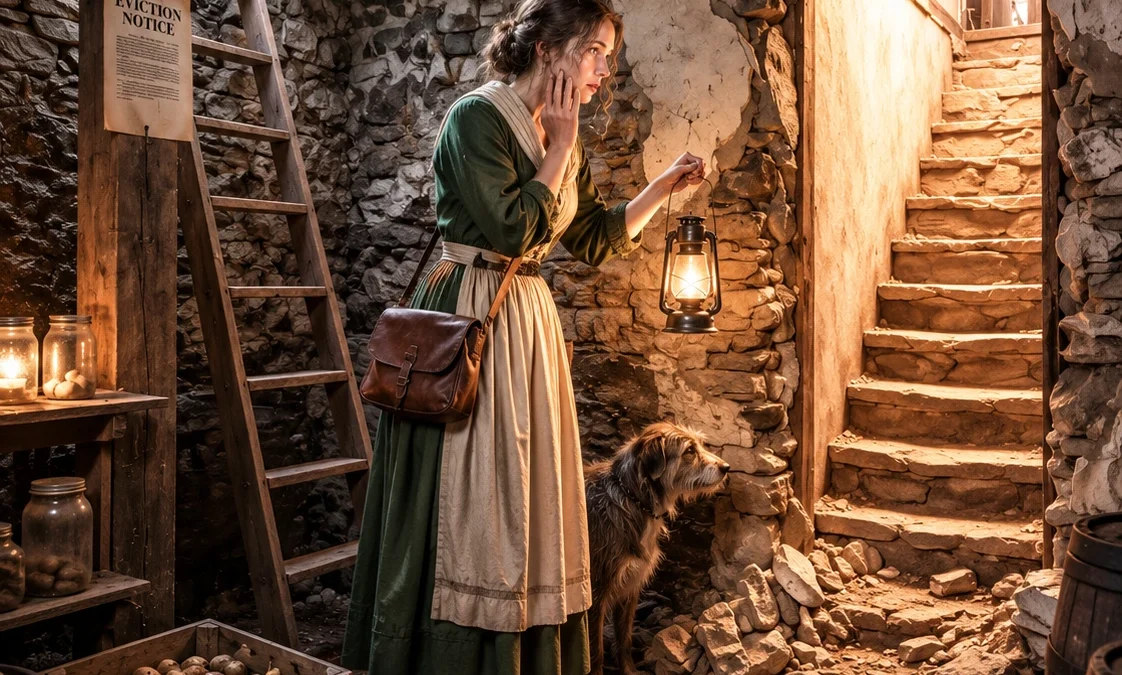
Nineteen-year-old Elsie Halverson knelt in the dim, cold glow of a lantern in her family’s root cellar, her breath misting in the air.
In her hand she gripped a heavy iron wrecking bar, its surface worn smooth from years of use.
Above her, the ranch house in Elhorn Bend felt quiet — too quiet — as if the very walls were holding their breath.
Three days earlier, the banker had ridden up the wagon track with a folded paper sealed in red wax.
Her only living relative, a half-aunt named Vera Milward whom she had never met, had bought the $420 note on the property from the bank.
Elsie had exactly 30 days to pay the full amount or leave the home where she had been born and raised.
Her father Isaiah had died just months before, leaving her with nothing but the house, six thin cattle, $42 tucked in her coat lining, and a story she had always believed: that her grandfather had built this place in 1852 on land no one had wanted before him.
Elsie had not wept.
Wilder Renshaw — the sharp, quiet widow who had taught her stonemasonry and carpentry from the time she was a girl — had once told her: “Weeping is for after the work.
Rarely fits anywhere else.
” So Elsie worked.
She sold three cattle to her neighbor Emory Whitlock.
She mended fences.
She planned repairs to make the house valuable enough to save.
And she started in the cellar, where her father had always said the floor joists were weakest.
That was when she noticed it.
Along the north wall, where the fieldstone ended, stood six wide planks painted a deep, dark red — the color of dried blood.
Isaiah had told her as a child they were simply there to hold back the earth.
But when Elsie pressed her palm against the wood, it did not feel damp or packed with soil behind it.
It felt cool, the way a wall feels when a room lies on the other side.
She fetched Wilder’s old folding rule — the one passed down from Wilder’s father, then her husband, then to Elsie on her 15th birthday — and measured.
Thirty-two inches wide.
Sixty-one inches tall.
Perfectly fitted.
And the wood was sound — far too sound to be a hastily built retaining wall.
That night she sat at the kitchen table long after the fire had died, thinking.
What if the story she had been told her whole life was only half the truth? What if the ground beneath her feet was never truly her grandfather’s to give?
The next morning, she took up the wrecking bar.
Inch by careful inch, she worked the nails loose.
One plank came away.
Then another.
By the time the fifth fell, the lantern light fell into a space no living soul had seen in decades — and a faint, dry scent drifted out: pine, old paper, and the ghost of a fire long extinguished.
When the sixth plank slipped free, Elsie froze.
There was no dirt behind the wall.
There was a doorway.
And beyond it, vanishing down into deep shadow, were twelve carefully built stairs leading into the dark.
Her heart hammered.
Who had hidden them? Why? And what lay below?
Part 2
Elsie stood motionless, the lantern raised high, its flame trembling as her breath caught.
The stairs were not roughly cut or hastily nailed together — each tread was mortised into solid timber, built to last for generations, as if the person who made them had known they might one day be found.
She gripped the handrail — worn smooth by hands long gone — and took the first step.
It held firm.
By the seventh tread, the lantern’s glow began to touch a floor.
By the twelfth, she stepped off into a room.
It was a fully furnished dwelling, buried beneath her own home.
Dry-stone walls as true and straight as any Wilder had ever built.
A small cast-iron stove.
A bed with a faded straw tick.
A table.
Shelves lined with books whose pages were still crisp.
And on the table, weighted down by a smooth river stone the size of a fist, lay an envelope sealed with red wax.
On the outside, in elegant, faded script, it read: For whoever finds this house.
Elsie sat slowly in the chair before the table.
She lifted the stone.
She broke the seal.
Inside were three things: a letter, a leather pouch heavy with gold coins, and a deed wrapped in oilcloth.
The deed was dated March 21, 1852 — three months before her grandfather was said to have arrived in the valley to build the house.
The name on it was not Halverson.
It belonged to Rachel Ashcraftoft, widow — who had claimed this land as her own.
The letter unfolded in her hands, and as she read, the world she had always known shifted beneath her.
Rachel had crossed the plains alone after her husband died on the trail.
She had built this underground home with her own hands in 1846.
She had bought the land.
She had taught the valley’s children to read.
And when her grandfather Owen Halverson arrived in 1852 seeking a place to settle, she had granted him permission to build above her home — on the condition the land would always remain hers.
Before leaving to nurse her sister in Ohio in 1857, she had made Owen promise to board up the stairs and tell no one — so that whoever came after her might one day find the truth.
Owen had kept his word.
He had told his son Isaiah the wall was only earth.
Isaiah had never known.
And Vera Milward? She knew — Elsie realized with a jolt.
That was why she had sent a lawyer with a lowball offer and threats of forged documents.
She was rushing Elsie out before the truth could surface.
Elsie looked up from the letter, her hands steadying as understanding settled in.
She had not inherited a stolen home.
She had been left a legacy hidden in plain sight — and a fight to defend it.
Part 3
By dawn, Elsie had her plan.
She counted the gold — more than enough to pay off the note, with plenty left over — and carefully rewrapped the deed and letter.
She rode straight to the records office in Rowan Falls, where Ambrose Whitaker, the clerk, confirmed the Ashcraftoft deed was indeed properly recorded and had never been revoked.
Then she went to the bank, laid the full payment before Silas Krebs, and watched him mark the note satisfied.
When she rode back toward the ranch, the sky had cleared — and so had her purpose.
But as she rounded the bend to the house, her blood ran cold.
A covered carriage stood in the yard, and on the porch, waiting as if she owned the place, stood Vera Milward herself.
Beside her was the lawyer Thaddius Corbin.
“You’re trespassing,” Elsie said, dismounting and stepping onto the porch.
Vera smiled — the same sharp, practiced smile Corbin had worn.
“Your father’s signature meant nothing.
The land belongs to me — and I have the papers to prove it.
” She produced a leather portfolio and held it aloft: a land patent supposedly granted to Owen Halverson in 1846.
Elsie did not flinch.
“Oregon did not become a territory until August 1848.
No federal land office existed here in 1846.
Your patent is impossible — and you know it.
”
Vera’s smile did not falter, but her eyes hardened.
“We shall see you in court.
”
The hearing was set.
Elsie did not wait.
She sought out Barnaby Otley, the elderly stonemason who had helped build Rachel’s walls as a young man — he swore to testify he had seen Rachel sign the deed.
She found Letty Groves, who had been paid to lie about Rachel’s character but admitted the truth, her conscience finally outweighing her need.
She showed Josephine Vance, the schoolmistress, Rachel’s letter — who confirmed its voice was unmistakably that of a teacher.
And she produced Wilder’s notebook, where Rachel’s receipt for a purchased tool matched the deed’s handwriting perfectly.
On the morning of the hearing, the small records office was packed.
Vera presented her patent first, but Judge Howerin dismissed it instantly — the dates and seals were impossible.
When Corbin called his witnesses, Letty Groves stepped forward and told the truth of the bribe.
Barnaby confirmed Rachel’s existence.
Josephine spoke to the letter’s authenticity.
Elsie laid out the deed, the notebook, the gold, and Rachel’s letter — and the room fell silent.
Judge Howerin looked from one to the other.
“The Ashcraftoft deed is valid, recorded, and unchallenged on its face.
The opposing patent is void.
The land belongs to Rachel Ashcraftoft’s intended heir — Elsie Halverson.
”
Vera stood, folded her portfolio without a word, and left.
Neither she nor Corbin ever returned to Elhorn Bend.
That was not the end, though.
Elsie went back to the hidden room and found two more deeds Rachel had left behind — for the schoolhouse land and the north pasture — set aside to protect the valley from land speculators decades before.
Elsie granted the schoolhouse land to the district for 999 years at $1 rent a year, so children would always have a place to learn.
She leased the pasture to Emory Whitlock at a fair rate, securing his livelihood.
And she kept the ranch — and the room beneath it — as her own.
Barnaby carved a stone for above the hidden stairs: Rachel Ashcraftoft, 1815–unknown.
She built this room.
Elsie found it.
On quiet evenings, Elsie would light the lanterns below and sit at Rachel’s table, reading the old books or simply resting her hand on the wood.
She had not only saved a home — she had reclaimed a woman’s story that had been buried alive.
The walls around us may seem solid, Elsie learned.
We may be told there is nothing behind them.
But sometimes, if we dare to pick up the bar and pry loose the first plank, we find more than we bargained for.
We find the truth.
And sometimes, the truth was waiting all along, just for us.
✨
This story is entirely fictional and created for entertainment purposes only.
It does not represent any organization or individual, nor does it encourage inappropriate behavior.
The content was generated with AI assistance.








