She Humiliated a Stranger at Her Father’s Dinner Table. Then the Housekeeper Whispered Two Words, and the Man Holding Her Family’s Fate Found Something in Her Ledgers That Could Destroy Them Both
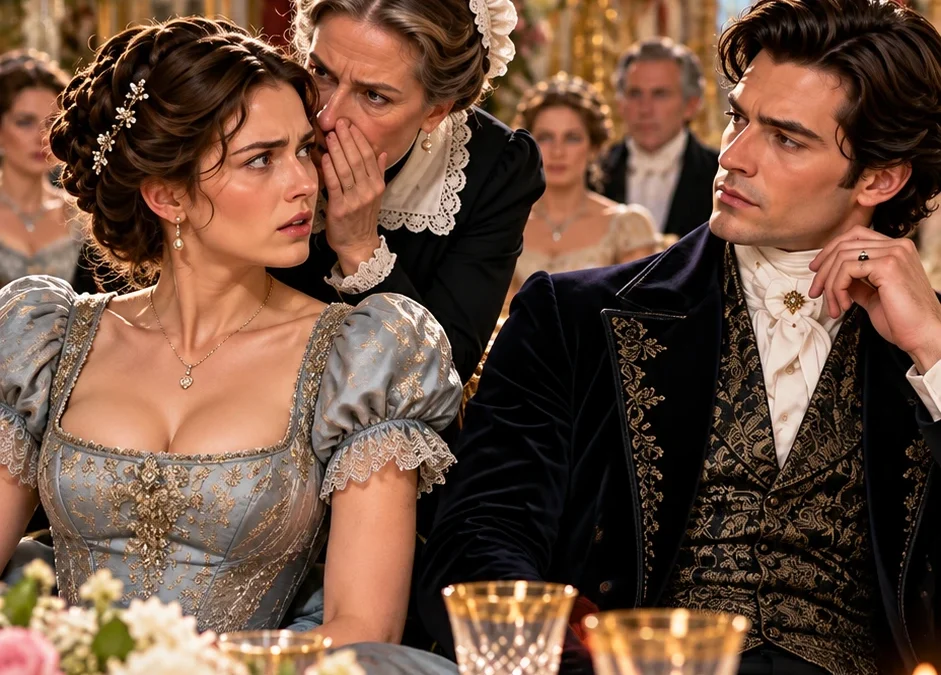
She Humiliated a Stranger at Her Father’s Dinner Table. Then the Housekeeper Whispered Two Words, and the Man Holding Her Family’s Fate Found Something in Her Ledgers That Could Destroy Them Both
Part 1
Snow battered the windows as Miss Clara Whitmore faced the arrogant stranger across her father’s dinner table. ❄️
He had criticized her estate. He had questioned her intelligence. He had dismissed five years of sacrifice without knowing a single thing about her.
Clara set down her glass.
“Arrogance, sir, is an expensive way to judge people.”
The room fell silent.
The stranger’s expression changed, but he offered no apology. Then the elderly housekeeper leaned toward Clara, trembling.
“Miss Whitmore,” she whispered. “That’s the Duke of Blackthorne.”
Clara’s blood turned cold. 😨
Because the man she had just humiliated held the mortgage to everything her family owned.
December had arrived at Briarwood Manor with a vengeance.
Snow had fallen for three days without pause, burying the fields beneath a heavy white silence. Wind moaned through the bare hedgerows. In the study, a single candle burned low beside a stack of ledgers, and Clara sat bent over them with her gray shawl drawn tight.
She had added the same column three times. The answer refused to change.
The autumn income had fallen short again. Grain wagons sat idle because no driver dared the icy roads. But the weather was not the true enemy. The real weight on Briarwood was the debt, an old, stubborn obligation that had clung to the Whitmore name for as long as she could remember.
For five years, Clara had carried the estate almost alone. She had outbargained merchants who expected to cheat a young woman. She had sold the second carriage and closed the unused rooms. Most of all, she had refused to raise the rents on the tenant families, even when neighbors whispered that she was a fool.
Those families had stood by Briarwood through hard seasons. She would not bleed them dry.
The study door creaked open. Her father, Edmund Whitmore, stepped in, a gentle, silver-haired man whose kindness had always outpaced his head for figures. He wore his best coat. There was a nervous brightness in his eyes that Clara had learned to distrust.
“We are having a guest for dinner tonight,” he said. “An important gentleman, my dear. He may be able to help us with the debt.”
“Who is he?”
Edmund only waved a hand. He seemed almost afraid to say the name aloud, as though it might shatter the fragile hope he had built around this evening.
Just before dusk, a black carriage emerged from the snow, its lamps glowing like amber eyes. A tall man stepped down in a dark gray coat and black leather gloves, with the unhurried bearing of someone who had been obeyed his entire life. His face was severe and striking, with cool gray eyes that weighed everything they touched.
Edmund introduced him simply as “Mr. Ravenscroft.”
The guest gave Clara a brief, correct bow. But his gaze slid past her toward the worn rugs and faded curtains of the hall.
Something in that glance made her spine stiffen.
Dinner began quietly. The fire crackled. A plain meal was served on the family’s last good china. Then Mr. Ravenscroft began asking questions.
How many acres were under cultivation? What were the rents? Why had income fallen so sharply?
Clara answered each one with care. He listened without expression, then observed that Briarwood appeared to be run with remarkable inefficiency. When she explained that she had lowered rents for struggling tenants, he called it sentimental, the kind of choice that invited ruin.
Clara set down her fork. With exact figures, she told him that tenants squeezed beyond their means produced less and abandoned their farms, and that an estate which drove away its workers would lose far more than it ever gained.
“Good intentions do not keep an estate solvent, Miss Whitmore.”
“Neither does arrogance, sir.”
Edmund made a strangled sound and tried to remark upon the weather. Neither of them glanced at him.
“You seem remarkably confident for someone facing financial ruin,” the guest said coolly.
“And you seem remarkably certain about an estate you have barely seen.”
She lifted her glass, then set it down with deliberate calm.
“Arrogance, sir, is an expensive way to judge people.”
Even the fire seemed to hush.
The stranger did not answer at once. Something unreadable shifted behind those cold gray eyes. Something that was not quite anger. 🔥
Then the door opened, and Mrs. Agnes Bellamy, the housekeeper who had served Briarwood for thirty years, entered with a fresh decanter. She glanced at the guest, and the color drained from her face. The decanter shook in her hands. She sank into a curtsy deeper than any Clara had ever seen her give.
“Your Grace.”
Clara did not understand at first. Then Mrs. Bellamy bent close and whispered the words that changed everything.
That’s the Duke of Blackthorne.
Clara knew the name. Everyone in the county did. Alexander Ravenscroft, master of a dozen estates, partner in banks, holder of investments stretching from the northern mills to the docks of London. And only a month ago, her father had confessed in a shaking voice that the Whitmore debt had been sold to a new creditor.
She had never learned who.
Now she knew.
Edmund looked ready to faint. He believed his daughter’s sharp tongue had just destroyed their last chance of keeping the house where five generations of Whitmores had been born and buried.
Yet beneath the fear, something stubborn refused to bend. Every word she had spoken was true.
Across the table, Alexander watched her. He understood at once that she had not known who he was. In his experience, people who offended him and then learned his title did one of two things. They groveled, or they fled.
Clara did neither. She rose and offered a curtsy that was correct in every particular and not one inch deeper than it needed to be.
“I beg your pardon, Your Grace, for failing to address you properly. I do not beg your pardon for defending Briarwood.”
His brows lifted very slightly.
“Since we are being candid, Miss Whitmore, I hold your family’s debt. If your family fails to meet its obligations, Briarwood may be reclaimed in full.”
Without a word of apology, Clara fetched the plans she had drafted over many sleepless nights. Long-term grain contracts. Draining the low meadows. Leasing unused pasture. The Duke turned the pages slowly and asked two pointed questions. She answered both without hesitation.
Then he rose. “Have every ledger ready.”
His carriage vanished into the snow.
Three days later, he returned with an offer. Six months. Suspend all proceedings, and if Clara could prove Briarwood could generate steady income, the loan would be restructured. If she failed, he would take everything.
She read every clause of the contract. Then she told the Duke of Blackthorne that three of his provisions were unacceptable.
Men twice her age had signed his contracts without a murmur.
He struck out the clauses.
The clock began to tick. ⏳
All winter, Alexander came to Briarwood. He challenged every decision. She answered every challenge with evidence. And somewhere between the arguments, something quietly shifted between them.
Then, late one February night, Clara pulled down an old ledger bound in cracked brown leather. She only meant to confirm one figure.
The interest did not match the contract.
She worked it a second time. A third. Her hand was no longer steady.
For fifteen years, her family had been charged more than they ever agreed to pay.
By dawn, she had laid every ledger across the study floor. The difference never wandered. It sat in every column, patient and deliberate. Then she found two amendments that extended the loan and raised the fees, signed the winter her mother lay gravely ill.
Her mother’s signature was firm and elegant, without a single tremor.
Clara remembered that winter. Her mother had been too weak to hold a spoon.
Then she found one last paper, dated the third of March, bearing her mother’s confident signature.
Her mother had died on the ninth.
Someone had used her dying mother’s hand to steal her family’s future. 😱
👉 Want Part 2? Find it in the comments, or leave any word and I’ll send it to you privately!
Part 2
Someone had used her dying mother’s hand to steal her family’s future. 😱
Clara did not sleep that night.
When Alexander arrived the next evening, snow falling thick and silent over the drive, she did not greet him. She simply placed the books in front of him and pointed to the columns.
At first, he was impatient. Surely she had misread the rate. She should check her calculations again.
Clara handed him a pencil and a blank sheet.
“Check them yourself, Your Grace.”
He worked in silence for nearly an hour. She watched his face change line by line. The impatience faded, then the doubt. By the time he set down the pencil, his jaw was tight and his eyes had gone dark.
“This was no clerical mistake. A careless clerk does not make the same error for fifteen consecutive years.”
“Who managed this loan?” Clara asked.
They both knew the answer before she found it in the correspondence.
Lord Percival Ashborne. 😶
For fifteen years he had been her father’s trusted financial adviser. A polished, courteous nobleman who dined at Briarwood every Michaelmas. A man who had sat at her mother’s funeral with his hand pressed sympathetically to Edmund’s shoulder.
Clara felt the betrayal like a blade. Her father trusted that man more than he trusted himself.
Alexander warned her gently. Suspicion was not proof. Ashborne had friends in every bank and courtroom. To accuse him without unshakable evidence would invite ruin, not justice.
Clara agreed without hesitation. She wanted the truth laid out so clearly that no title and no charm could explain it away.
So they began. Alexander summoned Mr. Nathaniel Pierce, a lean, sharp-eyed solicitor. Pierce arrived through a blizzard and spent three days reading. By the end, his expression had grown very grave.
The irregularities were real. And they did not end at Briarwood.
Ashborne had arranged loans for a great many noble families over two decades. Several of those families, with sound estates and decent harvests, had still fallen into crippling debt. One by one they had been forced to sell their lands at a fraction of their worth. 😰
Alexander said little. But that night, at Blackthorne Hall, he did something he had never thought to do. He opened the private archive of his own family and began examining his late father’s property records.
He read until the candles guttered and the sky turned pale.
He found eleven estates. Eleven properties acquired by the Ravenscroft family over twenty years. Every one bought through arrangements brokered by Lord Ashborne. Every one purchased at a price so low it could only have come from desperation.
The truth struck him like a physical blow.
His father, the man whose portrait hung above the great staircase, whose name was spoken with reverence across the county, had built part of the Blackthorne fortune on the ruin of other families.
The very power that allowed Alexander to walk into Briarwood and decide its fate had been fed by the same poisonous system that had brought Clara’s family to its knees. 💔
Two days later, he told her everything.
Clara listened without interrupting. Then she asked the only question that mattered.
“Do you intend to continue?”
Alexander walked to the window and stared at the snow. If he pursued this to its end, he said, he might lose a great deal. Money. Properties. And the Ravenscroft name, unblemished for three hundred years, would be dragged through every drawing room and courtroom in England.
Clara could not ask him to sacrifice all that for her family.
“I will go forward with or without you,” she said quietly. “But I will not think less of you if you step away.”
Alexander turned and looked at her for a long moment.
And then, in a voice she would remember for the rest of her life, he gave his answer.
But before he could finish speaking, Mrs. Bellamy burst through the study door, pale and breathless, holding a sealed letter with the crest of Silver Abbey.
Lady Beatrice Ravenscroft, the Duke’s formidable aunt, had issued an invitation to a grand winter ball.
And at the bottom of the guest list, in elegant ink, was one name Clara recognized.
Lord Percival Ashborne. 😳
👉 Want to see what happens when Clara walks into that ballroom with the evidence? LIKE or COMMENT “REVEAL” to unlock Part 3! Part 3 will be posted after enough comments. 🔔
Part 3
Alexander did not step away.
“I will not step away,” he said at last. “I will examine every transaction connected to my family’s estates, without exception and without mercy.”
That same afternoon, he instructed Mr. Pierce to do exactly that.
Clara realized then that his choice had been far harder than hers. Saving Briarwood would have been easy for a man of his wealth. What he faced was whether he had the courage to correct wrongs from which his own family had profited, wrongs that had made him who he was.
One evening, as snow buried the entrance to the manor, he admitted something he had never said aloud.
“I always believed that if a transaction was legal, it was fair.”
Clara set down her pen. “The law and justice are not always the same thing, Your Grace. Sometimes the law is simply the shape that power gives to its own convenience.”
He did not argue.
On the last evening of February, Mr. Pierce returned with the first results of his wider inquiry. He laid the papers on the table without ceremony.
The same inflated interest. The same unexplained fees. The same suspicious amendments, again and again, across estate after estate.
Ashborne had not merely cheated one family. He had built an entire machine for devouring estates. First, a friendly offer of a loan. Then the slow, quiet inflation of interest and fees. Then the crisis, when the owners could no longer pay. And finally a sale arranged by Ashborne himself, always to a buyer with deep pockets and few questions.
Too often, that buyer had been the late Duke of Blackthorne. 😔
Not everyone in the family agreed with what came next.
Lady Beatrice Ravenscroft, the Duke’s aunt, was a formidable woman of sixty, silver-haired and straight-backed, who had devoted her life to preserving the Ravenscroft name. She summoned Alexander to her sitting room and told him in a voice like cut glass that a duke’s first duty was to protect his family. The past was the past. Whatever his father had arranged was legal and long concluded. And it was deeply improper for a debt-ridden country girl to meddle in the affairs of England’s highest families.
Alexander heard her out with perfect courtesy.
Then he refused her completely.
“If my family grew rich from wrongdoing, then protecting the family means correcting that wrongdoing, not burying it. A name that can only survive by hiding the truth is not worth preserving.”
“And Miss Whitmore?”
“She uncovered in a single winter what my own bankers failed to see in fifteen years. I will hear no word against her.”
Lady Beatrice rose white with fury and swept from the room. Alexander knew with grim certainty that he had just made an enemy in his own house.
Meanwhile, Clara worked without rest.
She gathered every thread of evidence into one meticulous report, organized so that even a man who had never seen a ledger could follow it year by year. The agreed rate beside the rate charged. Every unexplained fee. Every amendment. Every date. Her mother’s signatures placed beside letters Eleanor had written in health, and beside them the sworn statement of the physician who had attended her in her final weeks.
Mr. Pierce added his summaries of the other estates. Page by page, the report grew into something no title could easily dismiss.
They spent long evenings over those papers while the wind howled across the frozen fields. They still argued, but the arguments had changed. They no longer argued to win. They argued to find the truth, hunting for weaknesses an enemy might exploit.
Sometimes, when Clara caught an error he had missed, Alexander would lean back in his chair and simply look at her. And she would feel her cheeks grow warm in a way that had nothing to do with the fire. 🔥
One night, after a long silence, he set down his pen.
“I judged you wrongly the night we met. I looked at a young woman in a worn dress, in a house with faded curtains, and decided I knew everything about her before she spoke a word.”
Clara studied him in the candlelight. “What matters is not that you were wrong. Everyone is wrong at times. What matters is whether you are willing to change.”
“Then let me say it properly. I am sorry, Clara.”
It was the first time he had used her Christian name. It was not a polite formality. It was a confession, and they both knew it.
On the night of the ball, Silver Abbey blazed against the winter dark like a lantern set in snow. Chandeliers scattered light across silk gowns and glittering jewels. When Clara entered in a simple dress of deep blue, without a single diamond at her throat, heads turned. Whispers followed her across the floor.
Everyone knew Briarwood was drowning in debt.
She kept her chin level and the bound folder tucked firmly beneath her arm.
Lady Beatrice found her within the hour, flanked by ladies of rank, her smile polished and merciless. “Miss Whitmore, how brave of you to come. I understand you have been advising my nephew on finance. A remarkable ambition for a young woman with no training and an estate on the edge of ruin.”
A few guests laughed softly.
Clara met her gaze. “Numbers do not change, my lady, simply because a woman is the one reading them.”
“Rank exists so that the right people make the important judgments.”
“Then should rank excuse a person from responsibility when those judgments are wrong?”
The circle fell silent.
Before Lady Beatrice could answer, a smooth voice interrupted. Lord Percival Ashborne stepped forward, silver-haired and immaculate, wearing the same gentle smile he had worn at her mother’s funeral. He took Clara’s hand as if comforting a child.
“I hear you have been troubling yourself over old accounts, my dear. Grief and inexperience can lead anyone to misunderstand complicated arrangements.”
Clara withdrew her hand.
Then she opened the folder.
In a clear, steady voice that carried across the great hall, she set out the original rate and the rate actually charged. The one and a half points added year after year. The fees with no lawful purpose. The music faltered and stopped. Guests drifted closer.
She laid out the transfer authorization dated the third of March. Beside it, a letter in her mother’s own hand. Beside that, the physician’s sworn statement that Eleanor Whitmore could not hold a pen in her final weeks.
For the first time, Ashborne’s smile slipped.
“This is slander! An outrageous insult to the honor of a gentleman!” He turned to the room for support.
Then Alexander stepped forward.
“Every document has been examined, my lord, by my own solicitor and by the bank that holds the originals. The discrepancies are real, and they are serious.” His voice was quiet, but the whole hall heard it. “Rank does not replace evidence.”
Mr. Pierce presented his findings on the other estates, one family after another. The same pattern repeated with mechanical precision.
Among the guests stood Judge Harold Whitfield, the county magistrate, who had listened in grim silence. He set down his glass.
“Lord Ashborne, you will accompany me to the library at once to account for these documents.”
The woman who had been mocked as unfit to read a ledger now stood before the wealthiest families in the county, and not one of them could dismiss her with a title. 😮
Ashborne looked at Alexander, searching his face. He understood then that the Duke would not protect him. And that to bring Ashborne to justice, Alexander would have to expose his own family’s shame.
An official inquiry began within the week. Independent auditors seized contracts and records. Landowners across the region came forward with their own papers. Amended clauses, unlawful interest, and forged signatures were brought into the light one by one.
By early summer, the matter came to trial.
Clara testified with the same calm precision she had shown at the ball. Mr. Pierce laid out his comparisons. And Alexander did what no one in the county had expected. He voluntarily disclosed every transaction connecting the Ravenscroft family to Ashborne. He concealed nothing, not even the advantages his father had gained.
Lady Beatrice, bitter and furious, accused him of destroying the legacy of his ancestors.
Alexander answered simply, “Honor cannot be built on property taken from others.”
The court found that Ashborne had committed systematic fraud involving nine estates. The unlawful interest was struck down. The affected properties were ordered reviewed for restitution or compensation. Alexander cooperated fully, accepting heavy financial losses and enduring cold looks in every drawing room.
Clara watched him choose what was right when it gained him nothing. She understood that he had truly changed. And Alexander understood that Clara had never needed a powerful man to rescue her. She needed a man willing to stand beside her in the truth. ✨
When the verdict was read, Mr. Pierce came to Briarwood with fresh papers. The Whitmore debt would be recalculated from the beginning. Every unlawful charge would be removed.
Clara sat very still as he spoke. Then she rose and walked to the window.
For the first time in fifteen years, her family had a real chance to keep their home without surrendering their dignity to anyone.
Snow melted from the lanes in thin silver streams. The dark earth appeared after long months beneath the frost. The debt was restructured on lawful figures, with a repayment plan stretching six to eight years. The grain contracts brought steady income, and the drained meadows promised the best harvest in a decade.
One evening, Edmund took his daughter’s hands in his, his eyes wet. “Without your persistence, we would have lost everything.”
Clara simply held him close.
A few days later, Alexander came to Briarwood. This time he carried no ultimatum and no contract. They sat beside the drawing room fire, and for a while he said nothing at all.
“Our first meeting changed the way I see people,” he said at last. “I believed power and rank gave me the right to judge anyone. You showed me that understanding and integrity matter far more than any title.” He looked at her. “I love you. Not because you saved Briarwood. Because you have always dared to stand up for what you believe, even when it cost you everything.”
Clara did not answer at once.
“Do you truly understand the life I want? I will not give up managing Briarwood. I will not become a duchess who does nothing but follow society’s rules and smile at the right people.”
Alexander shook his head. “I did not fall in love with you hoping you would change. I fell in love with the woman who contradicted me at her father’s dinner table.”
Clara smiled and gave him leave to court her properly. 💞
The six months had been meant to test her worth. In the end, it was Alexander who had needed to prove himself worthy of her trust.
Spring arrived in a rush of green. Young wheat covered the fields. The lower meadows stayed dry for the first time in years. Alexander visited often. They still argued, but now with respect and laughter. He listened. He admitted readily when she was right. And Clara, who had carried every burden alone for so long, slowly learned to share them.
One morning in early summer, beneath the old oaks along the drive, he asked her to marry him.
She agreed on one condition: that she would continue her work at Briarwood.
He accepted without the slightest hesitation.
The wedding took place in September, in the small stone church beside Briarwood, with golden light falling across the harvest fields. Edmund wept openly as he walked his daughter down the aisle. Mrs. Bellamy, dabbing her eyes in the front pew, remembered the snowy night she had trembled as she whispered the guest’s true name. And Lady Beatrice, seated stiffly among the Ravenscrofts, was forced at last to accept that Clara Whitmore was not a woman to be measured by her birth or her fortune.
When the vows were spoken, Clara became the Duchess of Blackthorne. But the title did not change her. She still checked the ledgers. She still cared for the tenants. She still walked the fields and spoke directly with the foreman.
Alexander never once called it unbecoming. He was proud of her, and he told anyone who cared to listen.
One autumn morning, they stood together at the window overlooking the gardens of Briarwood, watching the mist lift from the meadows. Alexander reminded her of their first dinner and asked, with a hint of mischief, whether she still considered him an arrogant man.
Clara smiled.
“You can still be arrogant at times, Your Grace. But at least now you know how to listen.”
Alexander laughed and drew her close. 🕊️
The Duke had arrived at Briarwood believing he held the power to decide her future. But in the end, it was Clara Whitmore who taught him what true nobility meant. Not wealth. Not titles. Not the unquestioning obedience of others. Only the courage to recognize the truth, the humility to admit when one was wrong, and the wisdom to love someone without trying to change who they were.
True nobility is not inherited through a title. It is earned through integrity, humility, and the courage to do what is right.
💬 Would you have dared to challenge the Duke at that dinner? Tell me below!
This story is entirely fictional and created for entertainment purposes only. It does not represent any organization or individual, nor does it encourage inappropriate behavior. The content was generated with AI assistance.








