SHE KNOCKED ON A LONELY MOUNTAIN MAN’S DOOR IN THE SNOW, BEGGING “WE’LL WORK, WE’LL COOK, WE’LL SERVE” 😳 BUT WHEN HE ASKED WHY THEY CHOSE HIS CABIN, HER ANSWER MADE HIM FREEZE
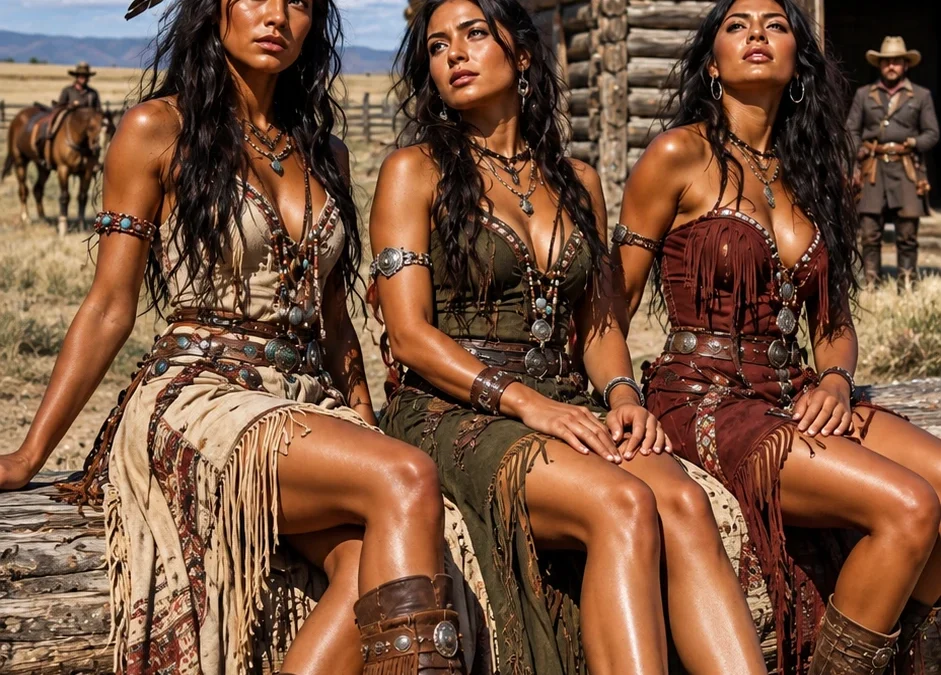
SHE KNOCKED ON A LONELY MOUNTAIN MAN’S DOOR IN THE SNOW, BEGGING “WE’LL WORK, WE’LL COOK, WE’LL SERVE” 😳 BUT WHEN HE ASKED WHY THEY CHOSE HIS CABIN, HER ANSWER MADE HIM FREEZE
Part 1
“We’ll work. We’ll cook. We’ll serve. Just let us in.”
The words came through the wood of the door, rough but steady, just as the last of the daylight died behind the ridgeline. ❄️
Rowan Pike sat alone in his cabin, dragging a knife across a whetstone. He didn’t need to sharpen it. He did it out of habit, because the scrape of steel was the only sound he had heard in months.
He was thirty-three, broad-shouldered, and tired in a way sleep never fixed. He had ridden scout for cavalry patrols and broken horses on cattle ranches. He had watched men tear each other apart over scraps of land and pride. Eventually he walked away from all of it and built a cabin in the Colorado high country where no one could ask anything of him.
He wasn’t a grieving widower. Nobody had broken his heart. He had simply decided that quiet was worth more than coin.
Then came the knock. Sharp. Hurried. Another one right behind it, as if whoever stood outside feared he wouldn’t answer fast enough.
His hand froze on the knife. Nobody came this way, not neighbors, not travelers, not unless they were lost or desperate. He glanced at the rifle leaning against the wall. He didn’t reach for it. Not yet.
The third knock was louder.
Rowan crossed the room, boots striking the planks, and pulled the door open. Cold air rushed in, thick with pine and snow.
Three women stood on his porch.
Apache. Their faces were drawn with hunger, their dresses torn and filthy from days of travel. Their bare feet were pressed into the snow on the boards. 🥶
The eldest stood in front, maybe twenty-five, black hair loose around her shoulders with leather strips still tied into a few strands. Bruises darkened her arms. Her lips trembled from the cold, yet her chin stayed lifted, as if the cold itself could not make her bow.
Behind her stood the middle sister, about twenty-two, sharper and more guarded. Her eyes went straight to the rifle and stayed there, weighing whether he would reach for it. Rowan knew that look. It belonged to someone who spent every day bracing for the worst.
The youngest, barely nineteen, clung to them both. Her breath shook in white clouds. Her eyes were wide with fear, but there was hope in them too, the desperate kind that only shows up when there is nothing else left.
“We’ll obey,” the eldest said. “We’ll work. We’ll cook. Just let us in.”
Rowan’s grip tightened on the doorframe. He had seen Apache families driven off their land, hounded by soldiers and settlers, blamed for every raid whether they were guilty or not. And he knew the arithmetic of his own cabin. Food was already tight. Firewood, blankets, everything counted for one man, not four.
If word reached town, there would be trouble. Settlers hated the sight of Apache faces.
But if he closed the door, these three would not live to see morning. He knew it as surely as he knew the snow beneath their feet.
His first instinct was to shut it. He had built this whole life to avoid other people’s troubles, and here trouble stood on his porch with bare feet and bruised skin.
The eldest didn’t beg again. She simply held his stare, steady, as if daring him to make the choice. 🔥
He thought he was not a man who gave in to pity. Pity had never kept anyone alive. But this wasn’t pity. It was whether he could sit by his fire sharpening a knife while three women froze to death outside.
Slowly, Rowan stepped back. One short nod. No words.
The eldest moved first, pushing her sisters ahead of her. They slipped inside, thin bodies brushing past him, carrying the smell of cold, leather, and smoke. The latch clicked shut.
For the first time in years, Rowan Pike was not alone.
The three sisters huddled by the hearth. Rowan pulled down a sack of beans and a strip of salt pork and dropped them on the table. “Food,” he said.
The middle sister moved at once, filling the pot, working with the quick, careful hands of someone used to making something out of nothing. When the meal was ready, she filled four bowls, and Rowan noticed what they did. They split their portions between the three of them and slid the largest bowl toward him.
He frowned and pushed it back. “Yours.”
The youngest looked up, startled, as if she couldn’t believe a man would refuse food. Then she took the bowl in both hands and sipped it like it was the most precious thing she had ever held.
Something shifted in Rowan’s chest. Not pity. A steady pressure, like responsibility settling on him whether he had chosen it or not.
That night they slept curled together on the floor by the fire. Rowan stayed awake long after the cabin went quiet, staring at the flames, knowing tomorrow would not look like yesterday.
By morning, the fire was already stoked before he reached it. The pot was filled. The youngest was dragging logs half her size, her face stubborn. Rowan realized he’d never even given them shoes. He dug out a pair of old wool socks and a small pair of boots a passing trader had left years ago, and set them by the fire without a word.
The eldest murmured something in Apache to her sisters, a thanks he didn’t need translated.
Over breakfast she finally spoke of their past. “Soldiers came. Settlement men came, too. Our home burned. We walked many nights.”
Rowan didn’t ask for details. He had scouted the frontier. He knew what those words meant.
He wasn’t a man to pry, and he told himself that was the end of it. They needed shelter. He had given it. Spring would come and they would go.
Then, as he lifted his axe to head outside, the eldest spoke again, quietly, so her sisters wouldn’t hear.
“You think we came to your door by chance,” she said. Her dark eyes held his, and for the first time since they arrived, he saw something there that wasn’t fear. “We did not. We were told your name before we ever saw this valley.”
Rowan’s blood went cold. He had never told his name to anyone in years.
📖 Want to know who sent them to his door? Find Part 2 in the comments, or leave any word and I’ll send it to you privately!
Part 2
Rowan’s blood went cold. He had never told his name to anyone in years.
The axe slid down in his hand until the blade rested against the floorboards.
“Who told you?” His voice came out lower than he intended.
The eldest glanced at her sisters. The middle one watched them from the hearth, her stitching forgotten in her lap. The youngest had gone still. They all knew this conversation was coming, Rowan realized. They had simply been waiting for him to be ready.
“Not today,” the eldest said. “When the snow gives way. Then I tell you all.”
Rowan wanted to push. Every instinct from his scouting days told him that a secret in a house was a crack in a wall. But when he looked at her, at the way she held herself so straight even now, he swallowed the questions.
He went outside and split wood until his shoulders burned. The hard, bright cold didn’t clear his head.
Who knew him? He had avoided towns, forts, and trading posts for years. He tried to remember the last time he had spoken his name aloud.
Days passed. Then weeks. The cabin changed around him. The youngest hummed while she swept. The middle sister rearranged his shelves and turned a handful of cornmeal into meals that stretched impossibly far. And the eldest kept finding reasons to stand beside him. 🕯️
She followed him to the fence line. She watched his hands. One afternoon he handed her the hammer, and her first strike was clumsy, but by the third it landed square. She looked back at him, waiting. He gave one nod. She smiled, a small, startled thing, and it struck him harder than he wanted to admit.
Late one night she touched the wood he was carving. “You fix things,” she said.
“Things break,” Rowan answered. “Somebody ought to mend them.”
Her fingers brushed the back of his hand. It was no accident, and he didn’t pull away. Across the room, the middle sister saw, and kept her eyes lowered. 👀
But Rowan noticed something else. Every few days, the eldest would stand at the window and look toward the far pass. She wasn’t watching for danger. She was watching like someone waiting for a message.
The first signs of thaw came on a gray morning. The creek ran faster. Dark earth showed through the snow along its banks. Rowan stood leaning on his axe, watching the water, when he heard the door open behind him.
The eldest came out with something wrapped in a scrap of faded cloth.
“Now I tell you,” she said.
She unfolded the cloth. Inside lay a small, weathered piece of leather, stitched crudely, with a mark burned into it. Rowan stared at it, and the ground seemed to tilt under him.
It was his mark. The one he used to burn into the tools he’d left behind at the old scout camp. A mark he hadn’t thought about in years.
“Where did you get this?” he whispered.
“My grandmother kept it,” the eldest said. “She said it belonged to the man on the ridge.”
Rowan’s mouth went dry.
He remembered. God help him, he remembered. A winter long ago, deep in the mountains, a village starving beneath a pass. Something he had done on a freezing night when no one was watching, something he had never told a soul.
“She said,” the eldest continued, her voice trembling for the first time, “that if the soldiers ever came, we should find the man who left it. And she told us what he did.”
Her eyes filled. And what she said next made Rowan’s knees give way beneath him.
🔥 Part 3 will be posted once this gets enough comments. LIKE or COMMENT “REVEAL” to see the ending, and don’t forget to share this story with someone who needs it!
Part 3
“She said,” the eldest repeated, “that you saved all of us.”
Rowan sank down onto the chopping block, the leather token still in his shaking hand. The morning wind moved through the pines, and for a long moment neither of them spoke.
He remembered it now, whole and terrible and bright.
It had been nearly ten winters ago. He was riding scout then, still wearing the army’s blue. His patrol had been sent to find an Apache winter camp rumored to be hiding in the high country. The captain wanted it found and cleared before the snow closed the passes. Rowan found it first, on the third day, alone, from a ridge above a frozen valley.
He saw smoke curling from a dozen lodges. He saw children. He saw old women dragging firewood. And he saw how thin they all were, how little they had stored.
The captain would have burned it to the ground.
So Rowan rode back and lied. He told the captain the camp was a false trail, abandoned months ago. He drew a map that sent the patrol hard in the wrong direction. Then, that same night, he slipped away from his own men, rode back up to the ridge in a blizzard, and left what he could spare: a sack of flour, dried meat, a pair of blankets, and a set of tools wrapped in canvas, stamped with his mark.
He never saw the people he helped. He never learned their names. He rode away, finished his enlistment, and never spoke of it, because he was ashamed that it hadn’t been enough.
“I thought they died that winter,” Rowan said, his voice hoarse. “I thought it was a gesture that didn’t matter.”
“It mattered,” the eldest said. Tears ran down her face, but she didn’t wipe them away. “My grandmother was a girl in that camp. Your flour fed her family until spring. She kept the mark all her life. She told us the story every winter, so we would never forget that not every man in blue, or every man in a cabin, is our enemy.”
Rowan covered his face with his hand. 😢
“When the soldiers came to our village,” she went on, “we ran. My grandmother had already died. But I remembered her words. Find the ridge. Find the mark. We walked for many days asking quietly, trader to trader, who had burned this sign into tools. It took us weeks to find your name.”
“And you knocked on my door with nothing,” Rowan said slowly.
“With everything we had left,” she answered. “Hope.”
He let out a breath that shook. All those nights he had wondered whether he was a fool for opening the door. All those nights he had told himself it was pity, or loneliness, or plain stubbornness.
It had been something older than all of it. A debt, paid forward across the years, by a stranger he had never met.
“My name,” the eldest said softly, and he looked up, “is Dezba.”
It was the first time she had given it. The name sounded like something precious she was handing him to hold.
“Dezba,” he repeated.
She smiled through her tears. “My sister who cooks is Ahni. The little one is Nita.”
Rowan laughed, a rough, broken sound, half sob. “Ten years of silence,” he said, “and I never thought to ask.”
“You did not need to ask,” Dezba said. “You opened the door.”
Back inside, Rowan stood in front of the middle sister, who had watched him with suspicion for months.
“Ahni,” he said. “I never gave you reason to trust me. I’m sorry for that.”
Ahni set down her stitching. For a long moment her sharp eyes searched his face, and then, slowly, they softened. “You gave reason,” she said. “Every night you left the door open.”
“I thought it was foolish.”
“It was the bravest thing a man ever did for us,” she said quietly. “A man who bolts the door has something to hide. A man who leaves it open is telling you that you are free to go, and free to stay.”
Nita, the youngest, grinned shyly from beside the hearth, tugging at the boots he had given her months ago. “They fit now,” she said. “Even after I grew.”
Rowan chuckled, and the sound loosened something in his chest that had been clenched for a decade. 💛
That night the cabin glowed with firelight and low voices. Ahni made a stew from the last of the preserved venison and dried corn, and for once nobody counted portions. They ate together, four people around a table built for one.
Dezba sat beside Rowan, her shoulder against his.
“You told me, the first night, that you were not a man who gave in to pity,” she said.
“I wasn’t. I’m not.”
“I know.” She laid her hand over his. “That is why I stayed.”
Rowan turned his hand over and laced his fingers through hers. He had spent years convincing himself that solitude was strength. But strength, he understood now, was a door left unlatched.
“I carved something,” he said, rising.
He crossed to the corner he had kept hidden for days and lifted the juniper cradle board, smoothed until it shone, the leather straps cut and ready. He set it near the hearth.
The three sisters stared.
Dezba rose slowly. She touched the carved wood with trembling fingers, then looked up at him with tears in her eyes and a question she didn’t need to speak.
“Not because I expect anything,” Rowan said, his voice rough. “Because I want to build something that doesn’t end when I do. If you want it. If you’ll have me.”
Behind them, Nita covered her mouth with both hands, laughing and crying at once. Ahni wiped her eyes quickly, pretending she hadn’t.
Dezba turned back to him. “We stay,” she said, and this time her smile reached every corner of her face. “With you. Always.”
But Rowan had one more thing to do, and it frightened him more than the soldiers ever had.
The next morning, as the first green showed along the creek, he saddled his horse and rode down to town for supplies, his first trip in months. Dezba rode beside him on the old mare, spine straight, chin high, in the dress she had mended with her own hands.
The town stopped to stare. Rowan felt every eye on them. In the general store, a heavyset man behind the counter looked at Dezba and then back at Rowan, his lip curling.
“We don’t serve her kind,” he said.
Rowan set his hand on the counter, calm as stone. He had faced worse than a storekeeper. He had faced his own loneliness.
“Then I’ll take my silver to the next town,” he said evenly. “And I’ll tell everyone I meet that this store turned away the wife of Rowan Pike.”
Dezba’s head turned sharply. Wife. He had never said the word before. He met her eyes and did not take it back.
The storekeeper blinked. A farmer’s wife near the window cleared her throat. “My family’s been buying from the Pikes’ side of the valley for years,” she said carefully. “Seems to me this man’s never cheated anyone.”
A slow murmur rippled through the store. The storekeeper’s face reddened. At last, grudgingly, he began filling the order.
Outside, Dezba let out a shaky breath. “You said wife.”
“I did,” Rowan said. “I should have asked first.”
She laughed, a bright, startled sound he had never heard from her. “Ask me now.”
Right there on the dusty street, with half the town watching, Rowan Pike, who had once believed he needed nothing from anyone, took her hand and asked.
She said yes before he finished.
They were married that summer in the valley, with the creek running high and the pines standing tall around them. Ahni stood beside her sister, her sharp eyes wet. Nita braided wildflowers into Dezba’s hair and wouldn’t stop humming. A few neighbors from town who had once whispered came quietly to watch, and a few of them stayed to eat.
By the next winter, the cabin held a cradle.
On the first night of snow, Rowan sat by the fire with his infant son sleeping against his chest, the juniper cradle board resting beside him. Ahni mended a small blanket in the corner. Nita read aloud from a battered book he had taught her to read, stumbling happily through each word. Dezba leaned her head on his shoulder.
The knife and whetstone sat forgotten on the shelf.
Rowan looked at the door. It was unlatched, like every night since the first. Beyond it, the snow fell soft and endless over the dark valley.
He had once thought that opening that door was the mistake that would cost him his peace.
He understood now it was the only choice that had ever given him one. 🏡❤️
He had built a cabin to live alone. Instead, because of one night in a blizzard ten winters ago, and one stranger’s flour on a frozen ridge, he had built a home.
And somewhere in the dark, he felt certain, an old woman who had kept a scrap of burned leather her whole life was smiling.
THE END
This story is entirely fictional and created for entertainment purposes only. It does not represent any organization or individual, nor does it encourage inappropriate behavior. The content was generated with AI assistance.








