She Married a Duke to Save Her Family. Thirty Minutes Later, a Woman Nobody Else Could See Said Four Words That Made Him Go Deathly Pale
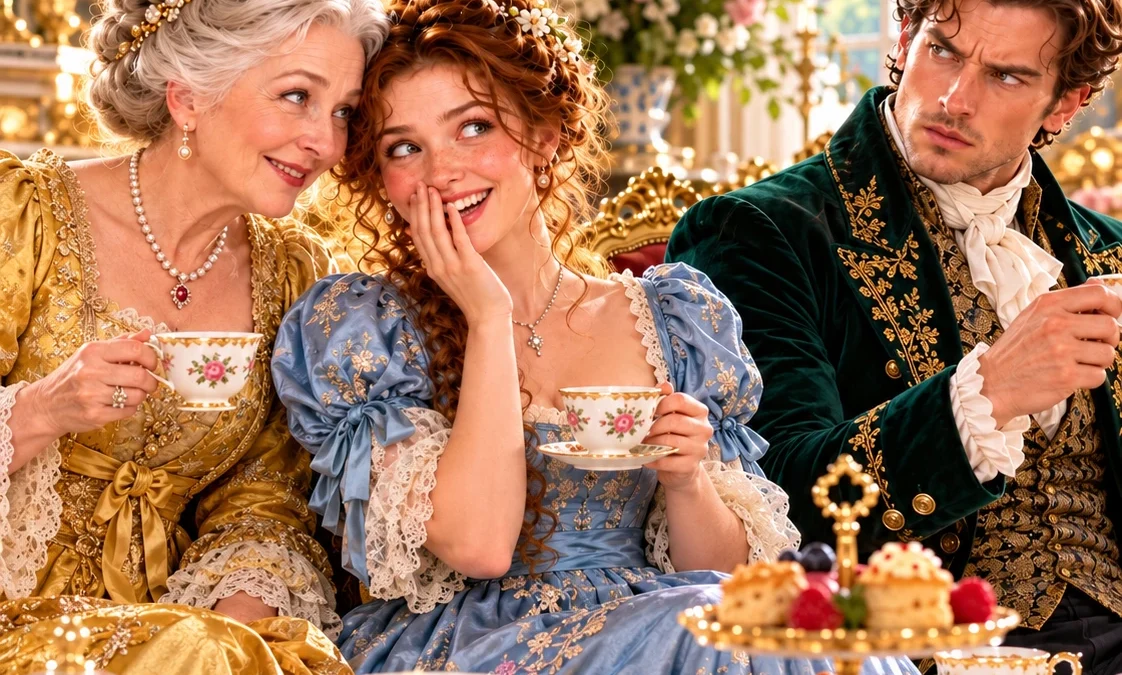
😱 She Married a Duke to Save Her Family. Thirty Minutes Later, a Woman Nobody Else Could See Said Four Words That Made Him Go Deathly Pale 👻
PART 1
Eliza Ashborne could see the dead. 👻
She had not chosen it. She did not enjoy it. It arrived like a sneeze: sudden, inconvenient, and always at the worst possible moment.
Like now. She had been married to the Duke of Ashborne for exactly thirty minutes, and she was sitting at the wedding supper, pretending to be a normal bride.
Then she noticed the old woman in the blue chair.
The woman wore a gown twenty years out of fashion and held a cane carved like a hawk. The cane did not touch the floor. Neither did her feet. Eliza lowered her head and pretended to straighten her napkin.
Do not look. Do not look. Do not look.
“He is holding that wine glass like a shield again,” said a voice from the chair.
Eliza picked up her own glass and drank.
“Do not pretend,” the voice said. “Your eyes went straight to him.”
At the far end of the table, Rowan, the Duke himself, put down his knife. He was tall, composed, and wrapped in a stillness so polished it looked expensive.
“You are pale,” he said.
“I am well.”
“What are you looking at?”
“The curtains.”
He glanced behind her. “The curtains are behind you.”
The old woman snorted. “He calls you Duchess when he is afraid to use your name.”
Eliza drew a long breath. She had married to pay her uncle’s debts. She had not married to translate for a dead woman.
“Very well,” she said. “Your Grace, your grandmother has something to say to you.”
Rowan studied her for a long moment. “My grandmother has been dead twelve years.”
“I know,” Eliza said. “She is sitting in the blue chair. And she says you hold your wine glass too tightly.”
The dining room went silent. 🕯️
“She also says you stand like a wardrobe when you are embarrassed,” Eliza added, then instantly regretted it.
“Excellent,” said the ghost, delighted. “He needs confusing.”
Rowan rose slowly. Then, very quietly: “Describe her.”
“An elderly lady in a silver gown. A cane carved like a hawk.”
He went white. 😶
“Ask her something,” Eliza said. “Something no one else would know.”
The ghost leaned forward, gleaming. “Tell him I know he fed my prize gooseberry tart to the mastiff and blamed Lord Wexley.”
Eliza repeated it word for word.
Rowan gripped the edge of the table. “I was eight,” he said, in a voice that was almost pain and almost laughter. “Old enough to lie poorly.”
“You improved,” Eliza said, before she could stop herself.
The ghost cackled. The Duke looked at his bride, and something in his face cracked open.
He did not send for a physician. He sent for brandy, coffee, and a plate of ham, because the soup had failed public confidence. Then he locked the dining room door, and they stayed there until the candles burned low.
He asked hard questions. A cracked porcelain shepherdess. A lullaby with rude lyrics. And at last, a small wooden soldier he had buried under a rosebush as a boy, after his father told him crying made boys soft.
“I found it,” the ghost said quietly. “I kept it in my jewel cabinet. Tell him I should have given it back.” Her hands tightened on her useless cane. “Tell him I was proud of him before he became useful.”
Eliza’s throat closed. She had expected a cold husband and a house that would consider her purchased. She had not expected to carry a dead woman’s apology across a wedding table.
“She says she was proud of you,” Eliza whispered, “before you became useful.”
No candle moved. No chair creaked. Still, the room felt as if something had knelt. 🥺
Rowan turned toward the empty blue chair. “You waited twelve years to say that.”
“I was dead,” the ghost said, crumbling. “You impossible child.”
He laughed. One short, rough sound. “He still laughs like a door opening,” the ghost whispered, and Eliza understood something too soon and too deeply: cold men are often only men who learned that warmth could be used against them.
At midnight, Rowan had her shown to separate rooms. The ghost was scandalized. “If caution were wool, you could close Scotland!”
At two in the morning, Eliza woke to find a dead duchess sitting at the foot of her bed.
“Do not scream. Screaming wakes maids, and maids carry better gossip than newspapers.”
Eliza found Rowan in the library, in shirtsleeves, his cravat gone, pretending not to drink. They spoke honestly, which was dangerous. He told her how his father had locked away his grandmother’s charity ledgers after she died, calling sentiment expensive.
“Not lost,” the ghost said suddenly. Eliza repeated it. “There is a green book. I told my solicitor to hide it where Edmund would never look.”
Then, in the corridor afterward, the ghost drifted beside Eliza and said lightly, “I chose well, you know.”
Eliza stopped walking. “Chose?”
“You were on a list.”
“That is worse.”
“A very short list.” The ghost looked delighted. “I cannot force a man, dead women have limits. But I whispered at portraits, rattled the east chimney, and made three noble candidates dream of eels.”
Eliza stared. “You haunted women away.”
“Only the unsuitable ones.”
“Did you haunt me?”
“No, dear. You told your uncle’s creditor that compound interest had the morals of a damp ferret. I heard about it from a dead banker.”
Eliza leaned against the wall. There are dead bankers.
“Why me?” she whispered.
The ghost’s amusement softened. “Because you looked at every trap and asked where the hinges were. And my grandson is locked inside a very large house.”
PART 2
The next morning, Ashborne House tried to pretend nothing extraordinary had happened. It failed before toast. 🍞
The housekeeper, Mrs. Pike, supervised breakfast with the rigid dignity of a woman who had heard rumors by sunrise. The butler, Mr. Vale, stood by the sideboard, prepared for haunting but disappointed by crumbs. The ghost drifted through a closed wall at 8:03.
“Is she here?” Rowan asked in front of every servant.
Eliza considered lying. “Yes.”
“Good morning, Grandmother,” he said to the air. Mr. Vale’s left eyebrow moved one dangerous fraction.
“Tell him good morning,” the ghost said gleefully, “and tell Vale his father still owes me sixpence.”
Eliza relayed it. Mr. Vale turned a remarkable color. Rowan bent his face over his plate, shoulders shaking, and Eliza realized the Duke of Ashborne was laughing silently. 😄
The servants did not flee. That mattered.
They found the green book three days later, hidden in a secret seam of the dowager’s writing desk. It was not an ordinary ledger. It was a map of kindness: widows, seamstresses, retired grooms, women abandoned by officers. Not charity. Strategy. The dowager had kept people from falling without making them kneel.
Eliza soon had a list. By supper, Rowan had a headache. By midnight, the ghost had invented the Ashborne Hearth Fund, a women’s employment venture, and named herself its patroness despite being unable to sign anything.
Then Lady Marabel Stain came to tea.
She was Rowan’s cousin by marriage, a widow with cheekbones, lace, and a talent for entering rooms as if they owed her rent. She had once expected to guide Ashborne House after Rowan married someone dull enough to resist. 🫖
“I only worry,” she said smoothly, “that a lady raised outside our circle may trust the wrong people.”
“So can relatives,” said Eliza.
“She stole my garnet comb,” the ghost hissed from the piano.
Eliza held her smile by force. Then Lady Marabel touched Rowan’s sleeve with old ownership, and Eliza found refusal less appealing.
“Lady Marabel,” she said sweetly, “did you ever see the late Dowager’s garnet comb?”
Silence fell too quickly. Lady Marabel withdrew her hand.
“Return it quietly,” Eliza said, “and we need not discuss it again.”
“You would take her side?” Lady Marabel asked her cousin.
Rowan looked at his wife, then at the empty space where his grandmother hovered. “I would take the side of what is true.”
The comb arrived the next morning in an unmarked box. 💎
The village slowly warmed. The Hearth Fund grew. A toddler tied the Duke’s bootlaces together with blue thread and called him tall horse, and Rowan laughed with the whole room for the first time in his life. He gave Eliza a small brass key to a drawer that locked, and she nearly cried, because her uncle had never let her lock anything.
One night in the old sitting room, he said quietly, “I bought a wife.”
“You married a stranger under pressure,” Eliza replied. “Let us be accurate.”
“Do you forgive the arrangement?”
“No.” He accepted that without flinching. “But I may forgive what we make of it.”
“And what are we making?”
Her heart turned foolish. Then the ghost swept in announcing she’d found proof Lord Pinchbeck wore padding at her silver ball, and ruined everything. Rowan laughed, a real laugh, and the room seemed to wake. 🥰
But the trouble with ghosts is that they remember old doors, and some old doors open.
It was late November. The winter fair was three days away. Ashborne House overflowed with ribbons, ginger, and baskets. Eliza’s handwriting had become a separate creature.
“Move those preserves,” the ghost said suddenly, her face strange.
“Why?”
“Because the west storeroom chimney smokes when the wind turns. Edmund never repaired it. And the candle boxes are stacked against that wall.”
Eliza turned. At the end of the passage, two maids were carrying boxes toward the west storeroom.
“Stop!” She stood so fast her chair fell. “Rowan! Is that chimney safe?”
His face changed. “It has not been used in years. But the flue runs behind that wall.”
Smoke appeared before he finished the sentence. 🔥
Not much. Enough. Eliza ran toward the storeroom door and flung it wide.
PART 3
Gray smoke curled behind the stacked candle boxes. A coal from an old service grate had caught in dry packing straw left by workmen. It had not yet become a disaster. It wanted to.
Rowan caught Eliza’s arm as she reached for the nearest box. “No, it will catch!”
“Then move faster!”
He did. So did everyone. There was shouting, coughing, sloshing buckets, and one footman who kept apologizing to the water. Rowan carried out two smoking boxes himself and burned his cuff. Eliza dragged ledgers from a nearby shelf. Mrs. Bell smothered sparks with her good cloak, then cursed it for being flammable. 🔥
The fire died before reaching the workroom. No one was hurt.
Afterward, Rowan found Eliza in the courtyard, coughing into a handkerchief. He took her shoulders hard. “Do not do that again.”
“I saved your house.”
“You reached toward fire while I was breathing.”
His hands were shaking. That frightened her more than the smoke.
Behind him stood the ghost, pale even for the dead. “I saw the chimney too late,” she whispered.
Rowan followed Eliza’s gaze. “Is she here? What did she say?”
The ghost shook her head. Eliza answered for herself. “She warned us in time.”
He closed his eyes. Then, in front of servants, village women, soot, and ruined candle boxes, he pulled her against him. Even the ghost did not speak. 🥹
That night, Rowan paid his third cost. He gathered Mrs. Pike, Mr. Vale, the head groom, Mrs. Bell, Nanette, and the carpenter around the long servants’ hall table.
“Neglect under my roof nearly caused harm today,” he said. “Some of it began before me. That does not absolve me. I inherited walls, titles, habits, and excuses. I kept too many of the excuses.”
He placed a small brass box on the table. “Any servant may report danger without passing through three superior men and a drawer. Her Grace and Mrs. Pike will hold keys. So will I.”
Mrs. Pike blinked. “More than I do, Your Grace.”
“Yes,” he said. That was not humility. That was agreement.
The winter fair opened on a bright, cold morning, smelling of sugared peel, beeswax, wool, ink, and triumph. Eliza insisted on holding it in the heart of the house, not hidden in a ballroom. Lord Greavves, the pompous magistrate who had insulted her at the assembly, came and bought two pies, three lace cuffs, and a handkerchief, possibly as penance, and possibly because the rector’s sister stood behind him.
At noon, a little girl named Polly dropped a jar of plum preserve at Rowan’s feet. It shattered beautifully across his polished boot. The hall froze. Polly burst into tears.
“If he scolds that child,” the ghost warned, “I shall haunt his shaving mirror.”
Rowan crouched, heedless of the jam. “Did the jar attack you?”
“No.”
“Then we shall call it an accident. I have broken larger things.”
“True,” murmured the ghost. 😂
“Are you angry?” Polly sniffed.
“Only at gravity.”
“Can you punish gravity?”
“I have tried. It ignores rank.”
The whole hall laughed. Eliza watched the Duke of Ashborne kneel in plum preserve while his people learned he was not made of marble.
Then came Mrs. Prunella Dart.
She was a wealthy coal patroness from Bath who believed charity improved when everyone could see her near it. She arrived uninvited, with three trunks and a lap dog, to request “a private demonstration” of the Duchess’s supernatural guidance.
“A subscription evening,” she suggested brightly. “A message for some grieving lady of quality. People pay generously for comfort.”
The ghost’s face lost every joke. Rowan’s did too. “No.”
“I am answering,” Eliza said, stepping forward. “Useful things can still be vulgar.” Then Mrs. Dart called the Hearth Fund workers little women, and Eliza felt a clean, warm anger.
“They are not little women. They are workers, sellers, mothers, widows, and partners. They do not need a dead duchess turned into a fairground lantern to make their goods worth buying.”
“Well said,” whispered the ghost. 👏
“You dismiss me?” Mrs. Dart gasped.
“No,” Rowan said. “My wife did. I am improving the logistics.”
But refusing her money created real trouble. The wool bill from York was due in ten days. Then the ghost remembered something: her portrait still hung in the Bath assembly rooms.
Eliza proposed a public sale beneath it: lace, linens, preserves, and open accounts. “Not a ghost show. A founder being honored, not summoned.”
Rowan was quiet. Using his grandmother’s likeness in a commercial sale would invite whispers. “No spirits,” he said. “No private grief for purchase.”
“Never.”
“Then yes.”
The Bath sale was chaos with ribbons. People came for the rumor, but they stayed for the work. Nanette left the accounts open on a side table, wages and all. A gentleman in a green waistcoat stared. “You show wages?”
“We are not ashamed of paying them,” Nanette said. He bought three collars. 🛍️
Even Mrs. Dart returned, her plume smaller. “I see you found a spectacle after all.”
“Yes,” said Eliza. “Competence.”
Mrs. Dart bought twelve of Mrs. Bell’s cuffs. When she left, Mrs. Bell sat down and wept into her apron. “She knew my name on the receipt.” Every maker’s name was on every receipt.
Rowan endured seven whispers and two raised eyebrows. When an old lord asked whether commerce in a duchess’s name was appropriate, he replied, “More appropriate than idleness in mine.”
Christmas brought snow, and a letter from Eliza’s uncle, who suddenly wrote dear niece five times now that the Fund had earned money.
“What do you want?” Rowan asked.
“To say no.”
“Then say no.”
She wrote: My household is not available for arrangements made at my expense. Her hand shook only once. Rowan read it and did not soften a word. “He may be angry,” she said. “He may be hungry,” Rowan replied. “Neither obliges you to be eaten.” 💪
In January, the ghost began to fade.
At first, Eliza blamed the winter light. Then she could see the chair pattern through her ribs. “Do not tell Rowan yet,” the ghost said. “He will try to solve it.”
“Can he?”
“No. Then he deserves time.” She looked out at the snow. “I am not afraid of where I go. I am afraid of being done.”
“You are not done,” Eliza said. “You are becoming less needed.”
“That is an appalling comfort.”
“It is the one I have.”
When Rowan heard, he went quiet in the old marble way. “I cannot lose her twice,” he said.
“Then do not be graceful,” Eliza told him. “Be angry. Be unfair. Say you are not done.”
“I am not done,” he said, and his breath broke.
They went together to the old sitting room, where the ghost waited, fainter than mist and twice as stubborn.
“Grandmother,” Rowan said. “I am angry.”
“Good,” said the ghost, smiling sadly.
“I wanted more time.”
“Greedy boy.”
He laughed brokenly. “I wanted you to insult the first gentleman who underpays them. I wanted you at Christmas next year. I wanted you to meet our children, if we have them.”
“Tell him not to rush the children for my convenience,” the ghost said, and Eliza covered her face. 🤭
“I love you,” Rowan said.
The ghost’s face changed. Eliza had never seen the dead look so alive. “I loved you first.”
Eliza repeated it. Rowan shut his eyes. The ghost’s hand rose to his cheek and passed through air, but he turned slightly, as if toward a breeze.
“Tell him Eliza is not my replacement. And tell him he must let the house belong to the living.”
He looked around at the fabrics, the ledgers, the toys, the baskets. “It does.”
“Then I did not fail.” 🥹
She lingered through January, forgetting names and remembering recipes. On the last morning of the month, the snow stopped. Eliza woke before dawn with a certainty she hated. She found Rowan on the floor beside the blue chair, one hand on the cushion. “I dreamed of gooseberry tart,” he said.
“Subtle, was it not?” the ghost murmured.
As morning touched the work baskets, the desk, and the brass key at Eliza’s waist, the ghost became nearly transparent. “Well. This is untidy.”
“Typical,” Rowan said, when Eliza told him.
“Look after him when he becomes furniture,” the ghost told Eliza. “And you, child, do not let being loved make you smaller.” Her voice gentled. “You were never bought. You were brought to a locked house and found the latch.”
Eliza told Rowan only: “Something for me.” He nodded, and demanded nothing. That was love, too.
The sunlight reached the blue chair. For one breath, the dead Dowager Duchess looked solid, younger, radiant, and loved.
Then the chair was empty. 🕊️
Rowan pulled Eliza into his arms, and they sat on the floor while Ashborne House woke around them. No cane tapped. No voice criticized curtains. Yet the room did not feel empty. It felt entrusted.
Spring brought work, which helped. The gardener’s cottage opened as the Ashborne Hearth Workshop, its sign painted with two unnecessary flourishes. Rowan came on Thursdays to review accounts, and on Tuesdays, which had no purpose. One day, he brought the repaired garnet comb. “It is yours. No conditions. Wear it, lock it away, sell it if you must.”
“I would not.”
“I know that, too.” He slid it into her hair with careful hands. Then Polly shouted that a goat was eating an invoice from Lord Greavves, and the workshop echoed with laughter. 🐐
By summer, one evening, Rowan stood before the blue chair, thanking her for Eliza, among many things.
“I understand you better now,” he told his wife. “I know when you are hurt but prefer arithmetic. And when you want to be asked instead of arranged.” He touched her cheek. “Will you stay my wife because you choose it?”
There were grander proposals in the world. None would have suited them.
“Yes,” Eliza said.
On their first anniversary, Rowan held his wine glass like a shield, and Eliza stopped in the doorway. “Do not say it.”
“I said nothing.”
“Your face said it.”
“My face has inherited responsibilities.” 😂
The soup was not dull. Mrs. Pike had seen to that. For a moment, Eliza felt a brush of rain-cool memory against her hand. The blue chair was empty. Rowan saw her look. “Is she there?”
“No,” she said, smiling through the ache. He nodded, trusting her answer. That was another kind of miracle.
Later, in the old sitting room, with six pence and violets on the mantle, Eliza leaned back against her husband and listened. Footsteps. Fire. Wind. Laughter somewhere in the servants’ hall that no one hushed.
She had entered Ashborne as a bargain. She remained as herself.
The silence was not empty. It was full of everything they had learned to say while they still could. ❤️
💬 Have you ever had someone, living or gone, whose voice changed the way you love? Tell me about them in the comments. 👇
Disclaimer: This story is entirely fictional and created for entertainment purposes only. It does not represent any organization or individual, nor does it encourage inappropriate behavior. The content was generated with AI assistance.








