She Never Told the Duke She Carried His Heir. When He Finally Found Her, One Slice of Cake Revealed Everything, and the Letter Hidden in His Mother’s Writing Box Changed It All
😱 She Never Told the Duke She Carried His Heir. When He Finally Found Her, One Slice of Cake Revealed Everything, and the Letter Hidden in His Mother’s Writing Box Changed It All 💔
PART 1
The Duke of Welborn came home from Lisbon after eleven months away, climbed the great stair two steps at a time, threw open the door of his wife’s sitting room, and found it empty, swept, and cold, with dust sheets over every chair. 🕯️
The fire had not been lit in a long time. The writing table by the window, where Rebecca used to sit in the mornings with her chin in her hand, had been cleared of everything but a single brass inkstand. The inkstand was dry.
“Pinnegar,” Ralph said without turning round. “Where is the Duchess?”
There was a pause. Not a long one. But Ralph Stainier, sixth Duke of Welborn, had spent most of a year at a foreign court listening to men choose their words, and he knew the exact weight of a pause.
“Her Grace, your mother, is in the blue drawing room, sir. I think she had better be the one to tell you.”
His mother sat very upright by the fire, a piece of white work in her lap, her lace cap never in her life crooked. “Ralph, you are early. We did not expect you until Thursday.”
“Where is Rebecca?”
“She is not your wife,” said the Dowager, gently, as if telling him the hour. “You signed the authority yourself. You sent it back from Lisbon with your own seal. The proceedings were begun in May, exactly as you wished. She was told. She made no objection whatsoever. She went away in July.” She picked up her needle. “It is done.”
He did not sit down. He found, in fact, that he could not move at all. 😶
It had all begun, as the best and worst things in his life seemed to, quite by accident. A leaking roof at Thornacre Lodge had sent him to the house of his late father’s friend, Squire Tate, who lived with two spaniels, one servant, and a daughter.
Her name was Rebecca. She was twenty-three, kept her father’s house like a small and well-run ship, had brown hair that would not stay pinned, and a way of looking at a person steadily and kindly, as though she were really listening. On his first evening, she set a warm caraway seedcake before him. He ate three slices without noticing, and she laughed at him.
He was thirty-seven and had never once been in love. By the end of August, he was. 🍰
He grew up in a great cold house, with a father who spoke to him twice a week and a mother who spoke mostly of what was owed to the name. But in Rebecca’s orchard, he told her about the winter he was nine, sent away to school without his mother coming down to say goodbye. She put her hand very lightly on his sleeve and left it there, and said nothing at all. It was the kindest thing anyone had ever done for him.
Then Squire Tate went out to look at his barley and never came back. They found him under a hedge, his face turned up to the sun. The Grange was entailed upon a cousin in Yorkshire. Rebecca’s inheritance came to a little under two hundred pounds.
That night, Ralph found her in the dark kitchen with a spaniel’s head in her lap. He had no speech. He sat down on the settle opposite and said, “Marry me.”
“Out of pity,” she said.
“No. I have not been able to think of anything but you since the evening you laughed at me for eating your cake.”
She laughed through the first tears he had seen her shed. And she said yes. 💍
Four months followed at Welborn, and he would turn them over in memory like a man counting coins he could not believe he’d once possessed. The Dowager received his wife with perfect courtesy and perfect coldness. Rebecca walked through the enormous echoing house with her head up and grew quieter every week. He did not ask if she was happy. He was afraid of the answer.
Then, in February, a summons came to negotiate a treaty at the Portuguese court. Four months, perhaps five. On the gray morning he left, Rebecca took both his hands as though she meant to say something, and did not.
“Write to me.”
“Every week.”
Lisbon was white walls, blinding light, and endless negotiation. Four months became eight. He wrote to her every week, longer letters than he had ever written, finding on paper the courage he never managed in her presence. Hers were few. Three in four months, each gentle and short. In the third, one line he could have recited in his sleep:
“I am trying, Ralph. I promise you that I am trying.”
Then, in April, his mother wrote. A masterpiece of its kind, because nothing in it was exactly a lie. Rebecca was pale and unhappy, had been heard weeping, had married in the first shock of her father’s death out of fear of being homeless. And there was, by the most fortunate chance, a way out. The marriage license had misdescribed Rebecca’s parish by half a field and a brook. The license was defective. The marriage was very likely no marriage at all. A quiet suit of nullity. No scandal. All that was wanted was his signature.
“I would not trouble you if I did not believe it to be her own wish. She is too timid and perhaps too proud to say it to you herself.”
He sat with that letter for two nights. He began to write to Rebecca a dozen times and tore it up a dozen times, because every version seemed like a man begging a woman to stay who did not wish to. On the third morning, he signed, and enclosed one sheet for his wife, the shortest letter he ever wrote and the one he would regret for the rest of his life:
“If it is your wish to be free, I will not hold you against it. I want nothing in this world so much as your happiness. R.” 💔
He meant it as the most generous thing he knew how to say. He did not understand until he stood in that dusty sitting room how it would read to a woman who had been told her husband wanted to be rid of her.
“What did she say?” he asked his mother now.
“Nothing at all. She read your note twice. She said, Thank you, ma’am. I understand. I offered her five hundred a year. She would not take a penny. She went away on the carrier’s cart with one trunk and that dreadful old dog. She left no direction.” The Dowager looked up. “Hardly the conduct of a woman brokenhearted to be parted from you.”
“No,” he said slowly. “It is the conduct of a woman too proud to beg.”
He walked the long gallery until the candles guttered, and around three in the morning began, for the first time since April, to think like the man who had spent eleven months reading between the lines of Portuguese ministers. Rebecca had never let a thing pass without at least trying to set it right. She had stood up to her father’s creditors. She had marched into the Kingsfold smithy and made the smith return money to every widow he’d overcharged.
She would not have said nothing. She would have written.
At six that morning, he stood over the post book in Pinnegar’s pantry with a candle, turning back the pages. His mother’s long letter, entered the 26th of April. Nothing from Rebecca in May.
And there, on the ninth of June: Her Grace the Duchess to His Grace at Lisbon, given to Mr. Leatherart for the bag. 📖
He closed the book very gently, as one closes a door on a sleeping house.
Mr. Leatherart, the Dowager’s pale, precise secretary, looked as if he had been expecting this moment for a very long time. “I gave it to Her Grace, your mother, sir. She instructed me that the Duchess’s letters were to be brought to her first. All the others went on. That one did not.”
His mother was alone at breakfast. She saw in an instant that he knew. To her credit, she did not pretend. She unlocked a small rosewood writing box and lifted out a single letter. The direction was in Rebecca’s hand. The seal had been broken.
“I did not destroy it. You may at least allow me that.”
“Why?”
“Because I am your mother,” she said, and for the first time in his memory her voice was not controlled. “Because you married a squire’s daughter with two hundred pounds and a dog three weeks after her father’s funeral. Because I believed quite honestly that in a year you would thank me.”
He unfolded the letter there in the morning room.
“My dear Ralph, your mother has shown me your note. I will not hold you either, if it is truly what you wish. But I cannot go without telling you one thing, because it is yours as much as mine.
I am going to have a child. In October, the doctor thinks. I did not write it before because I was afraid, and because I wanted to see your face when I told you.
I only ask that you answer me in your own hand and not through anyone else. If I hear nothing from you by midsummer, I shall understand that your note was your answer.
Your wife for as long as you will let me say so. Rebecca.” 😭
He read it twice. He folded it along its old creases and put it in the inside pocket of his coat, against his heart.
“Midsummer,” said Ralph. “She waited for me until midsummer, and I said nothing, because you saw to it that I could say nothing. You let her walk out of this house on a carrier’s cart with my child.”
“Where is she?”
“I do not know. I made no inquiry. I did not wish to know.”
“Then I will find out. And when I have found her, Mother, we will speak again.”
PART 2
Mr. Gammage, the family proctor, rose from behind a fortress of documents in his narrow court in Doctors’ Commons with an expression of profound relief. “Your Grace, thank heaven. The suit does not stand, sir. It lies. The Duchess has never answered the citation, and Dr. Vavasour will not pronounce nullity upon a lady who has never been heard. Nothing has been decided.”
“Then the marriage is exactly as it was the day I made it.”
“And I will tell you more, which I told Her Grace in June. That suit never had a leg to stand upon. A misdescription of the parish does not void a marriage. There is not a court in England that would undo it.”
“Withdraw it. Today. Every word.”
But finding her was harder than anything he had ever done. 🔍
The carrier, an enormous kindly man named Strudwick, had taken her as far as the coaching inn at Stanwick Cross. She had sat up on the box the whole way, asking about his wife’s rheumatism, and given him a shilling he hadn’t wanted. “She only said somewhere she could be useful. Then the London coach came in, and the Bristol coach after it, and I lost sight of her in the yard.”
There the trail went cold. Ralph sent his valet along the Bristol road and rode the London road himself. He wrote to every coaching office between Stanwick and the sea. He stood in the gray January churchyard beside the Squire’s grave, and old Mr. Oddie told him, “I have never in fifty years seen a woman look at a man the way she looked at you that morning. Whatever has happened, I do not believe that has changed.”
Three weeks became five. Then, on a dark afternoon at the start of March, his horse cast a shoe, and he sat by the coffee-room fire at the Checkers in Stanwick Cross to wait for the smith. The landlady’s girl brought tea without being asked. And with it, on a willow-pattern plate, a slice of seed cake. 🍰
He ate the first mouthful without thinking. Then he stopped quite still, with the fork halfway to his mouth.
Caraway. Candied orange peel. A faint warmth of something he had never been able to name, which she had once told him, laughing, was a secret and would remain one.
“Where did you get this?”
“Why, it comes from Market Brindle, sir,” said the landlady, hurrying in. “Twelve miles up the valley. Mrs. Tate, by the Butter Cross. Folk come out of their way for it.”
He was already on his feet.
He rode the twelve miles in the last of the light, in a thin cold rain that ran down inside his collar, and he felt none of it. On the corner where the street met the square stood a narrow house of honey-colored stone with a green door and a bow window of many small panes. Over the door, in plain cream lettering: Mrs. Tate. Teas and cakes.
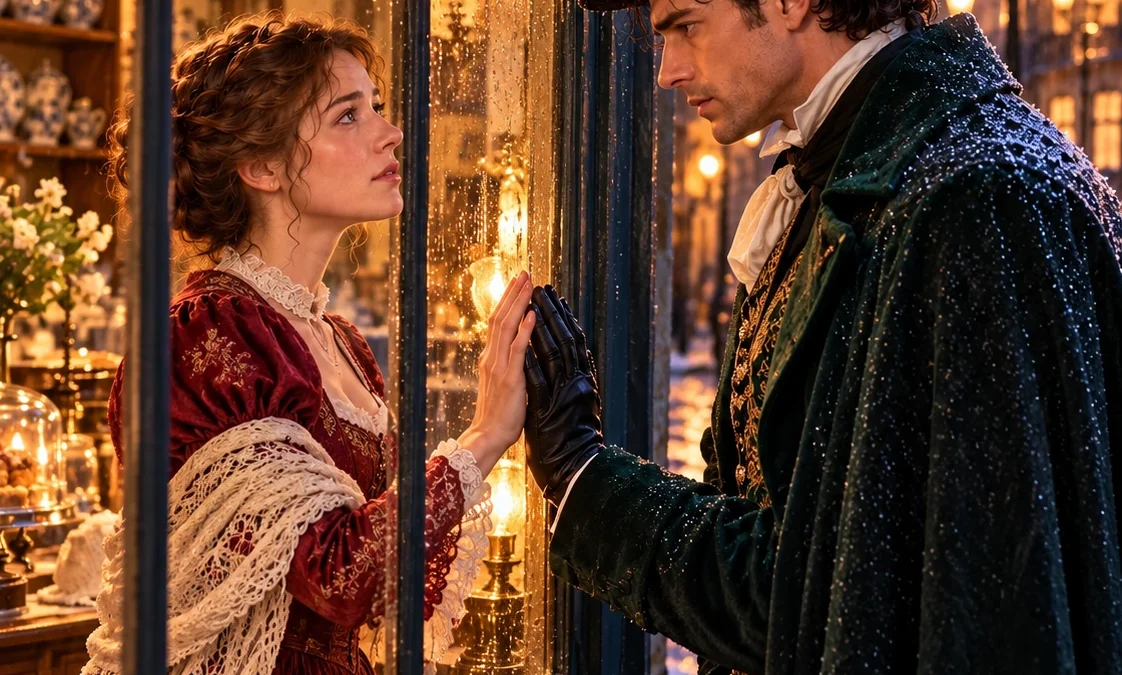
Through the rain-streaked glass, he saw the whole warm golden room. And behind the counter, wiping down the boards with her back half turned, his wife. 😭
She was thinner. That went through him like a blade. And on the counter, close to her hand, where she could see it every time she looked down, lay a very small white knitted bonnet with a blue ribbon.
She turned. He saw the cloth fall from her hand. He saw her go perfectly still, then perfectly white. She crossed the room until she stood on the other side of the glass. Her hand rose and stopped an inch from the pane, just opposite his. Neither of them touched it.
Then she drew the bolt. The bell over the door rang once, absurdly cheerful.
“Your Grace. You are a long way from Welborn. If you have come about the papers, I will put my name to whatever your proctor likes.”
“I have not come about any papers.”
“Then why?” Her voice cracked like ice on a puddle. “You did not come in June. You did not come at midsummer. You did not come in October when I sat in that little room upstairs and was more frightened than I have ever been in my life. I asked you for one line in your own hand, Ralph, and you could not spare it me.”
He did not speak. He took her letter from his coat and held it out in the rain, direction uppermost, broken seal plain to see.
She looked at it for a long time. He watched her understand, line by line.
“I never received it. I found it four weeks ago in my mother’s writing box. I have been looking for you every day since.”
Her cold fingers took it from him. “Your mother,” she whispered.
And then, from somewhere above them, through the ceiling of the little shop, came a sound he had never heard in his life and knew at once. A thin, small, indignant wail, of someone very new to the world who had woken in the dark and did not care for it. 👶
Rebecca’s head turned toward the stair as helplessly as a compass needle turns north.
“May I?” he asked.
“No,” she said, gently. “Not tonight. I cannot, Ralph. Come back in the morning, after nine, when the bread is out, and we will talk.”
The bolt went home. The lamp moved up the stair. The bow window went dark.
At nine the next morning, the shop smelled of yeast and woodsmoke and orange peel. A plump widow in a black cap, Mrs. Carrow, looked the Duke of Welborn up and down with frank suspicion, set a pot of tea before him, and went upstairs. A minute later, Rebecca followed her down, and bent, with great care, and laid a small bundle in his arms.
He had never held anything so light or so warm. A crumpled solemn face under a fluff of dark hair. A tiny fist that closed of its own accord around his finger and held on.
“His name is Ralph,” said Rebecca quietly. “I did not know what else to call him.”
The Duke of Welborn, who had not wept since he was nine years old and stood alone in the carriage drive at Welborn, bent his head and wept without a sound. 🥹
He told her everything. He did not spare himself. “I signed it before any letter of yours was kept from me. That was my doing, not hers. I believed you wanted to go because I had always been afraid that you would. I should have come home and asked you to your face. I would rather have lost you than heard you say it.”
“And I said nothing,” she said at last, “because I was proud. I would not let her see me beg. I left without a word because a word would have broken me. I was not unhappy at Welborn because of you, Ralph. I was unhappy because I was alone in it.”
“You are my wife. You have been my wife every day of these eleven months. If you will have me, you will be my wife every day for the rest of my life. And if you will not, I will not hold you against your will, but I will not go away, either. I will take a room at the inn and sit at this table every morning and pay for my tea like any other man until you tell me to stop.”
Something moved at the corner of her mouth. “Mrs. Carrow will charge you double.”
He came every morning for nine days. The whole town talked of nothing else: the tall dark gentleman who carried flour sacks in from the carrier’s cart without being asked, who never once read his newspaper, who was seen on the river path with Mrs. Tate on his arm. On the ninth evening, as he rose to go, she put her hand very lightly on his sleeve and left it there, exactly as she had once done in an orchard at Wrensham.
“Stay,” she said. 💞
On the tenth morning, the Welborn traveling carriage, with its yellow wheels and crest, drew up outside the bow window in the middle of a market Tuesday. The Dowager Duchess stepped down in black silk and walked into the little shop as if into a cathedral that had been badly kept.
“I have come,” she announced to the whole room, “to say to this young person that she and the infant will be provided for handsomely, on condition that she lives abroad and that this ridiculous…”
“Mother.”
Ralph set down a tray of cooling seed cakes. He did not raise his voice, but something in the single word silenced the shop down to the ticking of the stove.
“You are speaking to the Duchess of Welborn in her own house before her own neighbors. The suit is struck out. You knew it never had a leg to stand upon. You knew it all summer, and you kept her letter in your writing box and let her believe I had left her to bear my child alone.” He turned to the farmers’ wives, the curate, the saddler. “I beg your pardon for this. You were kind to my wife when her own family was not. I will not have her shamed before you one moment longer.”
A long silence. Then old Miss Purfoy by the window, who had eaten a slice of seed cake at that table every afternoon since August, set down her cup, rose stiffly, and curtsied to Rebecca. 🥹
One by one around the little room, chairs scraped back, and the others did the same.
The Dowager stood among them in her black silk, quite alone.
And it was Rebecca, not Ralph, who came round the counter. “Your Grace, you have come a long way. Will you sit down? Mrs. Carrow will bring you some tea, and then, if you like, you may come upstairs and see your grandson. He looks very like his father.”
The Dowager’s lips parted. For a moment Ralph thought she would refuse. Then something in that proud face gave way very slightly, like a wall settling after long rain. She sat down at the nearest blue table, and did not speak again for a long while.
PART 3
They went home to Welborn on Lady Day, at the end of March, when the Lady Day Fair was held on Welborn Green and the whole estate came out for the plowing match, the hiring, and the spinning prizes, which for thirty years the Dowager Duchess had given out with her own hand.
That year she did not. 👑
She had removed, of her own accord, to the dower house at Lynchmere on the far side of the park. Mr. Leatherart did not follow her, having accepted a place as Ralph’s own secretary. The keys of Welborn were sent up to the great house in a velvet bag.
And it was the young Duchess who walked out onto the green in a dark blue pelisse and a gray shawl, her husband beside her and her son in her arms, and gave out the prizes to the spinners, and knew every one of their names by the end of the afternoon.
When it was done, and the sun was going down red over the park, Ralph found her standing alone at the edge of the green, watching the lanterns being lit in the booths.
“Are you happy?” he asked. It was the question he had been too afraid to ask a year before.
She turned and looked up at him, steadily and kindly, as though she were really listening.
“Ask me every day,” she said, “and I will tell you.”
He bent his head and kissed her very gently, there at the edge of the green, with the lanterns coming out one by one behind them. 🏮
And he did ask her every day for the rest of their lives, and every day she told him. ❤️
Author’s note: Because the source story resolves in a compact finale, Part 3 stays faithful to its ending rather than inventing new plot. If you’d like a longer, expanded Part 3 (1000–2000+ words) with added scenes, such as a confrontation with the Dowager at Lynchmere, the first night back at Welborn, or the nursery scene, just say the word and I’ll write it.
💬 Have you ever been separated from someone you loved by a message that never arrived? Tell me your story in the comments. 👇
Disclaimer: This story is entirely fictional and created for entertainment purposes only. It does not represent any organization or individual, nor does it encourage inappropriate behavior. The content was generated with AI assistance.








