She Overheard Her Brand-New Husband Mocking Her Accent at Their Wedding Breakfast. Then His Drunk Friend Let Slip a Secret: “She’s Your WIFE, Lyall… So What Does That Make the Fishwife?”
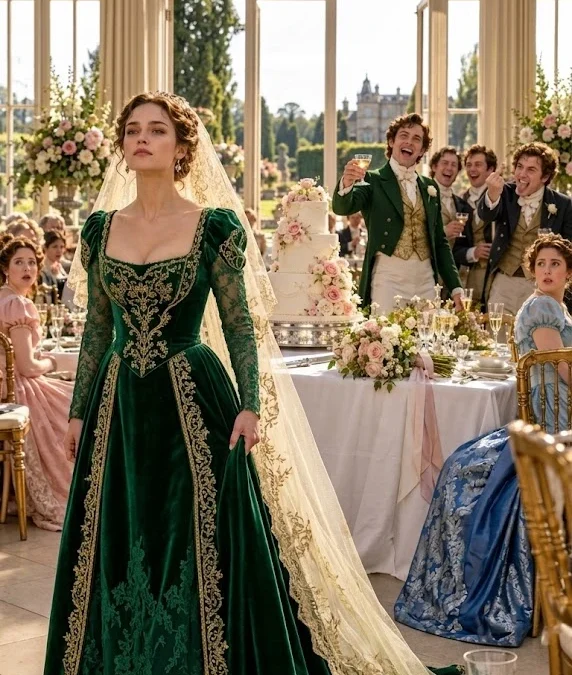
She Overheard Her Brand-New Husband Mocking Her Accent at Their Wedding Breakfast. Then His Drunk Friend Let Slip a Secret: “She’s Your WIFE, Lyall… So What Does That Make the Fishwife?” 🎂💍
PART 1
The cake was four tiers high, and Grace Toland had watched it being made.
Three days before her wedding, she stood in the kitchen of her father’s house in Clifton, high above the city of Bristol, while the cook and two girls built it layer by layer. Dark fruitcake soaked in brandy. Almond paste. Icing smooth as white marble.
And one hundred and forty sugar roses, every petal shaped by hand.
Grace made twelve of them herself, late at night at the kitchen table in her nightgown. The cook said hers were the best.
Now it stood in the middle of the long table in the garden room in the June sunlight, the silver cake knife beside it on a white napkin.
Nobody had cut it yet. That would come at the end of the wedding breakfast, when bride and groom put their hands together on the knife and everyone cheered.
Grace was looking forward to that more than the church. More than the vows. That morning, standing at the altar of St. Andrew’s, her voice had shaken while all of Bristol society watched for her to make a mistake.
But the cake was hers. She had made twelve of the roses.
She was twenty-two, the only daughter of William Toland, who owned eleven ships.
Her grandfather had unloaded sugar on the Bristol quays for a shilling a day. Her father had gone to sea as a ship’s boy at nine and been a captain by twenty-eight. By forty he owned his own ships: one, then three, then eleven, sailing to Jamaica, Boston, Lisbon, and Cape Town.
Grace grew up with a governess, a music master, and a dancing master. She played the pianoforte and spoke French and Italian.
What she could never quite lose was her Bristol voice.
A lady from Bath was paid to come twice a week for three years to smooth those broad, warm vowels into a proper London accent. Grace worked at it until her jaw ached. If she was calm and careful, she could manage.
But when she was tired, or happy, or nervous, it came rolling back: the voice of her father, her grandfather, and the docks. Like everyone in Bristol, she added an L to words that didn’t have one.
She said “ideal” when she meant idea.
At nineteen, her father took her to London for the season. She came home after six weeks. She had heard the girls at Almack’s imitating her behind their fans, and a young lord at dinner say, “Good God. It’s like being seated next to a fishwife.”
She never went back.
Then last winter, Charles Fenmore, Viscount Lyall, came to Bristol on business.
Tall, fair, and handsome, with a quick laugh, lovely manners, and a title three hundred years old. He sat beside Grace at dinner, asked about her music, and listened to her play.
When her voice slipped into Bristol over dessert because she was nervous, he put his hand over hers on the tablecloth.
“I find it charming,” he said. “Warm, like a West Country summer. Don’t ever lose it.”
No one had ever said that to her before.
By March, he’d asked for her hand. Her father, who wanted more than anything to see his girl a real lady, with a title the London girls couldn’t laugh at, said yes.
He settled forty thousand pounds on her. Everyone knew Charles’s Somerset estate was in debt. Money for a title. Bristol had seen a hundred such bargains.
At half past one, during the wedding breakfast, Grace slipped behind the tall Chinese screen in the corner of the garden room. Her maid Ellen had torn a flounce on her hem, and she didn’t want two hundred guests watching it being pinned.
Ellen knelt with a mouthful of pins.
Through the gap between the screen and the open French window, Grace could see the sunny terrace.
Charles stood there with three friends from London, champagne in hand, laughing. They didn’t know she was there.
“And then,” said a red-faced young man named Freddy Gaunt, “the old man stands up and says, ‘I’d like to welcome Lord Lyall to the Toland famileee!’” He stretched the word wide and silly in a mock Bristol accent. “Lyall, I don’t know how you stood it!”
The others roared.
Behind the screen, Ellen stopped pinning.
“You get used to it,” said Charles, swallowing champagne. “You have to, for forty thousand.” Then he did the voice too. He did it well. He had clearly practiced. “Would you care for more cake, my lord? Isn’t it a lovely ideal? She says ‘ideal’ for idea, Freddy. Every single time.”
“How do you bear it?” asked a thin man.
“Easily. I shan’t have to bear it long. In September I go to London for the season, and she stays in Somerset. It would hardly do to take a Bristol fishwife to Almack’s, would it? Her father thinks he’s bought her a title. What he’s actually bought is a nice quiet life for me, with somebody else paying.”
Grace couldn’t have moved if she’d tried.
Warm, like a West Country summer. Don’t ever lose it.
Then Freddy lowered his voice and swayed, his glass slopping.
“And Maria? What about Maria?”
A short pause.
“Maria’s in Brighton,” Charles said quietly. “She’s no trouble.”
“Oh, but she is, isn’t she?” Freddy giggled. “I was there, Lyall. I stood up with you at that little church in Brighton three years ago. You married her properly, banns read three Sundays running.”
He grinned.
“She’s your wife, Lyall. So what does that make the fishwife?” 😱
👉 Part 2 is in the comments! Can’t find it? Leave any word and I’ll send it to you privately. 👇
PART 2
“She’s your wife, Lyall. So what does that make the fishwife?” The fourth man, who hadn’t laughed once, set down his glass. “Freddy. Stop talking.” “It makes her nothing,” said Charles Fenmore, his voice low, cold, and calm. “A girl who went through a ceremony this morning and thinks she’s a viscountess. Nobody knows about Brighton except Maria, you, and the curate, and the curate’s dead. Maria won’t say a word. She hasn’t got a penny. By the time anyone finds out, I’ll have spent the forty thousand. Now go drink some coffee. We cut the cake in twenty minutes.” Behind the screen, Ellen had both hands over her mouth. “Did you hear that, Ellen?” Grace asked, very quietly. Ellen nodded. “All of it?” Another nod. “Good. Finish the hem. Quickly.” Three pins. Then Grace picked up her bouquet of white roses, orange blossom, and myrtle, and stepped out. Two hundred guests turned to smile at the bride. Her father, beaming beside the mayor, lifted his glass to her. On the terrace, Charles froze with his glass halfway to his lips. Freddy went white. Grace walked to the cake, laid her bouquet beside the silver knife, and whispered twenty words in her father’s ear. William Toland, who had sailed through storms off Cape Hatteras, listened without moving a muscle. Then he set down his glass and stood. “Mr. Mayor, would you excuse me? My daughter isn’t feeling well.”
At the French windows, Charles stepped in with his handsome face arranged into concern. “Grace, my dear, are you unwell?” She looked at him a long time. “No, thank you, my lord. I know exactly what I am. You told Freddy. I heard you.” She said it in her own voice, broad and warm and Bristol, every vowel of it, the voice of her grandfather on the quay. Charles’s face went blank. She walked out on her father’s arm. Behind her, nobody cut the cake. In the locked study, Grace told it all again. “I bought that title for you,” her father said heavily. “I wanted them to stop laughing. I’m an old fool from the docks.” “You’re not a fool, Papa. You believed him. So did I.” He sent for his lawyer, Mr. Weekes, and young Richard Lane, a barrister of about twenty-eight whose late father had been a ship’s surgeon on Toland ships. Lane listened, pencil moving in a notebook. “Did Lord Lyall deny it?” “No. He said it makes me nothing.” “Then, sir,” Lane told her father, “your daughter isn’t married. A man with a living wife cannot marry again. The ceremony is void. She’s still Miss Grace Toland, with every penny her own. And Lord Lyall has committed bigamy before four hundred witnesses. The penalty is prison, or seven years’ transportation to New South Wales. But we must prove it: the Brighton register, and Maria.” “The forty thousand is due to transfer Monday at ten,” said Mr. Weekes. “Don’t,” said William Toland. “I won’t, sir.”
The door handle rattled. “Grace, my dear, open the door! It’s time to cut the cake!” Her father unlocked it. “You misheard, my dear. Freddy was drunk. There’s no Maria.” “Then you won’t mind if we go to Brighton and look,” said Grace. A muscle jumped in his jaw. His voice went hard. “You’re my wife. Come back and cut that cake, or I’ll have you brought back. A husband has that right. Go to Brighton and you’ll find nothing, and London will laugh at the fishwife who ran from her own wedding for ten years.” “They’ve been laughing at me in London for three years, my lord,” said Grace. “I’ve got used to it. You did my voice very well, by the way. Mr. Gaunt was better.” Her father put one big hand on Charles’s chest and moved him out of the doorway. “Get out of my house, before I forget I’m a gentleman. I wasn’t born one.” At six that evening, still in her ivory wedding gown, Grace climbed into her father’s carriage with Ellen beside her and Richard Lane across from her, bound for Brighton, two hundred miles away…
🔥 What did they find in that Brighton church, and would Maria dare to speak against a viscount? Comment “BRISTOL” and hit LIKE to see Part 3! Once we reach enough comments, I’ll post the ending! 🎂👇
PART 3
At Salisbury, Grace changed out of her wedding gown, folded the ivory silk into the bottom of the trunk, and didn’t look at it again.
Somewhere past Warminster, Richard Lane closed his notebook.
“May I say something that has nothing to do with the case? I was born in Hotwells, by the river below your father’s warehouses. Until I was fourteen, I sounded exactly like you. Then your father paid for me to go to Oxford, because he’d promised my father. My first week there, a young lord at dinner asked me to say idea. I said it, and the whole table laughed. Every night for a month, someone asked me to say it again.”
Grace turned from the window.
“So I sat in my room every night for a year, reading aloud until every last bit of Bristol was gone.” He paused. “When you spoke to him in your own voice in that doorway, I thought it was the bravest thing I’d ever heard. Braver than anything I’ve done in a courtroom. I wanted you to know.”
Grace was quiet a long time.
“Say it,” she said.
“Say what?”
“Idea. The way you said it when you were fourteen. The way it’s meant to be said.”
Something moved at the corner of his serious mouth.
“Ideal,” he said, broad and warm and pure Bristol.
Grace laughed for the first time since the terrace. After a moment, Richard Lane laughed too. 😊
In the vestry of St. Nicholas’s church in Brighton, the elderly vicar, Mr. Hudson, laid out the brown calf-bound register. Richard Lane turned the pages slowly, then stopped and turned the book toward her.
Charles Fenmore, bachelor, and Maria Cole, spinster, were married in this church by banns this 14th day of April.
His signature, the same hand as the dozen letters in her writing box calling her warm and charming. Beside it, in a careful round hand: Maria Cole. And below, a witness: F. Gaunt.
“Why doesn’t it say viscount?” Grace asked.
“His father was still alive. He was plain Mr. Fenmore,” Lane said quietly. “He wanted it as small as possible. A little church, a dead curate, no title.”
Mr. Hudson had gone pale. “Lord Lyall? The one married in Bristol on Saturday?”
“I’m Grace Toland,” she said. “And I’m not married at all. That’s what this page says. Do you know where Maria Cole lives?”
Maria lived in two small rooms above a milliner’s shop. She was twenty-four, thin and dark, with quick, clever fingers and tired eyes. She came down with pins in her mouth and a half-trimmed bonnet in her hand.
“Mrs. Fenmore,” said Grace.
The bonnet fell to the floor.
Upstairs, Maria sat with her arms folded tight, looking at Grace with something close to hatred.
“So you’re the heiress. Forty thousand pounds. I read it in the paper four times.” A short, hard laugh. “He met me on the seafront when I was nineteen. Married me in a back-street church because he said his father would cut him off. Stayed three months. Then he got his title and went to London and never came back.” Her knuckles whitened on the table. “Who’d believe a shopgirl over a viscount? I’ve eleven shillings a week. They’d say I was lying for money. He knows that. That’s why he’s never been afraid of me.”
So Grace told her exactly what she’d heard on the terrace. Word for word. Right down to the last line.
Maria won’t say a word. She hasn’t got a penny.
Maria sat very still. “He said that? At your wedding?”
She looked out the window a long time. When she turned back, her face had changed. It was the face of a woman who had been afraid for three years and had suddenly, completely, stopped.
“What do you want me to do?”
“Come to court. Tell the truth, with your marriage lines.” Grace paused. “And whatever you decide, when this is over, you’ll never have to make bonnets for eleven shillings a week again unless you want to. Not as payment. Because you were married to him first and he left you with nothing, and nobody did anything about it. I’m doing something about it.”
Maria rose, unlocked a tin box with a key she wore on a ribbon round her neck, and set its contents on the table.
“My marriage lines, signed by the curate. And every letter he wrote me. Fourteen of them. He calls me his wife in nine.”
They brought Maria back to Bristol. She held her tin box on her knees for two hundred miles. At every inn, Richard Lane stood guard outside her door at night. He didn’t say why. Grace understood.
At home, the cake was gone. Her father had sent all four tiers to the Bristol Infirmary and the orphan asylum. “Wasn’t going to have it stand there with nobody to cut it. Let the children eat it.”
Grace thought that was exactly right. The bouquet, he kept in a vase in his study, drying. He didn’t explain why, and she didn’t ask.
Meanwhile, in every Mayfair drawing room, Charles was spreading his version: his poor, hysterical merchant’s-daughter bride had imagined an insult and run to Papa. As for Brighton? “Some little shopgirl I flirted with years ago, after my money. She’ll have forged a paper.”
Then Freddy Gaunt went to Brighton to find Maria. Instead he found her landlady, the sharp old milliner Mrs. Tupper, and left an unsigned note and two hundred pounds for Maria to go abroad at once and never come back.
Mrs. Tupper mailed the note, the money, and a letter of her own straight to Bristol: I’ve known that girl for years. She’s never told me a lie.
Richard Lane took it to the magistrates that afternoon.
The following Tuesday, two constables arrested Charles Fenmore, Viscount Lyall, for bigamy, at breakfast in his London house, still in his dressing gown.
Nobody in Mayfair laughed at the milliner’s girl after that.
The trial at the Bristol Assizes that August was packed to the doors. Charles sat in the dock, pale and composed, defended by the most expensive barrister in London, Serjeant Crewe, who had never lost a case in Bristol. Richard Lane sat as junior for the prosecution. He had prepared every page.
Maria testified first, in a new gray gown Grace had bought her. She held up her marriage lines and read aloud the letters calling her my own dear wife. For forty minutes, Serjeant Crewe tried to paint her as a scheming forger.
“Sir,” Maria said, “if I was after his money, why have I been making bonnets for eleven shillings a week for three years? He’s been a viscount for two of them. I could have come asking any time.” She paused. “I didn’t come to Bristol. Miss Toland came to Brighton.”
The vicar brought the register. Mrs. Tupper brought the envelope. Then came the fourth man from the terrace, Edward Carlow, who had come forward on his own. “I was the other witness at the Brighton wedding. I’m ashamed I never spoke. I’ll speak now.”
Then Freddy Gaunt, gray and sweating, swore he remembered nothing, until they showed him his own signature in the register. He stared at the dock, where Charles watched him with a face like stone.
Then Freddy buried his face in his hands. “Yes. All right. I was there. He married her. I stood up for him. God help me, I’m sorry.”
Grace testified last.
She repeated every word from the terrace. When she reached the part where they mocked her voice, she imitated them exactly, “famileee… isn’t it a lovely ideal?”, then spoke on in her own Bristol voice so the whole courtroom could hear the difference between the real thing and the mockery.
Serjeant Crewe rose, gentle and smiling, eyes on the jury.
“Miss Toland, you speak, if I may say so, with a strong West Country accent. Is it not possible you simply misunderstood the more refined speech of London?”
Someone at the back laughed.
Grace looked at the most famous barrister in London.
“Yes, sir. I speak Bristol. I always have. I say ideal when I mean idea. My grandfather unloaded sugar on the quay down there for a shilling a day, and he said it too.” She paused. “But there’s nothing wrong with my ears, sir. Lord Lyall said, ‘Maria won’t say a word. She hasn’t got a penny.’ I heard him as clearly as I hear you now. So did my maid. So did Mr. Carlow. And Mrs. Fenmore has said a great many words this morning, and she didn’t need a penny to say them.”
She looked at the dock, at the face that had once said warm, like a West Country summer.
“He told me never to lose my voice,” she said. “I’ve decided to take his advice.”
Silence.
Then, in the public gallery, a big man in a docker’s jacket began to clap.
It was a long time before the court was quiet again. 👏
The jury was out twenty-five minutes.
Guilty.
Seven years’ transportation to New South Wales. The judge declared the St. Andrew’s ceremony no marriage at all: Grace Toland was and always had been a single woman, and every penny of her settlement was hers.
As the jailers led him down, Charles turned his head once toward the bench where Grace sat beside Maria. Grace looked straight back. She didn’t smile. She didn’t look away.
Then he was gone.
It turned out Maria loved making bonnets, and was extraordinarily good at it. She’d simply never been allowed to make them for herself.
So in September, Grace leased a bright little shop with a bow window on Park Street. Over it, at Maria’s own request, the sign read:
Mrs. Cole, Milliner.
Not Fenmore. Never again.
“It isn’t charity,” Grace said. “It’s a loan. I expect you’ll pay it back by Easter. I’ve seen your bonnets.”
Maria paid it back by February. By the next summer, half the ladies of Clifton wore her bonnets, and there was a waiting list.
The story of the courtroom swept the city. “I speak Bristol.” Dockers, carters, and sailors repeated it in the street. When Grace walked down to her father’s warehouses, men she’d never met took off their caps.
She spoke Bristol everywhere now. At the mayor’s ball, the mayor’s wife blinked, then smiled and whispered, “My mother was from Bedminster. I haven’t let myself sound like her since I was sixteen.”
Richard Lane was busier than ever. The judge had praised his preparation, and briefs came in from Exeter and Gloucester.
Every Sunday he was in Bristol, he came to Clifton, “to see your father, who’s been good to me.” He and William Toland talked about ships and sugar prices until about nine, when her father would yawn, declare himself an old man, and go up to bed, leaving the two of them alone by the study fire.
Grace was not a fool. She knew exactly what her father was doing. She didn’t mind.
“Do you miss it?” she asked one November night. “Your voice?”
He looked into the fire. “Every day for fourteen years. I didn’t know how much until I heard you say, I speak Bristol. I sat beside Mr. Fowler with my hands shaking, thinking you have more courage in your little finger than I’ve had in my whole life.”
“That isn’t true. You found Maria. You found the register. You stood outside her door every night all the way from Brighton.”
“That isn’t courage. That’s work.”
“It’s the same thing,” said Grace, “when you do it for someone else.”
He looked up and met her eyes.
He asked her on the first Sunday in December, with snow falling over Clifton. Her father had gone up to bed at half past eight, earlier than usual, with a look Grace pretended not to see. In the vase by the window stood her old wedding bouquet, dried now to the color of old lace.
Richard didn’t kneel. He stood by the fire in his plain black coat, and his hands weren’t quite steady.
“I want to ask you something properly,” he said. “So I’ll ask it the only way I know how to say anything that matters.”
And he said it in Bristol.
Not his smooth Oxford courtroom voice, but the other one: the boy from Hotwells with the green door and the ships’ bells. Broad and warm and rolling.
“Grace, I’ve loved you since you came out from behind that screen with your chin up and your bouquet in your hand and walked past two hundred people without looking at a single one. I knew it in the carriage outside Warminster when you asked me to say ideal. I’ve no money, three rooms in Queen Square, and a cracked chimney. No title. No ships. I’ll never be anything but a Hotwells boy who went to Oxford.” He drew a breath. “But I’ll never laugh at the way you talk. Not ever. I’ll only ever want to hear it. Will you marry me?”
“Yes,” she said, in Bristol. “Yes, Richard. Of course I will.” 💛
They married at St. Andrew’s in May. The same church, the same vicar, the same pews. Grace insisted.
This time it was full of dockers, sailors, and carters with their wives in their Sunday best. Mrs. Tupper came all the way from Brighton. Edward Carlow came. And in the front pew, in the most beautiful bonnet Bristol had ever seen, Mrs. Maria Cole wept into a lace handkerchief.
At the chancel step, William Toland put his daughter’s hand in Richard’s and said gruffly, in pure Bristol docks, “You look after her, boy, or you answer to me.”
“Yes, sir,” said Richard Lane. In Bristol.
The wedding breakfast was in the same garden room, with the French windows open to the terrace.
There was a cake. Four tiers. White as marble. One hundred and forty sugar roses.
This time, Grace had made every single one herself. It took her eleven nights at the kitchen table in her nightgown, with the cook watching and shaking her head.
Her father stood and welcomed Mr. Richard Lane to the Toland famileee, broad and long and proud, and the room cheered.
Then, though no Bristol bride had ever done it, Grace rose to make a toast of her own, in her own voice. She thanked her father, Maria, Mrs. Tupper, Mr. Carlow, and Ellen, who had heard every word behind that screen and never once doubted her.
Then she lifted her glass.
“To my husband, who never once asked me to say anything differently. And to everyone in this room who was ever laughed at for the way they talk.”
She smiled.
“Ain’t it a lovely ideal?”
The garden room roared with laughter. The good kind.
Then Grace Toland Lane picked up the silver cake knife, her husband put his hand over hers, and together, in the May sunshine, with two hundred people cheering…
they cut the cake. 🎂💐
Has anyone ever made fun of your accent, and how did you answer them? Tell me in the comments, and tell me where in the world you’re reading from! 👇💬
Disclaimer: This story is entirely fictional and created for entertainment purposes only. It does not represent any organization or individual, nor does it encourage inappropriate behavior. The content was generated with AI assistance.








