She Packed Her Suitcase Before Dawn to Escape a Town That Turned on Her. Then a Stranger Knocked and Offered Her a Job… and Someone Slid a Mysterious Envelope Under Her Door
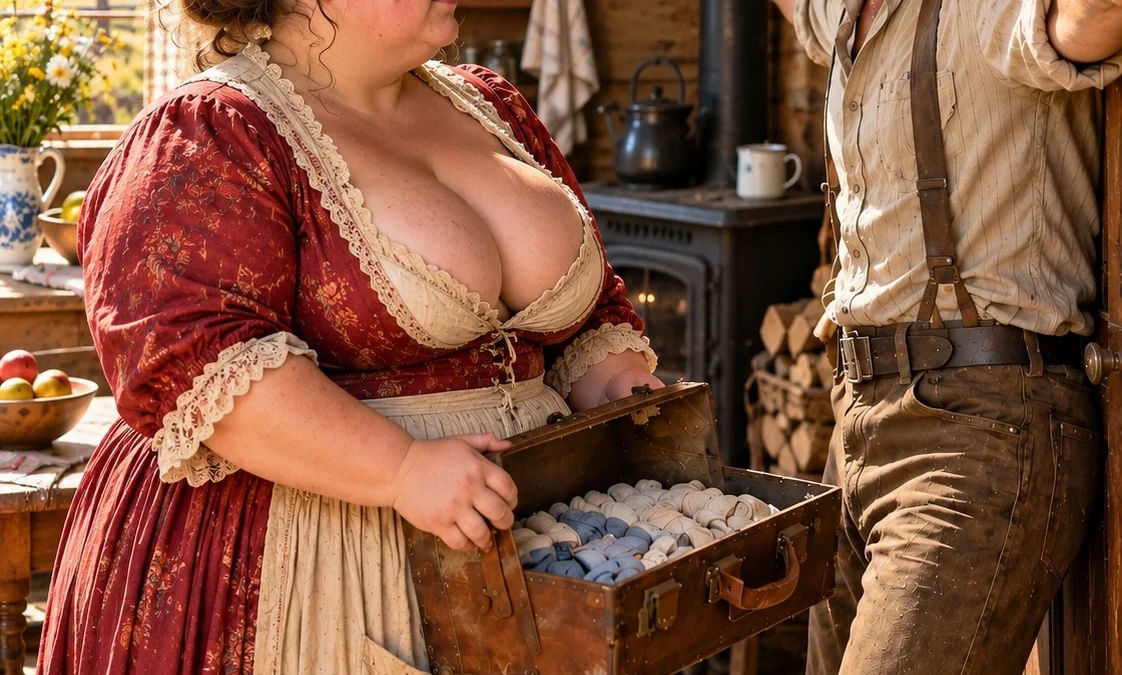
She Packed Her Suitcase Before Dawn to Escape a Town That Turned on Her. Then a Stranger Knocked and Offered Her a Job… and Someone Slid a Mysterious Envelope Under Her Door 😱
Part 1
Before sunrise, Nell Harper had already made the bed. 🌅
That was the strange part.
Her suitcase sat beside the door of the narrow room above Miller’s Feed Store, its leather cracked at the corners, the brass latch polished smooth by years of use. Everything she owned worth carrying was inside it. Two dresses. A sewing tin. Her mother’s recipe book. A photograph she rarely looked at.
Thirty-two dollars had brought her to Dry Creek sixteen months ago.
Eighteen might take her away.
She stood with one hand on the doorknob and looked back at the room. The floor was swept. The washbasin was emptied. Even the blanket had been folded square across the foot of the bed.
She had learned long ago to leave places cleaner than she found them. People who spend enough years feeling unwanted develop habits like that. They try to make their absence convenient. 💔
Nell turned the knob.
Three quiet knocks sounded from the other side.
She froze.
“Miss Harper.” A man’s voice, low and hurried. “If you’re leaving, I won’t stop you. But I’d like five minutes before you decide where you’re going.”
Her fingers stayed around the knob.
Sixteen months earlier, Dry Creek had seemed like exactly the sort of place where a woman could begin again. She had found work in Martha Bell’s boarding house kitchen before her first week ended. At night she mended shirts, shortened dresses, patched ranch coats, and saved every nickel. She was not charming. She was not delicate. But she worked hard, remembered names, and never charged a widow for mending a child’s winter coat.
Then Wesley Harlan noticed her.
Wesley was the son of one of the territory’s wealthiest livestock brokers, a man accustomed to doors opening before he reached them. At first he offered help. Customers. Introductions. A better room.
Then, one evening, standing too close behind the boarding house, he suggested that life in Dry Creek could become considerably easier if Nell were a little more grateful.
She understood him perfectly.
“Then I suppose I’ll have a harder life.”
His smile disappeared. 😶
The rumors began three days later. Nothing specific enough to confront. That was what made them effective. Women stopped bringing dresses for alterations. Men who once greeted her outside the general store suddenly became interested in their boots. At church, an empty space appeared beside Nell no matter which pew she chose.
No single person had ruined her. That would have been easier to understand.
A whole town had simply made hundreds of tiny decisions, each too small for anyone to feel cruel.
Martha stayed loyal. But loyalty from one person could not pay rent forever.
So Nell packed.
Last night, she had found an envelope beneath her door. Inside were eighteen dollars and four words.
For the train east.
She had marched downstairs and demanded to know whether Martha had left it. The old woman denied it. Nell left the money on the table. She would rather walk out poor than leave owing someone she could not name.
Now another stranger stood outside her door.
Nell opened it.
A tall man in a weathered brown coat held his hat against his chest. He looked close to forty, with tired eyes and the kind of face Wyoming weather carves slowly.
“Caleb Mercer,” he said. “Martha Bell sent me.”
Nell said nothing.
“I’ve got a ranch eight miles north. Two children, nine and six.” He glanced at the suitcase, then back at her face. “I need someone to run the house while I run everything else.”
“Why me?”
“Martha says you work when nobody’s watching.”
Nell almost laughed. “That recommendation doesn’t seem worth much around here.”
“It does to me.”
He offered thirty days, wages, meals, and her own room. At the end of the month, she could stay or leave.
“If you hate it,” Caleb said, “I’ll drive you to the station myself.”
Nell studied him. She had learned that generosity could be another kind of leash.
“What do you expect in return?”
“The work I’m paying you for. Nothing else.”
Silence filled the hallway.
Finally, Nell lifted her suitcase. Caleb stepped aside. He did not reach for it.
That small gesture persuaded her more than everything he had said.
Outside, the Wyoming morning was beginning to turn gold along the horizon. She climbed into the wagon with her suitcase still in her own hands. Behind her, the rented room waited in darkness. She pulled the door shut herself.
And for the first time in sixteen months, leaving did not feel quite the same as running.
The Mercer ranch was not beautiful. A fence leaned toward the road. Mud had swallowed half the path to the barn. A loose shutter knocked whenever the wind shifted.
But smoke rose from the chimney. That mattered more.
Two children waited in the kitchen. A boy sat at the table turning a wooden horse between his hands. A girl stood beside the stove with her arms folded.
“This is Rose,” Caleb said, “and that’s Ben.”
Rose looked Nell up and down. “You’re big.”
“I’ve been told.”
Rose seemed disappointed that the insult had failed. Then she asked, “How long are you staying?”
Nell noticed the question. Not who are you. Not are you our new housekeeper.
How long?
“Thirty days,” Nell said. “Then I decide.”
Rose’s mouth tightened. “People always decide to leave.”
Nell did not lie to her. “Then I won’t promise you I won’t.”
Rose stared at her. Then she turned away.
Nell carried her suitcase upstairs and slid it beneath the bed without unpacking it. Just in case.
And then, on the eleventh day, she returned to her room after supper and found something that turned her hands cold. 😨
Another envelope lay beneath the door. Inside were exactly eighteen dollars, and a note in handwriting she did not recognize: “You still have time.” 🔥
Part 2
Nell stared toward the dark window.
Someone knew where she was.
At supper she barely spoke. Caleb noticed, but he did not ask. After the children went upstairs, he paused beside the kitchen doorway.
“Whatever it is,” he said, “you don’t owe me the story before you’re ready.”
Then he left.
Nell stood alone beside the stove. She pulled the envelope from her pocket and held it above the fire. One movement and it would disappear.
Instead, she folded it carefully and hid it beneath her mattress.
Rain began tapping against the glass. But the window no longer rattled. On the seventh morning, she had woken to silence and found Caleb at the table with his coffee.
“You fixed my window.”
“Draft was coming through.”
“You didn’t have to.”
“I know.” He took another sip. “I wanted to.”
Four ordinary words. Nell had carried them around all day. Wesley had once offered her favors that came with invisible strings. Caleb repaired a window and seemed to forget he had done it.
Grand gestures had an audience. A repaired window had only winter. 🪟
Over the weeks, the house changed. Ben barely spoke, but he watched everything. One afternoon Nell mended his wooden horse’s broken hind leg with glue, thread, and a strip of leather. She said nothing. The next morning, Ben appeared in the kitchen while bread baked, climbed onto a chair, and stayed. That became his way of thanking her.
Rose was harder. One day Nell found a faded blue apron in a kitchen drawer.
“That’s my mother’s.”
The girl’s face had gone rigid.
“Were you going to wear it?”
Nell looked at the worn fabric. “No.” She folded it carefully and returned it exactly where she had found it.
That evening, Rose stopped watching her quite so closely.
On the nineteenth morning, Nell stopped with a piece of chalk against the kitchen calendar. Day 19. She had forgotten to count yesterday and the day before.
That frightened her more than the envelope.
For most of her life, she had measured places by how quickly she could leave them. Now she found herself measuring other things. How much flour remained. Whether Ben needed new boots. Whether Caleb would remember to eat before riding the north pasture. 💛
A person could become attached to a life through remarkably ordinary things.
That afternoon, Rose came home with dirt on her dress and blood drying beneath one nostril.
“A girl said everybody in Dry Creek knows what kind of woman Nell is,” she muttered. “So I hit her.”
Nell wiped flour from her hands. “Then defend me without becoming cruel.”
“You don’t even care!” Rose ran outside.
Nell found her behind the barn and sat beside her.
“Why didn’t you fight them?” Rose asked. “If they were lying, why didn’t you make them stop?”
It was the wrong question. But Nell understood what Rose was really asking. Why didn’t Mama survive? Why did good people lose?
“I was tired,” Nell said quietly. “People think courage disappears because you’re weak. Sometimes it disappears because you’ve been brave too long without any rest.”
Rose considered this. “Are you tired here?”
Nell looked toward the farmhouse.
“Less every day.”
That evening Ben placed a folded drawing on the table. Four figures stood beneath a crooked yellow sun. Caleb. Rose. Ben. And Nell, drawn several inches away from the others.
“Why am I over here?”
Ben shrugged. “Didn’t know if you’re staying.”
She did not promise him anything. Instead, she pinned the drawing beside the kitchen calendar. 📌
Three nights later, horses approached after dark.
Nell knew Wesley Harlan’s voice before she reached the porch. He stood below the steps with two men behind him. The old fear returned instantly. That angered her more than Wesley did.
He claimed she had been spreading lies. Then he mentioned the cattle contracts Caleb depended on.
The threat was obvious.
Caleb stepped down. Nell caught his arm.
“No. He came because of me.”
Caleb hesitated, then moved aside. Not away. Aside.
Nell walked to the edge of the porch.
“You lied because I told you no,” she said.
“You should be careful.”
“I was careful for months.” Her voice stayed steady. “You offered kindness because you thought gratitude would become obedience. When it didn’t, you punished me.”
One of Wesley’s men looked away.
“You think this rancher makes you brave.”
“No.” Nell descended one step. “I think surviving you did.”
Silence.
Wesley threatened Caleb’s business again. Nell looked directly at him.
“Then do whatever you are going to do. I’m finished helping you frighten me.”
He left. Only when the riders vanished did she realize her hands were shaking.
“I didn’t stop you,” Caleb said.
“No.”
For the first time, Nell understood that protection and possession could look similar from a distance. One stood beside you. The other stood in front of you.
Then she told him about the envelopes.
His face changed. “The first eighteen dollars. That was me. Martha said you might need train money. I didn’t know how else to help without embarrassing you.”
“And the second?”
Caleb went still.
“I didn’t send another.” 😨
Part 3
That night, Nell placed both envelopes on the kitchen table.
Same amount. Different handwriting.
Between them lay Ben’s drawing, four people beneath one crooked sun, and one woman still standing slightly apart.
The next morning, she rode back to Dry Creek alone. Caleb offered to come. She told him no. He did not argue.
Months earlier, she had planned to leave this town before sunrise, hoping darkness would spare her the humiliation of being seen. Now she rode down Main Street at noon.
People noticed. That was fine.
Martha Bell was kneading biscuit dough when Nell entered the boarding house kitchen and set the second envelope on the table.
“Did you send this?”
Martha’s hands stopped. That was answer enough.
“You wanted me gone.”
“No.”
“You sent me train money.”
“I sent you choice.”
Nell stared at her.
Martha wiped flour from her fingers. “You went out there with nothing but Caleb’s wages between you and being stranded. I didn’t like that.”
“He wouldn’t strand me.”
“I know.” Martha’s expression softened. “But a good man can still become the only door in a woman’s house. I wanted you to have another door.”
The anger inside Nell slowly changed shape. Martha had not been warning her away from Caleb. She had been making sure Nell could leave him.
“A good home isn’t much of a home,” Martha said, “if you can’t afford to walk out of it.”
For years Nell had believed independence meant needing no one. Perhaps real freedom was being able to need someone without surrendering the right to choose them. 💛
This time, she took the eighteen dollars and tucked it into her coat.
Not because she planned to leave. Because staying meant more when leaving remained possible.
On her way back to the livery, she noticed that people looked at her differently. Mrs. Talbott, who had once moved pews at church, stopped her outside the general store.
“I heard what Wesley did at the Mercer place. I suppose we may have judged too quickly.”
We. Such a useful word. It allowed everyone to apologize without remembering exactly what they had done.
Wesley’s hired men had talked. Ranchers were reconsidering contracts with the Harlans. Stories that had once sounded unbelievable suddenly became easy to believe. Not because Nell had changed.
Because believing her had finally become safe.
She accepted Mrs. Talbott’s apology. She did not accept her invitation for coffee. Forgiveness, Nell was beginning to understand, did not require returning someone to the place they once occupied in your life.
By the time she reached the Mercer ranch, the sky had turned gray.
Caleb was hitching two horses to the wagon.
“Storm coming through the pass,” he said, tightening a strap. “Road could close by midnight.”
Nell looked at the wagon. Her thirty days ended tomorrow.
Caleb avoided her eyes. “If you still want the train, we need to leave now.”
Something inside her dropped. “You want me to go?”
His head came up. “No.”
The answer came so quickly it hurt.
“Then why is the wagon ready?”
Caleb stood motionless. “Because wanting you here doesn’t give me the right to trap you here.”
For years, Nell had mistaken safety for a life in which nobody could hurt her because nobody mattered enough. Now a man who wanted her to stay was preparing the very wagon that could take her away.
That was the contradiction she had not known she needed. 🕊️
She walked toward him. “Unhitch them.”
“Nell, don’t stay because of the storm.”
“I’m not.”
“The children…”
“Not because of them either.” She swallowed. “I’m staying because when I imagine leaving now, it doesn’t feel like freedom.”
Caleb said nothing.
She looked toward the house. “I want to stay.”
The words frightened her. That was how she knew they mattered.
Caleb slowly began unhitching the team. Nell climbed the porch steps. Snow swept across the yard, whitening the road that could still take her away. She stood in the open doorway while warm kitchen light spilled around her boots.
For once, the open door behind her did not feel like an escape. ❄️
Spring came slowly to Wyoming. Snow retreated from the fields in dirty patches. The creek began moving again.
Nell stayed.
Weeks became months. Yet her suitcase remained beneath the bed. She had unpacked what she needed, a dress, her sewing tin, her mother’s recipe book, but several things remained inside. She told herself she simply had not gotten around to it.
Deep down she knew better. The suitcase was proof that she could still leave.
One evening, after repairing storm damage along the south fence, Caleb rested his arms across the top rail.
“Nell.”
Something in his voice made her stop.
He did not kneel. There was no ring held dramatically toward the sunset. He simply looked tired, nervous, and completely sincere.
“I’d like you beside me when we’re old.”
Nell’s throat tightened. She loved him. That was not the problem. The problem was that for years she had survived by keeping some part of herself ready to run. Marriage felt like unpacking the last thing she owned.
Her escape.
“I need tonight,” she whispered.
Caleb nodded. “Take it.”
Nothing else. No persuasion. No wounded pride.
That night Nell sat on the bedroom floor with the suitcase open. Rose found her there. The girl looked at the clothes, then at Nell. She did not ask the question she once would have asked.
She did not say, Are you leaving?
Instead she sat beside her. “What are you afraid happens if you unpack it?”
Nell almost answered. Then stopped.
“I don’t know.”
And that was the truth. A person could spend so many years surviving uncertainty that preparedness itself began to feel like safety.
Rose leaned against her shoulder. Neither spoke.
The next morning, Nell found Caleb repairing the same stretch of fence.
“Yes.”
He looked up.
She smiled. “Yes, Caleb.”
He crossed the distance between them slowly, as if even happiness should ask permission before coming closer. 💛
Months later, they married beneath a cottonwood tree behind the house.
There was no grand transformation afterward. Ben still forgot his boots. Rose still argued. Caleb still worked too late. Nell still burned biscuits when distracted.
That was perhaps the best part. Love did not turn life into something perfect. It simply gave ordinary difficulties somewhere to belong.
Years passed. When Rose was preparing for her own wedding, she found Nell in the kitchen.
“How did you know Dad was the right man?”
Nell thought about Wesley, the confrontation, the snowstorm, Caleb’s proposal. But none of those came first.
“The window,” she said.
Rose laughed. “What window?”
“The one in my room. It rattled.” Nell smiled. “He fixed it without making me grateful for it.”
Grand gestures could be rehearsed. Small kindnesses usually could not.
That evening Nell watched Caleb cross the yard, gray now showing at his temples. He noticed her looking. The same quiet smile passed between them.
Upstairs, beneath their bed, the old leather suitcase remained. Empty now, almost. At the bottom lay eighteen dollars and a faded train timetable.
Nell had never thrown them away. Not because she regretted staying. Because knowing she had always been free to leave was part of understanding why staying mattered.
The suitcase was still hers. The door was still unlocked.
And downstairs, Caleb was calling her name for breakfast. 🌅
This story is entirely fictional and created for entertainment purposes only. It does not represent any organization or individual, nor does it encourage inappropriate behavior. The content was generated with AI assistance.








