She Packed Her Trunk In Secret While The Duke Called Her “Perfect”… But When He Opened It, What Was Hidden Inside Her Stockings Made Him Fall To The Floor In Front Of His Entire Household
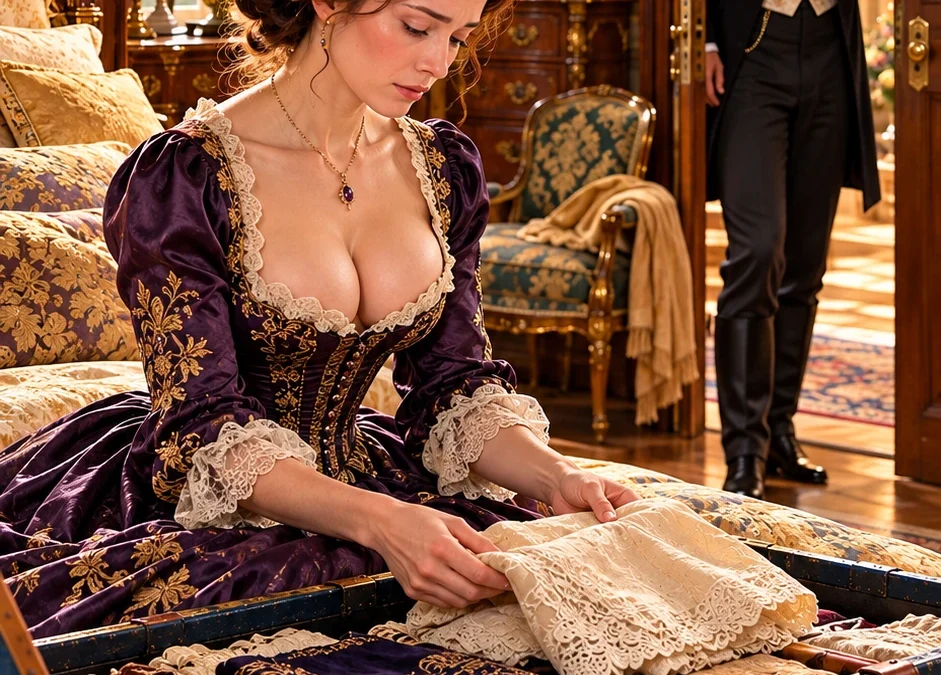
She Packed Her Trunk In Secret While The Duke Called Her “Perfect”… But When He Opened It, What Was Hidden Inside Her Stockings Made Him Fall To The Floor In Front Of His Entire Household 😱
Part 1
The Duke stopped in the doorway, and his breath caught.
A blue trunk stood beside the fireplace. 😳
Outside the tall windows, snow was burying the grounds of Wintermir Hall. It swallowed the hedges, the long drive, and the stone urns along the terrace.
His quiet wife stood calmly beside her writing desk, pressing a seal into warm red wax.
“Where are you going?” he demanded.
“Away,” she answered.
For eleven months, she had never raised her voice. She had never questioned his authority. She had never once complained.
Nathaniel Blackthornne, Duke of Wintermir, had mistaken her silence for happiness.
Now every folded dress, every bundled letter, and every carefully packed belonging told him otherwise.
It was the last week of December. He had spent the whole afternoon in a cold estate office in the market town, listening to land agents argue about drainage, timber, and the price of winter feed. He had ridden home through thickening snow with his collar turned up and his mind full of acreage.
Wintermir Hall rose out of the white Hampshire countryside like a great gray ship frozen in harbor.
When he climbed the stairs to his wife’s sitting room, he noticed, without quite thinking about it, that the fire inside burned low and thin.
As though someone had been rationing coal. 🥶
He opened the door and saw the trunk.
It was a sturdy thing with brass corners, strapped and buckled. A paper label hung from its handle in his wife’s neat, upright hand. It listed a coaching route to Portsmouth, the inns where horses could be changed, and a small warning near the bottom.
Avoid the brown gelding at the farm stage, for he bites and he sulks.
Eleanor, who had been born a Whitam and was now Duchess of Wintermir, sat finishing a letter. She did not startle. She did not even set down her pen until she had completed the line.
They had been married eleven months. In all that time, she had never shouted, never sulked in public, never demanded one unreasonable thing. He had been quietly proud of that. Other men complained of extravagant wives and quarrelsome wives and wives who wept at dinner.
His wife was sensible. His wife was calm.
And now his sensible, calm wife was sealing a letter beside a trunk packed for the coast.
So he began, as a reasonable man would, to list the reasons she could not go. There was a snowstorm. The low road was iced over. The bridge at Frostwick was unsafe. A duchess could not travel alone in such weather.
Eleanor answered each objection as briefly as a clerk ticking items off a ledger.
She had a fur-lined cloak. She had snow boots already oiled. She had an alternate route through Winchester if the bridge was closed, and money set aside for a respectable inn.
Every door he tried to shut, she had already locked from the other side.
At last, his patience broke.
“You cannot leave.”
Eleanor looked up, her gray-blue eyes perfectly steady.
“Can I not?”
Something cold moved through him, colder than the draft beneath the door.
He heard his own words as she must have heard them. Not as concern, but as a command. The kind a man gives about a horse or a parcel of land.
“I am not trying to be quarrelsome, Your Grace,” she said.
She had not called him Nathaniel.
The distance in that title wounded him more than the trunk itself.
“I have become very good at being quiet. Everyone in this house has mistaken it for permission.”
A knock came at the door. Mrs. Agnes Bellamy, the housekeeper, entered with snow still melting on her shawl.
A great oak weighed down with snow had just fallen across the north road. The south bridge was impossible until the ice could be broken. Her Grace would not be traveling tonight.
Relief rushed through Nathaniel so quickly that it must have shown on his face.
Eleanor saw it.
“Do not look pleased,” she said quietly. “The snow has delayed my departure. It has not changed my decision.”
He stood in the middle of her sitting room, a man who governed thousands of acres, and understood that he had no idea how unhappy his wife had been.
She was no longer pleading with him to understand. She had moved past pleading and into action.
“What has made you so determined?”
Eleanor rose, crossed to the trunk, and turned a small key in its lock.
“Then perhaps, Your Grace, you should see what I have packed.”
Nathaniel expected gowns. Books. A jewel case. Perhaps the miniature of her late father.
Instead, she lifted out a pair of gray wool stockings, rolled tight. From inside one of them, she drew a folded bill for linen. 🧦
The sheets in three guest bedrooms had gone damp and spotted with mildew in the autumn rains. She had asked Mr. Strickland, the steward, for funds to replace them. He had refused, judging the ornamental west gate more urgent, since visitors saw the gate and did not inspect their sheets until they were already lying in them.
So she had paid for the linen herself.
“Why did you never tell me?”
“I did,” said Eleanor. “Your secretary returned the memorandum marked domestic.”
He remembered then, dimly and with growing discomfort, the neat little packets that used to appear on his desk. He had passed them to his secretary unopened, assuming the house could take care of itself, the way it always had when his mother ran it.
Eleanor did not wait for him to finish remembering.
From a nightgown, she drew a receipt for coal bought to heat the servants’ wing during the November frost. From a slim book of poetry, a record of relief payments to village widows, delayed seven weeks. From a single kid glove, proof of kitchen wages paid late and paid at last from her own allowance. A bundle of letters recorded invitations she had declined because Lady Beatrice found her country accent unsuitable for London drawing rooms.
There were fifteen items in all.
Each one was evidence that she had tried to report a problem.
Each one was evidence that she had been ignored.
Nathaniel’s knees weakened. He asked Mrs. Bellamy to fetch him a chair.
Eleanor raised one hand.
“If Your Grace wishes to understand my trunk, Your Grace may sit on the floor.”
Mrs. Bellamy made a sound that was very nearly a laugh and turned it, with great professional skill, into a cough.
And so the Duke of Wintermir, a man whose name was spoken with respect in Parliament, lowered himself onto his wife’s hearthrug and sat there holding a gray stocking in one hand and a coal bill in the other. 😳
She had not insulted him. She had not raised her voice.
She had simply made him look at what was real, and that was far more humbling than any insult.
Then she told him the rest.
She had already secured a position in Portsmouth, as manager of a sewing and mending workshop run by a widow named Mrs. Florence Mercer.
“I do not need a larger allowance,” she said. “I need to belong to myself.”
But before he could answer, Mrs. Bellamy returned from the corridor with news that drained the last color from his face.
The kitchen ceiling had broken through, and water was pouring in.
“The leak is not new,” Eleanor said softly. “It began in March. It has been reported four times and patched once. Badly. If you wish to begin understanding, come to the kitchen and listen.”
And for the first time in his life, the Duke of Wintermir walked down to his own kitchen, not to give orders, but to hear the truth. 😨
💬 Part 2 is waiting in the comments! Can’t find it? Leave any word below and I’ll send it to you privately.
Part 2
For the first time in his life, the Duke of Wintermir walked down to his own kitchen, not to give orders, but to hear the truth.
The kitchen of Wintermir Hall was in uproar.
Heat from the great range had warmed the slates above, and the snow resting there had begun to melt and find its way through every crack. Water fell in steady drips into copper basins, saucepans, pudding molds, and one unfortunate tray of pastry.
In the middle of it all stood Mrs. Prudence Harlow, the cook, sleeves rolled to the elbow, wearing the expression of a general whose campaign had been ruined by weather.
When the Duke appeared in her doorway, she did not curtsy deeply. She looked at him as though he were one more leak. 💧
The roof had been failing since spring, she told him. The bread oven flue was cracked. The pantry door had swollen shut with damp. The servants’ hall had gone without proper coal during the worst of the frosts.
Her Grace had written request after request. The steward had answered each one by saying that servants’ quarters were not a place where honored guests would ever set foot.
“Why did no one bring these matters to me?” Nathaniel asked.
Eleanor answered from just behind his shoulder.
“We told you. You simply never heard us.”
One by one, the staff began to speak. A scullery maid described her chilblains. A footman described carrying coal in his own coat pockets. A boy who turned the spit admitted he slept beside the warm bricks of the bread oven because his attic room had frost on the inside of the window.
Nathaniel took out a pencil and reached for a scrap of paper.
Eleanor laid her hand over his.
“Before you write anything, ask who already has.”
Mrs. Bellamy produced a ledger from her apron. It was the third copy, she explained. The first had been lost in the steward’s office. The second had been returned unread.
Every page was in order. Every problem, every cost, every proposed repair.
The wife he had pictured idling over embroidery had been running nearly the whole living machinery of his house.
He ordered the kitchen roof repaired before anything else on the estate. Then, because no one else was free, he took off his coat and helped the footmen stretch oilcloth across the broken plaster. 💪
That was how his mother found him.
Lady Beatrice paused in the passage, silk skirts lifted above the wet flagstones, and stared at her son holding a copper basin full of water.
“Why are you carrying a kitchen basin?”
“Because the kitchen roof leaks.”
“That is why we have servants.”
“Yes, Mother. Wet ones.”
Behind him, Eleanor pressed her lips together and very nearly failed to hide her smile.
When Beatrice called a roof repair a trivial affair for a duchess, Nathaniel answered before Eleanor could. A broken roof was not trivial. If his mother wished to speak with him privately, he would do so “after I have finished listening to my wife.”
Eleanor went very still.
It was the first time her husband had ever taken her side in front of anyone.
She did not mistake one sentence for forgiveness.
That night, he discovered that every servant in the house had known about the trunk. The maids. The boot boy. Even the head groom, who had been asked about the brown gelding.
In his own home, the master had been the last to learn the truth.
Before bed, Eleanor had the blue trunk carried down and placed directly in front of the drawing room door.
“Because I want everyone to trip over it.”
In the morning, the steward came home.
Mr. Perival Strickland, fifty-two, broad in the shoulder, with a voice made for reassurance, entered the breakfast room carrying a leather folder and the easy confidence of a man who had been believed for twenty years.
He had no idea a blue trunk had just changed the balance of power inside Wintermir Hall. 😏
Eleanor asked to put three questions to him.
Had he personally inspected the mildewed bedrooms before refusing money for linen? Had the mason been paid in full before the kitchen roof was recorded as finished?
And her third question made the color leave his face.
Had he told the Duke that the rent relief set aside for the widows of Frostwick had been diverted to rebuild the ornamental west gate?
By the end of breakfast, his eggs had gone cold, and he had admitted to every error.
But the worst was still ahead.
That afternoon, the estate council arrived through the snow. Eleanor moved the meeting to the linen room, laid out her evidence on a long folding table, and walked every man through it until even the retired magistrate in three scarves stopped chewing his biscuit.
Then Nathaniel rose from an upturned laundry basket.
“Gentlemen, for eleven months, this house has benefited from my wife’s labor while giving her little authority, little credit, and less freedom.”
No one moved.
And then he made a promise that stunned the entire room.
“If she chooses to leave, I will carry the trunk myself.”
Lady Beatrice gasped from the doorway.
But Eleanor was looking at her husband as if seeing him for the very first time.
And what she decided next would change everything. 😱
💬 Want to know if the Duchess stays or goes? LIKE or COMMENT “REVEAL” to unlock Part 3! It will be posted as soon as we have enough comments. 🔥
Part 3
The linen room went completely silent.
Lady Beatrice protested that he could not possibly mean it. Nathaniel did not take back a single word.
For the first time, Eleanor understood that he was not offering pretty phrases. He was binding himself to something with consequences.
“A promise made before witnesses,” she reminded him, “becomes an obligation.”
“I know.”
The vicar wrote it down.
The meeting then turned from promises to decisions. The council approved repair of the kitchen roof, replacement of the village pump, wages paid on the day they were due, full reimbursement of Eleanor’s expenses, and a review of the widows’ rents. They divided Mr. Strickland’s duties so that no single man controlled every purse. They created a way for complaints to reach the household directly, without passing through the steward’s office first.
Throughout it all, Nathaniel practiced something new.
He did not interrupt his wife.
When a tenant questioned the cost of the pump, he did not leap up to defend her with grand speeches. He turned to her and asked, “Would you like me to answer that?”
Sometimes she said yes. Sometimes she answered herself. Once she told him not to speak like a statue in a town square, and the land agent laughed so hard he had to be given another biscuit. 😂
It was a small change.
But it was real.
Lady Beatrice followed Eleanor into the corridor, accusing her of disgracing the family.
Eleanor turned to face her.
“I have not disgraced this family. I have only shown what it tried to hide. Great houses teach women to speak softly, and then they praise them for being silent.”
Something shifted in the older woman’s face.
For a long while, she said nothing. Then, unexpectedly, she began to speak about her own marriage.
When she had come to Wintermir as a bride, her mother-in-law had held every key in the house. When that lady died, the keys had gone not to Beatrice but to the steward. When she asked to take part in running her own home, her husband had laughed, patted her hand, and changed the subject.
Nathaniel, standing in the doorway, felt the floor tilt beneath him.
His father had been exactly the kind of husband he himself had become.
“Why did you never help me?” Eleanor asked.
Beatrice lifted her chin. “Because your competence embarrassed me. You were doing what I was never allowed to do, and every time you succeeded, I was reminded that I had stopped trying.”
The confession did not erase eleven months of small cruelties.
But it changed the shape of what stood between them.
Then Beatrice surprised them both. She knew a widow in Portsmouth with connections in naval circles, she said, who might send contracts Mrs. Mercer’s way. She proposed opening a branch of the workshop in Frostwick, to give paid work to the village women through the long winters.
Eleanor regarded her with open suspicion. “I will not accept some pretend charity designed to keep a duchess amused.”
Nathaniel answered before his mother could.
“Then do not have a toy project. Have a business.”
Eleanor turned to him. “And if after all of this I still wish to go?”
He looked down the corridor toward the blue trunk.
“Then I carry it.”
That night, Eleanor had the trunk moved to the great hall, beneath the portrait of the first Duke. She tied a fresh label to its handle.
Still deciding.
In the morning, Nathaniel came down early with a cup of coffee he had poured himself and offered it to her.
She looked at the cup, then at him.
“I drink tea.”
He stood there, holding the coffee, and understood that after eleven months of marriage, he did not know what his wife liked to drink in the morning. ☕
He waited for a scolding. Instead, she thanked him for trying to notice, even if he had noticed incorrectly.
He drank the coffee himself, which was penance enough. He did not much care for it either.
She meant to walk down to Frostwick to inspect the pump and the cold cottages. Nathaniel opened his mouth to tell her to stay indoors because of the snow, and closed it again before the order could escape.
“Would you prefer company?” he asked instead.
She agreed on two conditions: proper boots, and no lectures about icy paths.
Where the lane dipped steeply toward the stream, the snow had packed into ice, and he held out his hand.
“I can manage,” she said.
“I know. I would merely like to help.”
After a moment, she took it.
In Frostwick, women came to their doors to tell Eleanor about the pump, the rents, a child with a cough, and a roof that sagged. They spoke to her easily. They spoke to him with bowed heads.
Nathaniel understood that they trusted her more than they trusted him. Not because he had ever been cruel, but because she had been present when they needed someone, and he had not.
He knelt beside the frozen pump, trying to work out what was wrong with it. Eleanor leaned over his shoulder and pointed at once to the cracked leather valve.
“I see that I do not see it,” he admitted. “That is progress.”
She laughed. A real laugh, bright in the cold air. ❄️
He looked at her, cheeks reddened by the wind, eyes alive with amusement, and realized she was not the faded, decorative creature he had believed he married. She was clever and sharp and strong, and full of a life he had kept shut up in a sitting room like a lamp no one bothered to light.
“I am sorry I never saw who you truly were.”
Eleanor did not forgive him. She only said, “That is closer.”
Late that night, the wind rose again and moaned around the chimneys.
Nathaniel stood on the gallery above the great hall, looking down at the blue trunk in the moonlight. Eleanor came along the gallery with a candle and told him something she had never told anyone.
The very first thing she had packed in that trunk was her pair of wedding gloves.
She had packed them because they reminded her of the promise she had made to stay beside him, and she no longer knew how much of herself that promise had cost her.
He asked very quietly whether she still loved him.
“I loved you,” she said.
The past tense struck him like a blow. 💔
She told him what she had loved. His kindness to tenants. His seriousness with the old soldiers who came begging at the gate. The way he always rose when a woman entered a room.
“But I grew tired of loving alone.”
“Is it entirely gone?”
“I do not know. And when the roads open, I will still decide for myself whether to leave.”
The storm broke before dawn.
By the time the sun cleared the beechwoods, gardeners and grooms were out with saws and shovels, cutting the fallen oak into lengths. The north road would be open before noon.
Eleanor came down the main staircase in a gray woolen traveling dress, a heavy cloak, and her oiled snow boots.
She was ready to go.
Nathaniel was waiting beside the trunk. He had not slept at all.
Lady Beatrice descended a few minutes later and handed Eleanor a sealed letter of introduction to her friend in Portsmouth, without a word. Mrs. Harlow arrived with a tin of shortbread, remarking that no one should face a coaching inn on an empty stomach. Mrs. Bellamy brought a bundle of lavender to tuck among the clothes. The maids came with rugs and hot bricks. The footmen came to carry the smaller bags.
Every person who had been warmed by Eleanor’s coal, paid from her purse, or simply noticed by her wanted to see her off. 🥹
Nathaniel bent and lifted the trunk.
It was heavier than he had imagined. All those months were inside it.
He carried it across the hall and set it beside the great door, and for the first time in his life, he was not trying to stop the woman he loved from walking through it.
Then, in front of everyone, he spoke.
He told her he did not want her to go. He told her he would not use that wish as a chain.
“I love you. Badly at present, lazily in the past, frightened now. But truly. I loved you the way a man loves a hill or a church spire, something that would always be there whenever I happened to look up. I understand now that love is not possession. If you leave, I will never call it betrayal.”
Eleanor looked at the trunk. She looked through the open door at the white road stretching away under the winter sky. She looked at her husband.
“I am still going to Portsmouth.”
Nathaniel bowed his head and accepted it.
“For three days,” she added. She would meet Mrs. Mercer in person, see the workshop with her own eyes, and judge whether the two enterprises might work together. She had not yet decided her whole future. She would take her own money, her trunk, and her choice.
He carried the trunk out himself and heaved it onto the back of the carriage, tightening the straps with great determination.
The head groom watched for a moment, then stepped forward and quietly retied every knot.
Eleanor pressed her glove to her mouth to hide a smile.
Nathaniel did not take her elbow. He waited, and only when she held out her hand did he offer his.
There was no dramatic kiss. There was no promise that everything had been mended. There was only respect, and it was new enough to feel almost fragile.
The carriage rolled away down the freshly cleared road. Nathaniel stood on the steps and watched until it vanished beyond the beech trees.
He did not run after it. He did not call her name.
Inside the carriage, Eleanor looked back through the little window once, not because anyone expected her to, but because she wanted to.
Wintermir Hall felt hollow without her.
The blank space where the blue trunk had stood caught his eye every time he passed. He found, to his surprise, that he missed even the luggage.
But he did not retreat into his library to brood. He went to work.
He climbed the ladder to inspect the kitchen roof and asked the mason questions until he understood every answer. Mrs. Harlow followed him up and down, pointing out every seam she considered unsatisfactory, and the Duke accepted each criticism without argument. In Frostwick, when he realized he still did not understand the pump’s valves, he did not pretend. He asked the women who drew water from it every morning, and they told him precisely, and with some enjoyment.
By evening, the villagers were saying to one another that the Duke actually listened.
He tried to write to his wife. The first letter was full of elegant sentences about love and regret, and it sounded like a man admiring his own sorrow. He burned it. The second described the roof repairs so thoroughly that it begged to be praised. He burned that too.
The third told only what he had learned. That he had never known the laundry chimney smoked in winter, because he had never set foot in the laundry in winter. That Mrs. Harlow had pronounced the new roof tolerable, which he gathered was her highest form of praise.
He did not ask Eleanor to come home. He simply told her the truth and sent it. ✉️
In the old schoolroom, he drafted a contract for the Frostwick women, full of phrases like noble opportunity and gracious patronage. The women were unimpressed. They wanted wages, delivery dates, and to know what happened if a buyer failed to pay.
Mrs. Harlow remarked that gracious patronage had never yet bought anyone a sack of flour.
Nathaniel struck out every grand phrase and wrote a plain contract with the women’s help. When it was ready, he paused before signing. It should wait until Eleanor returned, so she could decide for herself.
“And if Her Grace does not come back?” one woman asked.
“Then the work goes ahead on exactly these terms. You will be paid regardless of what happens in my marriage.”
He was no longer using kindness to others as a way to buy back his wife’s affection.
On the fourth morning, a letter came from Portsmouth.
Mrs. Mercer was shrewd and generous. The workshop did not need rescuing. It needed fair contracts, reliable transport, a proper warehouse, and investors who respected the right of the people running it to actually run it.
Eleanor expected to return the following day.
Nathaniel read the last line three times and could not keep the joy from his face.
That evening, he went up to her sitting room. On the rug by the hearth, the faint square imprint of the trunk remained. Kneeling there, he found a folded paper that had slipped beneath the edge.
On the outside, in her hand: If Nathaniel ever finds this, he should read it only when he has courage enough to face the answer.
He sat down on the floor, as she had once made him do, and unfolded it.
It was a list of reasons she did not wish to stay.
One. He listens to reports, but not to me.
Two. His mother enters my room without knocking.
Three. The servants trust me in secret, but honor him only in ceremony.
Four. I have begun saving my true thoughts for rooms he is not in.
Five. If I stay without the right to open a door, I will start being grateful for windows.
Six. I still love him when he is kind to people who can do nothing for him.
Seven. But kindness to strangers is not enough if he cannot be kind to his own wife.
He read it again and again until the candle burned low.
Then he took up a pen from her desk, and beneath the seventh line, he wrote:
8. He found this and did not hide it.
He laid the paper open on her writing desk, where she would be sure to see it. 🕯️
The next morning, a carriage appeared at the far end of the snowy drive.
The last gray clouds had drifted east, and the sky above Wintermir was a pale, clean blue. At the sound of wheels, the servants appeared one by one in the great hall, trying very hard to look as though they had all happened to be passing.
Eleanor stepped down, face a little pale from the cold, eyes bright and awake.
Nathaniel came down the steps toward her. He did not sweep her into his arms. He stopped at a respectful distance, glanced at the blue trunk strapped to the back of the carriage, and asked:
“May I carry it?”
“Wherever you choose.”
She chose the great hall, and he carried it inside and set it down exactly where she pointed.
Eleanor took off her gloves and told him she had read the eighth line. She had stopped at her sitting room before coming down, because she had wanted to know whether the list was still there.
“Did you hide the paper?”
“No.”
“Did you write on it?”
“I did.”
The smallest smile curved her mouth. He was learning to tell the truth, even the parts that might earn him blame.
Then, in front of the whole household, she spoke.
“I am staying.”
No one cheered. The great hall went so quiet that the fire could be heard ticking in the grate, and Mrs. Bellamy was seen to take out a handkerchief. 🥹
Nathaniel barely dared believe it. But Eleanor had not finished.
She would open the Frostwick branch of the workshop and sign the contract herself. She would travel to Portsmouth whenever the business required. She would keep her own account. Reports on the roof, the wages, the pump, and every matter once dismissed as unworthy of notice would come directly to her. She would not ask permission each time she wished to go somewhere.
“And the blue trunk will remain in the great hall.”
Lady Beatrice asked why on earth it must stay there.
“Because everyone in this house behaves better when watched by luggage.”
Mrs. Harlow laughed out loud. Nathaniel laughed too, and no one in the room saw the trunk as a threat anymore.
“Will it still be kept packed for leaving?” he asked.
“For journeys,” Eleanor said. “To Portsmouth. To Frostwick. To London, perhaps, if I ever care to see what the drawing rooms make of my accent now. To anywhere at all I might wish to go.”
The luggage that had once meant escape now meant the freedom to choose.
And Nathaniel understood at last that keeping her had never been the victory.
The precious thing was that she could leave and still wanted to come home.
They stood together beside the trunk. He wanted very much to take her hand, but he waited.
Eleanor noticed that he was waiting, and she held out her hand to him.
He took it.
“Welcome home,” he said.
“Home,” she answered, “is a word that must be maintained.”
He promised to keep learning, not only today but every day after, the way a good roof must be tended every winter, and not merely admired in summer.
Eleanor knelt and opened the trunk. From inside, she lifted the pair of gray wool stockings that had once hidden the linen bill. The old coaching label was gone from the handle. In its place hung a new one, lettered in her firm, upright hand.
Ask first.
Nathaniel understood. He straightened his coat and asked, with tremendous solemnity:
“May I unpack this stocking?”
Eleanor smiled up at him.
“Yes, Nathaniel. But only because you asked permission first.” 😊
Outside the tall windows, snow began to fall again, soft and slow over the gardens of Wintermir. The fire burned warm in the great hall, and the blue trunk sat at the heart of the house, no longer a sign of a marriage breaking apart, but a reminder that love only lasts when the one who stays is always free to go.
He had once believed that love meant a wife who would never leave.
Now he understood that true love meant becoming a husband she could freely choose to return to. ❤️
💬 If this story touched your heart, tell us in the comments: who in your life has been quiet for too long, and have you truly listened? Like and share this with someone who needs the reminder. 🙏
This story is entirely fictional and created for entertainment purposes only. It does not represent any organization or individual, nor does it encourage inappropriate behavior. The content was generated with AI assistance.








