She Pressed a Knife to His Ribs in the Dark of His Wagon and Whispered Seven Words That Would Cost Him Everything… “Pretend I’m Your Wife”
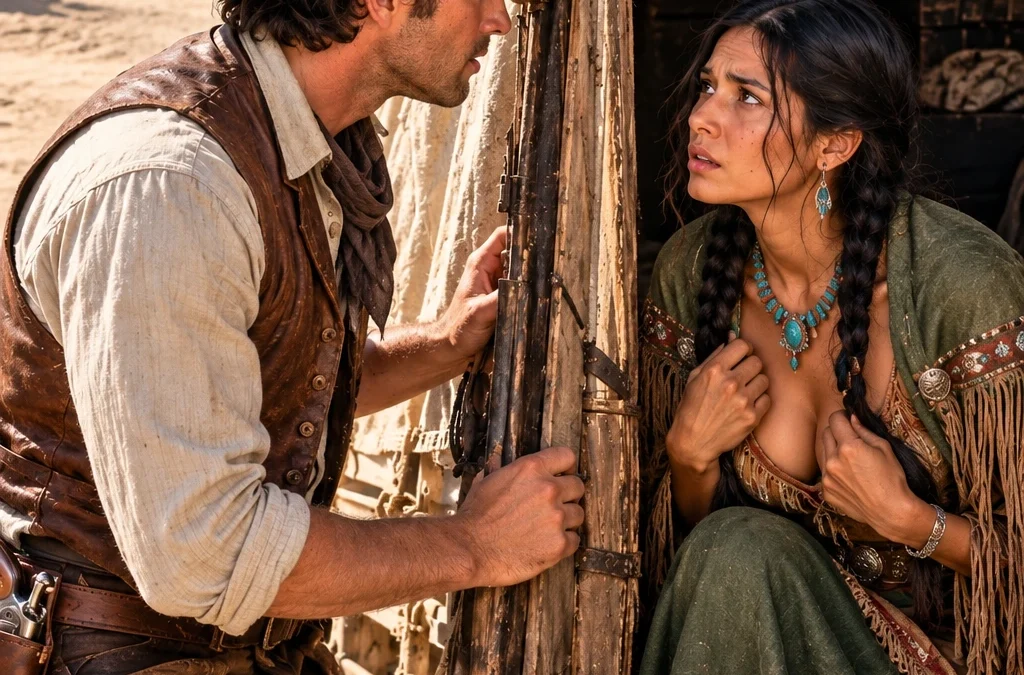
🔥 She Pressed a Knife to His Ribs in the Dark of His Wagon and Whispered Seven Words That Would Cost Him Everything… “Pretend I’m Your Wife” 😱
PART 1
She pressed a knife against his ribs in the dark of the wagon bed and said nothing. Not a plea. Not an apology. Just seven words that would cost him everything. 🔪
“Pretend I’m your wife until we’re out of town.”
Silas Everett had survived drought, debt, and a war that took his brother. But he had never survived a woman with eyes like that: calm, certain, and burning with something he didn’t have a word for yet. 🔥
The sun had been trying to kill him for three days straight.
He could feel it pressing down on the back of his neck like a flat iron. Steady. Merciless. Personal. The kind of heat that didn’t just dry out the earth. It dried out a man’s patience, his hope, his sense that anything good was still possible west of the Colorado River. ☀️
He had ridden into Coppervale that morning with one purpose: buy enough dry goods and rope to last two weeks, settle a small debt at the feed store, and get home before dark. Simple. Quiet. Exactly the kind of day Silas preferred. He was forty-one years old. He had earned the right to quiet days.
Coppervale sat at the edge of a long, flat valley, and in July it looked like something God had forgotten to finish. Dust on the main street. Dust on the windows. Dust on the faces of the men outside the saloon, watching every stranger with the slow, suspicious squint small frontier towns had perfected.
Silas tied his horse and wagon in front of Mercer’s General Store and took his time inside. He always did. Once he got back to the ranch, there would be no reason to leave for another two weeks. His only company there was a quiet older ranch hand named Cody, who talked mostly to the horses. 🐴
While old Mercer weighed out his flour, Silas heard the commotion outside. Not a fight, not yet. Just that low rumble of a crowd where laughter turns into something harder.
He paid, loaded the sacks into the wagon bed, and didn’t look up. He had learned long ago that other people’s trouble becomes your trouble the moment you make eye contact with it.
He climbed onto the bench, gathered the reins, and was about to pull away when he heard it.
A breath. Controlled. Deliberate. Coming from the covered wagon bed right behind him. 😨
Silas went very still. He didn’t turn around. “Whoever you are,” he said quietly to the empty air ahead, “don’t move.”
From beneath the canvas came a woman’s voice, barely above a whisper. Low. Careful. Steady in the way people are only steady when they’ve already accepted the worst that could happen to them.
“There are men looking for me.”
Bootsteps were already crossing the dry dirt. Four or five men, moving with purpose.
“How many?” he asked.
“The man in front wears a silver badge on his vest,” she said. “It isn’t real.”
Silas’s jaw tightened. There was only one man around Coppervale who wore a badge that belonged to no official office. Hollis Drum. A land broker who had made himself indispensable to the territory’s new money by doing the dirty work they didn’t want on their own hands. Finding reasons to remove people from land other people wanted. Legal reasons, or close enough to legal that nobody powerful ever looked too closely.
“What does he say you did?”
“He says I stole from him.” A pause. The kind that means someone is deciding how much truth you can handle. “I took documents. Documents that belonged to my father before Drum had him removed from his claim. I took back what was already mine.”
The bootsteps were twenty feet away.
“Stay down,” Silas said. “Don’t speak.”
He shifted on the bench and turned just enough to look natural, like a man checking his load. In that single second, he saw her between two flour sacks. Small. Young. Mid-twenties. Dark eyes watching him with an expression that was not fear. Something older than fear. Something that had already survived several things that should have broken it. There was dried blood on her sleeve. 🩸
Drum reached the wagon. His voice was smooth in the way that takes practice, the smoothness of a man who had been rough once and worked hard to cover it. He had good teeth, which was one of the things Silas liked least about him.
“I’m looking for a woman,” Drum said, almost casual. “Apache. Young. She stole property from me this morning. Blue dress. Small bag. She had papers on her, my papers, and I’d like them returned.”
“Can’t say I noticed anyone matching that,” Silas said.
Five men fanned out behind Drum. “You mind if my boys take a look?”
“I mind.”
Drum’s smile didn’t move. “Now, Silas, a little cooperation would go a long way.”
“I’m not interested in going a long way with you, Drum. I bought my goods. I settled my accounts. If you’ve got a legitimate grievance with a legitimate badge, take it to the county sheriff. Otherwise, step back from my horse.”
The quiet stretched thin as wire. Silas kept his eyes level. Not aggressive. Not afraid. Just completely certain.
Drum stepped back. “You’ll want to be careful this summer, Everett,” he said pleasantly, the way a man says something unpleasant when he wants you to know it’s a warning. “The road between here and your place gets rough this time of year.”
“Always has.”
He clicked his tongue, and the horse moved. He didn’t look back. 🌵
For twenty minutes he drove in silence. Then: “You can sit up now.”
The canvas shifted. He heard a long, slow exhale, the sound of someone who had been holding herself perfectly still for far too long.
“Thank you,” she said.
“Don’t thank me yet. I’m dropping you at the crossroads before Ridgeline Flat. That puts you six miles from the reservation boundary.”
“It isn’t far enough.” Her voice stayed steady, but something pressurized lay beneath it, like water finding cracks in a wall. “Drum has agreements with the land authority. He can have me removed from reservation land if he petitions the right people. He’s been acquiring land in this valley for two years. Seven ranches in the last fourteen months. He makes conditions unbearable, then makes an offer. When the offer is refused, things get worse. Until people leave.”
Silas said nothing.
“Your ranch is on his list,” she said. “I found the survey maps in his office, along with my father’s land claim. Yours is marked as priority. Your northern pasture sits on the only reliable water source left in this valley. Drum isn’t buying land, Silas. He’s buying water.”
Silas drove in silence for a long moment. He wasn’t a man who made quick judgments. But he had spent four decades developing an instinct for when someone was telling him something they didn’t have to tell him. She could have stayed quiet in the wagon bed. She told him anyway.
“What’s your name?”
“Nia.”
“Your father was Tomas Varela.”
A silence. “You knew him?”
“Knew of him. He filed a water rights claim at the county office some four years back. Made noise about creek diversion. Then stopped making noise. I always figured someone paid him to be quiet.”
“They didn’t pay him,” Nia said. Her voice was flat in the way voices get when they’re carrying something so heavy that any expression would crack them open. “He disappeared in November of eighty-three. They found him two months later.”
Silas had nothing to say to that.
So he drove her past the crossroads. He didn’t announce it. He just kept the horse moving when the fork came and went. And Nia, sitting quietly with her bag in her lap, watched it pass without a word. 🌅
That night, at his kitchen table, she laid out everything she had taken from Drum’s office. Worn documents, handled many times. A land claim filed by Tomas Varela in 1881, a cooperative water agreement covering three properties, including the northern edge of Everett’s Hollow. Two names were signed at the bottom: Tomas Varela and Silas’s own father.
“Your father included mine,” Silas said, stunned.
“He wanted to protect the small ranchers,” Nia said. “That’s why Drum needed the originals destroyed.”
Then she placed one more document on the table, heavier paper, official seals. “A federal land grant issued to my grandfather in 1869. It predates every claim Drum is making by twelve years. If this reaches a federal court, it doesn’t just protect my family. It nullifies his entire acquisition strategy for this valley.”
Silas straightened slowly. “You didn’t end up in my wagon by accident.”
“I’d been watching Coppervale for two days. I needed someone Drum wouldn’t search without hesitation. I chose someone who once stood up at a county meeting and told Hollis Drum, in front of thirty witnesses, that his land offer was a fraud.”
“I wasn’t smart enough to be afraid of him then.”
“Maybe,” she said. “Or maybe you’d already decided it didn’t matter.”
She stood to leave, then stopped in the doorway. “Silas. I want you to understand what you’re choosing. When I climbed into your wagon, I planned for a man who would help me get out of town. I didn’t plan for this.”
“What is this?”
She thought about it. “I don’t know yet. But it’s more dangerous.”
That night, three miles east, a rider on a ridge watched the yellow square of the kitchen window until the light went out. Then he turned his horse and rode back toward Coppervale. 👀
Two days later, Silas learned just how dangerous. Cody didn’t come back from town. Drum had him arrested on a false trespassing charge and sent a message through old Mercer: Come to the saloon at six. Alone. He wants to make you an offer.
Silas turned to Nia. “He’s using Cody as leverage.”
“He’s separating you from the documents,” she said. “Don’t go.”
“I’m going. And I’m not going alone.” He met her eyes. “I need witnesses.”
By quarter to six, he had four of them. Mercer with his thirty-year ledger of land transactions. A lean farmer named Aldis Fry. A white-haired widow named Margaret Calder, whose husband’s name was on the cooperative claim. They walked into the saloon behind him, and Drum’s smile faltered. Just for a flicker.
“Sit down, then,” Drum said pleasantly. “The more the merrier.”
His lawyer opened a leather case. “I want to make you a fair offer,” Drum began. And then, from the saloon doorway, a voice cut through the room, a voice that was never supposed to be there.
“I didn’t steal from you, Mr. Drum.”
Every head turned. Nia Varela stood in the doorway, her bag held tightly in both hands. She walked to the bar, calm as a river, and placed a single yellowed page on the nearest table.
“My father died in November of 1883,” she said. “The official record called it an accident. There was a witness. An old man named Ezekiel Horn, who lived near the wash where they found him. He gave a sworn statement. It was never recorded.” She looked straight at Drum. “I found it in your filing cabinet. Between two ledger books. Where it had been sitting for three years.”
The saloon went dead silent.
Then Drum’s lawyer was on his feet, protesting. And Drum, still composed, still smiling, looked at Nia with something almost like admiration and said the one sentence that made Silas’s blood run cold:
“You’ve made a remarkable effort, Miss Varela. But you’ve made one mistake. You walked into this room.” 😱
PART 2
Silas felt the room shift. Two strangers at the back of the saloon rose slowly from their chairs, hands drifting beneath their coats. Drum’s smile finally turned honest, thin and cold. “The documents on that table were taken without legal authority,” he said. “Miss Varela is a thief, and every man in this room who stands beside her is harboring one.” Margaret Calder rose to her feet, and in her trembling hand she held a yellowed letter. “My husband’s copy of the cooperative claim,” she said. “With your signature on it as a witness, Mr. Drum. Strange thing to sign if the claim was improperly filed.” The color didn’t drain from Drum’s face, but something went out of his eyes. 😰
Then a chair scraped in the far corner. Warren Hayes, the man who’d been acting as the valley’s lawman, stood with a receipt in his hand. “Filed yesterday at the county recorder’s office,” he said evenly. “The federal grant. The cooperative water claim. And a formal complaint about the unauthorized diversion of Everett’s Northern Creek.” He looked at Drum without expression. “And Cody Marsh is being released from the deputy’s office inside the hour.” Drum stared at him, then at the room full of people who had stopped being passive witnesses. He picked up his hat. “We’ll speak with lawyers,” he said to no one, and walked out. 🔥
Nia’s hands trembled only after the door swung shut. “You were supposed to stay outside,” Silas said. “One of his men was going to cut Mercer’s telegraph wire,” she said quietly. “I redirected him. He’s sitting behind the livery stable now. He’ll be fine.” A pause. “I’m Apache, Silas. We don’t need a firearm to discourage someone.” And Silas Everett laughed. A real one, short and startled, the first in years. But the victory was brief. At dawn, Hayes arrived at the ranch gate with a sealed court order, an emergency injunction filed by Judge Carver in Prescott, a man Drum had breakfasted with three times last month. The injunction named Nia specifically. It forbade Silas from sheltering her. 😨
“He wants you out of this house so you’re vulnerable,” Silas told her. “We’re not playing his game.” That night, the horse sounded again at the tree line. Nia read it instantly. “This is a two-part move. The creek is the distraction. The house is the target.” Drum’s men were going to tear down the dam on the northern creek, destroying the physical proof of the diversion, while a compliance officer served notice on the property to remove her by force. “Then we split,” Silas said. Nia slipped out the back door into the dark, silent as water. Forty minutes later, two men with a judge’s seal arrived at his gate. Silas read every word of the notice, looked up, and said calmly, “You’re going to want to come back in the morning. With a federal land officer arriving at eight, I’d hate for your piece of this to be the part that gets scrutinized.” 🛡️
Twenty minutes later, they heard voices from the north, then silence, then horses fleeing east. Then Nia came through the back door, dusty, her sleeve torn at the shoulder. She set a small lantern on the kitchen table. Stamped on its base: a letter D. “They dropped it,” she said. “Deputy Ror saw everything.” Margaret Calder laughed. Fry covered his mouth. The physical evidence was in their hands. At 7:45 the next morning, a lean gray-haired man in a federal badge rode through the gate: Aldridge. He stepped into the kitchen, looked at Nia, and said something that made the room go still. “Miss Varela. I knew your father. He wrote to my office in 1882. I was the officer who received his letter.” His jaw tightened. “I sent him a form response. I never followed up.” 😱
PART 3
Nia looked at Aldridge for a long moment. Her face was unreadable, the way it went when she needed complete internal stillness.
“You didn’t know,” she said at last.
“No. But I should have read more carefully.” He held her gaze. “I’ve been trying to correct that failure for three years. Ever since I found the pattern. The missing grants. The systematic removal of records. I knew the grant existed. I just didn’t know where the original had gone, until your name crossed my telegraph line four days ago.”
He crossed to the table and lifted the 1869 federal grant, holding it with the careful reverence of a man who finally has the thing he’d been chasing. “This is the fourth missing grant I’ve confirmed. This is the first original I’ve held in my hands.” He looked up. “What Drum has been doing in this valley is not an isolated operation. I have the same pattern in two other territories.”
“How long has this been happening?” Nia asked.
“At minimum, ten years. Drum is a face. A local operator. The money behind him comes from outside the territory. Eastern investors who understand that whoever controls the water in the Southwest controls everything that follows.” He paused. “Your father figured it out before almost anyone. That’s why he was removed.”
The word removed landed in the room like a stone.
“Can you prove it?” she asked quietly.
“Not yet. But the witness statement you recovered, combined with what I have, begins to build a picture a federal court can work with.” He met her eyes. “I want to be honest, Miss Varela. It isn’t justice yet. It may take months.”
“Then we start today,” Nia said.
He nodded once. “Show me the dam.”
Drum came at noon, alone.
He rode into the yard and stopped. Silas stood in the sun with Nia beside him. Aldridge was inside, reviewing Deputy Ror’s written account of the night at the creek.
“I heard there’s a federal man here,” Drum said. His composure hadn’t cracked, but Silas understood it now for what it was: not confidence, but a very practiced, very expensive performance.
“There is.”
“I want to make this right.” He was looking at Nia. “I’m willing to discuss a settlement. Fair compensation for the Varela land. Something that acknowledges the historical record.”
“No,” Nia said.
One word. No hesitation. No softening.
“Miss Varela, a settlement would benefit—”
“I know who it would benefit. You. It would close the case and make the federal investigation harder, because the aggrieved party would have accepted resolution.” Her voice didn’t waver. “My father spent three years trying to do this the right way. He filed documents. He wrote letters. He built agreements with his neighbors. And when that stopped working, someone made sure he stopped being a problem. You are not going to write a check that turns that into a real estate transaction.”
Drum looked at her for a long moment. Something behind his face shifted, like a building whose foundation had quietly moved. “You can’t prove anything about your father,” he said gently.
“Not yet,” she said. “But I have time.” A pause. “You don’t.”
He gathered his reins. He looked at the ranch, the house, the barn, the land beyond, with an expression Silas couldn’t fully read. The look of a man who had believed, right up until this week, that the thing he’d built was permanent.
Then he rode out. Nia exhaled, slow and controlled, the exhale of a body that had held something for a long time and finally decided to set it down. 🌅
But the story wasn’t over. 💛
Aldridge spent three days at the ranch. On the second afternoon, he went still over Margaret Calder’s correspondence files, reading one letter, his coffee growing cold beside him.
“What is it?” Nia asked.
“Your father wrote to Raymond Calder in October of 1883,” he said. “Six weeks before he disappeared.” He turned the letter so she could see. “He told Calder he’d been approached by a man from an Eastern investment group. The man offered him a substantial sum to remove his name from the cooperative water claim. He refused. And he wrote the name of the investment group down. Right here.”
Nia looked at the letter. She had never seen her father’s handwriting this recent. In his careful script, written to a neighbor who had kept it for three years without knowing what it contained, were the words that named the architect of everything.
She put one hand flat on the table. She didn’t speak.
Margaret Calder reached across and placed her hand over Nia’s. Just that. Just the weight of it.
“He knew something might happen to him,” Silas said softly. “He sent it to someone he trusted.”
“He knew,” Nia whispered. Her eyes were dry, but the effort of keeping them that way was visible for the first time. “He knew, and he left a trail for whoever came after.”
“Drum isn’t the architect,” Aldridge said gently. “He’s the instrument. And your father identified the architect six weeks before he died. This letter connects the local operation to the Eastern group. It turns this from a territorial land dispute into a federal fraud case. Judge Carver’s relationship with Drum becomes irrelevant. It goes above Drum.”
“How far above him?”
“Far enough that he’s no longer the most important man in this story.”
The first federal filing went in on the fourth day. Silas watched from the doorway as Aldridge drafted it at the kitchen table with Nia beside him, reviewing every word. He was looking at a woman who had started this fight before anyone would stand beside her, who had carried every piece of it alone through three years of silence and forms and polite explanations of why her fight didn’t count. And now she was writing the next sentence of a story that had been trying to end badly for a very long time.
Cody appeared beside him in the doorway. “She’s something,” he said. It was possibly the longest unrequested sentence Silas had heard from him in twelve years.
“Yes, she is.”
Drum’s lawyers fought back, of course. They challenged the chain of custody. They questioned the cooperative claim on technical grounds. They argued that Nia’s recovery of the documents constituted theft regardless of ownership.
Hayes handled that last argument himself. He stood in the county building and said, with the flat certainty of a man who had made peace with which side of the line he stood on, “The question of how the documents were recovered is secondary to the question of why they were in Mr. Drum’s possession in the first place. I’d be careful about making theft your centerpiece when the entity that filed the original complaint has a letter in your client’s own handwriting offering to pay for the removal of a federal land claim.” He picked up his hat. “That letter has been forwarded to the Federal Land Office in Washington. I’d have a conversation with your client about what else might be in federal hands before you decide which arguments to make.”
The legal process moved slowly, the way legal processes do. But it moved. Two other ranchers from Drum’s survey map came forward. The dam on Silas’s northern creek was classified as an unauthorized federal land violation. The Eastern Investment Group became the subject of a separate inquiry that went considerably higher than a land broker in Arizona Territory.
The water came back in August.
Silas stood at the north pasture fence the morning it happened, hands on the top rail, watching the creek run into channels that had been dry for two years. Something loosened in his chest that he hadn’t realized was tight.
Nia stood beside him. “Your cattle look confused.”
“They’ll figure it out.”
She smiled. A real one, full and unguarded, the first he had seen that had nothing careful around the edges. He looked away before she could catch him looking. She probably caught him anyway. She caught most things. 💛
In September, the Federal Land Office formally reinstated the cooperative claim. The Varela family grant was re-entered into the territorial record with full legal standing. Hollis Drum didn’t go to prison, not immediately, not for a long time. The law being what it was, and Eastern money being what it was, and the distance between what could be proven and what everyone knew being what it always is. But he left the valley quietly in October, without announcement. His properties came under federal review. The valley, without him, began to do what valleys do when the thing pressing down on them is removed. It breathed, slowly, unevenly, the halting way of land that needs time to remember what it felt like before.
Fry put up a new fence along his eastern line without anyone challenging it. Margaret Calder wrote a letter to the territorial newspaper about water rights and signed it with her full name, and the editor, her son having made a well-placed introduction, published it. Mercer updated his ledger with entries that, for once, didn’t have the character of damage being recorded.
Hayes came to the ranch one Thursday in October, hat in hand, and asked Nia formally whether she intended to pursue further legal action over her father’s death.
“Yes,” she said, after a long silence. “But not today. There are other people in this valley who need the immediate thing resolved first.” She paused. “Mr. Hayes. You chose when it mattered. I want you to know that I know.”
“It took me too long,” he said.
“Yes,” she agreed. “But you got there.”
In November, Silas repaired the front porch steps. Nia held the boards while he nailed them, because the angle was awkward and needed two sets of hands. They worked in silence for an hour. When they were done, she tested the bottom step twice with her weight and said, “Better.”
“Had a gap in the second one since June,” he said.
“I know. I noticed the first day.” She looked at him. “I didn’t say anything, because it wasn’t my porch.”
The November air was finally cool, finally carrying something that wasn’t heat and threat and urgency. Silas was looking at the porch, not at her, the way he looked at things when he was saying something that mattered and needed the saying to be clean.
“I’m not going to dress it up into something complicated,” he said. “You know what I’m saying?”
“I know what you’re saying.”
“You have a legal case that’s going to take years. And work in this valley. Other ranchers on Drum’s list whose claims need documentation. Other people in this territory whose land was taken the same way.” He finally looked at her, direct, the way he said things that were true all the way through. “I’m not asking you to put that down. I’m asking you to have a porch.”
She looked at him for a long moment. Then she looked at the step beneath her feet. The one that was fixed now. The one that had been waiting, without complaint, for the attention it needed.
“All right,” she said.
Just that. Clean. Unhesitating. The way she said things when they were true all the way through. 🥹
The case went to federal court the following spring. Two more territories joined the investigation by winter. The Eastern Investment Group, the one Tomas Varela had named in a letter six weeks before he vanished, became the subject of a congressional inquiry that made the territorial newspapers, and then the national ones.
And Tomas Varela’s name was entered into the federal land record as the original claimant of a water agreement that had protected an entire valley before anyone tried to take it apart. A small notation. Bureaucratic language. The kind of thing most people would read past without stopping.
Nia read it four times. She sat at her kitchen table with the official document in front of her, and she didn’t cry. She had done her crying in private over three years, and there was nothing left of that grief to spend publicly. But she sat very still for a long time.
Silas came in from outside, took one look at her, and understood. He poured two cups of coffee, set one in front of her, and sat down.
“He’s in the record,” she said.
“He’s in the record.”
“He was right about the law,” she said quietly. “He believed that if you did everything right, the system would protect you. He wasn’t wrong. He was just early.”
“You finished it,” Silas said.
She considered that. “We finished it. Every person who showed up. Hayes. Mercer. Fry. Margaret. Ror, standing at that creek in the dark.” She paused. “You.”
“You started it.”
She looked at him, and something in her eyes wasn’t the careful steadiness she showed the rest of the world. It was older, and quieter, and entirely without armor.
“My father started it,” she said. “I just refused to let it end the wrong way.”
Outside, the creek was running. The cattle were where they were supposed to be. The porch step was fixed. And in a valley that had spent two years forgetting how to breathe, the air came and went freely, and the land held the people on it the way land does when nobody is trying to steal it anymore: steadily, generously, without condition.
The valley remembered that summer for a long time. People talked about the federal investigation and the reinstated grants and the water that came back. But the thing they remembered most, the thing that stayed the way true things stay, was this: a man drove past a crossroads one July morning because a woman he didn’t know had given him one sentence, and he decided, for reasons that weren’t entirely rational and were entirely his, that the sentence was worth listening to.
That was the beginning. And beginnings, in this stubborn, difficult, occasionally luminous world, are everything. 🌄
Moral of the story: Justice rarely arrives with a single heroic act. It is built by ordinary people who decide, one by one, to stop looking away. And sometimes all it takes is one person willing to listen before they have a reason to. 💛
💬 Now it’s your turn: would you have driven past that crossroads for a stranger in your wagon? And who do you think was the real hero of this story: Silas, Nia, or the quiet neighbors who finally stood up? Tell us in the comments! If this story touched your heart, like it, share it with someone who needs a reminder that courage is contagious, and follow the page for more unforgettable tales of the Old West. 🤠
Disclaimer: This story is entirely fictional and created for entertainment purposes only. It does not represent any organization or individual, nor does it encourage inappropriate behavior. The content was generated with AI assistance.








