She Pried Up Her Cabin Floor and Built a Five-Ton Brick Stove While the Whole Valley Laughed. Then the Deadliest Winter in Montana History Came for Every Fire but Hers…
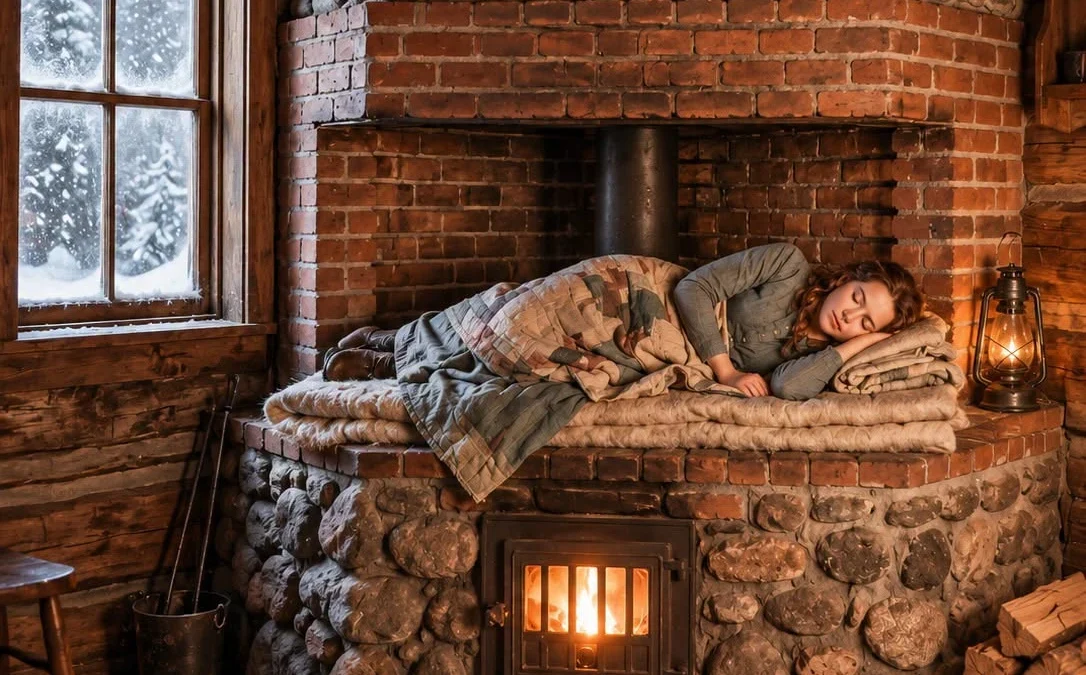
She Pried Up Her Cabin Floor and Built a Five-Ton Brick Stove While the Whole Valley Laughed. Then the Deadliest Winter in Montana History Came for Every Fire but Hers…
Part 1
In the first week of November 1888, the wind came down off the divide and went hunting for every unchinked log in Tamarack Crossing. 🧱
Old snow already lay in white seams along the fence lines of the Big Hole Valley. Every household on the creek was getting ready. Lyman Puit had his new cast-iron box stove set up in two days, and smoke rose from his chimney every evening, steady and gray against the hills. Amos Toiver, the blacksmith, went from cabin to cabin with a sack of tools, tightening pipe joints and testing dampers.
Only the Hollinger cabin had nothing new to show. Inside it, Willa Hollinger knelt where the floor used to be. She had pried up a square of planks with a bar and hammer and left the bare earth open beneath the rafters. In her hand was a mason’s square, its wooden handle worn smooth as a creek pebble. She had scratched a rectangle into the packed ground with its corner, and now she was setting flat creek stones inside the lines, bedding each in gravel.
She was twenty-three, strong through the shoulders from a summer of hauling, her chestnut hair pinned out of the way and her gray-blue eyes missing very little. Lime smudged her cheek. A shadow fell across the doorway. Lyman Puit stood there, forty-eight, a big man with a rancher’s squint and a sheepskin collar turned up against the wind. His eyes went from the stones to the cracked cook stove in the corner, then to the long mound of salvaged brick under canvas by the shed.
“Are you heating a house, Miss Hollinger, or building another room inside it?”
Willa set the next stone. “Her grandmother is sitting right here, Mr. Puit,” came a voice from the rocking chair, dry as kindling. Katherina Hollinger, seventy-two, small and straight-backed in charcoal wool, did not look up from her knitting. “And it is not my floor. It belongs to the government until we prove up.”
Within weeks, men up and down that valley would be stumbling out of bed in the dark to keep their fires alive until they could hardly remember an unbroken night’s sleep. Willa would sleep. That gray November morning, nobody had any reason to believe it.
The claim had been her father’s idea. Henry Hollinger, a stonemason, had brought them west from Pennsylvania in 1885. For two years he built footings and chimneys for half the ranchers on the Big Hole. Then in February 1887 he came home soaked from a sleet storm, took a fever, and died in nine days. The ground was too frozen to bury him until April. The winter just past was Willa’s first without him.
The cracked cook stove was all they had. She had fed it through every night, rising every two hours, because the iron went cold the moment she let it. By March, Gran had pneumonia. The doctor came by cutter from Dillon, stayed two nights, left a brown bottle and a fifteen-dollar bill, and told Willa on the doorstep that her grandmother’s lungs had come through by a thread. Another winter of cold nights and stove smoke, and I would not answer for them.
By autumn she had eleven dollars. A cast-iron stove cost twenty-two, plus freight. Neighbors all offered the same advice: take rooms in town. But a homestead left empty more than six months could be called abandoned. So Willa went looking for another answer, nine miles down the valley at Willow Gulch, where a man named Sautell had gone broke on a brick kiln. For four dollars she bought a wagonload of fire brick torn from the kiln’s lining, a long pile of common brick, and three barrels of lime. She spent the summer hauling it home behind her mule, Fritz, who had firm opinions about Willow Gulch and expressed them every trip. By September her palms were hard as harness leather. She had seven dollars left and a plan nobody understood. 💔
Gran asked the hard questions. Where will the table go? And when the brick cracks? And if the hard cold comes before your mortar is dry?
“Then I fire it slowly. Brick has to be given time.”
They were her father’s words, and both knew it. Willa had learned the trade at Henry Hollinger’s elbow. When she handed Gran the square, the old woman’s thumb found two letters cut into the handle, worn nearly smooth. KS. Willa had always heard it was her great-grandfather Conrad Staler’s. Gran’s voice came out lower. “This square has built more than you know.”
That evening, the unfinished heater already stood taller than anything else they owned. But the first real fire would nearly kill the woman it was built to save. And across the meadow, a grieving man was watching her chimney every single night. 😨
Part 2
Over two weeks the heater found its shape. The firebox sat low, lined with Sautell’s fire brick, bound in lime and creek clay. It measured nearly five feet square at the base and would rise taller than she could reach, close to five tons resting on its own footing in the earth. The plank floor would have splintered under it in a day. A broad ledge ran along one side, level with the square, smooth enough to lay a mattress on.
“You are building a bed into the stove,” Lyman said, laughing, not unkindly. At the store, a freighter’s wife asked sweetly whether Willa was building a bake oven to live in. Pity was the one crop in that valley that never failed, and she found the laughter harder to carry home than the salt. Only Amos asked a real question. “What are you using for mortar?”
“Lime and creek clay. Cement is too hard. Brick has to move a little when it heats.”
He nodded once, as if filing the answer away. In that valley that winter, it counted for something.
She remembered a wall in Gran’s Berks County farmhouse. At seven, she had come down one frozen January morning, the fire long out, and pressed her palm to the great plastered stove. It was warm, the way a loaf is warm an hour out of the oven, as if the wall had been holding something back for her all night. Her neighbors fought the cold the other way, feeding iron stoves that roared hot and cooled in minutes. They burn the heat, then stand in the cold and watch it leave, her father used to say.
At the Puit cabin, Mercy Puit took Willa’s shawl as if she were Sunday company. Lyman lit his stove, and within twenty minutes heat filled the room. “A man comes home in a wet coat when it is ten below. He needs warmth now, Miss Hollinger. Not three hours from now.”
“Mine answers a different question. What happens four hours after the flame is gone?”
“You add another log.” Something crossed his face quick as a bird’s shadow. Then he made his offer plainly: he would buy her claim. Fair price, better than fair. She held the only spring on that stretch of creek that never froze, and her line ran along his best hay meadow. “We will be staying. Our home is the one place in this valley where nobody can tell us to leave.” He did not press. Mercy, watching her husband, did not meet Willa’s eyes. Walking home, Willa realized that in three winters she had never once seen the Puits’ window go dark after midnight.
She finished the unseen part: above the firebox, a bell-shaped chamber where hot gases would spread against the brick, then sink through a narrow passage down one side before ever reaching the chimney. Every foot meant heat left behind. She did not want a small fire kept alive all night. She wanted one hard, clean burn, then none. The flame would do its work once. The brick would go on doing it afterward.
On December first she lit the real fire. The heater breathed deep inside the masonry, but little warmth reached the room. Lyman knocked and stood in the door without taking off his coat. Then the wind struck. Smoke poured from the firebox door, thicker with every gust, and the room filled with a gray haze. Gran began to cough, deep, as in March. She sagged against her chair, face gone ash-colored. Lyman crossed the cabin in three strides, lifted her like a sack of oats, and carried her into the snow, wrapping her in his sheepskin coat. “Breathe, ma’am. Clean air. That is all you have to do.” 😰
“I can sit up on my own, Mr. Puit.”
“Yes, ma’am.” He did not let go.
Willa studied the roof. The wind rolled over the ridge and spilled straight down over her chimney like a hand clamped over a mouth. She had built it only as high as the old cook stove’s. The flaw was hers. Lyman’s voice was quiet, certain. “Next time this thing smokes, I will carry her to my house, and she will not be coming back.”
“Don’t you dare give up on it,” Gran whispered that night. “A thing done wrong is not a thing done for. Fix it.”
By sunrise she was on the roof raising the chimney thirty inches with steaming mortar, wrapping it in burlap, with a gentle fire inside to keep the joints from freezing. Amos came with a peaked sheet-iron hood, riveted at his forge, to turn the wind aside. “Fixing your pipe does not prove your brick mountain.”
“Not yet.”
Two days later the draft held, the flame leaning inward steady as a compass needle. Gran lowered herself onto a mattress laid across the warm bench. Willa fell asleep in her corner before the lamp smoke cleared.
In the dark, Gran’s voice woke her. “Willa. Do you smell that?” The ticking at one end of the mattress was scorched brown, a thin gray thread rising from it. And in the morning, Lyman stood in her door with a standing offer: carry her grandmother across the meadow, or Willa would lose her one last chance. 😱
Part 3
She hauled the mattress into the snow and packed it with snow until nothing rose but steam. Gran was unhurt. Later the old woman ran her palm along the bench. “Hot here. Barely warm there. It is not spreading, Willa. It is running.” Inside, the hot gases were taking a shortcut past the near end instead of traveling the length of it. A mistake that smokes, anybody can see. It was the ones that looked like success you had to watch for.
Lyman and Mercy came with a basket that was mostly an excuse. “An iron stove needs a pipe and a damper. This thing has needed a new chimney and a tin hat, and now it has tried to burn the bed out from under her.” Mercy offered the back room.
Gran sat very straight. “Mr. Puit, you carried me out of this house the other night and I have not forgotten it. But I have buried a husband, a daughter-in-law, and a son. I crossed half a continent at an age when most women are content to sit by a window. I will choose where I sleep.”
Willa stood. “I will fix it, and fire it once more. If it fails, I will bring her across the meadow myself. You will not need to carry her.”
“One more.”
She let the heater go cold and chiseled out the outer courses. The partition meant to divide rising gases from falling ones stopped a few courses short. She rebuilt it higher and lengthened the path. Every brick she pulled wore a crust of old mortar to chip clean, and her knuckles split. Gran wrapped them nightly in flour sacking. On the third afternoon Gran pressed two fingers to a joint. “That one is thinner than its neighbors.” A hairline gap, finer than Willa would have caught. “Old women know a good many things nobody bothers to ask them. Fill it.” 💛
On the fifteenth of December, the thermometer read eight above. Willa burned seasoned lodgepole hard for two and a half hours, watching the bench warm evenly end to end. When the coals dulled to steady orange with no blue flame dancing, because her father had taught her a damper closed on blue flames shuts bad air in the house, she closed the damper and added nothing.
Across the meadow, Lyman watched the smoke thin and believed the cabin would be cold by morning. It was a reasonable thing to believe. The room did not cool. At two in the morning Gran woke to silence and realized she had not coughed since lying down. Tears ran into her hair, and she let them come without a sound, because the girl across the room had earned her sleep and the old woman did not intend to steal one minute of it. 🥹
At dawn the kettle on the heater’s ledge had no skin of ice. Willa chalked the hour on the brick beside the heater. “Write it down,” Gran said. “Memory flatters.” Lyman, at the door that evening, was not convinced. “Eight above proves nothing. Wait till it is forty below.”
Through January the valley paid the true price of quick heat in its wood piles. Lyman rose at midnight, two, and four to feed the stove. Letty Toiver moved her bread bowl to the center of her room as the far corners froze. Old Ezra Callaway, sixty-three, had cut too little wood and was burning damp cottonwood, his stovepipe bleeding black tar. “The warning a chimney gives you only once,” her father had called it. Ezra told her he’d see to it in spring.
Willa’s wood pile hardly seemed to shrink. Damp cloths near the bench were dry by morning. She had traded a warmer room for unbroken sleep and would have made the trade a hundred times.
When Gran finished a deep gray shawl for Lyman, Willa carried it over at noon. Lyman sat asleep in his chair beside the stove, boots still laced. Mercy led her to the cold end of the kitchen. “He does not sleep at night. Not in winter. Not for nine years.” Before her, Lyman had a wife, Sarah, in Dakota Territory. In January 1880 she took a fever, and a storm scattered his stock. After two days and nights bringing them in, he fell asleep in his chair beside her. “When he woke the fire was out. She died two days later. Some men keep a fire, Willa. Lyman keeps a vigil.”
Heat rose in Willa’s face. The offer to buy the claim. “He told me he could not lie awake listening for one more chimney. He meant yours. Every night he watches it.” Walking home, Willa understood the heater was also an argument with a grieving man, one only the brick could win.
By mid-January the northwest horizon flattened into a steel-gray band. Amos’s barometer fell all morning. Lyman strung a rope from his back door to the barn. Up the creek, Ezra carried in the driest of his cottonwood. Willa offered him dry pine from the lean-to. “Keep it. I have more than we will burn.”
For three days the storm outlasted everyone. At the Puit cabin the iron stove fought it with force, and force required a man awake. Ezra’s choked chimney pushed smoke back into his room. At the Hollinger cabin the evening firing burned out after supper, the firebox went dark, and Gran slept on the bench without stirring. Willa slept in her white dress, half expecting to rise in the night, and never did.
On the third day Lyman’s exhaustion caught him. The split log slipped from his hand. Mercy fed the fire herself and let him sleep. That night the wind died, and the clouds tore away, and the cold came straight down out of an enormous starry sky. By midnight the thermometer read thirty-eight below. From his window, Lyman saw the Hollinger chimney against the stars. No smoke. The fire was out, and somewhere beneath that dark roof lay an old woman on a bed of brick.
He snatched his coat. Mercy put herself in the doorway. “It is thirty-eight below. If you do not come back, I will be feeding the stove alone, watching two chimneys instead of one. Wait for light. Please.”
At dawn he crossed the crusted meadow without a lantern, the deep gray shawl wound around his throat, and found the Hollinger door open a hand’s width and no smoke at all. What he laid his palm against inside would change him. But before the week ended, a roaring chimney fire would send him running toward the one cabin that had been right all along. 😨
Part 4
Willa was shoveling drift from the door. “When did you feed it last?”
“After supper. Nothing since.”
Inside, the firebox was dark, the room cool enough to see breath near the window. On the bench, under a mound of quilts, Gran slept, breathing slow and even. She did not cough. Lyman pulled off his glove and laid his palm on the brick. It was not hot. It did not need to be. Deep in the masonry, a warmth that had come from no fire in ten hours pulsed steady as a heartbeat, enough to hold a sleeping woman through thirty-eight below. Willa put a warm cup of tea in his bare hand. He drank it standing, hand still on the brick. He did not tell her she was right. She noticed the gray shawl at his throat and kept that to herself.
“It does not need to be hot, Mr. Puit. It only needs to stay.”
“Go home and sleep. I will keep an eye on your chimney today.”
That night Mercy took the poker out of his hand and told him the two o’clock was hers. Lyman lay down fully dressed and slept three hours without moving. She did not wake him at four either. 💛
On the fourth day the wind returned and drifted Ezra’s path to his good wood. Lyman walked up the creek with a shovel and found him in coat and hat in a gray haze, the stove a sullen glow. “Ezra—” “Do not start. I have heard it from the girl already.” Then a sound came from the stovepipe like a freight wagon crossing a plank bridge. The elbow glowed red. The creosote had caught. Lyman hauled the old man out into the snow.
Willa saw sparks streaming off Ezra’s roof and grabbed the sack of coarse salt, telling Gran to stay by the brick. She waded the drifts and went straight into the smoke. Her father had said a burning chimney wants two things: air and panic. She gave it neither. She shut the draft, cracked the firebox door a palm wide, poured salt on the coals, and closed it. No water. Water on red iron would split the pipe and fill the room with scalding steam. Outside, Amos and Lyman heaped snow on the scorched shakes. For a long minute the roar held. Then it faltered, and the red dulled to black. The cabin stood.
The pipe had split along a seam. New pipe would not come until the pass opened. “You are coming to Miss Hollinger’s until this wind drops,” Lyman told Ezra. He turned to her. “Willa, go on ahead and make room.” He had never used her first name.
Lyman tied a dozen pieces of his best seasoned lodgepole into a bundle and carried it across the meadow himself. At the threshold he set it against the wall. Only then did Ezra step in. Nobody mentioned the brick mountain.
Ezra sat on the bench in his coat. No wall of heat broke over him. Warmth simply rose beneath him slow and patient, the way water rises in a well. After a while he took off his gloves, then unbuttoned his coat. Mercy and Letty came across the drifts with bread, dried beef, and stew, mittens soaked. Willa hung them near the masonry instead of an open flame, and within the hour they were dry. Gran pulled her rocker near Ezra. “A man lives alone long enough, he forgets it is a thing that can stop,” he admitted. Gran patted his knee without looking. “Pride makes a poor blanket, Mr. Callaway. I tried it for years.”
Letty touched the old soot stain by the firebox door. “You never scrubbed this off.”
“I leave it so I remember it did not start out right.”
“A thing that hides its mistakes will make them twice,” Gran said. Before the fire died, Ezra was asleep against the warm brick. Nobody woke him. 🕊️
When the storm blew out, the valley’s questions changed. Amos brought a spring scale and an oilcloth notebook. He no longer asked whether it worked. He wanted numbers. How much wood per firing? How long did the masonry stay warm? He weighed every stick Lyman burned, and Willa’s single charge. The iron stove still threw heat faster. But Lyman had burned nearly three times the wood, rebuilding that heat three or four times a night. Willa built hers once, stored it in brick, and slept. Amos closed the notebook. “How wide did you make that upper chamber?” The argument was over. Now he wanted dimensions.
In March, Lyman sat at her table. He would keep the iron stove, for cold mornings, and build a compact mass of brick behind it. He asked whether she would help him lay the first course.
Willa took the old square from its peg. Gran stopped her. “Before you hand that to anyone you ought to know whose it is. Conrad Staler’s own square went into the ground with him in 1851. This one he made for me the spring I turned fourteen. KS. Katherina Staler.”
Willa did not move.
“I built stoves alongside him from the time I was a girl. Every one went in under his name, because no farmer in Berks County would pay a girl to lay his brick. After he died, they went in under no name at all. I taught your father. He taught you. The stove wall you put your hands on at seven, the one that stayed warm all night, was mine.”
“All those questions. Whether the chimney would draw. I was asking whether you knew.”
“Why did you never tell me?”
“A thing you are told is borrowed. A thing you work out with your own hands is yours. It was always a woman’s square, Willa. Now it is yours to give.”
At the Puit place, Lyman had dug down to firm ground and laid a footing under her direction. Willa held out the square. Together they spread mortar. Lyman checked the first brick against its edge, frowning, nudged it, and checked again. The man who had laughed at a bed built into a stove was measuring the first course of his own. “Sarah would have liked a warm bench.” He did not explain who Sarah was. Willa did not ask. Across the room, Mercy turned and went into the kitchen. At dusk he wiped the square on his sleeve and held it out. “It goes home with you. It belongs there.” 🌅
By October 1889, a rancher drove twenty miles with Sautell brick to see Lyman’s changes. Lyman answered every question, and when he did not know an answer, he gave the figure Amos had recorded. Nobody went to fetch Willa. There was no reason to. Up the creek, new pipe gleamed on Ezra’s roof, and on Sundays he sat on Gran’s bench arguing about pie. Willa split lodgepole beside her cabin, her wood pile smaller than any neighbor’s and enough. Through the open door the brick heater stood where the valley had once called space wasted. Gran knitted by feel in the slant of light, and beside the door, on its peg, hung the old square.
The heater had not been proven right because its design was old, and Lyman’s iron stove had not been proven wrong because it was new. Heat made quickly had its value. Heat that stayed when a tired person needed to sleep had its value too. Willa raised her axe and split the pine clean through, and did not look up as the rancher’s wagon rolled out of Tamarack Crossing. 💛
This story is entirely fictional and created for entertainment purposes only. It does not represent any organization or individual, nor does it encourage inappropriate behavior. The content was generated with AI assistance.








