She Ran Into a Cave to Escape a Deadly Dust Storm. Inside the Mountain, She Found a Hidden Home, a Forgotten Deed, and a Dead Man’s Final Secret About Her Mother…
She Ran Into a Cave to Escape a Deadly Dust Storm. Inside the Mountain, She Found a Hidden Home, a Forgotten Deed, and a Dead Man’s Final Secret About Her Mother…
Part 1
The afternoon Mary Gray nearly died, she had eleven dollars in her pocket, a dead mother’s bone comb in her satchel, and sixty days to save a ranch three generations of her family had called home. 🌪️
She was eighteen. And according to the men who controlled Dry Creek County, she was about to lose everything.
Her grandfather, Thomas Gray, had settled the valley when it was still mostly wilderness. He built a log cabin beside a creek, cleared land for cattle, and spent four winters hauling stones from the riverbed to build a proper chimney. His wife, Ivy, planted vegetables in the rocky soil and raised their daughter, Adeline, to believe a person could survive almost anything with willing hands and a little common sense.
Addie became Mary’s mother. She could mend a fence in freezing weather, deliver a calf in darkness, and keep a household alive when money was scarce. Mary learned those skills before most children learned to write.
But the Gray family’s greatest treasure was not the cabin, the cattle, or the land. It was the spring.
High on a rocky hillside beyond the north pasture, clear water flowed from a narrow opening between iron-stained stones. Even in the worst drought, it never failed. Mary could place a bucket beneath it, count slowly to forty, and lift away a full bucket of cold water.
As long as that spring keeps running, this family has a chance, her mother always said.
Mary believed her. Until her mother died.
Addie had been sick for months, growing thinner while a stubborn cough stole her strength. Mary was fifteen when she stood beside the bed and understood there would be no recovery. Her father, Russell, had gone east years earlier, promising to send money. Three letters came. Then nothing.
On her last afternoon, Addie reached for her daughter’s hand. “Do not let the fire go out under those beans,” she whispered. “They are the last good ones.”
By evening she was gone. 💔
For three years Mary ran the ranch alone. She milked the old cow, Peg, repaired fences, grew what the soil allowed, and sold cattle whenever the bills grew impossible to ignore. Some mornings her hands were so stiff she struggled to button her dress. Some evenings she sat by the stove, listening to the wind, wishing someone would walk through the door and ask whether she had eaten.
Nobody came. She survived because stopping had never been an option.
Then the tax notice arrived. Two hundred and forty dollars. Mary had eleven dollars in bills and a dollar forty in coins. She read the notice three times. The number refused to change.
At Mallister’s general store, the old shopkeeper studied the paper. “Your father’s old obligations were never properly cleared. And somebody has acquired the claim.”
“Who?”
He looked away. “Ruf Bell.”
Bell owned the largest cattle operation south of the creek. For years he had tried to buy the Gray ranch, every offer wrapped in the same concern: a young woman should not struggle alone on so much land. Mary understood that he wanted the spring. Every rancher in Dry Creek knew what permanent water was worth.
She wrote to her aunt Prudence in Ashland, her mother’s older sister, married to a prosperous druggist, with a parlor piano and lace curtains. Mary promised to repay every penny with interest. Ten days later the answer came. Prudence regretted she had no money for such purposes. A young woman in so remote a place might consider respectable employment elsewhere.
Mary folded the letter, set it beside the stove, and went back to work.
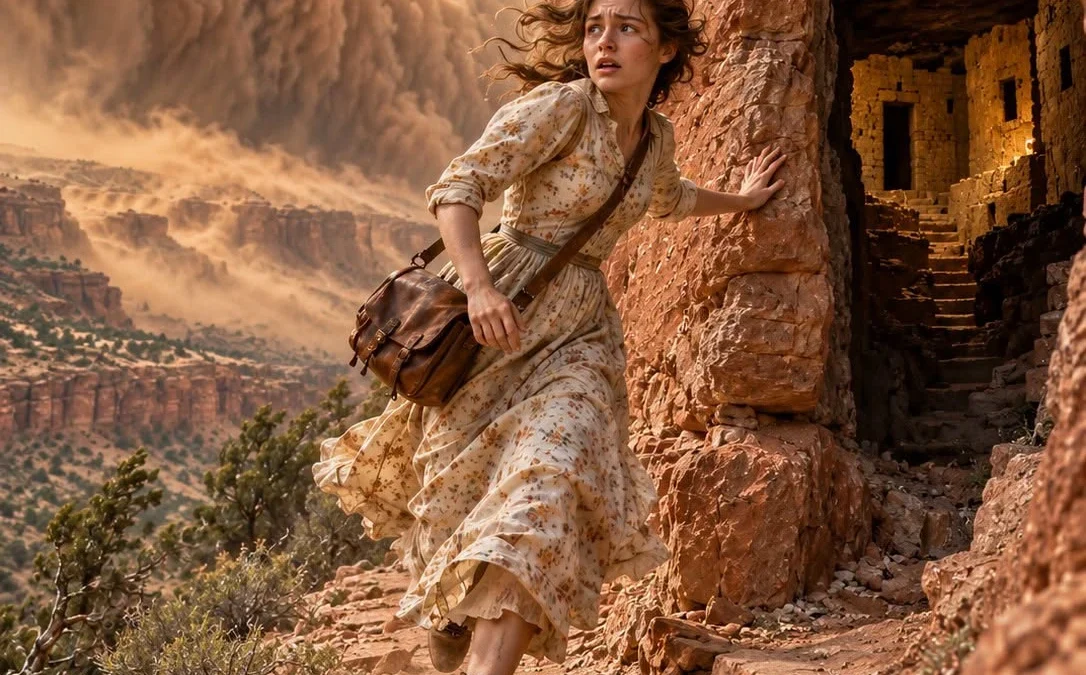
Three days later, she was carrying two empty buckets toward the spring when the northern horizon disappeared. At first she thought clouds had gathered over the ridge. Then the brown wall began moving, rising higher than the hills, swallowing the sky. Birds flew low across the valley. The horses crowded the fence.
She had seen dust storms before. Nothing like this. A mile of open ground separated her from the cabin. But above the spring, a narrow opening gaped in the hillside. She had seen it since childhood and never ventured far inside.
She pulled her skirt above her knees and ran. Sand struck her face like needles. Behind her, the valley vanished beneath a wall of moving earth. She threw herself onto her hands and knees and crawled into the dark.
The passage scraped her shoulders. She kept crawling until the roar began to soften. Then the passage widened. Her trembling fingers touched a wall. Not rough, natural rock. Flat stones. Carefully stacked. She moved her hand down and found a level floor.
Someone had built something inside this hill. 🕯️
Sitting in total darkness with a deadly storm outside, she heard something beyond the wind. A faint hollow sound, like air traveling through a distant room. And she had no idea the opening she had crawled through was tied to a secret that had been waiting for her longer than she had been alive.
Part 2
She drew her knees to her chest and whispered the words her mother always used in storms. “The wind will get tired before we do.”
By morning it had. The valley looked like another country, grass buried under gray-brown drifts, one bucket entombed beside the spring. Peg and the steers were alive, the roof had survived. But wedged above the door latch was a paper bearing the county seal.
Ruf Bell had acquired the claim. The ranch was being transferred through foreclosure. Mary must remove herself, her belongings, and her livestock before November first.
She sat on the step, the paper trembling. Something odd caught her eye. One hundred and fifty-six acres. Her grandfather had always called it a hundred-and-sixty-acre place. Four acres missing. She had no survey, no lawyer, no money. But she remembered the difference.
Inside, another letter from Prudence waited, colder than the last. There was no room for Mary in Ashland. But a family sought a domestic servant, twelve dollars a month with room and board. Mary put both letters beneath the flour tin and went out to milk Peg.
At Mallister’s, he showed her the ledger. Her father’s unpaid obligation. Bell’s signature on the assignment. “The papers are in order.”
“Does that make it right?” He did not answer.
Outside, Bell leaned on her wagon with his expensive boots and easy smile. “I will buy your cattle at a fair price. And you can stay in the cabin through winter. Keep house for me. Five dollars a month, plus your keep.”
She understood. He wanted her to become a servant in the house her grandfather built. “No, thank you.”
“You have nowhere else to go.”
“Then I will find somewhere.” 💔
For a week she packed her life into the wagon. Her mother’s blankets. Seed potatoes. Flour and salt. And the tools of old Hyram Deakons, a one-handed well digger who had taught her to read the land. That hill holds water like a jug, he used to say when they worked the north hillside. She had always thought he meant the spring.
On her last evening she laid her palm on the chimney stones her grandfather had carried by hand. “I am sorry,” she whispered. At dawn the washerwoman, Neta Puit, tucked a jar of preserves into the wagon. “Your mother was a good woman.”
At the rise above Dry Creek, the road forked. East toward Ashland and the servant’s position. South toward the county seat. Mary remembered the storm, and the stone passage, and Hyram’s voice. She turned the horses northwest, off the road, across the rough pasture toward the hill. 🐎
By late afternoon she reached the spring, drank, watered the animals, and made camp beside a shelf of rock. She took her mother’s comb from the satchel, carved from yellow bone, one tooth broken. Her grandfather had made it for her grandmother, her grandmother had given it to Addie, and Addie to Mary. It was almost all that remained of three generations. “Well, Mama. I have not found a home yet.”
At sunrise she entered the cave with a lantern, a hand axe, and a rope. The walls were built of flat gray stones fitted with narrow lines of mortar, workmanship like her grandfather’s chimney. The turns kept the wind from blowing straight in. At the final corner hung a rusty doorframe. Beyond it, three wooden bunks fitted into stone sockets. A second room held a cast-iron stove on a slate hearth, a pine table, two benches, tin plates, horn spoons, a coffee pot. A third, cooler room held crocks and an empty barrel. A vent shaft climbed through the ceiling. A stone-lined flue led smoke up the hill.
She had entered a hole. She had found a house.
She sat alone in the dim light. November first was coming. Then she got up. Worry could not repair a roof or feed a cow. She hauled her blankets uphill, then flour, then Hyram’s tools. By noon her arms shook. Peg watched her from below. “Do not look at me like that,” Mary told the cow. “You are not helping.” It was the first time she had laughed in days.
She swept the rooms, tested the flue with a small fire, and slept that night without a blanket over her head. Then, carrying firewood, she noticed four fallen stones near a wall, and behind them a narrow passage blocked by rubble. For two days she worked at it with Hyram’s chisels. A stone struck her ankle. She nearly threw the chisel. Then she heard Hyram. One stone at a time, girl. You do not move a hill by getting angry at it.
By evening, the way was open.
Beyond it lay a low chamber, and against its back wall stood a wooden chest, its lid unlocked. Inside, a rusted tin held more money than she had ever seen. Beneath it lay a notebook signed with a name she had never heard. And the name of her dead mother on the third page. 😱
Part 3
The tin held silver, a few gold pieces, and carefully wrapped banknotes. Mary counted twice by lantern light. One hundred sixty-nine dollars and sixty cents. Not enough to clear the debt, but more than thirteen times what she had carried into the storm. Beside it lay a horn thimble, fishhooks, a whetstone, and a narrow yellowed notebook. On the first page: Emmett Rowe.
His early entries described hauling stone and digging into the hillside. Later ones spoke of hunger, illness, and loneliness. He had buried a wife and a son. He had lost a hand years before and learned to work with the one that remained. Mary looked at the joined table and the shaped doorframe and thought of all that patient work.
Then her mother’s name appeared. Adeline. Emmett had watched Addie carry water. He had seen her share bread with a hungry traveler. He wrote of her small daughter following a one-handed well digger around the fields. Mary closed her eyes. Hyram. Had he known?
A sentence near the bottom of the page stopped her breath. Something is wrong with the county’s survey. Four acres wrong. And the spring stands inside those missing acres. She laid the county notice beside it. One hundred and fifty-six acres. 🌟
The next days brought hard weather and a limping blister, and one night she cried by the stove, missing her mother, missing the cabin, missing anyone to tell her whether she was making a terrible mistake. Then she rode to Mallister’s. “Emmett Rowe,” he murmured. “Quiet fellow. May have owned land. The county recorder would know.” She drove to the county seat. A clerk named Elias Mercer found Emmett’s name in a faded index, a land patent, a recorded instrument, references to four acres on the northern boundary. The full file was in archived books, and the recorder was away. Mary memorized the reference number.
On the road home, Ruf Bell reined in. “People say you have been asking about old county papers. You are not planning to interfere with the spring, are you?”
“No, sir.”
“I would hate for this to turn unpleasant.”
That night she read every surviving page of the notebook. The later entries were shorter, the handwriting weaker. Emmett wrote that he was leaving his tools and belongings for whoever might find the rooms. And he mentioned a gray blanket on the upper shelf, with something beneath it. 🧶
She had assumed it was bedding. It felt heavier than wool. Inside was a packet tied with waxed thread, and three folded sheets, two in Emmett’s hand, the third bearing a county recording notation and an old seal.
Emmett had acquired the separate four-acre tract, which included the spring. The document went further. It established that he held it in trust for the child of Adeline Gray, to pass to that child on his death. At the bottom he had written one sentence.
It is hers. She does not know it.
Mary covered her mouth. Years before her mother died. Years before Bell acquired the debt. Emmett’s last page explained that he had built the rooms for whoever the wind might bring inside, hidden money in the chest, and left the papers where a careful searcher would find them. If that person was Adeline Gray’s child, the property was meant for her. A lonely man, long dead, had left a place where someone in desperate need might find safety, and had remembered a mother and daughter the county had nearly forgotten.
Mary cried then, not from defeat, but from the terrible relief of learning that someone had once cared enough to think about her future. 💛
At the county seat the next morning, the old files were fetched and compared. The separate four-acre tract was confirmed. The spring had never been part of what Bell acquired through foreclosure. Surveyor and recorder would formally correct the boundary. But the cabin, pasture, and improvements remained under Bell’s claim. The spring was hers. The family home was not.
She sold two steers and some replaceable equipment, repaired a neighbor’s fence for pay, and counted every dollar with the care her mother had taught her. Then she met Bell outside Mallister’s, not to beg, but to make an offer. “Buy back the ranch?”
“The spring is not part of it.” She handed him a certified copy of the recorded instrument. He read it twice. “Emmett Rowe is dead.”
“And he left the property to my mother’s child.”
Without the spring, the ranch was useful ground but lost the permanent water that made it valuable to his herds. He could fight the records or accept them. “You are telling me I bought dry ground?”
“I am telling you the spring was not included.”
After a long silence, he asked her price. She named it, with terms to be recorded properly. He laughed once without amusement. “You are a hard girl, Mary Gray.”
“No, sir. Just tired of losing things.”
They settled. There was no grand apology. Mallister opened his ledger, found the Gray account, and wrote one word beside her name. Clear. Years of her father’s debt, her mother’s struggle, and her own fear, finished. “Would you like anything from the store?”
“Coffee. A full pound.” ☕
She unlocked the cabin door. The stove stood where her grandfather had set it, the chimney straight. She ran her fingers along the table where her mother had prepared so many meals. She was home. But the stone rooms above the spring had become home too, and she would not abandon them.
When the dry season came, creeks shrank and wells ran low. Bell rode up to her hillside with an empty canteen, hat in hand. “I know I have not given you much reason to welcome me.”
“No, sir.”
“My cattle need water.”
She thought of the county notice, the offer to be a servant in her mother’s cabin, the wagon packed in humiliation. The law was on her side. “You can fill your canteen. The cattle can use the overflow below the rocks, but they cannot stand in the spring or tear its banks. And nobody owns the water just because they have more cattle than their neighbors.”
“I understand.”
The spring became a gathering place. Neta Puit washed near the overflow on Mondays. Children came with buckets. A schoolteacher brought her students. Mary hung a tin cup on the path for travelers. Nobody was turned away thirsty.
Years later, two years after the storm, she sat at the pine table in the hill on a rainy Sunday with three things before her. Her mother’s yellow comb. Emmett Rowe’s horn thimble. His notebook. She wondered whether Hyram, another one-handed man, had known more about the hill than he ever said. She thought of her grandfather hauling stone through four winters, her grandmother’s first garden, her mother keeping the beans warm as her strength failed, and Neta’s jar of preserves. So many people had given Mary small things. Tools. Food. Knowledge. And one man had given her a home. 🏡
She had believed eleven dollars and a broken comb were all she owned. She had been wrong. She had inherited skills, endurance, memories, and the unseen kindness of people who lived before her.
She sharpened a carpenter’s pencil and wrote under Emmett’s last words, beneath the entry for the day’s work. The hill holds.
The wind could come again. The winters could be hard. But she knew now what her mother had been trying to teach her. A home was more than land recorded under a name. It was the work left by those who loved you, the kindness you chose to return, and the courage to keep the fire burning when the rest of the world had gone cold.
Mary placed another log in the stove. The flames rose. And the hill held. 🌅💛
This story is entirely fictional and created for entertainment purposes only. It does not represent any organization or individual, nor does it encourage inappropriate behavior. The content was generated with AI assistance.








