She Restored the Duke’s Mother’s Portrait, and Under the Paint Was a Second Woman Hidden for 26 Years
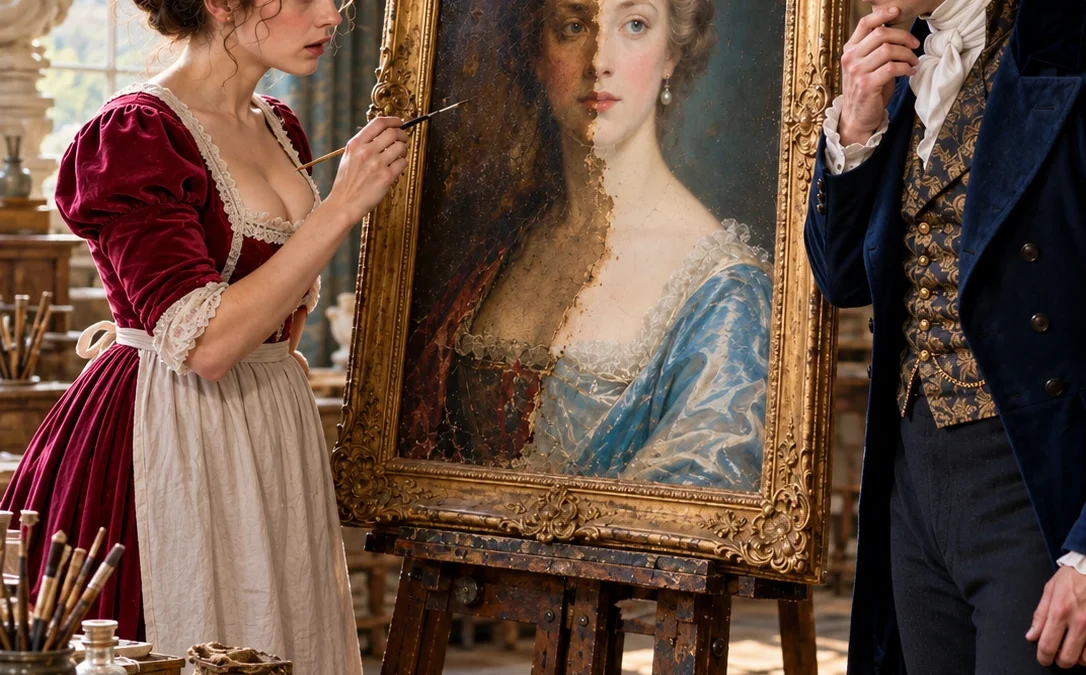
She Restored the Duke’s Mother’s Portrait, and Under the Paint Was a Second Woman Hidden for 26 Years
PART 1
She restored the Duke’s mother’s portrait.
Under the paint was a second woman.
The solvent was cool on the cotton swab, and the gallery was so quiet that Clara Whitlock could hear the rain ticking against the tall windows of Ravensworth Hall. She had been working on the same corner of the canvas for nearly an hour: a stretch of dark brown shadow behind the left shoulder of the late Duchess. Nobody ever looked at shadows. But Clara had learned from her father long ago that shadows were where the truth of a picture often hid.
She rolled the swab once, twice. A small cloud of old brown varnish came away. And underneath, where there should have been nothing but darkness, there were four slender fingers. A woman’s fingers, pale and delicate, painted with great tenderness, resting on the Duchess’s shoulder as if to comfort her. 😳
Someone had stood beside the Duchess when this portrait was painted. Someone had loved her enough to rest a hand upon her. And someone else, years afterward, had buried that woman beneath a wall of brown paint as if she had never existed.
Behind her, a low voice said, “Miss Bell, what have you done to my mother?”
Clara turned. The Duke of Ravensworth stood in the doorway, tall and dark and very still. And in his gray eyes she saw something she never expected to see in so powerful a man.
Not anger. Fear. 😨
But to understand how a poor picture restorer from a narrow London street came to be standing in a Duke’s gallery holding a secret that could break his heart, we must go back three weeks.
It was the autumn of 1821, and Clara lived in two small rooms above a frame maker’s shop in Long Acre. She was twenty-seven, which the world considered quite old enough to be called a spinster. She had no fortune, no family, and no prospects. What she had was steady hands, a sharp eye, and everything her father had taught her.
Thomas Whitlock had once been a fashionable portrait painter. Clara knew that much, though he rarely spoke of it. As a girl she had found letters in his trunk from earls and ladies begging him to come and paint them. But something had happened long before she could remember, and afterward the great houses closed their doors to him. He spent the rest of his life cleaning other men’s paintings for London dealers, patiently, without ever complaining.
Her mother had died when Clara was four. All Clara had of her was a tiny painted miniature in a gold locket and a brooch of seed pearls shaped like a forget-me-not, which she wore every day at her throat. 🌸
Her father had died two winters ago. On his last night, burning with fever, he gripped her hand and whispered words she never understood.
“It’s safe, Clara. I kept it safe behind her. I kept it behind her.”
“Behind whom, Papa?”
But he only smiled at something she could not see and said, very softly, “Anne.” Then he was gone.
Since then Clara had carried on his work under the name C. Bell, her mother’s maiden name, because no gentleman in England would let a woman touch his precious paintings. The dealers who knew the truth kept it quiet, because her work was simply too good to lose.
One gray morning, old Mr. Josiah Crane climbed her stairs puffing, a letter in his hand. “The Duke of Ravensworth has written. There was a chimney fire at his house in Yorkshire, and smoke has damaged a portrait of his late mother. He wants the finest restorer in England. Two hundred guineas, my dear.”
Clara sat down very suddenly. “Does he know that C. Bell is a woman?”
Mr. Crane studied the ceiling. “I may have neglected to mention the petticoats.”
A week later she was rattling north across wilder and emptier moors until, under a sky the color of a bruise, the carriage turned through iron gates and she saw Ravensworth Hall for the first time. Gray stone, rows of dark windows, chimneys like the masts of ships. It looked, she thought, like a house that had forgotten how to be happy.
The elderly housekeeper, Mrs. Hale, lifted her candle to greet her, then froze. The color drained from her face. “Forgive me, miss. For a moment in this light, you reminded me of someone I knew long ago.” 👀
In the crimson drawing room Clara met the Duke’s aunt, Lady Honoria Ashcombe, whose eyes were the cold pale blue of winter ice. And she met the Duke himself: Julian Ashcombe, thirty-five, with a face that might have been handsome if it had ever learned to smile.
“A woman, Julian,” said Lady Honoria. “I told you this was folly. Send her back tonight.”
“It is raining, aunt. I do not send dogs out in this weather, let alone young women.” He turned to Clara. “Tell me how you would proceed with a smoke-darkened painting.”
It was a test, and she knew it. “I would not touch it for a full day, your grace. I would study it in every light. A painting is not a tablecloth. You cannot scrub it. You must persuade it.”
Something flickered at the corner of his mouth. “Persuade it. Very well, Miss Bell. You have one week.”
The next morning he led her to the long gallery, to the portrait of Margaret, Duchess of Ravensworth. She was painted at twenty-six in deep blue silk with sapphires at her throat, but smoke had veiled her face in gray. And her eyes looked sadly to one side, toward the shadow at her shoulder, as though at someone who was not there.
“She died when I was nine,” the Duke said quietly. “I can no longer remember her face, only this one. And now even this has been taken from me. Can you give her back?”
For the first time he did not seem cold. He seemed like a boy in a very large, very empty room.
“I will try, your grace. I promise.”
On the second day, in the bottom right corner, Clara lifted a small square of soot, and her heart stopped. There, painted so tiny that no one would notice unless they knew to look, was a little brown sparrow sitting on a twig. 🐦
She knew that sparrow. It was in the corner of the sketches her father drew for her as a child. His private mark. His secret signature on every painting he was proud of.
Thomas Whitlock had painted this portrait. Her father had stood in this very house.
Why had he never told her?
That night at supper in the servants’ hall, a quick-tongued housemaid named Betsy leaned across the table. “Is it true the picture’s cursed, miss? On account of the painter. They say he made love to the Duchess right under the old Duke’s nose. The old Duke nearly shot him and threw him out in the night, and her Grace was so ashamed she took to her bed and died of it.”
Mrs. Hale rose, white with fury. “You will hold your tongue, girl, or you will pack your box tonight. Her Grace was the finest lady who ever lived in this house!”
Clara sat frozen. Her father, who set spiders outside rather than crush them. Her father, who had never looked at another woman in twenty years. They were saying he had seduced a Duchess and driven her to the grave.
It could not be true. But if anyone learned she was Thomas Whitlock’s daughter, she would be thrown out within the hour, and the truth would be lost to her forever.
So she stayed silent. She finished the week. And the Duke, astonished, saw his mother’s blue silk glowing again as if woven yesterday.
“You may stay, Miss Bell,” he said. Then, as if the words cost him: “Thank you.”
After that he began to come to the gallery in the evenings. One night he carried two cups of tea himself and set one at her elbow. “The servants are asleep, and I find I like to watch you persuade my mother back into the world. It is the only quiet hour of my day.” ☕
They began to talk. He told her of the moors and his struggling tenants. And one evening, he told her of his mother.
“She sang to me every night. Old Scottish songs. Then the year before she died, it stopped. My aunt told me she did not wish to see me. I used to stand outside her door and listen, hoping to hear her sing. I never did.”
Clara’s throat closed.
“After she died, my father told me she had loved another man, a painter, and betrayed us both. He told me to learn from her that love was a lie weak people tell themselves. I was nine. I believed him. I have believed him ever since.” He rose. “I am to be married in the spring to Lady Cecily Marlow. It is a sensible match. The engagement will be announced at a ball here in five weeks. I want my mother’s portrait hanging in this gallery when it happens. My aunt wants it burned.”
When he left, Clara wept for the little boy who had stood outside a door waiting for a song. 💔
Which brings us back to the rainy afternoon, and the four pale fingers in the shadow.
“What have you done?” the Duke demanded, crossing the gallery.
“Nothing, your grace. Look closely. This brown paint is coarser, thicker. It was laid on by a less skilled hand, many years after the original. Someone painted over this part of the picture. And underneath it…”
He bent beside her, so close she felt the warmth of his shoulder. He saw the fingers.
“There was someone standing beside her.”
“Who?”
“I do not know. Not yet.”
“Julian!” Lady Honoria stood in the doorway, her face white as chalk. “You will do no such thing. That painting was finished as your father wished. Have this tradeswoman stop at once. Some doors are closed for a reason. Do not open this one, I beg you.”
It was the first time Clara had heard the old woman beg for anything.
The Duke looked at his aunt for a long moment. “Why are you afraid, Aunt Honoria? What is under the paint?”
She did not answer. She turned and walked away, her cane tapping down the long corridor.
“Uncover her, Miss Bell,” said the Duke. “However long it takes.”
It took six days. Inch by inch, in candlelight, a woman rose out of the dark. A wrist in a sleeve of soft gray wool. A slender neck. Chestnut hair pinned simply, without jewels. A plain gray gown with a white collar. And she was smiling down at the Duchess with such warmth that it filled the whole painting. ✨
Now Clara understood the Duchess’s sideways glance. She had not been gazing sadly at nothing. She had been looking up at her friend. With the second woman restored, the Duchess was no longer sad. She was content.
“She looks happy,” the Duke said softly on the fifth evening. “I had forgotten she could look like that.”
On the sixth day, alone in the gallery, Clara uncovered the second woman’s face. Brown eyes, warm and laughing. A small upturned nose. A tiny mole beside the left corner of the mouth. And at her throat, painted in delicate touches of white and silver, a small brooch of seed pearls shaped like a forget-me-not.
Clara’s hand rose slowly to her own throat.
With trembling fingers she opened the gold locket she had never once taken off and held the tiny miniature up to the canvas. The same eyes. The same nose. The same mole.
The woman beneath the paint was her mother.
Clara did not remember sitting down. She only knew that later she was on the gallery floor with her back against the easel, the locket pressed to her heart, staring up at the mother she had never known. Her father’s last words rang like a bell in an empty church. Behind her. I kept it behind her.
“Miss Bell?” The Duke was kneeling beside her, alarmed. “You are white as paper. What has happened?”
She opened her mouth to tell him everything. “Your Grace, there is something I must tell you. I should have told you on the very first night. I…”
The gallery door swung open. Lady Honoria swept in with Mrs. Hale and two footmen, a bundle of papers tied with faded ribbon in her hand.
Clara knew those papers at once. Her father’s letters. The ones she had hidden beneath her winter petticoats. 😱
“I thought you would like to know, Julian,” said Lady Honoria, sweet and cold as poisoned honey, “exactly who you have been drinking tea with every evening. I had her room searched this morning. Her name is not Bell. It is Clara Whitlock. She is the daughter of the painter who destroyed your mother.”
Every eye turned to Clara. The Duke’s face went still, the way a lake goes still just before it freezes.
“Is it true?” he asked.
PART 2
“Is it true?” he asked.
Clara rose on shaking legs and made herself stand straight. “My name is Clara Whitlock. Thomas Whitlock was my father. But I did not know he painted this portrait until I found his mark on my second day. And I did not paint that face. I uncovered it. You sat beside me while I did.” She held out the open locket. “That woman is my mother. Look at her, please. Only look at her.”
But he did not look at the locket. He looked only at Clara, and his eyes were terrible.
“Every evening I told you things I have never told another living soul. About my mother. About my father. About what he said to me when I was nine. And all that time you knew whose daughter you were and said nothing.”
“I was afraid you would send me away before I could learn the truth.”
“The truth.” He laughed, a short terrible sound. “You lied to me with every breath you drew in this house.”
“Julian, please.”
It was the first time she had ever spoken his name. He flinched as if struck.
“You will leave Ravensworth in the morning. You will be paid for your work, every guinea. I will not have it said I cheated a Whitlock. But you will not touch that painting again.”
He walked out without looking back. 💔
Lady Honoria lingered a moment. And in her pale winter eyes, Clara saw something that was not triumph. It was older and sadder and far more frightening.
It was fear.
That night Clara packed her trunk by a single candle. She did not cry. She had cried all afternoon, and now she was empty, like a house after the furniture has been carried out.
A soft knock came at the door. Mrs. Hale stood in the corridor in her nightcap, eyes red. “There is something I ought to have told you on the very first night, when I thought I was seeing a ghost. I knew your mother, Miss Annabelle. She was the vicar’s daughter from the village. She and her Grace were friends since girlhood, closer than sisters.”
Clara sank onto the bed. “Please. Tell me everything.”
“Your father painted them both together, because her Grace would not sit alone. He was young and handsome and kind, and he fell in love with Miss Ann. But her father the vicar was hard and proud and would never have let her marry a painter. So they kept it secret. Your father wrote letters, and her Grace, bless her, hid them in her own writing desk.” 🕯️
“Then where did the rumor come from?”
The old woman’s face hardened. “From Lady Honoria. She was past thirty and unmarried, and she fell in love with your father. Hard. She wrote him a letter, I believe. He refused her gently. But she was not a woman who could bear being refused, not for a vicar’s daughter in a gray wool dress.”
Clara closed her eyes.
“A week later she went through her Grace’s desk and found one of your father’s letters. It said only My dearest and was signed T. She carried it to the old Duke and told him it was written to his wife. He threw your father out that very night. Your parents married quietly in London, and I was glad, so glad. But her Grace never recovered. A year later she fell ill with consumption.”
“And Julian? Why was he kept from her?”
“Lady Honoria nursed her. She told the boy his mother did not want to see him, and told her Grace the boy did not wish to come. She kept them apart, miss, the whole last year. I tried once to carry a message and was dismissed without a character.”
“And the painting? Who painted my mother out?”
“The old Duke hired another painter to finish it, and Lady Honoria stood over him every day. She had Miss Ann buried in brown paint so that no one would ever ask who she was.”
“But there is no proof. It is your word against a Duke’s aunt.”
Mrs. Hale was quiet. “There is one more thing. The night your father was sent away, I saw her Grace go down to the gallery. She put a little packet wrapped in oilcloth into his hands. I heard her say, Keep it with the picture, Thomas. Keep it where no one will look. One day my boy will look.”
Clara’s heart began to pound. Behind her. I kept it behind her.
Mrs. Hale drew a small iron key from her ring. “I am the housekeeper.”
The gallery was black at midnight, her candle a small trembling circle in the dark as the painted eyes of two hundred years of Ashcombes watched her pass. She turned the great painting around and studied the back. Her father had taught her how a canvas was built.
Along the bottom bar of the stretcher, directly behind where the Duchess sat, she found it: a narrow strip of extra canvas tacked over the wood, stitched closed with tiny careful stitches.
Stitches she knew. Her father had sewn on her buttons exactly like that every winter of her childhood. 🧵
With her finest scalpel she slit the thread, one stitch at a time. Behind the strip, pressed flat against the wood, lay a thin packet wrapped in faded oilcloth and tied with blue ribbon.
“I will take that, Miss Whitlock.”
Clara spun around. Lady Honoria stood a few yards away in a black dressing gown, an oil lamp in one hand and her cane in the other. In the lamplight her face looked a hundred years old.
“I knew he had hidden something. I searched that picture a dozen times. I never thought to look behind the wood. Give it to me, you foolish girl. It will destroy this family. It will destroy him.”
“If this is the truth,” said Clara, “then the truth cannot destroy him. Only lies have ever done that.”
Something cracked in the old woman’s face. For a moment she was not a proud aristocrat but a woman who had once been young and refused and humiliated.
“He chose her,” she whispered. “I offered him everything, and he chose a vicar’s daughter in a gray dress. I only told my brother what he was ready to believe. I painted her out once, that girl. I can paint her out again.”
She lifted the oil lamp high and flung it at the painting. 😱
Clara threw herself in front of the canvas. The lamp struck her shoulder and burst on the floor. Oil spilled across the boards and flame ran in a bright hungry line toward the linen cloth beneath the easel.
Fire leaped toward the frame. Clara tore off her shawl and beat at the flames with it. When the shawl was not enough, she beat at them with her bare hands. The pain was white and enormous, but she did not stop. She would not let them burn. Not her mother, not the Duchess, not the packet she had thrust inside her bodice, not the truth.
And then a man’s coat came down over the flames, once, twice, three times, and strong arms dragged her backward from the smoke.
“Clara! Stop! It is out! Let me see your hands. Dear God, your hands.” 🔥
It was the Duke, in his shirtsleeves, his face white with terror. Behind him, Mrs. Hale stood breathless with a candle. She had run to wake him the moment she saw Lady Honoria’s light on the stairs.
Clara looked at her palms, red and blistering, and watched them begin to shake.
“The painting,” she whispered. “Is the painting safe?”
The Duke looked over his shoulder. The bottom of the frame was scorched, but the canvas was untouched. The Duchess still sat in her blue silk, and Annabelle stood smiling beside her as she had for twenty-six years.
“It is safe, you brave, impossible fool. You might have burned yourself alive for a picture.”
“Not for a picture.” With burned, trembling fingers, she drew the oilcloth packet from her bodice and laid it in his hands. “For you. Your mother left this for you. My father kept it safe for twenty-six years behind her.”
The Duke looked down at the faded blue ribbon. His hands were not quite steady. Slowly, he began to untie it. 💌
PART 3
They read the letters in the library as the sky turned from black to gray to the pale pink of dawn. Mrs. Hale had bandaged Clara’s hands in cool linen soaked in lavender water, and Clara sat wrapped in a blanket by the fire. Across the room, Lady Honoria sat very straight in a hard wooden chair, hands folded, saying nothing. She had not tried to run. Perhaps, Clara thought, she had been running from this night for twenty-six years, and was glad in some dreadful way that it had finally caught her.
Inside the oilcloth were three things.
The first was Lady Honoria’s own letter to Thomas Whitlock, declaring her love and offering her hand and fortune. Across the bottom, in her father’s neat writing: Returned to me by her Grace, who found it among my things and thought I should keep it as proof, should proof ever be needed. I pray it never is. T.W.
The Duke read it in silence and set it down. He did not look at his aunt.
The second was a sworn statement, signed by Thomas Whitlock and witnessed by a London curate, dated the week of his marriage. It told the whole story: the letters to Anne, the Duchess’s kindness in hiding them, the false accusation, the night he was thrown out. At the end he had written: I swear before God that I never in my life spoke one word of love to Margaret, Duchess of Ravensworth, who was the truest and most faithful lady I have ever known, and who was my wife’s dearest friend.
The third was addressed in a soft, slanting hand: To my son Julian, to be opened when he is grown.
He held it for a long time without opening it.
“Would you like me to leave you alone?”
“No. Stay. Please stay.”
He broke the seal. His voice was low and rough, and more than once it failed him, and he had to begin again. 🕯️
“My darling Julian, if you are reading this, then you have found the place where I hid it, or someone kind has brought it to you, and you are grown into a man. They will tell you that I loved another man. It is not true. I have loved only two people in all my life with my whole heart. One is your father, though he will not believe it now, and I forgive him, for he has been told lies by someone he trusts. The other is you, my own dear boy.
They will tell you that I did not wish to see you. Do not believe it, not for one moment. Every morning I stand at my window and watch you ride your little pony across the lawn, and I count the minutes until I can see you again. I think someone stands between us. I think I know who, but I am too weak now to fight her.
Know that I sang to you every night of your life, even when you could not hear me. I sang through the wall, our song, the one about the bonny boat. Perhaps if you listen, you will still hear it.
One more thing, my darling. Annabelle is my sister in all but blood. She has been wronged by this family, and so has her good husband. If ever you meet their children, be kind to them. Be kinder than we were. Do not be afraid of love, Julian. It is not a lie. It is the only true thing there is.
Your loving mother, Margaret.”
The Duke lowered the letter and sat very still with his head bowed. Then, quite suddenly, he put his face in his hands, and his broad shoulders began to shake. The Duke of Ravensworth, who had not wept since he was nine years old, wept like a child. 😭
Clara could not use her bandaged hands, so she simply knelt beside him and laid her cheek against his shoulder, and stayed there until he was finished.
Across the room, tears ran silently down Lady Honoria’s lined face. “I was so angry,” she said at last, to no one. “For so many years. And then she died, and he was a little boy. I told myself I was protecting him. I said it so many times that I believed it. I do not ask you to forgive me, Julian. I do not think I could forgive myself.”
The Duke lifted his head. His eyes were red, but his voice was steady.
“You stole her from me, Aunt. For the last year of her life, you stole her. And for twenty-six years after, you let me believe she had never loved me.” He drew a long breath. “You will leave Ravensworth today. You will go to the house in Harrogate, with a companion and an income, and you will want for nothing. But I do not wish to see you again. Not for a very long time. Perhaps not ever.”
Lady Honoria bowed her head and rose, leaning on her silver-headed cane, and walked slowly to the door. There she stopped and looked back, not at the Duke, but at Clara.
“You have her eyes. Your mother’s. I hated them once. I am sorry, Miss Whitlock.”
Then she was gone.
Gently, as though she might break, the Duke took Clara’s bandaged hands in his. “I said terrible things to you. I called you a liar and sent you away.”
“I did lie to you, about my name.”
“You lied because my family had taught you that the name Whitlock was a crime in this house. That is not your shame, Clara. It is mine.” His voice broke. “My mother asked me to be kind to Annabelle’s children. The first time I met one, I threw her out into the night. And she came back and walked into a fire to save my mother’s letter for me. Can you forgive me?”
Clara looked at this proud, lonely man with tears still drying on his face, and found she had forgiven him long ago, somewhere between the first cup of tea and the last.
“There is nothing to forgive. There is only one thing I would ask. Let me finish her. Let me finish them both.” 🥹
Clara could not hold a brush for nearly two weeks. So she sat beside the easel and directed, while the Duke himself, under her strict and frequently impatient instruction, learned to hold a swab.
“Gently. You are not scrubbing a horse.”
“I am being gentle.”
“You are being a Duke. Be gentler than that.”
And he would laugh. That was the strangest thing of all, and the most wonderful. The servants heard it echoing down the long gallery in the evenings and looked at one another in astonishment. Mrs. Hale only smiled, and went about her work humming an old Scottish song about a bonny boat. 🎶
When her hands were well, Clara finished the work herself. She lifted the last of the smoke from the Duchess’s face, and the face beneath was warm and luminous and full of quiet joy. She cleaned the yellow varnish from Annabelle’s gray dress until the wool looked soft enough to touch. And in the bottom right corner, she cleaned the little brown sparrow until it seemed ready to fly.
During those weeks the Duke made one journey, riding across the moors to the Marlow estate. He was gone a full day. Clara did not ask why. He came back at dusk, windblown, looking like a man who had set down a very heavy load.
“Lady Cecily and I have agreed that we should not suit.”
Clara’s heart leaped and stumbled. “Was she very distressed?”
“She threw her arms around my neck and kissed me on both cheeks. It appears she has been in love with a naval captain for three years, and her mother and my aunt between them had frightened her half to death. She asked me to give you her compliments. She said she has heard all about the brave lady restorer of Ravensworth, and hopes you will be very happy.” He paused. “I did not tell her what she meant by that. I was rather hoping you might tell me.”
Clara turned back to the painting so he would not see her face, and pretended to study a perfectly finished patch of blue silk. 💙
The ball went ahead five weeks to the day after Clara first arrived, but it was not an engagement ball. The Duke invited every family in the county, and Mr. Josiah Crane, who arrived from London puffing and astonished in his best coat, and the old curate who had witnessed Thomas Whitlock’s statement, now a white-haired vicar near Islington.
The long gallery blazed with a thousand candles. At the far end, on the wall where it had always hung, the portrait of Margaret, Duchess of Ravensworth, was covered with a curtain of dark blue velvet.
When the company had gathered, the Duke raised his hand.
“Twenty-six years ago, a great injustice was done in this house. A good man was accused of a sin he never committed. A good woman was buried under paint so that no one would remember her. And my mother died believing her husband and her son thought her false. Tonight, I mean to put that right.”
He drew back the curtain. A murmur went through the crowd, and then a hush.
The Duchess sat in glowing blue silk with the sapphires bright at her throat, gazing up in quiet happiness at the young woman in gray beside her, one hand resting tenderly on her shoulder. ✨
“The lady standing beside my mother is Mrs. Anne Whitlock, born Anne Bell, my mother’s dearest friend. The man who painted them was Thomas Whitlock, one of the finest painters of his age and one of the most honorable men who ever set foot in this house. Let it be known in this county from tonight that my mother was faithful, and that Thomas Whitlock was innocent. And let it be known that this portrait was restored to the truth by his daughter.”
He turned and held out his hand.
Clara, standing quietly at the back in her one good gray gown with her mother’s forget-me-not brooch at her throat, found every face in the room turned toward her. She could not move. Mr. Crane gave her a gentle push between the shoulder blades, and somehow she walked the length of the gallery between two rows of staring gentry and laid her healed hand in the Duke’s. Someone began to applaud, then someone else, then the whole room. Clara did not hear it. She saw only his gray eyes, warm as summer. 👏
Later, when the dancing had begun and the gallery was empty again, he found her standing alone before the portrait, gazing up at her mother’s face.
“She is very beautiful. You have her smile. I noticed it the very first week, though I did not know why it moved me so.”
“I never knew her. All I had was the locket. And now I have this.” She smiled up at the painting through tears. “My father kept her safe all those years. He let the whole world think him a scoundrel rather than break his promise.”
“Then he was a better man than mine, and I owe him a debt I can never repay.” He took both her hands in his, and she saw that his own were not quite steady. “Clara. My mother asked me in her letter to be kind to Annabelle’s children. I have been thinking about that a great deal, and I find I should very much like to spend the rest of my life being kind to one of them, if she will let me.”
The music from the ballroom seemed to fade into nothing.
“I am a restorer,” she whispered. “A tradeswoman. I have no fortune and no family. The whole county will say you have lost your mind.”
“The whole county may say whatever it pleases. I spent twenty-six years being sensible, and I was the loneliest man in England. My mother told me not to be afraid of love. She said it was the only true thing there is.” He lifted her hand, the one burned saving his mother’s letter, and pressed his lips gently to the healed palm. “I am not afraid anymore. Will you marry me, Clara Whitlock?”
Clara looked up at the two women in the painting, the Duchess in blue silk and her mother in gray wool, smiling at one another across twenty-six years of silence and lies and darkness. Then she looked back at him.
“Yes. Oh, Julian, yes.” 💍
They were married in the little church in the valley where Annabelle’s father had once been vicar. Mrs. Hale wept from the first hymn to the last. Mr. Crane gave the bride away and told everyone at the wedding breakfast, at great length, that he had always known Clara would come to something.
A year later, almost to the day, a new portrait was hung in the long gallery at Ravensworth Hall beside the old one. It showed a tall, dark-haired man with gray eyes who was quite unmistakably smiling. Beside him sat a woman with warm brown eyes and a forget-me-not brooch at her throat, and in her arms she held a tiny girl wrapped in white lace, christened Margaret Ann.
The portrait had been painted by the Duchess herself, slowly, through the long winter evenings, with her husband beside her bringing her tea and complaining, as husbands will, that she made him sit still far too long.
And if you look very closely, down in the bottom right corner, half hidden in the shadow of the Duchess’s skirt, you will find a tiny brown sparrow sitting on a twig, the mark of Thomas Whitlock, who kept a promise for twenty-six years.
And beside it, so small that only those who love the painting will ever notice, there is a second sparrow, a little one, sitting close beside the first, as though it had finally come home. 🐦❤️
💭 Isn’t it something, how the truth waits patiently behind the paint?
If this story touched your heart, a LIKE genuinely helps. 👍 Share it with anyone who believes love is the only true thing there is. And tell me in the comments: would you have stayed silent, or told the Duke who you were? 👇
Disclaimer: This story is entirely fictional and created for entertainment purposes only. It does not represent any organization or individual, nor does it encourage inappropriate behavior. The content was generated with AI assistance.








