She Rode In Ready for War to Avenge Her Daughter — Then Saw What the Widowed Rancher Did and Everything Changed
She Rode In Ready for War to Avenge Her Daughter — Then Saw What the Widowed Rancher Did and Everything Changed 💔🔥
Part 1
The Arizona Territory, early 1880s.
The sun blazed so hot it seemed to burn the color right out of the sky, leaving only a blinding white glare over the red rock hills.
Beckett Hale was 32 years old, and he had buried his heart three years earlier, alongside his wife Mary, on a low rise east of the house they’d built together — notch by notch, board by board — when they were both still young enough to believe the frontier might be kind.
Mary had been taken by a fever before they’d held their first child, before Beckett had said all the things a man should say while there was still time.
Since then, he’d lived quiet, keeping mostly to himself, to his cattle, to the silence that filled every corner of a house built for two and lived in by one.
The townsfolk called him solitary.
He didn’t argue.
Some days, he thought “solitary” was far too gentle a word for the hollow quiet that greeted him when he walked through his own door.
That afternoon, he rode out alone to check the southern fence line.
The heat pressed heavy against his shoulders.
Cicadas droned in the mesquite thickets so loud the hum felt like it settled in his teeth.
His gelding kept tossing its head, pricking its ears toward a rocky rise a quarter mile off — sidestepping, refusing to move forward, restless in a way Beckett knew well.
An animal that insists on something usually knows a truth a man hasn’t caught up to yet.
He turned toward the rise.
There, half-hidden in the shade of an overhang, curled small against the stone like something that had run out of strength to run any further, he found her.
A young Apache girl — no more than 18 — her buckskin dress torn, her lips cracked pale, her chest rising in shallow, ragged gasps that looked like they might stop altogether at any moment.
One sandal was gone.
Her bare foot was blistered and raw from stone that would have blistered a boot.
When she heard his boots crunch on gravel, her eyes flew open in pure, raw terror.
She tried to push herself up, to grab a rock, anything — and her legs simply gave out.
She fell back with a broken little sound, and the fear in her face struck Beckett harder than any blow.
It wasn’t just fear of the desert.
It was fear of him.
Of a settler’s shadow falling over her.
Of all the terrible things she’d been told men like him would do when they found a girl alone and unable to fight.
Beckett had grown up hearing the same fear from the other side — stories of raids, stolen cattle, burned barns.
But in that moment, looking at her, he wondered for the first time if the fear ran both ways, equally heavy, equally sharp.
He did the only honest thing he could think of.
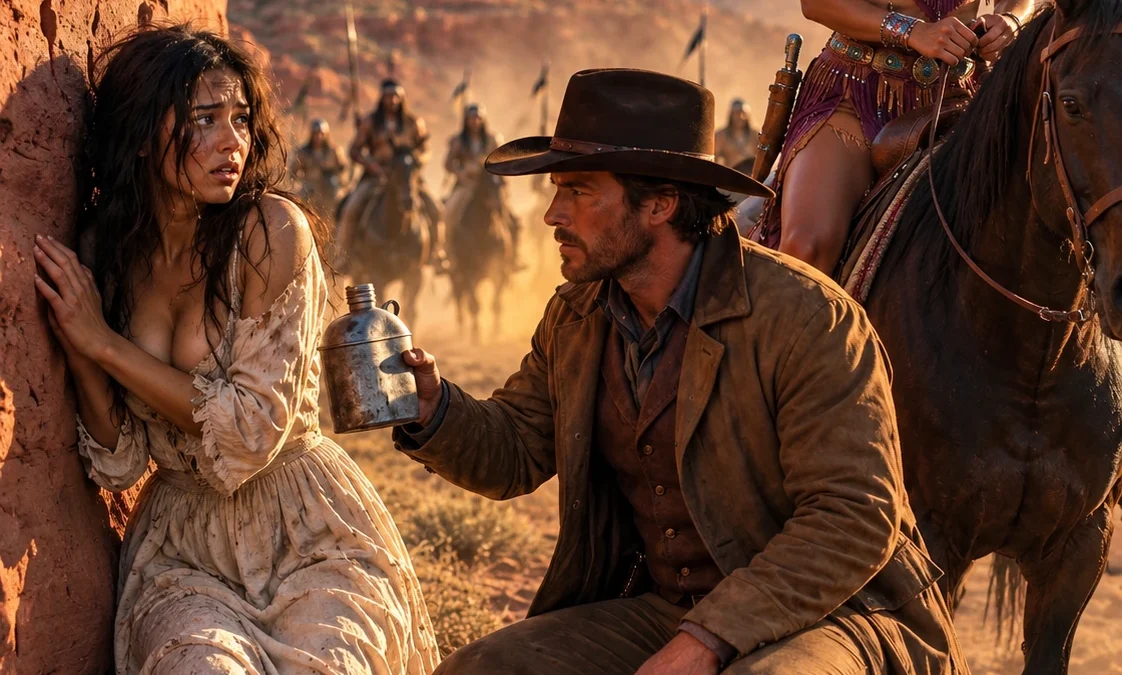
Slowly, so she could see every movement, he knelt in the dirt.
He unslung his rifle, laid it flat on the ground, and pushed it several feet away with his boot — far enough that there could be no mistaking his meaning.
He unhooked his canteen, uncorked it, and slid it across the sand toward her, gentle as sliding a coin to a stranger you don’t want to startle.
She stared at it.
Then at him.
Then at the water again, thirst warring with fear in her eyes until thirst won out.
She reached out with a shaking hand and drank in small, careful sips — the way someone drinks who has learned the hard way not to gulp when your stomach is empty too long.
“You’re safe,” Beckett said quietly, not moving an inch closer.
He laid bread and dried beef beside the canteen, sat back on his heels, and waited.
Slowly, the wariness in her face loosened.
She ate.
She watched him.
But when he asked her name, she only looked away, as if her name was something too precious to hand to a stranger just yet.
He told her she could stay at his ranch until her strength returned — that he would ask nothing of her, that she was free to leave whenever she wanted.
Something in the quiet, unhurried way he spoke seemed to reach her.
She studied his face a long time, as if checking it against every warning she’d ever been given, and found nothing there worth running from.
She was too weak to ride well, so Beckett walked the entire way back, leading the horse while she sat in the saddle.
They spoke little.
The sun sank low, painting the red rocks in gold and rust.
Twice, he caught her watching him — not with fear anymore, but with something he couldn’t quite name.
At the ranch, he heated water, set out beans, cornbread, and the last jar of preserves Mary had put up, and showed her the spare room — the one that had stood closed and untouched since Mary died.
He left a basin of clean water by the bed.
That night, for the first time in days, she slept without waking to check the dark.
Three quiet days passed.
She grew stronger.
She mended her dress with a needle Beckett found in a drawer he hadn’t opened in three years.
She sat on the porch step at dusk, watching the hills — the same way Beckett always had alone.
On the third evening, she told him her name: Isi.
Nothing more.
“Why did you lower your rifle instead of raising it?” she asked softly.
Beckett thought a long moment before answering.
“Because I’ve buried enough people in my life already,” he said.
“I didn’t want to add a stranger who never even got the chance to be anything else.
”
The fourth morning came before sunrise.
Beckett stepped out onto the porch and heard it — low, steady drumming rising from the east.
Hoofbeats.
Many of them.
Fast.
Organized.
He looked up and saw them cresting the hill: a dozen Apache riders, moving in a tight, purposeful line, dust swirling gold behind them.
And at their head rode a woman — straight-backed, fierce, eagle feathers in her hair, her face set in lines of iron resolve.
She looked like someone who had ridden days across broken country expecting to find her daughter’s body — and fully prepared to make someone pay for it.
She halted directly before the porch.
Her eyes swept the yard, the house, and locked onto Beckett — hands empty, standing still — with a look that could have cut stone.
Then Isi came running out the door.
The woman’s shoulders snapped rigid.
Her eyes widened.
She stared — not at Beckett — but at the girl standing alive, whole, color in her cheeks, arms outstretched.
The warrior’s composure shattered in a heartbeat.
Part 2
Before the horse had even fully stopped, she swung down and ran across the yard, every bit of her dignity forgotten.
They met in the dust — mother and daughter — clinging to each other, crying, and the sound the mother made was not a word in any language Beckett knew, but he understood it perfectly: the sound of getting back something you had already begun to mourn.
The riders behind them lowered their weapons.
Some turned away, wiping at their eyes.
The heavy, breathless tension that had ridden into the yard dissolved slowly, replaced by something soft and aching with relief.
When the mother finally lifted her head from Isi’s shoulder, her gaze found Beckett again — and it had changed entirely.
Hard edges softened, replaced by a weight of something deeper than gratitude.
She walked toward him, stopping at the same careful distance he had kept from Isi behind the rocks four days earlier.
“I am Tanaya,” she said, her voice steady but gentle now.
“My daughter tells me you asked nothing of her.
Not her name.
Not her people.
Not payment.
”
Beckett answered simply: “A person dying of thirst doesn’t owe anyone an explanation for existing.
”
Tanaya studied him — the house, the mended dress, the clean water waiting on the table — and saw the truth of it.
She told him how a sandstorm had scattered their hunting party, sweeping Isi miles away from their lands.
She had ridden without real sleep since, fearing every mother’s worst nightmare.
“You will not be forgotten for this,” she promised, and there was something in those words that settled deep in Beckett’s chest — something he would turn over in his mind long after they had ridden away and the yard fell quiet again.
They left.
Isi glanced back once, from the saddle behind her mother, her eyes bright and grateful, before the line of riders vanished over the horizon.
The ranch felt emptier than it ever had — lonelier even than the years right after Mary.
Beckett told himself the feeling would fade.
It did not.
He found himself keeping the spare room aired out, whistling while he mended fences that didn’t need mending, watching the eastern road more than he should.
His hired hand Otis teased him dryly: “A man who whistles mending fence he don’t need is a man thinking about something other than cattle.
”
Beckett rode to the trading post weeks later — ostensibly for supplies — and there she was.
Tanaya.
Dismounting by the hitching rail.
She saw him across the yard and smiled — warm, genuine, nothing guarded about it anymore.
“The rancher who asks for nothing,” she said.
They talked.
Again and again.
Weeks apart, then meetings at the post — longer each time.
She brought gifts: a woven basket, dried fruit, fine beadwork.
He learned to accept them.
Isi came too, bright and wholehearted, thanking him openly.
They spoke of their peoples’ struggles — broken treaties, fear, mistrust — and discovered how much they valued the same things: honesty, loyalty, family, courage that needs no audience.
Autumn drew near.
Tanaya sent a rider with an invitation.
Beckett traveled to their winter camp, where he was welcomed not as an enemy, but as a guest.
Elders nodded.
Children ran beside his horse.
Tanaya sat beside him through the evening meal, making it clear to everyone exactly what he meant to her.
Then the trouble came.
A vicious outlaw gang was terrorizing the territory — robbing, beating, burning — striking settlers and Apache alike without mercy.
Neither side was safe.
Tanaya rode to Beckett’s ranch alone, her face set with grim purpose.
“They don’t care whose land they’re on,” she told him.
“I mean to stop them before someone dies.
I’d rather ride beside a man I trust than go alone.
”
Beckett didn’t hesitate.
“Tell me when.
”
Three mornings later, they rode out together — Beckett and Tanaya’s warriors, moving as one.
She led with quiet, sure instinct, reading the land like an open book.
They camped without fire, posted watches, tracked the gang’s faint signs across canyon and dry riverbed.
On the second day, they found the outlaws — holed up in a narrow box canyon, certain they were untouchable.
Tanaya gave her orders in a whisper.
Half the group climbed the rim to block escape.
The rest would advance at dawn.
The sun rose.
They moved in.
Shots cracked against canyon walls.
Dust filled the air.
It was short, brutal, chaotic.
Beckett saw one outlaw scrambling up, raising his rifle toward Tanaya — and threw himself between them.
At the same instant, from the corner of his eye, he saw another man rushing toward him from behind, gun already lifted…
Part 3
Time seemed to slow.
Beckett had no time to turn, no time to raise his weapon — but before the man could fire, an arrow thudded home into his shoulder.
He spun, dropping his gun, and staggered back.
Tanaya lowered her bow, breath coming fast.
Her eyes locked with Beckett’s.
“You stood for me,” she said, “so I stood for you.
”
It was over almost as quickly as it had begun.
Caught between the group below and the riders above, the outlaws had nowhere left to run.
Not a single life was lost on either side — and when the dust settled, settlers and Apache stood together, shaking hands, sharing water, bound by something stronger than any treaty: the knowledge that they had stood side by side and prevailed.
Word spread like wildfire.
A settler family who had lost their wagon to the gang traveled to Tanaya’s camp to thank her in person — sitting together, sharing food and fire, people who had once been taught to fear one another finding they had far more in common than they’d ever dreamed.
The seasons turned.
Beckett and Tanaya kept meeting — not by chance anymore, but by choice.
He rode farther than business required.
She found reasons to pass near his land.
The distance between them — the careful, guarded space they’d both learned to keep — melted away into something easy and warm and real.
One evening as the first snow sifted down through the pines, they sat together by the fire in her camp.
Tanaya taught him words in her language, laughing when his tongue stumbled over sounds he’d never had reason to make before.
Isi watched them from across the fire, smiling quietly — as if she had known this would happen all along.
“You’ve spent your whole life protecting everyone else,” Isi told her mother one night.
“Let someone protect you for once.
You already have my blessing.
”
The elders, too, gave their approval.
They had watched — the rescue, the fight, the quiet kindness — and they saw something rare: a chance for understanding instead of grief.
When Tanaya rode to Beckett’s ranch one crisp, frosty morning, he was waiting on the porch step — the same spot where he had braced himself for war.
She told him plainly that she wanted to build her life beside him — if he would have her.
He came down the steps before she could finish.
He didn’t need words.
He simply took her hand, and she did not let go.
They married the following spring.
Settlers and Apache came together — filling the valley with laughter and music and a kind of joy no one had thought possible there.
Otis wept openly, declaring he’d known from the very first trading-post trip.
Alvarez closed his store so everyone could witness.
Isi stood beside her mother, radiant — the same girl who had once been too weak to stand alone behind the rocks, now shining as her family built something new.
The ranch changed.
It became a place of welcome — food, water, rest offered freely to anyone who passed through, just as Isi had been welcomed.
The spare room became a nursery, then another.
Beckett would stand in the doorway some evenings, watching Tanaya braid their daughter’s hair by lamplight, and marvel that a restless horse on an ordinary afternoon had led him here.
Isi married a young man from her mother’s band and raised her family within sight of the ranch.
Sundays found them all gathered around Beckett’s table — loud, crowded, full of laughter — the house that had once held only silence now overflowing with life.
Otis stayed on until he could work no more, happy to sit on the porch and tell anyone who’d listen that he’d seen it all coming.
Years later, travelers would hear the story — the widowed rancher, the lost girl, the mother who rode in ready for war and found love instead.
Some versions grew tall, embellished in the telling — but the truth never changed.
A man laid down his rifle instead of raising it.
A stranger chose kindness over fear.
And two worlds, divided by so much, found they could build something beautiful together.
It was not the ending anyone expected.
But it was the right one.
This story is entirely fictional and created for entertainment purposes only.
It does not represent any organization or individual, nor does it encourage inappropriate behavior.
The content was generated with AI assistance.








