SHE RODE INTO THE CANYON, LOOKED THE COWBOY IN THE EYE, AND SAID, “YOU HAVE NO IDEA WHAT I’VE BEEN HIDING BENEATH THIS HORSE.” WHAT HE FOUND LEFT HIM SPEECHLESS
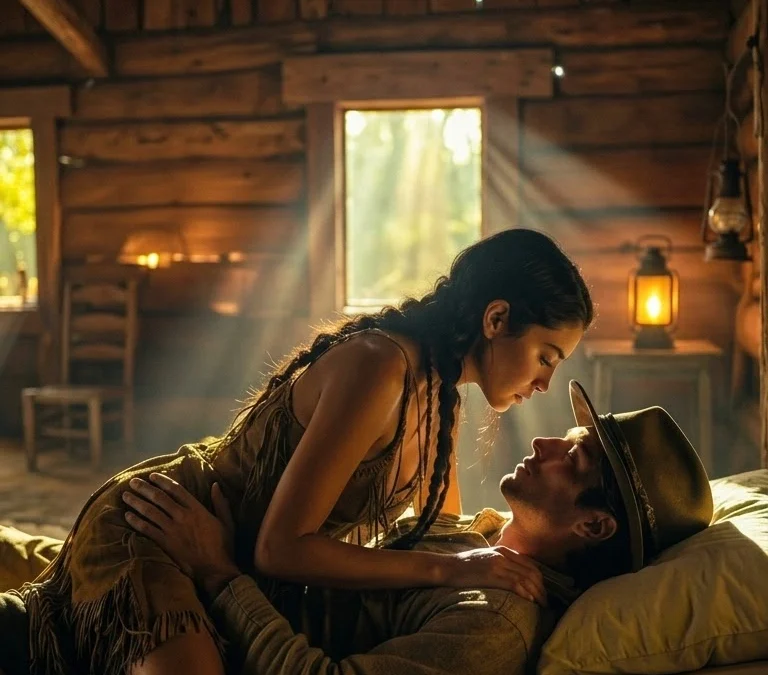
SHE RODE INTO THE CANYON, LOOKED THE COWBOY IN THE EYE, AND SAID, “YOU HAVE NO IDEA WHAT I’VE BEEN HIDING BENEATH THIS HORSE.” WHAT HE FOUND LEFT HIM SPEECHLESS 😳🔥
Part 1
The horse stood perfectly still.
Its flanks twitched in the Arizona heat, but the woman sitting astride it did not move at all. 🌵
Her stillness unnerved the cowboy more than any weapon could.
Her dark eyes were locked on his face, reading every small shift of his expression, every bead of sweat tracing down his sunburned skin. The red canyon walls leaned inward around them, turning the narrow pass into a natural trap.
“You have no idea what I’ve been carrying to you,” she said.
Her voice carried clearly across the thirty feet between them. The words hung in the desert air like smoke from a distant fire.
The cowboy’s hand hovered near his holster. But something in her posture told him that drawing would be the last mistake he ever made.
She wasn’t threatening him. She was stating a fact. 😶
His mare shifted nervously beneath him, sensing what he was only beginning to understand. This was no chance encounter. This was an appointment he had unknowingly made months ago.
“Ma’am, I don’t want trouble,” he began.
She cut him off with a slight shake of her head. The beadwork in her hair caught the afternoon light and sent small reflections dancing across the canyon walls. She wore traditional Apache clothing, but beneath her composure was something else, something that said she had walked in both worlds and been betrayed by each. 💔
“My name is Takakota,” she said.
She dismounted with a fluid grace that seemed impossible, given what she had been hiding.
And as her feet touched the ground, the cowboy saw it.
Strapped beneath the horse’s belly, wrapped in leather and cloth, something was moving.
Not a saddlebag. Not supplies.
A small hand. Then a face.
It was a child, a boy no more than four years old, with skin lighter than hers but darker than the cowboy’s. His eyes were wide and completely silent. They were the eyes of a child who had been trained, by necessity, to make no sound at all. 😨
The cowboy felt his throat tighten.
“Jesus Christ,” he whispered.
“He has been there six hours,” Takakota said, already working the bindings loose with practiced hands. “Since before dawn. He knows how to be quiet. He had to learn.”
She lifted the boy free and set him on his feet. He stood rigid beside her, one small hand clutching the fringe of her dress, the other resting near a tiny knife his mother had given him. His gaze never left the cowboy’s face.
It was the stare of someone who had already seen too much for his age.
“Why?” the cowboy managed.
It was all he could say.
Takakota ran her fingers along the child’s arms and legs, checking for numbness, for circulation, her touch quick and tender at once.
“Because you are going to take him to Fort Bowie,” she said without looking up. “You are going to tell them he is an orphan from a raid. You are going to make sure he grows up with a roof, and food, and a chance at something better than what waits for him out here.”
The cowboy shook his head slowly.
“Lady, I can’t just…”
“His father was a cavalry officer,” she said. “William Garrett. Posted at Fort Bowie three years ago.”
The name hit the cowboy like a punch. 💥
He had heard whispers about it. An officer who had gotten involved with an Apache woman during the brief peace talks of ’82. A man who had been transferred suddenly, without warning. A woman who had vanished into the mountains.
“Do you know what happens to children like him?” Takakota asked, and her voice turned hard as flint. “Born between two worlds. The Apache will not fully accept him because of his white blood. The whites will not accept him because of mine. He will be killed. Or worse, used as proof that my people are savages who need to be wiped out.”
The wind moved through the canyon, kicking up red dust.
“Garrett was a coward,” she said flatly. “He promised me things he never intended to keep. He told me he would make me his wife. He told me our son would have a future. Then his commanding officer found out, and within one week, William Garrett was gone.”
She looked at the boy.
“No goodbye. No letter. Nothing but silence, and a son who looks enough like him that anyone with eyes can see the truth.”
The cowboy stood frozen in the heat. He had come into this canyon thinking he was a man riding through on his own road.
But as he looked into the boy’s silent, watchful eyes, he understood something that made his blood run cold.
Takakota had not stumbled upon him by accident.
She had been following him for three months. 😨
👉 Want Part 2? Find it in the comments, or leave any word and I’ll send it to you privately!
Part 2
Takakota had not stumbled upon him by accident.
“Three months ago,” she said, “you were in Tucson.”
The cowboy stared at her.
“A Mexican boy stole bread from a merchant. The merchant was going to beat him to death with a wagon spoke. You stopped him. You paid for the bread and gave the boy two dollars.”
The memory came back to him slowly. He had thought nothing of it at the time. The boy had been starving. The merchant had been drunk and cruel. It had seemed like the only human thing to do.
“I was watching,” Takakota said. “I have been watching you ever since.”
A chill crawled down his spine. ❄️
“You treat your horse with respect. You pay fair prices to the Mexican traders when others cheat them. You broke up a saloon fight by buying both men a drink instead of drawing your gun.” Her eyes didn’t soften. “You are weak in some ways. Too trusting. Too slow to anger. But those weaknesses are exactly what I need.”
The words should have insulted him. Coming from her, they felt like a clinical judgment, the way a hunter studies the patterns of an animal.
“I need someone who will not sell him. Who will not abuse him. Who will not see him as less than human.”
The boy hadn’t made a sound. He simply watched, small and motionless, as his mother spoke as if he weren’t there.
“If you say no, I understand,” Takakota said, drawing her son closer. “I will find another way. But time is running out. The soldiers are pushing deeper into the mountains. They call it pacification. What they mean is extermination. Every week there are fewer places to hide.”
The cowboy looked at the boy. He saw himself at that age, before his father died in a Kansas wheat field, before the war, before he drifted west chasing something he could never name. 💔
“What happens to you?” he asked quietly.
“That is no concern of yours.” Her face became stone. “I go back to my people. We fight, or we surrender. We live, or we die. But he gets a chance. That is all I ask.”
Then she did something that made his stomach drop.
She turned to her horse and pulled out a small canvas bundle. Clothes that would fit a settler boy. A story about parents named John and Mary Fletcher from Missouri. A tiny Bible with their names written inside.
“I traded two deerskins for it in Tombstone,” she said.
The cowboy felt the breath leave his chest. This wasn’t desperation. This was a military operation, planned for three years by a mother preparing for the moment she would have to let go.
She knelt beside the boy and spoke to him in Apache, low and firm. Not soft. Not sentimental. Final lessons.
The boy nodded at every point, his small face serious beyond his years.
Then she kissed his forehead once, rose, and walked back to the cowboy.
“He will cry tonight,” she said. “Maybe tomorrow night, too. Let him. But do not let him speak Apache where others can hear. Do not let anyone know what he is.”
“You’re asking me to erase who he is,” the cowboy said, and heard the anger in his own voice.
“I am asking you to keep him alive.” Her eyes blazed. “Today, being Apache is a death sentence. I am choosing his life over his heritage. That is what mothers do.”
She placed a heavy leather pouch in his hands. Mexican silver. American gold. A few old Spanish coins.
“Everything I have saved. It is not nearly enough for what I am asking.”
The cowboy looked down at the pouch, then at the boy.
He was a drifter. No home. No wife. No stability.
“Then you will have to change,” Takakota said, as if she had read his mind. “Men change for children.”
The sun slid lower. The canyon shadows stretched long and dark across the red stone.
Decisions made in canyons have a way of becoming permanent.
And the boy looked up at the cowboy with eyes that asked no questions at all, because he had learned that questions were dangerous. 😢
Takakota swung back into her saddle. She looked down at the man who held her entire world in his hands.
“One more thing,” she said, her voice cracking for the first time. “In five years, on this exact date, go to the big cottonwood tree outside Tucson. If I am still alive…”
👉 What was she going to leave for him there? LIKE or COMMENT “REVEAL” to see Part 3! It will be posted once we have enough comments! 🔥
Part 3
“If I am still alive,” Takakota said, “I will leave a message. Just so you can tell him his mother did not forget him.”
“And if there’s no message?” the cowboy asked.
“Then he will know I died thinking of him. Either way, he will have an answer.”
She paused, and her composure cracked a little further.
“His favorite food is honey on flatbread. He has nightmares about eagles. Not ordinary dreams. Night terrors. Sing to him. Anything. He does not care about the words. He only needs to hear a human voice.” Her fingers tightened on the reins. “And he is afraid of deep water. But he must learn to swim. Do not let that fear stop him.”
The cowboy committed every word to memory. These were the sacred things, the small truths that make up a child’s inner world. She wasn’t just handing him a boy. She was handing him a whole person, with fears and loves and needs. 💔
“When he asks about me, and he will, tell him I was strong. Tell him I made the hard choice because I loved him. Do not tell him I was a victim. Do not make me a tragedy. Tell him I was a warrior who fought for his future.”
Her eyes were dry. His were not.
“I’ll tell him,” he said.
She looked at her son one last time. The boy raised his hand in a small gesture, something between a wave and something far more formal. Something Apache that the cowboy didn’t recognize.
She returned it.
Then she pressed a tiny wooden horse, carved to fit in the palm of a child, into the boy’s hand and whispered a few words in Apache. The boy nodded and slipped it into his pocket.
“What did you tell him?” the cowboy asked.
“That it is from me. That he must keep it hidden, but never lose it. That one day he will understand why I did this.”
She kicked her horse into motion.
She did not look back.
The cowboy understood why. Looking back would have broken her, and she couldn’t afford to break. Not with the long ride to her people ahead.
She disappeared around a bend in the canyon, and the silence closed behind her like a door.
The boy stood perfectly still for a moment. Then he walked to the cowboy’s horse and waited.
No tears. No questions. Only the practiced obedience of a child who had learned that survival depends on following instructions exactly.
The cowboy lifted him into the saddle and climbed up behind. The boy’s body was rigid at first. But by the time they cleared the canyon and turned northeast toward Fort Bowie, he had fallen asleep against the cowboy’s chest, exhausted from holding himself together. 😢
Three days later, they reached the fort.
The cowboy told the story Takakota had prepared. A burned wagon. An Apache raid. An orphaned boy. Commander Kittinden listened with the bored efficiency of a man who had heard a hundred versions of it, and assigned the child to a widow named Mrs. Patterson, who ran a small informal orphanage in the settlement outside the walls.
The cowboy could have left then. His obligation was technically fulfilled.
But four words kept echoing in his head.
Men change for children.
He took a job scouting for the fort. The pay was decent, and it kept him close. At first he visited the boy once a week. Then more often. He brought food, clothes, small toys. Then he began teaching him how to read tracks, how to handle a horse, how to defend himself.
Slowly, the silent child began to speak. Underneath all that training for survival was a sharp mind, quick with numbers, gentle with animals.
He never once mentioned his mother. But sometimes the cowboy caught him alone, thumb rubbing the worn surface of a tiny wooden horse. 💛
A year later, the cowboy realized something strange. He had stopped thinking of himself as a drifter. He had rented a room. Bought a second horse. Started planning beyond next week.
The boy had changed him, exactly as Takakota had predicted.
Five years after that day in the canyon, the cowboy rode alone to the cottonwood tree outside Tucson.
James, now nine and calling himself Jim, thought he was on business in town.
The tree was massive and ancient. The cowboy circled it slowly, searching for any sign, any mark. Then he found it, carved into the bark on the north side, so subtle he almost missed it.
An Apache symbol for mother.
And below it, three notches.
He knew what they meant. Three years since the wars had ended. Three years since her world had finished dying.
But she was alive.
His chest tightened. She had survived the wars, the relocations, the slow destruction of everything she knew, and she had kept her promise.
With his knife, he carved a simple answer beneath hers: a small horse, like the one she had given her son. A symbol that the boy was safe. That he was thriving.
He rode back and told no one. Some secrets were meant to be kept. 🌵
Jim grew into a young man with his mother’s cheekbones and his father’s height. Somewhere around age twelve, he started calling the cowboy simply Cal.
Cal never told him the full truth about that day. Some stories were too complicated for children.
But when Jim neared fifteen, Cal felt the time coming. They were camped in the foothills one night, checking a line of fence, when the question arrived. The one he had dreaded and expected for years.
“Cal, who are my real parents?”
The fire crackled between them. Cal looked at the young man across the flames. Takakota’s proud bearing. Garrett’s light coloring. A living bridge between two worlds that had gone to war.
“Your mother,” he said slowly, “was the bravest person I ever met. Apache. Strong. She loved you enough to give you a chance at a life she couldn’t give you herself. Your father was a cavalry officer who wasn’t brave enough to stand by his choices. You’ve got the best of one and nothing from the other.”
Jim was silent for a long time.
“Is she alive?”
“I believe so. She leaves messages. She wants you to know she thinks about you.”
“Does she want to see me?”
Cal chose his words carefully. “I think she wants to know you’re safe and happy more than she wants to see you. Seeing you would be for her. Knowing you’re all right is for you.”
Jim stared into the fire. “Then who am I supposed to be? Caught between the two of them?”
And Cal understood that it was the same question Takakota had faced in that canyon, though neither of them had known it then.
“You’re supposed to be Jim,” Cal said. “Not Apache. Not white. Just Jim. A man who gets to choose his own path, because someone loved you enough to make sure you had that choice.” 💔
Jim nodded slowly.
“I want to meet her someday. When I’m ready. When I’m someone she’d be proud of.”
“She’s already proud of you,” Cal said. “She was proud of you before you were born. That’s what mothers do.”
Somewhere in the dark, a coyote called. And in that moment Cal finally understood what Takakota had really given him in that canyon. Not just a child to raise. A purpose to live for. She had seen something in him that he had never seen in himself, the capacity to become more than what he was.
Years passed.
Jim grew into a man with a ranch of his own and children who would never fully understand the complicated heritage they carried. Cal grew old, slower, quieter.
One last time, he rode out to the cottonwood tree.
It still stood, though smaller carvings and carved initials had joined the old ones. He found Takakota’s mark, faded now but still there. Beneath it, more notches. More years survived. More years of keeping her promise to remember the son she had given away.
Cal took out his knife and added his own final mark. A single word, carved in English.
Proud.
It was the only word that mattered. The only message that needed to be sent. ✨
He rode home slowly, content with the life that had chosen him. He thought about that day in the canyon often. The Apache woman. The hidden child. The impossible request that changed three lives.
You have no idea what I’ve been carrying to you, she had said.
And she had been right.
What she carried beneath that horse was not just a child. It was a future. A hope that love could be stronger than hate, that choice could triumph over circumstance, that a boy caught between two worlds might build a bridge wide enough for others to follow. 🌄
The desert remembered it all. The canyon. The conversation. The moment three strangers became a family, bound not by blood but by a mother’s desperate courage and a drifter’s unexpected honor.
And in the end, Takakota had taught them both the difference between surviving and truly living.
That was the only lesson that mattered.
This story is entirely fictional and created for entertainment purposes only. It does not represent any organization or individual, nor does it encourage inappropriate behavior. The content was generated with AI assistance.








