She Sat Alone Drinking Tea—4 Tiny Boys Begged “Pretend You’re Our Mom”… Then Their Father Arrived & Exposed A Secret That Will Freeze Your Blood
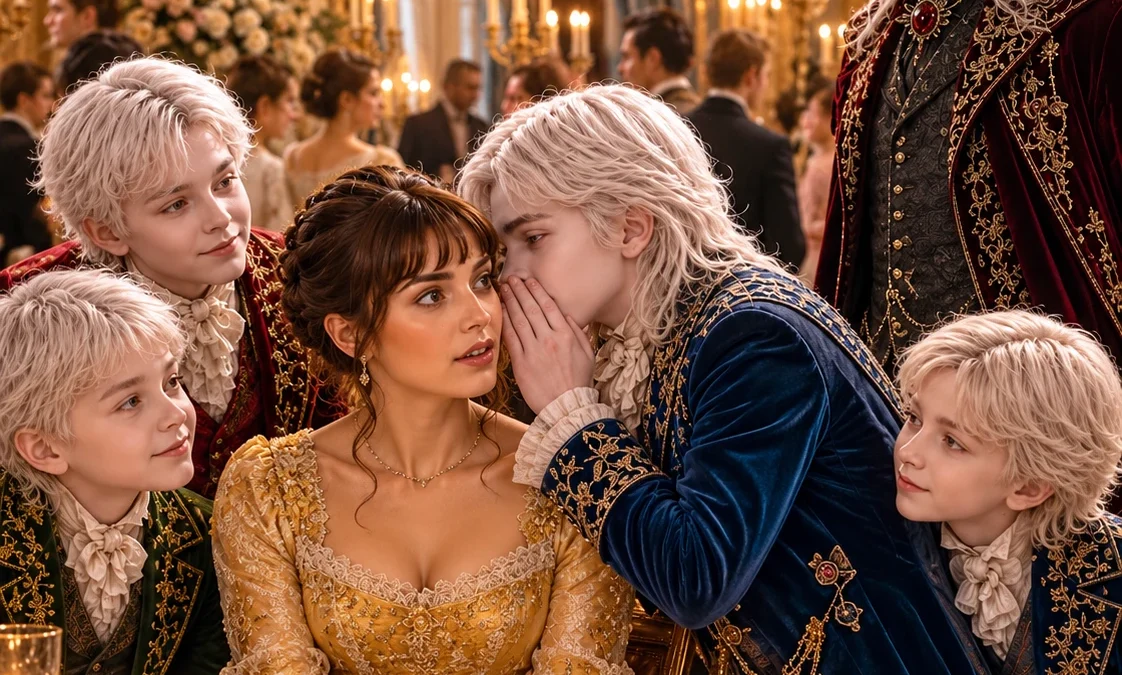
Part 1
The first frost bit Hollow Creek earlier than anyone expected.
By sunrise, the wooden tables outside Maple & Finch Tea House were edged in white, smoke curled soft and slow from cottage chimneys, and the bakery windows glowed misty-warm from ovens humming within.
Grace Whitmore sat alone by the back window.
At 27, she stitched for a living—mending dresses, patching curtains, rescuing every cloth the town couldn’t bear to throw away.
Most days she rose before dawn to work; at 10 o’clock sharp, she stopped.
That single hour was hers and hers alone.
Since her father passed last spring, her quiet rented room had felt too empty.
She’d learned to fill the silence with busy hands.
That morning, she was halfway through her tea when the bell above the door jingled.
Four little boys stepped inside.
Grace blinked.
They looked so alike—messy black hair, pale round faces, dark coats buttoned to the chin—that for a moment she wondered if the cold had blurred her eyes.
They seemed about five years old, though one stood a little straighter, a little braver than the rest.
Martha, the tea house owner, hurried out from behind the counter.
“Where did you four come from?”
They didn’t even glance her way.
They walked straight to Grace’s table.
The tallest one stopped right beside her cup.
“Can you pretend you’re our mother?”
Grace lowered her tea slowly.
“I’m so sorry…?”
“Just until after lunch,” the second boy said quickly.
“We won’t ask tomorrow,” added the third.
The fourth said nothing at all.
He lingered behind his brothers, watching her with huge, sad grey eyes.
Martha frowned.
“Children, you can’t just—”
Grace looked at their hands.
No gloves.
Fingers pink and stinging from the frost.
“Sit down,” she said softly.
They scrambled onto the bench beside her like little sparrows.
She ordered warm milk, fresh bread, jam.
“What are your names?”
“Henry, Matthew, Peter,” said the tallest.
The quiet one hesitated.
“Jamie.
”
“Why do you need a pretend mother?” Grace asked gently.
Henry looked down.
“Our school has Family Day.
Today.
Fathers are supposed to come, but… the mothers help make winter lanterns.
Everyone else’s mother will be there.
”
Grace’s heart tightened.
“Where is your mother, boys?”
Henry’s voice was very small.
“She died when we were born.
”
Her breath caught.
She reached out—then pulled back, not wanting to startle them.
They ate quietly.
Jamie got jam on his chin; Grace wiped it away with her handkerchief without thinking.
Just then the bell rang again.
Every head turned.
The whole room went quiet.
A man stood in the doorway.
Tall, broad-shouldered, hair not grey but pure white, falling soft across a face so pale it looked carved from moonlight.
His coat was simple black, but the way he held himself—still, watchful, ancient—made the air feel thinner, colder.
His eyes swept the room, locked instantly on the four boys.
“Father!” Henry jumped down.
The man crossed the room so fast Grace barely saw him move.
He knelt, touching Henry’s shoulder, Matthew’s head, Peter’s back, then cupped Jamie’s face in both hands like he was checking a treasure no gold could buy.
“All four,” he whispered, and something like relief broke in his voice.
Then he stood.
His gaze settled on Grace, steady and unreadable.
“I am William Frost,” he said.
“Thank you.
They are… everything to me.
”
They talked.
She offered tea; he sat.
He was polite, distant, yet there was a quiet exhaustion in him that she recognized.
When he left, the boys waved from the doorway.
Grace told herself she’d see them in town, maybe.
That was all.
The next morning, at 10 o’clock exactly, the bell jingled again.
Four familiar faces—then William, following close behind.
He looked even paler in the daylight, his white hair catching the sun like spun silver.
Martha nearly dropped her tray.
“May we join you?” he asked.
She nodded.
They talked.
She learned Henry loved maps, Matthew collected stones, Peter wanted to rename every vegetable, Jamie loved stories more than words.
When she asked where they lived, Henry said proudly: “Ravenhurst.
”
Grace went still.
Everyone in Hollow Creek knew Ravenhurst Estate—ancient, walled, hidden deep in the northern woods, gates locked longer than she’d been alive.
Townsfolk whispered tales: a master who never aged, who walked only after dark, who kept strange company.
Stories to frighten children.
She studied William.
The pale skin, the stillness, the eyes that seemed to hold centuries.
“Are those stories true?” she asked quietly.
He met her gaze straight on.
Some were exaggerated, he said.
Some were not.
Grace leaned forward.
“You’re a vampire.
”
Martha dropped a spoon behind the counter with a sharp clatter.
William did not flinch.
Did not deny it.
He simply nodded.
And Grace—she didn’t scream.
Didn’t run.
She’d spent her life seeing ordinary people be cruel without magic to help them.
“All right,” she said.
He blinked, surprised.
“All right?”
“I do have questions,” she said.
“Does Peter actually hate carrots, or is he just dramatic?”
William stared.
Then he laughed—low, quiet, warm, a sound the boys clearly didn’t hear nearly often enough.
Before they left, he asked her to step outside.
Their governess had fallen ill, he explained.
The boys had turned away every replacement.
They trusted her.
Would she come to Ravenhurst? A few afternoons a week?
He named a wage so generous she could only stare.
“Because you gave them tea,” he said simply.
“You wiped Jamie’s face.
You asked nothing in return.
”
She hesitated.
Thought of four lonely boys.
Thought of a father who looked as though he’d been guarding his heart for a hundred years.
“I’ll try one week,” she said.
Neither of them truly believed it would end there.
Part 2
Ravenhurst was nothing like the scary stories.
Sunlight spilled through trees; books lined walls floor to ceiling; children’s boots tumbled in the hallway; a wooden rocking horse stood beside a porcelain vase like it belonged there.
Margaret, the housekeeper with hair like spun sunlight and a smile that held secrets, greeted her like an old friend.
Grace fell into a rhythm fast.
Henry pored over maps.
Matthew worked through math.
Peter negotiated new names for carrots.
Jamie curled up beside her with a book while the others bickered.
Once, during a storm, thunder shook the windows—Jamie climbed silently onto the chair beside her.
Grace didn’t tell him he was too old to be afraid.
She just moved the lamp closer.
William found them later.
Jamie was asleep, head resting on her arm.
“I haven’t seen him sleep through thunder since he was three,” he whispered in the doorway.
“He didn’t need me to stop the storm,” Grace said softly.
“He just needed someone to stay.
”
Friendship grew easy.
William told her he was Vampire King—not with armies or castles, just mediating quiet disputes between families who’d lived hidden among humans for centuries.
The boys’ mother, Catherine, had been human.
The boys were human too—they’d choose whether to become vampires only when they grew up.
“I worry they’ll learn to fear what I am,” he admitted once.
Grace thought of the shopkeeper who smiled to your face and cheated you behind your back.
“Being human isn’t proof of goodness,” she said.
“And being a vampire isn’t proof of badness.
We’ll judge you by your tea instead.
”
He laughed, but his eyes were soft.
By December, she came every day.
The boys gave her a gift—a proper sewing kit, needles sharp, scissors smooth, because Jamie had noticed hers stuck.
But whispers grew in town.
People stared.
Victoria Ashford—Catherine’s own sister—arrived at Ravenhurst, cold and sharp-eyed.
She found Grace alone.
“You think you can replace her?” Victoria sneered.
“You think you’ll slip into this family, then into his bed?”
Grace stood steady.
“I don’t want to replace anyone.
I just want to help four children who asked me.
”
“Women like you always say that,” Victoria hissed.
Grace left that meeting shaken but unbroken—until the rumors worsened.
Martha pulled her aside: people said she’d moved into Ravenhurst, that she’d gotten the old governess fired, that she was scheming to be mistress of the estate.
Victoria’s friends were spreading the story far and wide.
Grace knew what she had to do.
She walked to Ravenhurst that afternoon.
Found William in his study.
“I’m leaving,” she said.
He went still.
“What? Why?”
“The rumors will reach the boys soon,” she told him.
“I won’t have Jamie hearing strangers whisper about me.
I won’t have Henry wondering why his friends’ parents look at him sideways.
”
“They’re just words,” William said, rising fast.
“Words stick,” Grace answered.
“Sometimes leaving isn’t surrender—it’s protecting them.
”
“Protecting them from what? From us?” His voice cracked.
“From cruelty,” she said gently.
He stepped closer, desperate.
“Grace—don’t go.
”
She held her ground, even though her heart ached.
“If I say goodbye properly, Peter will argue.
Henry will make plans.
Matthew will ask questions I can’t answer.
And Jamie… Jamie will understand.
”
That was the tragedy, wasn’t it? The quietest boy always saw the most.
William stood silent, shoulders slumped, looking older than Grace had ever seen him.
He pulled an envelope of money from the drawer—she pushed it back.
“Thank you,” he said, voice rough.
“For making this house noisy again.
”
Grace couldn’t speak.
She turned and walked out before he could see her tears fall.
A week passed.
She sat at her usual table every morning, drinking tea alone.
The chair across from her stayed empty.
Then Margaret found her.
Walked her to the churchyard, told her things William had never said—families he’d helped in secret, bills paid, medicine delivered, roofs fixed, all without a word of thanks.
“He thinks kindness loses its grace when it’s boasted,” Margaret said.
“He’s lived so long watching people change when they learn what he is… you treated him like a worried father before you knew anything else.
”
Grace’s throat tightened.
That night, someone knocked on her door.
She opened it.
William stood there—no carriage, no servants, snow dusting his white hair, coat worn thin at the cuffs.
He’d walked four miles in the dark just to see her.
Part 3
Grace stepped aside, heart thudding.
“You walked all that way? Come in—quick, before Martha hears and writes a whole chapter of gossip.
”
He stepped inside, tall and awkward in her small room, hands clasped tight as if he feared reaching out.
“I sent Victoria away,” he said at once.
“Not for you.
For them.
Jamie asked why people lie about good people.
And I realized—for years I taught my sons to stay quiet when humans misunderstood us.
I thought silence kept the peace.
But silence only leaves the room to whoever’s loudest and cruelest.
”
He pulled something from his coat—her handkerchief, the one she’d used to wipe jam from Jamie’s chin that very first day.
“Jamie kept it.
Said it was proof you’d come back.
”
Grace touched the soft cloth.
“He stole it?”
“He preserved it,” William corrected, a faint smile touching his lips.
“I stood outside Maple & Finch that morning before I walked in.
I watched you with them.
I’d searched an hour in a panic, and there you were—treating them like yours.
Not because you knew who their father was.
Not because I was a king.
Just because they needed someone.
”
He took a breath.
“I’ve spent centuries meeting people who change when they hear that word—king.
You didn’t.
You told me I made tea wrong.
”
Grace laughed through a mist of tears.
“You did make tea wrong.
”
“I know.
” He leaned a little closer, voice steady and sure.
“I don’t want you back just because the boys miss you.
I don’t want you back because Ravenhurst runs smoother with you there.
I want you back because when you leave a room, I notice.
I miss you.
Not as a governess.
Not as a friend.
As you.
”
Her heart skipped.
She’d spent so long guarding herself—father gone, days measured in stitches and silence—she’d forgotten what it felt like to be truly seen.
“I missed them,” she said softly.
“I missed Margaret.
I missed the house.
And…” She met his eyes.
“I missed you.
”
William didn’t rush.
Didn’t reach for her hand.
“May I come back tomorrow?”
“Yes,” she whispered.
And so they began—slow, steady, ordinary in the most beautiful way.
They walked through town, argued over books, shared tea, let the bond between them deepen without fanfare.
The boys returned to their corner table; Jamie sat beside Grace as if he’d never left.
“You took a very long holiday,” Peter told her, and she didn’t correct him.
“Some can,” William said honestly.
“I would never use it on you.
Not to make you stay.
Not ever.
”
“Then I’d open the door,” he promised.
“Even if it hurt.
Especially then.
”
Grace trusted him more for that answer than any grand declaration.
By early March, he brought her out to the balcony where snow was melting into soft green shoots.
“There’s something I need to say,” he began.
“If we marry, some will expect you to become like me.
To turn.
”
Grace held her breath.
“Do I have to?”
“Never,” he said firmly.
“Not now.
Not ever.
You will stay Grace.
You will age.
I will not.
”
She searched his face.
“And you still want this?”
“I used to think love meant avoiding anything I could lose,” he said quietly.
“I built walls around Ravenhurst, around myself, to keep safe.
But safety felt empty.
I’m done refusing good years just because they don’t last forever.
”
Grace reached for his cold hand.
“William—yes.
”
He smiled, relieved.
“I had a whole speech prepared.
”
“Save it for our anniversary,” she said.
From inside came a loud crash.
Peter appeared at the door, breathless.
“The board game had a disagreement!”
“Did it flip itself?” Grace asked, grinning.
“It was very opinionated,” Peter declared.
They married in late spring, not at Ravenhurst, but in the little white church where her father had once repaired the clock for free.
William wore a simple dark suit, not royal robes—“I want to marry William Frost, not a title,” she’d said.
The boys stood proudly: Henry guarded the rings, Matthew double-checked, Peter whispered that weddings took far too long, Jamie stood beside his father.
When Grace walked down the aisle, William forgot to look at anything else.
Afterward, the boys presented a cake they’d decorated themselves—lopsided, lumpy, perfect.
“It’s supposed to lean,” Peter said with folded arms.
Jamie set five tiny wooden figures and one tall one with white hair beside it.
“Us,” he said simply.
Life settled into something warm and real.
Grace still mended clothes, still visited the tea house, still told William when his tea was terrible.
She sat in meetings with vampire elders and asked why things couldn’t just be simple, why polite words needed to hide honest feelings.
Slowly, they began to listen.
One year to the day since four boys had walked into Maple & Finch, they gathered around that same table.
Martha brought six cups.
“Milk first,” Peter told her seriously.
Grace poured.
Jamie watched her quietly.
“I remember that first day,” he said.
“I thought you’d say no.
”
“Why did you pick me?” she asked him softly.
“Because you looked lonely,” he said.
“We were lonely too.
”
Grace set down the pot.
All this time she’d thought she’d rescued them—never guessing they’d seen her emptiness just as clearly, never guessing four small souls had reached out to pull her back to life.
Outside, frost edged the windows just like it had that first morning.
People passed by—hurrying, laughing, helping an elder cross the icy street.
Nothing dramatic.
No grand destiny.
Just ordinary days strung together like pearls.
William slipped his gloved hand into hers.
“Thinking?”
“That it’s enough,” she said.
“All of it.
”
He squeezed her fingers.
“You’re enough.
”
Years would come.
The boys would grow, choose their paths—some human, some not.
Ravenhurst would change.
Hollow Creek would change.
William would stay as he was, while she aged and greyed.
But she knew now that forever wasn’t the point.
Loving fully in the time you had—that was the gift.
Tomorrow would bring tea, jam, arguments, laughter, a hand that stayed cold no matter how long she held it.
And that was more than enough.
This story is entirely fictional and created for entertainment purposes only.
It does not represent any organization or individual, nor does it encourage inappropriate behavior.
The content was generated with AI assistance








