SHE SECRETLY KNITTED FOR 40 ORPHANS FOR FIVE WINTERS, BUT WHEN THE TOWN’S RICHEST WIDOW STOLE THE CREDIT AND CALLED HER A THIEF, THE EARL PULLED A TINY GRAY MITTEN FROM HIS COAT AND ASKED ONE QUESTION THAT SILENCED THE ENTIRE SQUARE
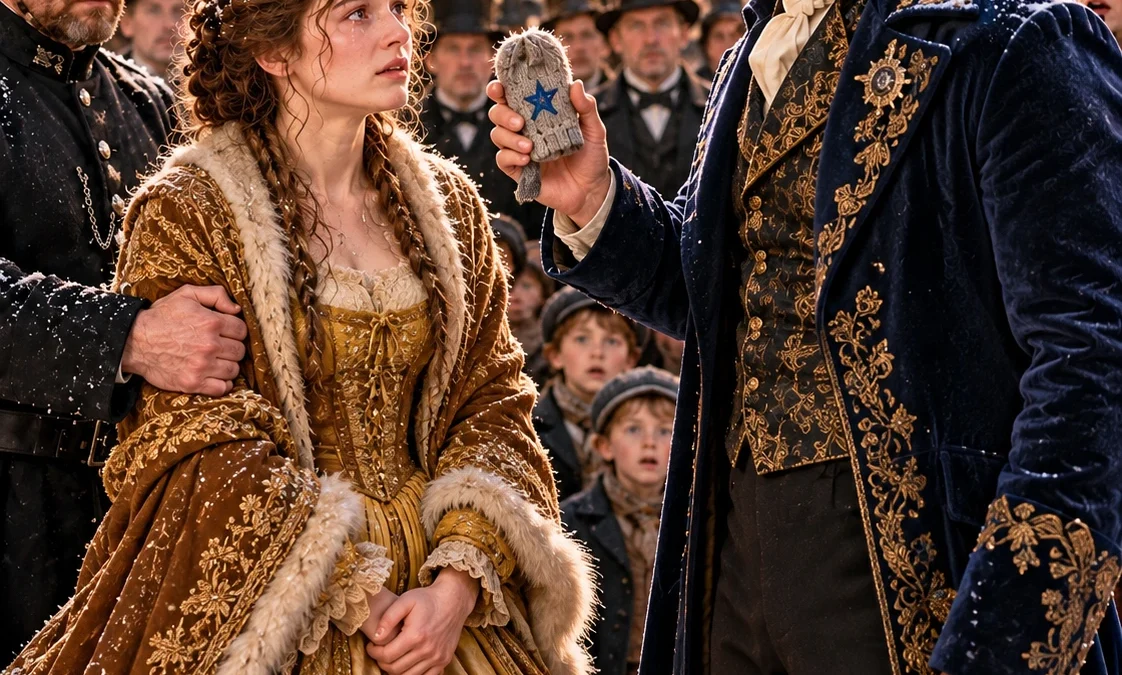
SHE SECRETLY KNITTED FOR 40 ORPHANS FOR FIVE WINTERS, BUT WHEN THE TOWN’S RICHEST WIDOW STOLE THE CREDIT AND CALLED HER A THIEF, THE EARL PULLED A TINY GRAY MITTEN FROM HIS COAT AND ASKED ONE QUESTION THAT SILENCED THE ENTIRE SQUARE 😱🧶
Part 1
The whole town of Milbrook stood in the snow and watched.
It was Christmas Eve, 1852. Lamps glowed in the square. A band played. The air smelled of hot chestnuts. ❄️
And in the middle of it all, a constable held a young woman by the arm.
Her name was Lucy Ward. She worked in the hat shop, and the entire town had just heard her called a thief.
She did not cry. She did not fight. She stood very straight in her old brown coat, snow caught in her hair.
Then the new Earl of Wexley pushed through the crowd.
He did not look at the constable. He did not look at the fine lady who had accused her. He slipped his hand into his coat and drew out something tiny.
A child’s gray mitten. Old and worn so thin it lay in the middle of his palm.
“Before anyone takes this woman anywhere,” he said, “I want to ask her one question.”
To understand why one small mitten silenced a whole town, we must go back to the cold, dark mornings of that winter. Back to a little room above a hat shop, one candle, and two needles that never stopped. 🕯️
Lucy Ward was twenty-seven. She wore her brown hair tied back tight. Her fingers were quick and sore. She lived in a small room above Mr. Pike’s hat shop on the high street, where she worked six days a week for very little money.
She sewed ribbons onto hats for rich ladies. She smiled at them. “Yes, madam, the blue suits you very well.” And the rich ladies never once looked at her face.
Lucy didn’t mind. She had a secret, and it kept her warm.
Every night when the shop closed, she climbed the stairs, lit one candle, and knitted. Mittens. Socks. Small warm hats. She bought the cheapest wool in town, the odd ends nobody else wanted, and turned them into something precious.
At the end of the high street stood St. Anne’s Home for Children. Forty children lived there with no mother and no father. The house was old. The fires were small. Every winter, the children’s hands went red, then blue, then cracked and bled.
So every Friday before sunrise, Lucy walked to St. Anne’s and left a parcel on the back step. Then she hurried away before anyone could see.
She had done it for five winters. 🧤
Inside every mitten, hidden in the cuff, she sewed a tiny star in blue thread. Five points. One point a little longer than the others.
Her mother, Mary Ward, had knitted for poor children too, long ago, before she died.
“The long point is not a mistake,” her mother used to say. “It points home. So a child always knows there is someone, somewhere, who cares if they are warm.”
The children had a name for the one who left the parcels. They called her the Blue Star. Soon the whole town did. People whispered it in the bakery and at church. Who is she? Is she rich? Is she a lady?
Nobody guessed the girl in the hat shop.
Only one person knew. A boy named Sam, eight years old, small, with big ears and bigger eyes. One freezing Friday, he had stayed up all night by the back door because he had to know. When Lucy came up the step in the dark, there he was.
She knelt in the snow. “Can you keep a secret, Sam?”
He nodded hard.
“Then this is ours. No one else’s.”
“I promise,” said Sam, and he held his new mittens against his chest as if they were made of gold.
He kept that promise for a whole year. Lucy might have gone on like that forever, a quiet girl with sore fingers and a happy secret.
But that winter, a carriage rolled down the high street. Inside was a man who had been searching for the Blue Star for twenty-five years. 👀
His name was Henry Blake, the new Earl of Wexley.
The great house on the hill had stood empty for a year. Now the whole town buzzed about its new master. He was thirty-three. Unmarried. Very rich, and very strange. He didn’t attend parties. He didn’t hunt. No one knew where he’d spent his boyhood.
Every mother in Milbrook with a daughter began to plan. And no one planned harder than Mrs. Pratt.
Mrs. Pratt was the richest widow in town, with a big house, a loud voice, and a pretty, bored daughter named Cordelia. She ran every good cause in Milbrook: the church flowers, the poor box, the Christmas fair. She loved good causes, as long as her name was printed at the top.
One cold Monday, she swept into the hat shop with Cordelia on her arm. “The best hat you have. The Earl is coming to church on Sunday, and my Cordelia must be seen.”
Lucy brought out hat after hat. Mrs. Pratt never once said thank you.
Then the bell rang. A tall man stepped in out of the snow. Plain dark coat. Tired gray eyes. He looked around the little shop as if he had never been inside one.
Mrs. Pratt went pink to the ears. “My lord! What a happy surprise!”
The Earl bowed politely. Then he turned to the counter where Lucy stood holding a hatbox.
“I need a warm hat. For an old lady who was my nurse. She feels the cold now, and she is too proud to buy herself anything.”
“Then not this one,” Lucy said. “It’s pretty, but the wind goes straight through. You want wool inside and flaps that come down over the ears. She’ll say it looks silly. She’ll wear it every day.”
The Earl looked at her. Really looked, for the first time.
“You sound very sure.”
“I know about the cold, my lord.”
She wrapped the hat in paper and tied it with string. Her fingers were red and rough. A tiny tail of blue thread clung to her cuff. She never noticed it.
The Earl did. 💙
At the door, he turned back to the whole shop. “May I ask something? I hear this town has someone they call the Blue Star. Someone who leaves warm things for the children at St. Anne’s, in secret, with a little blue star sewn inside. Do any of you know who she is?”
Lucy’s hands went still on the counter.
“Oh, everyone talks of her, my lord,” said Mrs. Pratt. “But no one knows.”
“I would like to find her. I would like to thank her.”
He went out into the snow. Mrs. Pratt stood very still. Lucy could almost see the thoughts moving behind her eyes. An earl. A secret. A thank-you.
“Cordelia,” she said slowly. “We shall take the blue hat after all.”
On Sunday, the church was packed to the doors. Lucy sat at the very back by the cold wall, where shop girls and maids always sat. The St. Anne’s children filled two rows nearby in their gray coats. Sam sat at the end, a pair of gray mittens on his hands.
After the service, Mrs. Pratt made her move, and she did it beautifully. She approached the Earl with Cordelia in the new blue hat. She placed her hand on her heart. She lowered her voice, but not so low that the crowd couldn’t hear.
“My lord, I cannot lie to a man of such good heart.” She dropped her eyes. “I am the Blue Star.”
A gasp swept through the crowd.
“I never meant anyone to know,” she said. “But when you said you wished to thank her, I could not let you go on searching.”
At the back of the crowd, Lucy stood frozen. 😶
The Earl’s face showed nothing at all. “Then I thank you, madam. I will send you two hundred pounds tomorrow for the children. You will know best how to use it.”
Mrs. Pratt glowed like a lamp.
Something tugged at Lucy’s coat. It was Sam, his face red, his eyes full of angry tears.
“That’s a lie,” he whispered. “That’s you, Miss Lucy! I’m going to tell!”
Lucy knelt in the snow. “Sam. You made me a promise.”
“But she’s stealing it!”
“She can’t steal it. Listen to me. She can have the thank-you. I don’t want it. What matters is that your hands are warm.” She took his mittened hands in hers. “Two hundred pounds, Sam. Think of all the coal. All the bread. As long as it gets to you, I don’t care at all.”
Sam wiped his nose on his sleeve. He nodded.
But the money never arrived.
A week passed. Then two. The fires at St. Anne’s stayed small. The bread stayed thin. Old Mrs. Green, who ran the home, waited and waited.
Meanwhile, Cordelia Pratt had a new silk dress, and Mrs. Pratt had a new carriage with bright red wheels. 🚗
Lucy watched it roll past the hat shop window. She said nothing. She only knitted faster, ate less, and sent more wool.
Then one Friday before dawn, she was walking home from St. Anne’s with her empty basket, snow falling thick in the dark, when she turned the corner by the church and nearly collided with a man walking alone.
No horse. No servant. Hands deep in his pockets.
“Miss Ward,” said the Earl.
So he had found out her name.
And that was the night everything began to change… ✨
👇 Want Part 2? Comment “PART 2” below or drop any word, and I’ll send it to you privately! 🔥
Part 2
So he had found out her name.
“My lord. You are out very early.”
“I don’t sleep well. I never have. And you?”
“I had hats to deliver.”
He glanced at her basket. It was empty. There wasn’t a hatbox in sight.
“Of course,” he said gently. “May I walk with you? It is dark.”
They walked together through the sleeping town, their feet making soft sounds in the snow.
“You asked me in the shop how I knew about the cold,” Lucy said. “May I ask you the same, my lord?”
He was quiet for a while. “I did not grow up an earl. Not until I was ten. I lived in a home for children with no parents. A house very like St. Anne’s. We were cold all winter. Every winter. I have never forgotten it.”
“I am sorry.”
“Don’t be. It taught me what matters.” He stopped at the hat shop door. “That a warm thing given by a stranger can keep a child alive. Not just the body. The heart.”
He bowed and walked away into the snow. Lucy stood at the door with her empty basket and her heart beating much too fast. 💓
The next day, the Earl visited St. Anne’s alone. Mrs. Green, small and tired, in a shawl full of holes, met him at the door. He asked how the children were. He asked if the two hundred pounds had helped.
She looked at him, puzzled. “What two hundred pounds, my lord?”
The Earl said nothing for a long moment. Then he asked to see the latest parcel from the Blue Star.
Mrs. Green brought it out. Ten pairs of mittens. Six pairs of socks. Three small hats. All made from odd bits of brown and gray and green wool, every stitch tight and even.
He turned one mitten inside out. There in the cuff was the little blue star. Five points, one a little longer than the rest.
His hand began to shake. 😢
That evening, just as Mr. Pike was locking up, the Earl returned to the hat shop. Lucy was alone at the counter, putting away ribbons.
“Miss Ward. May I show you something?”
He put his hand in his coat and took out a tiny gray mitten. Old. Worn so thin you could see light through it. So small it fit in the middle of his palm.
“I told you I grew up in a home for children. I did not tell you which one. It was St. Anne’s. Here in Milbrook.” Lucy gripped the counter. “They called me Harry. Just Harry. No other name. The winter I was eight, I was very ill. A fever, and a bad chest. The doctor said I would not see Christmas.”
He turned the mitten over. “One morning a parcel lay on the step. In it were these. Made just my size.” Inside the cuff, in faded blue, was a star. Five points, one longer than the others.
“I wore them day and night. Mrs. Green said I would not take them off. I held on to them like they were a hand. And I lived.”
He looked up at her. “Two years later, a lawyer came and told me I was the lost grandson of an earl. I was taken to a big cold house and taught to bow and speak like a lord. But I kept these. I have carried this one every day for twenty-five years. And this autumn, I heard the Blue Star had come back to Milbrook.”
His voice dropped very low.
“I want to know who saved my life. Do you know, Miss Ward? Do you know who she is?”
Lucy couldn’t speak. She knew that star better than her own face. It was her mother’s star.
She opened her mouth, then shut it. What could she say? That she, a shopgirl, was the Blue Star? The richest lady in town had already claimed it. Who would believe a shopgirl over Mrs. Pratt? They would say she was lying to catch an earl. They would laugh.
And worse, he might think so too.
“I think,” she said at last, very softly, “that whoever she was, she did not want to be found. My lord, I think she only wanted you to be warm.”
He looked at her for a long time. Then he put the mitten back in his coat. “Good night, Miss Ward.” 🌙
When he was gone, Lucy climbed to her room and did not light the candle. She knelt by her bed and pulled out an old wooden box, her mother’s sewing box. Inside lay needles, a thimble, and a little black notebook she hadn’t opened since the day her mother died.
By the light from the window, she turned the pages with shaking hands. Her mother had written down every child she ever knitted for. Names. Ages. A few words. Page after page, back and back, to the winter of 1827.
And there it was, in her mother’s neat round hand.
Harry, St. Anne’s. 8 years old. Fever and a bad chest. Gray mittens with the star. Please God, let him live.
Lucy pressed the book to her heart and cried as she hadn’t since she was a little girl.
“He lived, Mother,” she whispered. “He lived, and he came back.”
Still, she did not go to him. He had searched for an angel for twenty-five years. She couldn’t bear to see his face when he found only her.
But across town, Cordelia Pratt was staring out a window, and she had just noticed something that would change everything. 😨
👇 LIKE or COMMENT “REVEAL” to unlock Part 3! It will be posted as soon as we get enough comments! 🔥💬
Part 3
“Mother,” said Cordelia from the window, “why does the Earl keep going into that hat shop?”
Mrs. Pratt looked up from her tea. “What?”
“I’ve seen him go in three times. And once I saw him walking with that shopgirl, very early by the church. She had a basket. She buys wool every Saturday at the market. The cheap stuff, in a big bag. I always wondered what a shopgirl wanted with so much wool.”
Mrs. Pratt turned slowly in her chair. Her face went the color of cold milk.
She understood. All at once, she understood everything.
And Mrs. Pratt was not a woman who lost. 😠
That same afternoon, she called on Mr. Pike, the small, nervous owner of the hat shop who owed money to half the town. “I am afraid there is a thief in your shop,” she said sweetly. “That girl, Ward. I have reason to think she’s been taking from your till for years to buy all that wool.” She smiled. “Of course, if you don’t deal with it, I could not let my friends shop here anymore. None of us.”
Mr. Pike was a weak man and a frightened one. He understood perfectly.
The next morning, he stormed into the back room where Lucy worked. Two silver coins lay in her sewing basket, coins she had never seen before. Mrs. Pratt’s maid had visited the shop the day before.
“What is this?” He wouldn’t look at her.
“I don’t know, Mr. Pike. I have never seen them. Five years I’ve worked for you. I have never taken a penny.”
“Then where does the wool come from? Mrs. Pratt says…” His face went red. “Get out. Get your things and get out. And don’t think it ends here. The constable will hear of it.”
Lucy did not beg. She climbed the stairs one last time and packed her needles, her mother’s box, and her one other dress. She walked into the snow with everything she owned in her arms.
She had nowhere to go, so she went to St. Anne’s.
Mrs. Green opened the door, looked at her face, looked at the box in her arms, and asked no questions. “Come in, love. There’s always a bed here for you.”
Lucy stopped on the step. “You knew. Five winters of parcels, and the same little star my mother sewed.”
Mrs. Green smiled her tired smile. “Of course I knew. I knew your mother too. I was the one who put those gray mittens on that sick little boy. Come in out of the cold.” 🏠
By the next day, the story had spread over Milbrook like frost. The girl from the hat shop is a thief. After Christmas, the constable would take her before the judge. And Mrs. Pratt made one more arrangement. She asked the constable, very kindly, to attend the Christmas Eve fair, “so everyone can see.”
If the Earl ever heard Lucy’s word against hers, it would be the word of a thief, spoken in front of everyone.
And no one believes a thief.
Christmas Eve came cold and clear. The square blazed with lamps, music, hot chestnuts, and gingerbread. At one end stood a little wooden stage draped in green cloth, where the Earl would speak.
The children of St. Anne’s came down the hill in two long lines, holding hands. It was the one night each year they were allowed to see the fair. Mrs. Green led them. At the back, keeping the little ones in line, walked Lucy in her old brown coat.
She hadn’t wanted to come. But Mrs. Green had said, “The children need you, love, and you have done nothing wrong. You hold your head up.”
So she did.
She heard the whispers the moment she entered the square. That’s her. The thief. People moved away as if she might steal their purses.
Then the Earl climbed onto the stage, and the band fell silent. “For five winters, someone in this town has kept the children of St. Anne’s warm in secret, asking for nothing. You call her the Blue Star. Tonight, I want to thank her.”
Mrs. Pratt was already on the steps in a new fur coat, Cordelia behind her in the blue hat. But before she could open her mouth, she spotted Lucy in the crowd and couldn’t help herself.
“Oh, Constable!” she cried, loud enough for the whole square. “There she is! The thief! How dare she show her face among honest people!”
The big, slow constable pushed through the crowd and took Lucy by the arm. “Come along, miss. Quiet now.”
The children began to cry. “Let her go, you great fool!” Mrs. Green shouted. The crowd pressed in. Lucy stood very straight, snow in her hair, saying nothing at all.
That was when the Earl came down from the stage.
He walked straight through the crowd. People stepped back to let him pass. He stopped in front of Lucy and the constable. And he drew out a tiny, worn gray mitten.
“Before anyone takes this woman anywhere,” he said, “I want to ask her one question.”
The square went silent. 🤫
He turned the mitten inside out and held it up in the lamplight so everyone could see the faded blue star.
“Miss Ward. One point of this star is longer than the others. Why?”
Lucy looked at the mitten. Her eyes filled. She could still say I don’t know. She could still stay safe and small and unseen.
But he had carried it for twenty-five years.
“It points home,” she said. Her voice was quiet, but in that silence, it carried to every corner. “So that a child always knows there is someone who cares if they are warm. My mother taught me. Her name was Mary Ward.”
The Earl closed his eyes for a moment.
“She’s lying!” Mrs. Pratt cried from the stage. “Anyone could say that! She is a thief and a liar, trying to catch an earl!”
The Earl turned and looked up at her. “Then tell us, madam. You are the Blue Star, you say. Why is the point longer?”
Mrs. Pratt opened her mouth. Shut it. “A slip. A mistake of the needle.”
“Five winters of the same mistake,” said the Earl. “And while we are here, madam, Mrs. Green tells me St. Anne’s never saw a penny of my two hundred pounds. Where is your list?”
Mrs. Pratt went white. Cordelia slowly took off the blue hat. 😳
Then a small voice rose from the line of children.
“It’s her!”
Sam had broken out of line. He stood in the snow in front of everyone, fists balled in his gray mittens, tears streaming down his face.
“It’s Miss Lucy! I saw her! I stayed up all night and I saw her, and I promised I’d never tell. And I didn’t. Not even when that lady told a lie in front of the church. But you’re taking her away, and that’s not fair!” He turned to Lucy, crying. “I’m sorry, Miss Lucy. I’m sorry I had to.”
Lucy pulled her arm free. The constable let it go. She knelt in the snow and held Sam tight. “You did right, Sam,” she whispered. “You did right.”
Then, one by one, the children of St. Anne’s lifted their hands. Forty pairs of hands in forty pairs of mittens, brown and gray and green, made from odd ends of cheap wool. They held them high in the lamplight so the whole town could see.
Nobody said a word. Nobody needed to. 🧤
Mr. Pike pushed to the front, hat in his hands, face red. “She never took a penny,” he said, his voice shaking. “Not once in five years. Mrs. Pratt said she’d ruin me. Her maid put the coins in the basket. God forgive me, Miss Ward. I am so sorry.”
The constable looked at Mrs. Pratt. Mrs. Pratt looked at the crowd. And for the first time in her life, nobody in Milbrook looked back at her with anything but disgust.
She climbed down from the stage, took Cordelia by the arm, and walked out of the square without a word. The crowd opened to let her pass. It did not close again until she was gone.
Only the snow kept falling, soft and slow in the lamplight.
Lucy reached into the pocket of her old brown coat and took out a little black notebook.
“My lord,” she said, “I have something that belongs to you, I think.”
She opened it to the right page and held it out. He took it. He read the words in the faded round hand.
Harry, St. Anne’s. 8 years old. Fever and a bad chest. Gray mittens with the star. Please God, let him live.
The Earl of Wexley, the richest man in the county, stood in the middle of the square and read that one line over and over. His hands began to shake. And then, in front of the whole town, he covered his eyes with his hand and wept. 😭
Nobody laughed. Nobody looked away. Old Mrs. Green was crying. So was Mr. Pike. So were half the people there.
“She prayed for me,” he said at last, his voice broken. “She did not even know me, and she prayed for me.”
“She prayed for every one of them,” said Lucy softly. “Every child. It’s all in the book. She died when I was twelve. She never knew if any of them lived.”
“That one did,” said the Earl. “Tell her that one did.”
He closed the book carefully and gave it back. “Why didn’t you tell me that night in the shop? You knew. I saw your face.”
Lucy looked down at the snow. “Because you had been looking for an angel for twenty-five years, my lord. All you would find was a shopgirl with cheap wool and sore hands. I couldn’t bear to see your face when you found out.”
He was quiet a long moment.
“Miss Ward, I was never looking for an angel. I was looking for the one who cared. The one who walks out in the dark when no one is watching, does the good thing, and asks for nothing. I have met a great many fine ladies since I was ten years old. Not one of them would walk to that step in the snow. You have done it for five winters.”
And then, in front of the whole town of Milbrook, the Earl of Wexley went down on one knee in the snow. 💍
A sound went round the square like wind in the trees.
He took the tiny gray mitten from his coat, placed it gently in her hand, and closed her fingers around it. “Your mother kept a little boy warm one winter, a long time ago. She gave him his life. Let him spend that life keeping her daughter warm. Lucy Ward, will you marry me?”
Lucy looked down at him. At his tired gray eyes. At the snow in his dark hair. At the little mitten in her hand that her mother had made with her own two hands twenty-five years before.
She was not a girl who cried in front of people. She cried now.
“On one condition,” she said.
The crowd held its breath.
“That I keep knitting every winter, and the children of St. Anne’s are never cold again. Not one of them. Not ever.”
The Earl smiled. It was the first time anyone in Milbrook had seen him smile, and it changed his whole face.
“That is not a condition,” he said. “That is a promise. And I will keep it with you.”
“Then yes,” said Lucy. “Yes.”
He stood, and she put her hand in his. From the front of the crowd, a small boy with big ears threw both arms in the air. “She said YES!”
The whole square cheered. The band struck up. Somebody began to sing. The children of St. Anne’s ran in circles through the snow, waving their mittens, and Mrs. Green, wiping her eyes on her old shawl, said to nobody in particular, “Well. It’s about time somebody looked.” 🎄
They were married in spring, when the snow had gone and the lanes were full of primroses. It was a small wedding in the same church where Mrs. Pratt had told her lie, but this time there were no fine ladies in the front rows. The front rows were filled with children in new gray coats.
Sam sat at the end in shoes that fit, holding the rings on a little cushion. He had asked to do it, and he took the job very seriously. He did not drop them once.
Mrs. Green walked Lucy down the aisle, because Lucy had no father, and because there was no one in the world she would rather have. Mr. Pike sent a hat, the best one in his shop. Lucy wore it and thanked him, and he cried a little.
Mrs. Pratt did not come. She had sold her big house that winter and gone to live with a cousin in Bath. People said she no longer talked about good causes.
Cordelia stayed in Milbrook. Of all things, she began to climb the hill to St. Anne’s every Saturday, quiet and shy, to teach the girls to sew. No one had ever asked her to be useful before. It turned out she liked it. 🌸
When it came time for the vows, the Earl didn’t speak the words to the church. He said them to Lucy, as if no one else were there at all. When it was done, he placed a small parcel in her hands. Inside was the tiny gray mitten with the faded blue star, set in a little frame of dark wood with glass in front.
“It belongs to you now,” he said. “It always did.”
That summer, the Earl bought the empty house next door to St. Anne’s, and the one beside that. By the next winter, the old home had twice the rooms, a big fire in every one, and a long kitchen that always smelled of bread.
Lucy asked for one thing only, a name above the new door. Not hers. Not his. It read MARY WARD HOUSE.
The Earl stood beneath the sign the day it went up and didn’t speak for a long time. Then he took his wife’s hand. “She should have seen this.”
“She sees it,” said Lucy. “Every time a child comes in from the cold.” 💙
And Lucy never stopped knitting. Not when she became a countess. Not when she had children of her own. Every night by the fire in the great house on the hill, the Countess of Wexley sat with her two needles and her cheap odd ends of wool, while the Earl read aloud beside her. The mittens piled up in a basket at her feet, each with a small blue star sewn inside the cuff. Five points. One a little longer than the others.
She taught the stitch to her daughters. She taught it to the girls of St. Anne’s. She even taught it to Sam, who said it was not a thing for boys, then sat up half the night to get it right.
Sam grew up tall and kind and clever. And many years later, when the Earl and Countess were old and gray, it was Sam who ran Mary Ward House. Every Christmas Eve, he gave out the mittens himself.
The children who grew up there say it still. If you are ever lost or cold or alone, look for the long point of the star. It points home. 🌟
The town of Milbrook had looked at Lucy Ward for five winters and seen only a girl from the hat shop, with sore hands and an old brown coat.
But one boy, far away, had been looking for her his whole life.
And when he grew up, he came back and found her. 💖
This story is entirely fictional and created for entertainment purposes only. It does not represent any organization or individual, nor does it encourage inappropriate behavior. The content was generated with AI assistance.








