She Served Soup in an Apron at Her Own Wedding Dinner. Months Later, the Duke’s Mother Declared Her Mad, Took Her Newborn Baby, and Told the Whole County She Was Dead. Then the Church Doors Opened
She Served Soup in an Apron at Her Own Wedding Dinner. Months Later, the Duke’s Mother Declared Her Mad, Took Her Newborn Baby, and Told the Whole County She Was Dead. Then the Church Doors Opened 😱🕯️
Part 1
On her wedding night, the new Duchess of Godwick stood at the dining table with an apron tied over her bridal gray and a silver ladle in her hand.
The whole county had come to watch her cry. 🥣
The Dowager Duchess had handed her the apron herself, from the head of the table, in a voice made to carry. “A parson’s daughter knows how to serve, my dear. Let the county see you do something useful.”
Somebody laughed. Then more of them did.
Mercy Burl did not answer. She tied the strings at her back the way she had tied a hundred aprons in her father’s kitchen, and she began. She went down the table guest by guest, ladling hot white soup that smelled of mace, while a footman walked at her elbow with his eyes on the far wall, too ashamed on her behalf to look at her.
Halfway down sat a fair young woman in pale blue, smiling behind her wine glass. Saraphina Hebdon, the Dowager’s rich cousin. Everyone knew the old woman had chosen her for the Duke, and that the Duke had refused. Behind the Dowager’s chair stood her steward, Hobart Sprig, a thick man with a careful face who noted everything for his mistress.
And at the head of the table sat the Duke of Godwick, tall and spare in his black coat, gray eyes fixed on his glass. He did not laugh. But he did not stop it either. 💔
Mercy had known what she was marrying. That was the worst of it.
All her life she had been wanted for her use. Her father, the Reverend Burl, had wanted a daughter to keep his house and sit with the dying. The parish had wanted a girl who came when she was called to deliver a baby or nurse a fever. Nobody had ever asked if she was happy. Then her father died in December, and the vicarage would soon belong to another man.
In February, the Duke came to her door. In the plainest words she had ever heard, he offered a roof, a name, and his protection. Not one word of love. She said yes because she was a practical woman with nowhere to live.
What she did not let herself think about was the storm.
Last October, the night the river rose over the low road, she had delivered Catherine Skelton’s baby by one lamp in a flooded cottage. Past midnight, she had looked up and seen a man in the doorway in a soaked riding coat. The Duke. He neither came in nor left. He stood there until the baby cried and the gray light came, then went away without a word.
She had never understood why.
At the wedding table, the Dowager took Mercy’s left hand and turned it toward the candles. The new gold band, the Duke’s grandmother’s, shone on her finger.
“So small,” said the old woman. “So very new.”
Then she slid it off, slowly, so the whole table could watch.
“I will keep this for you, my dear. Until you are worthy of it.”
The county laughed louder. Mercy stood with her bare hand at her side, feeling the cold where the ring had been. She did not beg. She folded her apron, laid it over an empty chair, and went to stand by the wall, because there was no seat for her at her own wedding dinner.
The Duke did not look up. 🥀
That night he stopped at the door between their rooms. “I will not trouble you,” he said.
The house taught her its rules in a week. Forty rooms to walk through, not one to command. Dinner halfway down the table, her bare finger hidden in her lap. The Duke spoke to her three times a night: Good evening. Will you take wine? Good night.
Then came a night in April, when she went down to the library where he sat late, and laid her hand over his. He went entirely still.
“Mercy,” he said. It was the first time he had used her name. He said it as if he had waited a long time.
For one night, the cold rule between them broke. In the morning, he asked if she would take tea, and neither spoke of it. She made herself a rule: He married me to refuse his mother. I will not mistake that for love.
In June, he left for the embassy in Paris, then Vienna. “You will want for nothing.” That was all.
An hour later, his mother found a thick packet on his desk, sealed in black wax. Across the front, in his hand: For my wife. She carried it to her rosewood writing box and turned the key. 🔑
Eight days after that, Mercy’s trunks were carried to a cottage at the edge of the park that had stood empty for twelve years. The chimney smoked. The bread came down stale. And in July, Mercy sat on the edge of the narrow bed with her hand flat on her stomach.
She was a midwife. She knew before she finished counting.
She wrote to her husband that very afternoon. Plain, proud words: she was well, she was with child, and he should know. The letter never left the hall. It lay open on the Dowager’s desk.
“The girl is breeding,” said the old woman. “My son’s heir, in that cottage.”
“Your Grace will wish to write to the Duke—”
“My grace wishes nothing of the kind. A parson’s girl for a mother is a stain on this house for fifty years. But a motherless heir needs a lady to raise him.” She laid the letter in the box. “The child will be kept, Sprig. The mother will be got rid of.”
Letter after letter vanished. Her husband’s own letters from Paris and Vienna, addressed to his wife, were locked away unopened. 😢
In January, Mercy gave birth alone to a small, dark-haired, furious son. She named him Jonah. On the ninth day, the curate Barnabas Sturgis baptized him by a smoky fire and wrote in the parish register, in the margin: The mother present, of sound mind, clear and calm. He copied it out on a clean sheet, and that night Mercy sewed the paper into the hem of her gray gown.
Nine days later, a closed coach came down the park.
A soft man in a good coat stood on the step for two minutes and asked her nothing. Then he signed a paper against the doorframe. “Mad from childbed,” said Ignatius Snell. “Very sad.”
A wet nurse lifted Jonah out of Mercy’s arms. She did not beg. She only said, “His name is Jonah. He feeds best on the left side. Keep him warm.”
And a heavy door closed behind the Duchess of Godwick, and a key turned in the lock. 🔒
Part 2
And a heavy door closed behind the Duchess of Godwick, and a key turned in the lock.
The back ward was a long, narrow room with six beds and one barred window over the Lincoln Road. In the mornings there was ice on the water jug. The keeper’s wife, Sally Stokes, set Mercy’s bowl on the floor by her bed. “Breakfast, Your Grace. Mind you don’t spill it on your coronet.”
Mercy picked up the bowl and ate, because a woman who starves cannot walk out of anywhere. At night she lay with her hand on her hem, feeling the small flat square of paper through the cloth. It was the only thing in that house that knew who she was. 🕯️
Across the county, the Dowager moved fast. Barnabas Sturgis came to plead for her, and was threatened with exile to a Cumberland parish. Old Suki, the only servant who had seen the Duchess sane, was turned out without a character. Then a courier arrived: the Duke was coming home.
“Write to Stokes tonight,” the Dowager told Sprig. “I want a paper in his own hand. Died raving of the fever that follows childbed.”
Then she slid the thin gold band from her own finger onto Saraphina’s. “Wear it when he comes. A widower looks for comfort.” 💍
On the night of the twenty-seventh, in cold rain, Mercy heard hooves and harness ringing on the road below. A coach and four, driven hard, the way only a desperate man drives toward home. She did not know why her heart turned over. She struck the glass with both hands and screamed.
Sally Stokes dragged her back, slammed the shutter, and barred it. Through the slats, for one breath, Mercy saw a coach go by with its blinds drawn.
Then it was gone.
Jasper Gilchrist came home with mud to his knees and one soft, worn letter in his breast pocket. The child will come after Christmas. I am kept very cold. He had asked for leave that same night.
His mother met him on the stairs with a baby in her arms.
“My dear, I have news that will break your heart and news that will mend it.” She put the child in his hands. “Your son. Saraphina stands his godmother.”
“Where is my wife?”
“She is gone, my dear.” Her voice dropped, and the whole hall leaned in. “She was never well in her mind. After the birth, she went quite raving. She died of childbed fever, four days after we took her to a private house.”
On the hall table lay a certificate and a keeper’s note. And on Saraphina’s left hand, his grandmother’s ring.
“That is my wife’s ring.”
“It was always mine to keep.”
Jasper stood in his own hall with his son in his arms and felt everything he had been raised to be rise like cold water. The title before the man. When he said he would go to her grave, his mother whispered in his ear: “And the whole county will know the Duke of Godwick kneels at a lunatic’s grave.”
He did not go. 💔
He walked out alone across the dark park to the cold cottage. A chair stood turned toward the hall, as if someone had sat there a long time watching. On a peg hung a plain apron, washed thin. He sat down on the floor with it in his hands and wept.
Months passed. Then in March, Sally Stokes fell sick with fever, and Mercy, a midwife who had nursed more fevers than the keeper had kept lunatics, was given the key to her room. She nursed Sally for three weeks and refused to let go.
When Sally woke, clear-eyed, she began to cry. “I shut that window on you. They told me to. They knew the Duke would pass by that road.” And little by little she told Mercy everything: the hall’s money, the false death note, the Duke home since January, and never once come near the house.
Mercy lay in the dark and let it break over her.
He believed her dead. And he had not crossed a single field to look.
She grieved until dawn. Then she got up, because her son was still alive and still hers.
On the twentieth of April, before light, Sally unlocked the back door. Mercy walked a day and a half in a borrowed shawl, her shoes wearing through, until she fell into Catherine Skelton’s arms. They hid her in the loft.
Catherine brought the news up the ladder with her face gone white. “The christening is set. The fourth of May, at the church. The whole county has been asked. And the cousin stands godmother.” She swallowed. “Wearing your ring, they say.”
Mercy sat on the straw with the bowl going cold in her hands.
If she walked to the hall, Sprig would have her in a coach before she reached the stairs, and the next time, nobody would ever unlock the door. A woman sworn mad has no voice behind a closed door.
So she would not go behind a closed door.
She would go where the whole county was looking. 😳
Part 3
The fourth of May came in bright and cold, with blossom on the churchyard thorn.
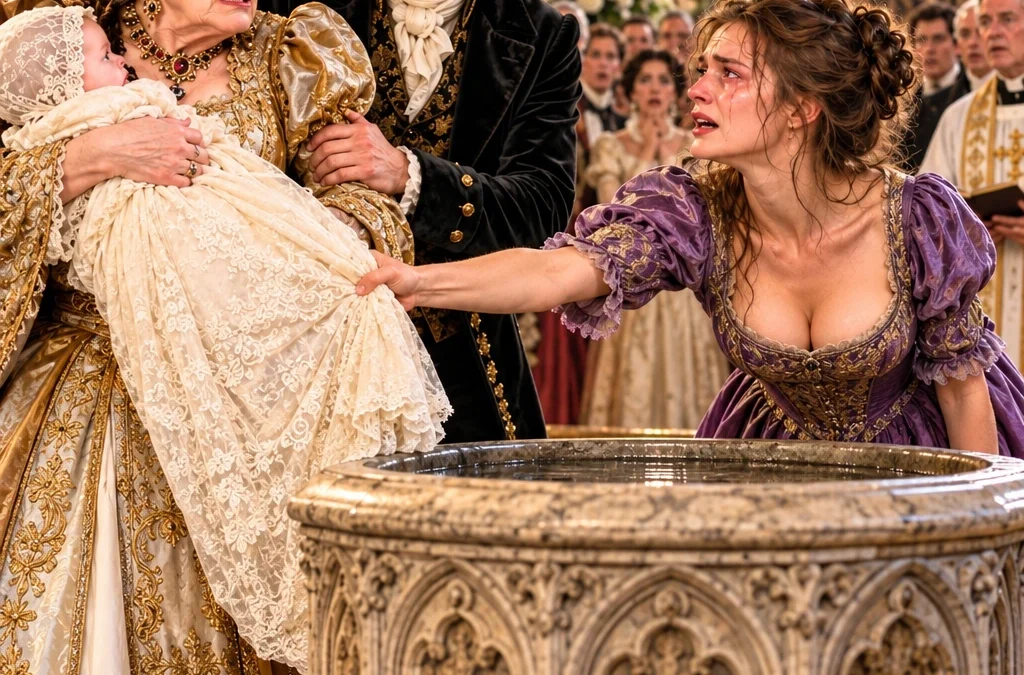
Jonah had been baptized in January in a smoky cottage, so this was his public reception into the church. But the whole county called it a christening, and the whole county came. The Dowager sat in the front pew in lilac silk. Hobart Sprig stood at the end of it. At the font, Barnabas Sturgis held the heir of Godwick in his thin arms, and beside him stood Saraphina Hebdon in white, with Mercy’s ring on her hand.
The Duke stood a little apart, gray-faced and grim.
At the back of the church, the door opened.
A whisper ran down the pews, and every head turned. 😮
Mercy walked up the aisle in the plain gray gown she had been married in and carried away in, stained from a day and a half on the road. She walked straight-backed and unhurried between the staring rows, as if she had been expected.
The Dowager rose, and her voice cracked across the stone.
“Mad woman! That woman is a lunatic, escaped! Sprig, take her out!”
Sprig took one step. Then he looked at the pews, at forty pairs of eyes, and did not take another.
Mercy did not look at the Dowager at all. She walked to the font and laid her hand very lightly on her son’s head, so as not to wake him. Then she turned to face the county.
“I am not mad,” she said, and her voice carried to the back wall. “I never was. And I can prove it.”
She knelt on the font step, unpicked the stitches of her hem with her own fingers, and laid a folded paper, worn soft, on the stone.
“The ninth of January. My son’s baptism, entered in the register of this church, in the curate’s own hand. The mother present, of sound mind, clear and calm.” She lifted her eyes. “Nine days later, a man who looked at me for two minutes in a doorway signed a paper saying I was raving.”
Every head turned to Barnabas Sturgis. He was white to the lips. But something in his thin young face set hard at last.
“That is my hand and my entry,” he said. “She was as sane as any soul in this church. I was told I would lose my curacy if I said so. I am saying so now.” ⚖️
From the back came a hard-faced woman in a borrowed bonnet, with Norman Skelton at her side. Sally Stokes stopped before the font and spoke in a loud, flat voice. Her husband had been paid by the hall to take the Duchess. He had been paid again in January to write that she was dead. Hobart Sprig had brought the money. She would swear to it before any magistrate in England.
Jasper stood where he was, looking at his wife.
She was alive. She was standing ten feet from him with her hand on their son, and the floor of the church had gone out from under him, and he could not feel his own hands.
“You did not write.” He heard himself say it. “Seven months. Not one word until the last.”
“I wrote to you,” Mercy said. “Every letter but the last, I gave to the bag.”
He turned his head very slowly. Who held the bag?
His eyes went down the front pew to his mother, to the small brass key she wore on a chain at her waist, the key she had worn all his life. He walked to her and unhooked the chain from her belt, and every household key in Godwick Hall with it.
“Sprig,” said the Duke. “Go to my mother’s rooms and bring me her writing box. Two gentlemen of the county will go with you, so nothing in it is lost on the way.” 🔑
Nobody left while they were gone.
When the rosewood box was set on the font step, Jasper fitted the little key and opened it before the whole church. Mercy’s letters, two of them, in her small plain hand. Five of his own, addressed to his wife, the seals unbroken. And beneath them all, the thick packet in black wax with three words across the front.
For my wife.
The Dowager came down out of the pew, and all the iron had gone out of her. She was only an old woman in lilac silk with her hands held out.
“Let me hold him, Jasper. Only once more. He is my blood, too.”
Jasper stepped between her and the font. He did not raise his voice.
“You took him from his mother. He will never hold him again.”
The county looked at the floor. Beside the font, Saraphina Hebdon hid her ringed hand in the folds of her white skirts. 😶
Jasper turned to the senior justice in the third pew. “Sir, I lay a charge before you. Conspiracy over a false certificate of lunacy against my wife. Against Ignatius Snell, a physician. Against Samson Stokes, keeper. And against my mother.” He set the ring of keys on the edge of the font. “She leaves Godwick today. She has no place in my house.”
Then he picked up the black sealed packet and held it out to his wife.
“This was left for you on the second of June. It is a settlement. A house and land in Kent, and an income in your own name that no one can touch. Not my mother. Not me. So that you would never again have to be anyone’s use.”
Mercy stared at it. She did not take it.
And the Duke of Godwick, who had never in his life said a wish aloud, said one now before the whole county.
“Because I have loved you since November of 1812. I stood at the back of your father’s church one evening where no one saw me, and heard you read to the sick and the poor. I watched you all night in the storm and could not say it. When I married you, I said I would not trouble you, because you had married me for a roof and I would not claim a wife who had not chosen me. I went to Vienna because my mother hated you for my sake, and I thought if I was gone, she would have no one left to punish. I was wrong. I was afraid of her, and afraid of myself, and it nearly cost you everything.” 💔
The whole last year turned over inside Mercy like a page. The man in the doorway in the storm. The door between their rooms, and his steps that crossed the floor and stopped. You will want for nothing, said in a cold hall with his mother watching from the stairs. Five letters in his hand that never reached her, while she sat at the cottage window and called his silence indifference.
None of it had been cold. All of it had been him.
Before the whole county, the Duke of Godwick knelt on the stone floor.
“I ask your pardon. I have no right to it. I ask it anyway.”
Mercy looked down at her husband and did not answer with words.
She reached past the curate and lifted her son out of his arms herself, and held him against her heart. Jonah woke and looked up at her with his father’s gray eyes, and he did not cry.
That was the end of the christening she had walked into. 😭
Only then did she look down at the man on the floor.
Jasper rose and went to Saraphina Hebdon. He took her left hand without a word and drew the gold band from her finger, and she stepped back into the crowd with her face burning. He came back to his wife. He did not take her hand. He held the ring between them and waited.
“May I?”
And then, because she had taught him how, he said it again. Not as an order, but as a wish.
“I would like to put this back where it belongs. If you will let me.”
Mercy looked at the ring that had been taken at her wedding dinner until she was worthy of it. Worn on the Dowager’s little finger at the cottage door. Slid onto another woman’s hand to comfort a widower. It had never once been the Dowager’s to keep.
She shifted her son to her right arm and held out her left hand.
He put the ring on her finger. It went over the knuckle and settled where it had been for six hours, a year before, and stayed.
“I will stay,” Mercy said. “As your wife. And as nobody’s use.”
He bowed his head over her hand, and she felt his breath shake against her fingers. For a long moment, the Duke of Godwick could not speak at all. 💍
The Dowager Duchess left Godwick Hall that same afternoon in a hired chaise with two trunks and no keys. She did not wait for the Lincoln Assizes. In June, she sailed from Dover for Lisbon, for life, stripped of her place and her name in the county, and she never saw the boy again.
In July, at the summer assizes, with the Duke and Duchess of Godwick sitting side by side in the court, Ignatius Snell and Samson Stokes were tried for conspiracy over the false certificate. Barnabas Sturgis gave his evidence and laid the register beside it, and did not look away from the dock once. Sally Stokes swore to every word. Snell lost his practice. Stokes lost his license and his house. Both went to gaol.
Suki Swale came home from her sister’s in Grantham to a place at the kitchen fire for life, and a salary. Norman and Catherine Skelton were given the finest tenancy on the estate, and a cottage with a chimney that drew. Barnabas Sturgis was given the living of Godwick, and the old mother he had feared for was moved into the vicarage beside him. 🌿
And in August, the long table in the great dining room was laid for the county again.
They came, all of them, the same faces that had laughed at a parson’s girl with a ladle sixteen months before. They came because a duchess had asked them, and they did not dare refuse.
Mercy sat at the head of the table. Not halfway down. Not at the wall. At the head, in a gown of dark blue silk, mistress of Godwick and of a house and land in Kent that were hers alone. The keys of the hall hung at her waist. Jonah sat on her knee, plump and fierce and seven months old, trying to eat a silver spoon. On her left hand, the gold band caught the candlelight.
No one laughed. Several of them could not meet her eyes. 👑
When the guests had gone and the candles were low, Jasper came and sat beside her in the empty dining room and opened a book. It was the book of Psalms her father had used, the one she had read from to the sick and the poor in the church that November, nearly three years gone. He had bought it from the new man at the vicarage at whatever price was asked.
He read to her. He was not good at it. His voice was too careful, and he lost his place twice.
Jonah fell asleep against her shoulder. Mercy leaned her head on her husband’s arm and listened.
For the first time in her life, she was not needed for anything at all. Only loved. 💛
The cruelest people in our lives are the ones who decide what we are worth. The bravest thing we can do is walk into the room where they said it and take back what is ours. 🕊️
This story is entirely fictional and created for entertainment purposes only. It does not represent any organization or individual, nor does it encourage inappropriate behavior. The content was generated with AI assistance.








