SHE SHOWED UP FOR A JOB NO ONE WOULD GIVE HER… THEN FOUND SOMETHING THAT TERRIFIED THE TOWN AND DESTROYED A POWERFUL MAN’S PLAN
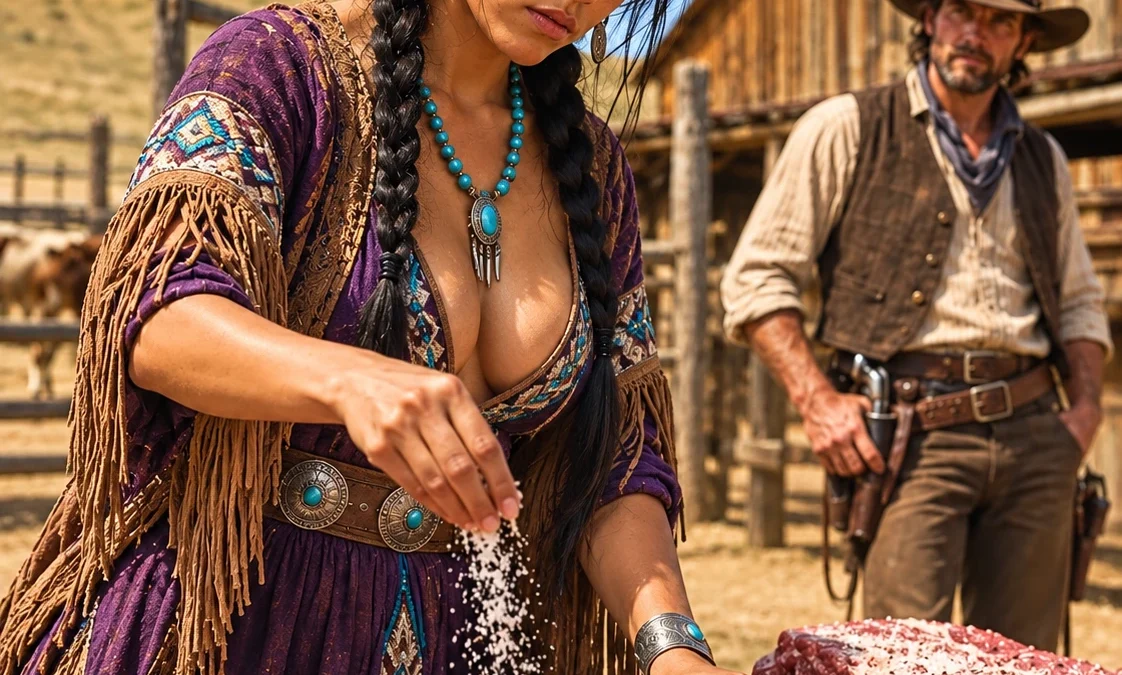
SHE SHOWED UP FOR A JOB NO ONE WOULD GIVE HER… THEN FOUND SOMETHING THAT TERRIFIED THE TOWN AND DESTROYED A POWERFUL MAN’S PLAN 🔥
Part 1
The sun hung low and hot over Ridgerest, Arizona Territory, when Ayana Red Feather rode up to Hayes Ranch.
The gate stood open, nailed to it a rough sign: NOT HIRING.
She didn’t turn back.
She’d traveled two days through dust and heat because this was the place her grandfather had spoken of—the land that held water the settlers had forgotten, and secrets they’d never learned.
Colton Hayes watched her from the porch.
He was thin, worn down by years of drought and debt, his cattle listless in the fields, his bank deadline looming like a storm cloud.
He’d sent for help to run the house, not to save the ranch—and he’d expected someone else entirely.
When he saw Ayana, Apache, quiet, carrying nothing but a worn leather satchel and a steady gaze, he hesitated.
But something in her bearing made him step down to meet her anyway.
Within hours, word had flown to Walter Crane.
He owned the biggest ranch in the territory—eight hundred head, prime land, water rights others would kill for—and he’d been waiting three years for Hayes Ranch to collapse.
He’d pulled strings, leaned on the bank, let the drought do its worst, certain the land would be his for pennies.
When he heard an Apache woman had arrived, he laughed.
“Desperation,” he told his foreman.
“He’s reached for anything.
It won’t change a thing.
”
Ayana wasted no time.
On her third morning, she led Colton, Wesley—the ranch’s loyal foreman of twenty-three years—and the hands to Northwest Ridge.
She pointed exactly where to dig: the angle, the depth, the direction to turn.
Garrett, usually the most skeptical of the crew, spoke up after an hour of shoveling.
“This is just rock.
How can you be so sure?”
“Keep digging,” Colton said quietly.
He didn’t know why he trusted her, but he did.
Another hour passed.
Then Cole’s shovel struck something solid.
A hollow thud, a low rumble rising from deep in the earth—like something waking after a long sleep.
Ayana knelt, pressed her palm to the damp earth, and stood.
“Two feet deeper,” she said, her voice calm but firm.
“Angle left.
”
They obeyed.
And then it happened.
Water surged up—not a trickle, not a seep, but strong and clear and cold, rushing as if it had been held back for a lifetime, soaking their boots before anyone could step back.
The spring they’d all said didn’t exist was there, exactly where she said it would be.
Wesley took off his hat and stood silent.
Cole stared open-mouthed.
Garrett looked away, ashamed he’d doubted her.
“How?” Colton asked, wiping water from his hands, his voice thick with wonder.
“How did you know?”
“My grandfather brought me here when I was eight,” she told them.
“He said: ‘Remember where the water is.
A time will come when the people above it forget.
And the land will need someone who still knows.
’”
Three weeks later, the trough ran full for the first time in four summers.
The cattle lifted their heads, moved with purpose, jostling and drinking—alive again.
But word reached town fast.
Patterson at the general store refused to sell Ayana the pipe fittings she needed.
On the ride back, Crane’s man Dobs stopped her wagon.
“Tell your boss Crane sends his regards,” he sneered.
“And tell you—an Apache can’t run a ranch that’s already dying.
Save yourself the time.
”
Ayana didn’t flinch.
“Tell Mr.
Crane I’ve seen the water table here.
Deeper and cleaner than anything on his land.
He should worry about his own ranch.
”
When she told Colton, his jaw tightened.
He explained the truth: Crane hadn’t just waited for the drought—he’d engineered it.
Called in loans, pressured the bank, forced other ranches into ruin so he could buy them cheap.
And now the September deadline was approaching.
If they couldn’t pay, Hayes Ranch would be his.
But Ayana had more to reveal.
That night, she laid a rough map on the kitchen table.
“There’s something else,” she said.
“The ridge where we dug… my grandfather called it the Red Wealth.
He said it holds iron ore—high-grade.
If I’m right, this land is worth ten times what Crane is offering.
More.
”
Colton stared at her.
Iron ore.
The railroad was pushing through the territory.
Whoever controlled that ridge would hold a fortune.
“He knows,” Ayana said softly.
“That’s why he wants this land so badly.
He’s not just after grazing fields.
He’s been waiting for someone to give up and hand it over.
”
Before anyone could speak, Wesley appeared in the doorway, his face grave.
“Crane’s men,” he said.
“Riding the ridge right now.
Taking notes.
Surveying from the property line.
”
Colton started for the door—Ayana caught his arm.
“Don’t,” she said firmly.
“If you confront them, they know you know.
Let them look.
They won’t see what matters from outside the fence.
”
They stood frozen as the riders moved slowly along the ridge, inspecting the rock, marking their findings.
Then they turned and rode east—straight toward Crane’s headquarters.
“They’ll be back,” Colton said quietly.
Ayana nodded.
“And we need to move faster.
We send for an independent assayer—tonight.
”
Part 2
They wrote the letter that very night—carefully, deliberately, hiding all urgency.
Wesley signed it; he knew Rudolph, the assayer, from years past.
A rider left at dawn.
Ten days later, Rudolph arrived: quiet, precise, hands stained with minerals, a man who let rocks speak louder than words.
He walked the ridge alone for forty minutes, chipping samples, tasting the water, studying the lay of the land.
When he came back down, his expression had shifted—careful, guarded, impressed.
“You were right,” he told Ayana.
“High-grade iron ore.
Significant deposit.
Extends four hundred yards along the ridge, depth unknown.
Commercially viable.
”
Then Ayana dropped the next revelation.
“The northwest boundary—your father had it resurveyed in 1879,” she said to Colton.
“It was shifted east.
Part of the ridge might sit inside the original 1871 line… and outside the newer one.
”
They dug through old papers by lamplight until midnight.
There it was: the 1871 survey, faded but clear.
The entire ore formation fell within the original boundary.
The 1879 adjustment had been a convenience—not a legal change.
“If we file both documents together,” Ayana said, “the ridge is all ours.
”
They filed at dawn before the town woke.
But a witness saw them.
By afternoon, the news reached Crane.
Two nights later, at 2:00 a.
m.
, Cole smelled smoke.
The east fence was burning—not in one spot, but three, spaced perfectly apart, as if lit on purpose.
The fire spread fast, driven by a sudden rising wind, heading straight for the barn and the cattle pens.
Everyone ran—Cole with wet sacks, Wesley to open gates, Colton hauling water.
And Ayana didn’t run away from the flames.
She ran toward them.
She reached the gatepost first, beating the fire back with wet burlap, methodical, focused, knowing exactly which section to hold.
Colton arrived seconds later, working beside her, heat stinging their faces, smoke stinging their eyes.
Together they beat the fire back from the gate.
Wesley and Cole contained the rest.
In twenty minutes it was over—fence scorched but standing, cattle safe, barn untouched.
They stood breathing hard, covered in ash.
Ayana stared at the blackened posts, her expression cold and clear.
“Three separate points,” she said.
“This wasn’t an accident.
He saw us file.
He’s trying to overwhelm us with repairs and fear so we can’t fight back.
”
By sunrise, Wesley rode for the marshal.
Colton filed a formal report of suspected arson.
But Crane didn’t send riders next time—he sent Margaret Hail, his lawyer, in a fine carriage, flanked by armed men.
She stepped onto the porch, composed and direct.
“Mr.
Crane makes a final offer,” she said, naming a sum so large it made Colton pause.
“If you refuse, he will challenge the 1871 boundary in court.
He claims the 1879 survey is the only legal one—and half your ore lies outside it.
”
Colton stood tall.
“Tell him we will see him in court.
”
Margaret Hail’s eyes flicked to Ayana, standing beside him.
For the first time, her composure faltered.
“And you?” she asked.
Ayana met her gaze.
“Tell him we hold the original documents.
And we will defend them.
”
The lawyer left.
Immediately, Ayana turned to the others.
“He’s bluffing about one thing—he doesn’t want court.
He wants us to fold before it gets there.
But we have a bigger problem: the bank deadline is still six weeks away.
If we can’t pay, the land goes to auction—ore or no ore.
”
Their attorney Harrove arrived that evening with a plan: lease mineral rights to the Arizona & Pacific Mining Company.
They would pay a large advance—enough to clear the debt immediately.
But the clock was ticking.
The mining representative would arrive in five days.
And Crane was already working behind the scenes to stop them…
Part 3
Arizona & Pacific’s representative Caldwell arrived four days later—sharp, brisk, a man who wasted no time.
He inspected Rudolph’s report, examined the documents, and walked the ridge.
Ninety minutes was all he needed.
Back at the table, he named the advance figure.
Colton kept his face steady only by sheer will—it was enough to pay the bank in full, with money left over.
“The land stays yours,” Caldwell confirmed.
“We lease mineral rights only.
Cattle operation continues as before.
Term: thirty years.
”
Harrove reviewed the contract overnight, added three protections, and Caldwell accepted them without argument.
They signed at dawn.
As Caldwell shook hands, he turned to Ayana.
“You identified the indicators,” he said.
“If you ever find another deposit anywhere in the territory—send word directly.
We listen.
”
After he left, Colton stood in the yard holding the signed agreement, feeling lighter than he had in years.
“Crane dropped the court challenge,” he told Ayana quietly.
“Harrove got word this morning.
Word of the mining deal reached town yesterday.
He knows he can’t win now.
”
Ayana searched his face.
“You knew before we signed?”
“I did,” he admitted.
“I wanted to be sure we’d done it on our terms, not his.
” He took a breath, steady and sincere.
“Ayana… I’d like you to stay.
Not as help.
Not as an employee.
As partner.
Your name on the deed.
Equal share.
”
For a long moment she said nothing.
Then: “My grandfather said the land chooses who stays.
I think this one chose me the day I rode through that gate.
” She met his eyes.
“I’ll stay.
On one condition: the spring, the knowledge that saved this place… it goes into the record.
Named.
Acknowledged.
Not erased.
”
“Done,” Colton promised.
They rode into Ridgerest the next morning to pay the bank.
The air felt different—people watched, but not with pity anymore.
Patterson at the store nodded.
The banker Whitmore processed the payment early, his manner flustered, avoiding their eyes.
As they mounted to leave, Wesley let out a long breath he’d seemed to hold for years.
“Your father would be proud,” he said softly.
But back at Crane’s ranch, the news hit like a blow.
He stood at his window, silent, long after the messenger left.
“An Apache woman,” he murmured—not with scorn this time, but with something colder: realization.
He had underestimated her.
Badly.
Three weeks later, the truth came out—not from the marshal, but from Peters, the supply rider.
Weighted by guilt, he went to Delaney: he’d been paid to report Ayana’s arrival; he’d seen Crane’s men near the ranch the night of the fire; he’d watched the pressure applied to the bank.
The warrant was served.
An investigation opened.
One by one, others stepped forward—ranchers who’d lost their land, witnesses who’d stayed silent too long.
Colton told Ayana the news that evening.
She read Peters’ statement slowly, then set it down.
“He made it right,” she said.
“That matters.
”
“You see things differently than most,” Colton observed.
“Justice isn’t one line,” she replied.
“It’s mending what’s broken.
”
The deed was recorded in October: Hayes and Red Feather Ranch.
Ayana’s name stood there, equal and permanent.
The mine expanded, the railroad came through, and the ranch thrived—not overnight, but steadily, honestly.
Some in town adjusted slowly; some never would.
But Patterson offered full credit and fair prices; children waved when they rode past; and the new hands learned the story on their first day.
They gathered for Wesley’s sixtieth birthday that month: Cole’s lopsided cake, Garrett’s shared whiskey, Ayana’s feast, all of them crowded around the table.
Wesley raised his glass, eyes bright.
“Best thing that ever walked through that gate,” he said, looking at Ayana.
“And she didn’t even let the sign stop her.
”
Ayana lifted her glass in return.
“To the land that waited,” she said simply.
Outside, the cattle grazed calm and full.
The spring ran clear and steady from the ridge—named, remembered, honoured.
And somewhere under the earth, the Red Wealth waited, too: not just ore, but proof that knowledge kept alive can save a home, that respect can rebuild what greed tears down, and that sometimes the one who changes everything is the person no one expected to show up at all.
This story is entirely fictional and created for entertainment purposes only.
It does not represent any organization or individual, nor does it encourage inappropriate behavior.
The content was generated with AI assistance.








