SHE SIGNED THE ANNULMENT WITHOUT A WORD… WALKED OUT CARRYING HIS CHILD… AND 4 YEARS LATER, A STRANGER’S CARRIAGE ROLLED INTO HER VILLAGE AND HE SAW THE BOY’S EYES
SHE SIGNED THE ANNULMENT WITHOUT A WORD… WALKED OUT CARRYING HIS CHILD… AND 4 YEARS LATER, A STRANGER’S CARRIAGE ROLLED INTO HER VILLAGE AND HE SAW THE BOY’S EYES 😱
Part 1
The ink on the annulment papers was still wet when the nausea hit her.
It wasn’t grief. It was the undeniable, fluttery tightening low in her belly.
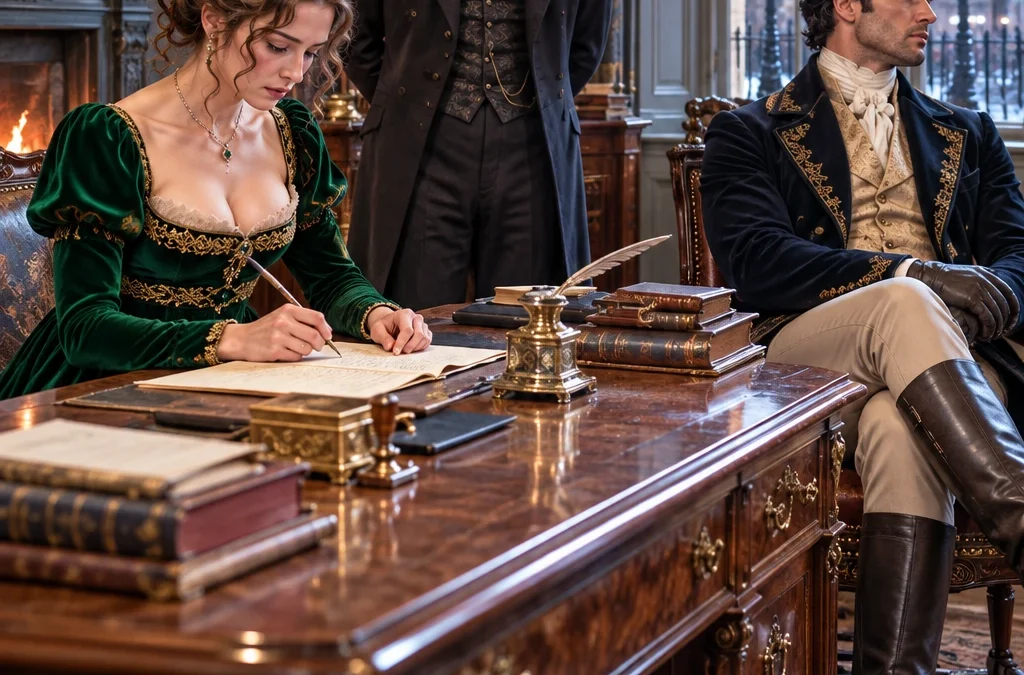
He sat across the mahogany desk, not looking at her, already moving on in his mind to his horses, his estate, his life unburdened.
She could have spoken. One sentence would have trapped him forever.
Instead, Norah laid the quill down, smoothed her skirts, and walked out, carrying his heir. 💔
The solicitor’s office smelled of dust, old wax, and the quiet death of a marriage. Mr. Finch, a man made entirely of sharp angles and gray wool, cleared his throat. It was the only sound in the room, save for the relentless ticking of the grandfather clock in the corner.
Norah stared at the parchment.
Non-consummation.
That was the lie they had agreed upon. The cleanest way out. A quiet annulment, a generous settlement, a mutual dissolving of an error made by two desperate families.
Across the wide desk sat Alistair, Lord Wickliffe, her husband of exactly eight months and twelve days. He was staring out the window at the rain lashing the glass, his jaw set in that familiar rigid line. He wore his indifference like armor. He had not looked at her since she entered.
“If you would sign at the bottom, Lady Wickliffe,” Mr. Finch murmured, sliding the heavy parchment toward her.
Norah did not reach for the quill. A wave of dizziness washed over her, hot and sudden, settling in her throat. She gripped the armrests until the leather creaked.
It was the third morning in a row. She knew what it meant. She was twenty-two, but she was not a fool. Her courses were three weeks late. Her breasts ached with a dull, heavy persistence.
And the lie on the paper glared up at her.
It had happened exactly once. Six weeks ago. A stormy night at his country estate, after a screaming match about his emotional absence and her stifling misery. The anger had splintered, leaving behind a raw, ugly desperation. They had fallen into each other like two people drowning.
It hadn’t been tender. It hadn’t fixed anything. When they woke, the cold reality of their incompatibility remained, and they had silently agreed never to speak of it.
Two days later, he suggested the annulment.
She picked up the quill. It trembled in her grip.
If she spoke now, everything would halt. Alistair would tear the paper to shreds. He was a man of agonizing duty. He would bind her to him forever, locking her away in the country while he lived his separate life in London, chained together by a child. A child raised in a house of ice.
Norah looked at him. Really looked. The broad shoulders. The dark hair brushed perfectly into place. The profile that might have been carved from flint.
He was a good man, perhaps. But a terrible husband.
He had never wanted her.
She pressed the nib to the paper and signed her maiden name with sharp, aggressive strokes. Norah Lynfield.
Alistair turned his head at the scratching sound. For a fraction of a second, his eyes met hers. Pale, striking gray, and entirely empty. No relief. No sorrow. Only the hollow echo of a transaction completed.
“It is done,” Mr. Finch said softly. “My lord. Miss Lynfield. You are free of one another.”
Alistair stood and shrugged on his dark overcoat. “I will have the funds transferred to your brother’s account by morning.”
“That is not necessary. But thank you.”
“It was the agreement.” He picked up his hat. “I wish you well, Norah.”
“And I, you.”
He gave a short, rigid bow. He did not wait for her. The heavy oak door clicked shut behind him.
Norah stood alone. She placed a gloved hand flat against her stomach. Beneath the corset and the layers of wool, a life was already taking root. His blood. The very thing that would have secured her place in society forever.
She walked out into the rain.
In the hackney, she closed her eyes. Her brother was a weak, grasping man who would sell her secret to Alistair the moment her waistline thickened. She could not go home. She could not stay in London. But the settlement money, guilt money, was already sitting in a private account she had opened under an assumed name days before, anticipating this very moment.
It was enough. It had to be.
The carriage lurched forward. A sharp bark of laughter rose in her throat and turned instantly into a sob. She was terrified. She was utterly alone.
But as she pressed her hand deeper against her stomach, a fierce, protective heat bloomed in her chest.
For the first time in eight months, she belonged entirely to herself.
And the child would be hers alone. 🌊
The wind off the Devonshire coast did not politely knock. It battered the cottage walls like a desperate beggar.
Six months had passed. Norah sat by the hearth, wrapped in a thick woolen shawl, vast and cumbersome now, her back aching with a grinding throb no rest could ease. Here, in this isolated fishing village, she was simply Mrs. Lynfield, a widow whose husband had been lost at sea. It was a common enough tragedy in Devon. It asked no questions.
A sharp rap at the door startled her. The post boy thrust a crumpled letter into her hand and bolted.
The handwriting was elegant, slanted, painfully familiar. Clara, her one remaining tether to the world she had burned.
The season is dreadfully dull. The Duke’s ball was a cramped affair, though I must tell you, Wickliffe was there. He looks entirely unchanged, Norah. Perhaps a bit harder around the eyes. There are rumors his family is pressing him to marry again. They say he needs an heir now more than ever, given his father’s failing health…
Norah stopped reading. The paper rattled in her shaking hands.
He needs an heir.
She looked down at the massive swell of her stomach. The heir was here, kicking against her ribs. She tossed the letter into the fire and watched Alistair’s name curl into ash.
“All right,” she murmured, stroking the tight skin. “All right, little fighter. It is just you and I.”
And she realized, for the first time, that she didn’t want to be saved.
The pain did not arrive in waves. It came as a collapsing wall.
The Devon summer was merciless. In a narrow rope-strung bed, with Mrs. Higgins, a fisherman’s widow who had pulled half the village into the world, barking at her to push, Norah bore down with a guttural sound torn from her throat.
In London, women of her station were given laudanum and soft voices. Here there was only a horsefly buzzing against the pane and the blinding agony of her own body.
She thought of Alistair, not with longing, but with vicious anger. He was likely in his immaculate study, drinking brandy, entirely untouched.
The anger gave her strength. She pushed.
Then came a thin, reedy wail.
“A boy,” said Mrs. Higgins, laying the bundle on her chest.
Norah looked down. The child was red and furious, tiny fists clenched, a shock of dark hair plastered to his skull. Then he opened his eyes.
Not the muddy blue of most newborns.
A startling, pale gray.
A cold spike of dread pierced her exhaustion. It was Alistair’s face. It was as though she had been erased from the equation entirely.
“What will you call him?” the midwife asked.
“Leo,” Norah whispered. “Leo Lynfield.”
Four years later, the name suited him perfectly. Leo was a force of nature, shaped by salt air and cold wind. He ran barefoot across the rocky beach, hauling kelp, chasing village dogs. And Norah, tanned, rough-handed, her nails chipped from scraping mussels off rocks, had never been happier.
But it was a fragile peace.
It cracked on a Tuesday in late autumn.
She was in the village square, trading salted cod for flour, when a heavy rumble drew her eyes. A black lacquered carriage, drawn by four magnificent bays, rolled down the muddy street. The village fell silent.
A man stepped out. It wasn’t Alistair. Relief flooded her, and was instantly replaced by panic.
She knew him. Viscount Halloway. A member of Alistair’s club. A man who had attended her disastrous wedding.
She dropped her chin and pulled her shawl over her hair. “Leo! Come!”
But Leo had dropped his dead crab. The shiny carriage had caught his eye. He marched straight toward it.
Halloway turned. His gaze fell on the boy in the dirt-smudged tunic. On the dark hair. On the pale gray eyes staring defiantly back at him.
A strange, puzzled expression crossed his face.
Norah grabbed Leo’s arm and ran. She didn’t stop until the cottage door was bolted behind them. She sank to the floor, burying her face in his neck.
“Mama, you are squeezing me!”
“I know, my love. I am sorry.”
Halloway might not have recognized her in rough clothes.
But he had looked at the boy.
And he had seen the ghost of Lord Wickliffe standing in the Devonshire mud. 🔥
Part 2
He had seen the ghost of Lord Wickliffe standing in the Devonshire mud.
London tasted of coal, dust, gin and obligation.
Alistair stood at the window of his cavernous study, a crystal tumbler of untouched amber in his hand. His father was dead. The late Earl had finally succumbed to a ruined liver and a lifetime of terrible decisions. The title was Alistair’s now, along with a mountain of hidden debts, a decaying country estate, and the relentless demand from his family to secure the bloodline.
He did not miss Norah. He was not a man given to sentiment. Their marriage had been a tactical error. The annulment was the only logical correction to a faulty equation.
Yet he thought of her, occasionally, in the dead of night. Of that single violent night in the country. An anomaly in his perfectly structured life.
A knock. His new solicitor, Mr. Caldwell, entered with a stack of leather ledgers.
“I have finished auditing the late Earl’s accounts, my lord. In reviewing outgoing funds from four years ago, I found a discrepancy.”
Alistair frowned. He hated discrepancies.
“When your annulment was finalized, you ordered ten thousand pounds transferred to Mr. Thomas Lynfield, your former wife’s brother. The brother was in bankruptcy proceedings. The funds were rerouted, by a secondary order, to a private banking house in Exeter. Under the name Mrs. E. Lynfield.”
Alistair sat forward.
“The lady never went to her brother’s estate, my lord. She took the money and vanished into the country. The account has been drawn upon steadily for four years. Small, modest withdrawals. Butcher bills. Flour. Coal.”
The neat black ink seemed to mock him.
Norah had lied. She had vanished with his money and built a quiet, fiercely independent life entirely off the map.
A strange, unfamiliar spark ignited in his chest. It was not anger. It was a sharp, clinical curiosity.
Why?
“Close the account,” he said abruptly. “If she is living under an assumed name, she will have to explain herself to me.”
Three days later, he was on a train bound for Exeter.
He tracked the drafts to a fishing village on the Devon coast called Oak Haven. Gray stone cottages huddled against the sea. The air smelled violently of salt and dead fish. It was no place for a woman raised in silk.
He spotted her from fifty yards away.
She was hauling a heavy wooden bucket up from the surf, in a faded blue dress, the hem soaked with seawater, her hair braided loosely down her back in wild, wind-blown strands. She moved with a physical strength he had never seen in her. She hoisted the bucket onto the seawall with a grunt and wiped her brow with the back of a tanned, bare hand.
She looked entirely foreign. And yet it was undeniably her.
His boots crunched on the gravel. Norah froze. The tension in her shoulders snapped tight, as if she could feel him altering the air pressure behind her.
Slowly, she turned.
All the color drained from her sun-browned face. The bucket slipped from the wall, crashing onto the rocks, spilling seawater and crabs across the stones. She didn’t look at the mess.
“Hello, Norah,” Alistair said.
Before she could answer, a high, clear voice pierced the silence.
“Mama! I found a seagull feather!”
Running up the stone path from the beach was a small boy. Three or four years old. Heavy woolen trousers, a rough tunic. He skidded to a halt, grabbed a fistful of her wet skirt, and looked up at Alistair.
Alistair felt the breath knocked out of his lungs.
He was staring down into his own pale gray eyes. Set in a face that was a flawless miniature of his own. The same stubborn jaw. The same thick, dark hair.
The crashing sea, the wind, the crying gulls went entirely silent. 😨
“Mama,” the boy said, tugging her skirt. “Who is this?”
Alistair shifted his gaze to Norah. The shock in his chest was crystallizing into something else. Ice. Cold, terrifying ice.
“Four years,” he said, barely a whisper, yet it cut through the wind with absolute clarity. “Four years, Norah.”
She stepped in front of the boy, her wet skirts shielding him, her hands dropping protectively to his small shoulders.
“You perjured yourself,” Alistair said, taking a slow step closer. “You signed a legal document swearing the marriage was never consummated.”
“And you signed it right beside me. You wanted the escape as much as I did.”
“I paid for a clean break. I did not pay for you to steal my bloodline.”
“Is he mine?” he demanded.
“He is mine,” she snarled.
“Look at him, Norah.”
“You robbed me?” she shouted, the veneer of calm shattering. “I saved him. From a freezing house, and a father who looks at everything like a ledger entry. I saved him from you.”
Inside the small cottage, Alistair ducked under the low doorway and stood in the center of the single room, taking up all its air. He took in the narrow stone hearth, the rough hewn table, the two wooden chairs.
“His name is Leo,” Norah said, pushing the boy gently toward a corner of wooden toys. “Go play. Mama must speak with the gentleman.”
“Leo,” Alistair repeated. Not an ancestral name. “He is the next Earl of Wickliffe. And you have hidden him from me. Do you have any conception of the legal ramifications?”
“The scandal would ruin you too.”
“My father is dead,” he said flatly. “Two months ago. I hold the title now. The estate is in chaos. I need an heir. And here I find one, already four years grown, playing in the mud.”
“You cannot just take him. He does not know you. You would break him.”
“He is my son.” Alistair backed her against the stone mantelpiece. “You played God with my blood. You lost the right to lecture me on morality the moment you forged your name on that annulment.”
She did not shrink. The heat of the fire behind her matched the rage in her veins.
“I survived,” she said, low and steady. “I survived you. And I will protect my son with my last breath.”
He stared down at her. She was not the quiet, weeping girl he had discarded. She was a woman carved from salt and stone.
“We will see about that,” he said.
He did not leave.
For three days, Alistair took a room at the village inn and became a silent, imposing fixture in Oak Haven, asking quiet, precise questions about Mrs. Lynfield and her fatherless son. He was building a cage around her, iron bar by iron bar, without ever laying a hand on her.
On the fourth morning, under a bruise-purple sky promising a storm, he came to her door.
“The legalities are precarious,” he said, maddeningly conversational. “To claim the boy as my heir, I must prove paternity. To prove paternity, I must admit we consummated the marriage before the annulment was filed.”
Norah swallowed hard.
“Which renders the annulment legally void. Fraudulent.” He shut the door himself. The sudden quiet was suffocating. His gray eyes locked on hers.
“Legally, Norah, we are still married.”
The words dropped like stones.
Part 3
Norah backed away until her hips hit the edge of the wooden table.
“No. The church granted it. Your solicitor filed the papers. It is done.”
“It was based on a lie. A lie you perpetuated to steal my child.” Alistair walked to the hearth, running a gloved hand along the rough stone mantel. “If I take you to court, the scandal will be absolute. My creditors will panic. My family name will be dragged through the mud. And you will be painted as a manipulative, hysterical woman who kidnapped an earl’s son and raised him in squalor. Who do you think a judge will side with? A wealthy earl, or a ruined woman living under a false name?”
Norah closed her eyes. A single tear slid down her cheek, hot and bitter. She knew exactly how society worked. She had fled it for that very reason.
“What do you want?” Her voice cracked. “Will you bring guards to drag a screaming child into your carriage?”
Alistair stopped pacing. He truly looked at her. Her face was pale. Her shoulders were bowed under the weight of defeat. He felt a strange, uncomfortable tightening in his chest. It wasn’t pity. Pity was useless. It was something darker and more possessive that he did not understand.
“No,” he said quietly. “I will not traumatize my son. Nor will I endure a public court battle.”
She opened her eyes, daring to hope.
“You are coming back to London with me. Both of you.”
The hope vanished.
“You will be Lady Wickliffe. We will say the annulment was an error, an overreaction during a temporary separation, quickly remedied. The boy was conceived before. You retreated to the country for your health. It is a plausible lie. Society will gossip for a month, and then they will move on.”
“You are asking me to put my head back in the noose.”
“I am offering you a choice.” He stepped forward until he stood over her. “Return to London as my wife, and you keep your son. Or refuse, and I will unleash the full weight of the law to take him from you, and leave you here with nothing. Choose.”
From the alcove, Leo called out, thick with sleep. “Mama?”
She looked at the alcove. Then at the man who had just destroyed the sanctuary she had bled to build.
“Fine,” she whispered, the word tasting like ash. “I will go.”
Oak Haven did not say goodbye. Fishermen paused in their mending and women stood in low doorways, faces impassive, as the black carriage swallowed the widow Lynfield and her boy.
Inside, the air was suffocating. Norah sat stiffly in the corner holding Leo. The boy vibrated with terror and awe, his gray eyes darting over the brass fittings and velvet curtains, and the imposing man on the opposite bench.
Alistair did not attempt conversation. He read his estate correspondence as though the last four years had been a brief administrative delay.
“Is this a king’s box?” Leo whispered loudly.
“It is a carriage,” Norah murmured.
“It is our carriage,” Alistair corrected, without looking up.
Leo frowned. He looked at Alistair, then at his mother. Then he said, in the plain clear voice of a four-year-old:
“He is my father.”
The words hung in the small space, sharp as a blow.
Norah stiffened. She had spent a frantic, tear-stained hour explaining a clumsy fiction to him before they left, that his father had not died at sea, but been lost, and now was found.
“Yes,” she said hollowly.
Alistair finally looked up. He studied the boy with the clinical intensity of a man appraising a prized, unbroken colt.
“Do you know what a father is, Leo?”
Leo jutted out his chin. It was exactly the way Alistair set his own jaw when defied.
“A father teaches you to tie knots. Robby’s father does. He takes him on the boats.”
“I do not own fishing boats. I own land. Farms, houses, forests. One day you will own them.”
Leo looked entirely unimpressed. “Can I have a dog?”
Alistair blinked. The question derailed his aristocratic authority completely.
“A big one,” Leo insisted. “Like Old Scruff in the village. He chases the gulls.”
“We will see,” Alistair said, retreating behind the vague dismissal of an adult with no intention of yielding.
London was choking on coal smoke and twilight when the carriage turned into the iron gates of Wickliffe House. The townhouse was a fortress of pale Portland stone, exactly as she remembered it. Massive, cold, and devoid of life. A museum meant to display wealth, not a home meant to hold a family.
The head butler, Mr. Graham, stood in the doorway with a line of servants. “Welcome home, my lord.” His gaze shifted to Norah, and for a fraction of a second, the impeccable mask slipped. “Welcome home, my lady.”
The lie had officially begun.
“Lady Wickliffe has returned from the country,” Alistair said, handing his gloves to a footman. He placed a heavy hand on Leo’s shoulder. “And this is my son. Viscount Lindley.”
A silent shock rippled through the staff. The resemblance was too absolute to deny.
“Have a nursery prepared on the second floor.”
“No,” Norah said sharply. The word echoed in the marble foyer. “He sleeps in my room. He does not know this house. He does not know you. I will not have him banished to a nursery with strangers.”
Alistair hated insubordination in front of the staff. But looking at the feral panic in her eyes, he calculated the cost of a scene.
“Very well. Put a cot in her ladyship’s dressing room, Graham.”
He walked to his study and shut the door with a resonant thud.
The invasion began at dawn. Dressmakers, tailors and governesses descended on the master suite.
“Keep your pins away from him!” Norah snapped, swatting a tailor’s hand as he tried to fit Leo for a velvet jacket. “He is four years old. He needs clothes he can run in.”
Alistair entered, impeccable in a charcoal morning coat, and ended the argument with his presence. “Dress him appropriately for the park. Nothing excessively restrictive. But he cannot look like a dock worker. We are taking the carriage out at noon.”
“The park?”
“We must be seen, Norah.” He lowered his voice. “The rumors of my trip to Devon have already reached the clubs. You are my wife. He is my son. We are a unified front.”
At noon, Hyde Park swarmed with the aristocracy. Norah sat beside him in the Landau in a new emerald silk gown that felt like a beautiful straitjacket, while Leo, in a dark blue sailor suit, spent the entire ride attempting to remove it.
Heads began to turn. Alistair tipped his hat, offering nothing but a polite nod. He did not explain. He let the sight of them do the work.
“Wickliffe!” a loud voice called.
Norah shrank back against the leather. It was Viscount Halloway, riding alongside on a magnificent gelding. His eyes darted to Norah, then to Leo. A slow realization spread across his face.
“Halloway,” Alistair greeted smoothly. “Beautiful day for a ride.”
“I had no idea Lady Wickliffe had returned to town.”
“Her health has finally permitted her to leave the country air.” Alistair lied with effortless grace. He gestured to the boy. “I believe you have not properly met my son, Leo.”
Halloway remembered the mud-spattered child by the docks. The fiercely protective woman in the rough shawl. He looked at Alistair, recognizing the sheer audacity of the lie.
But Halloway was a man of society. You did not call an earl a liar to his face.
“A fine boy,” he managed, his smile strained. “He favors you, Wickliffe.”
“He does,” Alistair agreed calmly. “Good day.”
The carriage rolled on. Norah’s hands trembled in her lap. “He knows. He knows you are lying.”
“It does not matter what he knows,” said Alistair, staring straight ahead. “It matters what he can prove. And he can prove nothing.”
Dinner that evening was a spectacular disaster.
Three places were set at a table large enough for twenty. Leo lasted exactly twelve minutes. He did not understand the heavy forks. He did not like the cream-heavy soup. He despised the high-backed chair.
“Eat your soup, Leo.”
“It tastes like fat. I want fish.”
“We are not having fish. You will eat what is prepared.”
Leo slammed his spoon against the mahogany. The crack made a footman jump.
“Do not strike the table,” Alistair warned, in a dangerous register.
Norah reached for his hand. “Leo, stop—”
But the boy was tired and overwhelmed. He shoved the bowl. It tipped, spilling thick cream soup across the white linen and onto Alistair’s cuffs.
Silence slammed into the room. 😳
Norah froze. She knew Alistair’s temper. It was never loud, but it was absolute. She braced herself, ready to pull Leo from the chair and run.
Alistair slowly laid his napkin beside his plate. He looked at Leo, who shrank back, realizing he had crossed a line.
Then Alistair stood. He did not yell. He took his spoon, reached across the table, and calmly tapped the back of Leo’s hand.
“In this house, we do not throw food like animals. If you do not wish to eat, you may be excused. But you will not throw a tantrum. Apologize to your mother.”
“Sorry,” Leo mumbled.
“Go to your room.”
Leo slid off the chair and ran. Norah sat frozen. Alistair picked up his wine glass and ignored the ruined soup.
He had not exploded. He had not been cruel. He had simply established a boundary with terrifying efficiency.
And Norah realized, with sinking dread, that the real danger wasn’t that Alistair would break her son.
It was that he would methodically raise him.
That night, Leo slept in the center of the great four-poster, small limbs sprawled in a star across the white sheets. Norah pulled a blanket over his shoulders. Then she walked down the dim corridor and found herself before the oak doors of Alistair’s study. The door stood an inch ajar.
He sat behind the same desk where she had signed the annulment. A single crystal glass of brandy sat untouched near his hand. Without the armor of formal dress, he looked startlingly human.
“He is asleep,” she said.
“I assumed.”
“You handled him. You did not break him, but you did not coddle him. It frightened me.”
“Why?”
“Because it means you intend to mold him.”
Alistair looked past her at the dark portrait of the late Earl above the mantel. “My father would have dragged me from the chair by my ear for spilling that soup. I learned obedience through absolute terror.” His voice was devoid of inflection. “I will not use terror on my son. But I require order, Norah. Without discipline, the world devours you.”
“He is a boy. He needs love, Alistair. Not just survival tactics.”
“And you have given him enough love for two lifetimes.” He stood and walked around the desk. “You made him resilient. I saw the way he stood between us on the beach.”
He stopped a few feet from her.
“You think I dragged you back purely for the title? Initially, yes. But watching you, you are not the terrified girl who wept when I left for the country. You are forged in iron. You fought me to a standstill.”
“I will always fight you when it comes to him.”
“I count on it.”
The admission hung in the air. It was a treaty, a recognition of equals in a war they had both survived.
“We are trapped together,” Norah whispered.
“Perhaps.” His knuckles lightly grazed hers on the desk. “But we are no longer victims of it.”
She looked down at his hand. The bitterness of four years was still there, but it was no longer consuming them.
“I will not sleep in the dressing room forever.”
“The entire west wing is yours. Decorate it however you see fit. Bring in mud and driftwood from Devon if you must.” A faint smirk touched his mouth. “Just keep the fish off the dining table.”
Norah let out a breath that sounded like a laugh. As she turned to leave, the crushing weight of isolation lifted. She wasn’t carrying the burden alone anymore. Alistair would carry half.
At the door, she paused. He was watching her. He did not look like a captor.
He looked like a partner.
“Good night, Alistair.”
“Good night, Norah.”
She closed the door behind her. She was Lady Wickliffe. She was Leo’s mother.
And for the first time in her life, she was entirely unbreakable. 🔥
And so a marriage broken by silence was rebuilt, at last, on a foundation of iron-willed truth. They did not find a soft fairy tale. They found something far more enduring: a gritty, fiercely protective partnership, forged in the fires of their past. ❤️
THE END
This story is entirely fictional and created for entertainment purposes only. It does not represent any organization or individual, nor does it encourage inappropriate behavior. The content was generated with AI assistance.








