SHE SPENT 10 YEARS HIDING FROM THE VAMPIRE KING. HE SPENT 10 YEARS SECRETLY TRACKING EVERY STEP SHE TOOK.
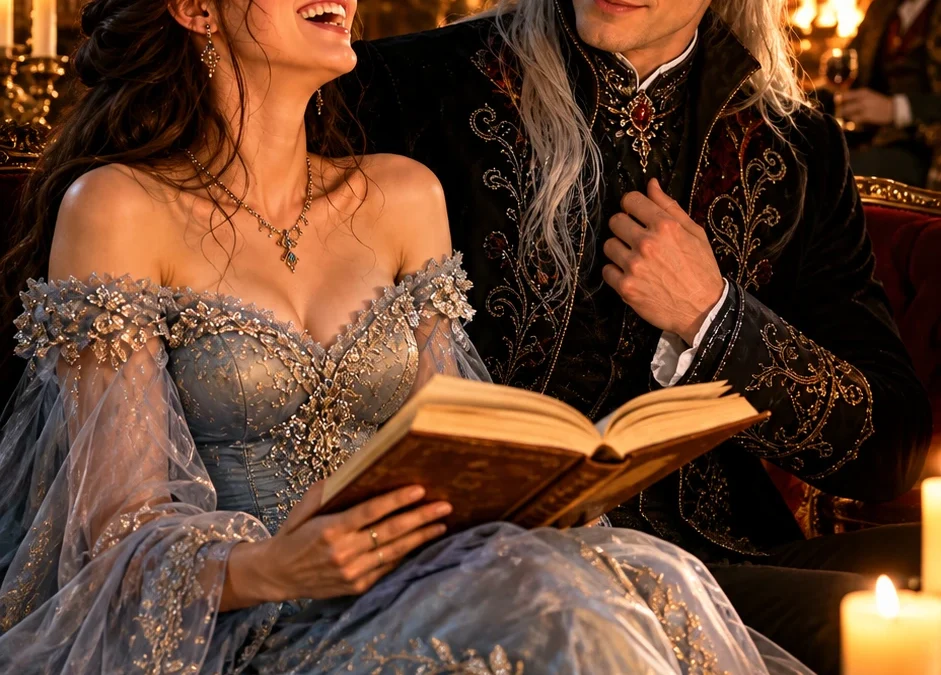
SHE SPENT 10 YEARS HIDING FROM THE VAMPIRE KING. HE SPENT 10 YEARS SECRETLY TRACKING EVERY STEP SHE TOOK. THEN HER OWN BROTHER, THE KING’S BEST FRIEND, SLAMMED HIS SWORD ON THE TABLE AND SCREAMED ONE SENTENCE THAT CHANGED EVERYTHING 😱🗺️🩸
Part 1
For ten years, I planned every expedition with one secret rule.
The dates had to match the vampire king’s travels, so I would never have to see him. 🗺️
During those same ten years, I learned much later, he checked my itineraries before his war reports. Just to know which corner of the world I was breathing in.
And my brother, the most feared general in the Night Court, knew everything about both of us from the very beginning. He waited an entire decade for one of us idiots to finally speak.
My name is Isabela Vega. I’m a cartographer. I draw the edges of the world for people who are afraid to look at them.
This is the story of how a map, a promise between friends, and ten years of silence almost cost me the love of my life.
Let’s start with the night I came back.
The port of Valmora smells of salt, tar, and something like eternity. It is the capital of the Night Court, where the blood clans have ruled for a thousand years beneath a sky that always looks freshly polished. Mortals live there too, protected by the pact. My family was one of them. Mortal-born, raised by merit.
My brother Emiliano was the first mortal-born general of the king’s armies in history. I was the first woman to lead the guild of royal cartographers. In Valmora they called us the impossible Vegas. We liked the nickname.
That night I walked down the gangway with forty kilos of map tubes on my back, three months of mountain dust in my boots, and a discovery in my leather bag that would change the history of the kingdom. I just didn’t know it yet.
What I did know, because I had checked it twice against the court calendar, was that King Valerian Noctari was touring the southern fortresses and wouldn’t return for three weeks.
Three weeks. Plenty of time to present my report, hug my brother, sleep in a real bed, and vanish into the highlands before His Majesty set foot in the capital.
That was the system. It had worked for ten years.
“Vela!”
My brother’s voice crossed the dock like a cannon shot. Emiliano doesn’t walk. He advances, as if the world were a battlefield he’s already won. He lifted me off the ground, map tubes and all, and spun me twice in front of the stevedores, who pretended not to see the general of the Night Court behaving like a child.
“You’re breaking my ribs.”
“I’m reminding you that you exist outside a map.”
He set me down and inspected me with that military-inventory stare. Thin. Sunburned. A new scar on my eyebrow.
“What happened to your face?”
“Rockslide at Carjal Pass. I won.”
“Of course you won.” He smiled. And then he made that pause. The pause I knew and hated. My brother’s pause when he’s about to say something he knows I won’t like.
“Vela… there’s a change of plans at court.”
Cold settled in my stomach before he finished.
“The king came back last night. The southern tour was cancelled. There was a landslide at Carjal Pass, curiously, and the southern roads are blocked.” He tilted his head. “The same landslide you won against, I assume.”
The world tilted a little. Ten years dodging a man with the precision of a watchmaker, and a stupid mountain had decided to betray me.
“It’s fine,” I said, in the flattest voice I could manufacture. “I present to the council, not the throne. I don’t have to see him.”
My brother looked at me for one long second. Emiliano has our mother’s honey-colored eyes and the tactical patience of a man who has won wars by waiting. I know now what was behind that look. He had spent ten years watching the king and me orbit each other like two cowardly stars, and that night on the dock he was already tired of waiting.
“Of course,” he said. “You don’t have to see him, liar.”
I should tell you how it all began, because no ten-year silence begins in silence. It begins in noise.
I was nineteen, with an arrogance the size of a mountain range. Emiliano had just been named general, the first mortal-born in a thousand years. And the king himself came to dinner at our house to celebrate. A simple stone house in the upper district with leaks in the study and a chessboard inherited from my father in the living room.
Everyone expected me to curtsy and disappear into the kitchen.
Instead, when the vampire king, lord of the blood clans, the oldest monarch on the continent, remarked with polite condescension that chess was a game of patience young people no longer understood, I set up the board and said:
“White or black, Majesty? Choose quickly. My patience is running out.”
I remember the silence. I remember the butler’s horrified face. I remember Emiliano covering his eyes and muttering “By all the saints of the night, Vela.”
And I remember the king’s face. Valerian Noctari. Four hundred years old. Eyes gray as a sword’s edge. The carved, terrible beauty of the lords of the night. And a smile that escaped from one corner of his mouth like a prisoner breaking out.
“Black,” he said. “I’ve always liked difficult causes.”
I beat him in thirty-one moves.
He stared at the board as if it had insulted him in the Ancient Tongue. Then he looked at me, and I held his gaze, because I didn’t know you don’t hold a king’s gaze. Or maybe I knew and didn’t care.
“Again,” he said, very slowly.
We played four games that night. I won two. He won one. The last ended in a draw because Emiliano snuffed our candles and sent us to bed like two cadets. The king of the Night Court let himself be thrown out of my living room, laughing, coat over his shoulder. At the door he turned.
“Miss Vega, are you the first person in two centuries who won’t let me win?”
“Someone had to do you the favor,” I said.
And right there, at the door of my house smelling of burnt wax, I fell in love with the most unreachable man in the world.
Not the king. The man who laughed as if it hurt from lack of use. Like a rusted hinge on a beautiful door. 💔
It took me a year to admit it to myself. It took me one night to decide I would never admit it to anyone else.
Because a year later, at the Blood Harvest festival, I overheard a conversation that wasn’t meant for me.
Emiliano and the king on the terrace, glasses in hand, with that brutal trust they shared. The most famous friendship at court. The king who treated a mortal like a brother. The general who treated the king like a man.
Some noble with more wine than judgment had made a remark about me. How much I’d grown. What alliances a girl like me might make possible. And I heard my brother’s voice, calm and icy as winter steel.
“Listen to me, Valerian, because I’ve said this to the whole court and I’m saying it to you, who are my friend before you’re my king. Everything I have is at your service. My sword, my life, my name. Everything but one thing. Not my sister. My sister is not a piece on this board. The first immortal who looks at her as a move, duke or king, answers to me.”
And the king’s voice, after a pause so small only someone who collected his silences would have noticed:
“You have my word.”
Three words. Ten years.
I stood behind the curtain with my heart in a fist, understanding two things at once. That my brother loved me more than his own life. And that he had just, without knowing it, closed the only door in the entire palace I cared about.
That week I requested my first long-duration expedition. I chose the dates by studying the royal calendar. And that’s how the ten years began.
Ten years is enough for many things. Enough to map the entire coast of the Gray Kingdoms, cross two deserts, and name fourteen mountains. Enough for an insolent nineteen-year-old to become the most famous explorer in the realm. Sailors call her the compass. Archivists call her a problem with boots.
Enough for twenty returns to Valmora. Every one calculated for weeks the king was elsewhere.
And enough to learn things I wasn’t trying to learn, because the court talks, and I listened.
I heard that King Valerian had rejected seven marriage proposals from the great houses. That Archduchess Carmilla of House Sanguinara offered him her own daughter with a dowry of three provinces, and he replied that the provinces were charming and so was the daughter, and precisely for that reason he wouldn’t ruin the lives of any of the four.
I heard that the Royal Library had a new room, the Hall of Charts, where every map the guild produced was archived with honors, and the king visited it at dawn when no one saw him.
I heard he’d ordered every guild expedition’s escort doubled after mine, the Saar Desert one, came back with three wounded.
I stored it all in the same drawer where I kept impossible things. Because there was the other matter, the big one, the one no mortal’s daughter could forget.
The Doctrine of Succession. A thousand years of law written in the Ancient Tongue. The throne of the Night Court may only be shared with immortal blood of pure lineage. A king could love whomever he wished, the court said, with that smile nobles use to spit without staining themselves. But he could only wed the night itself.
A queen of mortal line, according to the doctors of law, was a doctrinal abomination. According to Archduchess Carmilla, something worse: a political opportunity to destroy whoever dared.
So it wasn’t just my brother’s oath. It was the law. The court. A thousand years of doctrine. The whole abyss between a mortal cartographer and an eternal king.
I had ten years of practice at not looking into that abyss.
And then the mountain at Carjal collapsed, the king came home, and my perfect system fell apart in a single audience.
The Council of the Night Court meets in the Chamber of the Broken Moon, a circular room with a black crystal ceiling that lets the stars through. I’d presented there a dozen times. I knew the protocol. Twelve councilors in their seats. The throne at the far end, empty, because the king never attended cartography sessions.
That night I walked in with my leather tubes, my plans of the Erevan massif, and the discovery burning in my bag. And the first thing I saw was that the throne was not empty.
Valerian Noctari was sitting in it.
Ten years. Ten years without seeing him up close, and the unconsiderate man hadn’t changed a line. The same gray eyes. The same black hair with that single silver streak, the Noctari mark. The same impossible stillness of the ancient immortals, sitting as if time were a dog that obeyed him.
He was looking at me the way you look at a map of a country you swore never to return to. 🌑
“Master Vega,” said the chancellor, his voice reaching me from very far away. “The council hears you.”
Here is something people don’t know about explorers. Panic organizes us. When the ground opens, something in me turns clean and cold as summit air.
So I breathed, unrolled the first plan across the stone table, and for forty minutes I spoke about the Erevan massif without once looking at the throne, with a discipline that would have made my brother weep with pride.
And then I reached the part that wasn’t in the official report.
“There is something more.” My hand trembled slightly as I opened the leather bag. “On the northern face, at five thousand meters, my team found a structure. It appears on no chart, no archive, no chronicle I’ve consulted. It is a temple, my lords. Carved into living rock. Sealed by ancient ice. And I say this with all the rigor of my profession: it predates any known construction of the Night Court.”
Silence. The heavy kind.
“Impossible,” said the councilor of House Morvant. “Blood clan architecture doesn’t reach north of Erevan.”
“That’s what I thought.” I spread across the table the charcoal rubbing I’d made kneeling on the ice with my fingers freezing. “Until I copied this from the lintel.”
The twelve councilors leaned in. And for the first time in forty minutes I heard the king move. He rose from the throne. Crossed the chamber. Every step the only sound in the world. He stopped beside me. One pace away.
After ten years, one pace. And I felt his presence on my skin like a storm you sense before you see it.
He looked at the rubbing, and because I was close enough, I saw the vampire king go pale. I hadn’t known that was possible.
“This is the Ancient Tongue,” he said, very low. “The high form. Unwritten since before the first throne.”
“Can Your Majesty read it?” asked the chancellor.
Valerian passed his fingers over the rubbing without touching it, like a man afraid to touch a wound.
“Here sleeps the source. Here the first blood was sealed.”
He raised his eyes and found mine. And for one second he wasn’t a king looking at a subject. He was a man looking at the only person in the room who understood what it means to find something that should not exist.
“Master Vega. What else was on that door?”
“A seal I couldn’t open. A mechanism, I think. A ritual lock. And this.”
I drew out the last rubbing, the one I’d shown no one. Not even Emiliano. It had been carved beneath the seal. A circular symbol. Two crescent moons facing each other around a single drop.
The king looked at it and closed his eyes for an instant.
“The mark of the bond,” he said. “The emblem of the blood bond.”
A murmur ran through the council.
“My lords, that temple is the sanctuary of the First Blood. Our archives have called it legend for nine hundred years. If it’s real, it is the most important place in the history of our people. And it sits atop a mountain only one person in this kingdom knows how to climb.”
“I propose an immediate military expedition,” said the councilor of House Morvant.
“Your soldiers would die on the second cornice,” I said, before remembering that interrupting a councilor is rude. “With respect, my lord, the Erevan north pass isn’t taken with armies. It’s taken with rope, calculation, and humility. Two of those three are scarce in the military.”
Someone laughed. I swear it was a single, short, masculine laugh, badly disguised as a cough, and it came from the throne’s side.
King Valerian Noctari, lord of the eternal night, had laughed at my joke, and now he was staring at the black crystal ceiling like a man straightening his collar.
“The council will deliberate on funding…” the chancellor began.
“It won’t be necessary,” said the king. “The sanctuary of the First Blood concerns the crown directly. The expedition will have royal sponsorship. Unlimited resources. Absolute priority.”
A pause. I remember it exactly, because my entire life fit inside it.
“And since this concerns foundational doctrine and the Ancient Tongue, which I alone read fluently, the crown will not delegate supervision. I will work personally with Master Vega on the preparation.”
Personally.
Ten years of cross-referenced calendars. Ports chosen for their distance. Ten years of a perfect system, and it had just died in one sentence before twelve councilors under a ceiling of stars.
I searched for my brother in the military gallery, hoping to find my catastrophe reflected on his face.
Emiliano Vega, general of the Night Court, terror of three campaigns, was leaning back in his seat with arms crossed and the smallest, most dangerous smile I have ever seen on him.
I know now what that smile meant.
It meant: finally. 🔥
But what I didn’t know, as I stood under that ceiling of stars, was that two other people in that room were about to turn my entire world upside down… and that a promise made on a terrace ten years ago was about to be broken by the one person who swore to keep it.
🔥 Want Part 2? Comment “PART 2” below or drop any word and I’ll send it to you privately! 👇
Part 2
…a promise made on a terrace ten years ago was about to be broken by the one person who swore to keep it.
The first working session was three nights later, in the Hall of Charts.
I arrived early, on the theory that occupying the terrain before the adversary gives a tactical advantage. That’s an Emiliano line. My brother has lines for everything, and none of them helped when I opened the door and found the king had arrived even earlier.
He stood in the center of the room with his back to me, hands clasped behind him, looking at the north wall.
And I froze in the doorway. Because the north wall, the whole room, was my life.
My maps. All of them. From the first, the clumsy survey of the Balmora coast I drew at twenty with a slightly crooked compass rose, to the great chart of the Saar Desert that cost a companion two frozen fingers and nearly cost me my life.
Framed in fine wood, lit by study lamps. Ordered not by region or archive date, as any librarian would have done, but by expedition. By my chronology. Someone had reconstructed, map by map, the exact itinerary of my ten years of running away.
“The Morbane Strait is my favorite,” the king said without turning. “You drew the currents in two colors of ink. No one had done that. The northern captains call it the map that thinks.”
“It’s a very complete archive,” I managed. “It’s a room of honor.”
He turned at last. In the lamplight, without the distance of the throne, it was worse. More human. More him.
“The guild produces the kingdom’s most valuable work. It was kept in damp cellars. I corrected that nine years ago.”
Nine years. One year after the terrace. One year after You have my word.
I did the arithmetic without meaning to, because cartographers measure distances even when it hurts. And he watched me do it. For one second we both stood at the edge of the same cliff, measuring.
Then he stepped back toward the great worktable and put the king’s voice on like a glove.
“The sanctuary, Master Vega. Shall we begin?”
May the saints of the night forgive me. We began. And it was the worst good idea of my life.
Because working with Valerian Noctari turned out to be exactly like playing chess with him at nineteen. Fast. Fierce. Dazzling. I’d unroll a plan of the north face and he’d find in thirty seconds the question that had cost me three nights of camp. He’d recite doctrine from the old archives and I’d prove with contour lines why half of it was geographically impossible.
We argued. We argued marvelously, the whole room strewn with paper, and every so often one of us said something that silenced the other out of pure admiration. That silence was more dangerous than any argument.
“Here,” he said one night, the third or fourth, pointing at the seal rubbing. “I mistranslated this line in council.”
“The vampire king admits an error. Call a scribe. This must go in the chronicles.”
“Save the insolence for the mountain, Master.” But the corner of his mouth trembled. That corner. The same one from ten years ago. “Read it again. ‘Here sleeps the source.’ The high form is more precise. It says, ‘Here sleeps the origin of the bond.’ And this word below, the one you copied halfway…”
“Field note: my fingers were dying and the sun was setting.”
“A rigorously professional field note. This word isn’t ‘sealed.’ It’s ‘waiting.'” He lifted his eyes from the rubbing. “Here waits the First Blood. The sanctuary is not a tomb, Master Vega. Our ancestors didn’t close it to bury something. They closed it to keep something for someone.”
“For whom?”
“I don’t know.” He looked at the symbol, the two crescent moons and the drop, and something old and tired crossed his face. “The emblem of the blood bond on the door suggests someone bonded. A destined mate.”
The word hung between us like a lit candle in a room full of gunpowder.
I should explain this, because outside the Night Court it gets told wrong. The blood bond isn’t a marriage or a spell. It’s the oldest and most uncomfortable doctrine of the clans. The idea that, very rarely, once a century perhaps, an immortal’s blood recognizes a person. Only one. Before the mind. Before the heart. And from then on that blood pulls toward that person the way water pulls downhill.
The ancients called it the destined mate. The moderns call it superstition, because it suits the court. A bond doesn’t negotiate dowries. Doesn’t sign alliances. Doesn’t respect lineage. A bond is ungovernable.
“Do you believe in it?” I asked. My voice came out lower than I’d meant. “In the bond. In the destined mate.”
Valerian Noctari was silent for exactly three of my heartbeats. I counted. So did he, I suppose.
“I believe,” he said at last, choosing each word the way you choose handholds on an ice wall, “that there are doctrines a man can afford and a king cannot.”
“That’s not an answer.”
“It’s the only one I’m authorized to give.”
And he smiled with a sadness so politely contained that I wanted to scream. Instead I did something worse. Much worse.
“There’s a chessboard in that cabinet. It’s been distracting me all night. It’s four in the morning. We’ve been arguing the Ancient Tongue for six hours and my head hurts.” I crossed my arms. “White or black, Majesty? Choose quickly.”
The vampire king looked like a man handed back something he thought lost in a fire.
“Black,” he said, very slowly, the smile escaping its prison. “I’ve always liked difficult causes.” ♟️
We played until dawn. He won the first. I won the second, and he did not let me win, I swear, you could tell by the concentrated fury of his eyebrows. The third was left unfinished because the sun touched the glass and the curtains of the Hall of Charts closed themselves with that mechanical sigh of court buildings.
And suddenly the room was in golden half-light and we were bent over the same board, a hand’s breadth apart. Closer than we had been in ten years.
“Isabela,” he said.
My name. Not Master Vega. My name in that voice for the first time in a decade, and it sounded the way the Ancient Tongue sounds. Like something too old and too true to use lightly.
“Yes,” I said.
I saw him begin the sentence. I swear I saw it. It formed in his eyes before his mouth. Ten years of sentence. His hand halfway across the board toward mine. The air in the room turned to glass.
And then my brother’s boots sounded in the corridor.
It’s ridiculous how well we both knew that stride.
We sprang apart like two cadets caught in a guardhouse, he toward the window, I toward my plans so fast I knocked over the black queen. When Emiliano opened the door, he found the king of the Night Court contemplating closed curtains with strategic intensity and his sister arranging papers that were already arranged.
My brother looked at the scene. At the board. At the fallen queen.
“Interrupting,” he said, with no interrogative intent whatsoever.
“A translation exercise,” said the king.
“Foundational doctrine,” I said, at the exact same time.
“Fascinating,” said Emiliano. “Both at once. Such efficiency.”
I promise you a decorated general should not be able to smile like that. Like a shark being told a very good joke.
“Majesty, the War Council has been waiting an hour. Vela, your climbing gear arrived from the guild and the rope master says either you inspect it or he resigns.”
We walked out into the corridor. And when the king was already moving away, swallowed by his cloud of deans and solemnity, my brother leaned toward me and said softly, with an unbearable tenderness:
“The black queen was on e5, little sister. Bad square to drop her on. From there she controls the whole board.”
And he walked off whistling.
There are parts of this story I didn’t live. Emiliano told me later, in the tone of someone filing a campaign report. Valerian told me even later, in the tone of someone confessing. I’ll tell them as they were told to me, because without them nothing makes sense.
That same week the king went to find my brother in the training yard. He’d done it for twenty years. When the weight of the crown wouldn’t let him think, he went down to the yard before dawn, took a blunted practice sword, and fought Emiliano until the weight fell off his shoulders blow by blow.
My brother is the only living creature who dares hit the vampire king with real intent. That’s exactly why he was the only company that helped.
That dawn, both told me, the fight was different. The king attacked badly. Distracted, rough, leaving gaps a recruit would’ve seen. The third time Emiliano touched his ribs with the blunted blade, my brother lowered his guard and stared at him.
“All right,” he said. “Who is it?”
“Who is what?”
“Valerian. I’ve known you twenty-two years. You fight this badly for exactly one reason, and that reason always has a name. Who is it?”
And here was the first of all the opportunities, Valerian confessed much later. The sentence was ready. It had been ready for years. It’s Isabela. It’s always been Isabela. Forgive me. Three short sentences. A man who had declared wars with fewer words.
What he said was: “The sanctuary. The expedition has me uneasy. It’s uncharted territory.”
“Uncharted territory,” my brother repeated slowly, like someone tasting wine to confirm it’s spoiled. “The Erevan north pass has killed everyone who tried it. Everyone but my sister, who is going with you, because you yourself signed the sponsorship to work with her personally.”* He hung the practice sword on the rack with surgical calm. “Curious word, ‘personally.’ I’ve been thinking about it all week.”
“Emiliano…”
“Do you know what I like most about you, Valerian?” My brother turned, and there was no shark in his smile. Something older. Almost sad. “You’re the only powerful man I know who keeps his word even when it destroys him. It’s your best virtue.” He took his cloak from the bench. “Someday it’ll be your ruin. And on that day I hope to be present, because I plan to say: I told you so, with enormous pleasure.”
And he left the lord of the eternal night alone in the yard, a wooden sword in his hand and twenty-two years of friendship lodged in his throat.
Now understand this, because it’s the heart of everything. Valerian Noctari didn’t stay silent out of cowardice. He stayed silent out of arithmetic.
He explained it to me once, much later, and I haven’t forgotten a word.
“I had it calculated, Isabela. I knew exactly what happened if I spoke.
“One. Your brother, who swore before the court that no one would use you as a move, would have to choose between his oath and his king. And Emiliano has never broken an oath in his life, so he’d break himself.
“Two. The court would smell scandal before breakfast, and Archduchess Carmilla would turn your name into a doctrinal battlefield.
“Three. The law of succession would declare you impossible, and I’d have to choose between the throne and you. If I chose the throne, I’d lose you. If I chose you, the kingdom would split in two and the civil war would cost ten thousand lives, starting with your brother’s, who would die defending me.”
He paused, and added more quietly:
“I had everything calculated. The only thing I couldn’t calculate was how much it costs to stay silent. That number never came out. It still doesn’t.”
Ten years of that arithmetic. Ten years of checking my itineraries before war reports. Of secretly doubling my escorts. Of building me a room of honor and visiting it at dawn like a smuggler of his own memory. Ten years of collecting my maps because they were the only part of me he was permitted.
And on the other side of the board, me, with my own calendar system, convinced I was fleeing an impossibility, never knowing the impossibility was also fleeing me.
“We are,” Emiliano told me afterward, and I won’t argue it, “the two most brilliant and most profoundly stupid strategists the kingdom has ever produced.” 🤦
Meanwhile the expedition prep advanced, and with it my personal ruin. Because my calendar system had a flaw I hadn’t foreseen. It worked at a distance. Up close there was no system.
Up close there was a man who showed up in the Hall of Charts with two cups of mountain tea you can only buy at the Dawn Market, meaning someone with a crown had sent an aide to the Dawn Market. Or worse, gone himself with his face covered.
When I asked, he changed the subject so clumsily a diplomat of his experience should have died of shame.
Up close there was a king who knew my field notes by heart. Who quoted my own reports against me in technical arguments, with dates. Who one night, reviewing the climbing equipment list, read spare rope for the lead and asked why my spare rope weighed less than the others.
And when I explained that I climb as lead, the first on the rope, the one who climbs with no one above, and that the leader carries light because if she falls, she falls double, he fell silent a moment. Then he was insufferable the rest of the night, checking knots that had already been checked three times.
“The knots are fine, Majesty. They’re adequate. It’s a standard for activities where people don’t fall double. I’ve led for twelve years, and I have for twelve…”
He stopped. Stopped dead, like a horse before a ravine. I raised my eyes from the rope and found him looking at me with the whole sentence in his eyes. The forbidden one. The one that began on that terrace and never ended.
“Twelve years, what?” I asked softly. No mercy.
Silence. The whole room holding its breath. The lamps still. My ten years and his ten years sitting together at the same table, waiting.
“Twelve years,” he said at last, “trusting the guild’s judgment. Continue the inventory, Master Vega.”
That night I went home, closed the door, and sat on the study floor between the leaks and my father’s chessboard, and cried with rage for the first time in years. Not over him. Over me.
Because a woman who has beaten three deserts and fourteen mountains should have the courage to say a four-word sentence. And I was choosing safer routes on ice walls than in my own life.
And somewhere in the palace, though I didn’t know it then, a king of four hundred years was doing exactly the same thing. Without tears, because they hadn’t come in centuries. Staring at a map of the Morbane Strait, the map that thinks, in a room of honor built in secret for a woman who thought he didn’t remember her.
Ten years. And neither of us knew the clock had finally started. Because three nights later, at the Copper Moon Ball, Lord Damian of House Alarcón would arrive, and with him the countdown.
👍 Want to see Part 3? LIKE or COMMENT “REVEAL” below! Part 3 will be posted once we hit enough comments! 👇
Part 3
The Copper Moon Ball is the one night of the year the Night Court opens its doors to every rank. Blood clans and mortal families, warriors and guilds, all beneath the thousand copper lamps of the great hall.
I’d dodged it for ten years with the infallible excuse of always being on another continent. That year I had no continent to flee to, and the royal sponsorship obligated me. The sanctuary expedition was already the most discussed matter in the kingdom, and its chief cartographer couldn’t be absent.
I wore the only gala dress I own. Midnight blue, with the constellations of the southern hemisphere embroidered in silver thread. If a woman is going to be uncomfortable, let it be with astronomy.
I entered determined to endure three hours of courtesy and vanish. I lasted half of one.
Because there is a limit to what a woman can bear, and that limit is seeing Valerian Noctari in gala uniform across a ballroom, surrounded by the entire nobility, bored with that devastating elegance of his, and feeling the exact physical moment his eyes found me among four hundred people.
He didn’t search for me. That’s the terrible part. He didn’t sweep the room with his gaze. He turned his head directly toward where I stood, the way a compass turns to north.
I looked away first. Broke my own record for cowardice and made straight for the refreshment table, where a brown-haired gentleman with an easy smile was having serious trouble with the glassware protocol.
“Excuse me,” he said. “You look like a practical person. Is the tall glass for blood wine or for mead? I’ve been calculating five minutes, and a countess is looking at me as if I’m a diplomatic incident.”
“The tall one is mead. And the countess looks at everyone like that. She’s from House Morvant. They’re born with that face.”
He laughed, a frank laugh with no pose, and held out his hand as to a colleague. “Damian of House Alarcón, Marcher of the East. Mortal line, as you’ll have deduced from my catastrophic handling of crystal.”
“Isabela Vega, cartographers’ guild.”
“I know.” The easy smile turned serious, respectful. “The whole east knows, Master. Your eastern border chart saved us two years of boundary disputes and probably a small war. In my house you’re named with more affection than several saints.”
Ah. I hadn’t expected that.
Lord Damian was that rarest of things at court. A good man, without strategy. He spoke of his lands like a farmer and his soldiers like a father. He had read all my reports, and cited them well, not to flatter me but because they genuinely interested him, with intelligent questions about mountain passes and water rights. He had a laugh that didn’t ask permission and a way of listening with his whole body.
For one entire hour he made me forget that this room had a north and my head was a broken compass. We danced two pieces. He danced badly, with an honest enthusiasm that made up for technique. He stepped on my foot once and apologized three times. And I found myself genuinely laughing, and thought with a cold, clear pang: This is what I should want.
This man. Exactly this one. Good, brave, from my own world. No abyss. No doctrine. No oaths closing doors.
This is the possible.
And the possible looked at me with brown eyes growing less and less discreet.
On the other side of the room, my brother told me later, he stood by the columns with an untouched glass and his best off-duty-guard face. King Valerian Noctari watched both dances with perfectly serene expression while the crystal glass in his hand slowly developed a crack.
“Majesty,” Emiliano said without looking at him. “The glass.”
“What about the glass?”
“It belonged to my great-grandmother. The crystalware, I mean the royal treasury’s, and you’re murdering it.”
Valerian looked at the crack, set the glass down with exaggerated care, and said in the most neutral tone of his four-hundred-year repertoire: “Alarcón. What do we know?”
“Good soldier, better lord. His peasants eat, his borders hold, he pays his debts, and he doesn’t lie.” Emiliano made the cruelest pause of his military career. “And he’s one of ours. Mortal line. No doctrinal impediments of any kind.”
“I see. An excellent match for any lady of the realm, truly.”
“Practically perfect, Majesty.”
“Emiliano, be quiet.”
“At your command, Majesty.”
And my brother said later he fell silent with the satisfaction of a fisherman who feels the first tug on the line. 🎣
At midnight I slipped out to the Gargoyle Gallery to breathe. An explorer’s habit. In closed rooms with too many people, I look for the edge of the map. The gallery was empty, the copper moon enormous over the rooftops of Valmora, and I’d been there two minutes when I heard behind me a voice I knew better than my own.
“Fleeing the social terrain, Master Vega?”
“Identifying evacuation routes, Majesty. Professional training.”
Valerian came to lean on the balustrade at an exact protocol distance, and for a while we watched the city together. Silence with him was never empty. It was silence with furniture. Inhabited. Full of things that had lived there for a decade without paying rent.
“You dance well,” he said at last.
“I dance little. Kings don’t dance, they preside over dances.” A pause. “Alarcón seems…” He searched for the word with a care that hurt. “…a decent man.”
“He is.” I don’t know what demon made me add: “It’s rare. At this court, decency is scarcer than sunlight.”
“True.” A longer pause. His hands on the stone were too still, with that stillness immortals have, which in him I already knew was a sign of effort. “Isabela.”
Again my name. Again that weight.
“Yes.”
“When we’re on the mountain…”
He turned to look at me, and the copper moon set fire along the edge of his profile, and I forgot protocol, doctrine, and how to breathe.
“There is something I’ve owed you for a long time. Something I can’t say here, where I am this.” A minimal gesture toward the ballroom, the music, the thousand lamps. “But on the mountain there is no court. On the mountain, as you yourself said once, there is only rope, calculation, and humility. Up there…”
A king of the night who doesn’t need air took a breath.
“Up there I will tell you. I swear it. Ask me on the summit if I lose my nerve. Ask me what I’ve been doing for twelve years.”
My heart pounded so hard he had to hear it. And perhaps that’s why I let myself.
“And if I don’t lose my nerve first?” I said. “If I ask you now?”
I watched him fight. I swear I did. The man against the king, one pace from me. The sentence climbing his throat the way the lead climber goes up with no one above, knowing if she falls, she falls double.
“Isabela, I…”
“Majesty!”
A young page burst through the gallery door, breathless, with an emergency bow.
“Forgive me, Majesty. Archduchess Carmilla requests immediate audience. About the sanctuary expedition. She says…” The boy swallowed. “She says she brings a formal petition from the College of Doctrine.”
The king closed his eyes for an instant. When he opened them, the man was gone. He had raised the king like a war flag.
“Now,” he said. And then to me, in a low voice, with an intensity that sustained me the entire week to the summit:
“Isabela. Ask me.”
He left.
I stayed in the gallery with the copper moon and the gargoyles, trembling with hope, which is the most dangerous trembling of all.
I didn’t learn until the next day what Archduchess Carmilla had come to do that night.
I didn’t know her formal petition demanded doctrinal observers join my expedition. I didn’t know she’d been moving pieces for weeks, or that on her list of pieces, one name was underlined twice. Mine.
Archduchess Carmilla of House Sanguinara was nine hundred years old, with skin of funerary marble and the theory that the kingdom was a body and mortal blood an infection. She didn’t say it like that, of course. She said it with beautiful words. Preservation. Doctrinal purity. The sacred inheritance of the night.
She presided over the College of Doctrine, controlled three minor clans through marriage and debt, and hated two things above all: my brother’s influence over the king, and the existence of people like me, mortals who forgot our place in the order of blood.
Her petition was a masterpiece of administrative venom. It didn’t oppose the sanctuary expedition. On the contrary, it celebrated it. It only demanded guarantees: that any doctrinal finding remain in the College’s custody, that two of its observers accompany us up the mountain, and, here was the fang, that the suitability of entrusting the founding relic of the blood clans to personnel of mortal line be reviewed.
In other words, the woman who had found the sanctuary was, according to the document, the principal risk to the sanctuary expedition.
The king rejected the observers, the custody, and the review, all in one cold, cutting session, citing the Ancient Tongue from memory against the College’s own doctors. But Carmilla hadn’t gone to win. She’d gone to measure. She measured how much the expedition mattered to the king. She measured the exact tone in which he defended his cartographer. And she left the Chamber of the Broken Moon with the only victory she needed: the certainty that she had finally found Valerian Noctari’s weak point.
She did win one concrete thing. Postponement. Between appeals, petitions, and the belated thaw of the north pass, the expedition’s departure was set for six weeks away.
Six weeks. Remember that number, because everything fit inside it.
Lord Damian began to appear.
Not invasively. He didn’t know how to be invasive. He appeared the way good light does, silent, improving everything a little. He came to the guild with real questions about the eastern border and stayed to help me sort rubbings, and turned out to have an archivist’s patience and a superb memory.
He brought small, exact things. Candied fruit from the east. A rag-paper field notebook that resists rain. News of a bridge finally built where my map said it should go. Never flowers. He knew, because he listened, that flowers seem to me a sad gift. Beautiful things cut from their place to die in a vase.
With him everything was easy. That’s the word. I wish it were a bigger compliment. Easy. No codes. No furnished silences. No arithmetic of disaster. A man who could love me out loud at noon in front of everyone.
Emiliano watched him come with a neutrality so studied it was almost an insult.
“Aren’t you going to say anything?” I asked one afternoon, after Damian bowed his goodbyes and my brother walked him to the door with perfect courtesy.
“What do you want me to say? He’s an excellent man.”
“That’s exactly it. You have opinions about the weather. About your sister’s first serious suitor in a decade, you have none.”
“I have plenty.” He poured tea with that calm of his I wanted to throw the Saar map at. “But my opinions on your love life have been in recess for years, little sister. I’m a man of oaths.”
He looked at me over the cup two seconds too long. As if the sentence had a second floor. It did, and I didn’t see it, because nobody sees the map when they’re standing on it.
What I also didn’t see was the visit Damian paid the barracks that same week. Emiliano told me much later.
Damian arrived at his office stiff with solemnity and asked permission to formally court his sister.
“Why ask me?” said Emiliano. “She’s mistress of her own steps since she was nineteen. She drew the world’s edges. She needs no seal of mine.”
“I know. I’m not here for the seal. I’m here because you’re her family and I do things face to face.” And here, my brother said, Damian hesitated for the first time. “And I’m here to ask something soldier to soldier, and I ask that you answer the same. Is there someone else? Because sometimes, when she thinks no one is watching, she looks toward the palace. And I don’t want to win a fortress someone else already has under siege. I want a whole heart or none.”
My brother swore that was the hardest moment of his twenty years of service. He had the truth on the tip of his tongue. Mine and the king’s. Two sealed letters he’d carried for a decade that weren’t his to open.
That was Emiliano Vega’s iron code. Other people’s secrets aren’t told. You make room for them until their owners dare.
“I’ll answer soldier to soldier,” he said at last. “I know of no commitment. No word given. No right of anyone over my sister. If there’s a siege, it’s gone so long without a shot the garrison may have died of old age.” A pause. “But I’ll tell you one thing, Alarcón, and I say it with respect. Ask her. And accept the whole answer, not just the half you like.”
“I wouldn’t know how to do otherwise,” said Damian.
And it was true. That’s the tragedy of good men. It was true.
The proposal came on a Thursday at dusk, on the guild terrace, among my drawing tables. Damian didn’t kneel or stage theater. He stood before me with hands behind his back, like at a troop review, voice trembling. And still he spoke plainly, because he was like that. Plain even when breaking.
“Isabela, I know what I am and what I’m not. I’m not brilliant, or mysterious, or the most interesting man you know. I’m a border lord who sleeps well, wakes early, and keeps his word. But I’ve heard you talk about mountains that nearly killed you the way others talk about their children. And since then I can’t look at a map without searching for your handwriting. I love you the way I was taught to love, whole, face to face, and forever. Marry me.
“I offer you a good life in the east, with as many expeditions as you want, and someone to count your scars when you return.”
And as I stood breathless, heart split into two hemispheres like one of my own planispheres, he added, lower:
“Don’t answer today. I know the expedition leaves in three weeks. Answer before you go to the mountain. I ask only that when you climb that summit, I know whether you’re waiting for me or not. A soldier can endure any answer but fog.”
Three weeks.
The clock that had stood still for ten years began to run so loudly the whole kingdom could hear it.
I told him I’d answer before departure. He kissed my hand and left with the straight back of men who don’t want to show hope, and I stood among my drawing tables watching the afternoon go dark, understanding with horrible clarity that I faced the oldest crossroads in the world. A good, possible life with the man who spoke. Or the impossible, unpromised life with the man who stayed silent. And he’d asked me to question him on a summit at five thousand meters about what he’d been doing for twelve years.
The whole court knew within two days, because courts are animals that eat secrets. The archduchess knew, and smiled, they say, for the first time in a century. My brother knew, went serious, and said nothing, recess and all.
And the king knew.
They told me how. It happened in the north-wing office, reviewing the final expedition list with two secretaries. One of them, to fill a silence, mentioned the news. Lord Alarcón. Master Vega. An answer promised before departure.
They say the king kept signing. That he signed three more documents in perfect handwriting, then asked to be left alone in the calmest voice in the world. They say that night in the Hall of Charts someone rearranged every frame on the north wall one by one until dawn, and the Morbane Strait map was left crooked.
Which Valerian Noctari did, and which goes in my personal archive of disasters as the greatest idiocy ever committed by a genius in the history of the Night Court. And I’m competing against nine hundred years of archduchess.
The bar was high.
It was the reception for the eastern emissaries, five days after the proposal. Court full, ambassadors, the cream of the blood clans. Lord Damian was present by right, as Marcher of the East. I was present by obligation, as royal cartographer. And the king, from the dais, dispatched the eastern border business with his usual efficiency until he reached the end of the page, raised his eyes, and with the entire court listening, said:
“One more matter.”
“It has come to the crown’s attention that Lord Damian of House Alarcón has asked for the hand of Master Isabela Vega, royal cartographer and chief of the sanctuary expedition.”
My heart stopped. I watched Damian straighten, startled. I watched my brother, on the dais guard, turn very slowly toward the king.
“The crown,” Valerian continued in a voice so serene, so impeccably dead that only I, collector of his silences, heard the desert underneath, “wishes to express its pleasure. Lord Alarcón honors his house and his line. Master Vega is the pride of this realm. A union of merit and decency is exactly what this court needs to celebrate.
“Should the Master accept, the crown will offer the great hall for the betrothal and endow the bride as a daughter of the royal house.”
A minimal pause. The last stitch of his own executioner.
“That is all. The session is adjourned.”
And he left with the perfect back of kings. Amid bows. Leaving the court in a murmur of delighted approval. Damian moved and confused. The archduchess with the second smile of the century. And me, standing in my place, the embroidered constellations digging into my skin, understanding that I’d just been answered a question I’d no longer need to ask on any summit.
That’s what I thought. That’s what he thought. The two most brilliant and most profoundly stupid strategists in the kingdom.
What happened next Emiliano told me word for word, and some of it Valerian confirmed with the lowered eyes of the converted. It happened that very night in the king’s private study.
My brother requested audience through formal channels, which he never did. Between them, doors had stood open twenty years. He requested formal audience. Waited his turn like any petitioner. Entered. Closed the door. Slid the bolt. Unbuckled his sword from his belt and laid it on the king’s desk with a clang of steel that made the inkwells jump.
“What are you doing?” said Valerian.
“I’m renouncing my rank. What I’m about to say tonight to Your Majesty isn’t said by a general. It’s said by a man. And if tomorrow you want my head for it, there’s my sword to do it.”
My brother breathed once. They say you could hear it like a forge bellows.
“Can you tell me what the hell you did today, you imbecile?”
“Careful, Emiliano…”
“Careful.” My brother’s laugh, the corridor guards swore, came through the closed door. “Twenty-two years being careful. The oldest and wisest man on the continent, the strategist who won three wars, climbs a dais to gift a dowry to the woman he loves in front of the whole court. In that well-pressed funeral voice you use when you’re dying inside. You think I don’t know you, Valerian?
“I watched you shatter a crystal glass with two fingers because you saw her dance with someone else. You’ve spent a decade building her rooms of honor in secret like a four-hundred-year-old teenager.”
“I don’t know what…”
“If you tell me you don’t know what I’m talking about, I swear on my mother’s grave I’ll throw the inkwell at you.”
Silence. The king of the Night Court, they say, went very still, hands on the desk between his crown of papers and his friend’s sword.
“Since when?” he asked at last, very low.
“Since always. Since that first night. I was there. You lost at chess to a nineteen-year-old and you laughed for the first time in two centuries. And who saw you? Me. Who has seen the two of you all these years? Me. She choosing expeditions with your calendar in her hand. You reading her itineraries like love letters. The two of you measuring the whole world to keep a distance.”
“I’ve been for ten years the sole spectator of the most expensive and idiotic theater in the kingdom. And tonight it ends, because today you went from idiot to cruel. And against cruelty I do have oaths.”
“Emiliano.” The king’s voice cracked on something my brother had never heard in it. “You said that night on the terrace. You said not your sister. That the first immortal who looked at her, duke or king… You asked my word. I gave it. What did you want me to do? What kind of friend? What kind of man would I be?”
“Yes.”
And then my brother said the sentence. The one I’m writing this story for. The one the whole court ended up knowing by heart, because the corridor guards heard every word, and guards, I’ve said, feed courts secrets.
“I said no one should use her as a move, you thousand-year-old cretin. As a piece. As an alliance. I never said no one should love her.
“And you’ve spent ten years hiding behind a sentence you misunderstood on purpose, because you were afraid. And I’ve spent ten years waiting for you to ask me, you imbecile.
“Ten years waiting for my best friend, the man I’d trust with my life, my sword, and my name, to walk through my door and say Emiliano, I love your sister so I could finally say: So what are you waiting for, you wretch? She’s loved you since she was nineteen.”*
Absolute silence. The guards say after the shout you could hear, clear, the distant harbor bell. And then the king’s voice, unrecognizable. The voice of a man whose floor has just been moved after four hundred years.
“What did you say?”
“What you heard. She…”
The sound of a chair, as if someone had needed to sit or fall.
“Emiliano, think very carefully about what you’re saying. She chose to go away. Ten years of expeditions. Always far. Always when I…”
“When you were there. Exactly.” My brother’s voice softened. “And why do you think a woman with her mind checks the royal calendar before the seasons? Out of indifference? She fled you the way you fled her. For the same reason. With the same talent, which should have earned you both the Royal Prize for Waste.”
My brother leaned on the desk with both fists and finally lowered his voice. And they say it was worse, because the whole army knows Emiliano Vega shouting, but nobody knew Emiliano Vega with a broken voice.
“Listen to me. This is what I came to say, and I won’t repeat it. Tomorrow that woman begins to persuade herself to accept a good man she doesn’t love, because the man she loves gifted her away today in front of the whole court. And I know my sister. If she says yes, she keeps it to the death. And you, who keep your word even when it destroys you, will let her keep hers until it destroys all three of you.
“And in a hundred years, when she’s gone, you’ll still be here, eternal and perfect, tending a room of maps by a woman who died believing you never loved her.”
He picked his sword up off the desk, buckled it back on, and went to the door.
“I told you once in the training yard your virtue would be your ruin, and that I wanted to be present to say ‘I told you so.’ Well, here I am, Valerian. I told you so.”
He drew the bolt.
“You have until the expedition’s departure. Three weeks. If in three weeks you can’t say four words to the woman you love, don’t worry, I won’t break my oath or our friendship. I’ll do something much worse.”
“What?” asked the king.
And my brother, from the threshold, eyes bright, with that tired shark’s smile:
“I’ll tell her about the Hall of Charts. The itineraries. The Dawn Market tea. Everything. And then she’ll be the one to cross the palace to find you. And she will find you, because she’s the best cartographer in the world, and you’ll have to confess without even the dignity of taking the first step.
“Ten years of strategist, Majesty. Think. Do you truly want to lose this game too?”
And he closed the door.
Meanwhile, I knew nothing. That’s the cruel comedy of this story. The most important scenes of my life always took place in rooms where I wasn’t.
What I had was a half-written letter.
I’d spent two nights seated in my study among the leaks, drafting my reply to Damian. I’d written Dear Damian and fourteen different beginnings. All fourteen said yes, in ever smaller words, because that’s what you do the night you give up. You shrink the words so the life fits inside them.
A good man. A good life. Expeditions and someone to count my scars when I returned. The crown itself had blessed it. With a dowry and the great hall.
Even the king, I told myself with the pen in my hand. Even the king thinks it’s right.
I wrote the fifteenth beginning. Dear Damian, I accept.
I stared at the word and the word stared back. And at that precise moment, I swear the gods of night have a sense of drama, someone knocked at my door. Three firm, spaced, courteous knocks.
I opened it thinking of Emiliano, a guild messenger, anything in the wide world but what I found.
The vampire king. Lord of the blood clans. Alone, no escort, no crown, his travel cloak soaked with drizzle and the silver streak of his hair plastered to his forehead. Standing on the threshold of my stone house in the upper district, as he had ten years ago, except this time he hadn’t come for dinner, and he was breathing, an immortal who doesn’t need to breathe, as if he’d crossed the city running.
“It’s raining,” was what I thought to say.
“I haven’t felt rain in four hundred years. Tonight I feel all of it.”
And before I could process that, he added: “May I come in? I have four words to tell you, and I won’t say them on a threshold, because thresholds have won me every game for ten years.”
I stepped aside. He entered. And then he saw the table. The letter. The pen. The fifteenth beginning.
Dear Damian, I accept.
I watched him read it from across the room, because immortals read at ten paces, and I watched the color leave his face for the second time since I’d known him.
“Have you sent it?” he asked in a voice held up by a single thread.
“It’s not your answer to hear.”
“And why should my answer matter?”
Something broke in me there in front of him. Ten years of dike giving way at once.
“You dictated it. From your dais. With your well-pressed funeral voice, your dowry, your great hall, and your royal pleasure. You answered me before I asked, Valerian. On the gallery you asked me to ask on the summit what you’d been doing for twelve years, and five days later you gifted me to another man in front of the whole court. So don’t you dare. Don’t you dare come into my house with rain on you and ask about my letter.”
“You’re right.”
And he agrees with me. “You’re right about everything.” He took a step. “I was a coward with a dais. An idiot with protocol. I’ve committed the same mistake for ten years with a constancy that should be taught in academies.” Another step. “I was told tonight, with some violence, that I misunderstood on purpose, for a decade, the only sentence that mattered to me. Because I was afraid. And it’s true. I was afraid, Isabela.
“The man who has buried two centuries of enemies was afraid of a cartographer with a scar on her eyebrow. Because enemies, at most, can take my kingdom. You could take the meaning of the kingdom. And you took it anyway, ten years ago, in thirty-one moves. And I’ve governed a meaningless kingdom since, pretending nothing was missing.”
The study had run out of air. The leaks marked time like a metronome. My heart was in a fist and the fist was in my throat.
“What are the four words?” I managed. “You said you came to tell me four words. Cartographers count. It’s professional training.”
“Say them.”
And the vampire king, the oldest monarch on the continent, the man of furnished silences, stopped one pace from me. Exactly one pace. The distance he’d failed to cross for ten years.
And he crossed it.
He took my face in his hands with the care of a restorer of ancient maps. Cold, as all immortals’ hands are cold, and trembling, as no immortal’s hands tremble.
“I’ve loved you always.”
“That’s four,” I said, voice in pieces. “Well counted.”
“I’ve been counting for a decade.”
“Valerian.”
“Yes.”
“Now mine.” And I held his gaze, as that first night, because you don’t hold a king’s gaze and I’ve spent my whole life not caring. “Me too. Since before. Since the door with your coat over your shoulder. You took until checkmate at least. I have a head start. I always have a head start.”
And the lord of the eternal night laughed. Truly laughed, with that rusted-hinge laugh of a beautiful door, freer than in four centuries.
And he kissed me. Or I kissed him. Court historians will never agree, and I don’t care. Because in that first kiss tasting of rain, all the calendars ended at once, and the itineraries, and the secret rooms of honor, and the ten years of theater.
And there remained only a man and a woman in a leaking study, recovering time with interest. 🌧️
And something else remained, something neither of us expected.
Because at the moment of the kiss, I felt it. A deep, sweet tug beneath my breastbone, like when the rope goes taut and you know you’re no longer climbing alone.
He pulled back a centimeter, eyes wide, and I knew he’d felt it too.
“The blood,” he said, with a kind of reverent wonder. “Isabela. The blood is singing to me.” He rested his forehead against mine. “That is the bond. The archives say it sings when it’s finally no longer denied. Ten years denying it, and now…” Another incredulous laugh. “Now it won’t be quiet.”
“And what does it mean?”
“It means, Master Vega, that my people’s most uncomfortable doctrine has just confirmed what your brother has been shouting at me all night. That you are my destined mate. That you always were. And that I am officially the slowest strategist in the history of the blood clans.”
“The last part isn’t doctrine,” I said. “That’s Emiliano.”
“Which is doctrinally worse.”
We laughed together, forehead against forehead, drenched in someone else’s rain. And for one perfect moment, the world was exactly the size of my study.
Then, because happiness in this story never arrived without escort, I looked over his shoulder and saw the letter on the table. Dear Damian, I accept.
And the perfect moment filled with the face of a good man with a straight back, the kind who doesn’t want to show hope.
“I have to talk to him,” I said. “Not tonight. Tomorrow. Face to face, the way he speaks. I owe him the whole truth. Do you want to come?”
“No king. No escort. Nothing. This is mine.”
I took up the letter and tore it in two, then in four, and breathed.
“And Valerian. One more thing before tonight stays perfect, because I know this court. The moment this is known, and it will be known, Archduchess Carmilla gets the war she’s spent a century looking for. A queen of mortal line. The doctrinal abomination. She’ll come with everything.”
Valerian was quiet a moment, and then I saw something I hadn’t seen in ten years of collecting his expressions. The king and the man agreeing on the same face.
“Let her come,” he said. “I’ve spent four hundred years winning wars that didn’t matter to me. I’m curious how I’ll fight one that does.”
I found Damian the next day in the eastern delegation courtyard and asked him to walk with me, because bad news is delivered walking. My father taught me that, so the other person doesn’t have to hold your gaze while something in them breaks.
I told him face to face, as he spoke, that my answer was no. That he’d done nothing wrong. Quite the opposite. He’d done everything so well that for two whole nights I was one word away from saying yes, and precisely for that reason I owed him the full truth. There was someone else. There had been for ten years. An old, buried, stupid story that had just come unburied. And marrying him with that dead thing breathing down my neck would have been to rob a man of a life. A man who deserved a whole one.
Damian walked a while in silence, hands behind his back, troop-review style. Then he said:
“The palace.”
“Sorry?”
“When you thought no one was watching, you looked toward the palace. I asked your brother once if there was someone else. He said he knew of no commitment.” He smiled a little crooked, brave. “A soldier’s honest answer. ‘Not that he knew of.’ The thing is, there are fortresses that don’t surrender even when the siege has gone ten years without a shot. I said it myself and didn’t hear me.”
He stopped and looked at me full on. His eyes were bright and his voice steady, and I don’t know which hurt more.
“Thank you for not sending the letter that said yes. It would’ve given me the half I liked. And I told you I wanted the whole answer, so now I have it.” He breathed. “It hurts with admirable precision, Master. Like your maps.”
“Damian…”
“One more thing, and we close this with dignity intact.” He raised a hand, almost laughing from pure pain. “If that man in the palace, whoever he is, and I’m starting to fear who, because even a border lord can add, doesn’t care for you the way you care for water in the desert, the entire March of the East is going to have an opinion about it. And the East’s opinions carry lances.”
He kissed my hand one last time. “Be happy, Isabela Vega. Face to face. Whole. It’s an order from a soldier who loved you well.”
And he left with a straight back, and I stood in the courtyard crying for a man I wouldn’t have married, which is one of the strangest and truest forms of respect.
With Emiliano it was different.
With Emiliano it was that same night, in my study, where he arrived whistling, poured my tea unasked, dropped into my best chair, and said:
“Well. Tell me.”
“Tell you what?”
“Little sister. Light of my house.” He blew on the tea. “The king of the Night Court crossed half the city in the rain, alone, on foot, no escort, wearing a fisherman’s hat. A fisherman’s hat. I have witnesses. And this morning he signed an entire dispatch before noon, smiling at the inkwells. The secretaries are terrified. They think he’s planning to abdicate.”
He looked at me over the cup.
“He invaded, didn’t he? Territory invaded. Suppose this house. I’d have to play older brother and ask his intentions, and he’d say matrimony, and I’d have to feign surprise. It’ll be hard. I’ve spent ten years rehearsing my surprised face and it’s worn out.”
I stared at him, everything arriving at once. The smile on the dock. The black queen on e5. The recess. The two seconds too long over the teacup.
“You knew. About mine. Everything. From the beginning. From the first game.”
“…”
“And you said nothing. Ten years, Emiliano. TEN YEARS.”
“Other people’s secrets aren’t told. You make room.” He defended himself with the cup held high while I hit him with a cushion, then a roll of maps, then whatever I found. “I have a code!”
“Ow! The cushion! No, I’ve got stripes!”
“Vela, by the saints of the night, it was your secret. It had two owners and neither was me. I was only the idiot with no window who had to watch you waste a decade. Do you know what that is? Watching him alphabetize your maps at dawn and watching you study his calendar and not being able to say anything for ten years? I suffered too. I demand a monument.”
We ended up laughing until we cried, and then only crying. My brother hugged me like on the dock, lifting me off the floor, and said in my ear, low, with no shark in it:
“He’s the best man I know, Vela. Twenty-two years I’ve watched him carry a kingdom alone. You look after him now, since he won’t let me.”
Three days later the crown officially announced the betrothal of King Valerian Noctari to Master Isabela Vega, royal cartographer of mortal line.
And the kingdom exploded.
I don’t exaggerate as a narrator. It exploded. The bells of the mortal districts rang for festival without permission. The harbor esplanade filled with people chanting my name. Mine! I, who barely knew how to be famous among archivists. The guilds brought out their banners as if we’d won a war.
Because for half of Valmora it was proof the pact wasn’t charity. That mortal blood could climb to the highest step, the one forbidden for a thousand years.
And for the other half, the marble halls of the ancient clans, it was exactly what Carmilla had awaited for a century.
The archduchess didn’t scream. Enemies who scream are a gift. Carmilla was the other kind. She waited forty-eight exact hours, the time it takes forces to measure themselves. Then she laid before the throne, in nine centuries of perfect calligraphy, a petition of doctrinal nullity, backed by the full College and the seals of five great houses.
Translated from administrative venom, it said:
The Doctrine of Succession, written in the Ancient Tongue on the founding tablets, establishes that the throne may only be shared with immortal blood of pure lineage. It is not custom. It is the constitutive law of the kingdom, the very source of the crown’s legitimacy. Therefore the king may choose to renounce the betrothal, or renounce the throne.
And if he refuses both, the College will declare the line of legitimacy broken, and the signatory houses released from their blood oaths.
Released from their oaths. Five great houses with their own armies. It was the word war, written in silk gloves.
“She can do it,” the chancellor told the private council that night, face gray. “Doctrinally, Majesty, she can. The tablets say what they say. We’ve read them the same way for a thousand years.”
“Then we’ve read them wrong for a thousand years,” said Valerian.
“On what does Your Majesty base that?”
And Valerian looked at me, attending the council for the first time in my life, seated where no mortal had ever sat, and said:
“On the fact that there is a temple at the summit of Mount Erevan, older than the founding tablets, sealed with the emblem of the blood bond, whose door says Here waits the First Blood. Carmilla’s doctrine cites the oldest law in the kingdom. But it turns out the oldest law in the kingdom isn’t in her College. It’s five thousand meters up, beneath the ice. And the only person in the world who knows how to reach it…” A pause. The corner of his mouth. “…is the doctrinal abomination seated here.”
Every head in the council turned to me.
“The expedition leaves in two weeks,” I said, and unrolled my north-face plan across the table like someone unsheathing a sword. “My lords, I’m going to need better rope.”
Carmilla counterattacked before we left the city, because nine-hundred-year-old enemies don’t wait for the rival to put on her boots.
First: the deadline. The College set the doctrinal conclave, the plenary assembly where nullity would be voted, and with it the loyalty of five houses, for the equinox moon. Forty days. To go to Mount Erevan, climb the north face, open a sanctuary sealed since before history, and return with proof. Forty days. It had taken me three months just to get there the first time.
Second: the observers. This time the College didn’t ask. It demanded. With five houses behind it, the private council recommended yielding to avoid handing her pretexts. We were assigned two doctors of doctrine, and at their head the jewel in the crown of venom: Magister Corbus, Carmilla’s right hand. A lean, courteous immortal, thin as a stiletto, whose declared mission was to verify the findings and whose real one, everyone knew, was to ensure there’d be no findings to verify.
Third, and we learned it too late: money. Someone secretly bought the debt of three of the guild’s supply houses, and a week before departure we discovered our reserve ropes, ordered a month earlier, had gone “missing” at the port. If not for the guild’s rope master, who sniffed it out and wove replacements day and night with his apprentices, we’d have left with market-grade gear, the kind that kills people.
“She’s playing the clock,” Emiliano said on the eve of departure, the route map spread across the Hall of Charts. “She doesn’t need to beat you. She needs you late. A providential landslide, a lost permit, a week of storms, and the conclave votes without you. Nullity passes, the houses go loose, and when you come down with the truth in hand, the truth is already illegal.”
“And what do you propose, General?” asked Valerian.
“Three things. One: I stay.” He raised a hand before I could protest. “I know. It hurts me more. But if Carmilla wants to play with time, someone has to hold her clock here. The army is loyal to me, and with the king on the mountain, the capital needs the man the king trusts.
“Two: you take my second, Captain Ferro, with twenty of my personal guard. Northern mountain folk who know how to obey a cartographer.
“And three.” He looked at the king, and something passed between them. Twenty-two years of something. “Three. Valerian. If the conclave is moved up, if that woman forces the vote early, I will delay it by whatever means necessary.”
“Emiliano. Legal ones.”
“Legal. Entirely legal.” The shark smile. “I know the College’s rulebook better than the College. Some bore wrote it six hundred years ago and it has more secret passages than the palace. You bring me the First Blood, brother. I’ll guard the door.”
It was the first time in twenty-two years I’d heard him call the king brother out loud. He said it fast and left immediately to shout at a quartermaster, because Emiliano Vega would rather cross a minefield than a feeling.
And from the doorway, without turning:
“And look after her, all of you. The first on the rope carries light.” 🏔️
The road to the Erevan massif is twelve days by horse to the foot of the glacier. From there the world ends and the vertical kingdom begins. I’d made that trek with muleteers and with scientists. Doing it with a king was a new experience, and not for the reasons the court would’ve imagined.
Because Valerian Noctari, four hundred years of palaces, turned out to be an excellent expedition partner. He didn’t get in the way, which is the first mountain virtue. He learned fast. Carried his share. Never complained. And against the cold he had the indecent advantage of the immortals, so he took the first watch of every night, and Ferro’s soldiers began to look at him the way you look at a rope leader and not at a throne.
By the first week they were calling him Lord Dry-Boots, which in the language of northern soldiers is a title higher than Majesty.
And there were the nights. Nights when the camp slept and the two of us kept vigil beside the low fire, speaking softly of everything ten years hadn’t let us speak of.
His sister, dead three centuries in the last clan war, for whom he still lit a candle in the Ancient Tongue. My father, the cartographer, who died with an unfinished map I completed at twenty-two. What it feels like to be eternal. Like reading a marvelous library knowing every book ends but you. What it feels like to be mortal. Like climbing lead, Majesty. Carry light and don’t look down.
One of those nights he drew from his baggage, wrapped in felt, the most beautiful travel chessboard I’ve ever seen. Ebony and bone. We played with gloves on, and the game ended in a draw, because the bond, we discovered, has a technical inconvenience. When your blood sings, you forget to castle.
“This will be a problem at court,” I said. “A king who loses concentration every time his queen looks at him.”
“I’ve been losing it for ten years. The kingdom’s still standing.” He moved a bishop without looking at the board, looking at me. “Though I confess it’s harder now that I have permission to look back.”
Magister Corbus watched everything too. He wrote in his black notebook in a stiletto’s handwriting and was exquisitely courteous. And twice I caught him examining my route maps at hours he had no reason to. And once, on the glacier pass, his assistant stumbled squarely into the anchor holding the caravan’s fixed rope.
The anchor held, because I’ve set doubled anchors since I was twenty-three. Corbus dissolved in apologies for the boy’s clumsiness. I smiled, told him it was nothing, and that night posted two of Ferro’s soldiers to guard the gear. From then on I personally checked every knot that held the king’s life.
“You’re not going to sabotage us up here,” Valerian said. “If we die on the mountain, the king dies with you, and Carmilla doesn’t want an empty throne. She wants a weak king to dictate doctrine to. Corbus is here for something else. For the fine print. Whatever we find in there, his job is to find the crack in it.”
“And if it has no crack?”
“Every text has a crack, my love. A cartographer taught me that. Maps lie by omission.” He gazed at the north wall of Erevan, which had just appeared over the glacier’s shoulder, black and enormous against the stars. “That’s why we’ll bring the conclave something better than a text.”
The north face can’t be told well in words. Those who’ve seen it understand. A hundred meters of black ice and old rock, with two cornices where you can bivouac if the mountain is in the mood. The first time I climbed it in six days. This time we had four, because the conclave deadline gnawed at our heels and the spring weather was turning.
Every afternoon I led the whole wall. Valerian climbed second, and argued the position until I showed him the arithmetic. If the leader falls, she falls double. And of the two of us, the one who survives a double fall for certain is the immortal. So for once in this story, logic and heart gave me the same answer.
Shut up and belay.
Captain Ferro and her six best behind. The doctors of doctrine stayed at base camp, altitude-sick, to Magister Corbus’s great sorrow. He climbed with us. And it must be said, the stiletto climbed well.
On the fourth day, with the whole team’s fingers at their limit and the wind sharpening, we reached the upper cornice. We rounded the shoulder of the summit by the traverse I’d discovered the first time. The one that doesn’t appear complete in my official report, because there are secrets a cartographer keeps to bargain with fate.
And at five in the afternoon of day thirty-one of our forty, with the sun already orange over an ocean of clouds, we reached the door of the sanctuary of the First Blood.
The ice that had sealed it the first time had melted in a perfect circle. As if the mountain had been waiting.
“I didn’t do that,” I said.
“No,” said Valerian. He stood very still, eyes fixed on the symbol of the two crescents and the drop, and his voice came out strange, hollow, as if from far away. “My blood did. I’ve felt it pulling toward this door since the glacier. Isabela, the door knows we’ve arrived.”
The door was of a stone that exists in none of my catalogs. Dark. Warm. Warm, at five thousand meters. And beneath the bond emblem were two hand-shaped hollows, not identical. One larger, angular. One finer.
Around them, in the high form of the Ancient Tongue, a single line, which Valerian read aloud while the wind went suddenly still, as if the mountain were listening too.
“Neither blood alone, nor life alone. Only together do they enter.”
“It’s a bond lock,” said Magister Corbus behind us. For the first time on the whole expedition there was something human in his stiletto voice. Reverent fear. “The College archives mention them as allegory. A door that opens only to a bonded immortal and mortal. Majesty, this shouldn’t… this can’t be real.”
“Write in your notebook that it is.” Valerian held out his hand to me. “Master Vega. I believe this door has been waiting for us.”
We placed our hands in the hollows. His in the angular one. Mine in the finer, which embraced my fingers like a glove of warm stone. I felt a tiny prick in my palm, a needle’s kiss, and saw he felt his. And our two drops of blood ran down channels fine as carved veins until they met beneath the emblem.
When they touched, the whole mountain sounded.
It didn’t shake. It sounded. A deep, enormous note, like the string of an instrument the size of the world. And the door no army could have moved swung inward without a sound, with the smoothness of something perfectly cared for that has waited nine hundred years.
Exactly this.
Inside there was no gold. I say this to the treasure hunters who read this chronicle. Not one coin. There was something infinitely more valuable. Memory.
A circular chamber carved in the heart of the summit, with a quartz ceiling that caught the last orange light and turned it to amber. At the center a low altar. And on the altar, beneath centuries of the finest dust, tablets. Not the College’s founding tablets, the ones Carmilla cited, polished stone cut eight hundred years ago. These were older. Cruder and lovelier, carved by hand in the same warm stone as the door. And all around them, covering every handspan of the curved walls, the entire history in relief. The founding chronicle of the blood clans. The one the archives gave up for lost.
And on the main wall, opposite the door, where any temple places its god, two life-sized figures carved in stone. A man with sharp features and the Noctari streak cutting through his stone hair. And a woman with an astrolabe in her hand.
“Valerian,” I said. A thread of voice. “Read the wall.”
And the vampire king, by the amber light of the quartz ceiling, with Magister Corbus transcribing behind with trembling hands, and Captain Ferro and her soldiers on their knees without anyone ordering it, read aloud the secret his own kingdom had told itself backwards for a thousand years:
“Here is kept the truth of the First Blood, for the day the crown denies. Know, you who enter, and only those who must will enter: Ilvarion, first king of the night and founder of the clans, took as queen Eira of the valleys. Born mortal. Measurer of stars. Maker of roads.”
His voice cracked line by line.
“It was not his weakness. It was his foundation. The blood bond chose them, and from the bond was born the pact: that night and day should share one kingdom, as they shared one bed and one house. Every law of the night is born of this union. Whoever governs denying it governs over nothing.”
Silence under the quartz ceiling. And then the last section of the wall, the one that rewrote history.
“And know also the betrayal. That at the death of Eira, the lords of the houses, fearing the power of the mixed line, erased her name from the chronicles, carved new tablets to their convenience, and called their fear pure law. We, the last faithful, seal here the truth with the lock no fear can open, for it opens only to what they denied: blood and life together. Neither blood alone, nor life alone. This is the testament of the First Blood. This is the law before all laws.”
Valerian stood a long while before the two figures. Before Eira of the valleys, measurer of stars, maker of roads, with her stone astrolabe and something in the line of her jaw that, don’t argue with me, looked like insolence.
“A cartographer,” he said at last, with a broken laugh, passing a hand over his eyes. “The first queen of the night was a mortal cartographer. Nine hundred years of the doctrine of purity. Five houses sharpening armies. A whole conclave convened to declare you an abomination.”
He turned to me. And he was weeping, the lord of the eternal night, who hadn’t been able to cry in centuries. Weeping and laughing at once.
“You aren’t the exception to the law, Isabela. You are the law. You always were. What’s an exception, what’s heresy, what’s a lie carved by cowards, is everything else.”
“Majesty.” The voice of Magister Corbus. He had approached the altar tablets and was examining them with his doctor’s loupe. When he lifted his face he was gray. “I must… I ask that the captain record this as formal testimony. These tablets display the archaic high form. Authentic. Prior to every known sample. The patina is millennial, uniform, impossible to forge. The carving technique is not documented in any workshop of the last eight hundred years. And the text bears the notarial mark of the faithful, which the College preserves in three fragments, and it matches point for point.”
He swallowed.
“As a magister of the College of Doctrine, my professional ruling is that this sanctuary is genuine, and that the capital’s founding tablets are, accordingly, an amended copy. A derivative document. The archduchess sent me to find the crack in His Majesty’s findings.”
He drew himself up, and the stiletto did the sharpest thing a stiletto can do. It cut inward.
“I found it. But it isn’t in your findings. It’s in ours. It’s in the very heart of the College. It’s eight hundred years old, and I have devoted three centuries of my life to teaching a forgery as sacred. I formally request to accompany the evidence to the conclave and deliver my ruling. The truth doesn’t belong to the archduchess, or even to His Majesty. It’s the truth. And I’m its doctor, or I’m nothing.”
We spent the night in the sanctuary, the strangest and most beautiful of my life, copying walls by lamplight, measuring, documenting in triplicate, while Ferro stood guard and Valerian translated and Corbus certified. Three enemy trades stitched suddenly by the same needle.
At dawn, with the original tablets wrapped in felt and canvas, the sanctuary gave us one last surprise. Behind the altar, a spiral passage descended into the mountain. Carved steps. An interior way down that the temple’s logic explained on its own. The faithful didn’t climb ice walls. They entered from within. The door above was the lock. The stair was the road.
“It comes out at the south cirque of the glacier. If my measurements don’t lie,” I said, compass in one hand and barometer in the other, calculating by lamplight.
And my measurements don’t lie.
“This saves us the whole wall and five days.”
“Five days,” Valerian repeated. “With the passage we reach the conclave with margin.”
I should’ve kept quiet. You must never tell a mountain you have margin. 🏔️
We descended the stair of the faithful in a day and emerged, indeed, at the south cirque, exactly where my numbers said. And there at base camp a guard rider wearing my brother’s colors was waiting, his horse ridden half to death, and a sealed dispatch with two words in Emiliano’s hand that froze me deeper than the whole north face.
They advanced the conclave.
Hurry.
The full dispatch was worse. Carmilla had invoked an urgency clause, risk of imminent schism, backed by her five houses. The conclave would vote at the new moon, not the equinox. We had six days left for a twelve-day road.
“We won’t make it,” said Captain Ferro, who hadn’t uttered a pessimistic sentence the entire expedition, looking at the map. “Not even killing horses. Not by the royal road.”
I already had the map turned and the compass in my hand, and I felt in my chest the cold clarity of the summits. Panic, ordering me.
“No one makes it by the royal road. That’s why we’ll go this way.”
I put my finger on the brown stain no road crossed. The Bell Gorges. Three hundred kilometers of canyons carved by a dead river. The legendary shortcut no one had used in two centuries. Because the fords change with every thaw, and the old maps lie.
“The old maps lie,” said Ferro.
“The old ones, yes.”
I opened my personal leather tube and drew out the one no one had seen. Mine. I charted the Gorges four years after the great thaw. The expedition the guild filed as commercially unviable. Three months of my life for a map they told me would never serve anyone.
I unrolled it across the rock.
“Gentlemen. Madam captain. Welcome to utility.”
Six days. I count them among the best and worst of my life. We descended the Bell Gorges with the thaw water rising. We crossed fourteen fords my map predicted almost every one. There was nearly a fifteenth, improvised, for which Captain Ferro still hasn’t forgiven my sentence, the water shouldn’t rise above your waist, and we slept in shifts on horseback.
Valerian rode beside me all six days. And when at the last ford the current tore me from my horse, it was his hand that pulled me from the water before the river could finish what the court had started. He didn’t release my arm until the bank. And he didn’t release my gaze all night.
“I understand your brother now,” he told me, voice still ragged. “Ten years watching you leave for places like this. I’ll have to apologize to him for every itinerary I read without understanding what I was reading.”
At dawn of the sixth day, horses to the bone and ourselves worse, we crested the western hills and saw Valmora below, and over the sea the black band of the moonless sky. The new moon. The conclave began at dusk.
Now I have to tell you what my brother did those six days, because the official chronicles call it procedural irregularities, and history deserves more respect.
Emiliano Vega, general of the Night Court, presented himself before the College’s table the very day of the advance, with the six-hundred-year-old rulebook under his arm, the one a bore wrote and he turned into an arsenal.
Day one: he challenged the summons because the seal of one of the five houses was the son’s and not the father’s, who was away from home, and the rulebook requires the seal of the head of house. Two days.
Day three: he demanded the full opening rite, with reading of the names of every dead magister in the College’s history. Eight hundred years of magisters. Because the urgency clause, he read aloud, shortens deadlines, not rites. One whole day of names.
Day four: he recused a doctor for sixth-degree kinship to the archduchess. When the College dismissed the recusal, he appealed. And the appeal, rulebook in hand, suspends the count until resolved. Another day.
Day five, the afternoon his articles ran out: he planted himself at the chamber door with his personal guard in dress uniform and ordered a ceremonial security inspection of the room, artifact by artifact, chair by chair. So slow, so minute, so exasperatingly martial that Carmilla herself came down to the door to ask if he planned to count the dust motes too.
“Only the suspicious ones, Your Highness,” they say my brother replied, snapping to attention. “The security of your conclave is my highest priority.”
He bought us three days with paper and two with theater. The six we needed, minus a few hours.
So when the doors of the Chamber of the Broken Moon finally opened at dusk of the new moon, with the twelve council chairs, the forty seats of the College in full, the five signatory houses, Archduchess Carmilla standing on the dais with nine hundred years of patience finally collecting, and the empty throne, because the king, she’d proclaimed, has abandoned the capital and the doctrine alike…
When Carmilla raised her voice to open the nullity vote, the one that would release the armies, and pronounced the ritual formula, “Is there any who brings cause against this doctrine?” which is a rhetorical formula, an empty courtesy to which in eight hundred years no one had ever replied…
The rear doors opened, and I answered.
“There is one who brings cause.”
I’d have liked to enter with the dignity of statues. The historical truth is I entered with six days of gorges on me, hair stiff with dried mud, one torn sleeve, boots leaving water on the sacred marble.
And behind me, the vampire king looking like an elegant bandit. Captain Ferro looking like she’d forded hell. Eight soldiers carrying a bundle of canvas and felt the size of a door. And Magister Corbus, the archduchess’s right hand, clutching his black notebook like a weapon.
The silence in the chamber was so perfect you could hear, distinct, a single drop of water falling from my sleeve to the marble.
“This is irregular,” said Carmilla, and I must credit her, her voice didn’t tremble. “A cause against doctrine requires magister-crown rank.”
“Crown present,” said Valerian, advancing down the central aisle with his step of the world’s only sound, mud included.
“And magister also,” said Corbus, stepping forward. “And something more, Archduchess. Something of higher rank than all of us.”
The soldiers set the bundle down at the center of the chamber, where I’d unrolled my plans all my life. They unwrapped it fold by fold with liturgical care, and the tablets of the First Blood lay in view under the black crystal ceiling. Warm, dark stone, breathing centuries. I swear half the College stood without realizing it, because there are things the body recognizes before doctrine does.
What followed lasted until dawn, and it’s in the records, but I’ll sum it as I lived it.
Corbus delivered his ruling. Authenticity. Patina. Carving. The notarial mark of the faithful, point by point, in his stiletto voice slicing eight hundred years of lie into thin, transparent slices. And ended with the sentence that cost him everything and was worth everything:
“The document this College guards as foundational is a copy amended for convenience. I, who came sent to certify the opposite, certify it.”
Valerian translated the full testament standing beside the tablets, and when he reached whoever governs denying it governs over nothing, he read it looking at the five houses one by one.
And I presented the cartography. The sanctuary, the bond lock, the stair of the faithful, every measurement in triplicate. I answered hours of hostile questions from Carmilla’s wing without a single figure toppled, because they can dispute many things with me in this life, but never my numbers.
The archduchess fought to the end. I must credit that too. She questioned, maneuvered, invoked procedure, and when everything came apart in her fingers, she played her last card with the elegance of old poison:
“Even if all this were true, shall we undo a thousand years of order for a stone on a mountain?”
And then the oldest dean of the College rose from his seat, a stooped immortal who had taught doctrine to Carmilla herself, and said in a paper-thin voice:
“Undo, Your Highness, is what was done by those who carved new tablets and called their fear pure law. We aren’t undoing anything. We are ceasing to be undone.”
The vote ended at dawn. Thirty-one to nine.
You’ll permit me not to feign humility about the number thirty-one. Like the moves in that first game.
The Doctrine of Succession was declared a spurious amendment. The testament of the First Blood, founding law restored. The king’s betrothal not merely legitimate but, and the old dean drafted this with a smile, in conformity with the founding model of the kingdom.
The five houses withdrew their seals that same morning with the haste of rats watching the ship turn.
And Archduchess Carmilla of House Sanguinara, defeated by a stone, a stiletto, a six-hundred-year-old rulebook, and a mortal with wet boots, withdrew voluntarily to her winter domains. Where she remains, I’m told, writing memoirs no one will publish.
When we left the chamber with sunrise over the harbor, my brother was waiting on the steps. He hadn’t slept in six days. His dress uniform was wrinkled from procedural theater and he wore the biggest smile in the hemisphere.
“Well?” he said. “How many?”
“Thirty-one,” I said.
“Thirty-one,” he repeated. His eyes shone. “What a beautiful number.”
And he hugged us both at once. One arm for each idiot, in the middle of the steps, before the College guard and the entire kingdom. And said with a broken voice:
“Ten years. You’ve cost me ten years and six days. Pair of strategists. Let that be the last time.” 🥹
We married in autumn, under the copper moon, exactly one year after that ball where an eastern lord taught me which glass was for mead and a king broke historic crystal watching me dance. The court wanted a year of preparations. We gave them three months. The court wanted the rite of grand betrothal with the forty-nine bows and the procession of the clans. We gave them the old rite, the one of the tablets, of Ilvarion and Eira, which turned out to be described on the sanctuary wall and was, like everything true, scandalously simple.
Two people. Two witnesses. The mark. And the whole night in between.
Still, the great hall filled. Blood clans and guilds, northern soldiers and archivists, the entire March of the East with Lord Damian at the head, who arrived with his radiant betrothed. A border captain who looked at him the way you look at water in the desert, thank all the saints of the night. He brought me, as a wedding gift, a rag-paper field notebook with an inscription I keep close:
For the master who taught me that the whole answer hurts better. Be happy. It’s an order.
The guild’s rope master wove the nuptial cord himself, with a climbing-rope core. In case marriage has falls too, Master. May it hold the pull. And Captain Ferro commanded the honor guard and wept at attention, which she denies to this day.
And Emiliano walked me to the altar.
Our father had been dead a long time, so my brother did it, and he didn’t walk. He advanced, as if the central aisle were a battlefield he’d already won, my arm in his and chin so high you’d think he was the one getting married.
Halfway down, without moving his lips, in his troop-review voice, he whispered:
“Remember what I told you on the dock a year ago? That you existed outside a map.”
“I remember.”
“I was wrong.” He squeezed my arm. “You don’t exist outside a map. You are the map, little sister. This whole kingdom just redrew itself because you don’t know how to stay inside the borders. Dad would be insufferable with pride.”
And as I began to cry, he added, still without moving his lips:
“Don’t you dare. If you cry, I cry, and there are nine hundred nobles watching. I have a reputation that’s taken enough damage from the dust-mote inventory.”
We arrived at the altar where Valerian waited in his usual sober uniform and the face of a man who still couldn’t believe one part of his luck.
And then my brother did what the court chronicles call the most irregular giving-away in the history of royal betrothals, and what I call the greatest moment I’ve seen of him. He took my hand to place it in the king’s and didn’t let go. He stood there holding both, mine and his best friend’s, in his own, and looked Valerian in the eyes before the entire kingdom and said, in perfectly audible voice, because Emiliano Vega doesn’t whisper his oaths:
“Valerian Noctari. I give you my sister, who is not mine, nor yours, nor anyone’s, but her own. But custom requires someone bring her, and I’ve killed for less than ceding this aisle to another. Listen well, because I’ll say this once. You’re my king. You’re my brother. You’re the best man I know.
“And none of that will do you any good. Because if you ever make her cry because of you, even once, one single tear, there’ll be no throne, no doctrine, no bond, no four hundred years of fencing to save you from me. I’ll dig to the center of the night to find you. Is that understood?”
“Understood, General,” said Valerian, very seriously.
And then Emiliano’s voice broke entirely, and the most feared general of the Night Court joined our hands, squeezed them once, and embraced his king before nine hundred nobles. A battlefield embrace, the kind that creaks. And said in his ear, though the whole last row heard it:
“Ten years waiting for this day, brother. Look after her. And let her look after you. That you know less about.”
The old rite is short. The witnesses, Emiliano for my blood and the old dean for his, lit the two candles. We drank from the same cup, the tall one, which was for mead. And I know we both thought of Damian and his Morvant countess.
Then came the mark.
I should say, for those raised on lurid stories, that the bond mark isn’t a bite. That’s tavern folklore. It’s older and gentler. Each one’s wrist over the other’s heart, a shared drop of blood, and the words in the Ancient Tongue. The same as on the sanctuary door.
Neither blood alone, nor life alone. Only together do they enter.
When Valerian pronounced them, I felt the sweet tug beneath the breastbone, the rope tightening forever, and on the inside of my left wrist it appeared. Like a photograph surfacing in developer. The emblem. Two crescent moons facing each other around a single drop. Fine as if inked by the best cartographer in the world.
He has the same one, in the same place. When we’re apart, it goes cold. When we’re close, it sings. Modern doctrine still debates the mechanism. Modern doctrine may keep debating. We have the field data.
And afterward, life, which is the most underrated ending of all.
The queen consort of the Night Court. First of mortal line in nine hundred years. Second in history, if we count Eira, and we count Eira. I always kept my seat in the cartographers’ guild. Against the advice of three protocol masters who have collectively resigned eleven times. We don’t accept their resignations. For sport.
I still go on expedition twice a year. The difference is now I choose the dates by looking at the royal calendar to coincide. And these are the good expeditions. The ones with white earth on the map, where the crown declares itself on inspection tour, and the king of the night carries his share, takes the first watch, and argues my routes with an insolence I don’t know where he picked up.
Emiliano is still a general. Still winning wars with patience. Still the only man in the kingdom who yells at the king. Now he yells new things. Like kings don’t lead climbs, Valerian, get down from there.
He’s the most famous uncle in Valmora, though so far only to Captain Ferro’s children, and every copper moon he gets drunk on a tenth of what he says and tells anyone who’ll listen that he knew first, suffered most, and demands a monument.
Last year the guild named a strait after him. Vega’s Patience Strait. He cried like a cadet and threatened to demote anyone who mentioned it.
The sanctuary of the First Blood is now a pilgrimage site with the stair of the faithful restored. And Magister Corbus, now just Corbus, directs a doctrine school up there where the first lesson, carved above the classroom door, reads:
Every text has a crack. Seek it with honor.
And in the north wing of the palace, in the Hall of Charts, there’s a table with an ebony-and-bone chessboard where a game always sits half-finished. As of this chronicle, we’ve played 214 games. I’m winning, 109 to 105.
He says eternity plays in his favor, that the statistics will tip in a couple of centuries. I tell him that’s exactly why I plan to win with a margin while I can. And then he laughs, with the hinge no longer rusty from use, and looks at me across the board the way he looked at me that first night when I was nineteen, with all the arrogance of a mountain range.
Neither of us knew yet that the ten worst moves of our lives would be ten years of silence. Nor that the game that truly mattered, the only one, would end like this. In a draw forever, both of us on the same side of the board.
One night, late, with the mark singing softly between us, I told him:
“You know what’s funniest? Everything that saved us, we didn’t know what it was for. A map they filed as useless. A six-hundred-year-old rulebook written by a bore. A chess game with an insolent girl. A misunderstood oath. Nothing was where it belonged, and all of it served.”
Valerian thought about it with that translator-of-dead-languages seriousness of his.
“It’s your own theorem, my love. You told me in council the first night. Maps lie by omission. Life does too. Ten years lying to each other by omission.” He took my wrist, the one with the mark, and laid it over his heart, which beats slow and ancient, whatever the tavern stories say. “Thank the night a cartographer turned up and drew the edges.”
And that’s all. That’s the whole chronicle, face to face, as a good man from the east taught me to tell them.
If you ever go to Valmora, climb to the Hall of Charts. It’s open to the public on full moon days. Look on the north wall for a map of the Morbane Strait drawn in two colors of ink. The map that thinks.
Look closely at the frame.
It is still slightly crooked.
No one has permission to straighten it. 🗺️💫
This story is entirely fictional and created for entertainment purposes only. It does not represent any organization or individual, nor does it encourage inappropriate behavior. The content was generated with AI assistance.








