SHE SPENT 100 YEARS BEGGING HER VAMPIRE KING TO SHOW UP. THEN SHE VANISHED WITH HIS HEIR, AND HE FOUND A HIDDEN CHEST WITH 700 LETTERS HE NEVER KNEW SHE WROTE
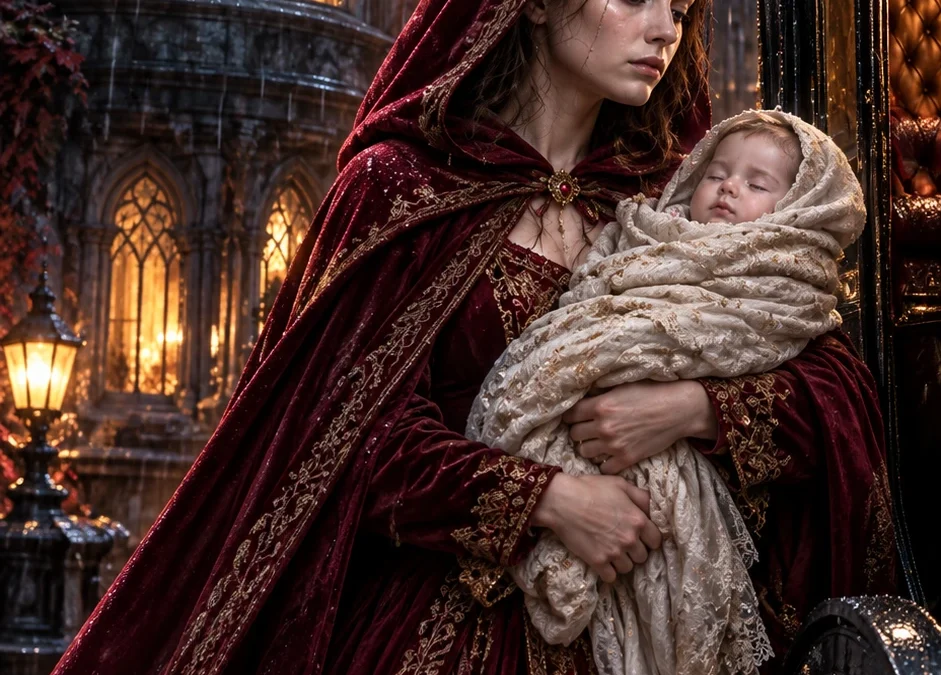
SHE SPENT 100 YEARS BEGGING HER VAMPIRE KING TO SHOW UP. THEN SHE VANISHED WITH HIS HEIR, AND HE FOUND A HIDDEN CHEST WITH 700 LETTERS HE NEVER KNEW SHE WROTE 😱🩸
Part 1
The vampire king believed his queen would never leave.
The blood bond that tied them together was, according to the Old Tongue, unbreakable. So he broke every promise he ever made her, one after another, with the calm of a gambler who knows the other player can’t leave the table. 🎲
Until one night the entire palace woke to an impossible silence.
The queen was gone. Her baby son was gone with her. And the bond, that eternal thread, had gone mute, like a bell buried at the bottom of the sea. 🔔
But to understand that night, we have to go back.
Serafina of Mirabel was never born for a throne. She grew up among dark vineyards in a quiet valley, the daughter of Lady Ivana, an ancient healer who taught her to read blood the way others read books.
Almost a century earlier, King Lucian Valmont, ruler of the seven blood clans and the most feared vampire on the continent, had found her. He didn’t choose her for politics.
The bond woke on its own, burning and undeniable, the night she healed a wound no one else could close.
“You are my destined one,” he told her, his voice shaking. “The Old Tongue never errs. Wherever you are, there is my kingdom.”
She believed him. That was her first mistake.
Her second was believing him for a hundred more years.
Because Lucian carried a wound deeper than any Serafina could close. His father had been murdered by the Court of Ash, a rebel clan from the south. Revenge became his secret religion.
At first it was a shadow in his eyes. Then a map spread across the council table at all hours. Then it was the only thing he saw.
The first broken promise was small, the way first ones always are.
It was the Rite of the Red Candles, the anniversary ceremony where the king and queen renew their mark before the entire court. Serafina stood in the great hall with her wrist bared before three hundred nobles while the candles burned down, one by one.
Lucian never came.
He was in the war room, drawing invasion routes with Duke Malvane of Crovenhall.
“There will be other rites,” he told her afterward, without lifting his eyes from the maps. “Centuries of them. I only have one chance to crush Ash.”
“I’m not asking for centuries,” she whispered. “I’m asking for one night.”
“You’re my destined one. You know how to wait.”
As if her eternity were a warehouse he could pull time from without ever paying. 💔
The second broken promise had a name. Guardian of the Seals, a title that belonged to the queen by ancestral right. Lucian handed it to Duke Malvane over dinner, with a smile as easy as someone gifting a ring he found in a drawer.
“That title was mine, Lucian. You swore no honor of mine would ever be currency.”
“It’s not an honor, my love. It’s paperwork.”
His tenderness always arrived late and always came cheap. She searched those gray eyes for the man who had sworn an oath in blood a century ago.
She found him still. So she stayed.
Then their son Darien was born in the coldest winter the court could remember, with gray eyes like his father’s and a cry that rattled the chandeliers.
On the night of the Naming Rite, when the heir was to be presented to the clans, Serafina dressed him in the white linen her mother had sewn decades earlier for a grandson she never lived to meet.
Lucian sent a messenger.
A messenger. 😢
Ash had burned a border outpost and the king was riding south. Serafina performed the father’s part of the rite herself, her voice steady and her heart a clenched fist, while three hundred nobles pretended not to notice.
And Duke Malvane watched from the front row with a compassion so perfect it seemed rehearsed.
“How alone our queen is,” he murmured, just loud enough for her to hear. “So beautiful, and so alone.”
When Lucian returned three weeks later, he brought gifts. Silks. A garnet necklace. A ceremonial dagger for a baby who couldn’t hold up his own head.
“You were magnificent, Casimir told me,” he said, leaning over the cradle.
“I was alone, Lucian. Magnificent and alone. I’m getting very good at that combination.”
By then she had started counting his promises the way you count casualties after a battle. That one was number forty-seven.
And what the court never saw, what even Lucian never saw, was everything the queen carried in silence.
She answered the letters of lesser clans the king forgot, in handwriting so close to his that no one ever noticed. She remembered every name, sent every gift, defused insults that would have cost armies. She caught poison in an ambassador’s wine before it touched his lips, and the war that never happened appeared in no chronicle.
She warned him about Malvane, too.
“He is isolating you. Every advisor who left this year left after speaking with him. Every report from the south passes through his hands. He’s building you a cage with bars made of favors.”
“He gave me three thousand lances and the mountain passes,” Lucian said, rubbing his eyes. “Ambitious, yes. I know how to handle ambitious men.”
“He isn’t serving you. He’s studying you.”
Then came the night everything shattered.
Duke Malvane stood before the Great Council with ten thousand lances, the treasure of his mines, and a single price: “A small valley in the south. Insignificant to the crown.”
The Valley of Mirabel.
Serafina’s home. Her mother’s grave. The only thing in the world that was hers and not the crown’s.
She stood and said, “This land is my ancestral dowry.”
Malvane smiled. “The law allows the crown to dispose of dowry lands in time of war… with the husband’s consent.”
Every eye in the hall turned to Lucian.
And Lucian looked at the map.
Not at his wife. At the map.
She watched him do the math. Ten thousand lances on one side. On the other, the anger of a woman who could never leave. A resource without limit. Like gravity.
“I’ll buy you ten valleys when Ash falls,” he said softly. “I promise.”
Promise number sixty-three.
Serafina didn’t scream. She didn’t cry. She looked at him for one long, terrible moment, like someone memorizing a face before a journey.
Then she bowed her head with perfect courtesy.
“Of course. My husband’s consent. Naturally.”
Lucian signed. The quill scratched the parchment with a small, dry sound, and to Serafina it sounded like a century splitting in two. ⚔️
That night she poured two glasses of Mirabel wine and said gently, “You were right, Lucian. I can be furious for a hundred years and I’ll still be here. We both know it.”
He kissed her forehead, the administrative kiss his love had become, and went to sleep the deep sleep of kings who believe everything is secured.
Serafina stood motionless until his footsteps faded.
Then she knelt by the cradle and whispered in her mother’s ancient language: “Your father isn’t a bad man, my love. He’s something worse. He’s a SURE man.”
She opened her mother’s chest, pulled a blood-red grimoire from the false bottom, and turned to a spell she had read a thousand times without letting herself understand it.
The Veil of Sleeping Blood. The art of silencing a bond that cannot be broken.
Three nights, she calculated. I need three nights.
On the fourth dawn, Malvane’s men would arrive to claim her valley.
By then, Serafina of Mirabel planned to be so far away that even the Old Tongue couldn’t pronounce where she’d gone.
But what she didn’t know, what no one in that palace knew, was what lay buried beneath the vineyards she was about to lose… and why Malvane had spent twenty years pushing the king toward it. 😳
🔥 Want Part 2? Comment “PART 2” below or drop any word and I’ll send it to you privately! 👇
Part 2
…and why Malvane had spent twenty years pushing the king toward it.
Serafina had no idea. She only knew she had three nights. 🌙
The first night, she prepared the blood. The Veil demanded three things: blood offered without fear, black poppy root grown under a new moon, and an object that had touched the heart of the bond. She chose the silver cup of their union, the very one where she and Lucian had mixed their blood a century before.
The second night, she bought silence. Not with gold, because gold leaves a trail. She paid with a hundred years of kindness to people nobody else noticed. Marta the cook, whose daughter Serafina had saved from red fever. The old guard at the Thorn Gate, whose gambling brother’s debt had been quietly paid a decade ago. Anca the maid, whom she’d protected and taught to read.
She didn’t ask them to lie. She asked for something simpler and safer: that on the third night, they see nothing.
“Take me with you, my queen,” Anca whispered, tears in her eyes.
“I can’t. Two women and a baby draw attention. But listen, Anca. When everything burns, and it will, go to Casimir. Tell him the queen said: the accounting is in the cedar chest.”
The third night, Lucian came to dinner.
It was almost cruel. He showed up with a bottle of wine and a shy, awkward look, as if the universe were testing her one last time.
“I’ve been thinking about what you said in council,” he offered. “Maybe after the war I can buy back part of the valley. At least the stone house.”
Maybe. A part. At least. Crumbs presented as banquets, with the total innocence of a man who has never been hungry.
“Do you know what’s saddest, Lucian? You’re not cruel. A cruel man would have made this easier.”
At the door, he turned back. “I don’t know what I’d do without you.”
“No,” she said softly. “You don’t.”
The door closed. She counted to one hundred.
Then she dressed Darien as a village child, packed her mother’s grimoire, a few bags of herbs, the spent silver cup, and a handful of unmarked jewels. A hundred years of life fit in one saddlebag.
She knelt, opened her palm with her mother’s dagger, and began to chant.
It hurt, a vast, dull pain, like having her soul bandaged in wet linen. But worse was the bond itself, that living thing that had sung between her chest and Lucian’s for a century, now curling under the veil like an animal that doesn’t understand why it’s being covered.
For one instant she almost faltered.
Then she looked at the cradle. “Forgive me,” she whispered, to the bond, to herself, to the man sleeping three corridors away.
The song went quiet. A murmur underwater.
She unraveled the palace wards one by one, not breaking them but blinding them, leaving a hole in the exact shape of a queen. 🕯️
“We’re going to play a game, my love,” she told Darien, a finger to his lips. “It’s called silence. You’ll be the best in the world.”
And the baby who rattled chandeliers stayed silent as if he understood.
They slipped down the servants’ stairs. Marta swept ashes without looking up. The old guard stared at the moon, jaw clenched, eyes wet. The Thorn Gate opened without a creak.
A cart waited in the fog.
Serafina took the reins and looked back once. The Alcázar of Nocterín stood black against black, one lone window lit in the king’s tower, where Lucian bent over his maps, planning the war that would cost him everything not drawn on any of them.
“Goodbye, Lucian,” she said, too softly for even the fog to hear. “May your revenge hold you at night. May it wait up for you. May it comfort you when you sicken of yourself. You’ll find out what it’s worth.”
She snapped the reins and the cart sank into the mist, heading east, along roads that existed only in a red grimoire.
The next evening, when the sun set over the Alcázar, the palace woke to the most famous silence in its history.
Lucian stood in the center of his wife’s empty room, reaching inside his own chest for a bond that had sung for a hundred years, and finding only a buried murmur, distant and impossible to follow, like a bell ringing under the sea.
“Serafina,” he said. First with irritation. Then with confusion. Then with something his voice had never held before.
“Serafina.”
The silence answered. And in that silence, for the first time in a century, the king heard exactly how much of the world his queen had been holding up.
All of it. 💔
But Lucian still thought he could simply summon her back. And far away, in a tower in Crovenhall, Duke Malvane was smiling, because his plan had just entered its final phase.
He didn’t want the queen returned to the king.
He wanted her found first. And he wanted her alone. 🩸
👍 Want to see Part 3? LIKE or COMMENT “REVEAL” below! Part 3 will be posted once we hit enough comments! 👇
Part 3
The first three days, Lucian raged.
“It’s a tantrum,” he told Casimir, the old Seneschal, pacing the throne room like a caged lion. “She’s hurt about Mirabel and wants to punish me. She’ll come back when it passes.”
“She has always come back with respect, Majesty,” said Casimir, hunched, his eyes having watched three dynasties fall. “But one cannot return who never left before.”
“A destined mate can’t hide from her bond. When I search calmly, I’ll find her.”
He searched calmly. That night in the chamber of seals, he followed the thread of the bond inward, as the priests of the night had taught him. The thread was there, alive, wrapped in something he had never felt: layer upon layer of woven silence. When he tried to push through, it was like shouting a name into a bell made of wool.
He left the chamber at dawn, gray-faced. “Bring the trackers.”
By the second week, Lucian was afraid, though he gave it other names.
The Morbat clan trackers, who could follow one drop of blood across a river, came back empty-handed. The harvest cart turned up abandoned at a crossroads where forty other roads met. The seers consulted their obsidian mirrors and found only fog. A royal infant should have blazed like a bonfire in snow, yet Darien, heir of the eternal night, appeared in no mirror at all.
“Someone helped her,” Lucian roared in council. “Someone in this palace opened doors and closed mouths. I want names.”
There were interrogations. But Marta only swept. The old guard only stared at the moon. And Anca only cried, and her tears were so real, because she truly missed her queen, that no inquisitor found a lie in them.
The queen had built her escape from the one material that leaves no fingerprints: old gratitude from invisible people.
“Since when does the cook have a daughter?” Lucian asked Casimir one night, not wanting to ask.
“Nineteen years, Majesty. The queen saved her life from red fever.”
“Why did no one tell me?”
Casimir gave him the patient, weary look of old servants. “The queen told you herself, spring of the year fourteen. You were signing maps.” 🗺️
Meanwhile, Duke Malvane arrived in furs and fake sympathy.
“A tragedy,” he sighed. “Though perhaps it’s for the best, Majesty. The queen was charming, but a discordant voice. She questioned your alliances. When your revenge is complete, there will be queens eager to fill the empty seat. My own niece, for one.”
What happened next was told for years in the halls of Nocterín.
The king crossed the room faster than a blink, and when the world refocused, Malvane was pinned against a pillar, the king’s hand around his throat, his feet a hand’s width off the floor.
“Speak again of an empty seat,” said Lucian, with a terrible softness, “and you will fill an empty grave.”
“We understand each other perfectly, loyal ally,” Malvane wheezed.
Lucian let go. And with his back turned, he didn’t see the duke’s gaze as he straightened his furs. There was no fear in it. Only cold satisfaction, the look of a chess player who has just confirmed the opposing king is exactly where he wanted him.
Because for Malvane of Crovenhall, everything was going to plan. A twenty-year plan. Isolate the queen drop by drop. Intercept her letters. Poison the king’s ear with urgencies timed to every rite and anniversary. And finally, tear Mirabel away from her.
Everyone thought it was a sentimental vineyard. Only Malvane, after years in forbidden archives, knew the truth: beneath the vines slept the Scarlet Spring, a wellspring of ancient blood, the power that had made the healers of Mirabel what they were, and could make a duke into a god.
There was only one problem. A small problem the size of a baby.
As long as the queen and heir lived free, the Mirabel line endured. And the Spring recognized its own blood the way dogs recognize their masters. It would never fully open for him.
So that night he gave secret orders to his nameless agents: “Find the queen. And when you do, don’t touch her. Tell only me.” 🕷️
Far away, a cart pulled by a tired horse crossed the eastern border in the rain.
Serafina traveled the healers’ roads from the grimoire, paths that no military map had ever drawn because they’d only ever carried women with herbs and haste.
She sold her first ruby in a nameless village. She bought scratchy wool and discovered it keeps you just as warm as fine fur, something queens never learn. She slept in barns with Darien on her chest, listening to the rain, and one night realized something that made her laugh and cry at once.
A whole week had passed and no one had lied to her.
In every village she paid for a roof with what she knew. A hard birth here. A fever there. A badly healed leg that had to be re-broken while the blacksmith bit down on a belt. And in every village, someone would squeeze her hands and say some version of the same thing.
“I wish you’d stay, ma’am. We need people like you.”
Not the queen. Not the king’s mate. People like you.
“Did you hear that, Darien?” she whispered one dawn. “They need the two of us. Just as we are. Without a crown.” 👑
Past the Besar mountains and the Needle Pass, the world opened to the sea. And in the margin of an old map, in her mother’s handwriting, a forty-year-old note:
Besaria, free city. No thrones, no clans, no lords of blood. Here, doors are earned. If all else fails, daughter, go to the lighthouse and ask for the house of midwives.
Serafina arrived with Darien asleep against her chest and a lame horse behind her. She read the words carved above the council house door three times: “No one rules here who does not serve here.”
She walked to the lighthouse and knocked.
The woman who answered, Otilia, was broad as a barn door, gray braids, forearms of someone who’d spent fifty years bringing people into the world.
“Name?”
“Cela,” said Serafina. She’d chosen it in the mountain pass. Short. No history. “I’m a healer. My mother taught me.”
“Everyone says that.” Otilia jerked her chin toward the sounds of a long labor. “The ropemaker’s daughter’s been at it two days. Breech. My hands are too big. If you’re what you say, prove it. If not, the door’s where you left it.”
For the next four hours, Serafina was no queen and no fugitive. She was two hands, a calm voice, and a thousand years of knowledge. When the ropemaker’s daughter wept over her living child, Otilia wiped her hands and delivered her verdict.
“You sleep upstairs. Small room. Work for roof and food three months, then we talk silver. And don’t tell me about the boy. Half this city got here running from something, and whoever asks pays for the next round.”
That was how it began.
Serafina learned how little she knew. She could read blood better than anyone alive, but not haggle over thread, not spot a dying man from a dockside actor, not that in Besaria medicine cost nothing to the poor and double to captains. Otilia taught her all of it in grunts, and beneath the grunts grew something Serafina had not felt in decades: respect earned, not inherited.
She met Joran the blacksmith, a mountain of a widower whose laugh shook his forge, who made her a better midwife’s kit than she’d had in the palace in exchange for fixing a shoulder that had hurt for ten years. She met Renata, captain of the Free Guard, a vampire with a scarred eyebrow and few words, who after watching her save a bleeding young guard said only, “You can settle in here.” From Renata, a welcome speech.
And she met the city itself, the strangest character of all, where decisions were made in glorious, shouting assemblies, and the wise old women won every vote because they knew how to wait for the shouters to tire.
Darien took his first steps chasing Otilia’s cat through hanging sheets. His first word, at the fish market, wasn’t mother or king. It was more, pointing at seagulls. He grew sun-browned, learned to swim before he learned to read, called Otilia Aunt and Joran Uncle, and sat in the forge on winter nights listening to tales of sea serpents.
He had his father’s gray eyes. Serafina made peace with that. She chose to see them as Darien’s own, not a debt owed to anyone.
“Do I have a father?” he asked at three, with a child’s terrible aim, while she picked scales out of his hair.
She had rehearsed a hundred answers and used none. “You do. He lives very far away. He’s fighting a very long war against a monster. One that hides behind mirrors.”
She meant it. “If he wins, he’ll come. Whether he comes or not isn’t what matters, my love. What matters is that you learn to fight too.” ⚓
On the rooftop at night, she allowed herself exactly ten minutes of memory. She touched the spot in her chest where the bond murmured beneath the veil, a faraway bell under the sea. Yes, it still hurt. No, she didn’t regret it. Both were true, and she’d learned she didn’t have to choose.
By the third year, when gray fever came on a ship from the north, Serafina organized the harbor quarantine with a precision that left the elected leaders blinking. After that they called her for everything: guild disputes, treaties with interior villages, a trade conflict with the merchants of Karsh she defused in two meetings and a dinner. Negotiating with furious fishmongers, she discovered, is identical to negotiating with clan lords. You just have to know what fear hides beneath each arrogance.
“Where did you learn all this, Cela?” Renata asked one night. “And don’t say your mother. Nobody learns to disarm ambassadors by curing fevers.”
“I was married,” said Serafina, after a silence. “To a man with many enemies and a poor memory. Someone had to remember for him.”
Renata nodded, with the courtesy of Besaria, which meant not asking more.
That night Serafina’s ten minutes went to a single question, one she’d never permitted herself, and one that surprised her with its lack of rage. Has he noticed yet? Has he discovered everything I carried? Or is his war still hiding the world from him?
The answer was writing itself in disaster.
Lucian’s collapse wasn’t a fall. It was a dripping. And every drop had the name of something his wife had held up in silence.
The first drop, four months after she left: the Lord of Bardan, ally of three generations, withdrew his troops without explanation. His reply was a dry letter. Bardan does not forget slights. Not one word at the solstice, not one sign at the mourning of my house. Pacts must be watered, Majesty, or they wither.
“What mourning?” Lucian demanded in council. “We’ve always honored Bardan. Every solstice, every birth, every funeral.”
Silence. Then Casimir, in the voice of one who’d waited months for the question: “Because the queen wrote them, Majesty. All of them. For sixty years. In your handwriting. She said a king at war can’t remember birthdays, but birthdays win more wars than sieges.”
The second drop: the eastern ambassador canceled the port treaty with a venomous line about courts where the wine could no longer be trusted. Without the queen tasting the intrigues, he no longer felt safe. Port treaty gone, the eastern grain went with it, then prices, then the mood of the lesser clans, who began looking toward other loyalties.
The third drop was the worst, because it was military. The great spring offensive against Ash, twenty years in the planning, collapsed in three weeks. Not for lack of lances; Malvane’s ten thousand were there. It failed because the fords he swore were secure weren’t. Because his supplies arrived late and rotten. Because the clans meant to close the western pincer no longer answered the letters of a king who had never learned to write them.
Lucian returned from the front with half his army and a suspicion growing inside him like a tumor.
He locked himself in his wife’s wing, kept untouched on his orders, and began to search. He didn’t know for what. He only knew he was searching for her, in the only way left: the trace of her work.
On the third night, he found the cedar chest. Anca, following Casimir’s instructions, told him where to look.
Inside there were no love letters. No diaries. Something far more devastating. Accounting.
Sixty years of records, ordered by date, in Serafina’s clear hand. Copies of seven hundred diplomatic letters written in the king’s name. Gift lists with notes: To the Lord of Bardan, southern balm, for his sister’s death. He doesn’t know. He was on maneuvers. Records of three poisoning attempts quietly defused. Did not worry him before the campaign. A map of the court, with threads of ink linking names, favors, and debts. The true circulatory system of the kingdom, drawn by the only person who’d seen it whole.
And at the bottom, a separate folder tied with red ribbon. On the cover, one word:
Malvane.
In case you ever decide to read.
Lucian read it with frozen hands. Years of meticulous observations. Every departed advisor, with the date of their last conversation with Malvane. Every altered report from the south, the real one and the one that reached the king, side by side. Every military emergency that had erupted with astonishing aim the eve of every rite, every anniversary, every promise.
And a final note, dated one month before her flight:
I still don’t know what he wants from Mirabel, but he’s been pushing you toward it for years. And you think the war was your idea. When you read this, if you read it, it’ll be too late for us. Perhaps not for you.
Signed, the discordant voice.
The king sat on the floor among his wife’s papers all night, like a man among the ruins of a house he thought eternal because he never once inspected its foundations.
And when dawn forced him to draw the curtains, Lucian Valmont did something he hadn’t done since his father’s death.
He wept. No witnesses. No dignity. The red folder pressed to his chest.
Then he stood up, and he was someone else. Not better yet. But awake.
“Casimir,” he said that night. “Tell me everything. Everything I didn’t see. Spare me nothing.”
“How much time does Your Majesty have?”
“All of eternity.”
“Then it will just be enough.”
And the old Seneschal talked for nights on end.
He told him about the Red Candles, how the queen waited until the last flame died, then thanked the musicians one by one so the night wouldn’t be entirely wasted. He told him about the game she’d invented for Darien, “When Papa comes,” and how she’d stopped playing it without announcing why. He told him about the Naming Rite and Malvane’s line, “how alone our queen is,” delivered in the exact tone of a man planting seed.
Lucian took each story standing, without defending himself. Defending was still not listening, and listening was all he had left of her.
“Why didn’t she force me to see it?” he asked one night, barely audible. “She had power. She had my bond. She could have screamed louder.”
“She screamed for a decade, Majesty. Politely. It’s how queens scream.” Casimir gathered the cups. “And if an old man may be insolent: when a man doesn’t hear the woman he loves, volume was never the problem.”
The hunt began that winter.
But anyone expecting the king of eternal night to raze villages for his queen would have been disappointed. Lucian left almost alone, with two trusted guards and unmarked clothes, leaving the regency to Casimir and a public order to suspend the war, an order that made Malvane howl in a way the new, awakened Lucian found extraordinarily informative. 👁️
He followed the only material clue: the harvest cart, the crossroads of forty roads.
And where the blood trackers had failed, the king found the trail his wife couldn’t help but leave, because it was the trail of who she was. A trail of healed people.
In the first village, an innkeeper spoke of a widow from the interior who’d turned a breech baby years ago. “People still say her name, sir.” In the second, a blacksmith flexed an arm that should have stayed stiff forever. “A saint. Wouldn’t even take payment for the wine.” In the third, nothing. The fourth, nothing. In the fifth, a shepherd remembered a woman with wise hands, headed east against all logic. “Nothing out there, sir. Mountains, and the sea beyond.”
Lucian rode from village to village for months, and each stop taught him a lesson that devastated him. People spoke of the stranger with more love than his entire court had ever shown their queen. And none knew she was one.
Stripped of everything he thought defined her, crown, throne, bond, Serafina had been loved within weeks by strangers for being exactly what she was. He’d had that exclusively for a century and spent it like currency.
“You know what I remember most about her?” an innkeeper told him, ladling soup he couldn’t eat. “She listened. Looked at you like there was nothing in the world more important than your pain. Strange, how rare that is, isn’t it, sir?”
“Yes,” said the king, eyes on the table. “Strange.”
That night, in a barn, because he’d started sleeping where she had slept, like a pilgrim retracing stations, Lucian reached inside his chest for the buried murmur of the bond. For the first time he did not try to pull on it, or follow it, or demand direction from it.
He only listened.
“I know you won’t lead me to her,” he told the dark. “I understand now. That’s not the road. I’ll find her the way you find things you broke. Piece by piece. Learning what each one was.”
In his tower at Crovenhall, Malvane received two pieces of news in the same week, and together they drew the most dangerous smile of his long life.
First: the king had suspended the southern war and was wandering the roads like a pilgrim. Perfect. An absent king was an open board, and the regent Casimir was honest, which in politics is a polite word for predictable.
Second, a nameless agent who smelled of faraway ports: “We found her, my lord. It took three years. A healer called Cela, in the free city of Besaria across the eastern mountains. A beloved midwife. She has a son, about four. Gray eyes.”
Malvane closed his eyes and savored it like old wine.
“And Besaria’s defenses?”
“Old walls. A small, tough free guard. No lord, no throne. They govern themselves.” The agent hesitated. “There’s one problem. The city protects her. Not like you protect a queen. Like you protect a neighbor. That’s worse.”
Malvane stepped to the map covering his study wall and laid a finger on the eastern coast.
“I can’t send my banners against a free city without the continent asking why. But I don’t need my banners. The southern war left thousands of Ash soldiers unpaid and homeless. The defeated are cheap, and cheap men don’t ask questions.”
With unmarked gold and unsigned orders, the duke bought the remnants of the Court of Ash, the very enemies he’d sworn ten thousand lances against, and gave them a new target.
“The free eastern ports. Burn them all, so no one notices which one matters. And in Besaria, find a healer and a boy. Alive. They’re my merchandise.”
The first port burned in autumn.
Caleta Brava lay twelve days’ sail from Besaria. The refugees who reached Besaria in small boats told the same story. Gray sails at dawn. Men with southern war scars. A sacking far too orderly to be a sacking.
Serafina was on the dock when the first wounded landed. She worked all night, and as she sutured, she listened. Healers hear what generals don’t. Fever loosens tongues.
And what she heard chilled her blood drop by drop. The burned men’s ravings repeated details she knew from another life. Southern formations. Insults in Ash dialect. And then something that made her stop the needle mid-stitch.
“They asked about people,” an old man with bandaged eyes murmured. “A woman and a boy. House by house. They asked before they burned.”
That night she went up to the rooftop, not for her ten minutes of memory. To think.
The next night she asked for the floor at the assembly.
The council house was packed to the rafters, loud with fear. The two elected leaders were arguing whether to pay tribute to the raiders, hire mercenaries, or trust the old walls.
Serafina waited, like the wise old women, for the shouters to tire. Then she stood.
“They’re not coming for plunder.” Her voice, trained in halls where a whisper crossed a hundred meters of marble, filled the room without effort. “A raider burns what he can’t carry and leaves before dawn. These men ask questions, then move from port to port in one direction. They haven’t touched Karsh’s shipyards, twice as rich and half as defended. It isn’t greed. It’s a rake. Someone is combing the coast looking for something, and using war as the comb.”
“And what are they looking for, Cela?” Renata asked, narrowing her eyes.
Serafina held her gaze one second. Two.
“What matters tonight isn’t what they seek. It’s that their road ends here. Besaria is the last great port on the coast. We have one winter to stop being prey and become a price too high to pay.”
“And what does a midwife propose?” someone shouted. “Welcome them with herbal tea?”
Nervous laughter. She waited for it to die.
“Three things. First, stop arguing about walls. They can’t be fixed in a winter. But the entrance channel is narrow, and a narrow channel with sunken chains and focused fire turns any fleet into a row of torches. Second, food and cisterns. Sieges aren’t won by courage. They’re won by water. Third, this city has twenty guilds that hate each other lovingly. A siege can’t survive twenty captains. We need one defense council, one clear command chosen tonight, answerable to the assembly but able to act without it when the gray sails come. Assemblies are wise and slow. Fire is stupid and fast.”
She sat.
The silence lasted as long as a wave takes to retreat. Then Otilia’s barn-door voice from the back: “I nominate Cela for that council.”
“Seconded,” said Joran.
“Seconded,” said Renata, worth a hundred votes.
Hands rose. Fishermen whose children she’d healed. Merchants whose deals she’d saved. Women who’d given birth in her hands. Half the city she’d stitched together person by person over three years, with no plan except work, turned out to be the net where her life landed instead of crashing.
Serafina looked at the raised hands and had to breathe deeply, because she understood something enormous in a small place in her chest. In Nocterín she’d had a throne and no votes. Here she had no throne and the votes rained down. 🌊
That week began the winter of work.
Anyone who had known the decorative, silenced consort of the eternal night would never have recognized the woman now striding through Besaria with a roll of blueprints under her arm. She organized the guilds the way she’d seen clans organize, minus the vanity. Coppersmiths to the channel chains. Fishermen to chart the sandbanks only they knew. Weavers to sew false sails for decoy ships. Field hospitals in the three upper squares. Forty boys and girls trained to stop hemorrhages, because wars are lost by those who bleed waiting.
With Renata she designed the defense in depth. The whole city turned into a funnel of friendly traps. Streets that seemed to lead to the center and led to dead-end courtyards commanded from rooftops. Barricades unseen until you turned the corner.
“Where did you learn sieges?” Renata asked one night over the blueprints. “And this time don’t answer with your forgetful husband.”
Serafina traced the channel with a finger. “I read every military treatise in the finest library on the continent. For a hundred years, while I waited for someone who never came back from his maps. Turns out I paid more attention than he did.”
Renata let out a short, rough laugh. “Then here’s to long waits. They’re going to save our hides.”
Darien turned five in Joran’s forge, hammering crooked nails with a goldsmith’s solemnity. At night he asked new things. Why is everyone scared? Why doesn’t Mama sleep? Why do the fishing boats come home so early?
Serafina always told him the truth, sized to his years, because she had sworn on her mother’s distant grave that her son would never be lied to for anyone’s comfort, as his father had been lied to by Malvane, and as she herself had been lied to by a century of promises.
“There’s going to be war, Mama.”
“Maybe, my love. And we may lose.” She lifted him onto the blueprint table and showed him the drawn bay, the chains, the fires, the names of every neighbor on the defense lists. “See how many we are? You only lose when you’re alone. And we, Darien, are never alone again.”
What Serafina didn’t know, as she kissed her son’s forehead over the maps of the city they both loved, was that at that very hour, on a snowbound mountain pass, a traveler in worn clothes with gray eyes was paying a muleteer to join the year’s last caravan to the coast. 🏔️
He had spent months reconstructing her route, village by village, cure by cure. He’d crossed the Needle Pass on foot, half frozen, sustained by a shepherd’s words. “Nothing east, sir, but the sea and the free cities.”
Free cities. No thrones. No clans. The only place in the world where a queen could stop being one.
“Where’s the caravan headed?” he asked.
“Besaria. Though they say come spring, Besaria will be at war.”
The traveler looked east, and something in his chest, a bell sunk in the sea, trembled faintly. So faintly it might have been the wind.
“Then we go fast,” said Lucian. “I know how to fight.”
Lucian saw Besaria for the first time from the high pass at dusk, and he was speechless. Not from beauty, though there was beauty. The half-moon bay, lamps lighting one by one as if the city were putting on necklaces.
He was speechless at the motion.
He’d seen cities prepare for war, and they always smelled of panic. This one smelled of purpose. Crews reinforcing the breakwater under torches. Chains thick as tree trunks snaking toward the channel on barges. Boys running messages. Old women stitching sails in the squares. And over all of it, an order without whips, a choreography of people who knew exactly what to do and why.
“Who organizes all this?” he asked the muleteer. “Your general?”
“We’ve got no general.” The man spat with pride. “We’ve got the defense council, and we’ve got Healer Cela. The one from the channel, the one with the chains. Ash doesn’t know what’s coming.”
“Cela,” Lucian repeated in silence.
He didn’t suspect.
That became his shame and his final lesson. He heard his own wife described, her mind, her voice, her network of gratitude, and did not recognize her, because in a hundred years he had never seen her whole. He knew the Serafina of his chambers. Now the world was presenting him with the Serafina of the world, and she was a stranger.
At the land gate, the Free Guard searched new arrivals. A vampire with a scarred eyebrow measured him head to toe.
“Name and trade.”
“Lucan. Soldier. Southern veteran.”
“Which side?”
“The side that lost what mattered.”
Renata raised her scarred brow. Veterans usually lied cheerfully. This one answered like a man paying debts.
“We need all arms. Report tomorrow to the drill yard. And a warning: here, having a past isn’t forbidden. Bringing it to work is frowned upon.”
On his third day, in the drill yard, Lucian Valmont saw his queen.
She came in with Renata and two councilors, a roll of plans under her arm, walking fast, hair pinned carelessly with a bone needle, talking about cisterns. She wore rough wool dyed blue and work boots. She was thinner. She had a small new scar above her left eyebrow.
And she was, with a difference so brutal his knees nearly buckled, the most alive woman he had ever seen.
In Nocterín, Serafina had been beautiful the way temple statues are beautiful. Perfect, and dimming. This woman burned. She laughed with her mouth open at something a coppersmith said. She scolded a captain twice her size who ducked his head like a cadet. She knew everyone’s name.
The bond beneath its years-old veil quivered like an old dog catching the scent of home. Lucian had to lean on the wall.
She passed ten paces away. And then came the moment he would replay every night for the rest of the siege. Serafina turned her head slightly. Her eyes crossed his, stopped for a fraction, the longest, coldest fraction of his century, and moved on.
No surprise. Nothing.
She didn’t recognize me, he thought, with the mud and the beard and the hood.
He was wrong.
She had known before she saw him. She’d felt him come through the land gate three days earlier, a sunken bell vibrating at the bottom of the sea, because the veil muffled the bond but she was the weaver of the veil, and the weaver hears what the wool conceals. She’d had three days to decide what to do. Denounce him. Banish him. Confront him.
She chose the fourth option, the one worthy of everything she’d learned. Nothing.
“The new southerner, Lucan,” Renata told her at the well. “Fights like twenty demons. Says little, watches much. Where do I put him?”
Serafina drank a ladle of water, taking her time. “Channel crews. Heavy work, clear orders, little spotlight. Let’s see if he knows how to obey.”
“And if he does?”
“Then he’ll have learned something new.”
So began, for the king of the eternal night, the strangest and most healing season of his five hundred years. The season of being nobody.
He hauled stone for the breakwater until the hands that signed treaties bled and callused. He laid chains in freezing channel water, shoulder to shoulder with fishermen who called him Southerner and handed him brandy without asking anything. He learned his crewmates’ names, then their children’s, because he discovered that’s what people with people do. And he discovered he could. That he always had. He’d just considered it other people’s work. Her work.
And he obeyed.
That was the core of it. The keystone of his pilgrimage. He obeyed Renata, Joran, the last coppersmith. And twice a week, at the open meetings of the Defense Council, standing among fifty volunteers in the back rows, he obeyed Healer Cela, who moved pieces across the bay map and unfolded before everyone the mind he’d had at his breakfast table for a hundred years and never once consulted.
“The Southerner,” she said one night without looking up from the map.
His dead heart stopped.
“Renata says in the south you saw naval fire. The lighthouse tower needs a brigade chief for the oils. It’s the most exposed post on the front line. Probable death. You’ll take it.”
Everyone looked at him. She looked at the map. Not one eyelash moved in her profile.
And Lucian understood two things in one heartbeat. This was a gift, the post where he’d be most useful. And it was a test. The question he’d waited three years to have answered. What are you worth when you don’t command? What do you do when the fire is aimed at you?
“I’ll take it,” he said.
“Good.” She moved a wooden token to the lighthouse. “Report to Joran at dawn. Next item. The upper district cisterns.”
That was all. Not even a glance on her way out.
“Congratulations, Southerner,” Joran clapped his back. “She just gave you the post she’d give someone she trusts. Or someone she wants to. With Cela you never know, and better not to find out the hard way.”
That night on the rooftop, Otilia found Serafina watching the sea. She sat beside her without permission, as grandmothers do.
“The Southerner,” said Otilia. “Gray eyes. Like the boy’s.”
Serafina said nothing.
Otilia nodded slowly, like someone confirming a fracture by touch. “When did you know?”
“Before he crossed the gate.”
“And why not throw him in the sea with a stone round his neck? Half the city would help you pick the stone.”
Serafina smiled faintly. Then the smile faded, leaving what lay beneath, which was serious and old and very calm.
“Because banishing him would be giving him importance, and making him king would be giving back what he had. There’s one thing that man has never been in his life. Someone who hauls stone. Who obeys a woman in front of fifty fishermen. Who learns, once and for all, who holds up the world.”
She drew her shawl against the wind.
“Besides, Otilia, war’s coming and he fights like twenty demons. We can’t afford to waste demons. And the boy doesn’t go near him until I say. That’s part of the choice too. Fatherhood isn’t a blood right. It’s a trade. And you learn a trade as an apprentice, sweeping the workshop first.”
Otilia let out her barn-door laugh, then grew serious and took the healer’s hand in her huge ones.
“Just promise me one thing, girl. When the time comes, and it will, don’t forgive him out of tiredness. Forgive him out of conviction. Or don’t forgive him. Tiredness makes ghastly marriages.”
“Otilia,” said Serafina, watching the sea. “I’m not tired. I sleep little, but from him I’ve rested for three years.”
Down in the harbor warehouse, the lighthouse oil brigade chief wrote by the light of a candle stub in a cheap notebook of wrapping paper. He’d started the habit in the mountains. They weren’t letters, since he never meant to send them. They were accounts. The accounting he’d never kept.
Today I saw her laugh. I never knew she laughed like that. Guilt is simple arithmetic: no one laughs like that in a house where she isn’t heard. The laughter was mine, and I spent it on maps. I keep adding what I owe. The list doesn’t end. Tomorrow I’ll carry oil and keep adding.
He closed the notebook, blew out the candle, and in the dark, among the snoring fishermen, the king of the eternal night murmured the three words that had become his prayer every dawn, said to no one, asked of no one, promised to no one but himself. Piece by piece. 🕯️
It was Darien who found his father, not the other way round, because children are the only truly unpredictable strategists.
It happened in Joran’s forge on a late-winter afternoon. Lucian had come for iron brackets for the lighthouse boilers and was waiting by the door when a five-year-old shot in like an arrow, climbed onto his usual bench, and began hammering a crooked nail with enormous concentration.
Lucian lost his breath.
He’d have known him among ten thousand children. Serafina’s dark hair. Lady Ivana’s frown. And his own gray eyes, his dead father’s eyes, staring at a nail with the gravity of a king being crowned.
“That nail’s already dead,” Lucian heard himself say, in a voice he didn’t know where it came from. “Are you burying it?”
Darien appraised him with the brutal frankness of his age.
“It’s a dragon. I’m defeating it. You’re the Southerner from the lighthouse.”
“So they say.”
“Aunt Renata says you fight like twenty demons. That’s a lot of demons.”
“Depends on the size of the demons.”
Darien considered this and approved with a nod. Then he pointed to the small hammer.
“Do you know how to defeat dragons?”
And Lucian Valmont, lord of seven clans, terror of the continent, sat on the dirt floor of a forge beside his son, who didn’t know he was his son, and spent a full hour defeating crooked nails.
That night he wrote in his wrapping-paper notebook: The most important hour of my five hundred years, and the saddest. They introduced me to my son, and I was no better than a stranger.
Joran had watched from his anvil. That night he went straight to the midwives’ house.
“The Southerner and the boy,” he told Serafina without preamble. “Today in my forge. An hour of dragons. He didn’t approach. Darien went to him, you know how he is. But I’m telling you because I saw how the man looked at him.” The blacksmith twisted his huge hands, hunting words. “How I look at fire when I’m carrying iron I might break. With that kind of care.”
Serafina listened in silence. Then she went upstairs, tucked her sleeping son in, and stayed long looking at him.
The next day she intercepted the oil brigade chief on his way down from the lighthouse and, for the first time in months, spoke to him outside a meeting.
“Lucan.”
“Healer.”
They stood face to face on the cliff path with the sea wind between them, and the whole comedy trembled for an instant in the air, because they were alone and both knew, and both knew the other knew. And yet the comedy was the only bridge that could bear the weight, so neither dropped it.
“The boy in the forge,” she said. “The healer’s son. They tell me he played with you. He’s a good boy. Defeats dragons.”
“Yes.”
A pause measured to the millimeter.
“His father doesn’t know him. Decided years ago that other wars mattered more. The boy doesn’t know it yet, and when he does, he’ll learn it with the words I choose, not by forge surprises. Understand me, Southerner? You may play with him. Children choose their giants, and I won’t be the one to take one away on the eve of war. But if you teach him one crooked thing, if you plant one confusion, I’ll put you out of my city on the night tide. Is that clear?”
“It’s clear.”
And then Lucian, looking at the sea, because looking at her was more than he allowed himself, added: “The father. The one who chose other wars. Does he know what he lost?”
Serafina studied him a long moment. There was something complex in her eyes. Not tenderness. The cold interest of a surgeon checking whether a wound is clean.
“He’s beginning to,” she said. “He’s not there yet.”
And she walked down the path.
Lucian stayed where he was, heart pounding like his son’s small hammer against every dragon in the world. 🐉
The gray sails came with the first full moon of spring.
The lighthouse lookout counted them at dawn. Forty-seven ships. The largest mercenary fleet ever assembled in the east, black with Ash soldiers and bristling with assault ladders.
Besaria’s bells rang the toll everyone had rehearsed and no one had wanted to believe in. The whole city moved like one animal. Children and elders to the mountain caves. Brigades to the rooftops. Chains pulled taut. Cauldrons lit.
On the main dock the Defense Council met one last time under open sky. Serafina, in simple leather armor, hair braided for war, reviewed the plan in a classroom voice.
“We can’t beat them on open water or in open field. We can beat them at the door. The entire battle is the door. The channel is our funnel, three ships at a time at most. Renata commands the south breakwater. Joran, the chains. The lighthouse fire covers the pass. The first three ships must burn inside the channel, because their wrecked hulls become our second wall.”
Her finger crossed the map.
“If something fails and they land, the city swallows them street by street as rehearsed. Nobody fights alone. Nobody is a hero. Heroes are people who left their crew.”
She looked up and swept her eyes over them all. Fishermen with harpoons. Coppersmiths with axes. Her forty young medics with bandage satchels slung across their chests.
“Listen well. I’ve seen empires, and I’m telling you what they’re worth. Nothing this city wants can be bought with what this city has. Besaria isn’t defending gold. It’s defending the one thing empires can’t manufacture: a door you earn, not inherit. Each of you is worth more than the whole fleet coming at us, because you know why you fight. They’re paid by the week.”
No one cheered. Besaria wasn’t built for cheering. Something better came: a grave, calm feeling, the feeling of people about to go to work. And Otilia’s voice from the back, with her barn-door tenderness:
“You heard her. To your posts. And whoever dies without my permission will answer to me.”
The first three ships entered the channel on the high tide, confident in their numbers, and the world turned to fire.
Lucian worked the lighthouse cauldrons the way he’d worked stone all winter. No glory. Precision. Burning oil fell exactly where it should, not a minute early, when the mirror signal came from the market tower. Two flashes: wait. Three flashes: now. And the three hulls ran aground ablaze across the pass, exactly as a woman had drawn them on a map months before.
The mercenary fleet churned outside, gnawing on a bone of stone and fire. For two days and two nights, Besaria held. And Lucian, between smoke and shift changes, watched his wife’s mind unfold, piece by piece, across an entire city.
Arrow stores right where quivers ran dry. Water relays arriving before thirst could cry out. Medic brigades running crouched down corridors of sandbags laid weeks in advance. It was the cedar chest. The same intelligence that had held up his kingdom in silence, only here no one ignored it. Here it was the visible architecture of everyone’s survival.
Grown men wept with gratitude finding the depots. And he thought: I had this at my breakfast table. I had this, and I signed maps.
On the third day, the mercenaries found the crack.
The North Breakwater, the oldest flank, where the wall sank into low water. Flat boats under dawn fog, and suddenly three hundred Ash veterans ashore inside the gate, spreading toward the market district.
The tower bell rang the toll no one wanted to hear. In the upper-square hospital courtyard, where she was stitching a fisherman among dozens of wounded, Serafina lifted her head. She heard the three tolls repeated, breach in the north, and her face went in one second from exhaustion to metallic calm.
“Otilia, take the hospital. Renata’s pinned in the south, she can’t move.”
She tore off her apron and took from the wall a short bow no one had ever seen her use.
“The north breach is mine.”
Otilia gripped her arm. “The low caves are in the north, Serafina. The children.”
“I know,” she said, already running. “My son is in the low caves.”
And from the lighthouse path, wrapped in smoke, a brigade chief with gray eyes saw the healer cut across the city like a blue arrow toward the broken flank, toward the sound of axes, toward where his son was. And for the first and only time, he abandoned an assigned post.
“Southerner!” his crew shouted. “Where are you going?”
“To obey the only old order I have left,” roared Lucian, vaulting stairs four at a time, snatching an axe from a barrel as he passed. “Where she is, my kingdom is.”
The north breach was chaos. Fog, axe blows, screaming. In the middle of it, Serafina of Mirabel planted her line.
She arrived before anyone, with thirty from the market reserve: weathered fishermen and two butcher sisters who fought back to back. She attempted no heroics. She did what she’d drawn a hundred times. Cede the first three streets that looked like easy plunder, and anchor the defense at the mouth of Fish Square, where the roofs were low and corners narrow, and where every rooftop hid twelve-year-old slingers who’d spent a winter training their aim on pumpkins.
“Let them into the throat,” her voice cut the din like a whistle. “Rooftops, wait for my signal. Nobody fights alone.”
The Ash veterans entered the throat. The throat closed.
Stones from the roofs. Weighted fishing nets dropping on the front ranks. The harpoon line holding the shock with that ugly, practical courage of people defending their own kitchens.
But they were three hundred and they were veterans, and the weight began to bend the line. Serafina, loosing arrow after arrow from the market portico, made the calculation commanders make with their stomachs.
We’re not going to make it.
Then the mercenaries’ left flank came undone.
Not bent. Undone, like paper in water. And through the gap came a lone figure with a cooper’s axe, and Serafina, who had felt him coming through the bond long before she saw him, the sunken bell ringing like mad under the sea, thought with an impossible mix of old rage and new relief: There he is. Five hundred years of wars, finally serving my fish square.
Lucian did not fight like a king. Kings fight surrounded. He fought the way people fight who have nothing left to protect from themselves. No ornament. No cruelty. Terrifying efficiency, always at the exact point where Besaria’s line was creaking, holding, covering, hauling wounded to the rear between charges.
At some point in the next hour they were ten paces apart, she up on the portico, he down in the line, and they worked together. Without a word. She pointing with her bow at the breaking points, he arriving as though a hundred years of silent breakfasts had been, unknowingly, the rehearsal for this one true conversation. ⚔️
By noon, with the sun burning off the fog, the mercenaries in the breach broke formation and ran for their boats. Fish Square stood. Besaria stood. And that night, when the gray fleet weighed anchor, bloodied and humiliated, the city didn’t celebrate. It slept, which was its deepest form of celebration.
But before sleeping, two conversations.
The first was in the fish market, turned blood hospital. Among the prisoners was a mercenary captain with his thigh laid open, and Serafina stitched him with her own hands because that was the law of her trade. And as she sewed, she asked, in the gentle voice that loosened tongues better than any pincers:
“How much were they paying you? Professional curiosity. I’d like to know what my city is worth.”
“More than any city’s worth.” The captain chuckled through his teeth, dizzy with poppy wine. “Unmarked gold, healer. Chests of it. And it wasn’t even about the city. The city was the disguise.” He leaned in, drunk and confiding. “It was for a woman and a boy. Alive. Orders from the paymaster. Burn the other ports, find them in Besaria. A healer from the interior and a gray-eyed kid. Funny, eh? Maybe it’s you.”
“Maybe.” Her hands didn’t tremble. She tied the last stitch. “And does the paymaster have a name?”
“Real paymasters never have names. They have middlemen.” The captain yawned, sinking into the poppy. “But I’ll tell you something free, since you sew well. The gold smelled of mountain. Silver from the western mines. And the middleman wore a ring with a bird on it. A crowned raven, or something.”
A crowned raven. The crest of Crovenhall.
Serafina closed her eyes for a moment, and sixty loose pieces of two decades fell into place with a silent, monstrous click. The estranged advisors. The intercepted letters. The emergencies on every anniversary. Clause seven in rust-colored ink.
It wasn’t your lack of love that destroyed my life, she thought, with a clarity that felt like vertigo. Your lack of love was the door. Someone else had been pushing it open from the start.
The second conversation was on the rooftop of the midwives’ house, after midnight. She sent for him, alone.
Lucian climbed the steps more afraid than he had been in the breach, and found her back to him, gazing over the bay where the three grounded hulls of their victory still smoldered.
Without turning, Serafina said, “You abandoned your post, brigade chief. In my council, that’s expulsion.”
“I know.”
“And what do you plead?”
“Nothing. The order was right and I disobeyed it. Again I thought I knew better than you what needed doing.” A pause. “It’s an old flaw. I’ve been inventorying it for three years.”
Then she turned and looked at him straight on, without the comedy for the first time, and said with a calm more terrible than any scream:
“How long did you plan to go on, Lucian?”
The name fell between them like an anchor. He didn’t feign surprise. He gave her the gift of not insulting her by pretending.
“Since when?” was all he asked.
“Since before you crossed the land gate. I’m the weaver of the veil, Lucian. The bell is sunk, but it’s my bell.” She crossed her arms. “Answer me. How long were you going to stay Lucan for as long as it took?”
Lucian held her gaze.
“I didn’t come to take you back, Serafina. I came because I read the cedar chest. I chased your trail a year and in every village they told me who you were, and I understood I was the only one who didn’t know. I came to see you whole, even if from the back row. If you banish me on the night tide, I’ll go, and every stone I carried will have been worth it, because carrying stone I learned more about you than in a hundred years on a throne.”
The sea wind passed between them, heavy with salt and smoke.
“Pretty speech,” she said at last. “You’ve had centuries of practice at speeches. I don’t buy words anymore, Lucian. I buy deeds, and I pay in installments.” She lowered her arms. “But I won’t banish you tonight. Three reasons. One: you fought well, and this city owes you blood. Two: my son chose you as his giant without knowing what you are, and breaking a giant in the middle of a war costs more than watching you. And three…”
Her voice turned to steel.
“…I just found out who paid for this fleet. Who’s been paying for everything for twenty years. And for what’s coming, I need exactly what you are.”
She told him everything. The mountain-scented gold. The crowned raven. A woman and a child hidden inside a war.
And she watched, with cold satisfaction, as Lucian’s face traveled in one minute the same abyss hers had: disbelief, then the clicking of pieces into place, and at last that still, temperatureless thing royal fury becomes when it finally finds its true name.
“Malvane,” he said, very low. “My entire war. All our ruin. His board, from the start. Your revenge was his carriage, and I was the toll.”
Serafina stepped closer, and for the first time in three years they stood within touching distance, and neither touched.
“Listen well, because this isn’t a reconciliation. It’s a war alliance. He wants my valley and my blood. That means Mirabel hides something worth more than a kingdom. And my mother died without telling me, without knowing. We’re going to find out. We’re going to prove before the seven clans what he did. And we’re going to strip him of the last button on his coat. After that, when it’s over, you and I will talk about you and me. In that order. Do you accept my terms?”
“I accept.”
“You haven’t heard the price.”
“I accept the price.”
“The price,” said Serafina, “is that in this war you serve under my command, as you have until today. The clans obey you, you obey me. And when Darien asks who you are, and he will ask, because he’s smarter than the two of us put together, the answer is mine. When I say. In my words. Your surname doesn’t buy my son, Lucian. You’ll be paid for it in forge hours.”
Lucian Valmont, king of the eternal night, bowed his head before the healer of Besaria with the deep, complete reverence of a vassal to a sovereign, a bow no living creature had ever seen him make.
“Where do we begin, Commander?”
And Serafina, looking west, where beyond the mountains a duke was counting chests and awaiting news of his fleet, smiled for the first time all night.
It wasn’t really a smile. Otilia would have recognized it. It was the smile from the throne room. Five hundred years of danger curved into one mouth.
“By writing a letter to a raven,” she said. “We’re going to invite him to my valley.” 🦅
The letter left Besaria on a fast ship, written in the hand of a hired spy of the kind Malvane paid by the dozen. It said, in merchant code: The merchandise the Lord of the Raven seeks was seen in the Valley of Mirabel. The woman has returned to her mother’s house to dig something up. She travels almost alone. The chance won’t come again.
“And if he doesn’t bite?” asked Renata, who had demanded to join the expedition with twenty of the Free Guard. “Whoever pays fleets against my city owes me a conversation.”
“He’ll bite,” said Serafina. “He’s wanted two things for twenty years. The valley and my blood. We’re serving him both on one plate. Greed is patient, Renata. Only until it sees the dish.”
The rest was choreography.
Casimir, alerted by a secure route, secretly summoned the lords of the seven clans to a ritual inspection of dowry lands at Mirabel, an arcane formality none understood but none refused, because the summons bore the double seal: the king’s, and for the first time in three years, the queen’s.
And the entire continent had been dying to know for three years. They’d arrive at the valley on the appointed night. Blood witnesses, the old law said. All seven, or the judgment is void.
Serafina returned to Mirabel one windy afternoon. Her mother’s stone house still stood among the vineyards, abandoned by Crovenhall’s new administrator, who had come only to measure and catalog.
She walked through the empty rooms holding Darien’s hand. “Here I put your grandmother to bed. Here she taught me to grind poppy. Here I burned myself on the stove at your age.” And the boy touched the walls as one touches a large, gentle animal.
And it was Darien, once again Darien, who found what no one had found in a thousand years.
He stopped in the middle of the cellar carved into the rock, tilted his head as he did when he listened to seagulls, and said:
“Mama, something’s singing down here. Under the stone of the oldest wine press.”
Past a spiral stair the rock had patiently kept, they found a grotto whose walls pulsed with red veins, and at its center, a spring of thick, luminous water, dark and alive, whispering in the Old Tongue with a hundred women’s voices.
The Scarlet Spring.
The oldest blood in the world. For thirty generations it had risen through vine roots into the hands of Mirabel’s healers, who never knew more than that their hands could heal what others couldn’t.
“All this for this,” Lucian whispered, pale in the red light.
“He thinks it’s for this,” said Serafina, watching the water sing to her son. “Power in a bottle. A god in a well. But look how it sings to Darien and me. And how it barely tolerates you. My mother would have understood in a minute. The Spring isn’t a weapon. It’s an inheritance. It recognizes those who heal. Malvane could bathe in it for a thousand years and all he’d get is indigestion from something he doesn’t understand. Men like him can’t steal this. They can only seal it for everyone.”
Malvane arrived three nights later, and not stealthily. He came with two hundred Crovenhall riders, certain of his information, certain of his strength. Certain, as he’d been all his life, that the world was a board and his the only hand.
He surrounded the stone house, deployed his men among the vines, and advanced to the wine-press courtyard where a lone woman waited beside the well in a coarse blue wool shawl.
“My queen.” He dismounted with an exquisite bow. “How long it’s been. The continent mourned you, and I always said, a woman like that doesn’t die. A woman like that administers. Digging up memories of Mother?”
“Digging, yes,” said Serafina. “It’s the season.”
“I’ll be brief, the night is short.” Malvane removed his gloves finger by finger, with that moneylender calm. “Beneath this valley lies something that belongs to me by treaty. Clause seven: lands and all they contain. You’ll lead me to it. Your blood and the boy’s will make the introductions, the easy way or the slow way. In return, I offer something generous. The child lives. Far away, anonymous, but alive. More than anyone in my position would offer. Royal orphans are an awkward seed.”
“Quite a complete offer,” said Serafina. “Would you like to hear mine?”
“You have two hundred riders around you, madam. You’re in no position to offer.”
“My offer,” she went on as if she hadn’t heard, “is this. Confess. Here and now, in your own words. Twenty years of intercepted letters. Bought advisors. Manufactured emergencies. The Ash fleet paid with your mine silver against free ports. Everything. Confess, and I’ll ask for exile for you instead of a blood sentence.”
Malvane laughed. Genuinely amused. And his laughter condemned him, because men certain of their strength are generous in victory, and the generosity of villains is always autobiographical.
“Confess?” he said. “My lady, confession is for the guilty, and guilt is for the clumsy. You want the account? I’ll gift it, from raven to fox, because in an hour it won’t matter. Every letter of yours to Bardan, read and burned. Every military emergency on every anniversary, cooked in my tower. Your husband ran to the bell like a dog. It was almost boring. The southern war, mine. Your exile, mine. I pushed you out so the valley would have no bloodline to defend it. And the fleet, mine, chest by chest, and I’d pay for it again, because beneath this soil sleeps the only thing I lack. You and your son are the keys. And keys, madam, don’t negotiate with the hand that uses them.”
The silence that followed was perfect. Too perfect.
Malvane, with the belated instinct of gamblers who’ve bet once too often, looked around. His two hundred riders stood motionless among the vines. Strangely motionless.
And from the stone house. From the wine press. From the cellar. From behind every wall of the courtyard. Figures emerged bearing the banners of the seven blood clans. Bardan, the wronged. The lords of the eastern ports. The lesser grain clans. One by one, with Casimir at the head, holding open the record of the inspection rite.
And the old law was crystal clear. What is confessed before the seven is confessed before the entire night.
“Blood witnesses,” said Casimir, in a voice of centuries. “The seven have heard.”
Last, from the shadows of the wine press, stepped the oil brigade chief of Besaria, wearing the obsidian crown Casimir had brought him in a chest, set upon his head for the first time in three years.
Malvane lost the blood from his face. In one glance he understood the whole architecture of the trap he’d been walking into for a week.
“Duke Malvane of Crovenhall,” said Lucian Valmont, and his voice was the throne room’s, the one that made continents tremble. “Your riders were released from their oaths an hour ago, when the lords of the seven clans showed them the proofs and reminded them the price of serving a convicted traitor. You’re alone. As you made sure my wife was. You’ll appreciate it. Loneliness is an art you’ve practiced on other people’s heads.”
Malvane did what cold players do when the board overturns. He recalculated. He looked at Serafina, and from the bottom of his defeat drew his last coin, the thin smile.
“My queen, you more than anyone know what this man is worth. He broke every promise to you. I, at least, was constant. Intercede for exile, as you offered. Your word is famous.”
“My word stands,” said Serafina. “I offered to ask for exile if you confessed when I asked. You confessed afterward, out of vanity, before the seven. What your life is worth now isn’t decided by my word. It’s decided by the blood law you yourself invoked one night in council, citing page two hundred twelve of the Crimson Codex.” A pause. “My memory never fails me either, my duke.”
The trial took place that same night in the wine-press courtyard, under the banners, because the ancient law knows no delay. The seven voted.
The sentence was unanimous and exact, so exact it made those present shiver. Not death, which for immortals is both too large and too small. It was the Debtor’s Seal, the oldest of punishments. Stripped of title, lands, mines, and name. His blood marked before the clans so no noble door would ever open to him. Condemned to repay with the labor of his own hands, century after century, the rebuilding of every port his gold had burned, beginning with Caleta Brava.
Carrying stone.
“Stone,” repeated Malvane, and for the first time in twenty years his voice was hollow. The voice of a man being shown the true size of his life.
“Stone,” confirmed Lucian. “I carried it a whole winter. Does wonders for perspective.”
They took him away with the first light.
In the courtyard remained the banners, the lords, the king with his crown recovered, and a healer in a blue shawl watching the dawn over her mother’s vineyards, hers again. And she felt in her chest, beneath the three-year veil, a sunken bell asking softly.
Is it time to rise to the surface?
Not yet, she answered it. The price remains. The letter remains. I’m no longer bought with victories.
What came after was not a happy ending. It was something better: a negotiation.
It lasted three months, and the continent followed it with bated breath, because it wasn’t a treaty being negotiated. It was something much rarer: the terms under which a queen who left might consider returning.
Serafina did not go back to Nocterín to negotiate. She negotiated from Besaria, from the midwives’ house, between births, and Lucian traveled to her every time, crossing half the world for every conversation. That geography was itself the first clause, though unwritten.
The one who broke it walks.
“I want to understand exactly what you’re asking,” said the king in the second session, in Otilia’s courtyard, with Casimir as scribe and the cat napping on the documents. “Not a return of a queen as consort. That died in the Hall of the Seven Pillars the night of clause seven.”
Serafina slid a sheet toward him in her clear hand.
“A double throne. Full co-regency, sealed before the seven clans. My signature equals yours in war, peace, alliances, and treasury. No treaty without both. Mirabel returns to my line in perpetuity, inalienable by new law. No dowry land of the kingdom, mine or any woman’s, may ever again be currency in any war. Call it the Law of Lady Ivana. And the Spring stays in the healers’ custody, not the crown’s. It will be a hospital, not an arsenal. All of it.”
Lucian signed without haggling. Then looked up. “And us? We’re the slow part.”
Serafina folded her hands on the table.
“We’ll live half the year in Nocterín and half in Besaria, because I won’t uproot Darien from his forge, his Aunt Otilia, or his city. And because a kingdom of yours needs to learn from a city where doors are earned. You’ll have your rooms and I’ll have mine. The rest, Lucian, isn’t signed. The rest is demonstrated. Every rite you arrive at on time. Every council where you listen to me. Every promise you keep without my reminding you. I don’t buy words anymore. I buy deeds, and I pay in installments. It may take ten years. It may take a hundred.”
“I have eternity,” he said.
“That’s what you used to say so as not to spend a single afternoon.” But she said it without edge, almost with humor.
And Casimir, who was keeping the record, noted in his century-long memory that this was the first joke between them in four years, and that kingdoms are rebuilt exactly like this: a joke before a kiss.
The oath was celebrated in Mirabel, not Nocterín. Serafina insisted and Lucian understood before she finished asking. New pacts aren’t signed where the old ones were broken.
Under the banners of the seven clans beside the wine-press well, on the earth where her mother’s hands lay buried, the king and queen mixed their blood in a new silver cup, since the old one had been spent on a veil. And they spoke in the Old Tongue not the vow of destined mates that already existed and hadn’t been enough, but a new one, written by her. The priests of the night later copied it into every codex, because no one had ever spoken anything like it before the clans.
“I do not swear that I will love you, for love swears alone and doesn’t know what it signs. I swear that I will see you, even when it is hard. That your work will not be invisible to me, nor your word small, nor your absence convenient. I swear that love without respect is theft, and I will not steal from you again. And if I break this oath, let the bond not punish me. Let it leave me. For staying must be a choice each night, and not a cage.”
Lucian spoke it in a firm voice to the last line, where it broke, and he didn’t care that the seven clans saw. Serafina spoke the same vow word for word, because she had written it for both. She too had learned things in Besaria about doors that are earned.
And that night, on the rooftop of the stone house, Serafina of Mirabel undid the Veil of Sleeping Blood.
She unknotted it thread by thread, just as she’d woven it, and the bell rose from the depths of the sea, and the bond sang again between their two chests, whole and deafening, with three years of silence accumulated in its throat.
Down in the courtyard, Lucian dropped to his knees without a sound. She stood, gripping the railing, letting it run through her.
It wasn’t the old song. It was deeper. Scarred. Veined with everything each had learned apart.
Better, the healer decided, listening with a clinician’s ear and a disordered heart. Well-set bones come back stronger where they broke. Badly-set ones have to be broken again.
This one set well. 🔔
They told Darien on an autumn afternoon in Joran’s forge, because Serafina chose the place where her son felt strongest. She spoke with the words she’d promised to choose, and the boy listened very seriously, looking back and forth between his mother and the Southerner from the lighthouse. At the end he asked one question, aimed at Lucian with the precision of his six freshly turned years.
“Did you defeat the monster? The one in the mirrors?”
Lucian crouched until he was eye to eye with those gray eyes that were his own and his dead father’s, three generations of the same gaze. And he answered with the only coin his son accepted. The truth.
“Not completely yet. It’s a monster that comes back. But I’ve learned two things. To see it coming, and to ask for help. Your mother sees it before anyone.”
Darien considered this with a goldsmith’s solemnity. Then he picked up the small hammer and held the big one out to his father.
“Okay,” he said. “You can stay close. But the dragons in this forge are mine to defeat.”
“Understood perfectly, my lord,” said the king of the eternal night, accepting the big hammer as one accepts the highest of investitures.
The years passed as they pass in long lives, fast in the chronicles, slow in the kitchens.
The co-regency worked, crooked and alive, like an ugly ship that nevertheless floats. There were famous arguments between the double thrones, and the seven clans discovered with astonishment that two who argue face to face govern better than one who decides alone among flatterers.
The Law of Lady Ivana crossed borders, copied by kingdoms that would never admit from whom. The Scarlet Spring healed under the hands of a new school of healers, which Serafina founded with Otilia as first teacher, grumbling with joy.
In the eastern ports, a man without a name carried stone year after year. The foremen said he almost never spoke, except once when a young stonemason asked who he’d been.
“A gambler,” he said. “I bet that other people’s loyalty was infinite and free. Remember this, boy. Nothing that breathes is infinite or free.”
And every year without fail, the entire court of the eternal night traveled to Besaria for the anniversary of the defense of the channel. And the king served the table at the midwives’ house with his own hands. The first time was a gesture, and Otilia told him not to get ideas above his station. In Besaria traditions are born that way.
As for the Red Candles, the rite of their union, it was celebrated again in the fifth year of the pact, when she judged it earned. The chronicles record that the king arrived before the musicians, before the servants, before the candles themselves, and waited at the door four hours.
When asked why so early, he answered with a phrase mothers of the kingdom still teach their children, though no one remembers where it came from.
“Because I spent a century making her wait, and centuries are repaid in the same metal.”
The last image the chronicles keep of them from those years is domestic, unworthy of chronicles, and therefore perfect.
A rooftop in Besaria. A summer sunset. The queen mending a neighbor’s net, because a healer’s hands don’t know how to be still. The king beside her peeling fruit for Darien, who in the courtyard below was explaining to two harbor children the correct technique for defeating dragons.
The bond singing softly between them, like a bell drying in the sun after all its years at sea.
“What are you thinking?” Lucian asked.
“That my mother was right,” said Serafina. “Doors you inherit rot. Doors you earn oil themselves. And ours…”
She looked at the bay, the city, their son crowned with sunlight in the courtyard below. Then at this man who’d spent years arriving early, listening whole, keeping the small promises, which is where the large ones always hide. And she held out half the net, because in her house no one watched another work with empty hands.
“Ours still creaks a little,” she said. “But it opens. Hold here, my king. Night is falling, and the night is ours now.” 🌙💫
This story is entirely fictional and created for entertainment purposes only. It does not represent any organization or individual, nor does it encourage inappropriate behavior. The content was generated with AI assistance.








