She Stabbed the Soldier Who Tried to Save Her… Years Later, Her Brother Whispered, “Tomorrow I Will Send You a Gift.” At Dawn, Three Giants Walked Out of the Desert Toward His Door
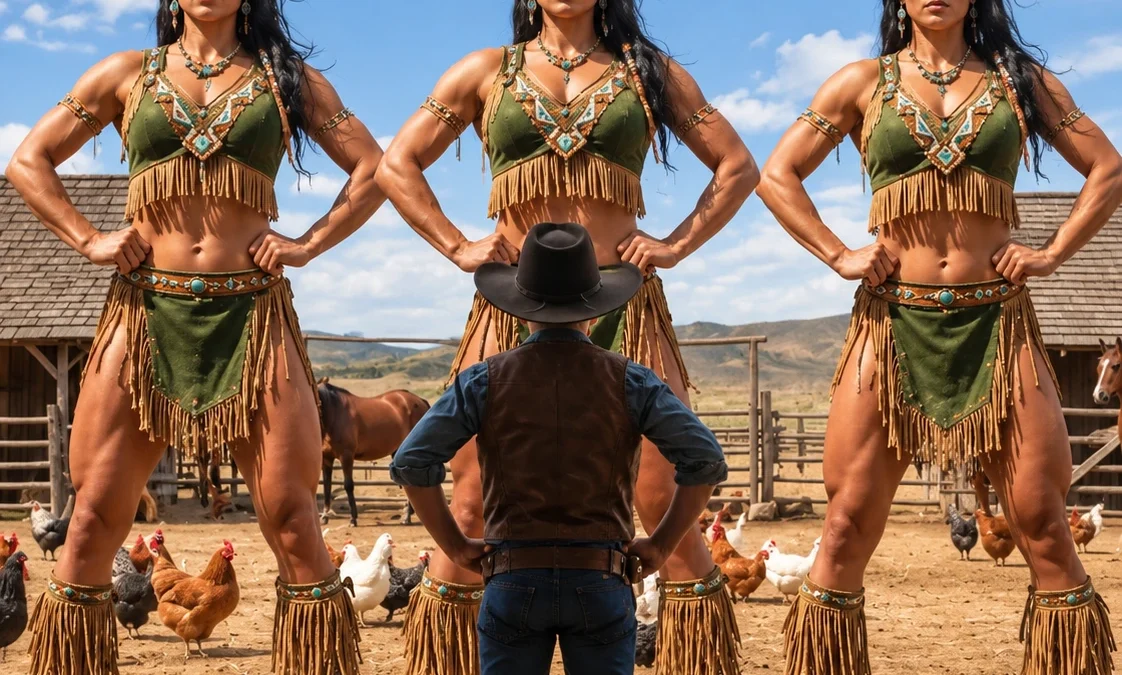
🔥 She Stabbed the Soldier Who Tried to Save Her… Years Later, Her Brother Whispered, “Tomorrow I Will Send You a Gift.” At Dawn, Three Giants Walked Out of the Desert Toward His Door 😱
PART 1
The winter of 1882 came to Arizona Territory like a whispered threat. 🌵
Elias Thorne stood on the porch of his crooked little ranch at dawn, watching the sun crawl over the White River basin. The light turned the sand from gray to gold, and he felt absolutely nothing.
He was forty-three, with the kind of face that made strangers look away. Not because it was ugly, but because the eyes behind it had seen things that should never be spoken aloud. His jaw was always tight. His shoulders held the stiff posture of a man who had worn a uniform too long. And his scarred hands trembled around a tin cup of coffee gone cold. ☕
He lived alone on forty worthless acres, between two dry creek beds that ran water only three months a year. He was not a rancher. He was not a farmer. He was a man trying very hard to disappear.
But the past doesn’t let you disappear. 👻
Every night, when he closed his eyes, the same scene played with cruel precision. Cibecue Creek, August 1881. Gunpowder and blood in the desert air. Screams that started loud and ended in wet silence. And the girl. Always the girl.
Elias had been a military surgeon with the Sixth Cavalry. His job was simple: keep soldiers alive. But at Cibecue, the orders changed. When the Apache camp was overrun and the shooting stopped, he found her among the wounded. A young woman, maybe nineteen, with a bullet in her side and eyes that still blazed with defiance as her life bled into the sand.
Against orders, against common sense, he knelt beside her and packed the wound with his bare hands. She stared at him with confusion first, then understanding. In broken English, she whispered:
“Thank you. You tried.”
And then she drove a knife into his chest. 🔪
It missed his heart by two inches. He lived. She didn’t. A sergeant put a bullet in her head while Elias lay gasping in the dirt. Later he learned her name: Desba. She had been unarmed. The knife was stolen from a dead soldier. She had died protecting nothing, because everyone she loved was already gone.
The army called him a hero for surviving an Apache attack. Nobody asked why he’d been trying to save an enemy. Nobody wanted to know. So he took his pension and ran, to this forgotten corner of Arizona, where he spoke to no one and tried to remember nothing.
It wasn’t working. 💔
That Tuesday, he rode into Fort Thomas for supplies, same as every month. Flour, salt, coffee, ammunition. He was halfway through counting coins at old Brennan’s general store when the noise started outside. Ugly laughter. Drunk men hunting for entertainment. Then one word cut through the wall like a blade.
“Apache.”
Elias told himself to stay put. Other people’s trouble wasn’t his business. But through the dusty window, he saw four miners circling a frail old Apache man in deerskin and beads, leaning on a carved walking staff. The biggest miner shoved him hard in the chest. The old man staggered, but he didn’t fall. He didn’t raise his hands. He just stood there, absorbing the insult with a dignity that twisted Elias’s stomach.
Nobody in the crowd moved. And Elias felt that cold, familiar weight settle in his chest, the same one he’d felt at Cibecue when the sergeant raised his pistol toward Desba’s head. 😨
The miner drew back his fist.
Elias’s body moved before his mind could stop it. He crashed through the door, boots hammering the boardwalk, and that’s when he saw the old man’s left hand. Faded white scars wrapped around the wrist, the marks of rope and leather. And on his forearm, a long, clean line left by a surgeon’s scalpel.
His scalpel. He had splinted three Apache men with broken arms that day at Cibecue, right before the order came to finish the wounded.
The old man turned and looked straight at him. Recognition flashed across his face. Not surprise. Not fear. He knew exactly who Elias was.
Elias’s hand settled on his revolver. “Back away,” he said, in the voice of a man who once gave orders in battle. The miners hesitated, spat in the dust, and retreated. The crowd melted away. Nobody thanked him.
The old man pressed a palm to his chest in thanks and spoke in perfect English:
“You carry blood on your hands, but also mercy. I see both.” 😶
Elias couldn’t breathe.
“My name is Nol-e. I know what you did at Cibecue Creek. I know you tried to save my sister Desba.”
The world tilted. Nol-e reached into a pouch and held out a strip of cloth stained brown with old blood. Elias recognized it instantly. It was the bandage he had tied around Desba’s wound.
“She kept this. I have carried it ever since, waiting to find the man who tried. She died regretting that knife.” 🥺
Elias took it with shaking hands. “Why tell me this?”
The old man’s eyes were ancient and unreadable.
“Tomorrow you will understand why mercy matters. Tomorrow I will send you a gift. Not because you deserve it, but because my sister’s last wish was that the man who tried to save her should not die alone and haunted.”
Then he walked away, staff tapping the dirt, and the crowd parted for him.
Elias didn’t sleep that night. He sat on the porch with the bloody bandage in one hand and his revolver in his lap, waiting for dawn, for judgment, for whatever “gift” a grieving brother might send to the man who failed his sister. ⚔️
At 6:17 a.m., the sun broke over the ridge. And he heard footsteps.
Three figures walked up the dry creek bed, single file, unhurried. Backlit by the sunrise, they looked like silhouettes carved from the sky itself. Impossibly tall.
As they stepped into the light, his mind refused to process what his eyes were seeing. Three Apache women. The first stood at least six and a half feet tall, broad-shouldered and muscled like a warrior. The second towered nearly as high, her braids shining with silver. The third, the youngest, hunched her shoulders as if she could somehow shrink. She couldn’t. She was close to six feet eight. 😱
Elias raised his revolver. The first woman didn’t even flinch.
“The Elder Nol-e sends us. He said you would understand.”
“I don’t want anything,” Elias rasped.
The youngest whispered, her voice trembling: “We are cursed. Giants. Omens of disaster. Our own people cast us out.”
Elias slowly lowered his gun. Then the second woman stepped forward, tears rising in her dark, knowing eyes, and spoke words that stopped his heart:
“My name is Kalyan. Desba was not just Nol-e’s sister. She was my mother.” 💥
PART 2
Elias’s knees almost gave out. Kalyan’s voice stayed steady even as her tears fell. “I was cut from her body after she died. The elder told me she lived long enough to feel me move. Her last words were about a white soldier with gentle hands who tried to stop her bleeding.” She pulled a rusted scalpel from a leather wrap. His scalpel, the one he’d dropped at Cibecue when Desba stabbed him. “He kept it all this time. He said the tool of healing should not be buried with the dead.” Elias took it with trembling fingers, and the weight of it nearly broke him. Then he holstered his revolver and said the words he hadn’t said in a year: “You can come inside.” 🥹
Their stories poured out in the cramped little cabin. Kalyan, a healer, was cut again and again by her own village to “release the bad spirits.” Nalnish, once a warrior, watched her husband burn to death shielding her from a mob who blamed her for a drought. Young Ashki’s mother died giving birth to her, and her family was driven from camp for the crime of raising a giant. Nol-e had hidden them for years, but he was dying now, and he wanted them safe before the end. Elias slept on the floor that night, and for the first time in a year, the nightmares loosened their grip. 💔
Days passed. The women rebuilt his rotting fences, mended his barn, and filled his silent cabin with voices. Ashki began to stand a little taller. One night by the creek, Elias told her, “One man can stand. Even if he stands alone, the standing matters.” Then he made a dangerous decision: they would walk into Fort Thomas together, openly, heads high. Hiding would only prove they were something shameful. The town went dead silent as the three giants walked down the main street. Men stared, children fled, and a drunk called them monsters. Old Brennan simply stepped aside and said, “Come in, let’s see what we can do for you.” 🛒
But Sheriff Luther Clayton was waiting, and Elias saw something strange in his eyes. Not anger. Terror. “Do not bring them back here,” the sheriff warned. “For their sake and yours.” Four mornings later, Kalyan woke in tears. “The elder is dead. He came to me in a dream and said goodbye.” Seconds later, Nalnish hissed from the window: “Riders from the east. Seven of them.” They weren’t drunk miners. They were disciplined former cavalry, rifles ready, led by Clayton himself. 😨
“Those women are coming with us,” Clayton announced. “Fort Apache. Federal custody.” Kalyan stepped onto the porch and said quietly, “You were at Cibecue Creek, sheriff. You were there when they killed my mother. You wrote in the report that no women or children were present. But we are the proof they were.” The silence cracked like ice. One rider whispered, “Luther… is that true?” Clayton’s hand slid to his revolver. “Which is exactly why they cannot be allowed to speak.” Elias realized with horror that this was never an arrest. It was an execution. He drew and aimed at Clayton’s chest, and seven rifles swung toward his porch. ⚔️
Then Ashki walked out holding a wooden staff, standing at her full height for the first time in her life. “You want to kill us because we remind you of your sins,” she said, voice steady. “I have been afraid my whole life. Afraid of my people, afraid of my body, afraid of existing. I am not afraid of you.” A young rider named Daniels lowered his rifle. “I can’t do this. This is murder.” Two more followed him and rode away. But Clayton’s face twisted, and his finger tightened on the trigger as he whispered, “Then I’ll finish it myself.” 🔥
And in the split second before it fired, a crack split the air from the ridge behind the cabin, and Elias saw a shadow rise against the rising sun. 😱
PART 3
The rifle shot from the ridge didn’t hit Elias. It didn’t hit the women either. It hit the dust a foot in front of Clayton’s horse, and the animal reared so violently that the sheriff’s shot went wild, tearing into the porch beam above Elias’s head.
A second shot knocked Morrison’s rifle spinning from his hands. A third sent a hat flying off the man beside Clayton, the bullet passing close enough to part his hair. 😳
Then they appeared on the ridge, one after another, silhouetted against the sunrise. Apache warriors, rifles raised, a dozen of them with perfect lines of fire. The youngest stepped forward and called out in clear English.
“The Elder Nol-e is dead. We come to honor his final wish. These women are under our protection. Any who harm them will face our justice.”
Elias knew the voice. It was Kuruk, the young scout who had once warned him about patrols near the creek. But the men beside him were tribal leaders, men whose presence commanded the kind of silence that doesn’t need a gun to enforce it.
Clayton’s horse danced beneath him. His voice cracked. “You’d start a war over three outcasts?”
“We are finishing what the elder started,” Kuruk answered. “For too long we let fear make us cruel. We called those who were different cursed. The elder said these women deserved protection, not punishment. We failed him in life. We will not fail him in death.” 🕊️
For a long moment, nobody breathed. The sheriff stared at the ridge, at the porch, at the three men who had already ridden away from him in disgust. Slowly, the rifle in his hand sank. He had come with numbers and found himself outmaneuvered. He had come to commit murder and found witnesses who would never let him bury it.
“This isn’t over,” he spat.
Elias’s voice was quiet. “Yes, Luther. It is. You lost the moment you chose fear over truth. Go back to Fort Thomas. Tell them whatever story helps you sleep. But leave us alone.”
Clayton wheeled his horse and rode away with his remaining men, dust trailing behind them. He had been beaten not by force, but by the simple refusal of good men to take part in his crime. 🌅
When the dust settled, the warriors came down from the ridge. Kuruk spoke to Kalyan in Apache, and she answered with a voice thick with tears. The elder had died peacefully, surrounded by those who loved him. His last words had been about the women, about giving them a chance at life. The tribal council had argued for hours, but in the end enough hearts had been moved by his sacrifice to vote for acceptance.
Kuruk turned to Elias. “The elder spoke of you before he died. He said you tried to heal even when healing was forbidden. He said you understood that mercy is not weakness. He said we should learn from you, if we are wise enough to listen.”
“I’m not a teacher,” Elias said. “I’m just a man trying to do better than I did before.”
“That is what makes you worth learning from.” 💛
The oldest warrior approached the women and spoke formally. Kalyan translated, wiping her eyes. “He says we are no longer outcasts. We may return to the tribe. The council has recognized that our differences do not make us cursed.”
Elias felt his chest tighten at the thought of them leaving. “Will you go?”
The three women exchanged a long silent look. Nalnish answered first, her voice hard but not unkind. “They offer us acceptance now, after years of cruelty, because a dying man shamed them into it. Their mercy comes from guilt, not understanding.” She met Elias’s eyes. “You accepted us when we were nothing. You stood in front of guns for us. You asked for nothing. Where would we go?”
“I’d have you stay,” Elias said. “If you want to.”
“We want to,” Kalyan whispered. Ashki said nothing, but she stepped closer to him, and that was answer enough. 🥹
The warriors rode away. Kuruk paused beside the porch. “The elder said healing the divide between our peoples would not come from grand treaties. It would come from small acts of courage by people who refused to hate. I think he was right about you.”
The four of them sat on the porch steps as the morning sun spilled over the ranch. Ashki’s hands were still shaking. “I thought we were going to die.”
“We almost did,” Nalnish said, and for the first time her voice held something close to pride. “You stood tall. You spoke truth.”
“I was terrified,” Ashki admitted.
“Bravery is not the absence of fear,” Kalyan said, taking her hand. “It is standing anyway.”
But the story wasn’t over, because mercy has a way of spreading. 🌱
A week later, Elias rode into Fort Thomas alone. The town’s hostility hadn’t vanished, but it had gone underground, whispers behind curtains, eyes that slid away. Old Brennan leaned over his counter and lowered his voice. “Clayton’s telling everyone you’re hiding fugitives. Half the town believes him. The other half is starting to ask questions. About Cibecue. About why he’s so desperate to get rid of three women who’ve done nothing wrong.” He paused. “Your giants have become a symbol, Thorne. Some see proof that the Apache are monsters. Others are starting to wonder whether we were the monsters all along.”
When Elias crested the hill near home, he pulled his horse to a halt. A wagon stood in his yard. Beside it huddled a thin, worn family: a father, a mother, and three children, one with fresh bruises on his face. Nalnish stood in the doorway, her hand near her knife but not touching it.
“Mr. Thorne,” the man said, twisting his hat. “My name is Samuel Garrett. Men from a mining company burned us off our homestead. The sheriff told us to hire a lawyer. We can’t even afford supper.” His wife, Mary, added quietly, “Mr. Brennan sent us. He said if you could show mercy to Apache, maybe you’d show mercy to us.”
Elias looked at the children’s hollow eyes and thought about the cramped cabin, the thin supplies, the danger. Then Nalnish spoke from the doorway, and he almost didn’t recognize the woman who had greeted him with a blade. “The elder taught us that those who have been shown mercy must show mercy to others.”
“Then we build more rooms,” Ashki said.
“You can stay,” said Elias.
That night, eleven people crowded into a cabin made for one. They ate beans and flatbread shoulder to shoulder, knees touching, and the walls rang with voices instead of silence. 🌙
And the word spread. A second family came. Then a former soldier who had been dishonorably discharged for refusing to join a massacre like Cibecue. Then an elderly Apache woman, abandoned by her tribe for growing too old. The little ranch swelled into a compound. Samuel taught carpentry. Mary took over the cooking. Little Elizabeth followed Kalyan everywhere, learning the healing herbs. Bruised, quiet Thomas attached himself to Nalnish, and the fierce warrior who had never known how to talk to a child began teaching him to read the desert’s tracks. And five-year-old Sarah claimed Ashki as her personal guardian, riding on her shoulders for hours, pointing at clouds. To that tiny girl, Ashki wasn’t a curse. She was wonderful. 💖
One evening, Elias sat on his porch watching it all. Kalyan joined him, as she often did now.
“The elder would be proud,” she said.
“The elder would point out everything we’re doing wrong,” Elias replied, smiling.
“That too.” She paused. “I’m afraid every day, Elias. We’re making ourselves targets.”
“So am I,” he admitted. “I wake up thinking about Clayton. About the army. About violence we can’t stop.”
“Fear is not weakness,” she said, taking his scarred hand in her enormous, gentle fingers. “It is wisdom. The question is what we do with it. We stand anyway. We build anyway. Because the alternative is to let fear make us small, and we have all been small for too long.”
He looked down at their joined hands. Dark skin and pale, giant and ordinary, Apache and white. A year ago, it would have been unthinkable. Now it felt like the most natural thing in the world.
“I thought I was running from my ghosts,” he said quietly. “But I was dying in my solitude. You saved my life by asking me to save yours.”
“Then we are even,” Kalyan said. “You saved mine by seeing me as human when the whole world insisted I was something else.” 🌄
Far away, in Fort Thomas, Sheriff Clayton plotted. In distant army forts, officers read reports of an unauthorized settlement. In the Apache camps, councils debated what to do about the growing refuge. Storms were gathering on every horizon.
But on that porch, under the desert stars, none of them were afraid.
Three months later, the compound had grown to thirty-seven souls. One afternoon, five Apache approached on foot, not warriors but families: a mother with two children, an old man leaning on a cane, a young couple holding hands. The woman at the front spoke in halting English.
“We heard of a place where the outcasts are welcomed. Is this that place?”
Elias stood on the porch of the expanded cabin, Kalyan beside him, Nalnish and Ashki at their sides. Behind them, white children and Apache children laughed together in the dust. He looked at Kalyan. She nodded.
“The door is open,” Elias said. “Not out of pity. Not out of obligation. Because I know what it means to have nowhere else to go.”
The woman’s eyes filled with tears. “We heard you stood against the sheriff and the army.”
“We stood,” Nalnish said simply. “And we will stand again if we must.”
As the newcomers walked inside, Kalyan slipped her hand into Elias’s. “People are asking what to call this place. They say it needs a name.”
Elias thought about Desba’s whispered thank you. About an old man’s strange, terrible, perfect gift. About three giant women who had walked to his door when he had nothing left to offer but stubbornness and an empty cabin.
“We call it what it is,” he said. “A refuge. A home where the rejected can stand tall.”
Kalyan smiled through her tears. “The elder had a word for such places. Bikou. It means where people walk in beauty together.”
“Then that is what we are.”
As the sun set over the White River basin, painting the growing settlement in gold, Elias Thorne stood with his hand in Kalyan’s and finally understood what he had been running from all along. Not guilt. Not punishment. He had been running from purpose.
The giants had risen. The outcasts had gathered. And in a forgotten corner of Arizona Territory, they had built something that would not be easily destroyed. Not because they were strong, but because they refused to stand alone. 🌟
Moral of the story: Mercy given to a stranger can come back as a family. When we choose to stand for those the world rejects, we give them, and ourselves, a place to belong. 💛
💬 Now it’s your turn: would you have opened your door to the three giants Nol-e sent? And who do you think was the real hero of this story, Elias, the elder, or Ashki, who finally stood tall? Tell us in the comments! If this story touched your heart, like it, share it with someone who needs a reminder that kindness matters, and follow the page for more unforgettable tales of the Old West. 🤠
Disclaimer: This story is entirely fictional and created for entertainment purposes only. It does not represent any organization or individual, nor does it encourage inappropriate behavior. The content was generated with AI assistance.








