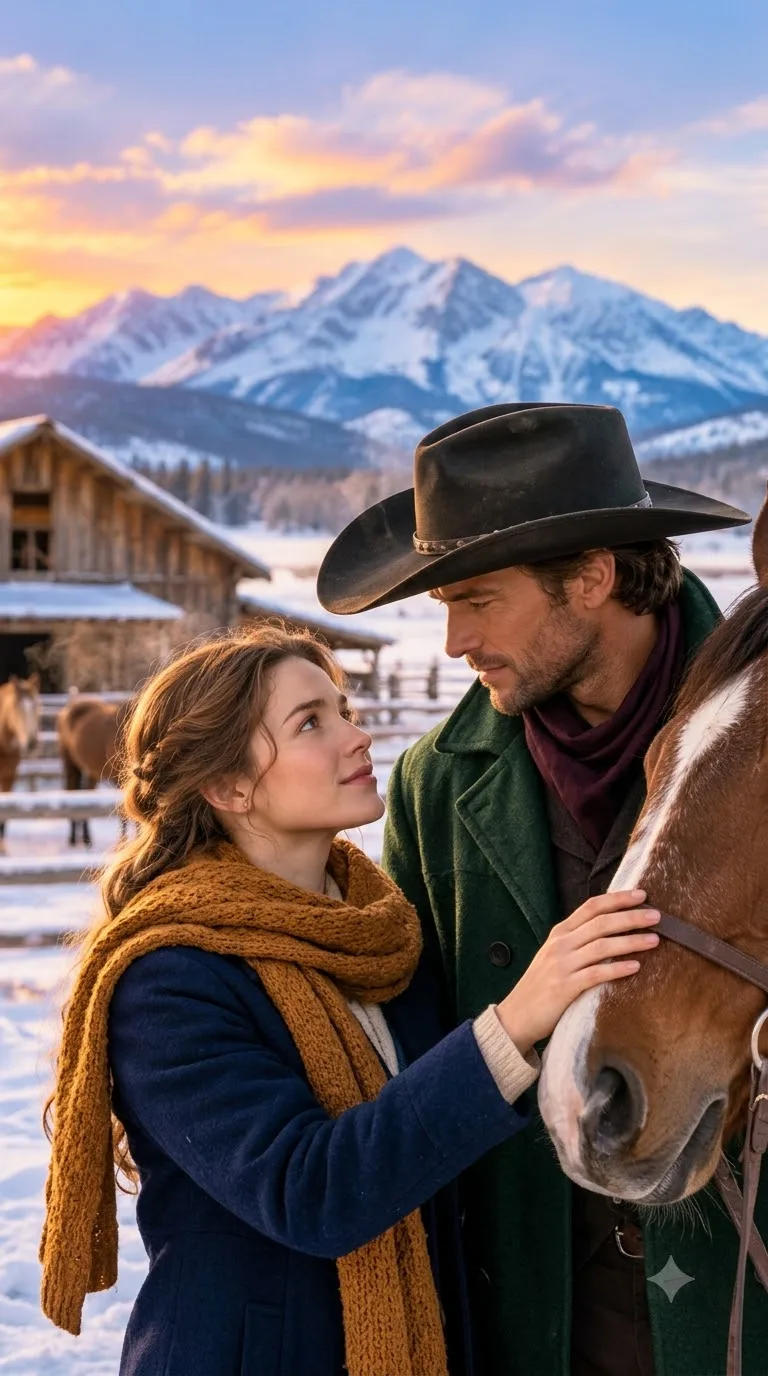
She Stepped Off the Wrong Stagecoach Into a Blizzard. One Frightened Black Mare Changed Her Life, and a Powerful Man Wanted Her Gone
🔥 She Stepped Off the Wrong Stagecoach Into a Blizzard. One Frightened Black Mare Changed Her Life, and a Powerful Man Wanted Her Gone 🐎❄️
PART 1
Edmund Pembroke’s gloved hand came down hard on his mahogany desk, rattling the ink bottles and sending his clerk stumbling backward.
“I don’t care what papers she carries,” he said, his voice dropping to something quiet and precise, which was far more frightening than shouting. “That woman is not a governess. She is a spy sent by Coulter Vance to steal what remains of my breeding records. Find out what she knows. And if she’s already been to Red Spur…” He paused, adjusting his cuff link with two deliberate fingers. “Make sure she has a reason never to go back.” 😨
His clerk swallowed. “Sir, she arrived on the wrong stage. The driver left her at…”
“I know exactly where the driver left her.” Pembroke turned to the window, looking out at his rows of perfect stables. “That’s what concerns me.”
The stagecoach driver’s name was Arlo Begs, and he had been making the Ash Creek run for eleven years without a single serious error. He was proud of that. He mentioned it to passengers regularly, usually when they started feeling nervous about the narrow mountain passes.
He mentioned it to Rosalie Bennett around noon, just before the sky turned the color of a dirty dishrag and the wind shoved the coach sideways on the frozen road.
“That’s reassuring,” Rosalie said, and meant it, because she had decided that worrying about the driver’s competence on top of the weather would simply be too much to manage at once.
She was twenty-eight. She had buried her father six months ago. She had sold the last of the Kentucky property three months after that, not because she wanted to, but because the debts he left behind were substantial and patient, and eventually they had eaten everything. What remained was a small trunk, a decent wool coat, a pair of riding gloves worn soft at the knuckles, and a letter from a woman named Margaret Pembroke offering her a position as governess for two young children on a ranch near Ash Creek, Montana Territory.
Not what she’d imagined for herself. But imagination, she had learned, was a luxury, and practical women took practical jobs.
The snow began around two in the afternoon. Real snow, the kind that came in sideways and turned the world into a gray wall thirty feet in front of your face. Arlo hauled the horses to a stop.
“I’m going to make a decision. I’m taking the north fork.”
“Is that the right fork?” asked the only other passenger, a dry goods merchant who’d been sleeping under his hat since noon.
“It gets us to shelter faster,” Arlo said, which was not quite an answer.
“Faster than what?” Rosalie asked.
“Faster than freezing.”
Nobody had a better idea. The snow closed around them like a fist.
They reached a ranch as the light gave out completely, and Rosalie knew something was wrong the moment she stepped down. Margaret Pembroke’s letter had painted a wide porch, white columns, a formal garden. What stood before her was a weathered ranch house with a porch that leaned slightly left and a dirty lamp in the window.
“Mr. Begs. This isn’t the Pembroke estate.”
A long, pained exhale from the box. “No, ma’am. I believe it is not.”
“Where is the Pembroke estate?”
“South Fork.”
“How far south?”
“Twenty miles, give or take.”
A gust hit them both, and the road behind was already vanishing under blowing snow. “You can’t drive back tonight.”
“No, ma’am. I cannot. I’ll leave Mr. Howell at the next town and come back at first light, conditions allowing.”
She almost laughed. She’d been in Montana four hours and had already learned that conditions governed everything in this territory, and very rarely allowed anything. She picked up her trunk. “I’ll explain myself to whoever owns this place.”
She had taken three steps when a terrible sound erupted from behind the barn: a horse shrieking in distress, then the splintering crack of wood giving way. 🐎
Three ranch hands came running around the corner, and behind them, a huge black mare, sixteen hands at least, deep-chested and built for speed, moving with the desperate energy of an animal frightened past thinking. A broken gate rail dragged behind her left hind leg, clattering with every stride, terrifying her all over again. Two men swung ropes. The third spread his arms wide in front of her, exactly the wrong thing to do.
Rosalie walked through the gate.
“Stop.”
The nearest hand, red-faced, snow in his eyebrows, turned. “Ma’am, get back! She’ll run you down!”
“She won’t. But she will run you down if you keep waving those ropes. Move.”
They moved.
Rosalie let her hands fall loose and open at her sides, making herself as unthreatening as possible. She didn’t approach the mare’s head. She cut a slight angle, eyes lowered, talking low and even, saying nothing in particular, just making the sound of a person who wasn’t alarmed and had all the time in the world.
The mare spun once. Rosalie stopped and waited. The mare’s nostrils flared.
Then Rosalie saw what she’d suspected from a distance. A length of old harness leather from the broken rail had lodged under the flank strap, still buckled around the mare’s barrel. Every time she moved, it pulled. Every time she stood still, it pulled again.
She wasn’t panicking over nothing. She was in pain.
Rosalie covered the last ten feet at that same steady walk and laid a hand on the mare’s neck. Every muscle under the black coat vibrated like a plucked wire.
“I see it. I know. Hold on.”
She worked the leather free with both hands, never breaking contact. It took less than a minute. When the pressure released, the mare let out a long, shuddering breath, then turned her head and pressed her nose against Rosalie’s shoulder with a weight that was almost trust and certainly exhaustion. 🤍
Nobody spoke. Neither did the man who had come around the barn in the last thirty seconds and watched the whole thing in silence. Rosalie felt him before she saw him.
He was a little over six feet, broad in the way that came from real work, with dark hair under a battered hat and a jaw that looked set against bad news so often it had settled that way. Maybe thirty-five. His expression sat somewhere between impressed and suspicious, which in her experience were often the same thing.
“Where’d you learn that?”
“Around horses that were smarter than the men handling them.”
Something shifted in his face. Not quite a smile, but the ancestor of one.
“I’m Rosalie Bennett. I’m supposed to be at the Pembroke estate. The driver left me here by mistake, and he can’t go back tonight.”
He looked at the coach, at the snow building against every surface, and nodded. “I’m Coulter Vance. This is Red Spur. You can have the spare room off the kitchen.”
He turned to his men. “Fix that gate before you lose feeling in your hands. Put the mare in the south stall. She’s had enough for one night.”
He walked toward the barn without looking back.
What Rosalie didn’t know yet was that Edmund Pembroke had been waiting years for a woman like her to wander into Red Spur, and that the “wrong turn” had just put her in the middle of a war she’d never agreed to fight. ⚔️
👇 Want Part 2? Find it in the comments, or drop any word and I’ll send it to you privately!
PART 2
The spare room was not much. A narrow bed, a washstand, a window that let in a thin line of cold air no matter how hard she pressed the frame. But the blankets were heavy wool, and she’d slept in worse places during the previous six months of dismantling her old life.
She didn’t sleep for a while. She lay listening to the storm work itself into the ranch and thinking about the black mare’s eyes. Not mean eyes. Frightened eyes. She had seen horses labeled dangerous because no one had stopped to ask what they were afraid of.
The next morning she went to the barn before the cook had lit the stove. She treated the raw stripe on the mare’s flank with carbolic from the back of the medicine chest. Boots hit the barn floor behind her.
“I was going to do that,” Coulter said.
“I know. I did it instead.”
He held out his only mug of coffee. She took it.
“She doesn’t let my men near that side. One tried last month and she put him through a wall.”
“She’s not mean. She’s particular. There’s a difference.” She handed the mug back. “She’s favoring her right hind. Old suspensory injury that wasn’t rested properly. Keep her off hard ground another month.”
“You can tell that from five minutes in a stall?”
“My father trained thoroughbreds and cavalry horses before the money ran out. I grew up watching.”
The storm held four days, and Rosalie had meant to stay invisible. She lasted until nine o’clock the first morning, when she found the breeding records shoved under a workbench beneath a canvas tarp, so carelessly kept that no one had consulted them in months.
“Your breeding records are a mess,” she told him at the south pasture fence. “Would you like me to straighten them out while I’m waiting for the roads?”
“Why would you want to do that?”
“Because they’re bothering me. And because your records say the mare in stall seven is barren, and she is absolutely not barren.”
He was already walking back to the barn at a pace that was nearly a jog.
Stall seven held an older bay with a white blaze and calm eyes. Coulter put both hands on the gate and said nothing for a long moment, his jaw working. “She was my mother’s horse,” he said finally. “She was supposed to be too old.”
“The foal’s positioned a little awkwardly. But she’s strong and calm. That’s in her favor.”
“Yeah. Okay.” He walked out without another word. She understood that, too. 🕯️
On the second night they delivered the foal together, two hours of cold, hard work with no room for awkwardness. A bay filly stood on her second try. Coulter sat back against the stall wall and pressed the heel of his hand to his eye.
“Get some sleep. You’ve been up since midnight.”
“So have you.”
“I live here. Sleep is sleep regardless of whose property you’re on.” He almost smiled. It still hadn’t quite made it.
By the third day she had reorganized his ledgers, found an unrecorded lameness that explained a young stallion’s performance, and told him as diplomatically as she could that his training wasn’t producing what he thought. He did not receive this well.
“I’ve been breaking horses fifteen years.”
“I know. And they’re broken. But broken and trained aren’t the same thing. That gray stallion in the east corral that no one can ride? He doesn’t bolt toward open ground. He bolts toward people. He’s not dangerous. He’s lonely and confused.”
“Nobody’s ever framed a horse as lonely before.”
“I’m not framing him. I’m describing him. Give me two afternoons.”
He gave her two afternoons. She didn’t produce a miracle. She produced a horse who would stand quietly beside her and accept a saddle blanket without a protest that had convinced everyone he was untrainable. Coulter watched the second afternoon from the fence rail and never said a word. She could feel what he thought anyway.
On the fourth day the storm broke. Arlo Begs arrived with a borrowed wagon full of apologies, smelling like whiskey and contrition. Before she left, Rosalie stopped at the black mare’s stall. The mare came straight to the gate and pressed her nose against Rosalie’s shoulder.
“You’re going to be fine. You’ve got people who look after you.”
Coulter stopped a few feet behind her. “She doesn’t usually say goodbye.”
“She’s not saying goodbye. She’s checking to see if I’m coming back.”
A silence. “Are you?”
“I have a position at the Pembroke estate. I have an obligation.”
“That’s not what I asked.”
She had no answer she trusted. He lifted her trunk into the wagon with those rough, calloused hands, then stepped back and looked at the road. “The Pembrokes are a particular kind of people. Edmund Pembroke most of all.”
Not a warning exactly. Closer to caution. “I’ll keep that in mind.”
She did not look back. But the black mare followed the wagon to the corral fence and stood with her nose over the top rail, ears forward, watching it shrink. Rosalie told herself the tight feeling in her chest was just the cold. She almost believed it. 🥶
The Pembroke estate appeared out of the winter afternoon like everything about it had been arranged on purpose: bare-branched trees lining the approach, a white fence in perfect repair, stables larger than the house she’d grown up in. Edmund Pembroke himself stood on the porch with his hands clasped behind his back, helping her down personally.
“Miss Bennett. We’ve been expecting you.”
“The storm delayed me. I was stranded briefly at a ranch to the north. Red Spur.”
Something moved across his face, small and quick, then gone. “Yes. Vance’s place.” The name came out with a specific neutrality that wasn’t neutral at all. “I hope he treated you properly.”
“He did.”
“Good. Come in out of the cold.”
She stepped onto the porch. She did not yet know what she had walked into. But the look on his face when she said Red Spur sat in the back of her mind with the patient weight of something that would not be forgotten.
Twenty miles north, the black mare stood at the fence for another hour after the wagon disappeared, breathing steam into the cold air and watching the empty road.
The Pembroke house was warm the way money makes things warm, insulated against every discomfort. But it was the warmth of a place where the temperature was controlled because everything else was controlled, too. The children, Charles and Violet, eight and six, had been left to servants so long they expected adults to either ignore them or give orders. Rosalie did neither. She sat on the floor with Violet and played an invented game with no logical structure for forty minutes. By the end, Violet had decided she was acceptable.
It was the stables that bothered her. On her fifth day she walked through them, because she could not be within a hundred yards of stables without gravitating toward them. Pembroke’s head wrangler, a lean man named Luther Dayne with a face like dried leather and eyes that never stopped moving, watched her the whole time. Not with curiosity. With calculation.
And then she noticed the freeze marks. Two animals in the back row of the second stable carried a pattern that matched nothing in the Pembroke brand registry posted on the tack room wall.
She might have dismissed it. But the pattern looked familiar. It sat in the back of her mind and quietly refused to leave.
Then one Tuesday, teaching Charles his multiplication tables, she heard Pembroke in the hallway, voice low, the study door not quite closed. “Three of Vance’s mares, by Friday. I don’t want tracks that can be followed. Use the men from Billings.” A murmur from Luther Dayne. “I don’t care about Vance’s opinion. Vance’s opinion will be irrelevant within the month.”
Her hand tightened on the pencil until her knuckles went pale.
“Miss Rosalie,” Charles said. “You stopped.”
“Six times seven,” she said.
“Forty-two.”
“Good.” Her voice was perfectly even. “Six times eight.”
Two days later, news came into Ash Creek: three mares had vanished from Red Spur. Pembroke was in the general store, shaking his head with a patient expression that conveyed sympathy and skepticism in equal parts. “I’m afraid Vance has been selling off stock when the bills get tight, then reporting it stolen when he needs sympathy. It’s not the first time.”
Two men at the counter nodded. And Rosalie, staring at a barrel of flour, said nothing. She had no evidence, no standing, no history in this town. Not yet.
But she felt something settle inside her, heavy and still, somewhere between anger and certainty.
That afternoon she knelt by the south gate of the Pembroke stable yard, reading the churned ground the way other people read newspapers. Multiple horses, more than usual rotation, moving south. And in the dirt, a specific impression: a horseshoe with a double bar across the heel.
She had seen that shoe before. On Luther Dayne’s own bay gelding.
Boots on the path behind her. Dayne stood ten feet away, watching with those flat, moving eyes. “Help you with something, miss?”
“Just checking whether any of the horses threw a shoe in the cold snap.”
“Mr. Pembroke prefers his guests stay out of the yard.”
“I’ll keep that in mind.”
She walked back to the house at an ordinary pace. Hurrying would tell him something about her state of mind, and she wasn’t ready for him to know it.
That night she couldn’t sleep. She lit a candle, sketched the freeze mark pattern from memory, and turned back two pages in her notebook to a note she’d made at Red Spur about the black mare’s brand. She held the sketch against it.
The angular V with the double bar through the center. Not identical, but unmistakably from the same source.
Red Spur horses, with altered brands, registered under Pembroke papers.
She sat on the edge of her bed with her hands pressed flat against her thighs. What she was holding was no longer suspicion. It had the specific terrible weight of a thing that was probably true. 😳
And then, from the hallway, she heard footsteps stop outside her door.
💬 Who was standing outside her door, and what does Rosalie do next? Comment the word “WRONGTURN” below, and once we reach our goal, Part 3 goes live! ❤️ LIKE this post so you don’t miss it!
PART 3
The footsteps stood outside her door a long moment. Then they moved on.
Rosalie let out a breath she hadn’t known she was holding. Whoever it had been, they were watching her now. She needed evidence, and she needed someone she could trust with it.
She started with what she could reach. Pembroke’s household office held a filing cabinet with the current year’s registration papers, unlocked, because why would you lock something guests were never supposed to need? On a Wednesday evening, while he was at a cattlemen’s meeting and the housekeeper was busy in the kitchen, she went through it.
Six registration certificates for horses in the Pembroke stables. She cross-referenced them against what she’d observed. Three didn’t match. The paperwork was well constructed, the stamps looked legitimate, but the physical descriptions were wrong. A gray with a sock on the left foreleg was registered with a sock on the right. A bay listed at fifteen hands was easily sixteen. Small discrepancies, the kind a busy clerk would miss. The kind that were wrong on purpose.
She heard the front door. Pembroke was back early.
Forty seconds, she estimated. She replaced the last file, pushed the drawer shut, grabbed the book she’d carried in as cover, and was seated at the reading table with her feet crossed when the door opened.
Pembroke stopped. He looked at the filing cabinet. Then at her.
“Miss Bennett.”
“Mr. Pembroke. I couldn’t sleep. Your library is excellent.”
A pause three seconds too long to be nothing. Then he sat at his desk with the deliberateness of a man making a decision. “I had an interesting conversation in town about Red Spur. It seems Vance has told people you reorganized his breeding records while you were there. Did you find anything interesting?”
She met his eyes. “Nothing. His records were incomplete. I brought them into reasonable order.”
“Hm. Good night, Miss Bennett.”
She walked upstairs at a normal pace. In her room, she noticed her hands weren’t shaking, which surprised her, since her heart was going at a pace that was not calm at all. He knew. She was nearly certain. And he was watching.
She wrote to Coulter, carefully, nothing explicit, tucking a reference to the markings on the back-row horses into a paragraph about the weather. Three days passed with no answer. Then Luther Dayne found her in the kitchen garden and said, with politeness so thin it barely covered what was underneath, that Mr. Pembroke would appreciate it if she kept her correspondence to family matters.
They were reading her letters.
“Of course. I’ll keep that in mind,” she said, which was the most useful phrase in the English language, because it committed her to nothing. Then she walked back inside and started planning a different way. 🌙
She left on a Friday night. She told no one. She borrowed, and she gave that word its full weight, one of the lighter stable horses she’d been quietly befriending on her afternoon walks, so that when she took him out at eleven, he stood quietly. Then she rode north in the dark, in brutal cold, hooves ringing on frozen road, certain for six miles that someone was behind her. Nobody was.
She found the North Fork. She found Red Spur. The house was dark. She was tying the horse in an empty stall when boots hit the barn floor and every muscle in her body clenched.
“Who’s there?”
“Rosalie Bennett. Don’t shoot anything.”
A lamp appeared. Coulter, in work pants and a half-buttoned shirt, hair doing something that suggested he’d been asleep an hour. He looked at her frozen coat, her face, the horse.
“You rode from Pembroke’s. In the dark.”
“I didn’t have a lot of options. I need to talk to you. I found something. They’re reading my mail.”
His face went somewhere harder. “Yeah. I figured that. Pembroke’s been watching Red Spur for two years.”
“You knew, and you didn’t answer my letter.”
“I didn’t know what you were.” Not unkindly, but directly. “At first.”
She let that sit. At first. “And now?”
He looked at her a moment over the lamp. “Go to the house, Miss Bennett. You’re turning blue.”
By the kitchen fire, he poured two cups of good whiskey without asking. She told him everything, carefully and in order, because her father had raised her to report observations without decoration. The freeze marks. Duchess, the mare with the white patch on her shoulder, in Pembroke’s second stable under mismatched papers. The certificates. The filing cabinet.
When she finished, he was quiet for a long time.
“He’ll say you broke into his files.”
“I was in his library reading a book. The cabinet was unlocked. I compared documents available to me as a resident of the household.”
“His lawyers will find a law.”
“The fraud goes back further than this winter, Coulter. Those freeze mark alterations weren’t recent work. Someone was building a case against Red Spur before you even knew there was a case.”
He stood and went to the window, back to her. “My father kept a private breeding ledger. Separate from the official records. He started it after Pembroke first tried to claim one of our bloodlines. Original registration, breeding dates, foaling records, all of it. He hid it before he died. He told me it existed, but never where.” A pause. “I’ve searched this place six times in four years.”
“And without it, everything you say about Pembroke is accusation.”
“And everything Pembroke says about me is just easier to believe.”
She set down her cup. “I’m resigning. I can’t work for him and investigate him at the same time. I can’t protect the children if I’m using the access their father gave me against him.”
“He’ll make it ugly. He’ll say things about you in town.”
“Let him.”
He looked at her the way he had that first morning, like she was a category of person he hadn’t known existed. “You shouldn’t have come out here alone at night.”
“I know. They were reading my letters. I made the option I had. Can we focus on what comes next?”
And then, finally, almost an actual smile. “Yeah. All right.”
He turned the cup in his hands. “My father marked his private saddle horses differently. A small V notch inside the left shoe of the hoof iron. I always thought it was a habit.”
“Unless the shoe impression was pointing at something,” Rosalie said slowly.
His eyes met hers. “Is there an outbuilding that was specifically his?”
“An old foaling barn. East side. We stopped using it eight years ago.”
“Take me there tomorrow.” 🕯️
The old foaling barn leaned inward on one rotted wall, like standing inside a question mark. Rosalie ran her hand along the framing in the back left corner, where Coulter said his father had always worked. Two original studs, nearly black with age. Four nail holes where a board had once hung. Below them, one board with a slightly different texture.
She pressed it. It moved, barely a quarter inch, when the boards on either side did not.
“Coulter.”
He was beside her in ten seconds. He slid his work knife along the seam, and the board swung inward on a hinge driven so flush you’d have to know it was there.
Behind it: a hollow scooped from the stud bay, lined with cracked oilcloth. Inside, an ammunition box with a rusted clasp. Inside that, a small leather-bound ledger, the cover worn smooth at the corners.
Coulter opened the first page. His expression did something complicated and private, and Rosalie looked away, because a man’s face when he finds his dead father’s handwriting is not something you observe without permission.
“Is it what you needed?”
“It’s all here.” His voice dropped quieter than usual. “Every transfer. Every foaling. Every animal that left Red Spur and where it went. Pembroke’s name is in here fourteen times. Fourteen transactions over six years, horses that left under legitimate sales and ended up with Pembroke papers that don’t list Red Spur.” He looked up. “He knew. He kept the proof and hid it because he was too sick to act.”
“He trusted someone to find it.”
“He didn’t know if it would be me.”
There was no good answer to that, so she didn’t offer one. A dying man had hidden a book and hoped.
“We take it to the territorial authorities in Billings. Not the local sheriff. Pembroke has too much influence in Ash Creek.” She looked at him steadily. “And Coulter, don’t ride south at night to take those mares back. You’d be a thief regardless of what that ledger says.”
“I know how to wait. I’ve been waiting four years.”
She believed him.
Pembroke’s response came not as a letter but as a man. Garrett Foss rode into Ash Creek and filed a complaint against Rosalie for breach of contract, abandonment of duties, and theft of a horse. The horse was the borrowed stable animal, which she had returned herself, left at the south gate with an apologetic note. Pembroke knew it wasn’t theft. That wasn’t the point. The complaint created a document, a court date, and a reason for Ash Creek to look at Rosalie with a skeptical eye.
She learned of it from Martha Greer, who owned the livery stable and had rented Rosalie the room above it, on the understanding that she would pay when she could and teach Martha’s granddaughter to read. “He’s been talking at the Cattleman’s Association dinners,” Martha said, setting down a plate of biscuits like she was announcing rain. “Says Vance turned your head. Says you were at Red Spur most nights.”
“I was there one night.”
“Doesn’t matter what you say. Not in this town. Not right now.” Martha bit into a biscuit. “But I think a woman doesn’t ride twelve miles alone in the dark in a Montana winter for a man she met once. I think she does it for a reason she believes in.”
Rosalie looked at the table. “Thank you.”
“Don’t thank me. Pay your rent.”
Coulter came to town three days later and climbed the outside stairs without announcement. He told her Foss was Pembroke’s man, same playbook as in Billings: create delays and costs until people settled. Then he pulled out a folded paper. In his father’s ledger, three entries were marked with a small cross, the ones he’d considered most provable, because there was a second record: the Ash Creek Land Registry, where his father had filed transfer notices for every cross-county sale.
Carl Weiss, the registrar, wore a green eyeshade indoors and out and distrusted everyone equally, which was its own kind of fairness. It took forty minutes to find the first entry. A transfer notice, filed in Coulter’s father’s handwriting, selling a registered bay mare. Beneath it, filed a year later: a Pembroke registration for the same animal, same number, different ownership history.
“Two records for the same horse,” Carl Weiss said, with the expression of a man who took the error personally. “That’s a problem.”
“Yes,” said Coulter.
He flagged all three. Rosalie breathed for the first time in what felt like hours.
She began teaching three town children at Martha’s kitchen table. She was paid in coins, salt pork, and once a pair of wool stockings from a trapper’s wife. And the gray stallion helped. Coulter brought him to town twice to continue the work in the livery corral. The first session drew three ranch hands. The second drew eleven people, including two horse buyers from the valley.
“That’s the Vance animal,” one said. “I was told he was unrideable.”
“He was misunderstood. There’s a difference.”
“I’d pay a fair price for him once he’s ready.”
“Talk to Coulter Vance. He’ll be ready by spring.” 🌅
She wrote to a lawyer in Helena named Hatch, carefully, through an intermediary. His reply was cautious, full of qualifications, but at the bottom: if the registry records and the ledger were as she described, there was sufficient ground for a formal fraud complaint to the territorial land and livestock office, which would supersede local jurisdiction and remove Morton Hail from the equation entirely.
She asked him to begin. She didn’t tell Coulter right away. Not to hide it, but because she was afraid that if he knew a lawyer was involved, he’d think the careful part was done, and it was barely started. When she finally told him, he stopped in the middle of the street.
“You’ve been running this whole time.”
“I told you everything. Not the order of it. You have four years of anger at Pembroke that’s completely justified. And justified anger is sometimes the most dangerous kind.”
He looked at his boots. Then, quietly: “Hatch is good. My father used him once. He’s slow, but thorough.” A pause. “You’re making decisions for Red Spur.”
She felt the question inside the statement. “I’m making decisions about a fraud case that involves Red Spur. If I’m overstepping…”
“I didn’t say that.” He started walking again. “I’m not used to it. Someone helping. Someone who does things without waiting to be asked.”
“Is that a problem?”
“No. It’s the opposite of a problem. That’s why it’s strange.” 🤍
On a cold, clear night in February, with a full moon turning the snow blue-white, the sound woke her. A low rumble of many hooves on frozen earth, building fast.
The road south of the livery was moving. Dozens of horses were pouring toward Ash Creek from the north. Red Spur horses.
Martha was already in the yard with a lamp. “Someone cut the Red Spur fences. Sixty, seventy animals. Coulter’s behind them, trying to turn them. They’re going to hit Main Street.”
Rosalie was already in the corral. She bridled the calm paint mare by feel and swung up bareback. “Is there open ground east of the feed mill?”
“Hendricks’s winter pasture. North gate. It’s just looped.”
“Rosalie.” Martha’s voice was sharp. “How many of those horses know you?”
“Enough of them.” She wasn’t sure that was true. She rode east at a gallop and hoped.
The full roar hit her before she cleared the feed mill. She came around the north side, and there they were, three hundred yards out and closing fast. Coulter on the left flank, pushing hard, trying to angle the leaders west. It wasn’t working. The leaders were locked into panic, following the road because everything else was dark.
She searched the herd for one horse. It took four seconds. The black mare, third from the front on the right, her white heel marking catching the moonlight.
She had spent a week building something with that horse. She had to trust it existed in the dark and the noise.
She drove the paint straight into the path of the herd.
Behind her, she heard Coulter scream her name. The sound carried even over the roar of hooves. She kept riding.
Twenty feet out, ten, five, and then she was alongside the black mare at full gallop on frozen ground, no saddle, nothing between her and the earth if anything went wrong.
“Hey,” she said, as if they were in a stall and she had a bucket.
The black mare’s ear flicked. Rosalie pressed the paint against her shoulder, guiding, not forcing. A few degrees to the right. Four strides of nothing. Then the black mare shifted, barely perceptible. The curve began. The horses behind her followed, because that was what horses did. They followed the leader, and the leader was turning.
A horse slammed her left leg hard enough to send white pain up her hip. She kept riding. The north gate of Hendricks’s pasture came up on the right, the chain loop hanging loose over the post. She leaned down at a gallop, caught it, and swung the gate wide. The black mare went through, and the herd poured in behind her like water through an opening.
In ninety seconds, the pasture was full of stampeding horses with somewhere to go that was not Main Street. 🐎
She stopped just inside the gate. Her hands were shaking. Her hip felt like someone had hit it with a board.
“You could have been killed.” Coulter’s voice wasn’t loud, which was worse than loud. He’d pulled up so close she could feel the heat of his horse. “You hear me?”
“The town is safe. The horses are contained.”
“Rosalie.”
“I’m fine.”
From the edge of the pasture, at the treeline, a bay gelding stood just outside the moonlight. For a moment the double bar shoe caught the light. Then the rider turned and vanished into the dark.
Rosalie had seen it. She said nothing yet. But she did not forget it.
The morning after, Ash Creek woke up different. No speeches. Small towns don’t work that way. But Harold Finch at the general store pushed three extra pounds of coffee across the counter and waved off her money. “You kept my front window from getting a horse through it last night.”
Coulter came to the livery before eight, through the back, and insisted on seeing her hip. The bruise covered most of her left side, deep purple-green. He pulled a breath through his nose. “That’s not fine.”
“Nothing is broken. It’ll be yellow by next week.”
“I saw Dayne,” she said. “At the treeline. Bay gelding, double bar shoes.”
“Pete thinks he saw a rider on the north ridge just before the fences went down. Together, you and Pete put Dayne at Red Spur before the stampede and at Hendricks’s after it. And Hatch wired me yesterday. The livestock board assigned an investigator. Aldis Crane, out of Helena. He arrives in five days.”
At the door, he stopped with his hand on the frame. “You scared me last night. Riding into that herd. I need you to know that. Not as criticism. Just that you scared me.”
“I know. I’m sorry for that.”
He nodded once and went out. She sat with her bruised hip and the complicated weight of that sentence, which was true and also not the whole truth. She had known what she was riding into. She would do it again. Both things were true.
Aldis Crane arrived on the regular stage: large, deliberate, gray-mustached, with the careful eyes of a man who had spent years reading records and people. She told him everything in the order it happened, distinguishing what she’d observed from what she’d inferred. When she showed him her notebook, with the freeze mark sketch dated three weeks before she had said a word to Coulter, he looked at it for a long time.
“People will say your motivation is personal attachment.”
“My feelings about Coulter Vance are not your business, Mr. Crane. The evidence is. Examine the evidence.”
“Fair enough.” He wrote something in his notes.
Before that, though, Garrett Foss had come to the livery yard. “Mr. Pembroke is prepared to withdraw the complaint and provide a statement about ‘administrative discrepancies’ in his registrations. In exchange for a letter saying your time at Red Spur was personal and unconnected to any investigation, and your departure from Ash Creek within thirty days.”
“Tell Mr. Pembroke the answer is no.”
“The complaint proceeds.”
“I grew up around men like Edmund Pembroke. They use women’s reputations the way they use anything else, as leverage. The moment I accept his offer, I confirm that it works.” She looked at him steadily. “It doesn’t.”
Crane went to the Pembroke estate with a territorial warrant and two territorial marshals, bypassing Morton Hail entirely. Pembroke cooperated, too careful to obstruct. Instead, Foss filed an emergency motion claiming the Red Spur ledger was a forgery, that Coulter had manufactured his dead father’s handwriting. The ledger was impounded for handwriting analysis.
Two weeks of waiting. Coulter came to the livery one evening and they sat over coffee in a quiet that needed no filling.
“There’s something I’ve been wanting to say,” he said at last, carefully, like words gone over many times. “You’ve done more for Red Spur than anyone who didn’t own it has any reason to do. I know you had your own reasons. But some of it was for me, I think. And I don’t know how to account for that.”
“You don’t need to. Some things don’t require balancing. People help because something matters to them and they have the capacity to act.” She looked at the table. “I was stranded at your ranch by a mistake. You gave me a room and a mug of coffee and let me work, which is all I’ve ever wanted from anyone.”
He was quiet a long time. “I’d like you to stay. Not at the ranch. Not as…” He stopped. “I don’t know how to say this without it being the wrong kind of offer. I’m asking because I’d like you to be here. In whatever way you want.”
“That’s enough,” she said. “You have the Kentucky offer to think about.”
“I haven’t decided. When this is over, I’ll decide. And when I decide, you’ll know.”
He nodded and picked up his hat, and at the door, as always, stopped to say the thing he’d almost not said. “Whatever you decide, you turned Red Spur around. My father would have liked you.”
She had no adequate words for that. So she didn’t try.
The handwriting analysis came back in eleven days: the ledger was consistent with documents from the late 1870s, with no sign of forgery. Three days later, Crane issued preliminary findings. Six horses on Pembroke’s property had registrations inconsistent with their physical descriptions. The Red Spur ledger appeared to be legitimate evidence of original ownership. And the disappearance of three Red Spur mares warranted criminal investigation, focused on Luther Dayne.
What Rosalie hadn’t anticipated was Pembroke’s response. The postmaster’s boy burst into the registry office, out of breath: Edmund Pembroke had closed his estate that morning and left for Helena with two wagons of household goods, and wasn’t expected back.
“He ran,” Rosalie said.
“It appears so,” said Carl Weiss. “He left Luther Dayne behind.”
She understood immediately. Pembroke had sacrificed Dayne, taken what he could move, and left his man to face the investigation Pembroke himself had orchestrated. It was also, she realized, his first real mistake. Because leaving was an admission, and it handed every person in Ash Creek a story with a very clear ending.
The marshals caught Dayne at the Pembroke stable, saddling the third horse. Coulter arrived at the livery at five o’clock, through the front door this time, and his face told her before he spoke.
“Dayne talked. The stolen mares, the altered brands, the forged certificates. He said Pembroke had been planning to acquire Red Spur’s bloodline for six years. That the fraud started before my father got sick.”
“Your father was right.”
“He was right. He just didn’t know how deep it went.” He looked at the floor. “I keep thinking about him, sick, knowing the ranch would be a target after he was gone, hiding that book and hoping. You found it.”
“We found it. Together. That’s how it works.”
He looked at her with the unguarded expression, the one without the management layer. And this time she was ready for it.
“Duchess is coming home. All three mares. Crane ordered the transfer this morning. And the breach of contract case is being withdrawn. Pembroke would rather lose the filing fee than have a court examine the terms of your employment.”
She picked up the bridle she’d been stitching, then put it down, because her hands weren’t steady. “You’ve been running on nerves since November,” he said. “You can stop now. For a day or two, at least.”
“One day.”
“One day.”
Duchess walked back through the Red Spur gate on a Tuesday. Rosalie stood at the fence beside Coulter and watched her go straight to the water trough, drink for a long time, then lift her head and look at the pasture, the way an animal looks at familiar ground after an absence. Coulter stood beside her and said nothing for several minutes. She could see four years of tension go out of his shoulders, the way ice goes out of a river, gradually, unevenly, and then all at once. 🥹
“Your letter came,” he said at last. “From Kentucky.” He pulled it from his coat. The return address read Haverfield Stables, Lexington. “You going to read it?”
“I know what it says. The position’s available until April first, and they’d appreciate a firm answer.” She started walking toward the barn. “I told you I’d tell you when I’d decided. Come help me with the gray stallion, and I’ll tell you on the way.”
Halfway between the fence and the barn, in the kind of February light that was still cold but carried the first faint suggestion of what came after the cold, she stopped.
“There’s real work here. The kind that doesn’t end when the legal matter closes. And I want to do it. Not as your employee. Not as a guest who overstayed and found a purpose. As a partner. The training program, the breeding records, the sales strategy. I want to build those with you.”
“I wasn’t going to offer you the charitable arrangement.”
“Good.” She pulled the Kentucky letter from her pocket, looked at it one more time, the clean envelope, the version of her life that had been waiting patiently since December, and tucked it, unopened, into the gap between a fence post and the rail. “The wind will take it eventually.”
“That’s a decision.”
“Yes.”
“Are you sure?”
She thought about the question seriously, because it deserved a serious answer and not a romantic one. She thought about Lexington, beautiful and familiar. Then she thought about a narrow room in a blizzard, a black mare’s nose against her shoulder, a gray stallion finally standing quiet, a hidden panel in a dying barn, and a ledger a dead man had trusted the future to find.
“Yes. I’m sure.”
He nodded once, like he was trying the weight of the word. “Partner.”
“Partner.”
They went to work.
The spring sale happened on the third Saturday in April. The gray stallion, whom she’d named Steadfast over Coulter’s mild objection that it was too long for a working horse, sold for four hundred and twenty dollars. It wasn’t a record. But it cleared Red Spur’s last outstanding debt and left a margin. Coulter handed her the draft first. She held it a minute, then gave it back. By late afternoon, Red Spur had sold five horses at prices that would sustain the operation through the next year, and three buyers had asked specifically about the next sale.
One good sale was luck. A reputation was built over time.
Luther Dayne was tried in Helena in June and convicted of theft, fraud in the transfer of registered livestock, and criminal conspiracy relating to the stampede. Edmund Pembroke was harder. He reached Helena with his lawyers and his money, and the territorial charges against him personally were reduced and eventually settled in a civil agreement requiring restitution to Red Spur. It wasn’t the accountability Rosalie wanted. She wanted something that acknowledged a man had systematically set out to destroy what another family had built. But the law gave her what it could: restitution, a civil record, and the knowledge that Edmund Pembroke had left Montana Territory and would not be returning to do this again.
She decided it would have to be enough.
It helped that the black mare delivered a colt in May, on a cool morning in the new foaling barn that smelled of fresh timber and clean straw. He was big and dark, with his mother’s deep chest and a curious, unfrightened disposition from his first hour.
“Name?” Coulter asked from the other side of the stall.
“Wrong Turn.”
He looked at her.
“He exists because a stage driver took the wrong fork in a blizzard. Seems appropriate.”
“That’s a terrible name for a horse.”
“It’s a perfect name for this horse. Buyers will ask what it means. Good. Then we’ll tell them the story.”
He had the expression that meant he’d decided not to argue because the argument was already lost. She had learned to recognize it, and found that she was honestly fond of it. 😊
They married in August, beneath the cottonwoods beside the main corral in the early evening, in the particular gold light Montana produced in late summer as if compensating for the other nine months. Martha Greer was there, and Carl Weiss, Harold Finch, Pete, and two of Rosalie’s morning-lesson families. Arlo Begs stood hat in hand, looking like a man who understood he occupied an unusual position in the history of this marriage and wasn’t sure how to carry it. “I’d like to say I planned this,” he said, and everyone who knew the story laughed.
Rosalie wore the dress she’d arrived in, and her riding boots under it. Coulter did not comment. When the circuit judge said the words, she said what she was asked to say and meant it without effort, which was how she had learned to recognize a true thing.
It wasn’t perfect. There were nights that first year when the finances were tight enough that they sat at the kitchen table with the account books and were short with each other in the way tired, worried people are. But she had never expected romance. She had expected real, and it was real. She found that she preferred it.
Wrong Turn grew into everything that first hour had promised. Red Spur’s breeding line built its reputation on that quality of trust, on horses that weren’t the simplest, but were the best: still reliable at twelve years old, still curious, still honest. And years later, travelers on the Northern Run could see the ranch from the stage road on clear days, the clean fence lines, the pastures full of horses, and the drivers would tell the story, which changed in the telling, the way good stories do. But the core stayed fixed: a young woman from Kentucky, a blizzard, a wrong fork in the road, a frightened mare.
One summer evening, Rosalie stood at the east fence watching Wrong Turn’s three-year-old daughter work the pasture, a dark filly with her grandmother’s white heel marking and her father’s unsettling intelligence. Coulter came up beside her at the rail.
“The Hendricks boy asked me today, writing something for school. He asked how Red Spur became what it is. I told him a stage driver made a mistake and the rest followed from that.”
“That’s not entirely accurate. The driver made a mistake. Everything else was decisions. People deciding to do the hard thing instead of the easy thing. Your father hiding that ledger. You holding on for four years when anyone reasonable would have sold. Me not going back to Kentucky.” She watched the filly. “It wasn’t luck. It was people doing what they believed in when it would have been easier not to.”
“He asked if you had any regrets.”
“What did you tell him?”
“To ask you.”
She thought about the narrow room, the borrowed horse, the filing cabinet, the stampede, the ledger, and Arlo Begs saying first light, conditions allowing, which had turned out to be the most consequential piece of bad navigation in her personal history.
“Tell him no. And tell him the things that matter most rarely arrive the way you planned. That the best work of your life might start with something going wrong. That when everything falls apart and you end up somewhere you never intended, the useful question isn’t how do I get back. It’s what do I do from here?”
The filly slowed to a trot along the far fence, stopped, and looked back toward them with her ears forward, a precise echo of her grandmother’s attention.
“You going to name her?”
“Not yet. She’ll tell us who she is.”
They stood at the fence as the light went golden, then amber, then began its slow decline toward the long Montana dusk. The filly lost interest and went back to grazing. Somewhere in the south pasture, Duchess moved through the last of the evening light with the unhurried ease of an animal that had been frightened, taken, and returned, and had come through with something still intact.
You didn’t always get to choose where you started. But you got to choose what you built from there. That was enough. That had always been enough. 🐎🌅❤️
If a wrong turn had dropped you at a stranger’s door in a blizzard, would you have stayed to help, or kept walking toward the life you were promised?
Disclaimer: This story is entirely fictional and created for entertainment purposes only. It does not represent any organization or individual, nor does it encourage inappropriate behavior. The content was generated with AI assistance.