SHE STOOD ON A LONDON BRIDGE AT 2 A.M. WITH THREE PENCE IN HER POCKET… THEN A DUKE’S CARRIAGE BROKE DOWN BEHIND HER, AND THE FIRST THING HE SAID MADE HER LAUGH
SHE STOOD ON A LONDON BRIDGE AT 2 A.M. WITH THREE PENCE IN HER POCKET… THEN A DUKE’S CARRIAGE BROKE DOWN BEHIND HER, AND THE FIRST THING HE SAID MADE HER LAUGH 😱
Part 1
Wind whipped off the Thames, carrying the stench of cold smoke and rotting wood.
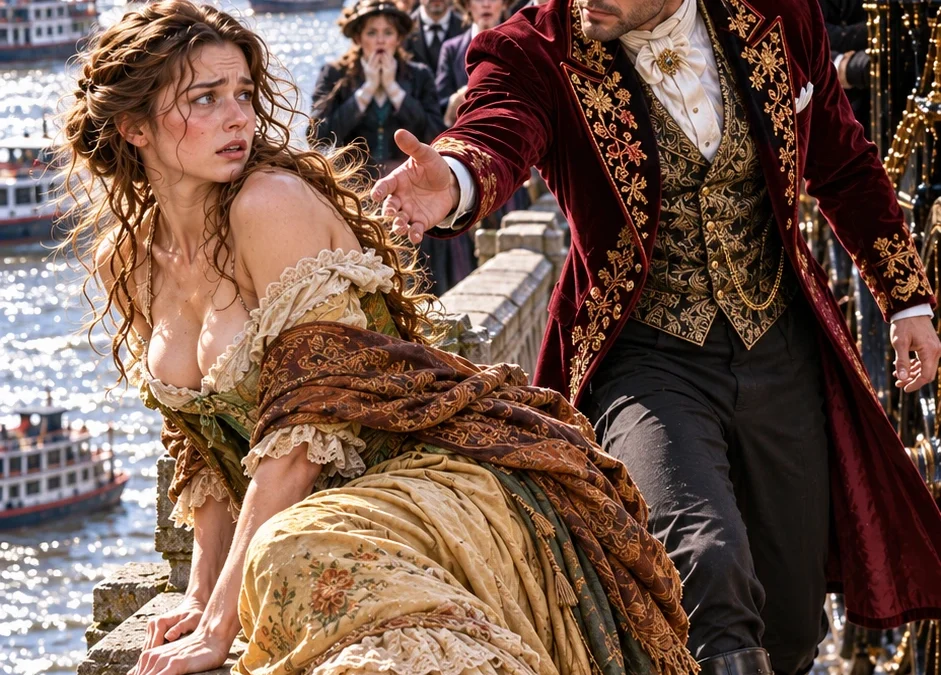
Diana stood on the stone parapet, her boots slipping on the frost. She wasn’t weeping. The tears had frozen an hour ago. Below her, the black water churned, a heavy silence promising an end to the landlord’s shouts and the gnawing ache in her ribs. 💔
She shifted her weight forward.
Then iron horseshoes clattered against the cobblestones behind her, followed by a violent snap.
The bridge was deserted, as it should have been at two in the morning. Fog rolled off the river in thick, greasy waves, swallowing the yellow light of the few working gas lamps. Diana Penrose had chosen this spot precisely for its isolation.
She was twenty-four years old. She had a torn woolen half-cape, boots worn through at the soles, and exactly three pence tied in a handkerchief. It was not enough for another week’s rent. It was not enough for a loaf of bread.
The terror of the water, she had told herself, was finite. The terror of her life on land was endless.
She was past hearing anything but her own exhaustion when a loud crack split the night, sharp as a musket shot. Behind her, out of the gray fog, a massive black carriage lurched to a halt. A horse screamed. A rough London voice cursed from the driver’s box.
“Snapped the bloody trace, your grace! And the offside wheels took a knock against the curb.”
Diana froze, her back to the carriage, her boots still perched on the narrow ledge. She held her breath, willing them to ignore the shadow on the parapet.
The carriage door opened with a quiet, well-oiled groan. A man stepped out onto the bridge. He did not slam the door. He moved with a heavy, deliberate slowness, in a dark wool greatcoat with the collar turned up.
“How long, Higgins?”
His voice was a low, resonant baritone, unhurried, the voice of a man who owned the ground he stood on, even if that ground was a rotting bridge over the Thames.
“Ten minutes, your grace.”
A match flared in the fog, lighting a sharp profile: a straight nose, a hard jaw, the shadow of several days’ beard. He lit a cheroot. Then he turned his head and looked directly at Diana.
A normal man might have shouted. A normal man might have lunged, panicked and grasping.
Philip Montgomery, Duke of Alstone, did neither. He took a drag, the cherry glowing in his dark eyes.
“The tide is going out,” he said, conversational and flat. “It is bitterly cold, and I have had a spectacularly tedious evening.”
“Leave me alone,” she whispered.
“I would. But my carriage is broken, and I am forced to stand here for ten minutes. I would rather not crown my evening by listening to a woman drown.”
The utter absurdity of it cut through the fog in her mind. A broken sound escaped her, half sob, half laugh. Her foot slipped on the wet stone.
Philip moved then, not in a frantic leap, but with three long, rapid strides, stopping just shy of the parapet. He extended a bare, ungloved hand. It was large and calloused, the knuckles scarred. Not the hand of a pampered aristocrat. 😨
“I have a fire at my house,” he said, his voice dropping, losing its dry cynicism, replaced by a startling, heavy gravity. “And I have a very old bottle of brandy. Both are infinitely better than the Thames. Step down.”
“Why?”
His eyes were dark, devoid of romantic pretense.
“Because you are freezing. And because I am tired of watching people die.”
The seductive, quiet promise of the river vanished, replaced by the stark reality of the cold. Her body, betraying her, began to shiver violently. The survival instinct, dormant and starved, clawed its way back to the surface.
She did not take his hand. She leaned backward, letting her weight fall away from the void. Her stiff legs gave out the moment her boots hit the cobbles, and Philip caught her under the shoulders, absorbing her dead weight against his greatcoat.
“Easy.”
He did not linger. He did not pull her into an embrace. Once she had her footing, he stepped back, one hand wrapped around her arm to steady her, and guided her to the carriage. 🥹
Inside, the carriage was a cavern of dark leather, smelling of bergamot, beeswax, and expensive tobacco. Diana huddled into the corner, her teeth chattering. He said nothing. The glow of passing street lamps strobed across his face, then dropped it back into shadow.
She waited for the questions. She knew how men operated. He had saved her life. Now he would want the tragic story. Or worse, gratitude.
Instead, he shrugged off his heavy greatcoat and tossed it across the space between them. It landed on her lap, a mountain of dark wool that smelled of his skin and cheroot smoke.
“Put it on.”
“I am ruining your seats.”
“They are leather. They can be wiped down.”
The residual heat trapped in the lining felt like stepping into a furnace.
“Who are you?” she asked, muffled by the collar. “The driver called you your grace.”
“The driver is overly formal. Philip will do.”
“Men do not pick women off bridges without a reason,” she said flatly. “If you intend to make me your mistress, you will be disappointed.”
A short, dusty sound that might have been a laugh. “I have no need for a mistress, and if I did, I would not recruit one from the edge of the Thames. It seems entirely too much work.”
“Then why?”
“I commanded a cavalry regiment at Waterloo. I have watched men bleed to death in the mud for the vanity of kings. I simply refused to watch a woman give up her life because she ran out of shillings.”
“I ran out of shillings four months ago,” Diana said quietly. “Tonight I ran out of hope.”
“Hope is a luxury. Warmth, food, and sleep are necessities. We will start with those.”
At his Mayfair townhouse, a stoic gray-haired butler named Bates held the door. His face betrayed nothing at the drowned rat of a woman trailing behind his master. The housekeeper, Mrs. Higgins, with a severe bun and soft, sharp eyes, drew Diana gently away for a scalding bath that stung her frozen skin like needles.
When she was led back, clean, in a velvet robe that swallowed her whole, a fire roared in the study. A tray of roast beef, bread, and cheese sat between two chairs. Her stomach cramped violently. She forced herself to sit still. She was a gentleman’s daughter, even if her father had died a bankrupt ruin.
Philip placed two slices of beef in her lap. “Eat. Do not bother with manners.”
Her control snapped. She ate like the starving thing she was, and he looked into the fire to give her the dignity of privacy.
“How long have you been falling?”
Diana stared into her brandy. “A year. My father lost everything on the Exchange. The house, the estate in Kent, my dowry. When the creditors came to the door, he went into his study and ended his life.” She said it factually, without melodrama. “They took the furniture while his blood was still on the carpet. The aunts and uncles suddenly found themselves terribly busy. Today the landlord told me to pay or leave. I had three pence.”
The fire popped. “Society is a pack of wild dogs,” said Philip at last. “They smell blood and turn on their own.”
“I cannot pay you back. Men always ask for payment.” The tears frozen on the bridge finally thawed. “I am so tired of fighting.”
He set his glass down. He did not offer platitudes. “Then stop fighting. Just for tonight. The bridge will not be going anywhere, Diana. But tonight you are warm.”
For the first time in a year, she closed her eyes, and she was not afraid of the dark. 🕯️
Four days passed in quiet routine. Madame Dubois, a brutally efficient seamstress, measured her for three heavy wool dresses and a walking coat. Philip bought her wool, not silk, for armor, not for a parlor. Diana hated how much it made her feel seen.
On the fifth afternoon, in her navy wool, she marched into his study. “I need to leave. I will find work.”
“You have no references. Your father died in a public scandal. The agencies will show you the door.”
“Then I will sweep floors! I will not sit in your house waiting for you to tire of your pet project. What do you want from me, Philip?”
He studied her a long moment. Then he lifted a thick leather ledger from his desk and dropped it in front of her with a heavy thud.
“My northern estates. Ten thousand acres of farms, timber, and a coal mine. For three years the yields have dropped by a fifth. My steward blames the weather. I suspect he is a thief.” He looked at her. “I despise paperwork. I want to set this book on fire. I am offering you a position, Miss Penrose. My auditor. Eighty pounds a year, room and board included. Answer only to me.”
Diana stared at the ledger. It was independence. It was safety. And she had no idea that the first man she would have to face was already on his way up the stairs… 😱
Part 2
“I am offering you a position, Miss Penrose.”
Eighty pounds a year was twice what a governess earned, and she would never have to wipe the nose of a spoiled child. Philip was not offering charity anymore. He was offering an alliance.
“If he is stealing from you,” Diana said, her voice dropping to a cool, businesslike register, “he will have masked it in the depreciation of equipment or exaggerated tenant repairs.”
A slow, genuine smile touched the corners of his mouth, the first she had ever seen. It transformed his harsh face.
“Find it.”
She clutched the ledger to her chest like a shield. “I require a desk and a well-lit room. I will not work in the dark.”
“Take the small library. Bates will see it outfitted.” As she reached the door: “And it is Philip. If you are going to handle my money, we will dispense with titles.”
By the end of the second week, she had found it. The small library had become her sanctuary, with a fire, endless tea, and three years of London market reports. The Yorkshire steward, a Mr. Higgins (no relation to the Duke’s driver, to the driver’s loud relief), had been selling prime oak timber to a shipyard at premium prices and recording the sales in the estate books as low-grade firewood. The difference went straight into his pocket. 🔥
She was drafting her final report, fingers stained with ink, when the peace of the townhouse shattered.
Raised voices in the foyer. Bates, unflappable Bates, sounding agitated. Then a sharp, nasal voice cutting through the library door.
“Nonsense, Bates. The Duke is always at home to me. Out of my way.”
Diana froze, her quill suspended. She knew that tone. It was the sound of the world that had devoured her father and spat her out.
The door swung open without a knock. A man in a bottle-green coat and an obscenely high cravat stood in the threshold, tapping a silver-tipped walking stick. Lord Harrington. A notorious gossip, who traded in ruined reputations with the glee of a merchant selling silk.
His pale eyes widened as they landed on her behind the desk.
“Well, well. I heard a rumor at White’s that Alstone had taken in a stray. I assumed it was a hunting hound. But this is infinitely more entertaining.”
The quill snapped in her grip. The safety of the house dissolved in an instant. By evening, every drawing room in Mayfair would know the bankrupt Penrose girl was playing house with the Duke of Alstone. 😨
“Lord Harrington. You are trespassing in a private room.”
“Hardly, my dear. Philip and I are old friends, though his tastes have become rather bohemian. Tell me, how much does one charge for services rendered after a bankruptcy? I imagine the rates are quite competitive.”
And from the doorway, in a voice she had never heard before, came two words that made the whole room go cold… 😱
\
Part 3
“Get out.”
The voice did not come from Diana. Harrington spun around.
Philip stood in the doorway, riding boots coated in fresh mud from Hyde Park, a heavy leather crop in his right hand. The easy posture he usually held was gone. He looked massive, radiating a cold, lethal violence that sucked the air from the room.
“Alstone,” said Harrington, his sneer faltering. “I was only making the acquaintance of your new companion. You have been hiding a rather tragic little beauty.”
Philip did not shout. He walked slowly into the room, tapping the crop rhythmically against his thigh. Thwack. Thwack.
“Harrington. You are standing on my rug. You are breathing my air. And you are insulting my employee.”
“Employee?” A harsh bark of laughter. “Is that what we are calling it this season? A secretary with ink on her fingers. How terribly domestic.”
Philip stopped two feet from him, half a head taller, his shoulders blocking the light from the hall.
“Miss Penrose. Have you finished the audit on the Yorkshire accounts?”
Diana swallowed and forced her voice steady. “I have. The steward has embezzled approximately four thousand pounds over three years. I am drafting the magistrate’s letter now.”
“Excellent work.” He finally looked down at Harrington, who had paled considerably, realizing too late that this was not scandalous banter but imminent danger. “You see, Harrington, Miss Penrose manages my money. Which makes her infinitely more valuable to me than a perfumed, gossiping parasite who cheats at cards. I know exactly what happened at the tables at Brooks’s last Tuesday.”
Harrington’s mouth opened. Nothing came out. The color drained from his face.
“If I hear Miss Penrose’s name in a drawing room,” said Philip, pressing the leather tip gently, almost intimately, against the center of his chest, “if I hear it whispered at a club, I will not challenge you to a duel. Duels are for gentlemen. I will drag you into an alley, break both your legs, and ruin you financially before the bones knit. Do we understand each other?”
“Perfectly,” Harrington choked.
“Good. Now get out of my house before I have Bates throw you down the front steps.”
Harrington scrambled backward, nearly tripping over his own cane. His footsteps pounded down the stairs. The front door slammed. 🔥
Silence rushed back. Philip lowered the crop, and the lethal tension drained from his shoulders. He turned to her.
“Are you all right?”
“You threatened to break his legs,” she breathed, the shock giving way to a trembling surge of adrenaline.
“I threatened to do much worse to his bank accounts.” He looked at the snapped quill in her hand. He reached into the inkstand, took a fresh pen, gently pried the broken one from her grip, and replaced it.
“They will still talk,” Diana whispered. “A young woman living in a duke’s house. I will be ruined anyway.”
“You were already ruined, Diana,” he said gently, stating the brutal truth without flinching. “The bridge was the end of that life. This is a new one. The rules of their society do not apply in this house.”
He did not touch her. He did not offer a comforting embrace. He offered her a pen. She looked at the ledgers, the proof of her own competence, the proof that she was not just a victim to be pitied.
She dipped the pen in the inkwell. “Then I suppose I should finish drafting the magistrate’s letter.”
He smiled, a full smile that reached his eyes. “Make it ruthless.”
“I intend to.” 🥹
The letter was not enough. Three days later, Philip ordered the carriage. They were going to Yorkshire.
The journey north took four grueling days over rutted winter roads, in a carriage that was bitterly cold. Yet as Diana sat opposite him in her own thick wool coat, she realized she was not afraid. The freezing draft through the window frames did not terrify her. It was just weather. It was no longer a death sentence.
They arrived at the Oak Haven estate at slate-gray dusk. The manor house was a blocky structure of dark stone, more like a barracks than a gentleman’s retreat. Dust sheets covered the furniture. The skeleton staff scrambled in panicked clusters. Philip asked for no fire and no meal. He strode into the estate office, his boots ringing on the flagstones, and ordered the steward summoned.
Diana placed the leather-bound ledgers on the heavy oak desk and stood beside them. Philip leaned against the stone mantelpiece, arms crossed, merging into the shadows of the unlit room.
Mr. Higgins arrived breathless and flushed, a thick-necked, prosperous man in a tailored coat that cost more than a year of a tenant farmer’s wages. “Your grace! We had no warning. The house is entirely unprepared.”
“If you had known, you would have had time to burn the secondary books,” said Philip, flat and unhurried.
Higgins froze. His eyes darted to the ledgers, then to Diana. He bristled, his panic masked by offended authority. “I do not understand why this woman is present for estate business.”
“This woman is my auditor. Miss Penrose has spent two weeks reviewing the timber yields from the western ridge.”
“A female auditor? Your grace, surely women do not understand the complexities of agricultural depreciation. The timber was blighted, rotted from the inside. I had to sell it as scrap firewood. It is all documented.”
Diana did not look at Philip. She opened the top ledger, her finger tracing a column of neat black ink.
“The oak was felled in October. According to the shipyard registry in Whitby, three hundred tons of prime hull timber were purchased from this estate in November, at twelve shillings a foot. You recorded a sale of three shillings a ton for firewood to a local mill.”
Higgins’s face lost its flush.
“You masked the deficit by inflating tenant repairs. You claimed fifty pounds for a new roof on the Miller farm. I reviewed the county material costs. Slate was at a ten-year low that spring. The roof cost fifteen. You pocketed the other thirty-five.”
“Listen here, you little clerk!” Higgins stepped forward, fists clenching, looming over the desk.
Philip crossed the room in two strides and clamped a hand on the back of the steward’s neck. The grip drove Higgins to his knees with a heavy thud.
“You will not raise your voice to her. You will not step toward her. You will listen to her, because she is deciding whether you walk out of this house a ruined man, or go to the penal colonies in chains.”
“Your grace, mercy…”
Philip looked up at Diana. He held the man pinned, waiting for her command. He was giving her the authority. He was letting her wield the blade.
She looked down at the man who had stolen four thousand pounds, a sum that could have saved her father, a sum that could have kept a hundred families from freezing. She felt no pity.
“You will vacate the steward’s cottage by dawn. You will leave the keys, the secondary ledgers, and the contents of your bank box on this desk. If you flee with a single stolen shilling, his grace will send the magistrate to hunt you down. If you comply, you will simply be dismissed without a character reference.”
Philip released him. Higgins collapsed, wheezing. “Get out.”
The steward scrambled out. The heavy oak door slammed. Diana stood over the ledgers, her hands shaking, not from fear, but from the intoxicating rush of agency. She controlled the numbers now. 🔥
Philip brought her a glass of scotch. “You were flawless. You gutted him methodically. It was a terrifying thing to witness.”
“I learned from the men who gutted my father. I just chose a better target.”
That night they sat by a roaring fire in the drawing room while the wind howled against thick stone walls. Philip stared into the flames, and he looked older here, burdened by the empty house.
“You hate it here.”
“My older brother Thomas loved this estate. He knew every tenant by name. He was meant to be the Duke. I was the second son. I bought a commission in the cavalry because I had no head for sheep and timber.” He drank slowly. “Thomas died of a fever in this house six years ago, just before I shipped out. I inherited the title and the land, survived the mud and the grapeshot at Waterloo, and came home entirely unequipped to be the man he was.” He looked at her. “That is why I let the estate rot. That is why men like Higgins were able to steal. I could not bear to walk the property lines without seeing my brother’s ghost.”
Diana understood survivor’s guilt. She understood the crushing weight of being the one left behind to clean up the wreckage.
“You did not break this estate. Higgins broke it. You were bleeding from a war. You cannot fault yourself for needing time to stop the hemorrhage.”
“I let it go on too long.”
“Perhaps. But you brought me here to fix it. You did not look away this time. You faced it.” She rose and stopped before his chair. “On the bridge, you told me you were tired of watching people die. You saved my life, Philip. Not just by pulling me into your carriage. By giving me a ledger. By giving me a purpose. Let me help you drag yourself back into the world, too.”
For a long moment, the only sound was the crackle of the logs. Slowly he took her right hand, still faintly stained with ink, and pressed his knuckles against her palm.
“You are a dangerous woman, Diana Penrose. You make me want to care about tomorrow. I had grown very comfortable in the dark.”
“The dark is easy,” she said, her breath catching. “The river was easy. But the fire is better.”
He stood and cupped her face, his calloused thumbs tracing her cheekbones. He kissed her. Not a desperate, frantic kiss born of adrenaline. Deep, deliberate, and grounding. The physical form of the alliance they had built in ledgers and ink. She kissed him back, gripping his lapels, anchoring herself, not as a drowning woman clinging to driftwood, but as an equal on solid earth. 🤍
“We will stay a month,” he whispered, forehead against hers. “We will audit every tenant farm. We will fix the roof on the Miller place. We will make it right.”
“Yes,” said Diana softly. “We will.”
Six months later, London sweltered under a brutal July heatwave, but inside the Duke of Alstone’s Mayfair townhouse, the air was cool and shaded by heavy silk curtains. Diana sat in the small library in light muslin of pale slate blue. The Oak Haven accounts balanced perfectly. The new steward sent weekly, rigorously audited reports. The estate’s profits had already risen fifteen percent.
Philip walked in, came around her desk, and dropped a small leather booklet onto her open ledger. A bank book from Coutts. Her name was embossed in gold on the cover.
“Your salary for six months. Plus a ten percent recovery bonus on the four thousand pounds you forced Higgins to return, and a very aggressive return on an investment I made in your name last month.”
She opened it. The number at the bottom was staggering. It was more money than her father had possessed in his final desperate year. It could buy a small cottage in Kent, hire a maid, and guarantee her absolute independence for life.
Her pulse drummed in her ears. “You are paying me off.”
“I am paying you what you earned. I told you I would not keep you as a pet project. I also will not keep you as a prisoner of gratitude. You are completely independent now, Diana. If you wish to leave this house, buy property, travel, or walk out that door and never see me again, you have the means.”
He was stripping away the last vestige of the power dynamic that had begun on the bridge. He had saved her life, and now he was handing it back to her, fully intact and fully funded.
“And if I leave, what will you do?”
A muscle feathered in his jaw. “I will hire a worse auditor. I will likely lose money on the timber next year. And the townhouse will be unbearably quiet.”
He did not beg. He did not command. He laid the truth bare and waited.
Diana traced the gold lettering of her name. Six months ago she would have bled for this book. Then she opened the desk drawer, dropped it inside, and closed it with a definitive wooden click.
“I am not leaving.”
Philip exhaled a slow, ragged breath that seemed to empty his lungs. The mask of detached stoicism shattered. He pulled her against his chest, his arms heavy and absolute around her.
“Society will never accept you. They will call you my mistress. They will cut you in the street.”
“Let them.” She wrapped her arms around his neck. “I survived the river. I survived starvation. I do not care about the opinions of people who cheat at cards and gossip in drawing rooms. I only care about this room. And I care about you.” 💍
He pulled back just enough to look into her eyes. The shadows that had haunted him since Waterloo were gone.
“Marry me. It is not a question. It is a vow. Let Harrington and the rest of the ton choke on it. Be my duchess. Audit my ledgers. Fix my ruined estates. Stay with me.”
Diana looked at the man who had walked out of the fog and refused to let her die. He had not offered her a fairy tale. He had offered her a coat, a desk, and a chance to fight back. He had given her the tools to save herself, and in doing so, they had saved each other.
She smiled, a brilliant, unguarded smile. “I suppose someone has to make sure you don’t let the new stewards steal the sheep.”
Philip laughed, a rich, booming sound that echoed off the bookshelves and banished the last ghosts from the house. He kissed her, holding her tight. Outside, London rolled on, a machine of commerce and cruelty. But inside, surrounded by ink and ledgers and the heat of the summer sun, Diana Penrose finally stood on solid ground. ✨
She was never going to fall again.
What was YOUR favorite moment: Philip’s first joke on the bridge, or Diana’s ruthless takedown of the steward? Tell me in the comments, and share this with someone who needs to hear that the worst night is not the last one. 👇
If you or someone you love is struggling, please reach out to someone you trust or a local crisis line. You are not alone, and there is always another chapter. 🤍
This story is entirely fictional and created for entertainment purposes only. It does not represent any organization or individual, nor does it encourage inappropriate behavior. The content was generated with AI assistance.








