She Stood Veiled at the Pump Room Door as Bath’s Living “Wages of Sin.” Then a Duke Opened a Ledger and Found Her Own Handwriting Recording the Price of Her Own Life
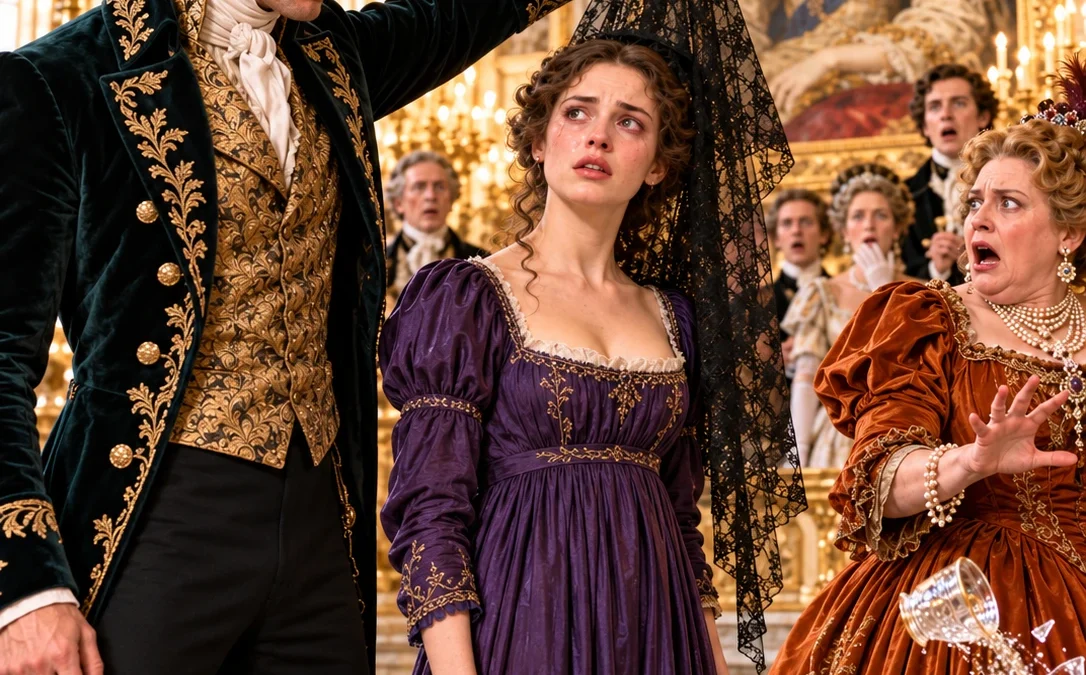
😱 She Stood Veiled at the Pump Room Door as Bath’s Living “Wages of Sin.” Then a Duke Opened a Ledger and Found Her Own Handwriting Recording the Price of Her Own Life 🕯️
PART 1
On a gray November morning in 1820, all of Bath came down Stall Street to take the waters. And at the door of the Pump Room stood a girl in a black veil, holding a basket of tracts on the wages of sin. 🖤
Every lady who passed knew exactly what she was meant to be. A countess swept by without a glance. A duke’s footman stepped around her. She was a public warning, set out on the step like a sign. In Bath, a girl marked that way had no suitor and no future, and no door would ever open to her again.
The veil was black crepe, pinned at the temples. It turned the world to gray mist, but she could hear every whisper.
“Read it aloud, Joan.”
Two young ladies had stopped in front of her, warm in fur-trimmed pelisses. Isabel Dorne plucked a tract from the basket with two gloved fingers. Joan Bramwell read in a bright, carrying voice:
“The sins of the mother shall be visited upon the child.”
Isabel laughed behind her fan. Joan laughed louder. Three gentlemen by the pillars turned to look.
The girl did not move. She held the basket perfectly level. She had learned long ago that a level basket gave them nothing to laugh at, and a shaking one gave them everything.
“Does it speak?” Joan asked.
“Only to God, I expect,” Isabel said. “And He never answers her.”
They swept inside on a wave of lavender water. 💔
Her name was Maud Chesney. She would be eighteen before the month was out, though no one in Bath had ever marked her birthday. She lived in a narrow house on Westgate Buildings with her aunt Judith, who had taken her in as an infant and never let her forget it. The story had worn smooth with telling: Maud’s mother had sinned, given the child away, and wished her dead.
Each quarter day, Judith showed her the proof, a short unsigned note on good paper:
You are fed. Be grateful. Do not ask for me.
Across one cheek, from the corner of her eye almost to her jaw, Maud had a pale birthmark like the shadow of a hand. Judith called it “the mark of the sin.” She had pinned the veil over it every morning since Maud was twelve.
The veil was Maud’s shame. It was also the only wall she had. Behind it, no one could see her face when Isabel laughed. Behind it, she could cry and no one would ever know.
She also kept her aunt’s household books, because Judith’s eyes were poor and Maud’s hand was neat. Every quarter day, a sum arrived that Judith called “an annuity from a late cousin.” And soon after each one, Judith had a new gown made up in gray silk.
Maud had never thought about it. A late cousin was a late cousin.
Inside the Pump Room, at a window table, a man sat with a ledger and a glass of the waters he had not touched. Montague, Duke of Havenly, tall and fair, his cravat knotted so precisely it looked carved. Nothing on his face moved when Isabel’s laugh rang across the room.
He had come to Bath to find a cheat. His godmother, Catherine, Countess of Hexley, had written to him every month since he was fourteen. For years, money from her late husband’s estate had gone each quarter to a banker in Bath, to be drawn by someone who signed only “JC.” When he asked her about it in London, she went white and left the room.
Through the window, he watched the girl at the door. A boy knocked her elbow. She did not flinch.
Most people flinched when they were looked at. He had spent his life watching them do it, and never once let himself do it back. 🥶
In December, the Duke announced that the library of his house on Royal Crescent was in a shocking state and must be cataloged by Christmas. The master of ceremonies had a name ready: the veiled girl, your Grace. She keeps her aunt’s books. She is not received, of course. But for a library, a hand is a hand.
Judith named a fee that made the Duke’s man blink, counted the coins twice, and pinned Maud’s veil tighter than usual. “Whatever you hear in that house, you will bring home to me.”
The Duke did not speak to Maud for six days. It suited her. Behind the veil, she was a pair of hands and a pen, and he would never see her face.
Then he left his steward’s books open on a sofa. They had not balanced since October. Maud could not bear an untidy sum, and in a quarter of an hour she found the error. He had paid a man in London a fortune to fail at the same task for a month.
Something in his chest went very still. 😶
He laid his godmother’s ledger before her, his finger on one repeated line. “Can you find where this money goes?”
Maud looked at the initials. JC. Something cold touched the back of her neck, and she pushed it away.
“I could try, your Grace. But I would want something in return.”
On December 18th, a letter came to Judith’s door under a crest in dark green wax. A pressed violet fell from it onto the tiles. The first line read: “My darling girl.” Judith put the violet in her pocket and held the letter to the coals. The flame ran up the page.
“It is from the woman who bore you,” Judith said, watching it burn. “She wished you dead the day you were born. She wishes it still. Do not ask me her name again.”
On January 8th, 1821, Maud laid down her pen. “I will find where your godmother’s money goes, every penny. And you are a duke, and people answer dukes. You will find out my mother’s name.”
The Duke was silent. He thought of his godmother’s white face.
“Done.” 🤝
On the 20th, the banker’s clerk carried three heavy books into the library. Maud worked without stopping. The money came from the Hexley steward in London. Before 1802, it came from a small trust in the name of Miss Katherine Chesney. The same days, the same bank, the same two initials.
She opened the bank’s drawing books and set them beside the ledger. Each quarter day, someone drew the money out and signed for it. She turned the first page and stopped.
She knew that hand, down to the heavy loop of the J. She had seen it on every grocer’s bill for ten years.
It was her aunt’s.
The very first payment fell in the Christmas quarter of 1802. She had been born that November. 😨
With cold fingers she opened her aunt’s account book. There, in her own neat writing: Received the quarter’s annuity from a late cousin. The sums matched to the penny. For ten years, she had written down her own price and never known it.
The Duke stood very close, his voice quiet in a way she had never heard.
“My godmother’s name, before she married, was Catherine Chesney. She had a younger sister. Her name is Judith.”
The fire ticked.
“Then my mother…”
“…is alive. She is the Countess of Hexley. And she is my godmother.”
The sinner. The woman who had wished her dead. The countess in London with a crest in dark green wax.
PART 2
Maud put her hand flat on the ledger to stop it shaking. The Duke’s hand came down on the same page, an inch from hers. Slowly, the side of his little finger came to rest against hers. He did not take it away. Neither did she. 🤍
“You knew,” she said.
“I wondered. From the first week. I would not say it without proof, and I would not do that to you.”
He wrote to his godmother that night. Three drafts. Her answer came in eight days: “I will come Tuesday the 6th. The Pump Room at noon. Tell no one in my sister’s house.”
“I can bring her here,” he offered. “You need never stand at that door again.”
“No. Let her see me where my aunt put me.” She did not tell him the rest. For six years she had begged God that no one would look at her. On Tuesday, for the first time, she wanted to be looked at by one woman.
The 6th of February was raw and wet. At a quarter to twelve, Joan Bramwell stared up at the gallery. “Isabel, look! The sick lady’s box. It is never taken in winter!”
Behind the lattice, the little door stood open. A footman in dark green livery waited at the stair. Above, a lady in gray sat in a black silk half-mask, so still she might have been a painting. Maud’s heart pounded in her wrists.
The lady rose, stepped to the rail, and turned her head toward the veiled girl on the wet step.
Then someone behind Maud drew a sharp breath. 😰
Judith had come for the waters. She stood in the rain in her new gray silk, and she was not looking at Maud. She was looking at the footman. And the footman bowed to the Duke as to family.
Her face went the color of the stone. Her fingers closed on Maud’s arm and dragged. The basket tipped. The tracts slid across the wet flagstones, and the “wages of sin” ran gray into the gutter.
That night, Judith knocked at a lodging in Laura Place. “Did you think I would not know your livery, Kate?”
“I wanted only to see her.”
Judith leaned close, her voice low and pleasant. “One step toward that girl, one letter in her hand, and I print it all. Every drawing room in England will know what the Countess of Hexley did in 1802. They will call her what she is. A bastard.” She straightened her gloves. “You know I will do it, Kate. You have always known.”
The next morning, Maud heard the Countess through the library door. “I have no daughter,” she said. Her gloved hands shook so badly the silver clasp of her reticule rattled.
Maud wrote the next card very neatly. She did not cry. Her wall went back up, higher than before.
And yet the library grew warm that month. The Duke laughed, a short, startled sound that surprised them both. Every morning when tea came, he walked to the window and stood with his back to her until she had finished, so she could lift her veil to drink. He never said a word. On the fourth morning, she took her time over the tea. ☕
Then Judith put her out on the doorstep in a hard frost. At midnight, the Duke found her in the Abbey porch. “I have been kept for eighteen years, your Grace. I will not be kept by you.”
His face closed like a door. He bowed and walked away.
She came to the library anyway the next morning. Beside her desk stood an iron brazier of glowing coals.
At dusk, in the red light, she asked him to shut his eyes. She unpinned the veil and kissed him, clumsily. His hand rose to the cheek with the mark, and he kissed her back, eyes shut the whole time. 💋
Then, on the 4th of March, handbills were pasted to every pillar of the Pump Room. They named the Countess of Hexley. They said she had borne a child in shame and abandoned her. They said the infant was the veiled girl at the door.
The Countess was hissed in the street and carried to her coach in a fever. That night, the Duke rode after her. Maud went to wait in the Abbey porch, shawl around her shoulders, her back against the great oak door.
The wind dropped. A slow, heavy step crossed the flagstones.
Before she could turn her head, a man’s hand closed over her mouth. 😱
PART 3
The Duke returned at first light on the 5th of March, mud to his knees, his great coat over his arm. All the way back in the dark, he had thought of one thing: he would put that coat around Maud’s shoulders whether she liked it or not.
The porch was empty. The bench was bare. Frost lay on the flags, broken and smeared by many feet. 🥶
The verger, Osric Gaunt, shifted his keys. “I heard a cart in the night, your Grace. I did not get up. It is not my business who drives a cart.”
At Westgate Buildings, Judith opened the door a few inches, fully dressed, hair smooth, face smiling. “If you seek my niece, she is gone. She ran off in the night with a soldier, like her mother before her. Blood will out, they say. Good morning.”
The door shut in his face. On the next step, Isabel Dorne watched him with bright eyes.
A soldier. He told himself it was a lie. Then he heard her voice in the porch: I will not be kept by you. He thought of every person who had come close enough to see past his manner and found nothing worth staying for.
Of course she had gone. They always went.
He ordered the carriage for London. At noon it rolled down the hill, and as it passed the Abbey, he heard himself call to the coachman to stop. In full daylight, he saw what the dawn had hidden: in the corner, where the wind had driven it, lay a scrap of black crepe.
Her veil. Torn at both temples, two bent pins still hanging in it, ground into the frost by heavy boots. 😢
He held it in both hands. She would not walk to the end of a street without this. She would never have run off barefaced through Bath.
The veil he had thought she hid behind was the proof that someone had taken her.
He put it inside his coat, against his chest, and told the coachman to go home.
The magistrate listened politely, then laughed. “An aunt says the girl ran off. You have a veil in a church porch. It is a family matter. I cannot send constables into a lady’s house on a duke’s hunch.”
In the attic on Westgate Buildings, Maud sat on a trunk with a bruise on her wrist. The window was nailed shut. Ivo Haddock, the porter, slept across the door. Judith brought broth and stood in the doorway.
“Your duke has left Bath. All Westgate saw his carriage. He paid for your hands the way a man pays for a good pen. He is finished with the pen. As for your mother, she ran too, in a fever, without once asking where you were.”
The key turned. Maud found an old veil at the bottom of a trunk, the one she wore at twelve. She pinned it on by feel in the dark. I was only ever a pair of hands.
By the last week of March, the Duke stopped asking and started naming. He gave the magistrate the house and the door and threatened to go to the Lord Lieutenant. On the 3rd of April, Judith unlocked the attic and brought Maud down to a parlor full of neighbors: Isabel, Joan, the Gaunts. She placed Maud’s hand on Mabel Gaunt’s arm like a parcel.
Meanwhile, Ivo had crept upstairs with something flat under his coat. Now Judith wept for the room. “This girl slipped into Laura Place and stole my poor sister’s pearls!”
“That is a lie!” Maud’s voice came out raw. “Ivo took me from the Abbey porch with his hand on my mouth. Ask him!”
They all climbed to the attic. Judith knelt, opened Maud’s own box, and lifted out a flat leather case. A rope of pearls lay on faded blue velvet. 😶
Isabel said, “Oh,” softly. Joan gasped. And Judith laughed. “Locked in an attic by a porter. Really? What a tale.”
They put Maud in irons and marched her down Westgate Buildings. Someone threw a cabbage stalk. She held her head level. A thief convicted of robbing a countess could be transported across the world, and could never claim her mother’s name.
The Duke reached the gaol at dusk. Through the bars of the outer wall, he held up the torn veil. “I found this. I knew you had not gone.”
“Go, your Grace,” she said, flat and far away. “A thief has no use for a duke’s pity.”
“It is not pity.”
“Go.”
She walked back into the dark. 💔
Only one person could say the pearls were never stolen, and she lay in a fever somewhere on the London road. The Duke rode all night. On the 7th of April, he found his godmother in Grosvenor Street, hot and small and silent. To find anything that would stand in court, he opened her writing box.
Bundle after bundle of letters in her hand. Beneath them, a packet in a heavy hand with a looped J. “Pay Kate or I print.” And at the bottom, a green leather book, worn soft, with two words in fading gold: Eighteen Springs.
He read the first line, and the face that had never broken, not at school, not at court, not at his own father’s grave, broke by her bed with no one to see it. 😭
Judith, meanwhile, paid the gaoler coin by coin. No visitors. No letters. Not one. The Duke came every day, and every letter came back unopened. Inside, Maud waited a week, then two, and told herself what she had always known: no one could love that face, and now she was a thief as well.
On Good Friday, Janet Garrett, Judith’s maid, came with the weekly basket and did not leave. “I saw that letter burn in December. I saw the first line. It said, My darling girl. I am so sorry.”
Maud had never trusted anyone with anything. She whispered: “The hearthstone in the back kitchen, the one that rocks. There is a book under it, wrapped in an apron. Take it to the Duke. Not the magistrate. Him.”
Janet ran from Ivo’s step, the book under her apron, until she reached the Crescent. The Duke opened it under the lamp: eighteen years of payments, the first eight in Judith’s hand, the last ten in Maud’s. The back board shifted under his thumb. Behind the marbled paper was a glued flap, and from it spilled scores of torn outer covers, each addressed to Miss Judith Chesney, each with a broken dark green seal. On the back of each, Judith had written a date.
She had burned the letters but kept the covers. A countess’s seal with a date was proof, if her sister ever stopped paying, that she had written to her child for eighteen years. All night the Duke laid them in rows, matching each cover to a copy from the writing box, date against date. 🕯️
Judith turned Janet out that night without a character. And Maud heard nothing.
On the 14th of May, the Guildhall was full. Isabel and Joan sat in new spring bonnets. Maud stood in the dock in her old gray veil, and someone laughed. Judith gave her evidence in dove gray silk, dabbing her eyes. Ivo swore. Mabel nodded.
Then the clerk called the Duke of Havenly.
He took the oath. He looked once at the dock, then at every face that had laughed.
“The handbill nailed to every door in March said the Countess of Hexley bore a child out of wedlock in Bath. I am her godson. I swear before this court that it is true. The prisoner is that child. The pearls she is charged with stealing were her mother’s. And on the fourth of March, she sat at a desk in my library from nine until dusk.”
A sound went through the court like wind in dry leaves. He had just sworn his own godmother’s ruin into the record, and he did not care. His voice was not quite steady, and the whole of Bath could hear it. 😮
He opened the green book. “Every quarter for eighteen years, my godmother paid her sister for the child’s keep. Every month, she wrote to her daughter. Whatever cold notes the prisoner was shown, her mother did not write them.” He read: “The thirteenth spring. Judith has put her at the door with tracts. I sat behind the lattice and could not go down. If I go down, the Earl casts us both out and they will throw stones at my girl. So I sat. God forgive me. I sat.”
Maud did not move. The sick lady’s box. The new gray silk. I have no daughter, said to keep the stones from her. But all her life she had been told things, and the things had been lies. Behind the veil, her face was wet.
Janet swore she saw the letter burn. The prosecutor rose. “The book is in the prisoner’s own hand. It proves nothing.”
The chairman looked at the dock, tired and not unkind. “Prisoner at the bar. Can you prove it?”
Maud stood straight. She raised both hands to her temples and drew out the pins.
The old gray veil came away. She laid it on the rail. The court saw her face: the gray eyes, the pale mark across her cheek like the shadow of a hand. Someone drew a breath. No one laughed. 🤍
She walked down into the well of the court to the table, picked up her aunt’s account book, and untied the string around the covers. “I kept this book for ten years. I never looked behind the board. I will read it now.”
“Christmas quarter, 1802. Received, in my aunt’s hand.” She laid a cover beside the line, read its date, found her mother’s copy with the same date, and read the first line. “My darling girl. You are four weeks old today.”
She did not stop. Lady Day, Midsummer, Michaelmas, Christmas, eighteen years of quarters. “Michaelmas, 1820. Received the quarter’s annuity from a late cousin.” Her voice shook once. “I wrote that line myself.”
More than two hundred covers lay across the table, one for every month of her life. All her life she had believed only what was written, and here it was, written, month after month, year after year. Her mother had never let her go.
The doors at the back opened.
A slight woman in gray entered on the arm of a physician, thin with fever. The day her fever broke, she had come two days on the road against every order. She did not look at her sister. She looked only at the barefaced girl at the table.
“She is mine,” said the Countess of Hexley, to the whole of Bath. “She was always mine.” 😭❤️
After that, things happened fast. Ivo sweated, stammered, and confessed that Judith had paid him. Maud was acquitted before the day was out. Judith was taken from the court between two constables, still saying she had fed the girl.
That night, in her mother’s lodging, Maud sat beside her on a small sofa and held her hand. She wore no veil. She never wore one again. They talked until the candles burned down.
The Duke’s family wrote from London. A duke cannot marry a countess’s natural daughter. It is not done. He answered each in the same few words: I am marrying Miss Chesney. You may come or not.
On the first fine morning of June, he walked with Maud along Royal Crescent in full view of every window. Her hand was on his arm, her face bare to the sun. At the end, in plain daylight, with his eyes wide open, he bent and kissed the mark on her cheek.
“I was not admired,” he said quietly. “Only watched. You are the first person who ever saw me come undone and stayed.”
“You kept your eyes shut,” she said.
“Not anymore.” 💞
In August, at the Somerset Assizes, Judith Chesney was convicted of extortion on her own account book and the letters she had sent her sister. She was sentenced to fourteen years’ transportation. Isabel and Joan watched her led from the dock. So did Janet, who now kept house for the Countess.
In June of 1822, Maud Chesney married the Duke of Havenly in Bath Abbey. She wore no veil. She walked up the aisle on her mother’s arm.
Afterward, the wedding party crossed the square to the Pump Room. Maud stopped on the step where she had once stood with a basket of tracts. Then she walked through the door, bare-faced, into the warm, crowded room. Up in the gallery, the little box behind its lattice stood empty.
Her mother was beside her, holding her hand.
That night, the Duke gave her a package. Inside was a green leather journal, worn soft at the corners. Folded between its last pages lay a torn black veil, two bent pins still caught in it, the one he had carried in his coat since the Abbey porch.
On the page above, her mother had written one new line, dated the spring of 1821:
“The nineteenth spring. I sat beside her.”
Sometimes the people who love us most are the ones who were never allowed to say so. And the bravest thing a woman can do is take off the veil and let herself be seen. 🕊️
💬 Have you ever discovered that someone you believed had abandoned you had been loving you in secret all along? I’d love to hear your story in the comments. 👇
Disclaimer: This story is entirely fictional and created for entertainment purposes only. It does not represent any organization or individual, nor does it encourage inappropriate behavior. The content was generated with AI assistance.








