SHE VANISHED INTO THIN AIR NEAR MOUNT SHASTA — THEN THEY HEARD SINGING COMING FROM 40 FEET UP… AND THE TRUTH IS WORSE THAN ANYONE IMAGINED
Part 1
September 12, 2015 dawned crystal-clear and biting-cold at Mount Shasta, but the peace was shattered four weeks later when loggers cutting deep in the forest heard something impossible: a woman’s voice, drifting down from the treetops, singing a soft, endless tune.
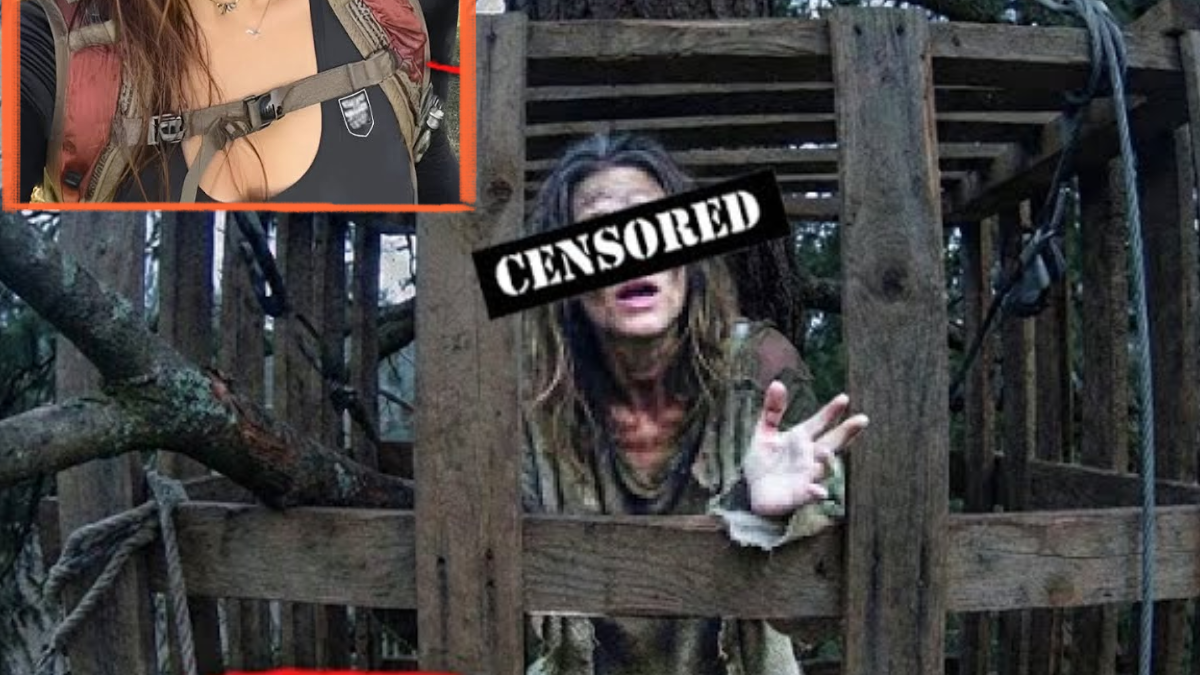
There was no trail leading to her, no footprints, no cry for help — only a wooden cage suspended forty feet in the air, hidden among the branches of a giant Douglas fir.
And inside, emaciated and covered in dust, was Alyssa Carter — the woman everyone had given up for dead.
No one could fathom it.
How had she gotten there? Who had built that prison high above the ground? And why, when she saw faces looking up from below, did she not scream for rescue — only sing louder, as if silence itself was the danger she feared most?
Alyssa had come to the mountain that crisp September morning seeking nothing but quiet.
At twenty-six, she ran a busy water park in Redding, her days a nonstop roar of crowds, deadlines, and demands.
She told her mother the night before she left: “I just need silence.
Real silence.
” She packed light — water, her camera, nothing else — drove up to Bunny Flat, and slipped away from the marked trails, chasing perfect light through the trees.
A group of students passing near Sand Flat spotted her once, standing still, framing a shot in the dappled shade.
That was the last time anyone saw her free.
By nightfall, her car sat alone in the parking lot, rimed with frost.
When she missed her third call home at ten o’clock, her family sounded the alarm.
By dawn, dozens of searchers were fanning out across the forest — rangers, volunteers, dog handlers — certain they would find her within hours.
But the dogs did something strange.
Instead of following the usual hiker paths upward, they led the team sharply sideways, plunging into a wall of thorny manzanita so thick rescuers had to hack their way through with machetes.
This was no place for a casual photographer.
It was wild, forgotten, untouched for twenty years.
Two miles in, they found it: her camera lens cap, resting face-up on bright green moss.
Not a speck of dirt on it.
Not a drop of dew.
As if it had been set down minutes before — though nearly a full day had passed since she vanished.
Her father identified it instantly.
Hope flared bright and sharp in his chest.
She had to be close.
Then the trail ended.
Just ended.
The dogs circled, whined, refused to take another step forward.
There were no more prints — not hers, not anyone else’s.
No broken branches, no scuff marks, no blood, no struggle.
The ground around the spot was soft pine needle, holding every impression perfectly — and it held nothing belonging to Alyssa.
It was as if she had simply walked into the air and kept going.
For four weeks, the search lingered and faded.
The sheriff’s office moved the case to its “passive phase.
” The odds of finding her alive shrank toward zero.
Her family waited in a silence far heavier than the one she had gone seeking.
Then came October 10th.
Loggers working in remote Sector E4, miles from where she had disappeared, stopped for lunch.
The sudden quiet after the chainsaws died away — and then it broke.
Not a shout.
Not a plea.
Singing.
Thin, hoarse, repeating the same simple melody over and over, without pause, without emotion, coming from high above the forest floor.
They tilted their heads back and saw it: the cage.
Massive, rough-hewn, hidden with spruce boughs, hanging from steel cables strung over thick branches.
And through the cracks between the boards, a pale face stared down.
When they called out to her, the singing stopped.
For a heartbeat the forest held its breath.
Then it began again — louder, faster, frantic, as if she raced to finish before something terrible caught up to her.
A skeletal hand waved through the slats — not in greeting, not in appeal, but rhythmic, sweeping, as though conducting a song no one else could hear.
Beneath the cage, a thin rope dangled down.
Tied to its end, swaying gently in the breeze, was an empty plastic milk jug — a bucket, lowered and raised.
A way to pass things up.
Someone had been feeding her.
Watching her.
Keeping her alive — and trapped — for all those weeks.
The realization hit them all at once: she hadn’t vanished.
She had been taken.
Held right there, in plain sight, while hundreds of people searched the ground below.
And whoever had her was still out there — gone, but not gone.
Part 2
The door had no lock, no latch, no handle — it had been nailed shut from the outside.
Sergeant James Potts, veteran climber and rescuer, had scaled the fir with agonizing care, every movement threatening to shift the cage swaying above him.
When he finally pried the planks apart, he found Alyssa curled on a damp, filthy blanket, shrunken, eyes wide and empty, singing to herself as if he were not there at all.
She did not answer her name.
She did not reach for him.
She did not even blink.
Inside, the horror deepened.
The space was barely big enough to sit up in.
A narrow slit in the floor held a rope for water; a tiny hole cut in the corner served as a toilet.
On the walls, rows of thin vertical scratches marched evenly across the wood — one line for every day.
She had marked them, one by one, counting out her captivity in the dark.
When they got her down and her feet touched solid earth, the singing cut off mid-note.
She drew one long, shuddering breath, stared at the crowd surrounding her — and fainted.
In the hospital, doctors found her physically depleted but unharmed by drugs or sedatives.
Her blood work was completely clean.
Whatever controlled her mind had not been put there by chemistry.
For two days she said nothing.
Then, as a nurse leaned in holding a glass of water, offering it gently, Alyssa flinched back as if the glass held fire.
Her eyes went wide with pure, animal terror.
And then she began to sing — loud, clear, perfect — holding the note until the last echo faded, only then reaching trembling hands to take the water.
The psychiatrist on duty understood instantly.
It was not madness.
It was training.
She had been conditioned.
The song was not a cry — it was a transaction.
She sang, and only then did she receive what she needed to survive.
Every drop, every bite, earned only by performing exactly as required.
And if she stopped? If she faltered? Nothing came.
When she finally spoke to Detective Thomas Blake, her voice was thin and brittle as dry leaves.
She described the voice that came from a cassette player lowered to her — a woman’s voice, slow and gentle, singing one single lullaby over and over.
The instructions had been simple, spoken once from the darkness below: “Sing like her.
If you sing exactly like her, you will get a drink.
”
She never saw his face.
He always stayed in the shadow of the tree trunk, communicating only through the rope and the recordings.
But she said something that stopped the detective cold.
He was not angry.
He was not cruel — not in the way they expected.
“He was sad,” she whispered.
“He told me his mother doesn’t sleep well.
That this song is the only thing that helps her.
He didn’t want to hurt me.
He wanted to use me.
”
The words hung in the air, heavy and unthinkable.
He had not kidnapped her out of malice or greed.
He wanted her voice — to replace one that had been lost.
Musicologists identified the melody immediately: All the Pretty Little Horses, but in a slow, dated arrangement from decades earlier, the kind played on late-night radio in the 1950s.
Something from a vanished past.
The profile shifted overnight.
They were not hunting a sadist.
They were hunting a man trapped in grief — a skilled craftsman, strong enough to build a prison in the canopy, alone, obsessed with restoring something time had taken away.
Then the name emerged: Darcy Benson.
Former music teacher.
Died exactly one year earlier from Alzheimer’s disease.
For years, she had been bedridden, frightened, unable to sleep — and her son had cared for her every moment.
His name was Jasper Benson.
Part 3
The pieces clicked into place with terrifying clarity.
Jasper Benson was thirty-four, a former professional arborist — one of the best climbers his foreman had ever seen, able to scale a trunk faster than most people could walk, disappearing into the treetops for hours at a time.
After his mother died, he vanished too — missed her funeral, cut off all contact, lived nowhere but the woods he knew so well.
When officers entered his small house on the edge of Weed, they found a time capsule of grief.
Everything preserved exactly as Darcy left it — her piano draped in plastic, her diplomas framed in perfect rows, her voice recorded on dozens of cassettes: singing when she was well, confused and weeping when the disease stole her words, and Jasper’s voice, calm and relentless, repeating the same instruction over and over: “Sing, Mom.
Just sing like you used to, and the fear will go away.
”
In his workshop, they found the proof.
Sketches of cages — small ones, practice ones, woven from willow — diagrams of knots and pulleys, receipts for climbing rope, blocks, and nails.
And on his wall, a map of the forest marked in red ink: Sector E4 circled, and another spot, deep in a gorge called Deadfall Meadow, circled twice.
He was not hiding.
He was building again.
Dawn broke cold and gray over Deadfall Meadow on October 19, 2015, fog clinging thick as wool to the trees.
SWAT officers surrounded the basin, cutting off every exit.
Thermal imaging picked up a heat signature not on the ground, but fifty feet up — a platform hidden in the crown of a giant pine, carefully woven into the branches.
His new nest.
When climbers ascended, a stone clattered against bark — and he knew.
Shouts rained down from above.
He did not surrender.
He had strung zip lines between the trees, and he launched himself into the void, racing toward the next trunk, wild and ragged, believing he could live in the canopy forever.
But the cable snapped under his weight.
He dangled in the empty air, knife in hand, screaming that he would not come down — until a taser strike stilled him, and they lowered him slowly to the earth.
He did not look like a monster.
He looked like a man worn thin by sorrow, his eyes unfocused, his hands trembling not with fear but with a hunger nothing could satisfy.
For six hours in the interrogation room, he said nothing — until Detective Blake set a cassette player on the table and pressed play.
Darcy’s voice filled the room — frail, wavering, singing the lullaby she could no longer remember.
Jasper leaned forward as if drawn by a magnet, tears spilling down cheeks that had forgotten how to cry.
“You found it,” he whispered.
“She’s singing again.
”
“She is, Jasper,” Blake said quietly.
“But Alyssa isn’t singing anymore.
Why did you put her in that cage?”
And then it all came out — not as a confession of evil, but as a man explaining a repair.
He had cared for Darcy through every stage of her unraveling.
When she could no longer remember him, when she could not sleep unless she heard the song, he had played it for her.
When she died, the silence was unbearable.
He needed another voice — pure, steady, unbreaking — to take her place.
Alyssa had the right timbre.
He had seen her in the forest, photographing the light, and in his fractured mind, he did not see a person — he saw an instrument.
“I raised her high,” he said simply.
“Closer to the sun.
So the sound would carry right.
She just needed practice.
”
He had not drugged her.
He had not beaten her.
He had simply held her most basic needs hostage until the song became her whole world.
Every mistake, every waver, meant no water.
Every perfect performance meant survival.
He had not been cruel — he had been indifferent to her humanity, seeing only whether she matched the memory he could not bear to lose.
The trial stretched into March 2017.
The public came expecting a monster and found something worse: a quiet, broken man who never looked at his victim, only at the ceiling, tapping the lullaby’s rhythm against his knee.
Alyssa testified calmly, her voice steady despite the hoarseness that never fully left her.
“He didn’t want to kill me,” she told the court.
“He wanted to erase me.
He wanted Alyssa Carter to cease to exist and in her place to be a function.
I was to become a thing — a living tape recorder that would turn on and off solely at his will.
My suffering meant nothing.
All that mattered was the purity of the sound.
”
At that, Jasper looked up — not at her pain, but at the flaw he could not let go.
“You were faking,” he called out, loud and clear.
“In the third verse, you always hit the wrong note.
”
It was the moment that sealed his fate.
Not rage, not remorse — only the cold judgment of a perfectionist who saw people as tools to be tuned.
The jury deliberated less than four hours.
Guilty on all counts — kidnapping, torture, false imprisonment.
Two life sentences without parole.
He died in Corcoran State Prison in 2021, alone in his cell.
The guards found nothing among his possessions but stacks of paper — hundreds of drawings, each one a cage, rendered with exact, obsessive precision, varying designs he would never build, waiting for a sound that would never come.
His mind had never come down from the trees.
Alyssa recovered.
She still loved the mountains, but she returned quietly, on her own terms, and when the wind moves through the branches above her, she does not run — she breathes.
The silence she went seeking was never the empty kind.
It was the kind she could fill with her own voice, freely, whenever she chose.
This story is entirely fictional and created for entertainment purposes only.
It does not represent any organization or individual, nor does it encourage inappropriate behavior.
The content was generated with AI assistance.








