SHE VANISHED ON A MOUNTAIN TRAIL — FOUND HEAD-DOWN IN BLACK MUD… AND HER LAST DRAWING NAMED THE KILLER
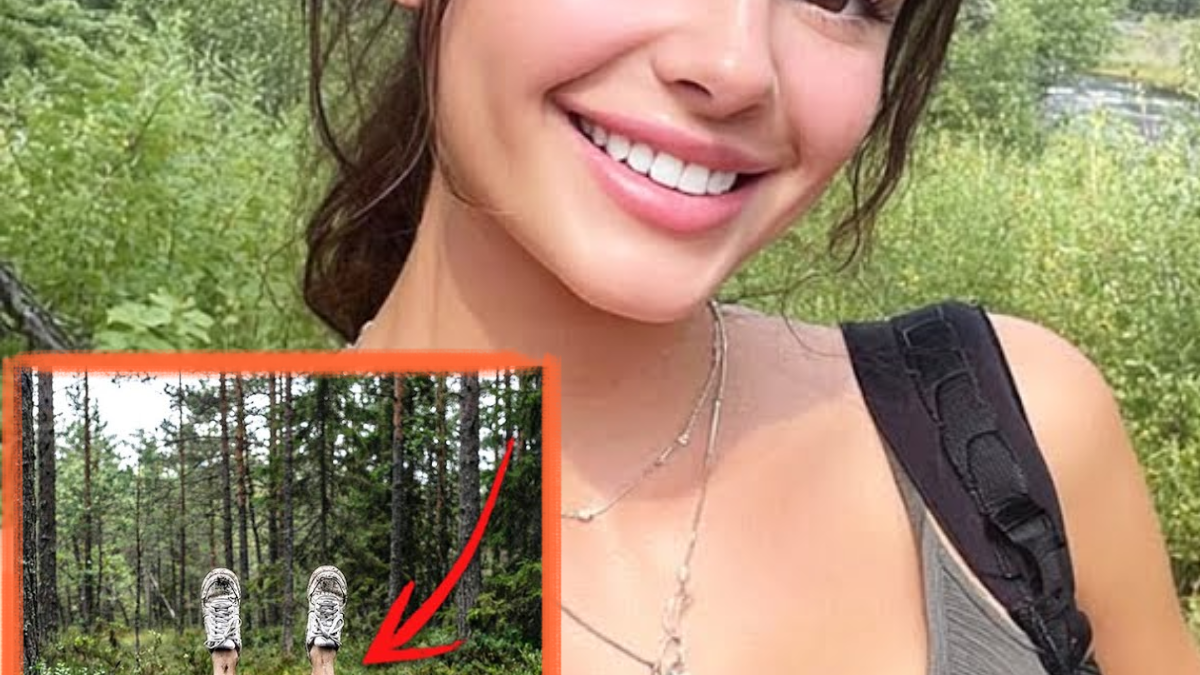
When surveyors stepped into the remote, forbidden swamp deep in Colorado’s San Juan Mountains one September morning in 2016, they expected nothing but silence and stillness.
Instead, they saw something impossible: two bright white sneakers sticking straight up from the thick, black, viscous mud — heels toward the sky, toes buried out of sight.
There was no sign of struggle, no arms, no face, no clothing visible above the muck.
Just those shoes, standing upright as if someone had deliberately driven the girl headfirst into the earth like a stake.
She had not fallen here by accident.
She had been placed here.
Her name was Louise McCarthy — 19 years old, a second-year art student, bright, gentle, and endlessly curious.
On August 25, she had boarded a shuttle to the Hermosa Creek Trail, her sketchbook fastened to her backpack, her heart set on capturing the golden late-summer light spilling across the peaks.
She told her roommate Emily she would text at exactly 8:00 PM when she reached the campsite pickup point.
The message never came.
At first, hope ran high.
She was experienced, prepared, familiar with the mountains.
But as hours stretched into days, the trail went cold.
Search teams scoured every mile; three bloodhounds tracked her scent along the main path — then stopped dead three miles in.
The trail vanished as if she had stepped into thin air.
No torn branches, no dropped pencil, no footprints, no sign of a struggle.
Her bank cards were untouched, her passport safe in her desk, her room neat and waiting.
She had not run away.
She had simply ceased to exist.
For a month, the mountains kept their secret.
Then the surveyors found the shoes.
When rescuers finally pulled her free — working for hours on planks over the treacherous bog — the horror deepened.
Around her left ankle, tightly twisted with pliers, was a heavy rusted wire fashioned into a noose.
Something heavy had been tied to it, meant to drag her down and hold her there forever.
The weight was gone, lost in the mire — but the message was clear: this was not a tragedy.
It was a calculated, cold-blooded attempt to erase her entirely.
Then the autopsy revealed the worst truth of all.
Her lungs were packed with silt, clay, and swamp water.
She had been alive when they put her in the mud.
She had breathed it in.
She had suffocated slowly, helplessly, trapped in total darkness, head down, unable to move, while the surface of the bog closed over her and the world went on without her.
The investigation shifted overnight.
This was no lost hiker.
This was a predator who knew the land — someone who could drive deep into the forest where no roads went, who could hide a body where no one would look, who could vanish as completely as his victim.
Divers pulled a massive, rusted 20-pound bulldozer track link from the depths — the weight that had been tied to her leg.
No hiker carries scrap iron like that.
The killer had arrived in a vehicle.
A cyclist came forward with a memory the police had dismissed before: on the very day Louise disappeared, he had seen fresh, deep ATV tracks cutting off the trail into the closed wilderness.
Later, he spotted a beat-up dark pickup truck parked at a remote turnout, towing an ATV covered in wet gray clay.
A man stood by it — stocky, oil-stained, rushing, glancing over his shoulder as if watched.
As the cyclist passed, the man hurriedly threw something bundled into the truck bed and pulled a tarp over it.
On the trailer, half-peeled but clear enough to read, was a sticker: Durango Off-Road Supply.
The police raced to the shop.
The list of regular customers was short — farmers, mechanics, off-road fanatics, locals who knew every hidden logging road and forgotten track.
But as detectives sifted through the names, a team of climbers exploring a remote ravine along the Million Dollar Highway made a discovery that turned the entire case upside down.
They found Louise’s backpack, half-buried in brush far below the road.
Her wallet and phone were gone — taken, presumably to destroy evidence — but her sketchbook remained.
The pages were swollen and stuck together, most drawings ruined by rain and fog.
But one page had been torn out violently, ripped from the spine in a hurry.
And beneath it, invisible to the naked eye, lay the faint, ghostly impression of what had been drawn there — pressed deep into the paper by the artist’s hand.
Using advanced electrostatic scanning technology, forensic experts slowly brought the hidden image into view.
It was not a mountain landscape, not a sunset, not a tree.
It was a portrait — a caricature, drawn quickly and with unmistakable skill, exaggerating every feature of the man she had seen.
A heavy, jutting jaw, deep-set eyes beneath thick, overhanging brows, a large hooked nose.
It was funny, lighthearted, the kind of sketch anyone might make of a stranger to share later — and it was the last thing she ever drew.
The realization hit the investigators like a cold wind.
She had not been killed by a stranger lying in wait.
She had met someone.
She had drawn him.
And he had seen it.
What she intended as harmless amusement had been read by him as mockery — a cruel, public joke at his expense.
He had torn the page away, furious, thinking he had destroyed it forever.
But Louise had left his face behind, hidden in the paper itself, a silent witness waiting to be found.
The sketch was shown to the manager of Durango Off-Road Supply.
He studied it for only a moment before his expression hardened.
He knew that face.
He knew the anger simmering just beneath the surface, the pride that could turn violent over a careless word, the man who bought old parts and heavy equipment and lived alone in a rusted scrapyard of machines deep in the hills.
His name was George Burroughs.
George was 35, a freelance mechanic who repaired and salvaged heavy machinery.
He had a history: fights in bars, threats over minor slights, a temper that flared out of nowhere when he felt disrespected.
He lived in a trailer surrounded by piles of scrap metal, old bulldozers, and dismantled trucks — a place locals called the Iron Graveyard.
And his property lay directly along the route from the mountains to the highway where the backpack had been discarded.
Detectives moved in before dawn.
They found him in his yard, bent over an engine, wiping grease from his hands, unhurried, almost defiant as they cuffed him.
He offered no resistance — only a cold, angry silence.
Then they walked his land.
There, half-hidden in weeds, sat an old yellow bulldozer from the 1980s — its right track broken, one link missing entirely.
The gap matched the piece pulled from the swamp exactly.
Nearby stood an ATV and a single-axle trailer, mud still clinging to its undercarriage, the faded Durango Off-Road sticker visible beneath grime.
But the most chilling discovery waited inside his trailer.
Tacked to the wall above his workbench, edges ragged, was the torn sheet from Louise’s sketchbook.
He had not burned it.
He had not buried it.
He had kept it — pinned up where he could see it every day.
Brown spots stained the corner: dried blood, transferred from his hands as he ripped it away.
It was not discarded evidence.
It was a trophy.
George Burroughs sat at the interview table, the sketch placed before him, and slowly his defiance crumbled.
He began to speak — not with remorse, but with the self-serving logic of a man who believed he had been wronged.
He had ridden his ATV into the closed area that afternoon, he said, searching for scrap metal from abandoned mining equipment.
He found Louise instead, sitting on a folding chair in a sunlit clearing, sketching.
She had smiled at him, unafraid, and he had asked her to draw him.
For her, it was a friendly request; for him, it was a chance to be seen.
When she turned the sketchbook around to show him, he saw not a likeness, but a caricature — his features exaggerated, made ridiculous, held up to scorn.
He snapped.
He snatched the page from her hands.
She laughed, surprised — and he struck her.
The blow was harder than he intended; she fell backward, her temple striking the metal frame of his ATV trailer.
She collapsed and lay still.
He did not check for a pulse.
He did not call for help.
He only saw what others would see: a dead girl, and him, the man who had killed her.
Panic and cold calculation took over.
He loaded her body onto his ATV, covered it with a tarp, and drove deep into the bog — a place only locals knew, where the mud swallowed everything and rarely gave it back.
He tore a track link from his bulldozer, wired it to her ankle to drag her down, and pushed her headfirst into the mire.
He believed she was already dead.
He was wrong.
The autopsy proved it: she had breathed in the silt.
She had been conscious as the mud closed over her, fighting for air in total darkness, until she could fight no more.
On the drive home, he stopped on the Million Dollar Highway and threw her backpack into the ravine — keeping only the sketch.
He could not bring himself to destroy it.
It was proof of what had happened, proof that someone had finally dared to mock him, and in his twisted mind, proof that he had silenced her.
He pinned it to his wall as a reminder — never dreaming the paper itself held a second image, one he could not tear away.
The trial lasted weeks.
The defense argued manslaughter, claiming George had acted in panic and believed Louise was already dead.
But the medical evidence was unshakable: she had been alive when he put her in the mud.
And the sketch, displayed for the jury, told its own story — of a harmless joke, a fatal explosion of rage, and a killer who kept his victim’s last drawing as a prize.
The jury deliberated less than four hours.
George Burroughs was found guilty of first-degree murder and sentenced to life in prison without parole.
He showed no emotion as the verdict was read — his face, the same face Louise had drawn so vividly, remained as hard and unyielding as the rocks around his home.
Louise’s family returned to the mountains where she loved to paint.
They planted wildflowers along the trail she walked and set up a bench overlooking the valley she had come to capture.
They spoke of her not as a victim, but as an artist who saw beauty where others saw only stone — and who, in the end, left behind the one image that would bring her killer to justice.
For a long time, the mountains had kept their secrets.
But Louise had left her mark — not just in the lines she drew, but in the quiet, stubborn truth that no darkness can hide forever.
Evil may try to bury what it fears, but the truth always rises.
And sometimes, the last thing anyone expects — a pencil stroke, a ghostly impression on a sheet of paper — is the thing that finally breaks the silence.
“This story is entirely fictional and created for entertainment purposes only.
It does not represent any organization or individual, nor does it encourage inappropriate behavior.
The content was generated with AI assistance.
”








