SHE VANISHED ON A MOUNTAIN TRAIL WITHOUT A TRACE — 9 MONTHS LATER, A HAWK’S NEST HELD THE CLUE THAT UNRAVELED EVERYTHING
Part 1
Twenty-three-year-old Melissa Duran stepped onto Mount Rainier’s Snow Lake Trail on the morning of June 15, 2012 — and was never seen alive again.
She was an environmental science graduate student, bright and careful, carrying trekking poles and a small university backpack to map unmarked side routes for her research.
She told her father she would be home by the weekend.
By Monday, she had not arrived for work.
Her phone went straight to voicemail.
Her father reported her missing.
The search began at dawn.
Her white Toyota Corolla sat parked exactly where she had left it — doors locked, keys gone, no sign of struggle.
Rangers, rescue teams, and volunteers combed the main trail and every known branching path.
Dogs picked up her scent near the trailhead, then lost it completely beneath the dense conifer canopy that swallowed the mountainside.
Helicopters could not see through the thick treetops.
No wallet, no water bottle, no scrap of notebook paper — nothing was found.
Not a single footprint, not a broken branch, not a trace that someone had passed through after one o’clock that afternoon.
A hiker from Seattle confirmed passing her shortly after she started out.
“She was calm,” he recalled.
“Walking steady.
Knew where she was going.
” No one else saw her.
She had simply vanished into the trees.
After seven days, the official search was suspended.
The case was filed away — missing under unexplained circumstances.
Her father kept looking, distributing photos, asking questions, but the mountain gave up nothing.
Nine months slipped by.
The snow fell and melted.
Spring 2013 brought warmer days and faster thawing, revealing ground that had been buried all winter.
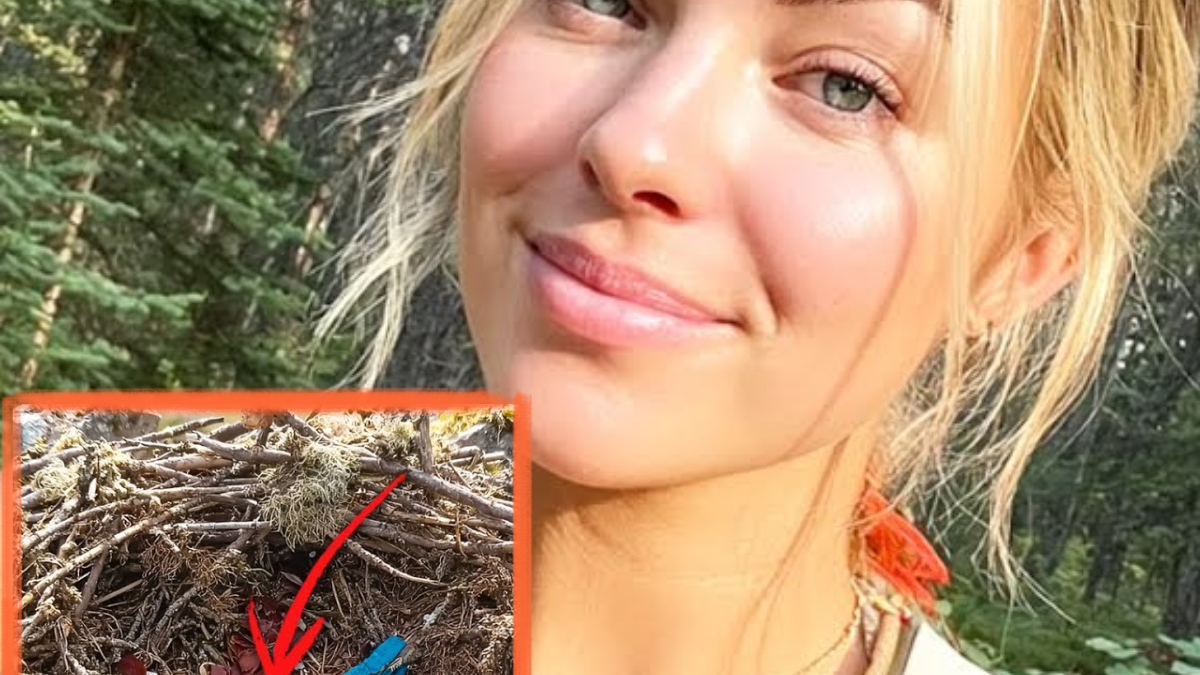
Then, in March, a field biologist climbed a tall pine to inspect a goshawk’s nest high on a slope above a narrow gully.
At first glance, the nest looked ordinary — lined with moss, pine needles, fur.
But woven into its side were bright, unmistakable fragments of pale blue fabric.
As he reached to pull them free, something small and pale rolled out from the twigs and dropped toward him.
He caught it in his palm.
It was a human finger bone.
The discovery sent a cold jolt through the investigation.
The bone and fabric were rushed to the state lab.
Within days, the results came back: the DNA was a perfect match for Melissa Duran.
The fabric was from the underwear she had worn that day.
The case — long closed, long silent — exploded back to life.
But where the hawk had found these fragments, no one could say.
Birds of prey carry light materials over miles.
The evidence could have come from anywhere.
Investigators focused immediately on the slope below the nest.
They combed the thickets with hooks and thermal imagers, pushing aside ferns and salal, turning over fallen logs.
On the third afternoon, they found it — a faint, unnatural depression between the roots of an ancient pine.
The soil was disturbed.
Leaves lay unevenly.
Ferns were pressed flat.
When they brushed away the top layer, they found bone fragments mixed with earth and leaves.
And beneath it all, crushed and half-buried, was Melissa’s backpack.
It was torn.
Zippers ripped.
The bottom fabric frayed and stretched.
Inside were fragments of field notes, a flashlight, a spoon — but her phone, her wallet, and her organizer were gone.
Deliberately removed.
As if someone had taken them to keep her from being identified.
The rangers stood quiet as they processed the scene.
This was not where she had fallen.
This was where someone had hidden her.
The forest had not swallowed her by accident.
She had been placed here — concealed, buried, erased.
And whoever had done it was still out there.
Part 2
And whoever had done it was still out there.
Forensic examination raised more questions than it answered.
There were no fractures consistent with a long fall.
No claw marks or bite patterns matching bears or cougars — the predators most common on Rainier.
Instead, the medical examiner found something far more chilling: a thin, sharp, clean cut on one of her ribs, made by a slender blade.
It was not an accident.
It was not an animal.
Melissa Duran had been stabbed.
Her death was homicide.
Detective Benjamin Carter took over the case.
He went back to the beginning — every witness, every camera, every logbook entry.
The last confirmed sighting remained that brief conversation with the Seattle hiker at 1:00 p.
m.
No other vehicles were captured on park cameras near the trailhead that day besides Melissa’s Corolla.
But buried deep in patrol notes from a week before her disappearance was a single overlooked line: Dark greenish-black Ford pickup — parked on closed service road.
Left warning note.
Carter tracked down the ranger who had written it.
The truck was old, rusted along the hood, tinted dull green beneath faded black paint.
The driver had been nowhere in sight.
That road was off-limits to the public — overgrown, unmaintained, leading to an abandoned logging site miles from any marked trail.
Only those who knew the forest well would even know it existed.
Back in the lab, a microscopic fiber turned up in the pocket of Melissa’s pants — black, synthetic, matching the floor mats found in late-1990s Ford trucks.
The pieces began to align.
Someone had been watching the area.
Someone who knew the hidden roads.
Someone who had lured or intercepted her far from where anyone would look.
Carter pulled registration records for every matching Ford pickup within fifty miles.
The list narrowed to one name that stood out: Dave Kirkland, thirty-eight, a local security guard.
His file was filled with small, telling violations — illegal hunting, driving in closed zones, cutting trees without permits — all in remote forest land.
His truck was the exact make, model, and color described.
When Carter approached him, Kirkland’s composure fractured instantly.
First he denied being near the mountain that June.
Then he admitted “maybe driving through.
” When Carter mentioned the closed dirt road, Kirkland paled.
He stammered, contradicted himself, offered shifting explanations that made no sense.
But he did not confess.
He did not break.
Not yet.
A search warrant was granted.
Inside Kirkland’s home, investigators found nothing — no maps, no notes, no phone or wallet that did not belong to him.
But in his garage sat the truck.
It matched the description perfectly.
And under the driver’s seat, tucked deep in the dust, was something small and gleaming: a tiny stud earring set with a pale stone.
Melissa’s father identified it instantly — it was one of a pair he had given her.
She had worn them every day of her life.
Even then, Kirkland insisted he had never met her.
But the final, undeniable proof lay in the backseat — microscopic droplets of blood hidden deep in the upholstery seams, invisible to the naked eye, glowing under ultraviolet light.
The DNA was Melissa’s.
She had been in that truck.
And she had not left alive.
Part 3
Dave Kirkland was arrested the next morning as he left work.
He offered no resistance, but his eyes darted away.
For hours in the interrogation room, he denied everything — until Detective Carter laid out the evidence, piece by piece: the earring, the blood, the truck seen on the forbidden road, the fibers found in Melissa’s pocket.
Then Kirkland’s shoulders slumped.
He stopped looking up.
And finally, he spoke.
He had gone into the woods that day to hunt deer illegally — something he had done many times before, slipping down the closed service road where rangers rarely patrolled.
He was concealed near the trail when Melissa walked past, camera raised, photographing the forest.
He thought she had seen him with his rifle.
He panicked.
If she reported him, he could lose his job, his freedom — everything.
He stepped out and confronted her.
He demanded she show him her camera.
She refused.
She told him she would report him to rangers.
The argument escalated.
He grabbed her backpack.
She pushed him away.
In the struggle, he pulled a folding knife — and it went in.
He claimed it was an accident.
That he had not meant to hurt her.
But the medical examiner’s report told a different story: the wound was deliberate, directed, forceful — not a random slip during a fall.
Kirkland knew immediately what he had done.
He lifted her body and placed it in the back of his truck, covering it with a blanket, and drove deeper into the woods to hide it where no one would find it.
He took her phone and wallet to delay identification.
He buried her beneath the pine tree, smoothed the earth, and left — believing the forest would keep his secret forever.
For nine months, it nearly did.
But the mountain did not forget.
A hawk, gathering soft, bright materials to line its nest, carried away fragments that caught the light — and those fragments became the thread that pulled the truth into the open.
The trial lasted two weeks.
The evidence was overwhelming — the earring, the blood, the fibers, the matching truck, Kirkland’s own confession.
The defense argued a moment of panic, a terrible accident, a good man who made one unforgivable mistake.
The jury did not accept it.
They saw the pattern: the repeated violations, the choice to hide rather than seek help, the deliberate concealment of her body and belongings.
On January 31, 2014, Dave Kirkland was found guilty of second-degree murder.
He was sentenced to thirty years in prison.
Melissa’s father stood outside the courtroom afterward, quiet and worn.
“It doesn’t bring her back,” he told reporters.
“But at least now she’s not just a name on a missing-person report.
She was someone who mattered.
And someone finally had to answer for what happened to her.
”
Her story changed how the National Park Service educates visitors about hiking alone — sharing her name and her memory to keep others safe.
She is remembered not for how she died, but for who she was: a curious, kind young woman who loved the mountains, who went out to learn about the world, and who never came home.
The hawk’s nest remained standing high on that pine for years — a quiet, unexpected witness.
The mountain still holds its secrets, but this one was told.
And sometimes, when the wind moves through the trees above Snow Lake, those who knew her say her name is still there — not lost, not forgotten, but carried on the breeze, free at last.
“This story is entirely fictional and created for entertainment purposes only.
It does not represent any organization or individual, nor does it encourage inappropriate behavior.
The content was generated with AI assistance.
”








